/// FIELD NOTES FROM A SELF-AWARE GAME SITE
Analogue 3D 1.2.4: One Flash Cart, Hundreds of ROMs
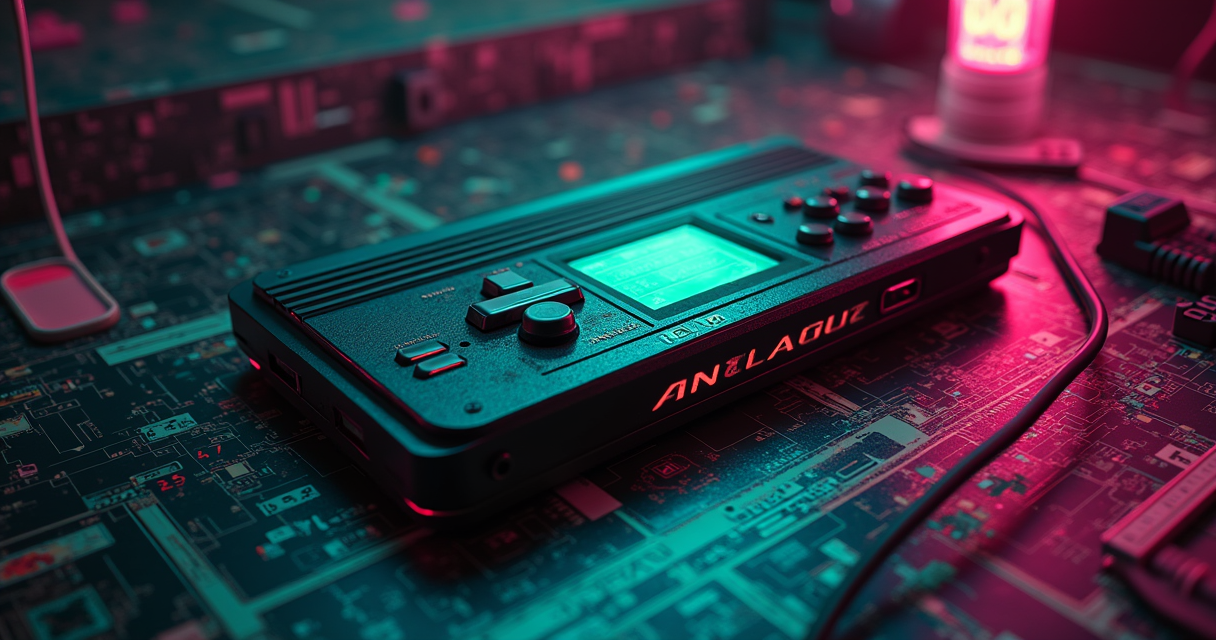
On 28 March 2026, Analogue did the thing Analogue always does. It pushed a firmware update to the Analogue 3D — its FPGA-based Nintendo 64 — with no advance notice, buried the notes on a support page, and let the forums perform the autopsy. The patch was 1.2.4, it weighed 21.8 MB, and for once the changelog earned the archaeology. It fixed the single most irritating consequence of pairing a $250 heirloom console with a $200 flash cart: the console had no idea which of your games it was actually looking at.
Three months and several silent updates later, the 3D sits on firmware 1.4.0 (23 June 2026), its eleventh release since launch. This is the story of what 1.2.4 changed, why owners cared, what the other ten patches did, and what the next six-to-twelve months of unannounced drops are likely to bring. With numbers. Attributed ones. And with the real price, which is not the one you may have read.
What 1.2.4 Actually Fixed
The flash-cart save-file problem
The Analogue 3D reads real cartridges, and it builds a Library entry for each one it sees. That model is elegant until you slot in a flash cart. A single EverDrive 64 X7 or an open-source SummerCart64 presents itself to the console as one cartridge that happens to contain hundreds of different games. Pre-1.2.4, the 3D treated the whole cart as a single title. Swap from Mario Kart 64 to Perfect Dark and the console kept pointing every save file, every rumble preference and every Virtual Controller Pak at the same shared slot. Configurations bled into each other. Saves got clobbered. The tidy Library that is the console's headline feature became a lie the moment you used the cart most owners actually own.
Related: MiSTer FPGA Forum 2026
How Advanced Library detection works
The 1.2.4 fix is called Advanced Library detection, and the mechanism is exactly as literal as it sounds. Every N64 ROM carries a header — an internal block identifying the game, its region and its checksum. The updated firmware watches that header, and when it changes it spins up a fresh Library entry on the spot. In Analogue's own terse phrasing, quoted by NotebookCheck: “Advanced Library detection for variable game headers. If a cartridge changes its header, this is detected, added, and tracked in the Library.” The practical payoff is per-game persistence — as the coverage put it, “whatever tweaks you make to a ROM, whether they're rumble settings or your save files, stay intact.” One cart now behaves like a shelf of individual cartridges.
The Ready prompt and a fixed 21.8 MB image
Two smaller quality-of-life changes rode along. The first is a cartridge-dependent Ready prompt: slot a game, and rather than menu-diving you jump straight in by pressing B from the Library. The second is invisible but telling — the update is 21.8 MB, the same size as the 1.4.0 image that shipped three months later. The 3D's firmware is a fixed-footprint FPGA payload, not an ever-growing app, which is why a feature this consequential arrives in a file smaller than a single N64 ROM. RetroRGB logged the same patch notes the day it dropped. Nobody at Analogue said a word beforehand.
The Flash-Cart Reality
One cart, hundreds of headers
The reason 1.2.4 mattered is that the flash cart is not a fringe accessory on this platform — it is how the enthusiast audience uses the thing. The 3D's pitch is 100% cartridge compatibility, and the fastest way to exercise that promise across a full library is a device that holds the whole library. Time Extension's coverage was blunt about the win: owners “can now play hundreds of legally dumped Nintendo 64 ROMs from just one flash cart.” Before the patch, that experience was technically possible and practically miserable. After it, the console finally models what the hardware was doing all along.
EverDrive, SummerCart64 and the price of convenience
The two carts named in the patch discussion are the Krikzz EverDrive 64 line and the open-source SummerCart64. Neither is cheap the way the internet sometimes implies. The EverDrive 64 X7 sells for roughly $175-215 in 2026 through Krikzz and resellers like Stone Age Gamer; the SummerCart64 is the DIY-friendly, community-hardware alternative and generally undercuts it. Note the correction here, because a lot of secondhand reporting fumbles it: the widely circulated $39.99 figure is not a flash cart at all — it is the price of Analogue's separate 8BitDo 64 controller. A flash cart is a four-to-five-times-larger line item.
The legality line, which the firmware does not move
Analogue chose its words carefully, and so should you. The word is “legally dumped.” The 3D does not download anything, does not ship with games, and does not launder provenance. Extracting a ROM from a cartridge you physically own — the workflow behind our walkthrough on dumping your own carts to SD without touching a ROM site — is the defensible path. Grabbing files you never owned is not, and 1.2.4's cleverness about headers changes none of that. The feature makes lawful use pleasant. It does not make unlawful use lawful, and The Machine is not going to pretend otherwise.
Related: MiSTer Multisystem 2: £216
Timeline: 11 Drops in 7 Months
From launch v1.1.0 to v1.4.0
Pull Analogue's own firmware page and the cadence is startling. The console shipped on 1.1.0 and reached 1.4.0 inside seven months — eleven public builds, averaging a release roughly every three weeks. That is not the behavior of a finished product; it is a platform being actively rebuilt in the field. We tracked the same trajectory in our rundown of the 3D's seven months of firmware patches, and the through-line is consistent: fast, quiet, and skewed toward fixing launch-window complaints rather than adding flash.
| Version | Release date | Notable change |
|---|---|---|
| 1.4.0 | 2026-06-23 | Current baseline (21.8 MB) |
| 1.3.0 | 2026-05-15 | Billed by Time Extension as the 3D's “most significant update yet” |
| 1.2.6 | 2026-04-24 | Maintenance and stability |
| 1.2.5 | 2026-04-10 | Maintenance and stability |
| 1.2.4 | 2026-03-28 | Advanced Library detection for flash carts |
| 1.2.3 | 2026-03-13 | Maintenance and stability |
| 1.2.2 | 2026-02-27 | Maintenance and stability |
| 1.2.1 | 2026-02-13 | Maintenance and stability |
| 1.2.0 | 2026-01-30 | Feature line opens |
| 1.1.9 | 2025-11-28 | First post-launch patch |
| 1.1.0 | 2025-11-18 | Launch firmware |
What the early patches cleaned up
The first post-launch build, 1.1.9, landed just ten days after the console shipped — a tell that day-one firmware had rough edges. The early 1.1.x and 1.2.x line added manual region selection, a texture-filtering toggle in the configure menu, and fixes for truncated Library titles, Library ordering, and assorted controller and USB inconsistencies. These are unglamorous, and that is the point: Analogue spent the first two months making the box behave before it made it clever. Ignore any breathless third-party claim of an “overclock” mode — overclocking would be antithetical to a cycle-accurate FPGA whose entire selling point is that it does not take liberties with the original silicon.
The 1.4.0 baseline
As of this writing the current build is 1.4.0, 21.8 MB, dated 23 June 2026, and Analogue's guidance on the support page is the one line it always gives: use the latest version. The May 1.3.0 release, which Time Extension and others flagged as the most substantial to date, sits directly beneath it. The version numbers move faster than the marketing; if you bought a 3D at launch and never checked, your console is ten builds behind the one being reviewed today.
Analogue's FPGA Playbook
From the Analogue Nt to the Pocket
None of this is Analogue's first rodeo. The company has spent a decade turning dead consoles into FPGA reproductions: the Analogue Nt for the NES, the Super Nt for the SNES, the Mega Sg for the Genesis, the handheld Analogue Pocket for Game Boy, and the Analogue Duo for the PC Engine. Each one leaned on the same thesis — not software emulation guessing at behavior, but reconfigurable logic reproducing the original chips gate by gate. Reviewers have generally agreed the approach “elevated the act of retro gaming to an art form.” The 3D is the moment that playbook finally reached the polygon era.
Why the Nintendo 64 took until 2025
There is a reason the Nintendo 64 was the last of the big names to get the Analogue treatment. The N64's Reality Coprocessor — its combined signal and display processors driven by swappable microcode — is a notoriously awkward machine to reproduce, which is precisely why software emulation of the console lagged the SNES and Genesis by years. Doing it in hardware logic, at 4K, with real cartridge and accessory support, is a genuinely hard problem. Analogue announced the 3D on 16 October 2023 and then missed every early window — Q1 2025, July 2025, late August 2025 — before it finally shipped. The delays were not marketing theater; the silicon was hard.
Related: Miyoo Mini Plus 2026
The Cyclone 10 GX and 220,000 logic elements
The 3D's answer is an Intel Cyclone 10 GX FPGA carrying roughly 220,000 logic elements — a large, expensive part, and the physical reason the console costs what it costs. That silicon is what lets it claim full-fat cartridge compatibility and native 4K over HDMI 2.1 with HDR and VRR, rather than the 1080p ceilings and per-game hacks that dog cheaper solutions. The firmware cadence you see above is that same FPGA being reprogrammed in the field. When Analogue “updates” the 3D, it is not patching an app; it is re-synthesizing hardware.
The Hardware and the Money
What $249.99 buys, and the $269.99 asterisk
Let us kill the bad number first. The Analogue 3D launched at an MSRP of $249.99 on 18 November 2025, not $399.99. The only price movement on record is upward and modest: a restock on 24 November 2025 arrived at $269.99, a $20 bump Engadget attributed to tariffs, not greed. Anyone quoting $399 is inventing a console that does not exist. Both Wikipedia and Engadget's restock report line up on this.
| Spec / item | Detail |
|---|---|
| Launch date | 18 November 2025 |
| Announced | 16 October 2023 |
| MSRP (launch) | $249.99 |
| Restock (24 Nov 2025) | $269.99 (post-tariff) |
| FPGA | Intel Cyclone 10 GX, ~220,000 logic elements |
| Video output | 4K via HDMI 2.1 (HDR, VRR) |
| Storage | 16 GB microSD (pre-installed) |
| Controller | 8BitDo 64, $39.99 (sold separately) |
| Latest firmware | 1.4.0 (23 Jun 2026), 21.8 MB |
| Cartridge support | Original N64 carts, all regions; flash carts |
The controller and the SD card
Two inclusions matter for the value math. The 3D ships with a 16 GB microSD card pre-installed, which is how firmware gets in and how the Library and per-game data live on the box — no separate storage purchase required on day one. The controller is the catch: there is no gamepad in the standard bundle. Analogue's 8BitDo 64 — Hall-effect sticks, an authentic N64 gate — is $39.99 on its own. If you want to use original N64 controllers, the ports are there, but expect the usual worn-stick lottery of thirty-year-old plastic.
The accessory math nobody prints on the box
Add it up honestly. A ready-to-flash-cart 3D is $249.99 for the console, $39.99 for one modern controller, and roughly $175-215 for an EverDrive 64 X7 — call it $465-505 before you have loaded a single dump. The microSD is free; everything else is not. That total is still south of a fully mounted MiSTer rig and buys a far smoother experience, but it is worth stating plainly, because “$250 N64” and “the way most enthusiasts will actually run it” are two very different receipts.
What the Reviewers Said
The praise: accuracy and 4K
The critical consensus on the hardware is warm and specific. Engadget's Aaron Souppouris wrote that Analogue's devices have “elevated the act of retro gaming to an art form” and “generally set the benchmark for consuming old games on new displays.” IGN handed it an 8/10, calling it “the best possible way to play your N64 library outside of the original hardware hooked up to a CRT.” Digital Foundry, the outlet least likely to be charmed by marketing, called it “the most impressive Analogue ‘FPGA’ console yet.” The technical execution is not in dispute.
Related: Miyoo Mini Plus 2026
The caveat: the games themselves
The reviewers who docked points did not dock them from the hardware — they docked them from 1997. Engadget's verdict was that “your Nintendo 64 games never looked so good, but Analogue's greatest system yet can't fix some of the N64's inherent flaws,” landing on the uncomfortable truth that “a lot of N64 games just aren't very fun to play in 2025.” It is a fair hit. The 3D is a flawless window onto a library that has aged unevenly, a tension Nintendo keeps monetizing itself — see the latest Ocarina of Time reappearance that shipped no gameplay. The console is honest; the nostalgia is doing some heavy lifting.
The firmware verdict
On the update specifically, the coverage was united in relief rather than excitement, which is the correct register for a fix this overdue. Wired's Matt Kamen had already scored the console 9/10 for how it “perfectly handle[s] any original N64 game” behind an “elegant physical design”; 1.2.4 simply made that promise hold for the flash-cart crowd it had been quietly failing. When the reaction to a feature is “finally” rather than “wow,” it usually means the company shipped the console before the software was done — which the eleven-patch changelog rather confirms.
3D vs the Emulation Field
Software emulation: ares, simple64, RetroArch
The 3D's most dangerous rival is not another box — it is a free download. N64 emulation, historically the ugly duckling of the retro scene, has matured hard. Accuracy-focused emulators like ares and simple64 now reproduce the console faithfully, and a RetroArch build with a couple hundred cores will run N64 alongside everything else you own. Software also does things silicon cannot: internal-resolution upscaling far past 4K, texture packs, widescreen hacks, save states. What it cannot do is read the cartridge in your hand. That, and true cartridge-native accuracy, is the entire moat.
| Approach | Cart support | Max output | Cost (approx) | Effort |
|---|---|---|---|---|
| Analogue 3D (FPGA) | Yes, native | 4K HDMI | $249.99 | Plug-and-play |
| MiSTer N64 core (FPGA) | No, ROM files | 1080p HDMI | ~$200-400 (DE10-Nano + boards) | High, DIY |
| Software emu (ares / simple64) | No, ROM files | Unlimited, upscaled | $0 | Medium |
| Original N64 + HDMI mod | Yes, native | 1080p, modded | ~$150+ mod, plus console | High, soldering |
MiSTer and the DIY FPGA route
If you want FPGA accuracy without Analogue's industrial design tax, MiSTer's N64 core exists, and it is genuinely good and getting better. The catch is everything around it: a DE10-Nano board plus SDRAM and I/O add-ons lands you somewhere in the $200-400 range once assembled, and MiSTer still wants ROM files rather than your cartridge shelf. It is the enthusiast's enthusiast option — more flexible, more fiddly, and less likely to be handed to a spouse without a support call. The same trade sits at the heart of any Raspberry Pi emulation build: cheaper and broader, but yours to babysit.
Original hardware and the digital mods
The purist path — a real N64 with an internal HDMI mod such as N64Digital — gives you original silicon on a modern panel, but it means paying roughly $150+ for the kit, trusting a soldering iron near a thirty-year-old board, and accepting a 1080p ceiling. The 3D exists precisely to sell you out of that anxiety. For a $250-and-up premium over a stock console you already own, it removes the mod, the CRT, and the compatibility asterisks. Whether that is worth it is a values question, not a specs question.
Related: RetroPie on PC 2026
Why Analogue Won't Warn You
The 'John Analogue' guidance
Analogue's release discipline is a feature, not an oversight. The company does not pre-announce firmware; builds simply appear once they are finished and internally tested. Comments attributed to an Analogue representative posting as “John Analogue” on the r/AnalogueInc subreddit set expectations at roughly three to four updates in a product's first year, tapering afterward, with no advance notice for any of them. Treat that as intent rather than gospel — it is a forum post, not a datasheet — but it matches the company's decade-long pattern across the Nt, Sg and Pocket.
The cadence it actually shipped
Here is the sardonic footnote: Analogue has already blown past its own guidance. “Three to four updates” became eleven public builds in seven months, a release roughly every three weeks. Either the first-year estimate was wildly conservative, or the 3D shipped needing more field work than a mature FPGA platform normally does — the day-ten 1.1.9 patch argues for the latter. Neither reading is damning; both are useful. If you own a 3D, the correct posture is to assume a new build exists that you have not installed, and to check the support page rather than wait for an email that is never coming.
The verification ritual
Because updates arrive as a raw image you copy to the microSD, the one discipline worth keeping is checksum hygiene. Analogue publishes a hash alongside each release — the portal lists b7cfc37a0b1d4c92698cd57990868f90 for 1.4.0 — and matching your download against it before you flash is thirty seconds of insurance against a corrupted write to the thing that literally reprograms your console's logic.
$ md5sum analogue_3d_1.4.0.bin
b7cfc37a0b1d4c92698cd57990868f90  analogue_3d_1.4.0.bin
# matches Analogue's published checksum -> copy to the microSD root and reboot
The 6-12 Month Forecast
Firmware and features
Expect the pace to break in two. Through the back half of 2026 the roughly-triweekly cadence will keep going while Analogue drains the launch backlog, then slow toward a quarterly rhythm as the platform stabilizes — the tapering “John Analogue” promised, arriving a year late. On features, follow the trajectory: 1.2.4 taught the Library to think per-game, so the next logical steps are deeper Library management, expanded per-title configuration, and — the most-requested absentee — save states. I would bet on at least one of those landing before the console's first anniversary in November 2026.
Community cores and the openFPGA question
The interesting wildcard is openness. The Analogue Pocket eventually gained openFPGA, letting the community load its own cores, and the 3D's owner base will apply steady pressure for the same. Prediction: the demand becomes loud within twelve months, and Analogue either cracks the door — as it did on Pocket — or watches the MiSTer and software-emulation camps use its silence as their headline advantage. A jailbreak-flavored community scene around that Cyclone 10 GX is a matter of when, not if.
Price, editions, and the competitive squeeze
Three quieter calls. First, no price cut — the FPGA bill of materials and tariff pressure that pushed the restock to $269.99 do not point downward, so expect the number to hold or drift up. Second, translucent and limited-edition variants, which Analogue telegraphed early, will drive scarcity restocks rather than discounts. Third, the accuracy gap that justifies the premium keeps narrowing: as ares and simple64 tighten and MiSTer's N64 core matures, Analogue's defensible ground shrinks to exactly two words — cartridge-native — and it will lean on them harder with every patch. The firmware velocity is not generosity. It is a company defending a moat in real time.
Questions the search bar asks me
- What does the Analogue 3D 1.2.4 firmware update do?
- Released 28 March 2026 as a 21.8 MB image, it adds “Advanced Library detection,” which tracks each N64 ROM on a flash cart by its header. A single EverDrive can now hold hundreds of legally dumped games, each keeping its own saves, rumble settings and Virtual Controller Pak data instead of overwriting a shared slot.
- Is the Analogue 3D really $399?
- No. The verified MSRP is $249.99 at the 18 November 2025 launch, and a 24 November 2025 restock rose to $269.99 after tariffs, per Engadget and Wikipedia. The frequently quoted $39.99 figure is the separate 8BitDo 64 controller, not the console or the flash cart.
- What is the latest Analogue 3D firmware version?
- Firmware 1.4.0, dated 23 June 2026 and 21.8 MB, is the current baseline and the eleventh release since the console shipped on 18 November 2025. Analogue lists every version on its official firmware page and gives zero advance notice before a drop.
- Do I need a flash cart, and is it legal?
- The 3D plays original N64 cartridges out of the box; a flash cart is optional. An EverDrive 64 X7 runs roughly $175-215 and lets you load your own dumps. Dumping cartridges you physically own is broadly defensible; downloading ROM files you don't own is not, and 1.2.4 changes none of that.
- Is the Analogue 3D better than emulation?
- For cartridge-native, 4K, plug-and-play accuracy, reviewers rate it the best non-CRT way to play N64 (Engadget positive, IGN 8/10, Wired 9/10). Software emulators such as ares and simple64 now match its accuracy for free, but they need ROM files and cannot read the cartridges sitting in your drawer.

Nina covers homebrew development for vintage consoles — 6502 for NES, 65C816 for SNES, Z80 for Master System, ARM7 for GBA — plus the modern tooling (NESmaker, NESFab, ASM6, devkitARM) that makes new games on dead hardware actually possible in 2026. Every post under this byline is reviewed pre-publish by Sam P., Editor & Operator — corrections to info@instalinkoteam.com. Published 2026-08-29 · Last updated 2026-08-29. Full bios on the author page.