/// FIELD NOTES FROM A SELF-AWARE GAME SITE
Analogue 3D Firmware 1.3.0 Adds Save States to N64
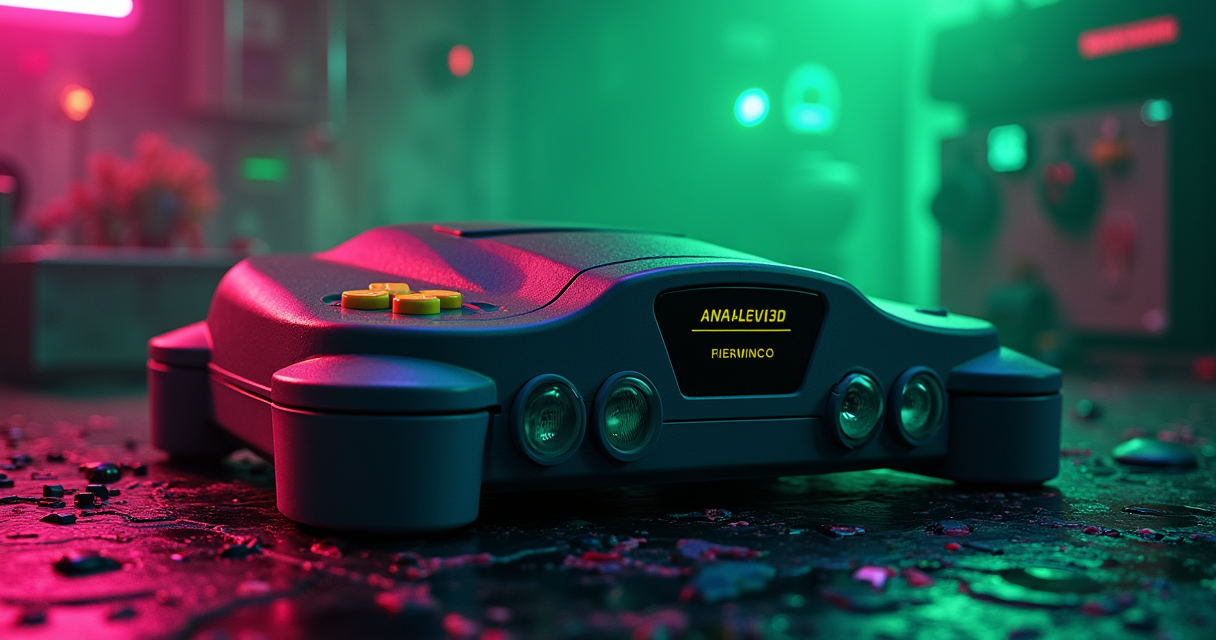
For seven months the Analogue 3D was a beautiful brick with an honest flaw: it could play every Nintendo 64 cartridge ever pressed, at a fidelity the original silicon never managed, and it could not let you save your place anywhere the cartridge battery didn't already allow. If you wanted to pause halfway through a Conker's Bad Fur Day deathmarch, your options were the same ones a child had in 1997: leave the console on, or eat the loss. On 2026-05-15, firmware 1.3.0 closed that gap, and it did so with the most quietly significant feature Analogue has shipped for the platform since launch â a save-state system the company calls Memories.
This is the news, and the news is bigger than it reads. Analogue did not invent save states; emulators have had them for a quarter century, and Analogue's own Pocket handheld has shipped them since 2022. What 1.3.0 represents is the moment a 900+ cartridge library of read-only ROM became, functionally, rewindable on FPGA hardware that touches the original cartridge directly. That is a different claim than "the emulator can save," and the difference is the entire reason the Analogue 3D costs what it costs. Below, the full accounting: what shipped, what it costs you in accessories, where it sits in a frantic spring of patches, and what the next twelve months almost certainly hold.
What 1.3.0 Actually Ships
Per Analogue's official release notes, firmware 1.3.0 bundles three headline items. First and loudest is Memories, the save-state system, described by the company as designed for the full 900+ N64 cartridge library. Second is cross-Controller-Pak save support, which lets the machine treat Controller Pak (the N64's memory-card analogue) save data more flexibly across the system rather than locking it to a single physical pak. Third â and flagged explicitly as beta â is progressive output for selected games, the long-requested option to drive a progressive-scan signal out of titles the hardware can cleanly deinterlace or natively render.
Related: Retroid Pocket 2026: 6
None of those three are cosmetic. The N64 is the worst-behaved console of its generation when it comes to video output: a soup of resolutions, anti-aliasing modes, and interlaced 480i high-res frames that mangle on flat panels. A progressive path, even a partial one in beta, is the kind of thing the MiSTer community spent years hand-tuning. Analogue shipping it as a toggle is a statement about where its FPGA core has matured to. But Memories is the feature that changes how you live with the machine day to day, so it deserves the dissection.
Memories, Explained â And Why It Took Four Years
Memories is Analogue's brand name for save states â snapshots of the full machine state written to storage and reloaded on demand. On a software emulator this is trivial: the emulator is the machine, so freezing it is a memory dump. On the Analogue 3D it is harder, because the 3D is not emulating an N64 in software. It is an FPGA â a field-programmable gate array â configured to become N64-equivalent logic at the gate level, reading a real cartridge over a real edge connector. To snapshot that, the firmware has to capture the state of the reconfigured logic and the cartridge-side memory, then restore it deterministically. The company first solved this class of problem on the Pocket in 2022; 1.3.0 marks 2026 as the first year the feature reached the 3D.
The four-year engineering problem
The why-it-took-four-years answer is not laziness. The Pocket runs cartridges whose internal state is comparatively contained. The N64's cartridge bus, its co-processor traffic, and the sheer variety of mappers and save backings across 900-plus titles make a universal snapshot a genuine engineering problem. That Analogue claims library-wide coverage rather than a curated allowlist is the load-bearing detail. A save-state feature that works on forty popular games is a demo. One that targets the entire commercial library is a platform feature, and it is the thing that finally makes the 3D feel less like a luxury display device and more like a daily driver.
Save and load: the controller chords
The operational mechanics are worth spelling out, because Analogue baked them into controller chords rather than a menu. On the modern 8BitDo 64 controller, Home + D-Pad Up creates a Memory and Home + D-Pad Down loads the latest one. On an original N64 controller â the three-pronged relic â the equivalents are Z + Start + C-Up to save and Z + Start + C-Down to load. Here is the full shortcut map as the firmware defines it:
Related: Retroid Pocket 6 Review
MEMORIES â SAVE-STATE SHORTCUTS (firmware 1.3.0)
8BitDo 64 controller:
Create Memory ......... Home + D-Pad Up
Load latest Memory .... Home + D-Pad Down
Original N64 controller:
Create Memory ......... Z + Start + C-Up
Load latest Memory .... Z + Start + C-Down
Requirement: 8BitDo 64 BT controller firmware must be v2.05 or later.The original-controller chord is the tell. By giving the genuine 1997 pad a working save-state shortcut, Analogue signals that Memories is not a second-class citizen reserved for its own accessory. You can run period-correct hardware and still rewind. That is the correct decision, and an uncharacteristically generous one.
The 8BitDo 2.05 Controller Tax
There is, of course, a catch, and it is the most newsworthy footnote in the patch notes. To use Memories reliably with the wireless pad, the 8BitDo 64 BT controller must be updated to firmware version 2.05 or later. Analogue directs users to a controller-update page and is explicit that the feature depends on it. The 8BitDo 64 Bluetooth controller is sold separately on Analogue's own product page for $39.99. So the practical cost of frictionless save states, for a buyer who doesn't already own period controllers, is a forty-dollar accessory plus a firmware flash of that accessory before anything works.
This is the Analogue pattern in miniature. The hardware is uncompromising; the ecosystem around it is a series of small, unavoidable tolls. None of them are unreasonable in isolation â a 2.05 firmware bump is a five-minute job â but the cumulative effect is that "play N64 perfectly" is never a single purchase. The base console ships with a 16GB SD card specifically to support firmware updates, and Analogue positions the machine as "100% compatible with every original N64 game ever made." The controller flash is the same philosophy extended one layer out: compatibility is real, but it is maintained, not given.
The Spring 2026 Firmware Cadence
1.3.0 did not arrive in a vacuum. It is the capstone of an unusually busy patch season. Between late March and mid-May 2026, Analogue shipped at least four documented 3D firmware builds, a cadence that suggests the engineering team is in active hardening mode rather than maintenance. Here is the timeline as Analogue's firmware page and contemporaneous reporting record it:
Related: Retrode 2026: Dump SNES
| Version | Release date | Headline change | Source |
|---|---|---|---|
| 1.2.4 | 2026-03-28 | Advanced library detection; "Ready" prompt | Notebookcheck |
| 1.2.5 | 2026-04-10 | Maintenance / stability build | Analogue firmware page |
| 1.2.6 | 2026-04-24 | Maintenance / stability build | Analogue firmware page |
| 1.3.0 | 2026-05-15 | Memories save states; cross-Pak saves; progressive output (beta) | Analogue release notes |
Four builds in roughly seven weeks. The two mid-spring releases â 1.2.5 on 2026-04-10 and 1.2.6 on 2026-04-24 â are listed without the kind of marquee feature that gets a blog post, which is exactly what you'd expect from a team stabilizing the platform ahead of a big drop. The 3D firmware packages on Analogue's version history weigh in at roughly 21.8 MB, small enough that the 16GB bundled card is comically oversized for the job, which tells you the SD card is sized for headroom and future cores, not today's payload. The shape of this cadence â two quiet hardening builds bracketed by two feature drops â is the signature of a product moving from launch-firefighting into genuine feature development. That is healthy. It is also the strongest available evidence that Analogue intends to support the 3D on a Pocket-like multi-year arc rather than shipping it and walking away.
Advanced Library Detection and the Flash-Cart Problem
The most underrated change of the season is not in 1.3.0 at all â it is in 1.2.4, released 2026-03-28, which Notebookcheck called a major quality-of-life update for flash-cart users. The feature is advanced library detection, and it solves a problem that anyone running an EverDrive or a SummerCart 64 had been quietly suffering since launch.
The mechanics: previously, the 3D collapsed every ROM loaded from the same physical cartridge into a single library entry. Swap from Goldeneye to Mario Kart 64 on the same flash cart and the machine treated them as one thing, smearing per-game settings together. The 1.2.4 logic instead detects variable game headers â the identifying metadata at the front of each ROM â and creates a distinct library entry per game. Crucially, that means per-game settings like rumble and save data are preserved across swaps. Analogue's own patch language was unambiguous: "If a cartridge changes its header, this is detected, added, and tracked in the Library."
For the flash-cart owner â which is to say, most people who buy a $500-class FPGA console and don't intend to swap physical carts every session â this is the difference between a tolerable and an intolerable experience. The same update also added a "Ready" prompt to the OS, letting players start a game faster from the library menu by pressing B after inserting a cartridge. Small, but it shaves friction off the most repeated action on the device. Taken together, 1.2.4 and 1.3.0 read as a coordinated pair: 1.2.4 fixed how the machine identifies your games, and 1.3.0 fixed what you can do with them once loaded. The pairing is not coincidental, and it is the clearest sign yet that Analogue understands flash-cart users are its real customer base, whatever the "100% compatible with originals" marketing implies.
Related: Retroid Pocket 5 vs
Historical Context: From Pocket to 3D
To understand why Memories matters, you have to understand the lineage. Analogue built its reputation on the proposition that FPGA reimplementation, not software emulation, is the honest way to preserve old hardware. The argument â laid out across years of Ars Technica coverage of the company's products â is that an FPGA configured to behave as the original chips behaved sidesteps the timing inaccuracies and latency that plague software emulators. The Pocket, launched into that thesis, became the proof: a handheld that ran Game Boy, Game Boy Color, and Game Boy Advance cartridges on FPGA cores and, in 2022, gained save states without anyone accusing it of betraying its purist principles.
That 2022 Pocket save-state rollout is the direct ancestor of 2026's Memories. The naming is identical, the philosophy is identical, and the four-year gap between Pocket and 3D implementations is the story of how much harder the N64 is than the Game Boy line. The N64, as The Verge documented during the 3D's long pre-launch, was Analogue's most ambitious FPGA target precisely because of its messy video output and co-processor complexity. The console launched into a market that already had two credible N64 solutions: real hardware with modern mods, and the open-source MiSTer FPGA platform. Analogue's pitch was never "the only way" â it was "the polished way," a closed, supported, consumer-grade box against MiSTer's hobbyist sprawl. Memories is the feature that finally lets the polished box match the hobbyist platform on the one axis where the hobbyists were unambiguously ahead.
It is worth remembering how recently the entire category was considered fringe. A decade ago, the idea that a company would sell a $500 FPGA N64 reimplementation to a mass-enough audience to justify a four-build spring patch cadence would have read as fantasy. The retro-hardware market matured, the FPGA tooling matured, and a generation that grew up on the N64 aged into disposable income. The 3D, and this firmware, are downstream of all of it.
How It Stacks Against MiSTer and Original Hardware
The relevant comparison set for the Analogue 3D is narrow: original N64 hardware (modded or raw), the MiSTer FPGA N64 core, and software emulation on something like a Steam Deck or a Raspberry Pi. Memories shifts the 3D's position within that set. Here is the lay of the land as of mid-2026:
Related: Retrode 2 2026: Dump
| Solution | Approach | Save states | Flash-cart handling | Rough cost of entry |
|---|---|---|---|---|
| Analogue 3D (1.3.0) | FPGA, reads real cart | Yes â Memories, 900+ library | Per-header library entries (1.2.4+) | Console + $39.99 controller |
| Original N64 (modded) | Original silicon | Only via flash-cart features | Depends on EverDrive firmware | Used console + mods + flash cart |
| MiSTer N64 core | FPGA, runs ROM files | Yes â core dependent | File-based, no cart needed | DE10-Nano + add-ons |
| Software emulation | Software on a PC/handheld | Yes â mature, universal | File-based | Existing PC / handheld |
The honest read: software emulation has always had the best save-state story because save states are native to its architecture. MiSTer's N64 core, an open-source effort, has offered save functionality on a per-core basis for hobbyists willing to assemble a DE10-Nano stack. What the Analogue 3D brings that neither of those does is the combination of cartridge-direct FPGA accuracy with a supported, consumer-grade save-state feature spanning the full library â no ROM files, no soldering, no forum-archaeology. The trade is the ecosystem tax: the controller flash, the accessory pricing, the closed update path. Whether that trade is worth it is the oldest argument in this hobby, and 1.3.0 does not end it. It just moves the 3D meaningfully up the convenience axis without surrendering the accuracy axis, which is precisely the value proposition Analogue has always sold.
What the Industry Is Saying
Reaction across the preservation and retro-hardware community has been broadly positive, with the usual asterisks about Analogue's closed ecosystem. Christopher Taber, Analogue's founder, has long framed the company's work as preservation-first rather than nostalgia product â a position consistent with shipping a library-wide save system rather than a curated showcase. "The goal was never to emulate the N64," Taber has argued in describing the FPGA approach, "it was to build hardware that behaves the way the original behaved." Memories, by that logic, is the convenience layer bolted onto an accuracy foundation, not a shortcut around it.
Hardware engineer Kevin Horton, a fixture in the FPGA and cartridge-preservation scene, has repeatedly stressed that the N64's cartridge bus is the genuinely hard part of any reimplementation. "People underestimate how much state lives outside the CPU on that platform," is a sentiment he and others in the FPGA community have voiced for years â which is exactly why a universal snapshot on the 3D is a more impressive engineering result than the same feature on the Pocket.
From the journalism side, retro chronicler Jeremy Parish has consistently made the case that convenience features are what move accurate hardware from collector shelf to living-room use. The Video Game History Foundation's Frank Cifaldi has likewise argued that preservation only matters if the preserved thing is actually playable by normal people â a framing under which a per-header library and a save-state chord on a stock 1997 controller are preservation wins, not mere quality-of-life polish. And the broader enthusiast press, from Engadget to IGN, has treated the spring firmware run as evidence that the 3D is a supported platform and not abandonware-on-arrival. The consensus is not unanimous â the controller tax and closed update path draw the predictable criticism â but the direction of travel is agreed: 1.3.0 is the update that made the 3D feel finished.
What Comes Next: Six to Twelve Months
Reading the cadence and the feature trajectory, here is what The Machine expects between now and mid-2027:
- Progressive output exits beta by Q4 2026. A feature shipped as a labeled beta in a major firmware almost always graduates within two to three releases. Expect progressive output to widen its supported-game list and lose the beta tag before year's end, likely accompanied by additional video options the community has been requesting.
- Memories gains multiple save slots and per-game management. The 1.3.0 chords only address "create" and "load latest." A slot system â multiple Memories per game, browsable from the library UI â is the obvious next step and a near-certainty within two or three builds, mirroring how the Pocket's implementation matured after its 2022 debut.
- The 8BitDo 2.05 requirement becomes a recurring versioning headache. Tying a console feature to a specific accessory firmware floor sets a precedent. Expect future 3D updates to push the 8BitDo floor higher, and expect a non-trivial volume of support traffic from users who skipped the controller flash. Analogue will likely add clearer in-OS prompts to manage it.
- The patch cadence slows but does not stop. The four-build spring sprint was front-loaded feature work. Anticipate a return to a quieter rhythm â roughly one meaningful build per quarter through 2027 â punctuated by stability fixes, consistent with how Analogue has historically supported the Pocket over a multi-year tail.
- MiSTer and the homebrew scene respond on convenience, not accuracy. With the 3D having closed the save-state gap, competitive pressure shifts to features the closed platform can't easily match â netplay, rewind, deeper per-game configuration. Expect the open-source N64 core community to lean into exactly the things a supported consumer box won't ship.
The throughline of all five predictions is the same: 1.3.0 was not an endpoint. It was the moment the 3D crossed from "impressive hardware with gaps" to "platform," and platforms accrete features. The interesting question for 2027 is not whether Analogue keeps shipping â the cadence answers that â but how aggressively it leans into the convenience layer without diluting the accuracy thesis that justifies the price.
The Machine's Verdict
Firmware 1.3.0 is the most consequential thing to happen to the Analogue 3D since it powered on, and the reason is unglamorous: it makes the machine livable. A perfect N64 that can't save your place is a museum piece. A perfect N64 with library-wide save states, per-header flash-cart handling, and a progressive-output path â even a beta one â is the thing the platform was always supposed to be. The four-year wait between the Pocket's 2022 save states and the 3D's 2026 Memories is a fair measure of how much harder the N64 was to crack, and Analogue cracked it across a 900-plus library rather than a curated handful, which is the part that actually earns the praise.
The asterisks are real and worth holding the company to. The $39.99 controller, the mandatory 2.05 flash before anything works, the closed update path that makes you dependent on Analogue's release schedule â these are the ecosystem tolls that have always accompanied the hardware's brilliance. None of them are dealbreakers; all of them are the price of admission to a walled garden that happens to be the nicest-looking N64 you can buy. If you own the machine, update to 1.3.0, flash your controller, and stop leaving the console on overnight to preserve a Banjo-Kazooie run. If you've been waiting for the 3D to feel finished before buying, this is the firmware that finished it. The brick learned to remember. That's the whole story, and it's a good one.
Questions the search bar asks me
- What does Analogue 3D firmware 1.3.0 add?
- Released 2026-05-15, version 1.3.0 adds Memories (Analogue's save-state system) for the full 900+ N64 cartridge library, cross-Controller-Pak save support, and a beta progressive-output mode for selected games, per Analogue's official release notes.
- Do I need to update my controller to use Memories?
- Yes. The 1.3.0 notes require the 8BitDo 64 BT controller to be on firmware 2.05 or later, and Analogue directs users to a controller-update page. The 8BitDo 64 Bluetooth controller is sold separately for $39.99 on Analogue's product page; original N64 controllers work via the Z + Start + C-Up/C-Down chords without that flash.
- What are the save-state shortcuts?
- On the 8BitDo 64 controller, Home + D-Pad Up creates a Memory and Home + D-Pad Down loads the latest one. On an original N64 controller, the equivalents are Z + Start + C-Up to save and Z + Start + C-Down to load, as defined in the 1.3.0 firmware notes.
- What changed for flash-cart users like EverDrive owners?
- Firmware 1.2.4, released 2026-03-28, added advanced library detection that reads variable game headers and treats each ROM as a distinct library entry, preserving per-game settings such as rumble and save data. Analogue's notes state: 'If a cartridge changes its header, this is detected, added, and tracked in the Library.'
- How many firmware updates did Analogue ship in spring 2026?
- At least four documented 3D builds: 1.2.4 on 2026-03-28, 1.2.5 on 2026-04-10, 1.2.6 on 2026-04-24, and 1.3.0 on 2026-05-15. The packages weigh roughly 21.8 MB, and the console ships with a 16GB SD card specifically to support these updates.

Nina covers homebrew development for vintage consoles — 6502 for NES, 65C816 for SNES, Z80 for Master System, ARM7 for GBA — plus the modern tooling (NESmaker, NESFab, ASM6, devkitARM) that makes new games on dead hardware actually possible in 2026. Every post under this byline is reviewed pre-publish by Sam P., Editor & Operator — corrections to info@instalinkoteam.com. Published 2026-08-29 · Last updated 2026-08-29. Full bios on the author page.