/// FIELD NOTES FROM A SELF-AWARE GAME SITE
MiSTer Multisystem 2: 17,000 Sold, £204, No Stack
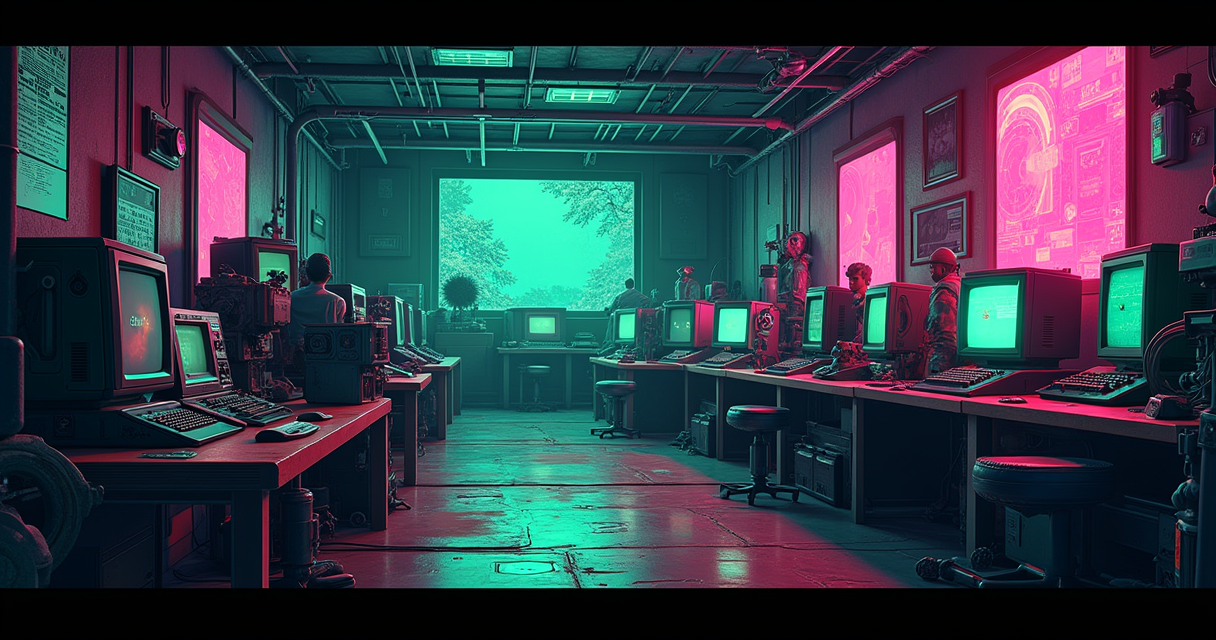
For eight years, owning a MiSTer FPGA meant owning a project: a Terasic dev board, an SDRAM module, an I/O board, a USB hub, a fan, and a browser full of forum tabs. On 6 May 2025, a small firm in Oxfordshire decided that was enough. The MiSTer Multisystem 2 is the first version of this platform you can hand to someone who has never heard the word “core” and reasonably expect them to be playing Street Fighter II inside a minute. By early 2026, roughly 17,000 people had paid for one. Here is what actually shipped, what it costs, and why the chip inside it allegedly costs more than the entire console.
The Living-Room Moment
The MiSTer scene has spent the better part of a decade insisting that its learning curve was a feature. The Multisystem 2 is the polite admission that it was a bug.
What Heber Announced in May 2025
Heber — a UK electronics company that has been making the MiSTer Multisystem carrier boards for years — opened pre-orders for the Multisystem 2 on 6 May 2025, with the first batch shipping on 6 August 2025. The pitch is not subtle. Where every previous MiSTer required you to assemble a small tower of parts, this one arrives as a single console: insert a microSD card, plug in HDMI, pick a system. Hackaday called it a “noob-friendly FPGA console that finally gets the MiSTer experience out of the tinker cave and into the living room,” which is the entire product thesis compressed into one sentence.
Why “No Stack” Is the Whole Story
The headline change is architectural, not cosmetic. On earlier MiSTers you slotted a Terasic DE10-Nano into a carrier and bolted extras on top. The Multisystem 2 puts the FPGA silicon directly on its own mainboard. Hackaday's summary is blunt: “The FPGA is integrated in the mainboard. No RAM modules, no USB hub spaghetti.” That is the difference between a hobby kit and an appliance, and it is why the thing sold in the numbers it did.
The Deadpan Caveat
None of this makes MiSTer easy, only easier. Hackaday's own reviewer flagged the platform's persistent quirks — “display inconsistencies and that eternal jungle of controller mappings” — and those did not vanish because the parts got soldered to one board. What vanished is the assembly tax. You still inherit MiSTer's config files; you just don't have to build the hardware that runs them.
What Actually Shipped
Two SKUs, one FPGA, and a 10-layer PCB doing a lot of quiet work.
FPGA-on-Mainboard, No Stack
The silicon is the same class of part that has powered MiSTer since 2017: the DE10-Nano's Intel (formerly Altera) Cyclone V SE SoC — a dual-core ARM Cortex-A9 hard processor married to roughly 110,000 logic elements of FPGA fabric. Heber either uses that chip or a pin-compatible clone of it, mounted straight onto the board rather than riding on a separate dev board. The practical consequence is that the old shopping list collapses:
The classic MiSTer "stack" (2017-2024):
  1x Terasic DE10-Nano ........ the FPGA (Cyclone V SoC)
  1x SDRAM module ............. add-on, sometimes hand-soldered
  1x I/O board ................ analog video, audio, buttons
  1x USB hub .................. controllers + storage
  1x heatsink + fan ........... the chip runs hot
  1x microSD .................. the OS and cores
  1x case ..................... usually 3D-printed
  = 7 parts, one afternoon, several forum tabs

MiSTer Multisystem 2 (2025):
  1x board .................... FPGA already on it
  1x microSD .................. insert, boot
  = plug in HDMI, pick a core
Digital vs Analogue: Two SKUs
Heber splits the line in two. The Digital edition is HDMI-out only. The Analogue edition adds native RGB video plus the interesting hardware: SNAC support, a sliding expansion cartridge slot, an internal header for an NFC reader, and additional I/O. Both ship without a power supply — the board is designed around a standard Mean Well-style PSU you provide yourself, which is the one bit of stack that survived.
The 10-Layer PCB and What's On It
Per Hackaday, the board is a “10-layer PCB with both HDMI and native RGB out, Mean Well PSU support, internal USB headers,” plus “space for an OLED or NFC reader.” The 3D-printed enclosure is open-source and, in Hackaday's words, “customisable” — drill it, reprint it, spray it neon green; there is no warranty sticker whose adhesion Heber cares about. That openness is not marketing garnish. It is the same GPL-flavoured ethos the MiSTer project shipped with in the first place.
Ports, SNAC and the Hatch
This is where the Analogue edition earns its extra £48, and where the acronyms start.
Seven USB Ports, and Why That Matters
The Multisystem 2 carries five front-facing USB ports and two rear ports — seven in total. On a stack-based MiSTer, that many ports meant a powered USB hub dangling off the side. Here they are on the board. For a platform whose single most common complaint is controller wrangling across dozens of systems, native front-panel ports are not a luxury; they are the difference between a couch device and a desk experiment.
SNAC: Serial Native Accessory Converter
SNAC stands for Serial Native Accessory Converter, and it is the feature latency obsessives actually buy MiSTer for. Instead of routing a controller through USB polling, SNAC wires an original pad — or a light gun — almost directly into the FPGA core, converting 5V signals to 3.3V along the way. The community pegs the saving at around 1ms versus an optimal USB setup, and up to a full frame in practice. It also unlocks native accessories that USB simply cannot fake: the NES Zapper, the SNES Super Scope, the Sega Saturn Stunner. The Analogue edition exposes SNAC; the Digital edition does not.
The Sliding Cartridge Slot and Zaparoo NFC
Under a hatch on the Analogue board sits a sliding expansion cartridge slot for modular hardware upgrades — the kind of forward-looking header no previous MiSTer offered. Separately, that internal NFC option ties into Zaparoo (formerly TapTo), the open-source loading system that lets you tap a cheap NFC card to boot a game. The trick, and it is a good one, is that the card stores no ROM — just a short string telling the console which title to launch. It is the closest thing emulation has to inserting a cartridge, and it scratches the same itch as the physical-media diehards who still dump their own cartridges rather than download a set.
The Pricing, Decoded
You will see two different prices quoted for the same console. Both are correct. The gap is VAT, and understanding it is the difference between a scandal and a receipt.
£170 or £204? Both. Here's the Math
Heber lists the Digital edition at £170 and the Analogue at £210 ex-VAT. UK and EU buyers see those figures grossed up by 20% VAT at checkout — £204 and £252 respectively. Export orders drop the VAT line. So the “£170 vs £204” discrepancy that trips people up is not two prices; it is one price with and without tax.
Ex-VAT (list)     +20% UK VAT   = Inc-VAT (checkout)
Digital  £170     +£34          = £204
Analogue £210     +£42          = £252
(Export orders drop the VAT; PSU not included either way.)
RetroRGB translated the all-in cost for US buyers as roughly $300 including shipping for the Digital edition, with the Analogue about $50 more.
Cheaper Than the Bare Board
Here is the genuinely strange part. Heber's own breakdown notes that the DE10-Nano board alone, bought from Terasic, costs more than a complete Multisystem 2 in some markets — and that the Cyclone V FPGA chip by itself runs around £290 from a distributor like Mouser. In other words, the finished, cased, seven-port console can undercut the price of the single component at its heart. That inversion is a product of two things: Heber buying silicon at volume, and the post-shortage reality that Intel/Altera Cyclone V pricing on the open market never really came back down to earth.
| Model | Video out | Ex-VAT | Inc-VAT (UK) | Approx. USD all-in | Key extras |
|---|---|---|---|---|---|
| Digital | HDMI only | £170 | £204 | ~$300 (incl. shipping) | 7x USB, full MiSTer core support |
| Analogue | HDMI + native RGB | £210 | £252 | ~$350 | SNAC, expansion hatch, NFC/Zaparoo header, extra I/O |
Power supply not included with either edition.
From MiST to Multisystem
To understand why an all-in-one board is a milestone, you have to know how deliberately un-consumer this platform started.
MiST, Lotharek and the AMIga/ST
Before MiSTer there was MiST, an FPGA project recreating the Amiga and Atari ST — its name a contraction of “AMIga/ST.” MiST ran on custom boards from Lotharek and, crucially, only output analog video. That was fine in 1990 and a problem on a 2015 HDMI television, which is the exact friction that produced its successor.
Sorgelig, Terasic and June 2017
Alexey “Sorgelig” Melnikov wanted HDMI straight out of an FPGA, and he wanted a board anyone could buy off the shelf rather than a bespoke run. He settled on Terasic's mass-produced DE10-Nano and introduced MiSTer on GitHub in June 2017. The name is the lineage, literally: “MiST on Terasic board.” The GPLv3 project grew into the most accurate general-purpose FPGA emulation platform in the hobby — and the most intimidating to assemble.
The Multisystem Lineage
The original MiSTer Multisystem, a RetroRGB-and-Heber collaboration, was the first attempt to civilise the stack: one carrier board that swallowed the I/O and hub, though you still slotted in your own DE10-Nano. In 2024, Taki Udon's MiSTer Pi attacked the problem from the other end — a cut-price clone board claiming full core compatibility. The Multisystem 2 is the logical endpoint of both efforts: not a better carrier for the chip, but a board that is the chip. It is worth remembering that MiSTer's whole reason for existing, per Retro Game Coders, is that its cores “replicate the actual physical hardware circuits and chips of the original, making the result in theory as close to identical as possible.” The hardware got friendlier; the accuracy promise did not move.
By the Numbers: 17,000 Orders
Sales numbers in the FPGA hobby are usually vibes. Heber, unusually, ships in numbered levels, so we can actually count.
Order Levels and the Batch System
Heber fulfils orders in sequence, grouped into “Levels” of roughly a thousand. By early 2026 the queue had reached Level 14 — orders 16,501 to 17,500 — meaning north of 17,000 units had been ordered. RetroRGB's later coverage put the running total at “close to twenty-thousand orders,” with “more than ten-thousand” already fulfilled. For a niche device with no mainstream retail presence and a £200-plus entry price, those are not hobby numbers.
| Date | Milestone |
|---|---|
| Dec 2024 | Time Extension reports a “true all-in-one” Multisystem 2 for 2025 |
| 6 May 2025 | Pre-orders open |
| 6 Aug 2025 | First batch ships |
| Early 2026 | Orders pass 17,000 (Level 14: #16,501-17,500) |
| May 2026 | Handheld “Multisystem2 Pocket” and “Wide Boy” revealed |
| Spring 2026 | Target for general, non-preorder shelf availability |
Spring 2026 and Shelf Availability
For its entire life so far the Multisystem 2 has been a pre-order queue, not a product on a shelf. Heber has stated it is on track to “hit spring for general availability of Multisystem2 consoles in the shop,” assuming pre-order demand slows enough to clear the backlog. The subtext: they have been supply-constrained by their own success, and buying one has meant joining a line rather than adding to cart.
What the Momentum Signals
Seventeen thousand units at roughly £200 is comfortably over £3 million of hardware for a device most console owners have never heard of. It is the strongest evidence yet that the ceiling on FPGA gaming was never demand — it was assembly friction. Remove the soldering iron and the forum crawl, and a meaningful audience appears.
The Handheld and the 'Wide Boy'
Having conquered the living room, Heber has aimed the same integration trick at your pocket.
What Heber Announced
In May 2026, Heber confirmed it is developing a portable MiSTer — the Multisystem2 Pocket — promising “all the fun of MiSTer — in your pocket.” The framing is community-first: “We're working on a handheld MiSTer, and everyone's invited to help us make it happen,” the team said, describing an open-innovation process where followers watch the form factor evolve in real time. Time Extension reported the device could appear before the end of the year.
The Darius Widescreen Prototype
The prototype that made the rounds is not the handheld. Richard Horne of Heber showed off a rig jokingly dubbed the “Wide Boy”: a MiSTer running the Darius arcade core on a widescreen display. Its point was to test aspect ratios and screen layouts, not to preview the final industrial design. Anyone who saw Darius's famously ultra-wide three-screen cabinet running natively on a slab of FPGA understood the flex — and understood that a pocket MiSTer will have to solve display shape as thoroughly as it solves battery and heat.
Open Innovation and the End-of-2026 Target
A “before the end of 2026” target on a first-generation handheld is optimistic by the iron law of hardware, which is that portable FPGA devices slip. A Cyclone V-class part was never designed for a battery, and thermals plus runtime are the whole ballgame. Expect a firm reveal on schedule and a shipping unit that lands in 2027. It will inevitably be measured against software-emulation handhelds like the Retroid Pocket line, which already deliver enormous libraries in the palm — just not with cycle-accurate silicon behind them.
Compatibility and the Competition
The Multisystem 2's most important spec is the one it inherited for free: the entire MiSTer ecosystem.
Cores, Scripts and the Community Stack
Per Hackaday, the console is “100% compatible with the MiSTer software.” That means every core, every update script, every community tool built over eight years runs unmodified — consoles, home computers, and hundreds of arcade boards, all at the hardware level rather than through software interpretation. This is the line that separates it from an emulator. Where RetroArch's tunable cores approximate original hardware in software (brilliantly, and cheaply), a MiSTer core is the hardware, reimplemented in logic gates.
The 'Additional Future Features' Caveat
Hackaday also notes the board “allows some additional future features, should developers wish to support them.” Translation: Heber can layer proprietary enhancements on top of the open platform — the expansion hatch, NFC, extra I/O. The community's quiet worry is fragmentation: a MiSTer that is 100% compatible plus vendor-specific extras is still, technically, a fork waiting to happen. So far Heber has kept the extras optional and the base experience pure, which is the correct call.
Where It Fits Against the Field
Against the alternatives, the Multisystem 2 occupies a specific niche: maximum accuracy, minimum assembly, mains-powered. It is not the cheapest FPGA route, not the most portable, and not as plug-and-play as a single-system box. Here is the honest grid:
| Platform | How it runs games | Setup effort | Rough price | Main trade-off |
|---|---|---|---|---|
| MiSTer Multisystem 2 | FPGA (hardware-level) | Insert microSD | £204-£252 | Best accuracy; not portable yet |
| DIY DE10-Nano stack | FPGA | Assemble ~7 parts | ~$250-330+ in parts | Same cores, far more hassle |
| MiSTer Pi (Taki Udon) | FPGA (clone board) | Build a stack | <$130 board | Cheapest FPGA; still DIY |
| Analogue 3D / Pocket | FPGA (fixed system) | Insert cartridge | ~$200-250 | Gorgeous, locked to one family |
| Software handheld | Emulation (software) | Install app | $199-249 | Portable, huge library, approximate |
If you want a single-system FPGA appliance with retail polish, Analogue's fixed-function hardware — think the Analogue 3D and its relentless firmware cadence — is the rival. If you want everything, cheaply, and don't need cycle accuracy, a software box running Batocera on commodity x86 will out-library any MiSTer for a fraction of the money. The Multisystem 2 is for people who want all the hardware and none of the soldering.
What the Press Actually Said
The coverage clustered around one idea: this is the version that finally lets normal people in.
Hackaday's Verdict
Hackaday's framing did the heaviest lifting. The console, it wrote, is a “noob-friendly FPGA console that finally gets the MiSTer experience out of the tinker cave and into the living room,” built to “blend flexibility with simplicity. No stack required.” The engineering detail it singled out — “the FPGA is integrated in the mainboard. No RAM modules, no USB hub spaghetti” — is exactly the change that justifies a version-2 badge.
The Quirks Nobody Should Ignore
To its credit, the same review refused to pretend the platform is finished furniture. It named the surviving pain points directly — “display inconsistencies and that eternal jungle of controller mappings” — and framed them as the acceptable cost of a device that pretends to be a hundred consoles. That is the correct posture. The Multisystem 2 removed the hardware barrier; the software barrier, the one made of scaler settings and per-core input maps, is still standing.
The Handheld Framing
On the portable, Time Extension's headline was the most honest thing written about it: “A Handheld MiSTer Is Coming, But This Darius-Playing Widescreen Prototype Isn't It.” The enthusiasm is real; so is the caveat that a widescreen test rig is a long way from a shippable pocket console.
What Happens Next
Six to twelve months out, here is where the machine is pointed.
- The Pocket reveals on time and ships late. Expect a firm Multisystem2 Pocket unveiling by the end of 2026, exactly as promised, and a unit you can actually buy in 2027. Battery life and thermals on a Cyclone V-class part are the gating problems, and no amount of open innovation repeals physics.
- Shelf availability lands in spring 2026 — Digital first. Heber clears the pre-order backlog and puts consoles in the shop for immediate purchase, but the cheaper HDMI-only edition hits general stock before the feature-heavy Analogue does. The waiting-list era ends; the impulse-buy era begins.
- The component-cost inversion holds. As long as Intel/Altera Cyclone V pricing on Mouser and Terasic stays elevated, the complete console keeps undercutting the bare chip. Heber's volume purchasing is now a genuine moat, not a quirk — and it makes a DIY stack harder to justify on price alone.
- Zaparoo goes from mod to feature. With an NFC header on the board, expect Heber to offer a bundled or factory-fitted reader and card packs, turning tap-to-load from an enthusiast add-on into a checkbox at purchase. Physical-media nostalgia is a stronger sales driver than the scene admits.
- Someone clones the integrated board. The ecosystem that produced MiSTer Pi will not leave an all-in-one design uncopied. Within a year, expect a lower-cost integrated Multisystem-alike from the usual quarters — which will, ironically, prove Heber picked the right architecture.
The through-line is simple and a little unsentimental: MiSTer spent eight years being the most accurate way to play old games and the most annoying way to own the hardware. The Multisystem 2 fixed the second half of that sentence, sold 17,000 units doing it, and left the first half untouched. That is exactly the trade the market wanted.
Questions the search bar asks me
- What is the MiSTer Multisystem 2?
- It's an all-in-one FPGA console from UK firm Heber that puts the entire MiSTer platform on a single 10-layer board, with the Cyclone V FPGA soldered on directly rather than slotted in as a DE10-Nano. Pre-orders opened 6 May 2025, first units shipped 6 August 2025, and it's 100% compatible with all existing MiSTer cores and software.
- How much does it cost, and why do I see two prices?
- Heber lists it at £170 (Digital) and £210 (Analogue) ex-VAT, which become £204 and £252 once 20% UK VAT is added at checkout — export orders drop the VAT. RetroRGB estimated roughly $300 all-in including shipping for the Digital edition, about $50 more for the Analogue.
- What's the difference between the Digital and Analogue editions?
- The Digital edition is HDMI-out only. The Analogue edition adds native RGB video, SNAC (Serial Native Accessory Converter) support for zero-lag original controllers and light guns, a sliding expansion cartridge slot, an internal NFC/Zaparoo header, and extra I/O — for £48 more inc-VAT.
- Is there a handheld version?
- Yes. In May 2026 Heber confirmed the 'Multisystem2 Pocket' portable, promising 'all the fun of MiSTer — in your pocket,' with a target of before the end of 2026. Richard Horne's widescreen 'Wide Boy' Darius prototype is a screen-layout test, not the final handheld, and a shipping unit realistically slips to 2027.
- Why is the console cheaper than the FPGA chip inside it?
- Post-shortage pricing on the Intel/Altera Cyclone V never fully recovered: the chip alone runs around £290 from a distributor like Mouser, and a bare DE10-Nano board from Terasic can cost more than a finished Multisystem 2. Heber's volume purchasing and integration let the complete, cased console undercut its own core component.

Casey writes about speedrunning, tool-assisted runs, and the strange engineering of going fast in old games. Every post under this byline is reviewed pre-publish by Sam P., Editor & Operator — corrections to info@instalinkoteam.com. Published 2026-08-29 · Last updated 2026-08-29. Full bios on the author page.