/// FIELD NOTES FROM A SELF-AWARE GAME SITE
PS5 vs Xbox Series X 2026: $549 vs $799 Price Flip
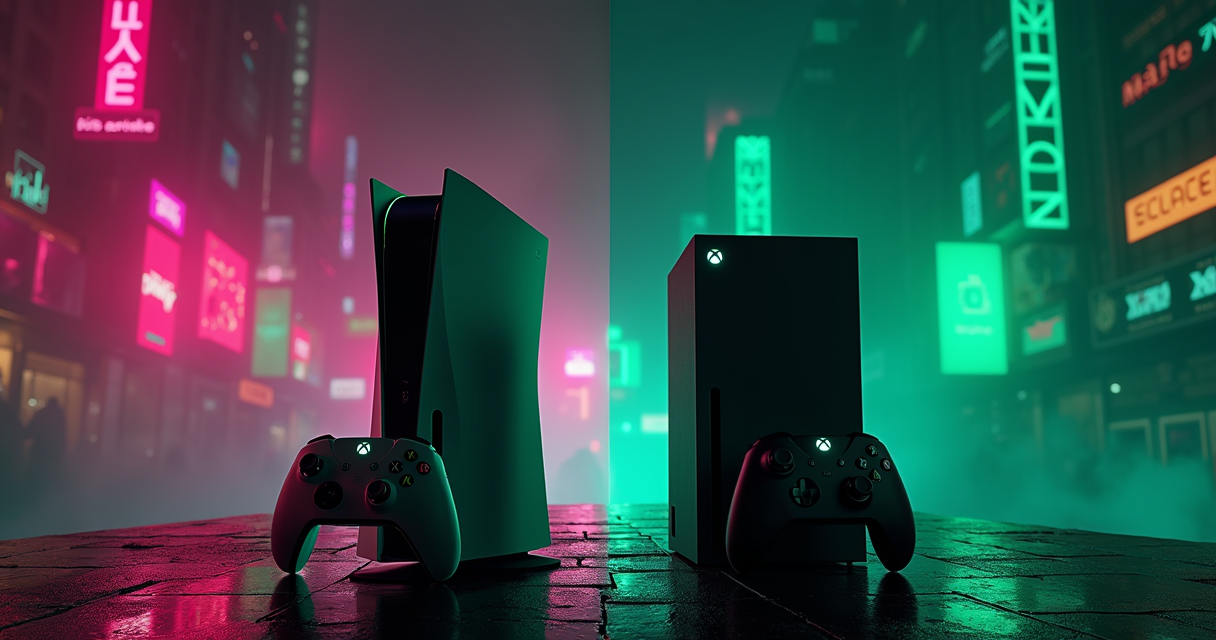
Two consoles launched in November 2020 at exactly the same price: $499.99, to the cent. For most of the generation that parity held like a gentleman's agreement, a shared understanding that a black box under the television was worth five hundred dollars and not a penny more. That agreement is now dead. As of today, August 27, 2026, a standard disc-drive PlayStation 5 costs $549.99 and a standard disc-drive Xbox Series X costs $799.99. The machine Microsoft still markets as the most powerful Xbox ever built is $250 more expensive than its rival. That is not a rounding error. It is a reversal of the entire value logic of the generation, and it happened inside a single chaotic twelve-month stretch of price hikes, tariffs, and a memory-chip shortage that nobody buying a games console asked to be a part of.
This is not a launch-week comparison written by someone who has held neither console. Both machines are six years old. We know precisely how they behave, how their exclusives have landed, how their subscription services have mutated, and how their prices have lurched. What has changed in 2026 is the money, and the money changes the recommendation. Below is the full accounting: the silicon, the measured performance, the whiplash pricing timeline, the backward-compatibility story that actually matters to a retro audience, and a verdict backed by numbers rather than allegiance.
The $250 Price Flip
Start with the headline, because the headline is the story. For the first time in the generation, the two flagship consoles are separated by a quarter of a thousand dollars, and the cheaper one is the PlayStation. If you told a 2020 buyer that Sony would end up undercutting the Xbox Series X by $250, they would have assumed you meant the Series S, the cut-down $299.99 sibling. They would have been wrong.
Two boxes, one launch price, six years of drift
The symmetry at launch was almost poetic. Both firms priced their flagship disc consoles at $499.99 and their cheaper alternatives beneath that. Sony offered a $399.99 Digital Edition; Microsoft offered the $299.99 Series S. Price competition, for once, was on features rather than the sticker. That equilibrium survived the pandemic, the scalper era, the chip shortage of 2021 and 2022, and the long mid-generation lull. It did not survive 2025 and 2026.
The unraveling was gradual and then sudden. Sony nudged the PS5 up by $50 in August 2025. Then, on April 2, 2026, it added another $100 to the base consoles and a brutal $150 to the PS5 Pro. Microsoft, which had held firm longer, cracked in the summer, raising the Series X by $150 effective August 1, 2026. And then Sony, in a move that gave every price tracker whiplash, reversed most of its April increase on August 21, 2026. The net effect of all that motion is a $250 gap that favors PlayStation at the disc tier and, if anything, the same $250 gap at the digital tier.
The number that matters on August 27, 2026
Here is the current state, verified against manufacturer listings. The PS5 Disc is $549.99 and the PS5 Digital Edition is $499.99, both back down after the August reversal. The Xbox Series X disc model is $799.99 and its all-digital 1TB sibling is $749.99, both up after the August hike. Compare like for like. Disc versus disc: $549.99 against $799.99. Digital versus digital: $499.99 against $749.99. Either way, the delta is $250 in Sony's favor. Microsoft's own store has quietly acknowledged the spread, listing the Xbox family from a range rather than a single tidy entry price, because there is no single tidy entry price anymore.
Why powerful stopped meaning expensive, then didn't
For decades the more powerful console was allowed to cost more; that was the deal, and buyers accepted it. What is strange about 2026 is not that the pricier box is more powerful, because it is, marginally. What is strange is the size of the gap relative to the size of the performance difference. You are being asked to pay $250 more for a machine that, as the next sections show, produces a performance difference most players cannot see from a sofa. The premium and the product have come uncoupled. That is the flip: not that Xbox became powerful, but that its power stopped justifying its price.
Specs Face-Off: Wide vs Fast
Both consoles are built on the same fundamental AMD platform: a Zen 2 CPU and an RDNA 2 GPU on a shared piece of silicon, paired with 16GB of GDDR6 and a custom NVMe SSD. They are cousins, not strangers. The differences are in how each firm chose to spend its transistor budget, and those choices produce the classic engineering fork of this generation: wide versus fast.
The silicon on paper
The table below lays out the hardware. The two figures that launched a thousand forum arguments are the teraflop numbers: 12.155 for the Series X against 10.28 for the PS5, a gap of roughly 18 percent in raw GPU throughput. Microsoft got there by going wide, packing in 52 compute units clocked at a fixed 1.825GHz. Sony went narrow and fast, running 36 compute units at a variable clock that peaks at 2.23GHz. More units versus higher frequency. On a spec sheet, wide wins. In a shipped game, as we will see, the story is muddier.
| Spec | PlayStation 5 (Disc) | Xbox Series X |
|---|---|---|
| CPU | 8-core AMD Zen 2, up to 3.5GHz (variable) | 8-core AMD Zen 2, 3.8GHz (3.66GHz with SMT) |
| GPU architecture | AMD RDNA 2, 36 CUs at up to 2.23GHz | AMD RDNA 2, 52 CUs at 1.825GHz (fixed) |
| GPU throughput | 10.28 TFLOPS | 12.155 TFLOPS |
| Memory | 16GB GDDR6, unified 448 GB/s | 16GB GDDR6, split 10GB at 560 plus 6GB at 336 GB/s |
| Storage | 1TB custom NVMe SSD (5.5 GB/s raw) | 1TB custom NVMe SSD (2.4 GB/s raw) |
| Optical drive | UHD Blu-ray (disc model); none (digital) | UHD Blu-ray (standard); none (digital 1TB) |
| Target resolution (supported systems) | Up to 4K, up to 120fps, 8K flagged | Native 4K, up to 120fps, 8K flagged |
| Ray tracing (shaders) | Hardware RT (RDNA 2) | Hardware RT (RDNA 2) |
| ML upscaling | PSSR (PS5 Pro only) | Auto HDR plus FSR (software) |
| Backward compatibility | PS4 (near-complete library) | Xbox One, Xbox 360, original Xbox (curated) |
| VRR / 120Hz (HDMI 2.1) | Yes / Yes | Yes / Yes |
| Suspend and resume (save states) | Single-game suspend | Quick Resume (multiple games) |
| VR | PSVR2 supported | None |
| Online service (netplay) | PS Plus (Essential / Extra / Premium) | Game Pass (Core / Standard / Ultimate) |
| Price (Aug 27, 2026) | $549.99 disc / $499.99 digital | $799.99 disc / $749.99 digital |
Wide versus fast: the RDNA 2 divergence
The engineering trade is real and it has consequences. A wider GPU with more compute units, like the Series X, has more parallel horsepower for brute-force workloads: high native resolutions, dense particle effects, heavy compute shaders. A narrower but faster GPU, like the PS5, clears certain bottlenecks more quickly because everything that is not compute-bound, rasterization, the command processor, geometry, benefits from the higher clock. This is why the two consoles trade blows rather than one simply winning. When a game is bandwidth or resolution bound, the Series X tends to pull a slightly higher pixel count. When a game is limited by the parts of the pipeline that scale with clock speed, the PS5 often holds a slightly steadier frame rate. Neither pattern is universal, and both effects are small.
Memory, storage, and the I/O story
The memory setups reveal the same design philosophies. The PS5 uses a single unified pool of 16GB at 448 GB/s, simple and predictable. The Series X splits its 16GB into a fast 10GB segment at 560 GB/s and a slower 6GB segment at 336 GB/s, which gives peak bandwidth to the GPU-critical data while relegating the operating system and background tasks to the slower tier. On paper the Series X has more peak bandwidth; in practice the split adds complexity that developers have to manage. Storage is where Sony took its biggest swing. The PS5 SSD runs at 5.5 GB/s raw against the Series X at 2.4 GB/s, more than double. Sony built an entire custom I/O complex around that number, and in the early cross-generation years it showed in shorter load times on PlayStation. As the generation matured and games were built to the lower common denominator, the gap in felt loading narrowed, but the PS5 still holds the raw advantage on the datasheet.
Performance in the Real World
Spec sheets are a hypothesis. Shipped games are the experiment. Six years of head-to-head multiplatform releases have been dissected frame by frame by the technical press, and the accumulated verdict is anticlimactic for anyone who wanted a knockout: in the overwhelming majority of games, the two consoles are close enough that you would need a capture card, a frame counter, and a grudge to tell them apart.
What Digital Foundry actually measured
The reference standard for this kind of analysis is Digital Foundry, whose entire remit is counting pixels and frames so the rest of us do not have to. Across hundreds of comparisons, the recurring pattern is a near-tie with tiny, game-dependent leans: the Series X occasionally edges ahead on resolution while the PS5 occasionally holds a slightly more stable frame rate. Independent outlets reading the same tea leaves reached the same place. PlayStation Lifestyle ran a multi-title performance survey concluding the PS5 came out ahead more often than the raw teraflop gap would predict, and Tom's Guide went so far as to headline a piece on the PS5 beating the Series X in performance despite Microsoft's on-paper advantage. Three sources, one conclusion: the 18 percent teraflop lead does not translate into an 18 percent experience, or anything close to it.
The compiler and API question
Why does the more powerful console so often fail to look more powerful? The answer developers keep giving is software, not silicon. Digital Foundry's Richard Leadbetter, reporting what studios told him, has been blunt about the developer experience. “Every single developer I've spoken to developing for PS5 has been evangelising how easy it is to work for,” he said, adding that on PlayStation “it's essentially the same development environment as PS4 and you scale up from there.” Microsoft's side, by his account, was more mixed: “Some people seem to be extremely happy with it, other people are having problems with it, because they've moved away from what was previously the XDK, which was specific for Xbox, to the GDK, which is a more general development environment for PC and for Xbox.” A more efficient GPU compiler, lower-level APIs, and higher clocks let the PS5 punch above its teraflop weight. The Series X had the harder toolchain to tame, and early in the generation it showed.
Where the extra teraflops go, and don't
To be fair to the silicon, Leadbetter has been equally clear on the raw hardware: “If you look at the numbers, there is simply no doubt that the Xbox Series X is on paper, the more powerful machine.” That is true and it matters in specific places. In the most demanding native-4K scenes, in certain ray-traced modes, and in games explicitly optimized to exploit the wider GPU, the Series X can and does render more pixels. The trouble for Microsoft is that these wins are narrow, situational, and usually invisible from ten feet away on a living-room television. The extra compute units are real. The experiences they unlock over the PS5 are, in 2026, marginal. You are not buying a generational leap when you pay the $250 premium. You are buying a slightly higher resolution in a subset of titles, plus the other things the Xbox does better, which we will come to.
Pricing and Availability (2026)
To understand why the recommendation flipped, you have to follow the money through a year that made no sense. The proximate cause is a global memory and storage shortage driven by AI data-center demand, layered on top of tariffs and currency pressure. Both firms passed the cost to buyers, then one of them partially blinked.
The 2026 whiplash, in order
The sequence matters, so here it is in full. The prices below are US MSRP; the same increases landed in the UK, Europe, and Japan, with Sony setting the standard PS5 at 569.99 pounds, 649.99 euros, and 97,980 yen at the April peak. GameSpot maintained a running cross-platform price history through all of it, which is the cleanest single reference for the carnage.
| Date | Event | PS5 Disc / Digital | PS5 Pro | Xbox Series X (disc) |
|---|---|---|---|---|
| Nov 2020 | Launch | $499.99 / $399.99 | n/a | $499.99 |
| Aug 2025 | Sony plus $50 | $549.99 / $499.99 | $749.99 | $649.99 (standing) |
| Apr 2, 2026 | Sony plus $100 / $150 | $649.99 / $599.99 | $899.99 | $649.99 |
| Aug 1, 2026 | Microsoft plus $150 | $649.99 / $599.99 | $899.99 | $799.99 |
| Aug 21, 2026 | Sony reversal | $549.99 / $499.99 | $749.99 | $799.99 |
A note on the Xbox column: the Series X launched at $499.99 and drifted to $649.99 through storage-driven adjustments in the 2024 to 2025 window before the August 2026 jump to $799.99. Microsoft did not always match Sony's exact dates, so treat the middle rows as its standing price during that period rather than same-day moves. The PS5 Pro, for its part, launched in November 2024 at $699.99, absorbed the same increases, and sits at $749.99 today. If you are weighing the Pro tier specifically, we broke down the PS5 Pro's free PSSR update against its pricier box separately.
Current availability (August 27, 2026)
Strip away the history and here is what you can actually buy today, at what it costs.
| Model | Optical drive | Storage | Price (Aug 27, 2026) |
|---|---|---|---|
| PS5 Digital Edition | None | 1TB | $499.99 |
| PS5 (Disc) | UHD Blu-ray | 1TB | $549.99 |
| PS5 Pro | None (drive plus $79.99) | 2TB | $749.99 |
| Xbox Series S | None | 512GB | from $499.99 |
| Xbox Series X (digital) | None | 1TB | $749.99 |
| Xbox Series X | UHD Blu-ray | 1TB | $799.99 |
Both companies said the quiet part out loud when they raised prices. Sony, announcing the April increase on the PlayStation Blog and in a statement to GamesIndustry.biz, cited “ongoing pressures in the global economic environment.” Microsoft was even more specific, warning via Xbox Wire that “console storage and memory prices have increased by more than 2.5x and we expect another doubling by the fall of 2027,” and reminding everyone that “consoles are typically not sold at a profit, but instead for less than they cost to make.” That last line is the tell: Microsoft says it still loses money on each Series X even at $799.99. This is not gouging so much as a supply crisis being passed down the chain, which is cold comfort at the till.
How this compares to the wider market
Context helps. The Nintendo Switch 2 launched in June 2025 at $449.99 and held that line for over a year before its own increase; we tracked the Switch 2's move to $499.99 from September 1. Against that backdrop the PS5 Digital at $499.99 looks almost reasonable, and the Xbox Series X at $799.99 looks like an outlier. Within Microsoft's own family the spread is dramatic: the Series S starts around $499.99 while the Series X disc sits at $799.99, a $300 internal gulf we unpacked in the Series X versus Series S comparison. The takeaway is that in 2026 there is no such thing as a cheap current-generation console, only degrees of expensive, and PlayStation currently occupies the least expensive rung of the 4K-class ladder.
Backward Compatibility and the Retro Case
For a retro audience this section is the one that earns its keep, because backward compatibility is the closest thing the current generation offers to a genuine philosophical divide. One company treats its back catalog as a museum with the lights on. The other treats it as a bridge you cross once and then forget. If your library is your identity, this is where the two diverge hardest.
Xbox's four-generation library
Microsoft's backward-compatibility program remains the most ambitious in console history and it is the single strongest argument for the Series X that nobody puts on the box. The Series X plays not only Xbox One titles but a large curated set of Xbox 360 games and even a slice of original Xbox titles from 2001, all running on modern hardware with the lights turned up. Many older games benefit from FPS Boost, doubling or quadrupling frame rates, and Auto HDR, which injects a high-dynamic-range grade into titles that never shipped with one. The catalog is frozen now, because the program stopped adding new titles years ago, but what exists is a genuine four-generation library on one machine. For a collector who owns a shelf of 360 discs, the Series X is a functional retro console that also happens to play the latest releases.
PlayStation's PS4 bridge and PS Plus classics
Sony's approach is narrower and more transactional. The PS5 plays the overwhelming majority of the PS4 library natively, and often better, with higher and steadier frame rates on titles that supported unlocked modes. That is real and valuable; it means a PS4 owner loses almost nothing crossing over. But go back further and the wall goes up. There is no native PS3, PS2, or PS1 disc support. Instead Sony gates its deeper history behind the top PS Plus Premium tier, which offers a rotating catalog of classics through cloud streaming and downloadable ports, plus streaming of a selection of PS3 games. It works, mostly, but it is a subscription rental of your own medium's history rather than a library you own. The philosophical gap is stark: Microsoft hands you the back catalog and walks away; Sony leases you access to a curated slice and keeps the meter running.
The retro verdict
If backward compatibility is a primary reason you are buying, the Series X wins this category outright, and it is not close. It plays more generations, it enhances more of them, and it does not put a monthly fee between you and a game you already own on disc. This does not by itself win the whole contest, because most buyers weight new games far more heavily than old ones, but it is the clearest single-category victory either console scores in this entire comparison, and it deserves to be stated plainly. On the metric this site cares most about, Xbox takes it.
Features, Services, Subscription Math
Consoles stopped being hardware-only propositions a long time ago. The subscription attached to the box now shapes the total cost of ownership more than the box does, and this is the arena where Microsoft has spent the generation trying to change the rules while Sony has mostly defended the old ones.
Game Pass versus PS Plus: the catalog math
Microsoft's Game Pass and Sony's PS Plus both come in three tiers, and both bundle online multiplayer with a library of downloadable games, but their centers of gravity differ. Game Pass Ultimate remains the more aggressive value proposition on paper because Microsoft puts its own new first-party releases into the service on day one. If you play broadly and do not need to own anything, a single Ultimate subscription can replace a stack of $70 purchases, and that math is exactly why the flip in hardware price stings Sony less than it might: an Xbox buyer is often really buying into Game Pass, and the console is the toll booth. PS Plus Extra and Premium offer large catalogs too, but Sony's biggest exclusives generally do not arrive on the service on launch day; they land months or years later. You subscribe to PS Plus to play a deep back catalog and to get online multiplayer. You subscribe to Game Pass to play new games without buying them. Those are different value propositions and your play style decides which is worth more.
Quick Resume, VRR, and quality-of-life
On the smaller conveniences the two are mostly at parity, with one standout in Microsoft's column. Quick Resume lets the Series X suspend several games at once and jump back into any of them near-instantly, a genuinely excellent feature that the PS5 has never matched; Sony's suspend handles one game at a time. Both consoles support variable refresh rate and 120Hz output over HDMI 2.1, both do 3D audio, both have activity and social layers, and both have matured their dashboards over six years of updates. The PS5's DualSense controller remains the more distinctive piece of kit, with haptics and adaptive triggers that a meaningful number of games use well, and that no Xbox pad replicates. Call the quality-of-life fight a draw with Quick Resume as Microsoft's ace and the DualSense as Sony's.
VR, remote play, and ecosystem extras
Two extras break cleanly by platform. Virtual reality exists on PlayStation and does not exist on Xbox: PSVR2 is a supported, if niche, part of the PS5 ecosystem, while Microsoft abandoned console VR entirely. Remote play is more evenly matched but PlayStation's implementation is the more polished and better supported, extending to a dedicated handheld and a mature app. If you want to stream your console to a phone or a laptop in another room, both can do it, but Sony has invested more visibly. None of these extras is a system-seller on its own. Together they tilt the ecosystem conversation slightly toward PlayStation for anyone who cares about VR or off-television play, and leave Xbox leaning on Game Pass and Quick Resume as its differentiators.
Five Buyers, Five Answers
There is no universal winner, only the right console for a specific person. Here are five real buyers and the machine each should walk out with, given today's prices.
The exclusives chaser and the library-breadth player
If you buy consoles for their signature single-player exclusives, the God of War games, Marvel's Spider-Man, Gran Turismo 7, Horizon, the answer is the PS5, and the price flip only sharpens it. You get the stronger exclusive lineup and you now pay $250 less for the flagship. That is a rare case of the better-fit product also being the cheaper one. If instead you play broadly, chase day-one new releases across every genre, and would rather rent a firehose of games than own a few, the Xbox Series X paired with Game Pass Ultimate is your machine despite the $799.99 sticker, because the subscription, not the hardware, is what you are really buying. The console is the price of admission to the library.
The home-theater and retro collector
Two buyers point at the disc drive for different reasons. The home-theater enthusiast wants a UHD Blu-ray player that also games, and both the Series X and the PS5 Disc qualify; here the PS5 Disc at $549.99 is the cheaper route to a 4K disc player with a games console attached, so it wins on price unless the buyer also wants the next thing. That next thing is the retro collector, who owns physical Xbox 360 and original Xbox games and wants to play them on modern hardware. That buyer has exactly one option, the Series X, because its four-generation backward compatibility is unmatched and Sony offers nothing comparable at any price. The disc drive matters to both, but for opposite reasons: one wants cheap 4K movies, the other wants a legacy library, and only Xbox serves the second.
The budget buyer and the competitive player
The buyer whose only real constraint is money should look hard at the two cheapest doors. The PS5 Digital at $499.99 is the least expensive 4K-class console on the market right now, full stop. The Xbox Series S from around $499.99 trades 4K for 1440p and drops the disc drive but plays the same Game Pass library on weaker silicon, which is a defensible call for a budget player who lives in the subscription and games on a smaller or older television. The competitive multiplayer player, finally, should mostly ignore this whole comparison, because the games that matter to them, the shooters and the sports titles, run cross-platform with cross-play, perform near-identically on both boxes, and care far more about the buyer's monitor and connection than the console badge. For that player the decision collapses to price and to which friends are on which platform, and at today's prices price says PlayStation.
Migrating Between the Two
Suppose the price flip has convinced you to switch sides, or a family upgrade has you moving between generations. Migration between the two ecosystems is possible but partial, and the honest guidance is to know exactly what does and does not survive the jump before you sell anything.
Before you switch: what carries over and what doesn't
The blunt truth is that you cannot transfer a library across platforms. Games you bought on Xbox stay on Xbox; games you bought on PlayStation stay on PlayStation. Your Game Pass library is not portable to PS Plus and the reverse is equally true. Wallet balances do not cross platforms either. What can follow you is progress in specific cross-progression titles, the live-service games built to link to a publisher account rather than a console account. Fortnite, Call of Duty, Diablo IV, Overwatch 2, Destiny 2 and a growing list of others store your saves and unlocks against an Epic, Activision, Battle.net, or Bungie account, so signing into that same account on the new console brings your progress with you. Everything outside that model, single-player campaigns, console-exclusive saves, achievements versus trophies, starts over.
PRE-MIGRATION CHECKLIST
[ ] List your five most-played games; confirm which support cross-progression
[ ] Link publisher accounts (Epic, Activision, Battle.net, Bungie) on BOTH consoles
[ ] Push local saves to the cloud (Xbox: automatic; PS5: PS Plus cloud or USB)
[ ] Spend remaining wallet balance BEFORE you leave (it does NOT transfer)
[ ] Cancel the sub you are leaving only AFTER the billing cycle ends
[ ] Export screenshots and clips to USB or the companion app
Step-by-step: leaving one ecosystem for the other
The process is the same in both directions. First, audit your library and accept the losses; anything not on the cross-progression list is not coming with you. Second, on the console you are leaving, link every relevant publisher account and force a cloud save sync so your live-service progress is safe in the publisher's cloud rather than only on local storage. Third, on the new console, install those same games and sign into the same publisher accounts; your progress reappears. Fourth, rebuild your subscription on the new side, Game Pass or PS Plus, understanding it is a fresh catalog. Fifth, only now, decommission the old console. If you are moving to PlayStation and hit any first-boot storage or performance oddities, a quick maintenance pass helps; our guide to clearing the PS5 cache via Safe Mode option 6 covers the ten-minute fix.
Same-family upgrades and data transfer
Staying within a family is far friendlier, because both firms built proper transfer tools. Moving from a PS4 to a PS5, or between PS5 units, you can use a direct LAN cable or Wi-Fi data transfer that copies games and saves wholesale, or lean on PS Plus cloud saves. Moving between Xbox consoles, the network transfer tool and universal cloud saves make it nearly seamless, and Quick Resume states can survive too. Same-family upgrades preserve everything: library, saves, subscriptions, achievements. Cross-family switches preserve only what the publishers chose to make portable. Decide which kind of move you are making before you commit, because the two are not remotely the same amount of pain.
Pros and Cons, Tallied
Six years of evidence, distilled. No console is without compromise at these prices, and pretending otherwise is how you end up disappointed on day two.
PlayStation 5: pros and cons
| PlayStation 5 - Pros | PlayStation 5 - Cons |
|---|---|
| $250 cheaper than the Series X at both disc and digital tiers | No native backward compatibility beyond PS4 |
| Stronger first-party exclusive lineup | Deeper retro catalog locked behind PS Plus Premium |
| DualSense haptics and adaptive triggers | Single-game suspend, no Quick Resume equivalent |
| Faster raw SSD (5.5 GB/s) and unified memory | New first-party games rarely hit the subscription day one |
| PSVR2, polished remote play, dedicated handheld | Slightly lower on-paper GPU throughput |
Xbox Series X: pros and cons
| Xbox Series X - Pros | Xbox Series X - Cons |
|---|---|
| Highest on-paper GPU throughput (12.155 TFLOPS) | $799.99, a $250 premium over the disc PS5 |
| Best-in-class four-generation backward compatibility | Weaker exclusive lineup than PlayStation |
| Game Pass puts first-party releases in on day one | Slower raw SSD (2.4 GB/s) and split memory pool |
| Quick Resume across multiple suspended games | No VR, thinner off-television story |
| UHD Blu-ray drive standard on the flagship | Historically harder developer toolchain (GDK) |
The tie-breakers
Line the two up and the pattern is legible. PlayStation wins on price, exclusives, controller, and raw I/O. Xbox wins on backward compatibility, subscription-day-one value, Quick Resume, and a sliver of GPU headroom. The performance difference in shipped multiplatform games is small enough to be a rounding error for most players, which means the decision rarely comes down to frames. It comes down to what you play, whether you buy or subscribe, and how much a legacy library is worth to you. Those are personal weights, not universal truths, which is why the verdict below is conditional rather than absolute.
The Verdict
A comparison that ends in cowardly on-the-other-hand hedging is useless, so here is a real recommendation with the reasoning attached and the exceptions named.
The data-backed pick
For most buyers in the United States on August 27, 2026, the PlayStation 5 is the better purchase, and the deciding factor is the one that changed this year: price. You get the stronger exclusive lineup, the faster raw SSD, the more distinctive controller, and VR, and you pay $250 less than the Series X at the flagship disc tier and the same $250 less at the digital tier. The performance gap that might once have justified paying more for Xbox is, by the measured testimony of Digital Foundry and multiple independent outlets, too small to see from a sofa in the vast majority of games. When the better-fitting product for most people is also the cheaper one by a quarter of a thousand dollars, the recommendation writes itself. Buy the PS5 Disc at $549.99, or the Digital at $499.99 if you have gone all-in on downloads.
Who should buy the other one
The Series X is still the correct call for two specific buyers, and they should not be talked out of it. First, the Game Pass devotee who plays broadly and would rather rent a constant stream of new releases than own a handful; for that person the $799.99 console is a toll on a subscription that pays for itself, and the exclusives gap disappears because Microsoft's first-party games are in the service on day one. Second, the retro collector who owns physical Xbox 360 and original Xbox games and wants them running on modern hardware, because Xbox's four-generation backward compatibility is unmatched at any price and Sony offers no equivalent. If you are either of those people, pay the premium with a clear conscience. If you are neither, the premium is money spent on teraflops you will not see.
Should you wait for PS6?
The reasonable objection to buying anything in 2026 is that the prices are absurd and a new generation might be near. On the second point, do not hold your breath: there is no fixed PlayStation 6 date, and the same memory-supply signals driving today's price chaos point the next generation toward 2028 rather than 2027, as we laid out in our look at why the PS6 lands in 2028 or 2029, not 2027. On the first point, the prices are absurd, but they are absurd for supply reasons that will not resolve on a schedule convenient to your purchase. If you need a console now, the PS5 at its post-reversal price is the least-bad deal on the current board. If you can wait, waiting has never been cheaper in patience or more expensive in missed games. Either way, the machine to buy today is the black box that costs $250 less and plays the games most people actually want. In 2026, improbably, that is the PlayStation.
Questions the search bar asks me
- Is the PS5 or Xbox Series X cheaper in 2026?
- As of August 27, 2026 the PS5 is cheaper by $250 at both tiers. The disc PS5 is $549.99 versus $799.99 for the Series X, and the digital PS5 is $499.99 versus $749.99 for the digital Series X, after Sony's August 21 reversal and Microsoft's August 1 hike.
- Which console is more powerful, PS5 or Xbox Series X?
- On paper the Series X, with 12.155 TFLOPS across 52 compute units versus the PS5's 10.28 TFLOPS across 36 units, roughly an 18 percent GPU advantage. In shipped multiplatform games Digital Foundry and others find the two near-identical, with the PS5 often holding a slightly steadier frame rate.
- Does the Xbox Series X play 4K Blu-rays?
- Yes. The standard Xbox Series X and the disc PlayStation 5 both include a UHD Blu-ray drive that plays 4K movie discs with HDR. The PS5 Digital Edition and the Xbox Series S have no optical drive at all, so neither plays any physical media.
- Can I transfer my games from Xbox to PS5?
- No, libraries do not transfer across platforms and neither Game Pass nor PS Plus catalogs are portable. Only cross-progression titles such as Fortnite, Call of Duty, Diablo IV, Overwatch 2 and Destiny 2 carry your saves, and only by signing into the same publisher account (Epic, Activision, Battle.net, Bungie).
- Should I wait for the PS6 instead of buying now?
- There is no fixed PlayStation 6 release date, and the 2026 memory-supply signals point toward a 2028 or later launch rather than 2027. If you need a console now, the post-reversal PS5 at $549.99 disc or $499.99 digital is the least expensive 4K-class option on the board.

Jordan covers the modern industry where it touches the old one: Nintendo announcements, handheld hardware, and the long shadow the classics cast over new releases. Every post under this byline is reviewed pre-publish by Sam P., Editor & Operator — corrections to info@instalinkoteam.com. Published 2026-08-29 · Last updated 2026-08-29. Full bios on the author page.