/// FIELD NOTES FROM A SELF-AWARE GAME SITE
PS5 vs Xbox Series X 2026: $649 vs $799 Price Flip
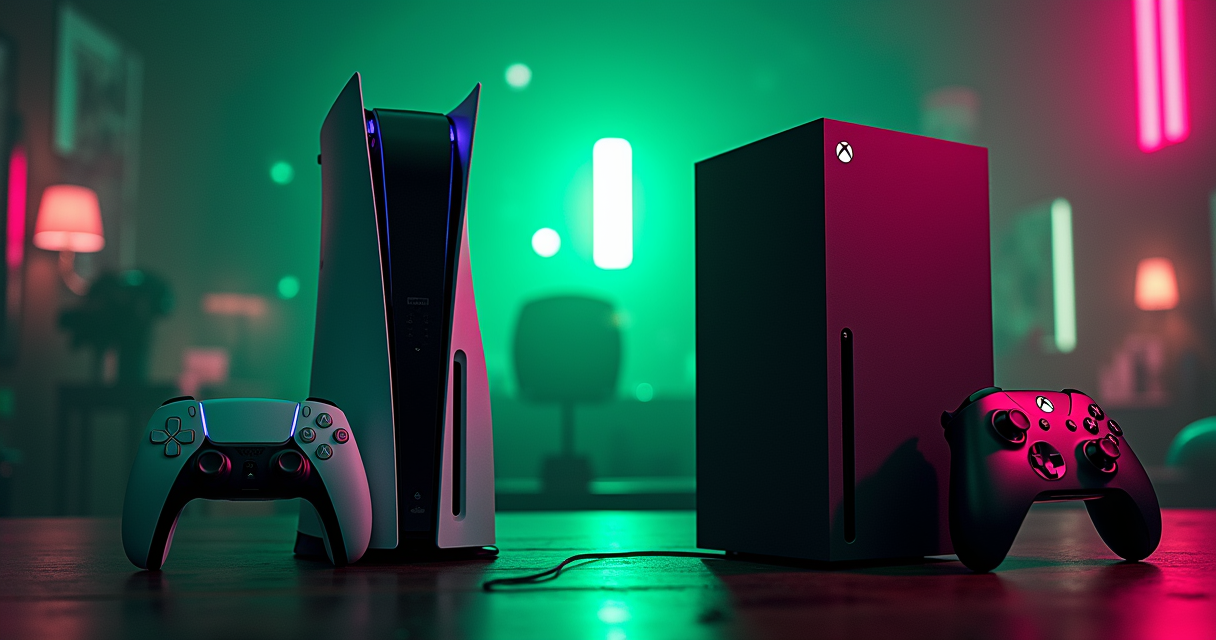
For six years the console war ran on a comfortable script. Sony sold the powerful, pricey box with the good controller and the exclusives. Microsoft sold the slightly-more-powerful box with the value subscription and the cheap little sibling. You could argue the particulars, but the shape of the argument never really moved. In 2026 it moved.
As of April 2, 2026, the standard PlayStation 5 costs $649.99. As of August 1, 2026, the disc-based Xbox Series X costs $799.99. Read those two numbers again. The console that spent a generation styled as the enthusiast's premium purchase is now the cheaper one, by a clean $150. Microsoft's flagship — the machine with the bigger teraflop figure printed on the box — is the one that crossed $800 first.
This comparison is written after five separate price increases across the two platforms, one discontinued SKU, a subscription that jumped fifty percent and then walked most of it back, and a memory shortage both companies now blame for roughly everything. If you are shopping in late 2026, the useful question is no longer which box is more powerful. It is which box is worth what they are now charging. Those are different questions, and the answers do not point the same way.
The 2026 Flip: How Xbox Became the Expensive One
Launch parity, then a slow divergence
Both machines shipped on the same day, November 10, 2020, at the same headline price: $499.99 for the disc-drive Xbox Series X and the disc-drive PlayStation 5. Sony added a $399.99 all-digital PS5; Microsoft added the $299.99 Series S. That pricing held for four years, which by console standards is an ice age. Consoles are supposed to get cheaper as the silicon matures and yields improve — the PS4 shed a hundred dollars inside three years, and the Xbox 360 dropped repeatedly across its life. This generation did the reverse, and it did it on both sides of the aisle at once, which is the part nobody selling you a console in 2020 would have believed.
Five hikes in fifteen months
Between May 2025 and August 2026 the two platforms raised U.S. prices five times combined. Sony went twice; Microsoft went three times. Each announcement arrived wrapped in the same laundered macroeconomic language, and each one pushed the two machines further from where they started and, more importantly, further apart from each other. Sony's March 2026 increase was described by the company, per CNBC's coverage, as a response to continued pressures in the global economic landscape. Microsoft's August 2026 increase was pinned on component costs, a point we will return to because the number they cited is genuinely startling.
Where that leaves a buyer in late 2026
The result is an inversion nobody at either company would have scripted in 2020. The PS5 disc model at $649.99 undercuts the Series X disc model at $799.99 by $150. The digital-versus-digital comparison is identical: the PS5 Digital Edition at $599.99 against the disc-less Robot White 1TB Series X at $749.99 — again $150 in Sony's favor. Microsoft still owns the cheaper doorway into the ecosystem, the $499.99 Series S, but that is a materially weaker machine; we walk through the roughly 3x GPU gulf between the Series X and Series S separately. Flagship against flagship, the matchup now favors PlayStation on price for the first time in the generation's life.
Price Timeline: From $499 Twins to a $150 Gap
The 2025 increases
Microsoft moved first. On May 1, 2025, the disc-based Series X jumped from $499.99 to $599.99, and the company paired the hardware news with a warning that some holiday releases would carry $80 price tags — a software squeeze layered on top of the hardware one. Sony followed on August 20, 2025, raising the Digital Edition from $450 to $500, the standard PS5 from $500 to $550, and the PS5 Pro from $700 to $750. Then Microsoft went again: on September 19, 2025, a second Xbox increase pushed the Series X past its own launch price and up to $649.99, a mid-generation repricing documented at the time as unusual for a console that had not been on the market five years.
The 2026 increases
On March 27, 2026, Sony announced its largest single adjustment yet, effective April 2, 2026: the standard PS5 to $649.99, the Digital Edition to $599.99, and the PS5 Pro to $899.99, with the PlayStation Portal remote player climbing from $199.99 to $249.99. Push Square called them gigantic, and the math backs the adjective — the Digital Edition alone is up $200 from launch. The same announcement set Japan's PS5 at ¥97,980, the Digital Edition at ¥89,980, the Pro at ¥137,980, and the Portal at ¥39,980. If you are weighing the Pro specifically, our breakdown of the $899.99 PS5 Pro and its free PSSR update covers whether the mid-gen upgrade earns the premium.
The August 2026 Xbox hike that sealed the flip
The decisive move came on August 1, 2026, when Microsoft raised prices a third time: the Series X disc model to $799.99, the all-digital Series X to $749.99, the Series S 512GB to $499.99, and the Series S 1TB to $599.99. The 2TB Galaxy Black Special Edition, previously $799.99, was discontinued rather than pushed toward the $1,000 line. Microsoft's stated justification was blunt: console storage and memory prices have increased by more than 2.5x, with the company expecting another doubling by the fall of 2027. Reporting around the hike noted that even at $800, Microsoft is reportedly losing on the order of $150 per Series X sold — consoles, as the company has said plainly, are typically not sold at a profit. When your $800 flagship still loses money per unit, you are watching a business model buckle in real time.
Here is the whole sorry ledger in one place. Launch prices are U.S. MSRP from November 2020, or each SKU's own launch where it arrived later; the Current column reflects the situation as of August 2026.
| Model | Launch MSRP | After 2025 hikes | Current (Aug 2026) | Change vs launch |
|---|---|---|---|---|
| PS5 (disc) | $499.99 (Nov 2020) | $549.99 | $649.99 | +$150 |
| PS5 Digital Edition | $399.99 (Nov 2020) | $499.99 | $599.99 | +$200 |
| PS5 Pro | $699.99 (Nov 2024) | $749.99 | $899.99 | +$200 |
| PlayStation Portal | $199.99 (Nov 2023) | $199.99 | $249.99 | +$50 |
| Xbox Series X (disc) | $499.99 (Nov 2020) | $649.99 | $799.99 | +$300 |
| Xbox Series X (all-digital, 1TB) | $449.99 (Oct 2024) | $599.99 | $749.99 | +$300 |
| Xbox Series S (512GB) | $299.99 (Nov 2020) | $399.99 | $499.99 | +$200 |
| Xbox Series S (1TB) | $349.99 (Sep 2023) | $449.99 | $599.99 | +$250 |
| Xbox Series X (2TB Galaxy Black) | $599.99 (Oct 2024) | $799.99 | Discontinued | — |
PRICE TIMELINE - U.S. MSRP, flagship disc models
                        PS5 (disc)      Xbox Series X (disc)
Nov 2020 (launch) ..... $499.99         $499.99
2025 hikes ............ $549.99         $649.99   (May + Sep)
2026 hikes ............ $649.99         $799.99   (Apr / Aug)
------------------------------------------------------------
Net vs launch ......... +$150 (+30%)    +$300 (+60%)
Standing today ........ PS5 is $150 cheaper, both editions
Specs Head to Head: The 10.28 vs 12.155 TFLOP Question
The spec sheets have not changed since 2020 — no amount of repricing alters the silicon — so the technical comparison is the one stable thing in this entire article. Here it is in full, and then we will argue about what it actually means.
| Specification | PlayStation 5 | Xbox Series X |
|---|---|---|
| Release date | Nov 10, 2020 | Nov 10, 2020 |
| Launch price (disc) | $499.99 | $499.99 |
| Current price (disc) | $649.99 | $799.99 |
| Current price (digital) | $599.99 | $749.99 |
| CPU | 8-core AMD Zen 2, up to 3.5 GHz (variable) | 8-core AMD Zen 2, 3.8 GHz (3.66 GHz w/ SMT) |
| GPU architecture | Custom RDNA 2 | Custom RDNA 2 |
| GPU compute units | 36 CUs | 52 CUs |
| GPU clock | Up to 2.23 GHz (variable) | 1.825 GHz (fixed) |
| GPU throughput | 10.28 TFLOPS | 12.155 TFLOPS |
| Memory | 16GB GDDR6 (unified) | 16GB GDDR6 (split) |
| Memory bandwidth | 448 GB/s (uniform) | 560 GB/s (10GB) + 336 GB/s (6GB) |
| SSD raw speed | 5.5 GB/s (~8-9 compressed) | 2.4 GB/s (~4.8 compressed) |
| SSD capacity (usable) | 825GB (~667GB) | 1TB (~802GB) |
| Storage expansion | Standard M.2 NVMe slot | Proprietary expansion card |
| Optical drive | 4K UHD Blu-ray (disc model) | 4K UHD Blu-ray (disc model) |
| Target output | Up to 4K/120, 8K support | Up to 4K/120, 8K support |
| Ray tracing | Hardware-accelerated (RDNA 2) | Hardware-accelerated (RDNA 2) |
| VRR / 120Hz | Yes / Yes | Yes / Yes |
| Backward compatibility | PS4 (PS1-PS3 via PS Plus Premium) | Xbox One, Xbox 360, original Xbox |
| Signature feature | DualSense haptics and adaptive triggers | Quick Resume (multi-game suspend) |
| Measured noise (load) | ~45-50 dBA | ~39-43 dBA |
| Lifetime units (2026) | ~93.7M shipped | ~34M (est.) |
GPU: Microsoft's paper advantage
On raw graphics compute, the Series X wins the number: 12.155 teraflops from 52 active RDNA 2 compute units locked at a fixed 1.825 GHz, against the PS5's 10.28 teraflops from 36 units running at a variable clock that peaks at 2.23 GHz. That is roughly an 18% theoretical GPU lead for Xbox. Sony's counter-argument, made at length by system architect Mark Cerny in the Road to PS5 presentation, was that fewer-but-faster units keep more of the GPU busy more of the time — higher clocks lift rasterization, triangle throughput, and cache bandwidth, not just shading. Whether 18% on paper becomes 18% on screen is the question the next section exists to answer. The short version: it does not, and it never really has.
CPU and memory: unified versus split
Both use the same eight-core AMD Zen 2 CPU. The Series X clocks it slightly higher — 3.8 GHz, or 3.66 GHz with simultaneous multithreading enabled — versus the PS5's variable ceiling of 3.5 GHz. The memory is where the philosophies genuinely diverge. The PS5 carries 16GB of GDDR6 as a single unified pool at a uniform 448 GB/s. The Series X splits its 16GB into a fast 10GB segment at 560 GB/s and a slow 6GB segment at 336 GB/s. That fast pool is genuinely quicker than anything on the PS5, but only for 10GB; step outside it and bandwidth falls below Sony's uniform figure. Developers have spent the entire generation managing that split, and it is one recurring reason the Xbox's paper GPU lead so rarely lands cleanly in a shipping game.
Storage: raw speed versus a simpler card
Here Sony wins the number that arguably matters more day to day. The PS5's custom SSD moves 5.5 GB/s raw, roughly 8 to 9 GB/s with Kraken compression, across an 825GB drive of which about 667GB is usable — and expansion is a standard M.2 NVMe slot you can fill with an off-the-shelf drive from any electronics aisle. The Series X SSD runs 2.4 GB/s raw, about 4.8 GB/s with BCPack, across a 1TB drive with roughly 802GB usable, and expansion means a proprietary Seagate or Western Digital card sold at a premium. Sony's drive is more than twice as fast on paper; Microsoft's is larger out of the box and cheaper to fill only if you buy the base machine and never expand it. If you have ever timed a fast-travel sequence across both, you have felt the difference the raw numbers predict.
Performance in Practice: What the TFLOP Gap Actually Buys
The multiplatform reality
Six years of Digital Foundry face-offs have produced a consistent, faintly anticlimactic verdict: on the overwhelming majority of cross-platform releases, the two machines land within a hair of each other, and where a gap exists it is as likely to favor the PS5 as the Series X. The theoretical 18% GPU advantage repeatedly fails to materialize as an 18% framerate lead, because games are bottlenecked by more than shader throughput — the split memory, the maturity of each platform's tools, and the variable-clock behavior all intervene. Early in the generation, several high-profile multiplats actually ran better on the lower-teraflop PS5; Assassin's Creed Valhalla famously rendered at a higher resolution on PS5 than on Series X at launch, an outcome that quietly embarrassed the most powerful console marketing and forced a round of patches.
Acoustics and thermals
If there is one area where the Series X wins cleanly and consistently, it is noise. Measured under sustained load, the Series X typically sits around 39 to 43 dBA; PS5 units, particularly early launch hardware, have been measured up in the 45 to 50 dBA range, and Sony's later board revisions improved but did not erase the gap. Digital Foundry, in its acoustic testing, went as far as to say that with the Series X, breaking out the noise meter is a pointless exercise — it simply stays quiet. The PS5's enormous heatsink keeps thermals comfortably safe, and the launch units even used liquid metal between die and cooler, but the fan is more audible in a quiet room. If your console lives under a TV three feet from your head, this is not a trivial distinction.
The variable-clock debate, settled by time
Sony's variable-frequency approach — where the CPU and GPU share a power budget and clocks flex to stay within it — drew skepticism in 2020, on the theory that it would cause visible, unpredictable dips in demanding scenes. In practice it has been a non-event. The clocks spend the vast majority of their time at or near the ceiling, and the feared downclock-in-the-boss-fight scenario turned out to be a rounding error rather than a felt problem. Six years of shipped games have vindicated the design far more than the spec-sheet warriors predicted, which is the recurring theme whenever the raw 12.155-versus-10.28 comparison meets an actual frame counter. Power on paper is not power on screen, and this generation proved it about as decisively as a generation can.
Features That Stick: DualSense, Quick Resume, and Preservation
The DualSense argument
The single most-cited reason to pick a PS5 has nothing to do with teraflops. It is the controller. The DualSense's adaptive triggers and high-fidelity haptics were novel enough at launch that TIME ran the assessment that the DualSense controller is the best reason to get a PlayStation 5, and six years on that has aged well — a well-implemented DualSense game still does things an Xbox controller physically cannot, from the tension of a drawn bowstring to the granular texture of a surface under your thumbs. Microsoft's pad remains the ergonomic gold standard and the default for PC players, and it still takes standard AA batteries, which is either charmingly old-fashioned or quietly infuriating depending on your temperament. But the DualSense is the one that makes people hand you the controller and say you have to feel this.
Quick Resume, still Xbox's quiet ace
Microsoft's counter is a system-level feature Sony still has not matched: Quick Resume, which suspends multiple games to storage and lets you jump back into any of them, mid-level, in a handful of seconds. GameSpot called it a literal game changer, and the description is fair — juggling three or four titles without sitting through boot logos and load sequences genuinely changes how you use the machine. The PS5's single-game suspend is fine and fast, but Quick Resume is a category better, and it is consistently the feature Xbox owners say they miss most when they switch platforms.
Backward compatibility and preservation
This is Microsoft's most under-marketed strength. The Series X plays a deep catalog reaching back through Xbox One, Xbox 360, and even original Xbox titles, many with automatic HDR and doubled framerates applied for free. The PS5, by contrast, is essentially a PS4-and-newer machine — no native PS1, PS2, or PS3 discs, with older classics gated behind the PS Plus Premium streaming-and-emulation tier and its rotating, incomplete library. For anyone who values an existing collection or cares about game preservation as a principle, Xbox's approach is the more respectful one, and it is a real point in the $799.99 column. If you would rather stream your PS5 to another screen than dig through old discs, our guide to 1080p PS Remote Play in about 30 minutes is the modern living-room equivalent of that flexibility.
Ecosystem & Subscriptions: Game Pass vs PS Plus in 2026
Game Pass after the $22.99 reset
Game Pass remains the strongest single argument for the Xbox platform, but 2026 was a turbulent year for it. Microsoft had pushed Game Pass Ultimate to $29.99 per month in late 2025, then reversed course on April 21, 2026, cutting it to $22.99 — a reduction of more than 23% — under new Xbox chief Asha Sharma, who framed it as a move to recommit to players. PC Game Pass fell to $13.99 in the same shuffle. CNBC covered the cut as an affordability correction after subscriber growth stalled at the higher price. A price cut is not something a confident product does; it is something a product does after it has watched people leave.
GAME PASS ULTIMATE - annualized (after Apr 21, 2026 cut)
$22.99 / mo   x 12   =  $275.88 / year
Prior rate ($29.99)  =  $359.88 / year   (you save ~$84/yr)
PC Game Pass ($13.99) = $167.88 / year
Catch: new Call of Duty is NO LONGER day-one (arrives ~1 yr later)
The Call of Duty asterisk
The catch buried in that price cut matters more than the cut itself. As The Game Business reported, future Call of Duty titles will no longer arrive on Game Pass on day one — they will land roughly a year after release, though existing entries such as Black Ops 7 remain in the library. For a household that bought into Xbox specifically to play the year's biggest shooter at no extra cost the weekend it launched, that is a real erosion of the pitch. The value is still there for broad, restless players who bounce between a dozen games a month; it is noticeably thinner for the people who wanted the tentpoles on release day.
PS Plus, exclusives, and the Xbox-everywhere pivot
Sony's PS Plus counters with Essential, Extra, and Premium tiers, but Sony's real ecosystem argument is still first-party exclusives, which remain deeper and more consistent than Microsoft's. Meanwhile Microsoft has spent 2026 blurring the definition of Xbox itself — putting its games on PlayStation, leaning hard into cloud, and shipping handheld hardware like the ROG Xbox Ally, launched across 45 countries in October 2025. If Xbox becomes a service that runs anywhere, the argument for the $799.99 box specifically gets harder to make, not easier. And when the generation's biggest cross-platform release finally lands — see our GTA 6 release-date rundown for the November 19, 2026 launch — it plays on both machines, flattening yet another of the exclusive-driven reasons to prefer one over the other.
Which Console Fits You: 6 Real-World Scenarios
Specs and prices are abstractions until you map them onto an actual person. Here are six concrete profiles and the honest answer for each.
Buy the PlayStation 5 if...
- You are a single-player, controller-forward player. If your calendar is God of War, Spider-Man, Final Fantasy, and the annual prestige exclusive, the PS5 is the obvious pick — deeper first-party library, and the DualSense turns those specific games into something the Xbox pad cannot replicate.
- You are price-sensitive at the high end. Post-flip, the PS5 disc model is $150 cheaper than the Series X disc model, and $150 cheaper digital-to-digital. If you were always going to buy the more powerful of the two flagships, that decision now also happens to be the cheaper one, which is a first.
Buy the Xbox Series X if...
- You are a high-volume variety player who lives in a subscription. At $22.99 a month, Game Pass Ultimate is still the best raw content value in gaming if you play widely and finish little — provided you have made peace with waiting a year for Call of Duty.
- You care about backward compatibility and preservation. If you own a large Xbox 360 or original Xbox library, or you simply want the machine that treats its back catalog with respect, the Series X is unmatched — auto-HDR and framerate boosts on decades-old games are a real, unglamorous joy that Sony offers no equivalent to.
Buy neither flagship yet if...
- You are value-first and do not need 4K flagship power. The $499.99 Series S plays the same games at lower resolution and is $300 less than the Series X; for a large slice of players that is the rational buy, not either flagship, and pretending otherwise is how people overspend.
- You are hoping prices come back down. They are not going to. With Microsoft forecasting component costs doubling again by fall 2027, the realistic expectation is flat-to-higher pricing, not relief. Waiting saves you nothing and costs you the months of games you would have played.
The Sales Scoreboard: 93 Million vs 34 Million
The shipment gap
Whatever the spec sheets say, the market has already voted, and it was not close. Sony reported the PS5 at roughly 93.7 million units shipped as of March 31, 2026, having added about 16 million in the prior fiscal year alone. Microsoft's Series X and Series S, by the best available estimates — Microsoft stopped disclosing console unit sales years ago — sit near 34 million combined. That is a gap of nearly 60 million machines and a ratio of about 2.7 to 1, per the VGChartz tracking that now fills the vacuum Microsoft's silence created.
Why Microsoft stopped counting
The reporting asymmetry is itself the story. Sony still trumpets shipment milestones because they are flattering; Microsoft shifted years ago to talking about engagement, Game Pass subscribers, and players, precisely because the raw hardware number stopped helping the narrative. When a company changes which metric it celebrates, it is quietly telling you which metric it is losing. The 34-million figure is an estimate for exactly that reason — the manufacturer would very much prefer you counted something, anything, else.
What the install base means for you
This is not academic scorekeeping. A 93-million install base is why the PS5 gets more day-one third-party attention, more physical retail shelf space, and a healthier used-game market with more downward price pressure. It is also the concrete reason Microsoft is now porting its once-exclusive games to PlayStation at all: the audience is there, and it is nearly three times the size of its own. Buying into the larger platform generally means better long-tail support for the eight years you will actually own the thing, and on that specific axis it is not a contest.
Migration Guide: Switching Platforms Without Losing Everything
The one rule that governs everything
Before any steps, internalize this: your game licenses do not move. A digital game bought on PlayStation is a PlayStation license, and the same title on Xbox is a separate purchase; there is no cross-platform transfer of ownership for the games themselves, and there never has been. What can move is your progress — via publisher accounts, cloud saves, and cross-progression — and your peripherals, partially. Plan around that single reality and the switch is painless. Ignore it and you will feel robbed the first time a game asks you to buy it again.
Switching from Xbox to PlayStation
- Inventory what uses cross-progression. Link your Activision, EA, Ubisoft, and Epic accounts on the Xbox first; anything tied to those (Fortnite, Call of Duty, Apex Legends, EA Sports) carries your progress across automatically.
- Note what will not transfer: single-player saves for games without cloud cross-save, and every digital license you own. Budget to re-buy anything you cannot live without, or keep the Xbox around purely for that library.
- Set up the PS5, sign into those same publisher accounts, and reinstall the cross-progression titles. Your ranks, cosmetics, currencies, and unlocks reappear where the publisher supports it.
- Bring your headset and USB peripherals — most wired headsets and many wireless ones work on both platforms. Controllers do not cross over, so budget for at least one DualSense from day one.
- If you were a Game Pass subscriber, decide whether to keep it for PC or cloud or cancel it outright; its value does not follow you to PlayStation in any form.
Switching from PlayStation to Xbox
- Enable and verify PS Plus cloud saves before you do anything else, and upload every save you care about. Cross-progression titles behave exactly as they do in the other direction.
- Accept that PS Plus Extra and Premium catalog games, plus all your PlayStation digital licenses, stay on PlayStation. This is the same license wall, simply facing the other way.
- On the Series X, sign into your publisher accounts, reinstall the cross-progression games, and confirm your saves pull down before you delete anything on the old machine.
- Keep the DualSense for PC use if you like, but buy a proper Xbox controller for the Xbox; the platform expects its own pad for full feature support.
- Subscribe to Game Pass only after you have confirmed the specific games you want are actually in it this month. The catalog rotates, and titles leave with about two weeks notice.
Pros & Cons: The Honest Ledger
PlayStation 5
| Pros | Cons |
|---|---|
| $150 cheaper than Series X, both editions | Still $150-$200 above its 2020 launch price |
| DualSense haptics and adaptive triggers are unmatched | Louder under load (~45-50 dBA) |
| SSD more than 2x faster raw (5.5 vs 2.4 GB/s) | Backward compatibility stops at PS4 |
| Standard M.2 expansion using cheap off-the-shelf drives | PS1-PS3 classics locked behind PS Plus Premium |
| Deeper, more consistent first-party exclusives | No Quick Resume equivalent |
| ~93.7M install base means best third-party and retail support | PS Plus Extra/Premium costs stack up over years |
Xbox Series X
| Pros | Cons |
|---|---|
| Higher raw GPU throughput (12.155 TFLOPS) | $799.99 - the pricier flagship by a full $150 |
| Quick Resume across multiple suspended games | Up $300 over its own 2020 launch price |
| Best-in-class backward compatibility and preservation | Slower SSD (2.4 GB/s) and proprietary expansion cards |
| Quieter under load (~39-43 dBA) | Split 10+6GB memory complicates development |
| Game Pass Ultimate at $22.99 is strong for variety players | New Call of Duty no longer day-one on Game Pass |
| Larger out-of-box storage (1TB, ~802GB usable) | ~34M install base and shrinking third-party priority |
Line the ledgers up and a pattern emerges. Nearly every PS5 con is a matter of ecosystem policy — subscription creep, gated retro catalogs, a missing convenience feature — while its pros are structural: cheaper, faster, better-supported. The Series X's pros are real but narrow (preservation, quiet operation, Game Pass breadth), and its central con is the one printed on the box in eighteen-point type: $799.99. When the cheaper machine is also the faster and better-supported one, the burden of proof shifts entirely onto the more expensive box, and in 2026 preservation alone has to carry that weight.
The Verdict: Buy the PS5, With One Asterisk
For most people, it is the PS5
Strip away six years of accumulated brand loyalty and look at the 2026 numbers cold. The PlayStation 5 is $150 cheaper than the Xbox Series X, has the faster SSD, the better controller, the deeper exclusive library, and an install base nearly three times larger — which translates directly into better third-party and retail support for the life of the machine. The Series X's one hardware trump card, its roughly 18% paper GPU advantage, has spent the entire generation failing to show up in shipped games. For the default buyer, this is not a close call, and the price flip removed the last reason it ever was. You are no longer paying a premium for the better all-round console. You are paying less for it.
For the Game Pass household, it is closer
There is exactly one profile for whom the Series X still makes clean sense: the high-volume, variety-first player who lives inside Game Pass. At $22.99 a month, Ultimate remains the best raw content value in the industry if you play broadly and buy little, and the day-one first-party releases still land there the moment they ship. But 2026 dulled even this edge — the Call of Duty carve-out means the single biggest annual draw now arrives a year late on the service, and the price cut itself was a public admission that $29.99 had pushed people out the door. If you are a Game Pass true believer, buy the Xbox with clear eyes. Everyone else should notice the value pitch is measurably thinner than it was twelve months ago.
The preservation footnote
The one thing money cannot buy back on PlayStation is Microsoft's backward-compatibility program. If your identity as a player is bound up in a library that stretches back to the Xbox 360 or the original Xbox, the Series X is the machine that honors it, and no amount of Sony's raw speed changes that calculus. It is a niche argument, but for the people it applies to it is decisive, and it is the single most defensible reason to spend the extra $150. For everyone else, in the specific and slightly absurd market of late 2026, the recommendation is as blunt as the price tags themselves: buy the PlayStation 5. It is the better console, and it is now also the cheaper one, and that particular combination has not existed in this matchup until this year.
Questions the search bar asks me
- Is the PS5 or Xbox Series X cheaper in 2026?
- The PS5 is cheaper. As of the August 1, 2026 Xbox hike, the disc Series X is $799.99 while the disc PS5 is $649.99 (since April 2, 2026) — a $150 gap. Digital-to-digital it is identical: PS5 Digital Edition $599.99 versus all-digital Series X $749.99.
- Why did both consoles get more expensive instead of cheaper?
- Repeated component and macroeconomic pressure. Sony cited continued pressures in the global economic landscape (CNBC, March 2026); Microsoft blamed console storage and memory prices rising more than 2.5x with another doubling expected by fall 2027 (Variety/TechRadar, August 2026). Between them the two platforms hiked U.S. prices five times from May 2025 to August 2026.
- Which is more powerful, the PS5 or Xbox Series X?
- On paper the Series X, at 12.155 TFLOPS versus the PS5's 10.28, a roughly 18% GPU edge. In practice Digital Foundry has found near-parity across most cross-platform games for six years, and some early multiplats like Assassin's Creed Valhalla ran better on PS5. The PS5's SSD is more than twice as fast (5.5 vs 2.4 GB/s raw).
- Is Xbox Game Pass still worth it in 2026?
- It depends how you play. Game Pass Ultimate was cut to $22.99/month on April 21, 2026 (down from $29.99), and PC Game Pass to $13.99 — strong value for variety players. The catch: new Call of Duty titles are no longer day-one and arrive about a year after release, per The Game Business.
- How many PS5 and Xbox Series X units have sold?
- Sony reported roughly 93.7 million PS5 units shipped as of March 31, 2026. Microsoft stopped disclosing console sales, so the Xbox Series X and S sit near 34 million combined by VGChartz estimates — a gap of nearly 60 million machines and a ratio of about 2.7 to 1 in Sony's favor.

Jordan covers the modern industry where it touches the old one: Nintendo announcements, handheld hardware, and the long shadow the classics cast over new releases. Every post under this byline is reviewed pre-publish by Sam P., Editor & Operator — corrections to info@instalinkoteam.com. Published 2026-08-29 · Last updated 2026-08-29. Full bios on the author page.