/// FIELD NOTES FROM A SELF-AWARE GAME SITE
Retroid Pocket 5 vs 6 2026: 70% Faster, $45 More
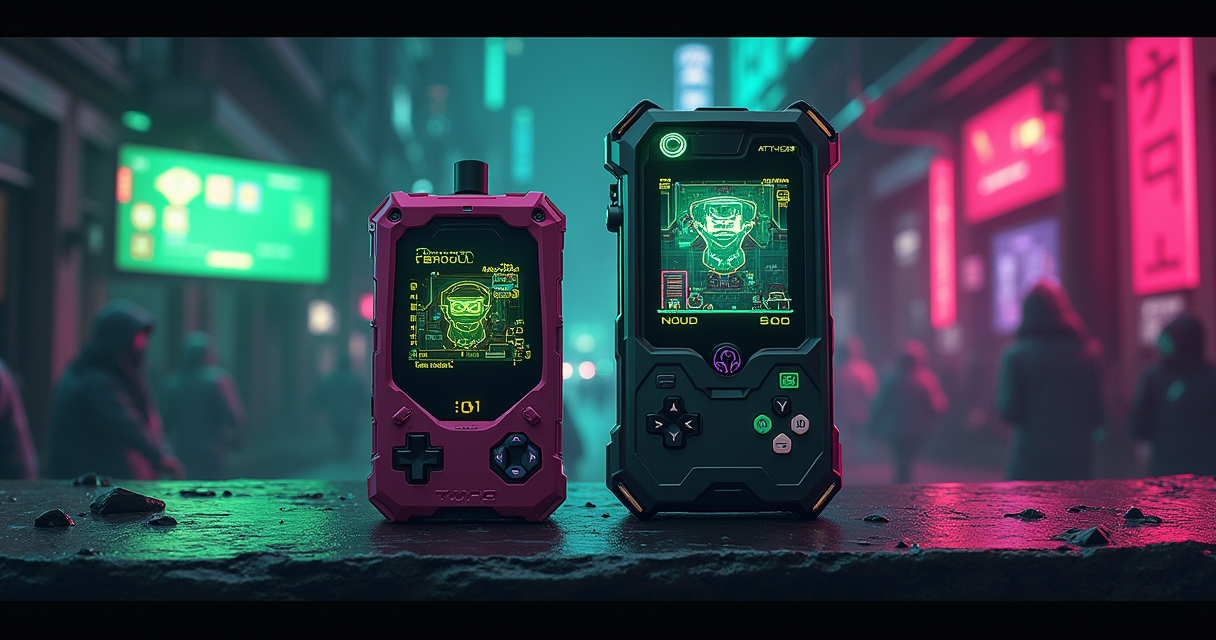
There is a genre of hardware review that exists only because a company shipped the same product twice. The Retroid Pocket 5 and the Retroid Pocket 6 are that genre. Same 5.5-inch body, same 1080p AMOLED format, same Android 13, same Hall-effect sticks, same annual cadence that phone makers use — because underneath, these are phones that forgot to pack a modem. What changed is the silicon, the refresh rate, the battery, and, thanks to a memory market that lost its mind in 2026, the price and the very existence of the model everyone actually wanted to buy.
The short version, for people who came here to be told what to do: the Pocket 6 is roughly 70% faster in single-core Geekbench (1,985 versus 1,176) and about $45 dearer ($244 versus roughly $199), and whether that trade is worth making depends entirely on which decade of console you emulate. If you live at or below the PSP and the Dreamcast, the Pocket 5 already does everything and the upgrade is a rounding error you will feel in your wallet but not on your screen. If you want PlayStation 2, GameCube, Wii, and the first honest crack at Switch titles in a device this small, the Pocket 6 is the only one of the two that clears the bar. It clears it, in the assessment of the man who reviewed it for RetroDodo, while having "played it too safe."
That tension is the whole review, and we are going to spend the next several thousand words on it, because the details are where the money is. Start with what these two machines actually are, because it is not what the marketing says.
Two Flagships, Out of Time
The most useful thing to understand about any Retroid Pocket is that you are not buying a games console. You are buying a smartphone processor from two or three years ago, wearing a controller as a coat. Once you internalize that, every spec on the sheet stops being a mystery and starts being a date on a calendar.
The annual-handheld treadmill
Retroid has shipped a numbered Pocket on a roughly yearly beat since the Pocket 2 arrived in 2020: take a system-on-chip that flagship phones were built around a couple of years earlier, drop it into a shell with real buttons, delete the cellular radio and the camera nobody would use, and sell it for a fraction of the phone's launch price. The Pocket 4, the Pocket 5, and now the Pocket 6 are the mature, confident end of that idea. Notebookcheck framed the Pocket 6's arrival as a device out to "redefine the Android gaming handheld scene," which is generous. The honest framing is the one everyone actually uses when they hand it to a friend: this is last-generation phone power at a retro-handheld price, and that has always been the entire pitch.
What a Snapdragon 865 really is
The Pocket 5 runs a Qualcomm Snapdragon 865 — Qualcomm's SM8250 "Kona," a 7nm part with an Adreno 650 GPU. That is the chip that powered the Galaxy S20 and most of the 2020 Android flagship class. Putting it in a $199 handheld in late 2024 was a shrewd, unromantic decision: the 865 is a known quantity, its thermal behavior is thoroughly mapped, and every serious Android emulator has been hand-tuned against it for years. Paired with 8GB of LPDDR4x and 128GB of UFS 3.1 storage, it is a machine with no surprises left in it. In a handheld, that is a compliment. Surprises in emulation are almost always bad ones.
What a Snapdragon 8 Gen 2 really is
The Pocket 6 jumps to the Snapdragon 8 Gen 2 — the SM8550 "Kalama," a 4nm part with an Adreno 740 GPU, one Cortex-X3 prime core, and the general shape of the 2023 flagship class behind devices like the Galaxy S23. That is not a nudge. It is two generations, a node shrink, and a GPU that roughly doubles the 650's throughput, fed by faster LPDDR5x. There is a quiet lesson buried in that choice: the reason retro handhelds run last-generation flagship silicon rather than the newest chip is that emulator authors need years to tune their cores against a given GPU and its drivers, and a two-year-old flagship is both cheaper and more thoroughly understood than whatever launched last month. Maturity beats raw numbers here. And here is the first trap you will trip over on a dozen auto-generated "comparison" pages: they claim the Pocket 5 runs a MediaTek Dimensity 1100. It does not. The Dimensity 1100 lives in the Retroid Pocket G2, a different and now-discontinued device; some content mill crossed the wires, and the error has been laundered through enough sites to pass for fact. The same pages will tell you the Pocket 5 has an "IPS screen." It has an AMOLED. When a spec sheet gets both of those wrong, close the tab and back away.
The Spec Sheet, Line by Line
Here is the whole argument in one table. Read it top to bottom and you will notice something: for the first two-thirds of the sheet the two devices are near-identical twins, and then a cluster of rows near the bottom carries all the weight. That distribution is the review.
| Detail | Retroid Pocket 5 | Retroid Pocket 6 |
|---|---|---|
| Launch | September 2024 | Preorder late 2025 / retail Dec 2025 |
| SoC | Snapdragon 865 (SM8250, 7nm) | Snapdragon 8 Gen 2 (SM8550, 4nm) |
| GPU | Adreno 650 | Adreno 740 (~2x) |
| Lineage | 2020 flagship phone chip | 2023 flagship phone chip |
| RAM | 8GB LPDDR4x | 8GB or 12GB LPDDR5x |
| Storage | 128GB UFS 3.1 | 128GB or 256GB UFS 3.1 |
| Display | 5.5in AMOLED, 1080p | 5.5in AMOLED, 1080p |
| Refresh rate | 60Hz | 120Hz |
| Battery | 5,000mAh | 6,000mAh |
| Charging | Standard (no fast charge) | 27W wired |
| Wi-Fi / Bluetooth | Wi-Fi 6 / BT 5.1 | Wi-Fi 7 / BT 5.3 |
| Video out | USB-C DisplayPort (4K30; 4K60 via dock) | USB-C 3.1 DisplayPort, 4K60 |
| Controls | Hall sticks, D-pad, active cooling | Hall sticks, choice of D-pad-top or stick-top, active cooling |
| Saves / expansion | Per-emulator, microSD/TF | Per-emulator, microSD/TF |
| Weight | 280g | ~320g |
| OS | Android 13 | Android 13 |
| Geekbench 6 (single-core) | 1,176 | 1,985 |
| AnTuTu | ~668,000 | ~1,200,081 |
| Price (mid-2026) | ~$199 (sale-only) | $244 (8/128) |
Where the two agree
The chassis is, for practical purposes, shared. Both are 5.5-inch, 1080p AMOLED handhelds running Android 13 with 128GB of UFS 3.1 as the base tier, expandable by microSD. Both use Hall-effect analog sticks — magnetic sensors with no wiper to wear out, which is the single most important reliability upgrade the whole category made this decade and the reason your grandkids will still be playing on these without stick drift. Both have active cooling, a small fan doing quiet, unglamorous work. Both give you a 3.5mm headphone jack, because Retroid's audience would revolt otherwise. If you put a Pocket 5 and a Pocket 6 in front of a stranger and asked them to guess which cost more, they would have to turn them on to find out.
Where they diverge
Everything that matters is in six rows. The SoC (two generations). The refresh rate (60Hz to 120Hz). The battery and charging (5,000mAh to 6,000mAh, plus 27W). The radios (Wi-Fi 6/BT 5.1 to Wi-Fi 7/BT 5.3). The weight (280g to about 320g). And the price. Notice what is not on that list: the screen size, the resolution, the panel technology, the storage interface, the operating system. The Pocket 6 is not a redesign. It is a re-silicon. That is why RetroDodo's Brandon Saltalamacchia rated it 8.4/10 and still wrote that "the only disappointment comes from knowing that Retroid can do better here," adding that "a $250 device should have something unique." He is right, and it does not.
Controls, saves, and the boring-but-important bits
Two small details separate the buyer who is happy from the buyer who is annoyed. First, the sticks: both devices use Hall-effect sensors, but the Pocket 6 lets you choose at checkout between a D-pad-top (Xbox-style, asymmetric) or stick-top (PlayStation-style, symmetric) layout. If you play a lot of 2D — and if you bought a retro handheld, you do — the D-pad-top layout puts the most important input under your left thumb where it belongs. Choose deliberately; you cannot swap it later, and it is one of the few genuinely unique decisions Retroid hands you. Second, saves. Neither device has a magic universal save system. Saves live wherever your emulator puts them — RetroArch save states in RetroArch's folders, standalone cores like DuckStation or Dolphin in theirs. Back up your microSD before you factory-reset, because Android will not do it for you, and no fingerprint reader — which the Pocket 6 conspicuously lacks at $250 — will save your progress.
The Display and the 120Hz Question
The screen is the row people fixate on, and it is worth being precise about what actually changed, because the marketing wants you to believe more than the physics delivers.
Same glass, faster clock
Both panels are 5.5-inch, 1920x1080 AMOLED displays. Same size, same resolution, same fundamental technology. The Pocket 6's panel runs at 120Hz where the Pocket 5's tops out at 60Hz, and it is rated around 550 nits of brightness. Saltalamacchia called the 6's display "beautiful" and "one I simply cannot fault," noting that "a 5.5-inch AMOLED display makes the device feel incredibly modern." All true. It is also, pixel for pixel in a static scene, the same class of image the Pocket 5 already gave you. AMOLED's party tricks — the perfect blacks, the punchy color, the per-pixel contrast — were on the 5 too.
Does 120Hz actually matter for retro games?
Here is the deadpan truth the spec bullet will not tell you: most of what you will run does not care. A Game Boy Advance game outputs at roughly 60Hz. A SNES title runs at 60 (or 50, if you are being period-correct about PAL). Dreamcast, PS1, N64 — all of it is 60fps-or-less content, and a 120Hz panel showing you a 60fps game is showing you each frame twice. Where the 120Hz genuinely earns its keep is everywhere around the games: scrolling the Android launcher, browsing your library, playing the handful of native Android titles that render above 60, and running frame-doubling or black-frame-insertion tricks that a subset of users will actually configure. If you told me you were buying the Pocket 6 for the 120Hz, I would ask you to name three games that would benefit, and I would wait a while.
Brightness, blacks, and the burn-in asterisk
The 6's roughly 550 nits is enough for indoor use and shaded outdoor use, and not enough for direct summer sun — which is true of nearly every handheld that is not a Steam Deck OLED with its 1,000-nit HDR party. The AMOLED caveat applies to both devices equally: static HUD elements — the eternal hearts in the corner, the fixed minimap, the always-on health bar — are exactly the kind of content that, over hundreds of hours, can ghost into an OLED panel. It is not a reason to avoid either machine. It is a reason to turn the screen off during long pauses, which the fast 120Hz UI on the 6 at least makes pleasant to wake back up.
Performance: What 70% Buys You
This is the section the whole purchase turns on, so let us be numerate about it and then be honest about what the numbers mean at the console level.
The benchmark numbers
In synthetic tests, the gap is real and large. The Pocket 6 posts a Geekbench 6 single-core score of 1,985 against the Pocket 5's 1,176 — a 69% lead, which everyone sensibly rounds to "about 70% faster." In AnTuTu, the spread widens to roughly 1,200,081 versus 668,000, an ~80% advantage that reflects the Adreno 740's GPU muscle on top of the CPU gap. In actual emulation workloads — which are messier than synthetics because they are bottlenecked by single-thread performance, memory latency, and driver quirks all at once — the practical uplift lands closer to 40-60% in the demanding titles. That is the number that matters, and it is still a generational leap. It is also, at the low end of the library, completely invisible.
System by system: where the gap appears and where it vanishes
Draw a line through the console timeline and the story tells itself. Below the line — 8-bit and 16-bit, PS1, N64, the Dreamcast, PSP, DS — both devices are comprehensively overpowered. The Snapdragon 865 was already curb-stomping this material in 2024; the 8 Gen 2 stomps it harder, but you cannot make a solved problem more solved. Hardcore Gaming 101's Dreamcast retrospective is a fine reminder that this is a deep, weird, wonderful library, and either handheld will run all of it at full speed with headroom to upscale. Even the awkward middle children behave: the Saturn — long the white whale of emulation because of its dual-CPU, quadrilateral-drawing madness — is playable on both via the Beetle and Kronos cores, and the DS and 3DS upscale cleanly, the 3DS being the one genuinely modern-ish system the 865 already handles without drama. Above the line is where your $45 goes. On the Pocket 6, Saltalamacchia ran PS2 games "at 1.5x and 2x native resolution" and GameCube "at 3x native resolution"; hands-on coverage confirms practical Wii play — Super Mario Galaxy, Xenoblade Chronicles, Donkey Kong Country Returns — and playable PlayStation 2 heavyweights like Gran Turismo 4 with minor tweaks. The Pocket 5 can touch GameCube, but realistically only the friendliest three or four titles — The Wind Waker, Luigi's Mansion, a clean Melee — before it runs out of thermal and single-thread room.
The GameCube wall, and the accuracy asterisk
The canonical torture test for GameCube emulation is F-Zero GX — Sega Amusement Vision's 60fps-locked, Triforce-arcade-derived masterpiece, the game every emulator author uses to find out whether they are lying to themselves. The Pocket 6 handles it; the Pocket 5 sweats. If that single sentence describes the games you care about, the decision is made for you. But note the ceiling on both machines: these are sixth-generation-and-earlier devices. PS3 and Xbox 360 are not "limited" here — they are a slideshow, RPCS3 and Xenia territory that no Snapdragon in a handheld shell is playing at speed, whatever the AI-written listicles insist. Remember, too, that all of this runs on top of Android: you are managing per-emulator settings, storage permissions, and the occasional app update that quietly breaks a working core. That friction is the tax you pay for the flexibility, and it lands identically on both devices. And if what you actually want is not raw speed but cycle-accurate correctness — the kind where the emulation matches the original silicon frame for frame — that is a different conversation entirely, the one that ends at an FPGA. Our writeup on the MiSTer Multisystem 2 covers why software emulation and hardware recreation are different religions, not competing brands.
# Retroid Pocket 6 — sane day-one resolution targets (1080p panel)
GB / GBC / NES / SNES / Genesis   -> integer scale + CRT shader
PS1  (DuckStation)                -> 4x-6x internal, PGXP on
N64  (Mupen64Plus-Next)           -> 2x-3x, per-game hacks
Dreamcast (Flycast)               -> 4x-6x, widescreen optional
PSP  (PPSSPP)                     -> 3x = native 1080p
Saturn (Beetle/Kronos)            -> software render, 1x-2x
PS2  (NetherSX2)                  -> 1.5x-2x internal (GT4 territory)
GameCube (Dolphin MMJR2)          -> 2x-3x  (F-Zero GX is the wall)
Wii  (Dolphin)                    -> 1x-2x, motion mapped to gyro
Switch (post-Yuzu forks)          -> 1x docked, expect asterisks

# On the Pocket 5: back PS2 down to ~1x, treat GameCube as
# "the top three or four games only," and stop at the DS/PSP tier
# for a genuinely stress-free experience.
Battery, Heat, and 27W
The battery is the second-most-important upgrade after the chip, and unlike the 120Hz panel, it is one you feel every single session.
5,000 versus 6,000mAh in the real world
The Pocket 5 carries a 5,000mAh cell with no fast charging; heavy emulation drains it in roughly 3 hours 35 minutes. The Pocket 6 steps up to 6,000mAh and adds 27W wired charging, and the extra capacity is doing real work against a hungrier chip. Saltalamacchia reported "around 4.5 hours" of mixed use, 6-8 hours of light 2D play, and 2.5-3 hours running flat out on GameCube and PS2. That is the honest shape of it: the bigger battery does not so much extend your marathon as it offsets the more demanding processor and then adds a cushion on top. The 27W charging is the quietly excellent part — top it up over a lunch break instead of babysitting it overnight, a convenience the Pocket 5 simply does not offer at any speed.
Active cooling and the throttle wall
Both devices have fans, and both use them well. The practical upshot is that neither throttles the way a passively cooled handheld does after twenty minutes. Under sustained heavy load — hours of GameCube, not minutes — the Pocket 6's better thermal envelope lets it hold clocks longer before it has to back off, which is exactly what you want on the demanding systems where it already has the advantage. On the lighter systems, the fan barely spins on either. This is a category that solved its heat problem a generation ago, and both machines inherited the fix. If you have ever cooked a passively cooled Anbernic on Dolphin until it stuttered, the difference is the whole reason these cost what they cost.
The 40-gram tax
Bigger battery, more weight. The Pocket 6 comes in around 320 grams against the Pocket 5's 280 — call it the thick end of 40 grams, though hands-on coverage pegged the felt difference at "about 30 grams," and attributed nearly all of it to the larger cell. In the hand it is noticeable if you are looking for it and forgettable within a session. If you have small hands or a commute that involves holding the thing one-handed on a train, it is a real, if minor, consideration. If you play sitting down, it is a number on a spec sheet.
The DRAM Crunch and the Price
Here is where a routine spec-bump comparison turned into a genuinely strange 2026 story, and where the smart-money configuration you would have recommended in January stopped existing by March.
The launch prices, as intended
The Pocket 6 launched into a clean, sensible two-tier structure. The 8GB/128GB model opened at $209 for early-bird preorders and settled to $229 at retail. The 12GB/256GB model — the enthusiast pick, the one with real headroom for PC streaming and the fattest game library — came in around $279 at retail, $259 for preorders. That is a normal, well-priced handheld lineup, and for a few months it behaved like one.
March 2026: $244, and a vanished SKU
Then the memory market detonated. The 2026 AI buildout drove DRAM and NAND pricing to levels the consumer-hardware business had not budgeted for, and on March 2, 2026, Retroid responded: it raised the 8GB model to roughly $244 and discontinued the 12GB/256GB entirely. Steam Deck HQ's Shawn Wilkins put it flatly: "The increasingly difficult RAM shortage continues to impact hardware companies across the industry." The Gadgeteer re-confirmed the $244 base in June 2026. Retro Game Corps' Russ summed up the whiplash: "Even at $245 it's the most affordable Snapdragon 8 Gen 2 handheld on the market. The 12GB RAM model provides more headroom for PC gaming, and it's a bummer that it's discontinued." A 12GB variant did claw its way back in June — but as a 128GB-only model at $279, quietly trading storage for the RAM. The configuration you wanted is gone; the one you can buy costs more for less.
| Config | Launch | Preorder | Mid-2026 status |
|---|---|---|---|
| Pocket 5 — 8GB/128GB | $199 (Sep 2024) | — | ~$175-199, sale-only |
| Pocket 6 — 8GB/128GB | $229 | $209 | $244 (raised Mar 2026) |
| Pocket 6 — 12GB/256GB | $279 | $259 | Discontinued Mar 2026 |
| Pocket 6 — 12GB/128GB | — | — | $279 (returned Jun 2026) |
What the Pocket 5 costs now, and why it matters
The crunch did the Pocket 5 a strange favor. It launched at $199 and now sells sale-only, often around $175, precisely because it is being cannibalized from above. That collapses the price gap to the current Pocket 6 to about $45 on paper — but if you catch the 5 on a genuine clearance, the real-world spread can be $60-70, and suddenly the value math tilts hard toward the older machine for anyone who does not need the top-tier systems. The used market has followed the same logic: clean secondhand Pocket 5 units float around the low-$170s, which is a lot of solved-emulation for the money. Gardiner Bryant, incidentally, called the 8GB configuration "the sweet spot" on the Pocket 6 — and with the 12GB now either dead or storage-crippled, the sweet spot is also the only spot. If you are the sort of buyer who agonizes over 128MB versus 256MB on cheaper hardware — and there is a real argument that less RAM can beat more when the firmware is tuned for it — the collapse of the 12GB tier will bother you less than it bothers the spec-sheet crowd.
How It Plays: Five Scenarios
Specs are an abstraction. Here is how the two devices actually behave for five kinds of player, because the right answer genuinely changes depending on who is holding it.
The casual after-work player
You want to flop on the couch and play forty minutes of Advance Wars, Chrono Trigger, or a Metroidvania before bed. For you, these two devices are indistinguishable, and I mean that literally — the game you are running was solved on the Pocket 5 and is still solved on the Pocket 6. Buy on price. The 5 on clearance is the correct, unsentimental choice, and the 120Hz you are paying extra for on the 6 will show up only in how fast the launcher scrolls. If the $45 buys you peace of mind about future-proofing, fine, but be honest that that is what you are buying.
The completionist and library-hoarder
You have a 512GB card, a spreadsheet, and an intention to own one of everything from the Atari 2600 to the PS2. Two things matter to you: storage and the ceiling. The vanished 12GB/256GB tier stings here more than anywhere — you wanted the biggest internal storage and the most RAM headroom, and the crunch took it. On what remains, the Pocket 6's higher ceiling means your "one of everything" actually includes the demanding sixth-gen shelf at playable settings, where the Pocket 5's list quietly caps out below GameCube. A microSD does most of the heavy lifting for a hoarder regardless — internal storage is where the OS and your most-played cores live, not the whole 900GB library — so the loss of the 256GB tier is more insult than injury. For the hoarder, the 6 is still the right tool.
The latency-obsessed: speedrunners and fighting-game players
You care about frames and input lag more than resolution. Good news and a caveat. The 120Hz panel on the Pocket 6 can, in principle, reduce display latency and pairs well with low-lag emulator configs and run-ahead — which is the single best latency feature RetroArch ever shipped, predicting and pre-rendering frames to hide inherent emulator lag, and which the faster chip runs with more headroom. The caveat: you are still playing over Android, over Bluetooth if your controller is wireless (both do BT 5.x), and over emulation, none of which is deterministic the way original hardware is. For serious frame-perfect work, the Pocket 6's extra CPU room to run run-ahead without dropping frames is a genuine edge over the 5. For fighting games specifically, wire your controller and turn the wireless off.
The couch co-op and TV-out player
You want to dock it, hand a friend a second controller, and play four-player Mario Kart: Double Dash on the television. Both do video-out over USB-C, but the details favor the 6: it drives 4K60 over its USB 3.1 DisplayPort connection directly, where the 5 is happiest at 4K30 and wants the official dock for 4K60. More importantly, GameCube and Wii multiplayer — the actual reason anyone docks one of these — lives on the demanding shelf where only the Pocket 6 is comfortable. For couch co-op on sixth-gen systems, the 6 is the one to dock. Pair Bluetooth controllers, or better, plug them in.
The commuter
You play on a train, a plane, or a lunch break, one-handed as often as not. Here the 40-gram weight penalty on the Pocket 6 is a genuine, felt cost, and the 5's lighter frame is a quiet virtue. But the 6's 27W fast charging is the commuter's real friend — a dead handheld is back to usable over a single coffee. And if your commute is where you finally play the LucasArts point-and-click canon through ScummVM, both run it perfectly; the Digital Antiquarian's history of the SCUMM engine is the reading that makes Day of the Tentacle on a train feel less like nostalgia and more like archaeology. For the commuter, it is close: lighter 5, or faster-charging 6.
The Competition
Neither device exists in a vacuum, and Phil Retro's line about the Pocket 5 — "the problem isn't the device; it's the neighborhood it lives in" — applies to the whole comparison. Here is the neighborhood.
| Device | Class / SoC | Display | Price (2026) | Best at |
|---|---|---|---|---|
| Retroid Pocket 6 | Snapdragon 8 Gen 2 (Android) | 5.5in AMOLED, 120Hz | $244 | PS2/GC/light Switch, pocketable |
| Retroid Pocket 5 | Snapdragon 865 (Android) | 5.5in AMOLED, 60Hz | ~$199 | PSP/Dreamcast value |
| AYN Odin 2 Portal | Snapdragon 8 Gen 2 (Android) | 7in AMOLED, 120Hz | ~$249 | Bigger screen, 8,000mAh |
| Retroid Pocket Nova | QCS8550 (Android) | 4:3, 1280x960 | ~$229 | 4:3 systems (PS1/DS/arcade) |
| Steam Deck OLED | x86 AMD (SteamOS) | 7.4in OLED, 90Hz | $789 (512GB) | Native PC + heavy emulation |
AYN Odin 2 Portal: the real rival
The device that should actually give a Pocket 6 buyer pause is the AYN Odin 2 Portal. For roughly the same money — about $249 base — it pairs the same Snapdragon 8 Gen 2 with a bigger 7-inch 1080p 120Hz OLED and a substantially larger 8,000mAh battery. If you value screen real estate and endurance over pocketability, the Portal is arguably the better buy at the same silicon tier, and it is the comparison Retroid clearly had in mind when it declined to reinvent anything. The Pocket 6's counter-argument is size and nothing else: it genuinely fits a jeans pocket in a way a 7-inch slab does not, and for some buyers that single fact is the whole game. Decide which of those two things you value before you spend, because they cost almost identically.
The rest of the Retroid family
Retroid competes with itself as aggressively as anyone competes with it. The Pocket Nova (~$229) brings a Snapdragon-class QCS8550 and, crucially, a 4:3 1280x960 display — the correct aspect ratio for PS1, DS, and a huge swath of arcade and 8/16-bit content that the 16:9 Pockets pillarbox into thin strips. If your library skews pre-widescreen, the Nova's tall screen wastes less glass than either Pocket. And the Pocket G2 (~$219, discontinued March 16, 2026) is the device whose Dimensity 1100 chip keeps getting misattributed to the Pocket 5; our Pocket 6 versus a dead G2 breakdown covers why a discontinued handheld can still be the value pick if you find one in stock. This internal cannibalization is exactly why Saltalamacchia hesitated to recommend upgrading at all.
The x86 elephant: Steam Deck OLED
And then there is the Steam Deck OLED, which after its May 2026 price hike now starts at $789 for the 512GB model — roughly three Pocket 6s. It is not really a competitor so much as a different category: it plays native PC games, it runs the heaviest emulation these Android chips cannot touch, and it does so on a full desktop-class OS. If your endgame is a device that boots a proper Linux emulation front-end and never says no to a fifth-gen or later system, that is a Steam Deck (or any x86 handheld) running something like Batocera, not a Pocket. The Pocket's entire reason to exist is that it costs a third as much and fits in a jacket. Judge it on that, not against silicon in a different weight class and a different price bracket.
Who Should Buy Which
Enough hedging. Here are the actual recommendations, in the form of if-then statements you can act on.
Buy the Pocket 6 if…
- Your library includes the sixth-gen shelf. If you want PS2 at 1.5-2x, GameCube at 3x, practical Wii, and a real (if asterisked) shot at Switch, the Pocket 6 is the only one of the two that delivers. This is the entire case, and it is a strong one.
- This is your first modern handheld. Retro Game Corps is right that it is the most affordable Snapdragon 8 Gen 2 device going, and a first-time buyer should just buy the ceiling and not think about it again for three years.
- You dock to a TV for GameCube/Wii co-op. 4K60 out, plus the only chip here that runs the games you are docking for.
Buy (or keep) the Pocket 5 if…
- You live at or below the Dreamcast and PSP. Everything you play is already solved. The 70% you are not buying is 70% of headroom you will never touch. Take the ~$45-70 savings.
- You already own a Pocket 5 or a G2. Saltalamacchia would not advise the upgrade, and neither would I. The devices are, in his words, too similar to justify the price. Skip it.
- You find one on a genuine clearance. The crunch made the 5 an accidental bargain. At ~$175 it is one of the best value propositions in the category, full stop.
Buy neither if…
- You only play 2D and want it tiny and cheap. A vertical Miyoo-class device does 8/16-bit beautifully for a fraction of the price; our Miyoo Mini Plus versus RG35XX comparison is the better shopping guide for that buyer.
- You want cycle-accuracy, not just speed. That is an FPGA conversation — a MiSTer — not an Android emulation box.
- You want native PC and the absolute top of emulation, and money is no object. Buy an x86 handheld and accept the size, weight, and $789 price.
Pros and Cons
The compressed version, for the scanners.
Retroid Pocket 6
- Pro: Genuinely faster where it counts — ~70% single-core, ~2x GPU, the only one that does the sixth-gen shelf well.
- Pro: 120Hz AMOLED, 6,000mAh, 27W fast charge, Wi-Fi 7, 4K60 out. The modern-conveniences sweep.
- Pro: Choice of D-pad-top or stick-top layout at checkout.
- Con: "Played it too safe" — a re-silicon of the 5, not a redesign. No fingerprint reader at $250.
- Con: The DRAM crunch killed the 12GB/256GB you wanted and pushed the base to $244.
- Con: The Odin 2 Portal offers the same chip, a bigger screen, and a bigger battery for about the same money.
Retroid Pocket 5
- Pro: Still a genuinely excellent handheld — Phil Retro's "in a vacuum, a fantastic gaming machine" is exactly right.
- Pro: Same 5.5in AMOLED, same 128GB base, same Hall sticks, lighter by ~40g, now sale-only around $175.
- Pro: Everything up to and including PSP/Dreamcast runs flawlessly with room to spare.
- Con: 60Hz panel, no fast charging, older Wi-Fi 6/BT 5.1 radios.
- Con: Runs out of room above the Dreamcast — GameCube is "top few games only," PS2 is a stretch.
- Con: Cannibalized from every direction. "Outpaced by its own shadow," as Phil Retro put it.
What neither fixes
- It is Android. You will manage per-emulator settings, storage permissions, and the occasional update that breaks a core. That friction is the price of the flexibility.
- Neither touches PS3 or Xbox 360. Do not believe the listicles.
- Neither is cycle-accurate. Emulation is an approximation, a very good one, but an approximation.
The Verdict and the Score
Two devices, one chassis, a two-generation gap in silicon, and a memory crisis that rewrote the price list in the middle of the review. Here is where it all lands.
The score
Retroid Pocket 6 — 8/10. It is the better machine, unambiguously, and it is the most affordable way to buy a Snapdragon 8 Gen 2 in a handheld. It is also, as its most sympathetic reviewer kept saying, boring: a competent, safe, incremental device that does exactly what the spec sheet promises and nothing that surprises you. The lost 12GB tier and the $244 floor knock a half-point off what could have been an 8.5, and the Odin 2 Portal existing at the same price knocks off the other half. Retroid Pocket 5 — 7.5/10. A year older, a generation slower, and — for the majority of a retro library that stops at the Dreamcast — completely sufficient, at a clearance price the 6 cannot match. Its score is dragged down not by any flaw of its own but by the neighborhood. Notebookcheck's roundup of the critical consensus — "praise its performance and value, but knock some of its design choices" — is the fairest one-line summary of the pair that exists.
The one-line answer
Emulate PS2, GameCube, Wii, or Switch? Buy the Pocket 6 and never think about it again. Emulate the Dreamcast and everything older? Buy the Pocket 5 on sale, pocket the difference, and spend it on games. There is no wrong answer here, only a mismatched one — the sin is buying the 6 to play Game Boy games, or buying the 5 and then wondering why F-Zero GX stutters.
A closing note on ROMs and the law
The Machine will leave you with the part the marketing never mentions: the emulator is legal, the ROM usually is not. That distinction is not folklore — it is settled American case law. In Sony Computer Entertainment, Inc. v. Connectix Corp., 203 F.3d 596 (9th Cir. 2000), the Ninth Circuit held that reverse-engineering a console's BIOS to build an emulator was fair use, calling the resulting Virtual Game Station "modestly transformative." Emulators won. What the court did not bless was downloading a stranger's disc images. The clean way to fill either of these handhelds is to dump the games you own — a boring, virtuous afternoon with a cartridge reader, which our guide to dumping your own carts to ROMs walks through in about forty minutes. Buy the hardware that fits your library, source the library like an adult, and either of these little machines will outlast the console it is pretending to be.
Questions the search bar asks me
- Is the Retroid Pocket 6 worth it over the Pocket 5?
- It depends entirely on what you emulate. The Pocket 6 posts a Geekbench 6 single-core score of 1,985 against the Pocket 5's 1,176 — about 70% faster — and that gap only cashes out at the PS2, GameCube, Wii and select-Switch tier. For PSP, Dreamcast and everything older, the two are a wash, and you are paying roughly $45 more ($244 versus about $199) for headroom you will not see on screen.
- Why was the 12GB Pocket 6 discontinued?
- The 2026 AI-driven DRAM shortage. On March 2, 2026, Retroid raised the 8GB model from $229 to about $244 and dropped the 12GB/256GB SKU entirely; Steam Deck HQ's Shawn Wilkins quoted the reason as an "increasingly difficult RAM shortage." A 12GB variant later returned in June 2026 — but as a 128GB-only model at $279, trading storage back for the RAM.
- What is the real battery difference between them?
- The Pocket 6 carries a 6,000mAh cell with 27W wired charging; the Pocket 5 has 5,000mAh and no fast charging. In practice RetroDodo's Brandon Saltalamacchia got around 4.5 hours of mixed use out of the 6 (2.5-3 hours flat out), versus roughly 3 hours 35 minutes of heavy emulation on the 5. The 6 pays for it with about 40 grams of extra weight.
- Does the Pocket 6 run PS2, GameCube and Switch games well?
- PS2 runs well "at 1.5x and 2x native resolution" and GameCube "at 3x native resolution," per Saltalamacchia — F-Zero GX remains the genre's torture test. Switch titles boot but come with asterisks, both technical and legal, on post-Yuzu community forks. What it does not do is PS3 or Xbox 360; that silicon is a slideshow, whatever the content-mill pages claim.
- Is the Retroid Pocket 5 still worth buying in 2026?
- Yes, if you live at or below the Dreamcast and PSP. It runs a Snapdragon 865 — a 2020 flagship chip — and now sells sale-only around $175-199. HandheldRank's Phil Retro put it best: "In a vacuum, it's still a fantastic gaming machine. The problem isn't the device; it's the neighborhood it lives in" — cannibalized by the G2 and the Pocket 6 above it.

Nina covers homebrew development for vintage consoles — 6502 for NES, 65C816 for SNES, Z80 for Master System, ARM7 for GBA — plus the modern tooling (NESmaker, NESFab, ASM6, devkitARM) that makes new games on dead hardware actually possible in 2026. Every post under this byline is reviewed pre-publish by Sam P., Editor & Operator — corrections to info@instalinkoteam.com. Published 2026-08-29 · Last updated 2026-08-29. Full bios on the author page.