/// FIELD NOTES FROM A SELF-AWARE GAME SITE
PCIe 6.0 Motherboards 2026: AMD Hits 64 GT/s First
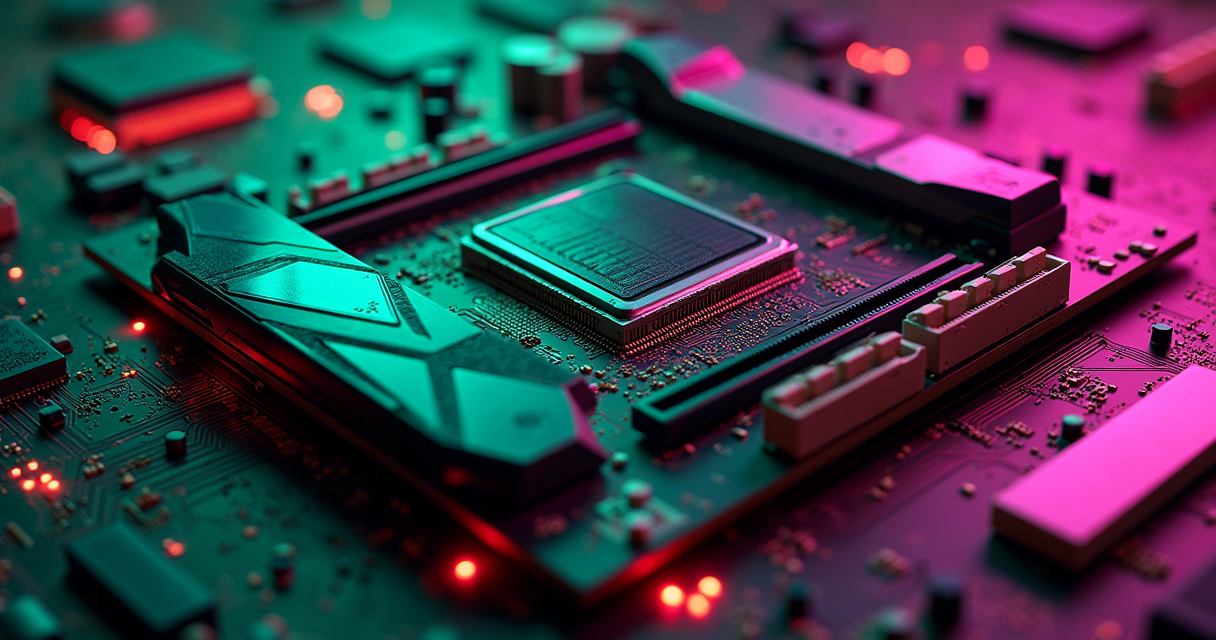
Two weeks ago, on July 22 and 23, 2026, AMD stood on stage at its Advancing AI event in San Francisco and launched EPYC "Venice" — the first Zen 6 server processor, and the first shipping x86 platform to carry PCI Express 6.0 to market. Its x16 links run at 64 GT/s, delivering 256 GB/s of aggregate bandwidth, exactly double PCIe 5.0. It is a genuine engineering milestone. It is also, for approximately everyone reading a retro-and-hardware site, completely unbuyable — and that gap between "exists" and "exists for you" is the entire story of PCIe 6.0 motherboards in 2026.
The specification was ratified in January 2022. Four and a half years later, the first board you can actually name is a liquid-cooled server platform on a socket that will never see the inside of an ATX case. This is not a delay. As we will see, it is the plan.
AMD Shipped It. You Can't Buy It.
What AMD actually launched
EPYC "Venice" is not a paper tease. The flagship EPYC 9996 scales to 256 Zen 6 cores — a 33% jump over the 192-core "Turin" it replaces — built on TSMC's 2 nm process, the first high-performance server part to reach production on that node. It lands on AMD's new SP7 socket with 16-channel memory good for up to 1.6 TB/s of bandwidth, up to 1,024 MB of L3 cache, 5 GHz-plus clocks, and, crucially for this article, native PCIe Gen 6. AMD's own slides claim up to a 3.4x lead over Intel's current Xeon and roughly 20% over NVIDIA's Vera CPU, with better than 70% higher performance and efficiency versus the Zen 5 generation. Those are vendor numbers, and vendor numbers are a genre of fiction, but the launch itself is real and dated.
The 64 GT/s demo that preceded it
The showcase warmed up months earlier. At a PCI-SIG Developer's Conference, AMD ran pre-production Zen 6 EPYC silicon on a motherboard passing full PCIe 6.0 compliance at the complete 64 GT/s signaling rate, which OC3D described as a 2x performance boost over PCIe 5.0. That is the important word: compliance. Getting a link to negotiate 64 GT/s across a board and stay inside the error budget is the hard part, and AMD demonstrated it works. Then it shipped the product that uses it — to hyperscalers and enterprise, not to you.
Why "you can't buy it" is the actual headline
SP7 is a server socket. Venice boards are 12-inch-plus multi-thousand-dollar slabs with liquid-cooled retimers and power delivery sized for 500-watt CPUs. There is no consumer equivalent, no AM5-successor with a 6.0 slot, no retail SKU. This is exactly the position we staked out in our look at how PCIe 6.0 motherboards in 2026 offer 64 GT/s and nothing to actually buy: the standard is finished, the server silicon is here, and the shelf is empty. Nothing about the Venice launch changes that. It confirms it.
The Numbers: 64 GT/s and PAM4
The bandwidth headline
The pitch is arithmetic. PCIe 6.0 runs each lane at 64 GT/s. An x16 link therefore moves 128 GB/s in each direction, or 256 GB/s aggregate — the number the PCI-SIG specification leads with. Per lane, that is roughly 8 GB/s each way. Double PCIe 5.0, quadruple PCIe 4.0, and the reason anyone building AI fabric cares. Here is the math with nothing hidden:
PCIe 6.0 bandwidth math (one x16 link)
------------------------------------------------
  Signaling      PAM4, 2 bits per symbol
  Raw rate       64 GT/s per lane
  Per lane       64 Gb/s -> 8 GB/s each direction
  x16 one-way    8 GB/s  x 16 = 128 GB/s
  x16 aggregate  128 GB/s x 2  = 256 GB/s   <-- the headline
------------------------------------------------
PCIe 5.0 (NRZ, 32 GT/s) for contrast
  x16 aggregate  64 GB/s  x 2  = 128 GB/s
Delta: exactly 2x. On paper.
PAM4: the change that pays for it
Every prior generation of PCIe doubled bandwidth by doubling the clock. PCIe 6.0 could not — the frequencies were becoming unroutable on real fiberglass. So the standard changed the alphabet instead. PCIe 5.0 and earlier used NRZ signaling: two voltage levels, one bit per symbol. PCIe 6.0 switches to PAM4: four voltage levels (00, 01, 10, 11), two bits per symbol. Same baud rate, double the data. The catch is physics. Four levels stacked in the same voltage window leave a third of the margin between states, which costs roughly a 9.6 dB hit to signal-to-noise ratio and doubles the jitter the receiver has to tolerate. The signal is twice as fast and far more fragile.
FLIT and FEC: the tax on the tax
PAM4's raw error rate is too high to ship. So PCIe 6.0 mandates two things NRZ never needed: FLIT-based transmission (fixed 256-byte flow-control units) and forward error correction, which detect and repair the errors PAM4 inevitably produces. FEC and FLIT let the link run dirty and clean it up on the fly. The upside is that the old 128b/130b line-code overhead disappears, so the payload efficiency is near-perfect. The downside is latency, silicon area, and power — a recurring theme. It is the same "double on paper, complicated in practice" pattern we flagged in DDR5 versus DDR6, where 2x the spec doesn't win the benchmark. Doubling the number is the easy part. Making it survive contact with a motherboard is the rest of the decade.
Spec Sheet: PCIe 4.0 to 7.0
How four generations stack
The lineage is clean and relentless. Every generation doubles per-lane throughput; the encoding held steady from 3.0 through 5.0 and then broke to PAM4 at 6.0. The x16 aggregate figures below are the bidirectional numbers the PCI-SIG quotes.
| Generation | Spec finalized | Per-lane rate | x16 aggregate | Signaling / coding |
|---|---|---|---|---|
| PCIe 4.0 | 2017 | 16 GT/s | 64 GB/s | NRZ, 128b/130b |
| PCIe 5.0 | 2019 | 32 GT/s | 128 GB/s | NRZ, 128b/130b |
| PCIe 6.0 | January 2022 | 64 GT/s | 256 GB/s | PAM4, FLIT + FEC |
| PCIe 7.0 | June 2025 | 128 GT/s | 512 GB/s | PAM4, FLIT + FEC |
The cadence nobody can keep
Look at the finalization dates. The PCI-SIG ships a new specification roughly every three years, and it does not miss. PCIe 7.0 was finalized in June 2025 at 128 GT/s and 512 GB/s on x16 — a full generation beyond the platform that just barely reached the market. The paperwork is a metronome. The silicon is a shrug. The distance between those two things is now measured in years, and it is widening, not closing.
What 256 GB/s actually feeds
Here is the uncomfortable part for anyone hoping this matters to their next build: nothing consumer needs it. A 256 GB/s x16 link exists to move data between GPUs and AI accelerators, to feed 800-gigabit Ethernet NICs, and to underpin CXL memory pooling. It is fabric for machines that think for a living. Your graphics card does not saturate the previous generation, a point we will return to below, and no consumer device on the market or on any public roadmap comes close to asking for a quarter-terabyte-per-second slot.
Why No Consumer Board Exists
The loss budget got tighter, not looser
Intuition says a faster standard should be more forgiving. It is the opposite. PCIe 6.0 tightens the total channel insertion-loss budget to roughly 32 dB, down from about 36 dB on PCIe 5.0. You are running twice as fast with less headroom for the board to eat. That kills cheap FR4 fiberglass, mandates low-loss laminates, adds copper layers, and turns trace routing into a black art. A consumer board is a cost-engineered commodity. A PCIe 6.0 channel is a signal-integrity problem that hates being cheap.
Retimers, and the standard only lets you use two
Because the signal degrades so fast, PCIe 6.0 designs lean on retimers — active silicon that captures the failing signal and regenerates a clean copy to extend reach across the board. The specification permits at most two retimers in a link. Each one is a chip that costs money, draws power, and eats board area, as semiconductor-engineering coverage of PCIe 6.0 layout lays out in unglamorous detail. On a server board with a four-figure BOM, two retimers are a rounding error. On a $200 consumer motherboard, they are the whole margin.
The cost math that ends the conversation
Then there is the controller itself. Taping out a PCIe Gen6 controller runs an estimated $30-40 million, against $16-20 million for a Gen5 part — roughly double the up-front silicon bill before a single board ships. Add the power penalty (PAM4 physical layers are hungrier than NRZ), the exotic PCB, the retimers, and the near-total absence of any consumer device that benefits, and the business case collapses. This is why the people who make CPUs are conspicuously quiet about it. As the head of one major controller vendor put it bluntly, the platform holders "do not even want to talk about it" — a quote we will get to in full below.
Historical Context: A Broken Lag
From 2.5 GT/s to 64 GT/s
PCI Express has been doubling itself for two decades. PCIe 1.0 arrived in 2003 at 2.5 GT/s; 2.0 in 2007 at 5 GT/s; 3.0 in 2010 at 8 GT/s, where it introduced the efficient 128b/130b encoding that carried the standard for a decade; 4.0 in 2017; 5.0 in 2019; 6.0 in January 2022; and 7.0 in June 2025. The full genealogy on Wikipedia reads like a Moore's Law footnote — a clean exponential that never stumbled on the specification side.
The spec-to-shelf rhythm
What historically stayed constant was the lag between a finished spec and a board you could buy. PCIe 4.0 was ratified in 2017 and reached consumers in mid-2019 with AMD's X570 and Ryzen 3000 — about two years. PCIe 5.0 was ratified in 2019 and arrived on Intel's Alder Lake and Z690 in late 2021, then AMD's AM5 in 2022 — roughly two to three years. Set your watch by it: spec, then consumer silicon, two-to-three years later, every time.
| Generation | Spec year | First consumer board | Lag |
|---|---|---|---|
| PCIe 4.0 | 2017 | AMD X570 / Ryzen 3000 (2019) | ~2 years |
| PCIe 5.0 | 2019 | Intel Z690 (2021) / AMD AM5 (2022) | ~2-3 years |
| PCIe 6.0 | 2022 | None as of Aug 2026 | 4.5 years and counting |
6.0 broke the pattern
Run the arithmetic forward and PCIe 6.0, finalized in early 2022, "should" have reached consumer boards by 2024 or 2025. It is August 2026 and the answer is a server socket you cannot buy. The two-year rhythm that governed 4.0 and 5.0 simply broke. The cause is not incompetence or bad luck; it is PAM4 and its entire tax bill — the SNR penalty, the retimers, the laminate, the tape-out cost. For the first time in PCI Express history, the physical layer got expensive faster than the market got hungry. PCWorld senior editor Mark Hachman called the standard "still vapor" in consumer terms, noting it was approved in January 2022 and that "PCIe's new advances only matter when [you] see them in the real world, and that process can take years."
AMD vs Intel: Who Ships First
AMD Venice: first across the line
In the two-horse x86 race, AMD reached 64 GT/s first. EPYC "Venice" ships PCIe 6.0 today, on the SP7 platform, to the enterprise buyers who can use it. The Zen 6 architecture pairs it with 16-channel memory and the core counts above. Whatever you think of AMD's benchmark theater, the interconnect claim is verifiable: it demonstrated compliance, then shipped the platform. That is first blood on PCIe 6.0 in a shipping x86 CPU.
Intel: Clearwater Forest stays on 5.0; Diamond Rapids waits
Intel's 2026 server answer, the Xeon 6+ "Clearwater Forest" built on the 18A process, is a formidable all-E-core part — up to 288 cores on the LGA 7529 socket, 12 DDR5 channels at 8000 MT/s. It also, notably, stays on 96 lanes of PCIe 5.0. Intel's PCIe 6.0 does not arrive until the Xeon 7 "Diamond Rapids" platform, which ServeTheHome now places in 2027 on the 18A-P node, with 16 memory channels, PCIe Gen 6, and 818 GB/s or more of memory bandwidth. In server terms, AMD is roughly a year ahead on the interconnect.
The scorecard
The competitive picture, laid out plainly:
| Platform | Vendor | Segment | PCIe 6.0? | Availability |
|---|---|---|---|---|
| EPYC "Venice" (Zen 6) | AMD | Server | Yes (64 GT/s) | Launched Jul 22-23, 2026 |
| Xeon 6+ "Clearwater Forest" | Intel | Server | No (PCIe 5.0, 96 lanes) | Shipping 2026 |
| Xeon 7 "Diamond Rapids" | Intel | Server | Yes | 2027 |
| Desktop Zen 6 (Ryzen) | AMD | Consumer | Unconfirmed / likely 5.0 | CES 2027 reveal |
| Any consumer 6.0 board | — | Consumer | — | 2027+ (SSDs ~2030) |
Read the bottom two rows twice. Neither AMD nor Intel has a consumer PCIe 6.0 motherboard on any public roadmap. The desktop Zen 6 chips due at CES 2027 are expected to stay on PCIe 5.0. The story is server, server, server — and then a very long pause.
What Builders Should Watch
The GPU slot does not need it
The instinct is that a faster slot helps your graphics card. It does not, and it will not for years. Even a flagship GPU barely distinguishes PCIe 5.0 from the ancient PCIe 4.0 in games — low single-digit percentages, inside the margin of error. Our own RTX 5090 review, where a $4,300 card runs 30% faster and still melts its connector, ran on PCIe 5.0 and left bandwidth on the table. A x16 PCIe 6.0 slot for a single gaming GPU is 256 GB/s of solution to a problem no game has. If you are wondering whether a 6.0 board would make your card faster, the answer is no, and it would not be close.
Storage is the slowest to arrive
Surely the SSD, then? Also no — and this is the longest wait of all. Silicon Motion's CEO has been explicit that consumer PCIe 6.0 SSDs are not coming until around 2030, and even Tom's Hardware frames PCIe 5.0 drives as here to stay. Today's Gen5 M.2 drives already run hot enough to need heatsinks and hit diminishing real-world returns; a Gen6 consumer drive would be a thermal and cost nightmare in search of a workload.
Networking and M.2 fan-out is the real driver
Where PCIe 6.0 earns its keep on a board is not the primary GPU slot but the plumbing: M.2 storage arrays, high-speed NICs, and lane fan-out for accelerators. Motherboard vendors are beginning to expose 6.0 lanes with exactly those uses in mind. But every one of those is an enterprise or workstation need first, a consumer curiosity a distant second. If you are speccing a mainstream build in 2026, PCIe 6.0 belongs in the "interesting, irrelevant" column.
What the Engineers Say
The people who make the controllers
Silicon Motion CEO Wallace Kou has been the most quotable skeptic, telling PCGamesN in June 2025 exactly where consumer 6.0 stands: "For consumer? You will not see any PCIe Gen6 [solutions] until 2030." He went further on why the platform vendors are silent: "PC OEMs have very little interest in PCIe 6.0 right now. They do not even want to talk about it. AMD and Intel do not want to talk about it." That is the tape-out math from the section above, said out loud.
The people who make the CPUs
AMD frames it, unsurprisingly, as an enterprise story. CTO Mark Papermaster, previewing the Venice launch to Club386 in July 2026, put the demand squarely in the data center: "Every enterprise conversation I'm having now, this comes up. Because enterprises have decades of running x86. They're not going to move that install base." Note what is absent from that sentence: consumers. And Micron's Alvaro Toledo, VP and GM of Core Data Center, named the actual force pulling PCIe 6.0 forward — not gaming, but AI: "In an AI driven world where data must move continuously, predictably, and at massive scale, storage performance has become a first order design constraint."
The people who write the spec
Even the standards body treats the next doubling with caution. PCI-SIG president Al Yanes, on finalizing PCIe 7.0, told The Register: "We are hoping to double again, but I don't want to make any definitive claims at the moment." Between Hachman's "still vapor," Kou's "not until 2030," and Yanes' careful hedge, the consensus among the people actually building this is unanimous: the specification is finished, the consumer product is not, and pretending otherwise is marketing.
6 Predictions for the Next Year
Server and enterprise (next 6-12 months)
1. Venice OEM boards ramp through early 2027. Expect Dell, HPE, and Supermicro to field PCIe 6.0 server platforms around EPYC "Venice" in volume by the first half of 2027, all liquid-adjacent, all four-figure-plus, none consumer.
2. Intel's PCIe 6.0 does not arrive early. Diamond Rapids stays a 2027 story. If anything slips, it slips later, not sooner — 18A-P yield and validation are the gating factors, and Intel has no incentive to rush an interconnect its 2026 Clearwater Forest already omitted.
3. NICs and switches, not CPUs, drive the real volume. The PCIe 6.0 units that matter over the next year are networking and CXL parts — 800GbE adapters, switch silicon, memory-pooling fabric — feeding the AI buildout Toledo described. That is where the bandwidth is actually spent.
Consumer (next 6-12 months)
4. No consumer PCIe 6.0 board gets announced before mid-2027. Desktop Zen 6, due to break cover at CES 2027, will almost certainly stay on PCIe 5.0. A retail 6.0 motherboard in the next twelve months would surprise every source above.
5. Consumer PCIe 6.0 SSDs stay a 2030 problem. Nothing in the next year moves Kou's timeline. Gen5 drives remain the enthusiast ceiling, and "Gen5 is plenty" hardens from opinion into received wisdom.
6. "PCIe 6.0-ready" marketing appears before the silicon does. Watch premium consumer boards start advertising 6.0 "readiness" — a trace-layout claim, not a working slot — well ahead of any CPU that can drive it. When you see it, look for the asterisk. There will be an asterisk.
The Bottom Line
If you're building in 2026
Buy PCIe 5.0 and stop thinking about it. There is no consumer PCIe 6.0 board to wait for, your GPU does not need the bandwidth, and your SSD will not offer it until the end of the decade. Spend the money you would have burned "future-proofing" on a better GPU, more RAM, or an afternoon squeezing 15% more out of the card you already own in twelve steps. That is a real gain today; a 6.0 slot is a real gain for a machine you are not building.
If you're an enterprise buyer
Venice is the genuine article. If you are bandwidth-bound — large-model training, high-throughput networking, memory pooling — PCIe 6.0 and 16-channel memory are exactly the interconnect you have been waiting for, and AMD got there first. If you are not, PCIe 5.0 and Clearwater Forest remain plenty, and you will pay a real premium for headroom you cannot fill.
The verdict
PCIe 6.0 is real, shipping, and not for you. The specification turned four and a half years old this year, and the first motherboard anyone can name costs more than a used car and bolts to a socket no consumer will ever own. The bandwidth is spectacular. The signaling is brilliant. The PAM4 engineering is a genuine achievement. And the consumer motherboard remains, in the only sense that matters to a builder, vapor. AMD hitting 64 GT/s first is the news. That you still can't buy it is the story — and it will be the story through 2027.
Questions the search bar asks me
- Can you buy a PCIe 6.0 motherboard in 2026?
- No consumer PCIe 6.0 board exists. The only shipping PCIe 6.0 platform is server silicon like AMD's EPYC "Venice" (Zen 6), launched July 22-23, 2026 on the SP7 socket. Industry sources put consumer boards at 2027 or later and consumer SSDs around 2030.
- What is the bandwidth of PCIe 6.0?
- PCIe 6.0 runs 64 GT/s per lane and delivers up to 256 GB/s aggregate on an x16 link (128 GB/s each direction) — exactly double PCIe 5.0. Per lane that works out to roughly 8 GB/s in each direction.
- Why is PCIe 6.0 taking so long to reach consumers?
- The switch to PAM4 signaling costs about 9.6 dB of SNR and tightens the channel loss budget to ~32 dB (versus 36 dB on 5.0), forcing exotic PCBs and mandatory retimers. Gen6 controller tape-outs run an estimated $30-40M versus $16-20M for Gen5 — margins a mainstream board can't absorb.
- Does a gaming GPU need PCIe 6.0?
- No. Even a flagship like the RTX 5090 barely separates PCIe 5.0 from PCIe 4.0 in games, within low single-digit percentages. PCIe 6.0's 256 GB/s targets GPU-to-GPU fabric, 800GbE networking, and CXL memory pooling — data-center workloads, not gaming.
- When will Intel ship PCIe 6.0?
- Intel's PCIe 6.0 arrives with the Xeon 7 "Diamond Rapids" platform in 2027. Its 2026 server chip, Xeon 6+ "Clearwater Forest," stays on PCIe 5.0 with 96 lanes, which puts AMD roughly a year ahead on the interconnect in servers.

Marcus covers the gaming PC, GPU, and peripheral side of staresback. Every post under this byline is reviewed pre-publish by Sam P., Editor & Operator — corrections to info@instalinkoteam.com. Published 2026-08-29 · Last updated 2026-08-29. Full bios on the author page.