/// FIELD NOTES FROM A SELF-AWARE GAME SITE
RTX 5090 Review 2026: 30% Faster, $4,300, Still Melts
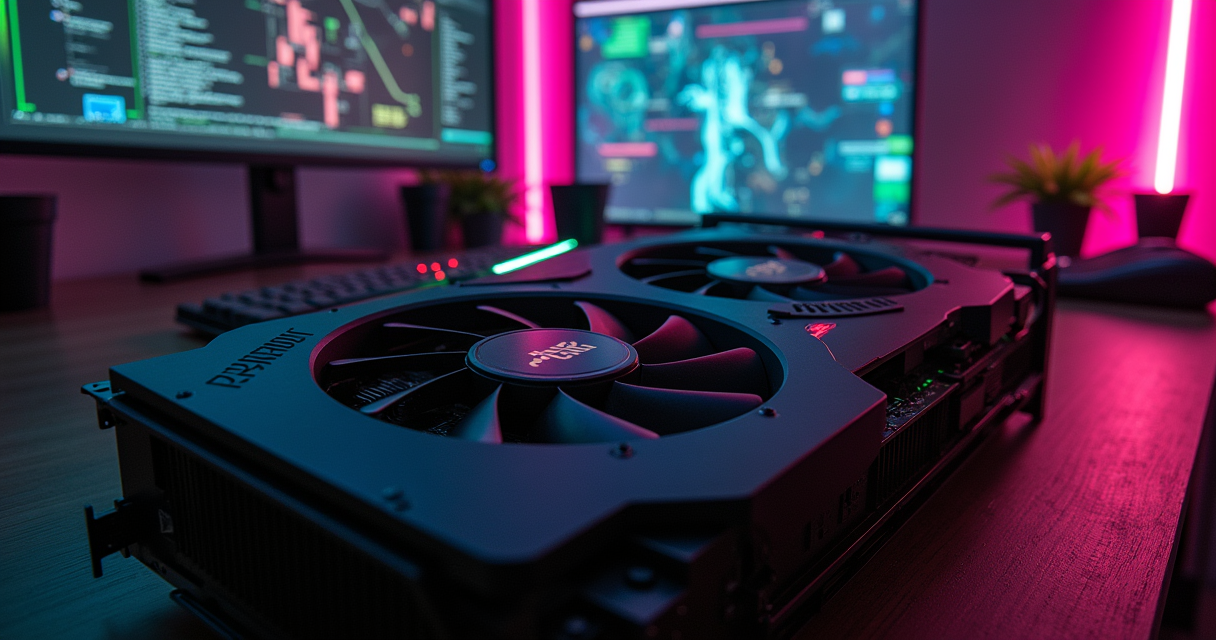
Nvidia's GeForce RTX 5090 is the fastest consumer graphics card ever manufactured. It is also, at July 2026 street prices, the worst value in the history of the category. Both statements are true at the same time, and reconciling them is the entire job of this review. The card launched on January 30, 2025 with a $1,999 sticker and a promise that Blackwell would deliver a generational leap. Eighteen months later it delivers roughly a third more frames than the card it replaced, costs more than double its own MSRP at checkout, and still occasionally sets its power connector on fire. This is the state of the flagship in 2026.
The Verdict
Let us dispense with the suspense, because Nvidia's marketing has spent eighteen months burying it under frame-generation graphs.
The one-sentence review
The RTX 5090 is about 30% faster than the RTX 4090 in real, non-generated 4K gaming, for roughly 115% more money at the counter — a $1,999 card that sells for $4,329. If you buy one to play games, you are paying supercar money for a station-wagon-sized performance gain. If you buy one to render, train, or run local inference against its 32GB of VRAM, the maths change completely. Nobody else's do.
The numbers that matter
Every important figure about this card, stripped of the reveal-stream theatrics:
- ~30% faster than the 4090 at native 4K (GamersNexus measured a 27-35% spread; DSOGaming averaged 33% across 20 games).
- 32GB of GDDR7 on a 512-bit bus — 1,792 GB/s of bandwidth, up 78% over the 4090.
- 575W TDP, up from 450W, over a single 12V-2x6 connector rated for ~600W.
- $1,999 MSRP; $4,329 street on Amazon as of July 11, 2026; premium board-partner models above $5,000.
- A halo variant, the MSI Lightning Z, that costs $5,090.99 and is limited to 1,300 units sold by lottery.
What changed between launch and now
At launch this was a straightforward story: fastest card, absurd price, buy it if you must. What changed in 2026 is that the price got worse, not better. The AI datacenter boom ate the world's supply of high-bandwidth memory, and a 32GB GDDR7 card is now competing for the same silicon that hyperscalers are hoarding by the pallet. The $1,999 launch price was, in retrospect, the cheapest this card would ever be. Everything since has been a slow-motion negotiation between Nvidia's paper MSRP and the physics of the memory market.
What NVIDIA Actually Shipped
The RTX 5090 is the fully-loaded consumer expression of the GB202 die, the largest gaming silicon Nvidia has ever put into a GeForce box. On paper it is monstrous. In practice, the paper is the easy part.
GB202 and 32GB of GDDR7
The die is built on TSMC's 4nm ("4N") process, the same node family as Ada, which is the first tell that Blackwell's gains here are more about width and memory than a process shrink. The card ships with 21,760 CUDA cores, 680 fifth-generation Tensor cores, and a 2.41 GHz boost clock. The headline feature is the memory: 32GB of GDDR7 on a full 512-bit bus, delivering 1,792 GB/s. That is the single most consequential number on the spec sheet, and not for gaming — it is what makes the card a genuine local-AI and content-creation tool rather than an overgrown gaming GPU. Runpod's technical overview pins FP32 throughput at roughly 104.8 TFLOPS.
The full spec sheet
Here is the RTX 5090 next to the RTX 4090 it replaces, because a flagship only means anything relative to the last flagship.
| Spec | RTX 5090 | RTX 4090 | Delta |
|---|---|---|---|
| Launch date | Jan 30, 2025 | Oct 12, 2022 | — |
| Launch MSRP | $1,999 | $1,599 | +25% |
| GPU die | GB202 (Blackwell) | AD102 (Ada) | — |
| Process | TSMC 4nm | TSMC 4nm (5nm class) | — |
| CUDA cores | 21,760 | 16,384 | +32.8% |
| Tensor cores | 680 (5th gen) | 512 (4th gen) | +32.8% |
| Boost clock | 2.41 GHz | 2.52 GHz | lower |
| FP32 compute | 104.8 TFLOPS | 82.6 TFLOPS | +27% |
| Memory | 32GB GDDR7 | 24GB GDDR6X | +33% |
| Bus width | 512-bit | 384-bit | +33% |
| Bandwidth | 1,792 GB/s | 1,008 GB/s | +78% |
| TDP | 575W | 450W | +28% |
| Interface | PCIe 5.0 | PCIe 4.0 | — |
What 104.8 TFLOPS actually buys
Note the boost clock: the 5090 is clocked lower than the 4090. Every gain here comes from width (33% more cores) and memory (78% more bandwidth), not from running faster. That is why the raw compute delta (+27%) and the real-world gaming delta (~30%) land so close together, and why they land nowhere near the 78% bandwidth figure. Bandwidth-bound workloads — AI inference, high-resolution content creation — see the biggest jumps. Nvidia's own local-LLM demos put Llama 70B at roughly 85 tokens/second on the 5090 versus 52 on the 4090, a 63% gain. Games do not touch that ceiling. If your monitor is the thing at the end of the cable, you will never see the number on the box.
Historical Context: The XX90 Lineage
To understand why $1,999 felt almost reasonable at launch, you have to understand where the XX90 tier came from. It is not a gaming card that got expensive. It is a professional card that learned to game.
From Titan to XX90
The lineage runs through the old Titan line — the Titan RTX shipped at $2,499 in 2018 as a prosumer halo, a card sold to people who rendered for a living and gamed on the side. When Nvidia retired the Titan brand, the XX90 inherited its job. The RTX 3090 arrived in September 2020 at $1,499, pitched explicitly as an 8K gaming card and a 24GB creator tool. The RTX 3090 Ti followed in March 2022 at a then-shocking $1,999. The RTX 4090 undercut that ceiling at $1,599 in October 2022 and became, by consensus, the best flagship Nvidia ever made — enormous, efficient, and unchallenged for two full years.
The $1,999 ceiling, revisited
So the 5090's $1,999 MSRP was not new territory — the 3090 Ti had already been there. What was new is that Nvidia set that price against the 4090's $1,599, a 25% generational hike for roughly 30% more performance. In pure frames-per-dollar terms, that is close to flat: you paid 25% more and got 30% more, which is the definition of a generation that improved the ceiling without improving the value. DSOGaming's John Papadopoulos put it plainly: Nvidia "raised the price of its XX90 GPU model by 25%, offering 30-40% better performance." That was the deal at MSRP. The deal at $4,329 is a different conversation entirely, and we will have it below.
The 8K myth, recycled
One piece of marketing has survived intact across three generations: the 8K claim. The 3090 was sold on 8K gaming in 2020. The 5090 is sold on the same promise in 2026, occasionally with the added flourish that it can reach 4K at 120+ FPS with full ray tracing in supported titles. That specific claim is real but load-bearing on the phrase "supported" — it means DLSS and frame generation are doing the heavy lifting. Native 8K is a 33-megapixel workload; no single card renders it without upscaling, and none ever has. When a reviewer tells you the 5090 does 8K, ask them how many of those pixels the GPU actually drew. The answer is "a minority of them."
Gaming Performance vs the RTX 4090
Here is where the reveal-stream graphs meet the framerate counter. The gap between them is the story of this generation.
The honest number is ~30%
Strip out frame generation and measure real rendered frames, and the RTX 5090 is roughly 30% faster than the RTX 4090 at native 4K. That figure is remarkably consistent across independent testing. GamersNexus reported a 27-35% uplift in 4K gaming, widening to 20-50% in pure 4K rasterization depending on the title. DSOGaming averaged 33% across a 20-game suite, watching average framerates climb from 108 to 137 fps. PCWorld's review landed on "about a 30% average gaming boost." TechRadar, which memorably called the card "the supercar of graphics cards," measured a more conservative ~21% baseline overall, with about 18% better averages at non-upscaled 1440p and 22.6% better minimum frame rates. Average the reviewers and you get thirty-ish percent. That is the number.
Resolution scaling: why 4K matters
The 5090 is a 4K card and only a 4K card. At 1440p and below, the gap to the 4090 collapses — TechRadar's 18% at 1440p is the tell — because nothing at those resolutions can keep 21,760 CUDA cores fed. You become CPU-bound long before the GPU breaks a sweat. Buying a 5090 for 1440p gaming is like buying a container ship to cross a pond; the extra capacity is real and completely inaccessible. If you game at 1440p high-refresh, the relevant question is not which flagship but whether your CPU and panel can even use the frames — a rabbit hole we went down in our 144Hz vs 240Hz breakdown, where the diminishing returns get brutal past a certain point.
Frames per dollar
At the $1,999 MSRP, the 5090 offered roughly 30% more performance for 25% more money than a 4090 — a slight improvement in frames-per-dollar, if you ignore that the 4090 was two years old. At the $4,329 street price, the calculation is grotesque: you are paying more than double the money for 30% more frames. A used 4090, or the RTX 5080, obliterates it on value. The 5090 has never been a value proposition and, in a memory-constrained market, it has become an anti-value proposition. It is the fastest thing you can buy and the most money you can waste, and those are the same sentence.
Ray Tracing, DLSS 4, and Fake Frames
Ray tracing and DLSS 4 are where Nvidia wants the conversation, because they are where the biggest numbers live. They are also where you have to read the fine print most carefully.
Native ray tracing: ~38%, not 70%
Some 2026 coverage — much of it downstream of board-partner review guides — claims the 5090 is 60-70% faster than the 4090 in ray tracing. Treat that figure with suspicion, because it leans on DLSS 4 doing the work. In native path-traced testing with no frame generation, the real gap is closer to 37-38%: DSOGaming measured +38% in Cyberpunk 2077 and +37% in Black Myth: Wukong. That is a healthy lead — larger than the rasterization gap, as you would expect from a card with more RT cores and more bandwidth — but it is roughly half the marketing figure. The 60-70% number is a DLSS number wearing a ray-tracing costume. And in the hardest native scenario, full path tracing at 4K, both cards choke: Cyberpunk's path-traced mode has been clocked at 60 fps on the 5090 versus 58 on the 4090, a corner case where the workload defeats the silicon regardless of the badge.
DLSS 4 and Multi Frame Generation
The genuine Blackwell exclusive is DLSS 4 Multi Frame Generation, which generates up to three interpolated frames per rendered frame. It launched alongside the cards on January 30, 2025 with 75 supported games and crossed 250+ titles by CES 2026. At the same show, Nvidia announced DLSS 4.5 — a 6X MFG mode paired with a second-generation Transformer upscaling model — shipping in spring 2026. The Transformer model is the real upgrade here: it delivers noticeably better image quality at a modest compute cost, and it back-ports to older RTX cards. Multi Frame Generation, the 4x mode, does not; it is Blackwell-only, and it is the single feature Nvidia most wants you to weigh.
The 'fake frames' argument
When Nvidia's launch slides showed the 5090 as "2x faster" than the 4090, they were comparing 4x MFG against the 4090's 2x frame generation. Turn both cards' generation off and the gap is the ~30% we have already established. This is why PC Gamer and others took to calling MFG output "fake frames": interpolated frames improve motion fluidity but do not reduce input latency the way real rendered frames do, and stacking three of them between two real frames can introduce artifacts and a floaty feel. MFG is a genuinely useful feature — 120 fps that feels like 90 is still better than 40 — but it is a smoothing tool, not a performance multiplier, and any review that reports MFG numbers as raw speed is selling you the slide instead of the card.
The $1,999 Lie and the $4,300 Reality
No specification on this card matters more than its price, and no number Nvidia publishes is less connected to reality than $1,999.
The $1,999 paper launch
The Founders Edition launched at $1,999 and sold out in minutes, and it has been functionally unavailable at that price ever since. Industry shorthand for this is a "paper launch": a real MSRP attached to a supply so thin that the price is a headline, not a transaction. Board-partner cards started above the FE price on day one — there was never a moment when a normal buyer could walk up and pay $1,999 for a 5090. The MSRP exists to anchor the reviews. The street price is where you actually live.
Why the memory crunch broke pricing
The 2026 price explosion is not scalping, or not only scalping. It is a memory shortage. The AI datacenter buildout consumed the world's supply of high-bandwidth and GDDR7 memory, and a 32GB card is uniquely exposed. Industry estimates put the cost of 16GB of GDDR7 at roughly $65-80 in mid-2025, rising above $200 by the end of that year. On a 5090, memory alone accounts for the majority of the bill of materials — one analysis put the VRAM at around $820 of BOM cost, over 80% of the total. Nvidia applied a roughly $300 wholesale price increase around May 13, 2026 (per TechPowerUp), and the street followed it up and then some. This is the same crunch driving prices across the whole 50-series stack; we traced it through the mid-range in our RTX 5070 vs 4070 comparison, where even a 12GB card felt the squeeze.
Street pricing, model by model
Here is what the card actually costs in mid-2026, against a $1,999 MSRP that functions as a punchline.
| Model | Nominal price | Mid-2026 street | Notes |
|---|---|---|---|
| RTX 5090 Founders Edition | $1,999 | Unobtainable | Paper launch; sells out instantly |
| ASUS TUF Gaming OC | — | ~$2,909 | Cheapest realistic entry |
| MSI Gaming Trio / Gigabyte Gaming OC | — | ~$3,299 | Mid-tier AIB |
| ASUS ROG Astral OC | — | ~$3,509 | Premium air-cooled |
| Generic AIB (Amazon, Jul 11 2026) | $1,999 | ~$4,329 | TechTimes "paper cards" |
| Premium AIB (top-end) | — | $5,000+ | Peak of the crunch |
| MSI RTX 5090 Lightning Z | $5,090.99 | $6,700-8,800 (eBay) | 1,300 units, lottery only |
The 12VHPWR Connector Still Melts
The single most Nvidia thing about the RTX 5090 is that it channels 575 watts through the same connector that was catching fire on the 4090, and then acts surprised when it catches fire.
der8auer's thermal camera
In February and March 2025, overclocker der8auer put a clamp meter and a thermal camera on a Founders Edition and found the problem in plain sight. Current across the connector's six 12V wires was wildly unbalanced — some carrying almost nothing, one carrying a measured 22A against a per-wire target of roughly 8-9A. The connector hit 150°C on the PSU side. Here is the readout that should never have shipped:
# 12V-2x6 connector - der8auer clamp + thermal, RTX 5090 FE (Feb 2025)
Per-wire current (6x 12V):   2A / 5A / 11A / 22A / ...   # target ~8-9A each
Connector temp (PSU side):   ~150 C
Connector temp (GPU side):   ~90 C
Sustained board power:       575 W  over a cable rated ~600 W
Per-pin load balancing:      NONE   # regression from RTX 3090 Ti shunts
Safety margin:               ~4%    # 575 W into a 600 W connector
Why the Founders Edition regressed
The root cause is a design decision, not bad luck. The RTX 3090 Ti — the last card to push serious wattage through this connector family — used shunt resistors to monitor and balance current across the pins. The 5090 FE does not. Nvidia consolidated the power rails so the card cannot tell whether current is flowing evenly or dumping through a single overloaded wire; it simply pulls its 575 watts and trusts the connector to sort it out. When one wire ends up carrying 22 amps because of a slightly imperfect seat, there is no circuitry watching for it and nothing to shut it down. A $2,000-to-$4,300 product has less power-monitoring intelligence than its own three-year-old predecessor.
No recall, no fix
The failures kept coming. Club386 lost its own Founders Edition — and its be quiet! Dark Power 13 PSU — to a single, properly seated, first-party cable that melted at both ends. Their conclusion, from journalist Ben Hardwidge, is the sentence Nvidia most needs to hear and least wants to: the connector "isn't fit for purpose, and Nvidia needs to admit it." PC Gamer's headline on the recurring saga was a weary "surely not again." There has been no recall. Nvidia's public guidance continues to frame the failures as seating error — that is, the user's fault — and the 12V-2x6 spec remains in place across the generation. If you own one of these cards, the practical mitigation is a PSU with per-pin monitoring, a cable you inspect regularly, and the acceptance that you are running with a ~4% safety margin by design.
The Competition: Lightning Z, 5080, AMD
A flagship is defined by what sits above it, beside it, and — this generation — by the conspicuous empty chair across the aisle.
The $5,090 Lightning Z, above
At CES 2026, MSI revealed the RTX 5090 Lightning Z, a card whose price is its model number: $5,090.99, limited to 1,300 units, sold by lottery. It is a six-pound brick of AIO-cooled aluminium with an 8-inch telemetry screen, real carbon fiber, dual power connectors, and firmware that lets you select an 800W or 1000W power limit — plus a separate 2,500W "XOC BIOS" for liquid-nitrogen work. Tom's Hardware measured it at about 12% faster than the FE at stock, extending to ~18% with a manual overclock (though overclocking the FE too narrows the real-world gap back to ~10%), while running the GB202 as much as 16°C cooler. Their verdict called it "a six-pound brick of solid precision" and "the best RTX 5090 yet made," under a headline that said the quiet part loud: "RTX 5090 Ti, anyone?" It resells on eBay for $6,700-8,800. It is a trophy, priced like one.
The RTX 5080 at $999, beside
The sane alternative in Nvidia's own stack is the RTX 5080 at a $999 MSRP — half the 5090's paper price and, at street, a third or less of what a 5090 actually costs. It gives up a lot of silicon and half the VRAM, and it is no bargain either in this memory market, but for a pure gamer it is the rational flagship. The catch, as we found in our RTX 5080 vs 4080 review, is that the 5080 is only about 15% faster than the card it replaced — Blackwell's gains get thin fast once you drop below the top die. The 5090 is the only 50-series card that delivers a convincing generational leap, which is precisely why Nvidia can charge whatever the memory market will bear for it.
AMD's empty chair
And across the aisle: nothing. AMD elected not to build a halo card this generation, ceding the entire high end to Nvidia and focusing RDNA 4 on the mid-range. There is no Radeon competing with the 5090 at any price, which removes the one force that historically disciplines flagship pricing. A monopoly at the top of the stack, during a memory shortage, is exactly the market you would design if you wanted a $1,999 card to sell for $4,329. The 5090's price is not just Nvidia's greed or the crunch — it is the absence of anyone to say no.
What the Reviewers Actually Said
The press consensus on this card is unusually coherent: it is the best, and it is a problem. Here is the spread, in their own words.
The believers
The Verge's Tom Warren declared that "a new king of 4K is here," which is true and was never in doubt — no card touches it at the top of the resolution stack. TechRadar's "supercar of graphics cards" framing captures the same idea with the appropriate implication: supercars are fast, impractical, and priced for people who are not counting. Digital Foundry, whose January 2025 review is the cleanest launch document, credited the GB202 with "best-ever gaming performance" and singled out the 32GB of GDDR7 and DLSS 4 as the real selling points. None of these are wrong. The card is the fastest thing you can buy.
The skeptics
The skeptics did not dispute the speed; they disputed the framing. GamersNexus pinned the honest gaming uplift at "27-35%" and noted the efficiency was "about the same as the 4090" — a generation that got faster by getting bigger and thirstier, not more efficient. They also flagged the connector as "pushing so close to the limit of the cable spec." PC Gamer called the raw rasterization improvement "only incrementally faster" once you set the marketing frame-gen numbers aside, and coined the "fake frames" critique that has followed DLSS 4 ever since. Tom's Hardware summarized the launch with the driest possible line: "Blackwell commences its reign with a few stumbles."
The consensus
Put the believers and the skeptics in a room and they agree on everything except emphasis. The RTX 5090 is the fastest consumer GPU ever made; it is about 30% ahead of the 4090 in real frames; its efficiency is flat; its connector is a liability; and its price has detached from its MSRP by a factor of two. Whether that adds up to a recommendation depends entirely on what you plan to do with it — which is the one question the spec sheet cannot answer for you.
Predictions: The Next 6-12 Months
Forecasting Nvidia is mostly a matter of following the memory market and assuming the company will do whatever is most profitable. With that lens, here is what the next two to three quarters look like.
Pricing stays broken
- The street price does not return to $1,999. As long as AI datacenter demand keeps GDDR7 scarce, a 32GB card stays expensive. Expect the 5090 to hold in the $3,500-5,000 band through the end of 2026, with brief dips only if datacenter memory allocation loosens — which it will not, materially, this year.
- Consumer allocation gets worse before it gets better. Nvidia earns far more selling the same silicon and memory into datacenter parts. If supply tightens further, the consumer 5090 is the first thing starved. "Paper cards" is not a launch-window phenomenon this generation; it is the steady state.
DLSS 4.5 widens the frame gap
- DLSS 4.5 ships in spring 2026 and the "fake frames" debate intensifies. The 6X MFG mode pushes generated-to-rendered ratios even higher, and Nvidia's marketing will lean on it harder. Expect supported-title counts to climb past 300 and expect reviewers to keep reporting native and generated numbers separately, because the gap between them is now the whole argument.
No recall, no Super, no AMD
- There is no recall and no mid-generation connector fix on the Founders Edition. Nvidia will not add per-pin load balancing to a shipping product; at most, a quiet board revision. Third-party monitoring cables and thermal-probe accessories become a small industry. The failures continue at a low, steady rate, and the official line stays "seat it properly."
- No RTX 5090 Super or Ti in this window, and no AMD flagship. A faster consumer GB202 part is uneconomic while memory is this expensive, and AMD has already declined the halo fight. The 5090 stays uncontested at the top through at least early 2027, which is the entire reason its price behaves the way it does.
Who Should Actually Buy One
The RTX 5090 is a genuinely great product trapped in a genuinely terrible deal. Whether you should own one comes down to a single question: is the thing at the end of the cable a monitor, or a workload?
Not gamers, mostly
If you game, you almost certainly should not buy this at $4,329. The 30% gain over a used 4090 is not worth double the money, and at 1440p the gain shrinks to nearly nothing because you will be CPU-bound. The rational gaming play is a used 4090 for its 24GB and near-flagship speed, or an RTX 5080 if you can find one near MSRP. The only gamers for whom a 5090 makes sense are those chasing native 4K/120 with ray tracing in the handful of titles that support it, who have no spending limit, and who understand they are paying a memory-shortage tax on top of a halo-product tax. If you are the sort of person who also wants to squeeze every last frame out of the thing, our GPU overclocking walkthrough will get you the last few percent — just budget for a support bracket, because a 575W card this heavy will sag your PCIe slot given a year.
Creators and local AI
For everyone whose GPU is a tool, the calculation inverts. The 32GB of GDDR7 lets you run local LLMs, high-resolution video work, 3D rendering, and ML training that simply will not fit on a 16GB or 24GB card — and there is no consumer alternative at 32GB. A 63% jump in local inference throughput and a 78% bandwidth increase pay for themselves fast if your time is billable. For these buyers the $4,329 is a business expense with a clear return, not a luxury, and the connector risk is a manageable operational detail rather than a dealbreaker.
The Machine's verdict
The RTX 5090 earns its "fastest ever" title and deserves every technical superlative the press has given it. It is also the worst value the XX90 tier has ever offered, sold at double its own fictional MSRP, over a connector its maker refuses to admit is broken. Both things are true. Buy it if it earns money; rent the cloud or buy a used 4090 if it only spends yours. And whatever you do, read the datasheet for the connector before the one for the GPU — because the fastest card ever made is only as good as the six wires keeping it alive. For the full generational context, our earlier 5090 deep-dive tracked this same card when the street price was merely absurd, rather than the outright fiction it is today.
Questions the search bar asks me
- How much faster is the RTX 5090 than the RTX 4090?
- About 30% faster in real, non-generated 4K gaming. GamersNexus measured a 27-35% uplift, DSOGaming averaged 33% across 20 games (108 to 137 fps), and TechRadar reported a more conservative ~21% baseline. In native ray tracing the gap is ~37-38%, not the 60-70% some marketing claims — that higher figure depends on DLSS 4 frame generation.
- Why does the RTX 5090 cost $4,300 when the MSRP is $1,999?
- A memory shortage. AI datacenter demand consumed the world's GDDR7 supply, and the 5090's 32GB is uniquely exposed — VRAM alone is roughly $820 of the card's bill of materials. Nvidia added a ~$300 wholesale hike around May 2026, and by July 11, 2026 street pricing hit $4,329 on Amazon (TechTimes), with premium models above $5,000.
- Is the RTX 5090 power connector still melting?
- Yes. Overclocker der8auer measured one 12V wire carrying 22A (target ~8-9A) and connector temperatures of 150°C, because the Founders Edition dropped the per-pin load balancing the RTX 3090 Ti had. Club386 lost its FE and its PSU to a properly seated first-party cable and called the connector "not fit for purpose." There has been no recall.
- What is the MSI RTX 5090 Lightning Z and why does it cost $5,090?
- It's a CES 2026 halo card whose price is literally its model number: $5,090.99, limited to 1,300 units sold by lottery. It has an 8-inch telemetry screen, dual power connectors, and a 2,500W liquid-nitrogen BIOS. Tom's Hardware measured it ~12% faster than the FE at stock (up to ~18% overclocked) and called it "the best RTX 5090 yet made." It resells for $6,700-8,800.
- Should I buy an RTX 5090 for gaming?
- Probably not at $4,329. The ~30% gain over a used 4090 isn't worth double the money, and at 1440p you'll be CPU-bound and see almost no benefit. A used 4090 or an RTX 5080 near its $999 MSRP is the rational gaming buy. The 5090 only makes sense for content creators and local-AI users who need its 32GB of VRAM, where no consumer alternative exists.

Ben covers the hardware end of retro gaming: FPGA cores, real-cartridge dumping, capture setups, CRT vs scaler workflows, and the legal and physical preservation infrastructure that keeps old games playable. Every post under this byline is reviewed pre-publish by Sam P., Editor & Operator — corrections to info@instalinkoteam.com. Published 2026-08-29 · Last updated 2026-08-29. Full bios on the author page.