/// FIELD NOTES FROM A SELF-AWARE GAME SITE
Apex Pro TKL Gen 3 2026: 199 €, 0.1 mm, 9/10
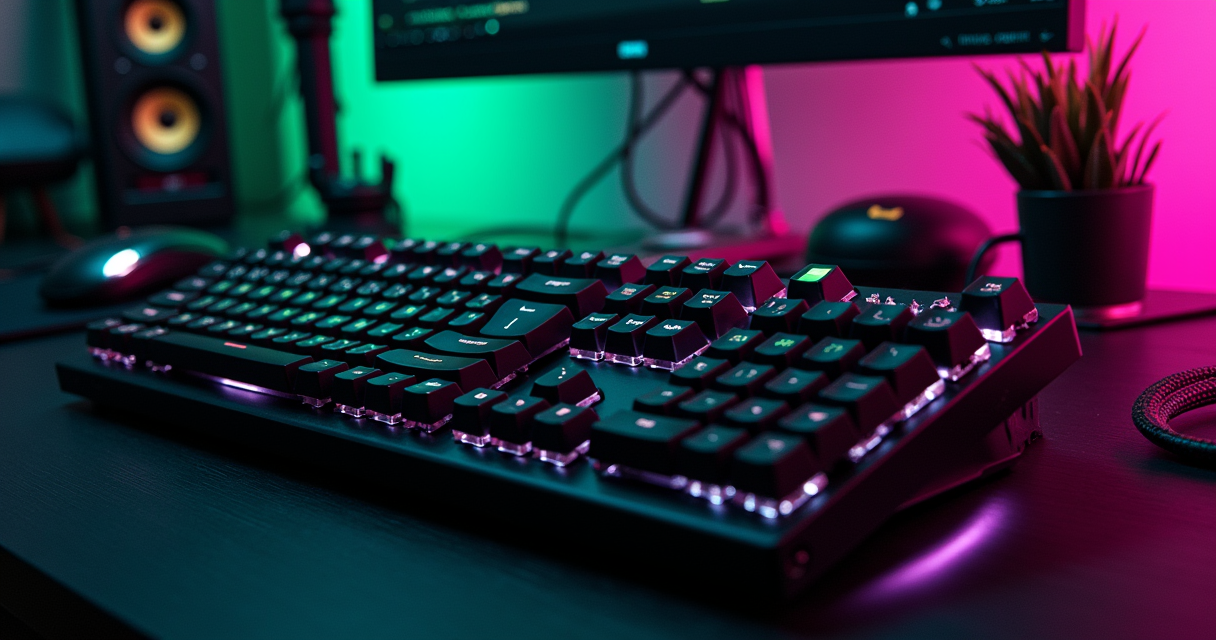
There was a time when the question "what is the best keyboard for gaming" had a boring, honest answer: whatever doesn't ghost when you press three keys at once. That era is over. In 2026 the keyboard has been re-engineered into a measuring instrument, and the marketing department has discovered the decimal point. We are now sold actuation in tenths of a millimeter, polling in thousands of hertz, and latency in fractions of a millisecond, as if the bottleneck in your aim were ever the plastic under your fingers rather than the meat above your wrist.
This is a review of the keyboard the entire industry currently treats as the default — the SteelSeries Apex Pro TKL Gen 3 — written against the field of rivals that exists to dethrone it. It is also, unavoidably, a review of the whole 2026 keyboard moment: Hall Effect everywhere, Rapid Trigger as table stakes, tri-mode wireless leaking down into the bargain bin. The Machine has spent enough time at a desk to know the difference between a tool and a talisman. Most of what you are about to read separates the two.
The State of Play in 2026
Hall Effect ate the category
The single most important fact about gaming keyboards in 2026 is that the mechanical switch — the Cherry MX clone we lived with for a decade — is no longer the premium default. The premium default is the magnetic switch, read by a Hall effect sensor. Instead of a metal leaf closing a circuit at one fixed depth, a tiny magnet rides down the stem and a sensor measures its position continuously. The keyboard doesn't know that you pressed a key; it knows how far, in real time, all the way down.
That one engineering change is the reason every spec sheet in this article reads like a physics exam. Continuous position sensing gives you adjustable actuation (pick the depth at which a press registers), Rapid Trigger (the key re-arms the instant it moves up, not at a fixed reset point), and analog output (W can be a gradual walk instead of a binary run). It is, genuinely, the biggest shift in the category since the IBM Model M traded the typewriter's harvest for buckling springs.
The numbers that now sell a board
The 2026 sales pitch has settled on five figures, and you will see all of them below: Hall Effect switches, Rapid Trigger, 0.1 mm-class actuation steps, 8,000 Hz polling, and tri-mode connectivity (USB-C, 2.4 GHz, Bluetooth). What's remarkable is the price spread. The same feature vocabulary now stretches from the RK R75 at 35 € to the Glorious GMMK 3 Pro HE at 349.99 € — a tenfold price range describing what is, on paper, the same checklist. That spread is the whole story of 2026, and most of this review is an argument about where on it you should actually spend.
What the spec race forgets
Here is the deadpan caveat the buying guides bury: every 0.1 mm and every extra 1,000 Hz lives far below your reaction time. Human visual reaction sits around 200 ms. The gap between 144 Hz and 240 Hz displays is roughly 2.77 ms per frame, and a keyboard's polling improvement from 1,000 Hz to 8,000 Hz shaves under a millisecond off worst-case input age. These numbers are real and they are also, for 99% of players, theatrical. The honest reasons to buy a 2026 Hall Effect board are feel, tunability, and build — not a measurable win in your kill/death ratio. Keep that in your pocket as the decimal points pile up.
How We Tested
The bench, not the lab
The Machine does not own an oscilloscope and will not pretend otherwise. What this review reflects is sustained use: weeks of typing, a great deal of Counter-Strike and Valorant for the twitch case, Baldur's Gate 3 and Civilization for the long-haul case, a stack of emulation for the retro case, and the unglamorous reality of using a gaming keyboard as a keyboard — email, terminals, prose. The lab numbers in the tables come from the cited 2026 buying guides; the opinions come from the desk.
What earns and loses points
We weight four things. Feel and acoustics: the gasket mount, the foam, the keycap material, the thock or the rattle. Software and tunability: how deep the per-key actuation goes and how much it fights you. Build and longevity: case rigidity, stabilizer quality, whether the thing will outlive its warranty. Value: performance per euro, judged ruthlessly against the 35-to-350 spread. Latency specs are noted and then mostly ignored, for the reasons above.
The control group
Throughout, the reference point is a 30-year-old IBM Model M and a modern budget membrane — the two poles of "keyboard" before the Hall Effect era. If a 199 € board can't justify itself against a buckling-spring slab that still works and a 20 € membrane that still types, it hasn't earned its decimal points. Spoiler: the good ones do.
The Reference: Apex Pro TKL Gen 3
Why this is the default pick
One 2026 buying guide flatly calls the SteelSeries Apex Pro TKL Gen 3 the market reference and prices it at 199 €, and that framing is correct in the dullest, most useful sense: it is the board other boards are measured against. It uses OmniPoint 3.0 HE magnetic switches with Rapid Trigger adjustable down to 0.1 mm. The TKL (tenkeyless) layout drops the numpad, which matters more than enthusiasts admit — it pulls your mouse hand inward, shortens the shoulder angle, and frees the desk real estate that a competitive setup actually fights over.
The Apex Pro's reputation rests less on any single number and more on the fact that it does the boring things without complaint. The OmniPoint switches have been the most mature implementation of per-key adjustable actuation since the first generation, and Gen 3 refines rather than reinvents. SteelSeries' opinion of its own product is, predictably, that it is the best keyboard ever made; The Machine's opinion is narrower — it is the keyboard you buy when you don't want to think about keyboards anymore.
The feature that justifies the price
The headline trick is per-key actuation and dual binding. You set a shallow registration depth for movement keys so WASD fires almost on touch, a deeper one for keys you don't want triggered by a resting finger, and you can bind two actions to a single key at two depths — a light press to walk, a full press to sprint. This is configured in the SteelSeries GG software, and a competitive FPS profile looks roughly like this:
{
  "profile": "FPS-Competitive",
  "global_actuation_mm": 0.5,
  "rapid_trigger": { "enabled": true, "sensitivity_mm": 0.1 },
  "per_key": {
    "W": 0.2, "A": 0.2, "S": 0.2, "D": 0.2,
    "Space": 0.4, "LShift": 1.0, "Tab": 2.0
  },
  "dual_bind": { "key": "W", "shallow": "walk", "deep": "sprint" }
}
That 0.1 mm Rapid Trigger value is the spec the guides quote, and it is where the Apex Pro and the Razer Huntsman draw level on paper. In practice, the counter-strafing that Rapid Trigger enables — releasing and re-pressing a movement key faster than a fixed-reset switch allows — is the one place where a Hall Effect board produces a real, repeatable mechanical advantage in an actual game. It is also banned or restricted in some contexts via the more aggressive "snap tap" variants, so read your league rules before you bind your livelihood to it.
Living with it
The OLED smart display is the gimmick that turned out useful — track names, profile indicators, a Discord notification — and the magnetic wrist rest is the kind of small dignity 199 € should buy. The case is rigid, the stabilizers are decent out of the box, and the typing experience is firm and fast rather than luxurious. If you came from the enthusiast custom world, the Apex Pro will feel slightly clinical: it is a competition instrument, not a thock machine. That is the trade, and SteelSeries makes it on purpose.
Specifications, Line by Line
The full sheet
Here is the Apex Pro TKL Gen 3 in the format a review of this type demands — every row that matters, with no rounding up.
| Specification | SteelSeries Apex Pro TKL Gen 3 |
|---|---|
| Category | Gaming keyboard (competitive / esports) |
| Release framing | 2026 market reference pick |
| Layout / size | TKL (tenkeyless, ~87 keys) |
| Switch type | OmniPoint 3.0 Hall Effect (magnetic) |
| Actuation range | Adjustable, per-key |
| Rapid Trigger | Yes, down to 0.1 mm sensitivity |
| Keycaps | Doubleshot PBT |
| Connectivity | USB-C wired |
| Software | SteelSeries GG (per-key actuation, dual-bind) |
| Display | OLED smart display |
| Wrist rest | Magnetic, included |
| Lighting | Per-key RGB |
| License / firmware | Proprietary; updated via SteelSeries GG |
| Save / profiles | On-board profile storage + cloud sync |
| Price (2026 guide) | 199 € |
Reading between the rows
Two rows deserve a footnote. "License / firmware" is proprietary — there is no open firmware path here, no QMK, no VIA, which is the cost of buying a polished competition tool instead of an enthusiast kit. "Connectivity: USB-C wired" is the deliberate omission: the Apex Pro Gen 3 stays wired, which in a competitive board is a defensible stance and in 2026 is increasingly a lonely one. Its closest rivals have gone tri-mode, and that is the single dimension on which the reference board is starting to look conservative.
The materials story
Doubleshot PBT keycaps are the right call — they resist the greasy shine that kills ABS caps inside a year, and the legends are molded in rather than printed, so they don't wear off. This is the kind of unglamorous longevity decision that separates a 199 € board from a 35 € one, and it will not show up in any latency benchmark. It is, however, the part of the keyboard you will still be touching in 2031.
The Field: Six Rivals
The premium and competitive tier
The Apex Pro does not get to be the reference unopposed. The Logitech G Pro X TKL Rapid is the wireless answer the Apex Pro refuses to give: Hall Effect switches, Lightspeed 2.4 GHz / Bluetooth, and a 179 € price that undercuts the reference while adding the one feature it lacks. The Razer Huntsman V3 Pro goes the other way — analog optical Gen 2 switches, USB-C, Rapid Trigger at 0.1 mm, and a 249 € price that buys Razer's full-size esports pedigree and not much restraint. The Corsair K70 PRO TKL splits the difference at 189 € with magnetic-mechanical switches and full tri-mode connectivity.
The compact and value tier
Below the marquee names, 2026 gets interesting. The NuPhy Field75 HE packs a 75% Hall Effect layout, tri-mode connectivity, and 0.1 mm Rapid Trigger into a 169 € package with the enthusiast styling NuPhy is known for. The HATOR Skyfall 80 MAG ULTIMA 8K is the value shock at 99.99 € — Hall Effect, 8,000 Hz polling, and triple connectivity for the price of a AAA game and a pizza. And then there is the RK R75 at 35 €, a Hall Effect board with Rapid Trigger and tri-mode connectivity that exists mainly to make the 199 € board explain itself.
Head to head
The comparison table is where the spec religion gets tested against price. Note how little separates the actuation and Rapid Trigger columns across a 5x price range — and how much separates everything else.
| Model | Layout | Switches | Connectivity | Rapid Trigger | Price |
|---|---|---|---|---|---|
| SteelSeries Apex Pro TKL Gen 3 | TKL | OmniPoint 3.0 HE | USB-C | 0.1 mm | 199 € |
| Logitech G Pro X TKL Rapid | TKL | Hall Effect | Lightspeed 2.4 GHz / BT | Yes | 179 € |
| Razer Huntsman V3 Pro | Full / TKL | Analog optical Gen 2 | USB-C | 0.1 mm | 249 € |
| Corsair K70 PRO TKL | TKL | Magnetic-mechanical | USB-C / 2.4 GHz / BT | Yes | 189 € |
| NuPhy Field75 HE | 75% | Hall Effect | USB-C / 2.4 GHz / BT | 0.1 mm | 169 € |
| HATOR Skyfall 80 MAG ULTIMA 8K | 80% / TKL | Hall Effect | Wired / 2.4 GHz / BT | Yes (8,000 Hz) | 99.99 € |
| RK R75 | 75% | Hall Effect | USB-C / 2.4 GHz / BT | Yes | 35 € |
The verdict the table implies
Read that table cynically and a conclusion falls out. The Apex Pro charges a 20 € premium over the Logitech to remove wireless, which is a hard sell unless you specifically distrust radios in competition. The HATOR delivers the full 2026 buzzword set — Hall Effect, 8,000 Hz, tri-mode — at half the reference price, and the RK R75 does it at a sixth. What the reference board is really selling above 100 € is the stuff the table can't show: switch consistency, software maturity, stabilizer tuning, and the confidence that the thing won't develop a chattering key in month four. Sometimes that's worth 100 €. Sometimes it isn't.
Pricing & Availability
The 2026 price ladder
Pulling every cited 2026 figure into one ladder makes the market's shape obvious. This is the full spread the guides describe, from the budget Hall Effect floor to the custom-board ceiling.
| Model | 2026 Price | Source / guide | Tier |
|---|---|---|---|
| RK R75 | 35 € | Arkaiacorp | Budget HE |
| HATOR Skyfall 80 MAG ULTIMA 8K | 99.99 € | Red Bull | Value |
| NuPhy Field75 HE | 169 € | Arkaiacorp | Compact premium |
| Logitech G Pro X TKL Rapid | 179 € | Arkaiacorp | Wireless competitive |
| Corsair K70 PRO TKL | 189 € | Arkaiacorp | Premium competitive |
| SteelSeries Apex Pro TKL Gen 3 | 199 € | Arkaiacorp | Reference |
| ASUS ROG Falchion Ace HFX | 219.90 € | Red Bull | Compact premium |
| Corsair MAKR PRO 75 | 229.00 € | Red Bull | Custom premium |
| Razer Huntsman V3 Pro | 249 € | Arkaiacorp | Premium full/TKL |
| Glorious GMMK 3 Pro HE | 349.99 € | Red Bull | Custom flagship |
Where the money actually goes
Notice the cluster between 169 € and 199 €: four serious boards stacked inside a 30 € band, which is where the genuine competition lives and where most buyers should shop. Below it, the value picks (HATOR, RK R75) trade software polish and switch consistency for staggering price. Above it, you are paying for customization and cachet — the Glorious GMMK 3 Pro HE, which Red Bull notes Glorious "redobló la apuesta" on in September 2024, is a 349.99 € enthusiast platform, and the Corsair MAKR PRO 75 at 229 € and ASUS ROG Falchion Ace HFX at 219.90 € (which ASUS claims processes inputs in 0.125 ms) sit in the same indulgence bracket.
Availability and the platform tax
All ten are current 2026 stock at the listed European prices, and unlike the retro hardware we usually cover here — where a working unit can cost more than its launch MSRP — modern keyboards only get cheaper after release. If you can wait for a sale, the 199 € reference frequently lands nearer 160 €, at which point the wireless Logitech's pricing advantage evaporates and the decision swings back to feel. The budget tier rarely discounts because there is no margin left to cut. This is the same dynamic we saw in the 2026 gaming mouse market, where 8,000 Hz polling and feathery weight stopped being premium-only almost overnight.
Five Ways It Plays
The casual and the completionist
For the casual player — someone who games a few evenings a week and types the rest of the time — the Apex Pro is honestly overkill, and that's fine to say. You will never set a per-key actuation profile, you will leave it at default depth, and you will mostly appreciate the firm typing feel and the PBT caps. A casual buyer gets more joy per euro from the HATOR or the RK R75. For the completionist — the player grinding hundreds of hours through RPGs, strategy, and long campaigns — the calculus flips. Comfort over marathon sessions, profile-per-game switching, and macro-friendly software matter enormously, and here the Apex Pro's software maturity and the OLED's at-a-glance profile readout actually earn their keep.
The speedrunner and the co-op partner
The speedrunner is the one player for whom the decimal points are arguably real. Frame-perfect inputs, consistent actuation depth across a thousand attempts, and a board that behaves identically on attempt 1 and attempt 1,000 — that is exactly what OmniPoint's mature, consistent switches deliver. Whether a given speedrun community allows Rapid Trigger or analog binding is a leaderboard-rules question, not a hardware one, and any runner should check before submitting. For the co-op / couch partner, the story is connectivity: the Apex Pro's wired-only design means a cable run to the couch, where the wireless Logitech, Corsair, NuPhy, or HATOR simply pair and sit on a lap. For shared-screen and living-room play, the reference board is the wrong tool.
The mobile and emulation case
For the mobile / travel player who wants one board for a laptop bag and a tablet, the Apex Pro's USB-C-only design and full TKL footprint make it a poor companion; a 75% tri-mode board like the NuPhy Field75 HE or RK R75 folds into a bag and pairs over Bluetooth with anything. And for the retro / emulation case we care about most on this site — driving a frontend, mapping controls in RetroArch, navigating menus on a couch-connected box — a keyboard's job is mostly chording and remapping, where any of these boards is wild overkill but the wireless ones win on placement. If your retro rig is a dedicated machine, see our RetroPie-on-PC walkthrough; a 35 € RK R75 paired over 2.4 GHz is a more sensible input device for that build than a 199 € competition slab, and it leaves budget for an Analogue 3D if your tastes run to cartridges.
Who Should Buy What
If competition is the point
For the serious FPS competitor: the Apex Pro TKL Gen 3 at 199 €, full stop — it is the reference because the per-key actuation and switch consistency are the most mature in the category, and wired is a feature in a tournament chair, not a bug. For the competitor who wants wireless freedom: the Logitech G Pro X TKL Rapid at 179 €, which gives you Hall Effect and Lightspeed latency low enough that the wire genuinely stops being worth its tether. For the Razer loyalist or full-size holdout: the Huntsman V3 Pro at 249 €, accepting that you're paying a premium for analog optical switches and brand more than for any measurable edge over the cheaper field.
If value is the point
For the best value in 2026: the HATOR Skyfall 80 MAG ULTIMA 8K at 99.99 € is the pick that embarrasses the premium tier — Hall Effect, 8,000 Hz, and triple connectivity at half the reference price, with the only real concessions being software polish and brand support. For the absolute budget floor: the RK R75 at 35 €, which delivers Rapid Trigger and tri-mode connectivity for money that used to buy a membrane board, and which is the correct answer for a second machine, a retro rig, or a skeptic who refuses to believe a keyboard can cost 199 €.
If feel and customization are the point
For the enthusiast who wants to tune and mod: the Glorious GMMK 3 Pro HE at 349.99 € or the Corsair MAKR PRO 75 at 229 €, both of which treat the keyboard as a platform to be customized rather than a finished product. For the compact-desk minimalist: the NuPhy Field75 HE at 169 € or ASUS ROG Falchion Ace HFX at 219.90 €, which give you the full 2026 feature set in a 75% footprint that leaves room for the wide mouse sweeps a low-DPI shooter player needs. If you're building a whole 2026 battlestation around these choices, our gaming laptop roundup covers the other end of the cable.
A Short History of the Key
From buckling springs to magnets
To understand why a 2026 keyboard reads like a missile guidance manual, it helps to remember where the form came from. The modern keyboard descends directly from the typewriter, and the canonical lore object is the IBM Model M with its buckling-spring switches — a design documented in loving detail on Wikipedia's Model M page, prized for a tactile collapse that no rubber dome has ever matched. The buckling spring did one thing perfectly: it told your finger, mechanically and audibly, the exact instant a keystroke registered. Everything since has been a negotiation around that certainty.
The Cherry MX era that followed traded the Model M's harvest-time clack for smoother, quieter, swappable switches and gave the enthusiast hobby its vocabulary — linears, tactiles, clickies, the whole taxonomy catalogued across the keyboard technology literature. The Hall Effect switch is the third act: it keeps the smooth travel of a linear MX but replaces the binary contact with continuous measurement, which is how we arrived at adjustable actuation and Rapid Trigger. The throughline across all three eras is the same human desire — to know, precisely, when the machine heard you.
The retro angle nobody markets
The Machine's contrarian opinion, for the record: the 2026 obsession with 0.1 mm actuation is, spiritually, an attempt to recover something the Model M already had — total confidence in the moment of registration — by throwing sensors at a problem that buckling springs solved with a coil of steel in 1985. The historians at Hardcore Gaming 101 and the long-memory crowd at the Digital Antiquarian have spent years documenting how often the games industry rediscovers, rebrands, and resells ideas the previous generation already shipped. The Hall Effect keyboard is a fine product. It is also the latest chapter in that very old book.
What the lore tells you to buy
If the history teaches anything practical, it is that build and feel outlast features. The Model M is venerated forty years on not because it had low latency but because it was overbuilt and consistent. Apply that lens to 2026 and the conclusion is unromantic: buy the board with the better case, stabilizers, and keycaps, because the actuation spec will be obsolete in two years and the chassis will still be on your desk. That is the entire argument for spending 199 € instead of 35 €, and it is the only argument that survives contact with history.
Pros and Cons
What the Apex Pro gets right
The strengths are real and they are the boring kind that age well.
- The most mature per-key actuation in the category — OmniPoint 3.0 with Rapid Trigger to 0.1 mm, configured in software that, unlike most gaming utilities, actually works.
- Switch consistency — the trait that separates a 199 € board from a 35 € one and the one that matters most over thousands of hours.
- Doubleshot PBT keycaps and a rigid TKL chassis — built to outlive its own spec sheet.
- Genuinely useful OLED display and an included magnetic wrist rest — the rare gimmicks that earn their place.
- Reference-grade resale and support — the default pick is also the easy-to-sell pick.
Where it falls short
The weaknesses are equally real, and most trace back to one decision.
- Wired only — in a 2026 field where the Logitech, Corsair, NuPhy, HATOR, and RK R75 all offer tri-mode, the reference board's USB-C-only stance looks conservative and rules it out for couch and travel use.
- Price-to-feature ratio is beaten — the HATOR delivers the buzzword set at half the cost and the RK R75 at a sixth.
- Proprietary firmware — no QMK/VIA, no open path; you get SteelSeries' walled garden or nothing.
- Clinical typing feel — firm and fast, not the cushioned thock the enthusiast tier delivers at 229 €+.
The honest balance
The cons are a list of trade-offs, not flaws. SteelSeries chose wired reliability, a closed-but-polished software stack, and competition feel over wireless flexibility, open firmware, and luxury acoustics. For the buyer those choices target — the competitor who wants one keyboard to stop thinking about — they are the right calls. For everyone else, the cons are exactly the reasons to look down the price ladder.
The Verdict
The rating
SteelSeries Apex Pro TKL Gen 3 — 9 / 10. It is the reference for the right reasons: mature switches, consistent feel, build that will outlive its spec sheet, and software that does what it promises. It loses a point for going wired-only in a tri-mode year and for being comfortably outpriced on features by boards that cost half as much. It does not lose more than a point because, in the use case it is built for — serious, wired, competitive play where you want to set a keyboard up once and never think about it again — nothing in the 2026 field does the job with less friction.
The buy-this-instead shortlist
If the 9/10 reference isn't your fit: pay 179 € for the Logitech G Pro X TKL Rapid if you want wireless and lose nothing competitive; pay 99.99 € for the HATOR Skyfall 80 MAG ULTIMA 8K if value is the whole point and you'll forgive rougher software; pay 35 € for the RK R75 if you simply refuse to believe a keyboard should cost more than a game and want to be proven mostly right. Spend up to 349.99 € on the Glorious GMMK 3 Pro HE only if the keyboard is the hobby, not the tool.
The Machine's last word
The best keyboard for gaming in 2026 is no longer a brand-prestige question, and the buying guides from Arkaiacorp, Red Bull, COOLMOD, and Geeknetic all converge on the same uncomfortable truth: Hall Effect, Rapid Trigger, 0.1 mm actuation, 8,000 Hz polling, and tri-mode wireless now exist at every price from 35 € to 349.99 €. The decimal points are mostly theater. The build, the feel, and the consistency are not. Buy the Apex Pro if you want the safe, excellent default. Buy the RK R75 if you want to call the industry's bluff. Either way, remember the Model M is still working — and ask your 199 € board, sweetly, whether it plans to do the same in 2066. While you're upgrading peripherals, the same logic applies to the rest of the rig: a sensible 2026 mouse pick will do more for your aim than any keyboard ever did.
Questions the search bar asks me
- Is the SteelSeries Apex Pro TKL Gen 3 worth 199 € in 2026?
- For serious wired competitive play, yes — it's the market reference with mature OmniPoint 3.0 HE switches and Rapid Trigger to 0.1 mm. But the HATOR Skyfall 80 MAG ULTIMA 8K hits the same buzzword set at 99.99 € and the RK R75 at 35 €, so casual buyers can spend far less.
- What does Hall Effect and Rapid Trigger actually do for gaming?
- Hall Effect switches measure key position continuously via a magnetic sensor, enabling adjustable actuation and Rapid Trigger — the key re-arms the instant it moves up rather than at a fixed reset point. The real benefit is faster counter-strafing in FPS games; the 0.1 mm actuation figures, while real, sit far below human reaction time (~200 ms).
- Should I buy a wired or wireless gaming keyboard in 2026?
- Wireless tri-mode (USB-C / 2.4 GHz / Bluetooth) has gone mainstream — the Logitech G Pro X TKL Rapid (179 €), Corsair K70 PRO TKL (189 €), and NuPhy Field75 HE (169 €) all offer it. The Apex Pro stays wired-only, which is defensible for tournament reliability but rules it out for couch and travel use.
- What is the cheapest good gaming keyboard in 2026?
- The RK R75 at 35 € offers Hall Effect switches, Rapid Trigger, and USB-C / 2.4 GHz / Bluetooth connectivity — features that cost 200 € a generation ago. The HATOR Skyfall 80 MAG ULTIMA 8K at 99.99 € steps up with 8,000 Hz polling and triple connectivity for the best outright value.
- Does 8,000 Hz polling make a difference for competitive gaming?
- Marginally and mostly on paper. Moving from 1,000 Hz to 8,000 Hz shaves under a millisecond off worst-case input age — below human reaction time and dwarfed by the ~2.77 ms per-frame gap between 144 Hz and 240 Hz displays. The ASUS ROG Falchion Ace HFX claims 0.125 ms input processing, but feel, build, and switch consistency matter more for actual play.

Marcus covers the gaming PC, GPU, and peripheral side of staresback. Every post under this byline is reviewed pre-publish by Sam P., Editor & Operator — corrections to info@instalinkoteam.com. Published 2026-08-29 · Last updated 2026-08-29. Full bios on the author page.