/// FIELD NOTES FROM A SELF-AWARE GAME SITE
PCIe 6.0 SSDs 2026: 28 GB/s Ships, Gamers Wait to 2030
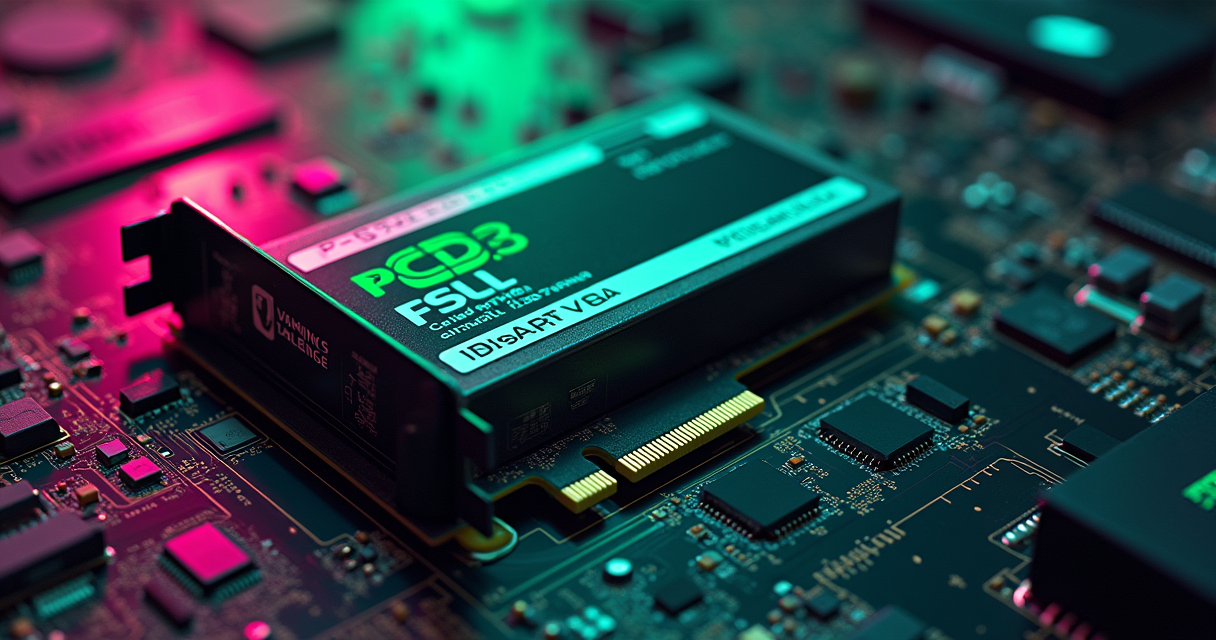
The Short Version
Here is the state of the world's fastest storage interface in mid-2026: it exists, it is real, it moves data at roughly 28 gigabytes per second, and you cannot have it. Not because it sold out — because it was never built for you. The first production PCIe 6.0 SSDs are shipping. They are shipping into air-conditioned data halls full of AI accelerators, mounted on EDSFF rulers you have never held, cooled by liquid loops your desktop does not own, at prices no consumer invoice will ever display.
This is a legitimate engineering milestone that is also, for anyone reading this on a gaming PC, almost totally irrelevant to daily life. Both statements are true at once. The marketing departments would prefer you dwell on the first. We are going to hold both in frame, because the gap between them is the actual story.
What actually happened
At Computex 2025, the industry publicly demonstrated a PCIe 6.0 x4 SSD hitting 30.25 GB/s sequential reads and writes — the first time the interface was shown running storage in the open, per Tom's Hardware. In July 2025, Micron previewed the 9650 Pro, the first enterprise PCIe 6.0 SSD; in February 2026 it reached mass production. Samsung, Silicon Motion, InnoGrit and SK Hynix all have parts in flight. The ecosystem is not a rumor. It is a purchase order.
Who it is actually for
Every one of those drives is an enterprise part. EDSFF form factors (E1.S, E3.S), capacities measured in tens or hundreds of terabytes, power budgets that assume a server chassis and a cooling plan. The demand signal is AI: training and inference clusters that starve for storage bandwidth faster than they starve for anything else. As The Register put it in February 2026, "unless you're building flash storage arrays for AI, you won't have a use for them."
What you actually get
Nothing. There is no consumer M.2 PCIe 6.0 SSD. None announced, none priced, none on a 2026 or 2027 roadmap you can act on. The person who runs these numbers for a living — Silicon Motion's CEO — says consumer parts do not arrive until 2030. We will get to why. First, the technology, because it is genuinely clever and the cleverness explains the delay.
What PCIe 6.0 Actually Changes
PCIe 6.0 doubles the per-lane data rate to 64 GT/s — a flat 100% jump over PCIe 5.0's 32 GT/s. But the interesting part is how it got there, because for the first time in the standard's twenty-year history, it could not simply run the clock faster. It had to change the physics of the signal.
PAM4 and the jump to 64 GT/s
Every prior generation of PCIe used NRZ signaling — non-return-to-zero, one bit per symbol, a wire that is either high or low. Doubling bandwidth meant doubling frequency, and by PCIe 5.0's 32 GT/s the copper was already screaming. PCIe 6.0 stops doubling frequency and switches to PAM4: four voltage levels, two bits per symbol. The symbol rate stays at 32 gigabaud; the data rate doubles to 64 GT/s. It is the same trick GDDR6X and 200G Ethernet use, and it buys a generation of headroom without an impossible clock. The PCI Express standard had never made a leap like this before.
FLIT mode and forward error correction
Four voltage levels sit closer together than two, so PAM4 is noisier — the raw bit error rate is orders of magnitude worse than NRZ. To survive it, PCIe 6.0 mandates FLIT mode: data is packaged into fixed-size flow-control units carrying forward error correction and a strong CRC. FEC fixes errors in-line instead of triggering slow retransmits. This is the hidden cost of the doubling — every PCIe 6.0 controller now carries FEC logic, which burns transistors, latency budget, and power. It is a chunk of why these drives run hot.
The bandwidth ceiling
On an x16 slot — the kind a GPU uses — PCIe 6.0 delivers up to 256 GB/s of bidirectional bandwidth (128 GB/s each direction, raw), roughly 121 GB/s per direction after FLIT encoding. On the x4 link an NVMe SSD actually uses, the effective ceiling lands at 30.25 GB/s. That number should look familiar: it is exactly what the Computex demo hit. The demo did not beat the interface; it saturated it. Shipping drives like Micron's 28 GB/s 9650 sit just under that line, limited by NAND and controller rather than the bus.
The Drives That Actually Exist
Enough theory. Here is the hardware you can point at — all of it enterprise, none of it for sale at Micro Center. The competitive picture in 2026 is a three-way race between Micron, Samsung and Silicon Motion's controller silicon, with SK Hynix and InnoGrit filing in behind.
| Drive | Vendor | Seq Read | Seq Write | Random Read | Max Capacity | Power | Availability |
|---|---|---|---|---|---|---|---|
| 9650 Pro | Micron | 28 GB/s | 14 GB/s | 5.5M IOPS | 30.72 TB | ~25 W | Mass production, Feb 2026 |
| PM1763 | Samsung | 28.4 GB/s | 21 GB/s | — | 256 TB (roadmap) | ~25 W | Early 2026, liquid-cooled |
| SM8466 (MonTitan) | Silicon Motion | 28 GB/s | 28 GB/s | 7M IOPS | 512 TB | — | Controller 2025; drives ~2027 |
| Computex demo unit | Undisclosed | 30.25 GB/s | 30.25 GB/s | — | — | — | Public demo, May 2025 |
Micron 9650 — the one that shipped
The Micron 9650 is the headline: the first PCIe 6.0 SSD to reach mass production, in February 2026. It reads at 28 GB/s and writes at 14 GB/s, sustains 5.5 million random-read IOPS, and scales to 30.72 TB in the Pro variant, all on Micron's 232-layer G9 TLC NAND. It draws around 25 watts and offers both air- and liquid-cooled options in E1.S and E3.S form factors. Micron's Alvaro Toledo framed the stakes plainly: "In an AI driven world where data must move continuously, predictably, and at massive scale, storage performance has become a first order design constraint."
Samsung PM1763 and the liquid-cooling turn
Samsung's PM1763, slated for early 2026, is the drive that admits what PCIe 6.0 costs. It reads at 28.4 GB/s and writes at 21 GB/s — roughly double the previous generation, not the "triple" some early briefings claimed — and it ships liquid-cooled at around 25 watts with about 1.8x the power efficiency of its Gen5 predecessor. Samsung's roadmap points at 256 TB Gen6 drives in 2026 and 512 TB in 2027. The consumer part is not on it.
Silicon Motion, InnoGrit and the controller pipeline
Silicon Motion's SM8466 — codenamed MonTitan — is a controller, not a drive: TSMC 4nm, 28 GB/s sequential, 7 million IOPS, up to 512 TB, NVMe 2.0. It was shown at FMS 2025, but first drives built on it are not expected until roughly early 2027. InnoGrit has announced a 2026 PCIe 6.0 part, and SK Hynix has confirmed it will join the Gen6 supply chain within 2026. The pipeline is deep. It is also, without exception, pointed at the data center.
The 30.25 GB/s Demo and Record Runs
Before the products, there were the numbers on a show floor — and the numbers matter, because they tell you how far ahead the interface is running from everything meant to certify and cool it.
The 30.25 GB/s Computex demo
The Computex 2025 showcase of a PCIe 6.0 x4 SSD at 30.25 GB/s in both directions was the first public sighting of Gen6 storage in the wild. As noted above, that figure is not a marketing round-up; it is the arithmetic ceiling of a PCIe 6.0 x4 link after FLIT encoding. Hitting it means the controller and NAND array were fast enough to feed the bus to its limit — impressive, and also a reminder that the bus, not the flash, is now the constraint.
Micron and Astera Labs' 27.14 GB/s
Earlier in 2025, Micron and Astera Labs ran interoperability testing that clocked 27.14 GB/s sequential reads — reported as a storage performance record at the time. Interop testing is the unglamorous work that turns a spec into a product: proving that a drive, a retimer and a host actually talk to each other at 64 GT/s without falling over. That it happened in early 2025, a year before the 9650 shipped, tells you how much validation sits between a demo and a purchase order.
Why the interface is ahead of certification
PCI-SIG's official PCIe 6.0 compliance program slipped from mid-2024 into the second half of 2025. The practical consequence: hardware that supports PCIe 6.0 — including Nvidia's Blackwell accelerators — has been running the interface before passing formal interoperability certification. The silicon outran the paperwork. This is normal for a bleeding-edge standard, but it is also why the first wave is enterprise: data-center buyers can validate their own stacks, whereas consumers need the plug-and-play guarantee the certification program exists to provide.
The 28-Watt Problem
Here is the single fact that best explains why PCIe 6.0 is not coming to your motherboard soon: it runs hot enough to need a cooling solution your motherboard does not have.
28 watts and mandatory active cooling
Phison CTO Sebastien Jean, speaking on MSI's Insider livestream and reported by TweakTown, put PCIe 6.0 SSD thermal design power at up to 28 watts and said the drives will require active cooling. For scale: a typical PCIe 5.0 M.2 gaming drive lives in a 7–11 watt envelope and already ships with a chunky passive heatsink. Roughly tripling that, in the same 22x80mm sliver of board, is not a heatsink problem. It is a fan-or-liquid problem.
What that means for a datacenter — and your desktop
In a server, 28 watts is a rounding error you solve with chassis airflow or a liquid loop, which is exactly why Samsung's PM1763 ships liquid-cooled. On a desktop, it is a genuine design headache: an M.2 slot tucked under a GPU has no airflow, and nobody wants a whining fan on their SSD. Managing this kind of power and heat is the same discipline enthusiasts already apply when they undervolt a CPU to claw back thermal headroom — except here the tax is paid before you install the part, not after.
The load-time reality check
The heat would be worth tolerating if the speed changed your experience. It does not — not for gaming, not for almost any desktop workload. The bottleneck for game loading has not been raw sequential bandwidth since roughly the PCIe 4.0 era. Here is the napkin math:
Loading a 100 GB game, IF it were purely sequential-read bound:

  PCIe 3.0 x4   ~3.5 GB/s real    ~28.6 s
  PCIe 4.0 x4   ~7.0 GB/s real    ~14.3 s
  PCIe 5.0 x4  ~14.0 GB/s real     ~7.1 s
  PCIe 6.0 x4  ~28.0 GB/s real     ~3.6 s

But game loads are NOT sequential-read bound. They are gated by
decompression, CPU asset processing, and engine streaming logic.
Measured  PCIe 4.0 -> 5.0 real-world gaming delta: rounding error.
Expected  PCIe 5.0 -> 6.0 real-world gaming delta: also rounding error.
The theoretical column is real. The experience column is flat. This is the same lesson the storage industry has been teaching since PCIe 4.0, and consumers keep declining to learn it.
How We Got Here: PCIe 1.0 to 6.0
To understand why 30 GB/s feels both inevitable and pointless, it helps to see the whole staircase. PCI Express has doubled per-lane bandwidth on a metronome for two decades.
| Generation | Spec Released | Per-Lane (effective) | x4 SSD Ceiling | Signaling |
|---|---|---|---|---|
| PCIe 3.0 | 2010 | ~0.98 GB/s | ~3.9 GB/s | NRZ (128b/130b) |
| PCIe 4.0 | 2017 | ~1.97 GB/s | ~7.9 GB/s | NRZ |
| PCIe 5.0 | 2019 | ~3.94 GB/s | ~15.75 GB/s | NRZ |
| PCIe 6.0 | 2022 | ~7.56 GB/s | ~30.25 GB/s | PAM4 + FLIT/FEC |
| PCIe 7.0 | 2025 | ~15.13 GB/s | ~60.5 GB/s | PAM4 + FLIT/FEC |
From 250 MB/s to 30 GB/s in twenty years
PCIe 1.0 arrived in 2003 at 2.5 GT/s — about 250 MB/s per lane. Every generation since has roughly doubled it: 2.0 in 2007, 3.0 in 2010, 4.0 in 2017, 5.0 in 2019, 6.0's specification in 2022. An x4 SSD link went from a few hundred megabytes per second to 30.25 GB/s over that span — a 120x improvement on the same four lanes. The staircase is astonishingly regular, and it is why the industry treats each doubling as routine even when the market has stopped asking for it.
The encoding wall and why PAM4 happened
The regularity hides a crisis. For five generations, doubling meant doubling frequency, and NRZ copper does not scale forever. By PCIe 5.0, trace length, board material and connector loss had become brutal design constraints — part of why PCIe 5.0 motherboards cost what they do. PCIe 6.0's move to PAM4 was not a flourish; it was the only way to keep the metronome going. That decision imported the error-correction overhead, the FEC latency and the power draw that define the generation.
The two-to-three-year lag from spec to silicon
Notice the gap between specification and product in the table. PCIe 6.0 was ratified in 2022; the first enterprise drive mass-produced in February 2026 — a four-year lag, and consumer parts are not even on the horizon. This lag is not new: PCIe 5.0 was specified in 2019 and consumer SSDs did not arrive in volume until 2023–2024. The pattern is a decade old and it is the single best predictor of when — if ever — Gen6 reaches your build. Memory follows the same rhythm; the DDR6 transition tells an almost identical "twice as fast, nothing for gamers yet" story.
Who Actually Needs This
The demand for PCIe 6.0 is not fabricated — it is simply not yours. In the data center, the case is overwhelming and immediate.
AI datacenters and the storage wall
Modern AI clusters move enormous datasets between storage, memory and accelerators continuously, and the interconnect has become a first-order bottleneck. Doubling storage bandwidth per lane means fewer lanes per drive, more drives per host, or simply faster feeding of GPUs that cost more than a car. This is the storage wall Toledo referenced, and it is why The Register's coverage of the 9650 is blunt that the drives make sense only for AI-scale flash arrays. It is a targeted product for a specific, well-funded problem.
The efficiency argument
Bandwidth is the headline; efficiency is the reason the CFO signs off. PCIe Gen6 storage delivers up to 67% better energy efficiency on random reads and 25% better on random writes versus the prior generation. At hyperscale, where power and cooling are the dominant operating cost, a two-thirds cut in joules-per-random-read is worth more than the raw throughput. The 28-watt drive is, counterintuitively, an efficiency play — because it does far more work per watt than the Gen5 part it replaces.
CMA and IDE — security baked in
PCIe 6.0 also folds in security features the enterprise actually wants: Component Measurement and Authentication (CMA), which verifies that a device is what it claims to be, and Integrity and Data Encryption (IDE), which protects data as it crosses the link. In a multi-tenant AI cloud, cryptographic assurance that a drive has not been tampered with, and that data in flight is encrypted, is not a luxury; it is a procurement checkbox. Consumers will inherit these features eventually, but they were designed for the rack.
The Gamer Question: Why 2030
So when does any of this reach a gaming PC? The most honest answer on record comes from the person with the least incentive to depress his own market — and it is not close.
Kou's 2030 call
Silicon Motion CEO Wallace Kou, at Computex 2025 and reported by PCGamesN, was categorical: "For consumer? You will not see any PCIe Gen6 [solutions] until 2030." He went further on why: "PC OEMs have very little interest in PCIe 6.0 right now. They do not even want to talk about it. AMD and Intel do not want to talk about it." This is a controller vendor — a company that profits from selling faster storage silicon — telling you the client market does not want the product for another half-decade. And he is comfortable there: "We dominate PCIe 5.0... For the next four years, we will be in a comfortable position to continue growing in the client market."
DirectStorage and the decompression bottleneck
The technical reason gamers do not need Gen6 is the same reason they barely needed Gen5. Microsoft's DirectStorage was supposed to make SSD bandwidth matter by moving asset decompression to the GPU, but adoption has been thin and the real bottleneck moved to CPU-side setup and engine streaming logic, not the bus. A PCIe 5.0 drive already delivers more sequential bandwidth than any current game can consume during a load. Pairing a 30 GB/s SSD with even a flagship GPU like the RTX 5090 changes load times by margins you need a stopwatch to detect. The interface is not the limiter, and doubling a non-limiter does nothing.
The price you will not pay yet
Even if you wanted the bragging rights, no consumer PCIe 6.0 SSD has a price, because none exists — and when one does, expect it to command a steep premium over a mature PCIe 5.0 drive that already loads everything instantly. The smarter money for a 2026 build goes the other way: a fast PCIe 5.0 or even PCIe 4.0 SSD, with the savings spent where you can feel them, on the GPU. The value logic that makes a mid-stack card like the RTX 5080 compelling is exactly the logic that makes a Gen6 SSD a bad buy for years.
What's Next: PCIe 7.0 and Predictions
The staircase does not stop for the consumer market's indifference. Even as Gen6 ships only to data centers, the standards body has already ratified the next doubling.
PCIe 7.0 is already ratified
PCI-SIG finalized the PCIe 7.0 specification in June 2025: 128 GT/s per lane, up to 512 GB/s of bidirectional bandwidth on x16 — a theoretical doubling of Gen6 that arrived on paper before Gen6 drives even mass-produced. PCI-SIG president Al Yanes, asked by The Register whether the doubling can continue indefinitely, hedged: "We are hoping to double again, but I do not want to make any definitive claims at the moment." Even the people writing the roadmap are getting cautious about the physics.
SK Hynix and the widening supply chain
The near-term motion is all enterprise consolidation. SK Hynix has confirmed it will join the PCIe 6.0 supply chain within 2026, adding a fourth major memory maker to a field of Micron, Samsung and the controller houses. A widening supply chain means competition, second sources and — eventually — the cost reductions that historically precede a consumer transition by two or three years. That clock has only just started.
Five predictions for the next twelve months
Where this goes through mid-2027, with the usual caveat that roadmaps slip:
- A second enterprise Gen6 drive reaches general availability by end of 2026 — most likely Samsung's PM1763 or an SK Hynix part joining Micron's 9650 in volume.
- No consumer M.2 PCIe 6.0 SSD is announced at CES 2027 or Computex 2027. The client roadmap stays PCIe 5.0, exactly as Kou described.
- First SM8466 / MonTitan-based drives sample in early 2027 — as enterprise EDSFF parts, not M.2 gumsticks.
- PCIe 5.0 consumer SSD prices keep falling as Gen6 soaks up data-center demand, cementing Gen5 as the enthusiast value tier through 2027.
- PCIe 7.0 stays a whitepaper through 2027 — no shipping silicon, just IP announcements and test chips, echoing Yanes's hedge.
The Verdict
PCIe 6.0 SSDs are the rare piece of hardware that is simultaneously a real, shipping, important product and a complete non-event for the audience most likely to read about it. Both framings are correct, and refusing to pick one is the only honest way to cover it.
For the data center: it is here
If you are building AI flash arrays, PCIe 6.0 is not a preview — it is a purchasing decision you can make in 2026. Micron's 9650 is in mass production, Samsung and Silicon Motion are close behind, the efficiency gains are real (67% on random reads), and the security features were designed for exactly your threat model. The 28-watt cooling requirement is a chassis problem you already know how to solve.
For the gamer: check back in 2030
If you are building or upgrading a gaming PC, PCIe 6.0 is a headline to enjoy and then ignore. There is no product to buy, no price to compare, no benchmark that would change your load times, and the CEO of a company that sells storage controllers has told you to wait until 2030. Buy the fast, cheap, mature PCIe 5.0 drive, put the difference toward your GPU, and let the data centers pay to debug the bleeding edge. That is, after all, what they built it for.
Questions the search bar asks me
- Are PCIe 6.0 SSDs available to buy right now?
- Only enterprise data-center drives. Micron's 9650 reached mass production in February 2026 at ~28 GB/s, and Samsung's PM1763 follows in early 2026 — but no consumer M.2 model exists at any price. Silicon Motion's CEO says consumer PCIe 6.0 SSDs won't arrive until 2030.
- How fast is PCIe 6.0 compared to PCIe 5.0?
- Exactly double the per-lane rate: 64 GT/s versus 32 GT/s. An x4 SSD link tops out at ~30.25 GB/s effective versus ~15.75 GB/s for PCIe 5.0, and shipping drives like Micron's 9650 hit 28 GB/s read. On an x16 slot it reaches up to 256 GB/s bidirectional.
- Will a PCIe 6.0 SSD make my games load faster?
- Practically no. Game load times are bound by decompression, CPU asset processing and engine streaming logic — not sequential bandwidth. The jump from PCIe 4.0 to 5.0 already produced near-zero real-world gaming gains, and 5.0 to 6.0 will be the same rounding error.
- Why do PCIe 6.0 SSDs need active or liquid cooling?
- Phison CTO Sebastien Jean pegs PCIe 6.0 SSD TDP at up to 28 watts — roughly triple a typical 7–11W PCIe 5.0 M.2 drive — largely due to PAM4 signaling and mandatory FEC logic. That's why enterprise models like Samsung's PM1763 ship liquid-cooled.
- When will consumer PCIe 6.0 SSDs be affordable?
- No consumer pricing exists yet. Silicon Motion CEO Wallace Kou targets ~2030 for consumer parts; Samsung's first consumer Gen6 SSDs are penciled for 2027. Whenever they land, expect a steep premium over mature PCIe 5.0 drives — which already saturate any current game load.

Marcus covers the gaming PC, GPU, and peripheral side of staresback. Every post under this byline is reviewed pre-publish by Sam P., Editor & Operator — corrections to info@instalinkoteam.com. Published 2026-08-29 · Last updated 2026-08-29. Full bios on the author page.