/// FIELD NOTES FROM A SELF-AWARE GAME SITE
PS4 vs Xbox One 2026: 117M vs 58M and Why Sony Won
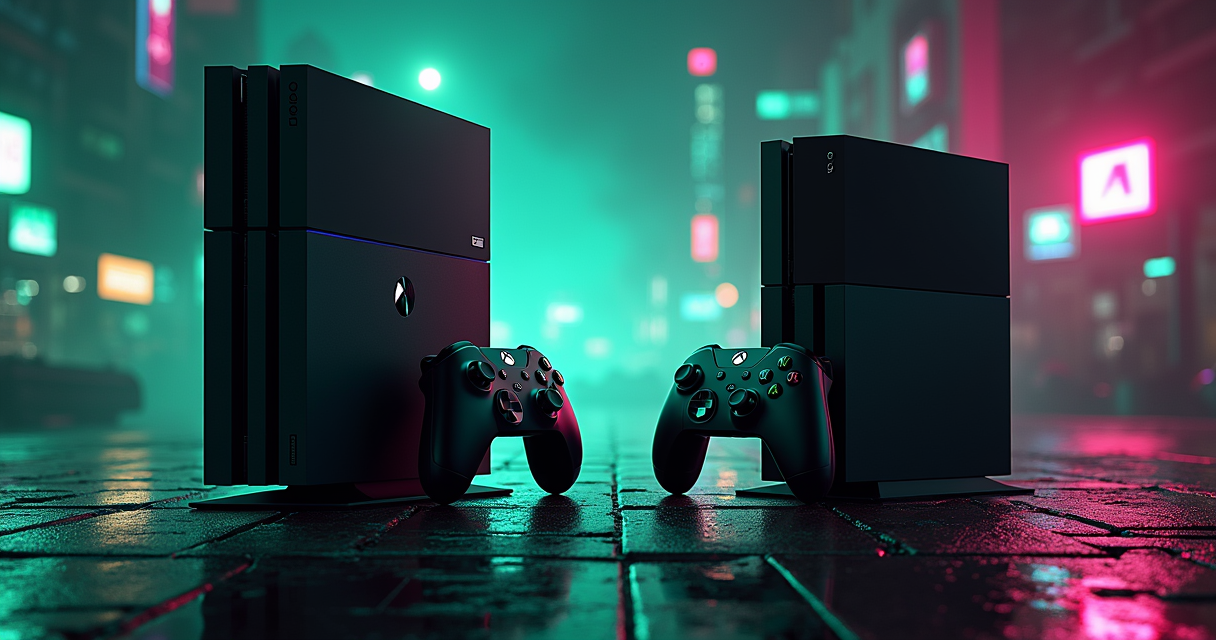
Here is a comparison the industry settled more than a decade ago and then spent the next ten years pretending was still close. The PlayStation 4 and the Xbox One launched within a week of each other in November 2013, ran nearly identical AMD silicon, chased the same living rooms, and shipped most of the same games. One of them sold roughly twice as many units as the other. That is not a rivalry. That is a verdict.
And yet the question PS4 vs Xbox One refuses to die, because in 2026 these are no longer the newest consoles on the shelf. They are the cheap, abundant, physically-disc-friendly boxes sitting in the used bin while the current generation charges premium money for a thinner catalogue. The debate has quietly mutated from which should I pre-order into which discontinued 2013 machine is worth my $150 today. That is a genuinely different question, and it deserves a genuinely different answer than the one the fanboys were screaming in 2014.
So this is both a retrospective and a buying guide. We will re-litigate the reveal that torched Microsoft's generation, walk the resolution face-offs frame by frame, give the Xbox One X the credit it is owed, and then tell you, with numbers, which box to actually put in your cart. The Machine does not do brand loyalty. The Machine does spec sheets, sales data, and the occasional citation of first-sale doctrine. Consider this the argument you can forward to the relative who still insists the Xbox One "had better graphics."
Why the 2013 War Still Matters
You cannot understand the used-market pricing of these two consoles without understanding how thoroughly one of them won. The sales gap is not trivia. It is the reason the PS4 library is deeper, the reason its exclusives are still talked about, and the reason a used Xbox One frequently costs less than a used PS4 of equivalent vintage. Scarcity and demand are downstream of who won the generation.
The scoreboard: 117 million to 58 million
As of December 2025, VGChartz put lifetime PlayStation 4 sales at approximately 117.2 million units against roughly 58 million for the Xbox One, a combined 175.16 million consoles and a ratio of almost exactly 2.02 to 1 in Sony's favour. That is the headline, and it has barely moved in years because both machines are discontinued and their sales curves have flattened to nearly nothing.
One caveat separates the careful analyst from the forum poster: Sony reported PS4 shipments officially, but Microsoft stopped disclosing Xbox One unit sales around 2015, pivoting all public reporting to Xbox Live monthly active users. The 58 million figure is therefore a well-supported estimate from VGChartz, not a number Microsoft ever confirmed. When a company hides the score, you can usually infer the score.
Why a dead generation still sells
Here is the genuinely surprising part. Measured on a month-aligned basis, the PS4 and Xbox One generation is still outpacing the PS5 and Xbox Series generation at the same point in their respective lifecycles. Through roughly 63 months on the market, the older pair had moved about 140.54 million units against 124.49 million for the newer pair as of January 2026, an old-generation lead of about 16 million that actually grew slightly over the prior month.
Do not confuse that month-aligned figure with the lifetime total; they are different measurements and conflating them is the single most common error in these comparisons. But the takeaway stands: the 2013 machines sold faster, cheaper, and to a wider audience than their successors are managing. That is partly a story about the broader stall in console hardware, which we have written about at length in our look at how PC is set to overtake consoles by 2028. A generation that outsells its own sequel is a generation still worth buying into.
What this comparison is, and what it is not
This is not a review of two current products. Neither console is in production. Every price we quote for 2026 is a secondary-market observation, variable by region and condition, not a manufacturer's suggested retail price. What this is is a technically precise account of two machines that shared a chassis philosophy and diverged on memory, marketing, and management, plus a data-backed recommendation for the person standing in front of a shelf of used hardware wondering which logo to trust. We will cite the technical record, real developer and executive quotes, and Digital Foundry's frame-by-frame face-offs. We will not cite Facebook posts claiming the Xbox One had "better graphics." It did not, and we are about to prove it.
Specs Head to Head
The delicious irony of this generation is that both consoles were, for the first time, essentially mid-range PCs in a plastic shell. They shared a CPU family, a GPU architecture, and a memory capacity. The differences were narrow on the box and decisive on the screen.
The silicon: same Jaguar, different GPUs
Both machines ran an AMD "Jaguar" eight-core x86-64 CPU, a low-power, PC-derived design that made cross-platform development dramatically easier than the exotic Cell processor of the PS3 era. Microsoft clocked its Jaguar slightly higher, at 1.75GHz against Sony's 1.6GHz, a rare spec-sheet win for the Xbox. It did not matter much, because the generation was won and lost on the GPU. And neither Jaguar was fast in absolute terms; in CPU-bound open-world games both consoles could buckle into the low-20s in the worst spots, a reminder that many of the generation's framerate sins were the processor's fault, not the graphics chip's.
The PS4's graphics processor delivered 1.84 teraflops across 18 GCN compute units. The Xbox One managed 1.31 teraflops across 12 compute units. That is a 40 percent raw compute advantage for Sony, baked into the hardware, unpatchable, and present in every single multiplatform game for the life of the base consoles. When developers were asked why PS4 versions looked sharper, the answer was rarely complicated: the PS4 was simply the more powerful box.
Memory: GDDR5 versus DDR3 and the ESRAM band-aid
The most consequential engineering decision of the generation was memory. Sony gave the PS4 8GB of unified GDDR5 running at 176GB/s, the same fast graphics memory a gaming PC uses, shared freely between CPU and GPU. Microsoft chose 8GB of slower DDR3 at 68.3GB/s and then bolted on 32MB of embedded ESRAM as a high-speed scratchpad to compensate, a peak of roughly 204GB/s but only across a tiny 32MB window.
That ESRAM was a constant headache. Developers had to carefully tile their render targets to fit the 32MB budget, and the ones who could not simply dropped resolution. Sony's flat, fast, unified pool needed no such gymnastics. One more detail the fanboys always got backwards: the Xbox One reserved 3GB for the OS and left 5GB for games, not the other way around. Precision matters.
The full spec sheet
Here is the complete head-to-head for the launch consoles, every row of it traceable to the technical record.
| Feature | PlayStation 4 | Xbox One |
|---|---|---|
| Launch date (NA) | Nov 15, 2013 | Nov 22, 2013 |
| Launch price | $399 | $499 (Kinect bundled) |
| CPU | AMD Jaguar 8-core @ 1.6GHz | AMD Jaguar 8-core @ 1.75GHz |
| GPU compute | 1.84 TFLOPs (18 GCN CUs) | 1.31 TFLOPs (12 GCN CUs) |
| Memory | 8GB unified GDDR5 (176GB/s) | 8GB DDR3 (68GB/s) + 32MB ESRAM |
| OS / game RAM split | ~3.5GB reserved / ~4.5GB games | 3GB reserved / 5GB games |
| Storage (launch) | 500GB HDD (user-replaceable) | 500GB HDD (not user-replaceable) |
| Optical drive | Blu-ray / DVD | Blu-ray / DVD |
| Bundled camera | PS Camera (optional, ~$59) | Kinect (mandatory at launch) |
| Typical multiplat resolution | 1080p | 900p |
| Native backward compatibility | None | Xbox 360 + original Xbox (select) |
| Dimensions (H x W x D) | 5.3 x 27.5 x 30.5 cm | 7.9 x 27.4 x 33.3 cm |
| Lifetime sales (Dec 2025) | ~117.2 million | ~58 million (est.) |
Note the physical footprint. The launch Xbox One was a comically large slab, 7.9cm tall against the PS4's 5.3cm, because it housed an internal power supply and enough cooling to run cool and quiet. Sony went thinner and used an external power brick. Neither choice was wrong; both tell you how differently the two companies weighted the same problem.
The controllers deserve their own line, because on a used console the pad is the part most likely to be worn out. Sony's DualShock 4 was the bigger generational leap: it added a clickable touchpad, a dedicated Share button that turned clip capture into a system-level habit, a front-facing light bar, and a built-in rechargeable battery charged over micro-USB. Microsoft's Xbox One pad was a subtler refinement of the already-excellent Xbox 360 design, keeping the offset sticks and adding impulse triggers with an independent haptic motor in each trigger, a genuinely novel touch that a handful of racing games used well. Its one divisive choice was shipping with removable AA batteries by default rather than an internal pack. Both remain comfortable a decade on; budget for a fresh one either way.
The Reveal That Lost a Generation
If the hardware gap explains why PS4 games looked better, the reveal explains why the sales gap became a chasm. Microsoft did not lose 2013 on the spec sheet. It lost 2013 at a podium, in interviews, and in a single sentence that will outlive everyone who was in the room.
May 2013: television, television, television
When Microsoft unveiled the Xbox One in May 2013, it led with television integration, an HDMI passthrough for your cable box, and Kinect voice control. It then layered on a DRM regime that required the console to phone home every 24 hours and imposed publisher-controlled restrictions on used and shared games. For a device that cost $100 more than the competition, the pitch to core gamers amounted to please point your cable remote at our expensive camera.
The legal subtext was worse than the marketing. The original Xbox One used-game policy effectively tried to route around the first-sale doctrine, the century-old principle that once you buy a copy of a work, you may lend, resell, or gift it without the rightsholder's permission. Microsoft's licensing scheme would have let publishers gate exactly those rights. Gamers may not have known the term, but they understood the theft of it instantly.
The Mattrick line that launched a thousand memes
Then Xbox chief Don Mattrick did the interview. Asked what always-online players without reliable internet should do, he said, verbatim: "fortunately we have a product for people who aren't able to get some form of connectivity, it's called Xbox 360." He went on, unprompted, to muse about a hypothetical customer on a nuclear submarine: "I don't even know what it means to be on a nuclear sub but I've gotta imagine it's not easy to get an internet connection."
You can read the full exchange in Engadget's June 2013 coverage. Telling your prospective customers to go buy your last-generation console because your new one does not want them is not a gaffe. It is a mission statement. Mattrick left Microsoft for Zynga weeks later.
Sony's 21-second knife twist
Sony's counter at E3 2013 was surgical. PlayStation boss Jack Tretton took the stage and confirmed the PS4 would cost $100 less, would not require an always-online connection, and would "not impose any new restrictions on the use of PS4 game discs." The room gave him a standing ovation. Then Sony released a now-legendary 21-second video titled the "Official PlayStation Used Game Instructional Video," in which one employee hands a game to another. That was the whole video. It has since drawn roughly 17 million views, and as Push Square documented, executives Adam Boyes and Shuhei Yoshida coordinated posting it the moment Tretton finished speaking.
The $100 that decided everything
Under the backlash, Microsoft reversed the DRM policy on June 19, 2013, with Mattrick announcing that customers could "trade-in, lend, resell, gift, and rent disc based games just like you do today," per Engadget's report. The internet dubbed it the "Xbox 180." But the reversal did not touch Kinect, so the $499 price held against the $399 PS4 until Microsoft finally shipped a Kinect-free box at $399 in June 2014. By then the narrative was set in concrete: the PS4 was the cheaper, more powerful, more consumer-friendly machine, and it never surrendered the lead.
The Resolution Gap: 1080p vs 900p
Marketing decided who bought the consoles. Hardware decided how the games looked once they got them home. And for the first several years of the generation, the same multiplatform game routinely rendered at a higher resolution on PS4 than on Xbox One. This was not a rumour; it was measured, repeatedly, by the same outlet, on a capture card.
The pattern nobody could unsee
Digital Foundry, the industry's forensic-analysis desk, ran side-by-side face-offs on nearly every major cross-platform release. The pattern was so consistent it became a running joke. Kotaku's contemporaneous explainer of why the resolution difference mattered noted that upscaling the Xbox One's lower-resolution image to fill a 1080p screen produced a softer, muddier picture, visibly jaggier than the PS4 output to the naked eye in most titles.
What Digital Foundry actually measured
Here are the receipts, drawn from multiple Digital Foundry face-offs across the generation. This is your benchmark table, sourced from more than three separate analyses.
| Game | PS4 | Xbox One | Notes |
|---|---|---|---|
| Call of Duty: Ghosts | 1080p | 720p | Launch title; the gap was immediate |
| Battlefield 4 | 900p | 720p | Both 60fps target |
| Metal Gear Solid V: Ground Zeroes | 1080p | 720p | Both hold 60fps |
| Tomb Raider: Definitive Edition | 1080p / 60fps | 1080p / 30fps | Matched res, halved framerate |
| Watch Dogs | 900p | 792p | Narrower but still present |
| The Witcher 3 | 1080p | 900p | Two years in, gap persists |
| Assassin's Creed Unity | 900p | 900p | Forced parity; see below |
On Metal Gear Solid V: Ground Zeroes, Digital Foundry's Thomas Morgan wrote that "the king of the roost is most certainly the PS4 version," citing its "clear lead over the maximum 720p possible on Xbox One" while both held 60 frames per second. When the same reviewer, using the same capture setup, keeps crowning the same console, that is not bias. That is a measurement.
Parity, eventually, and the Unity scandal
Two things complicate the clean narrative. First, the gap narrowed over time as Microsoft matured its tools and shipped the DirectX 12 API, so late-generation titles like The Witcher 3 showed a smaller 1080p-versus-900p delta than the launch-window 1080p-versus-720p chasm. None of that rescued the launch-window deficit, but it did mean a 2018 cross-platform game was a far closer contest than a 2014 one. Second, the infamous case of Assassin's Creed Unity, which Ubisoft locked to 900p on both consoles "to avoid all the debates," a decision widely read as capping the PS4 to protect Xbox One's optics. The backlash was ferocious, and it told you everything about which way the hardware actually leaned. You do not force parity down to protect the stronger machine.
Mid-Gen Refresh: One X Strikes Back
Now the part that Sony partisans conveniently forget. Halfway through the generation, both companies shipped upgraded hardware, and this time Microsoft did not just close the gap. It leapt over it. The Xbox One X is, on raw specification, the most powerful console of the entire eighth generation, and it beats the PS4 Pro on nearly every metric that a home-theater enthusiast cares about.
PS4 Pro: checkerboard 4K on a budget
Sony moved first, launching the PS4 Pro on November 10, 2016 at $399. It roughly doubled the base PS4's GPU to 4.2 teraflops across 36 compute units at 911MHz, paired with 8GB of GDDR5 at 218GB/s. The Pro's headline trick was checkerboard rendering, a clever reconstruction technique that approximated a 4K image without the horsepower to render one natively. It was a smart, cost-conscious box that got most games to a convincing pseudo-4K at 30fps.
It also carried one baffling omission we will return to: no 4K UHD Blu-ray drive. Sony built a console explicitly marketed for 4K and then declined to let it play 4K discs.
Xbox One X: the most powerful box of the generation
A year later, Microsoft answered with the Xbox One X on November 7, 2017 at $499, billing it, accurately for once, as "the world's most powerful console." The numbers back the boast: 6.0 teraflops across 40 compute units at 1,172MHz, plus a full 12GB of GDDR5 at 326GB/s. That is roughly 1.4 times the GPU throughput of the PS4 Pro and a 50 percent larger, faster memory pool. Where the Pro reconstructed 4K, the One X frequently rendered it natively.
The spec table that finally favored Microsoft
For the first and only time in this comparison, the table tilts green. Digital Trends' teardown reached the same conclusion.
| Spec | PS4 Pro (2016) | Xbox One X (2017) |
|---|---|---|
| Launch price | $399 | $499 |
| GPU compute | 4.2 TFLOPs (36 CUs @ 911MHz) | 6.0 TFLOPs (40 CUs @ 1,172MHz) |
| Memory | 8GB GDDR5 @ 218GB/s | 12GB GDDR5 @ 326GB/s |
| 4K Blu-ray drive | No (standard Blu-ray only) | Yes (UHD) |
| HDR | HDR10 | HDR10 + Dolby Vision |
| Object audio | No Dolby Atmos passthrough | Dolby Atmos + bitstream passthrough |
| Typical 4K approach | Checkerboard reconstruction | More often native 4K |
The catch, true of both refreshes, was that developers had to opt in. Games needed a patch to become "PS4 Pro Enhanced" or "Xbox One X Enhanced," and plenty of back-catalogue titles never got one, running exactly as they did on the base hardware. The missing 4K disc drive on the Pro, however, was not a footnote to the enthusiast press. Forbes' David Thier put it bluntly: the absence of UHD Blu-ray on the PS4 Pro "is a big problem, which is great for Microsoft." If you were building a 4K home theater in 2017, the One X was the obvious machine, and it still is in 2026.
Where Xbox Actually Won
Losing the sales war two-to-one does not mean losing every argument. On several fronts that a used buyer in 2026 should weigh heavily, the Xbox One is the smarter machine. Refusing to admit that is how you end up with a worse setup out of tribal loyalty.
Backward compatibility as a love letter
This is the one that should embarrass Sony. The Xbox One plays more than 600 Xbox 360 and original Xbox titles natively, from disc or digital, running inside a per-title emulator with modern features like faster loading and, on the One X, upscaled resolution. Xbox 360 backward compatibility arrived in November 2015; original Xbox titles followed in October 2017. Wikipedia maintains the full list, and it is enormous.
The PS4, by contrast, has zero native backward compatibility. Not with PS3, not with PS2, not with PS1. Sony's answer was to sell you streaming access or remasters. If your goal is a single box that plays two decades of one platform's history, the Xbox One is not merely ahead; it is the only option in the room.
4K Blu-ray and the home-theater case
We covered the disc drive above, but the home-theater story is broader than one component. The Xbox One S and One X both ship a 4K UHD Blu-ray drive, support Dolby Vision HDR, and pass through Dolby Atmos object audio via bitstream. The PS4 Pro does none of these. For a media-room build, the cheapest competent 4K disc player Microsoft ever made doubles as a game console, and that combination remains genuinely useful. If you are chasing a streaming-first setup instead, our walkthrough on getting 1080p out of PS Remote Play covers the PlayStation side of the same living-room problem.
Game Pass and the quiet strategy shift
The most important thing Microsoft built this generation was not hardware at all. It was Xbox Game Pass, the subscription that turned a losing console into a beachhead for a services business that now spans PC and cloud. Microsoft also treated the controller as a platform in its own right, from the machined-steel Elite pads to broad native PC and Bluetooth support, an ecosystem play that outlasted the console itself. Phil Spencer's Xbox spent the Xbox One years pivoting away from box-count as the metric that mattered, a shift you can see culminating in hardware like the handheld we covered in our ROG Xbox Ally piece. The Xbox One lost the unit war and arguably won the strategic one. That is cold comfort if you just want the better 2013 console, but it is the truth.
Pricing and Availability in 2026
Both consoles are discontinued. Nothing here has an MSRP anymore; everything trades on the secondary market, where condition, region, and bundled storage swing prices more than the logo does. What follows is the official price history, which is the only pricing we will state as fact, plus an honest account of the used landscape.
The MSRP history
Every figure in this table is an official launch price, documented at the time. Treat it as the anchor against which secondhand asks should be judged.
| Model | Launch MSRP | Launched | Status in 2026 |
|---|---|---|---|
| Xbox One (w/ Kinect) | $499 | Nov 2013 | Discontinued, used only |
| PS4 (base) | $399 | Nov 2013 | Discontinued, used only |
| Xbox One (Kinect-free) | $399 | Jun 2014 | Discontinued, used only |
| Xbox One S | $299 | Aug 2016 | Discontinued, used only |
| PS4 Slim | $299 | Sep 2016 | Discontinued, used only |
| PS4 Pro | $399 | Nov 2016 | Discontinued, used only |
| Xbox One X | $499 | Nov 2017 | Discontinued, used only |
The used market in 2026
Secondhand pricing is a moving target and not an official figure, so take the following as observation rather than quotation. As a rule, a working base PS4 or PS4 Slim commands a modest premium over an equivalent Xbox One, precisely because the PS4's library and resale demand are stronger. The Xbox One X, being the more powerful and less common machine, tends to hold its value better than the PS4 Pro, and the PS4 Pro's missing 4K disc drive dents its appeal to media buyers. Kinect bundles are effectively worthless; nobody wants the camera. Expect all of these to change hands for well under half their launch price, with the usual caveats about controller drift, dying hard drives, and disc-drive wear.
What to actually pay for
Do not overpay for storage you will replace anyway. The PS4's 2.5-inch hard drive is user-swappable in minutes, so a cheap unit with a small drive plus a $40 SSD beats a pricey 2TB model. The Xbox One's drive is not officially user-serviceable, but it accepts external USB 3.0 drives freely, so the same logic applies. Buy the console in good cosmetic and thermal condition, budget for a fresh controller, and put the savings into a solid-state drive. Load times on both platforms improve dramatically, and a well-maintained box is worth more than a spec bump. The same maintenance discipline that keeps a current console healthy, like the database housekeeping in our PS5 cache-clear guide, applies just as well to a decade-old PS4.
Which One Fits You: Six Scenarios
Averages lie. The right console depends entirely on what you actually intend to do with it, and there are at least six distinct buyers here, each with a different correct answer. Find yourself below.
Buy a PS4 if you are one of these three
The exclusives seeker. This is the majority case and the easy one. The PS4's first-party catalogue is the deepest of the generation: God of War (2018), Bloodborne, Horizon Zero Dawn, Marvel's Spider-Man, Ghost of Tsushima, Uncharted 4, and The Last of Us Part II, plus Sucker Punch's inFamous Second Son from March 2014. Several of these rank among the highest-rated games of their years, and Sony has been slow to port most of them anywhere, so the PS4 remains the cheapest legitimate way to play them. None run on Xbox. If you want the games that defined the era, there is no debate.
The multiplayer-with-friends buyer. Player populations follow install base, and with roughly twice the consoles sold, the PS4 has healthier lobbies in most cross-platform and PlayStation-centric titles a decade on. If your friends are on one platform, buy that platform; if they are scattered, the PS4 is the safer demographic bet.
The collector who values resale. PS4 hardware and games hold value better. If you expect to flip the console or the library later, the stronger secondary-market demand works in your favour, and physical PS4 exclusives in particular have proven resilient.
Buy an Xbox One if you are one of these two
The backward-compatibility historian. If your dream box plays original Xbox and Xbox 360 classics natively alongside modern titles, the Xbox One is the only console that does it. Six hundred-plus legacy games, many enhanced on the One X with higher resolution and better loading, is a preservation library Sony never offered on the PS4.
The home-theater builder. You want a 4K UHD Blu-ray player, Dolby Vision, and Atmos passthrough in a single sub-$200 box that also plays games. The Xbox One S or One X is that box. The PS4 Pro, lacking the disc drive entirely, is not in the conversation.
The one scenario where it is a coin flip
The cheapest-working-console buyer. If you simply want the least-expensive functioning eighth-gen console to play a specific multiplatform game or two, buy whichever is cheaper and healthier locally. At the bargain end the Xbox One is frequently the value pick precisely because it lost the sales war, and for a casual buyer who does not care about exclusives, that discount is real money. The library gap only matters if you intend to use the library.
Migrating From One to the Other
Say you already own one and are tempted to cross over, or you are upgrading from a base console to a Pro or One X within the same family. The friction is entirely about saves, licenses, and libraries, because the games themselves do not transfer across brands. Here is the honest migration path.
Before you jump: the hard truth about libraries
Digital purchases do not move between PlayStation and Xbox. Ever. A game you bought on PS4 is gone the moment you switch to Xbox, and vice versa. Physical discs are your only cross-brand portability, and only for multiplatform titles you would have to buy again on the new platform anyway. This is the single biggest cost of switching brands, and it is why platform lock-in is so powerful. Phil Spencer himself, reflecting on the era, admitted Microsoft "lost the worst generation to lose" precisely because customers who built digital libraries on PlayStation had every financial reason to stay there. Count your digital library before you leap; it is the real switching cost.
Same-family upgrades are painless
Moving from a base PS4 to a PS4 Pro, or a base Xbox One to a One X, is trivial. Both platforms offer local system-to-system transfer over a network cable or Wi-Fi, plus cloud saves. Sign in on the new box, pull your library from the account (all your digital purchases re-download), and restore saves. Your entitlements live on your account, not the hardware, so a dead console never means a dead library.
The cloud-save asymmetry
Here is a genuine, ongoing difference worth knowing. On Xbox, cloud saves sync automatically with any free Microsoft account, no subscription required. On PlayStation, uploading saves to online storage requires an active PlayStation Plus membership. If you are the sort who reinstalls often or juggles two consoles, that asymmetry matters.
# Same-family save migration paths

# PlayStation 4 -> PS4 Pro (cloud route)
Settings
  > Application Saved Data Management
    > Saved Data in System Storage
      > Upload to Online Storage   # REQUIRES PlayStation Plus
# then on the new console: Download to System Storage

# Xbox One -> Xbox One X (cloud route)
# Saves sync automatically to the cloud with any
# free Microsoft account. No subscription needed.
# Sign in on the new console and they are simply there.

# Cross-BRAND (PlayStation to/from Xbox)
# Not possible. Digital licenses and saves do not transfer.
# Only physical discs of multiplatform games carry over,
# and you re-buy the software on the new platform.
The practical rule: switching consoles inside a family is a lunch-break task; switching brands is a fresh start. Plan accordingly, and never assume a digital purchase will follow you across the aisle.
Pros and Cons at a Glance
Strip away the history and the fanfare and it comes down to two short lists per machine. Here they are, without hedging.
PlayStation 4: pros and cons
| Pros | Cons |
|---|---|
| Deepest exclusive library of the generation | Zero native backward compatibility |
| More powerful base hardware (1.84 vs 1.31 TFLOPs) | PS4 Pro lacks a 4K UHD Blu-ray drive |
| Higher resolution in most multiplatform games | Cloud saves require paid PS Plus |
| User-swappable hard drive | Weaker media / home-theater feature set |
| Stronger resale value and larger player base | Commands a modest used-price premium |
Xbox One: pros and cons
| Pros | Cons |
|---|---|
| 600+ native backward-compatible 360 / OG Xbox games | Launch hardware weaker than base PS4 |
| 4K UHD Blu-ray, Dolby Vision, Dolby Atmos (S / X) | Lower resolution in many multiplat titles |
| Xbox One X is the generation's most powerful console | Thinner marquee exclusive lineup |
| Free cloud saves, no subscription | Botched, anti-consumer reveal poisoned the brand |
| Frequently the cheaper used buy | Microsoft hid final sales; weaker resale demand |
Read those side by side and the shape of the decision is obvious. The PS4 wins on games and raw base power; the Xbox One wins on compatibility, media, and, in the One X, peak horsepower. Your use case picks the column.
The Machine's Verdict
A decade of data, two consoles, one recommendation. Here it is, unhedged, then the caveats that would change it.
The data-backed pick
For most buyers in 2026, buy a PlayStation 4, specifically a PS4 Slim if you want cheap and quiet or a PS4 Pro if you have a 4K set. The reasoning is not sentiment; it is the same reasoning 117 million people acted on the first time. The PS4 has the deeper library, the stronger exclusives, the higher resolution in shared games, the swappable drive, and the healthier resale market. It won the generation two-to-one because it was the better gaming machine, and nothing about that has changed now that both are cheap. The exclusives, in particular, have aged into stone classics that still are not available anywhere else.
The contrarian case for Xbox
But the verdict flips cleanly for two specific people. If you want a backward-compatibility library spanning two decades of Xbox history, or a 4K home-theater box with a UHD Blu-ray drive and Dolby Vision, buy the Xbox One X without a second thought. It is the most powerful console of its generation, it plays 600-plus legacy titles the PS4 cannot touch, and it does media the PS4 Pro simply refuses to do. In those lanes it is not the runner-up; it is the correct answer, and the PS4 is not even competing.
The bottom line
Neither of these machines is a bad purchase in 2026. They are proven, abundant, disc-friendly, and priced like the decade-old hardware they are, a welcome contrast to a current generation whose successors we are still waiting on with no firm date before 2028. Match the box to the job and you cannot lose.
DECISION TREE - PS4 vs Xbox One, 2026

start:
  want the best exclusives / deepest library?      -> PS4 (Slim or Pro)
  want native backward compatibility (360 / OG)?   -> Xbox One X or One S
  want a 4K UHD Blu-ray home-theater box?          -> Xbox One X or One S
  want the most raw power of the generation?       -> Xbox One X
  want higher res in shared multiplat games?       -> PS4
  just want the cheapest working console?          -> whichever is
                                                      cheaper + healthier
                                                      locally (often Xbox)
  already own one of them?                          -> keep it; a
                                                      cross-brand swap in
                                                      2026 rarely beats
                                                      keeping your
                                                      digital library
Sony won the war. Microsoft, quietly, won a few of the battles that a careful buyer should still care about. Know which fight you are in before you spend a dollar. The Machine has spoken.
Questions the search bar asks me
- Did the PS4 really outsell the Xbox One two-to-one?
- Effectively, yes. By December 2025 VGChartz put the PlayStation 4 at roughly 117.2 million lifetime units against about 58 million for the Xbox One, a ratio of almost exactly 2.02:1 across a combined 175.16 million boxes. The nuance worth knowing: Sony reported PS4 numbers officially, while Microsoft stopped disclosing Xbox One unit sales around 2015, so the 58 million figure is a respected estimate rather than a confirmed total.
- Is the Xbox One X more powerful than the PS4 Pro?
- Yes, and it is not close on paper. The Xbox One X runs a 6.0-teraflop GPU (40 compute units at 1,172MHz) versus the PS4 Pro's 4.2 teraflops (36 CUs at 911MHz), roughly 1.4x the graphics throughput, plus 12GB of GDDR5 at 326GB/s against the Pro's 8GB at 218GB/s. The One X also ships a 4K UHD Blu-ray drive the PS4 Pro conspicuously lacks.
- Why did the Xbox One launch at $499 when the PS4 was $399?
- Microsoft bundled the Kinect sensor into every Xbox One, adding about $100 to the price. Sony launched the PS4 at $399 in November 2013 with the camera as an optional accessory. Microsoft dropped the mandatory Kinect in June 2014 and shipped a $399 sensor-free SKU, but by then the price gap had already framed the entire generation.
- Can the PS4 play PS3 or PS2 games natively?
- No. The PS4 has no native backward compatibility at all; older PlayStation titles are only reachable via streaming or re-released remasters. The Xbox One, by contrast, plays 600-plus Xbox 360 and original Xbox games natively from disc or download, backward compatibility that arrived for the 360 in November 2015 and the original Xbox in October 2017.
- Which should I actually buy in 2026?
- For the deepest library and the best exclusives (God of War, Bloodborne, Ghost of Tsushima, The Last of Us Part II), buy a PS4 Slim or PS4 Pro. For backward compatibility, a 4K UHD Blu-ray drive, and Dolby Vision, buy an Xbox One X or One S. Both consoles are discontinued and sold secondhand only, so condition and local price matter more than brand loyalty.

Ben covers the hardware end of retro gaming: FPGA cores, real-cartridge dumping, capture setups, CRT vs scaler workflows, and the legal and physical preservation infrastructure that keeps old games playable. Every post under this byline is reviewed pre-publish by Sam P., Editor & Operator — corrections to info@instalinkoteam.com. Published 2026-08-29 · Last updated 2026-08-29. Full bios on the author page.