/// FIELD NOTES FROM A SELF-AWARE GAME SITE
PS4 vs Xbox One 2026: 175M Sold, Sony Won 2-to-1
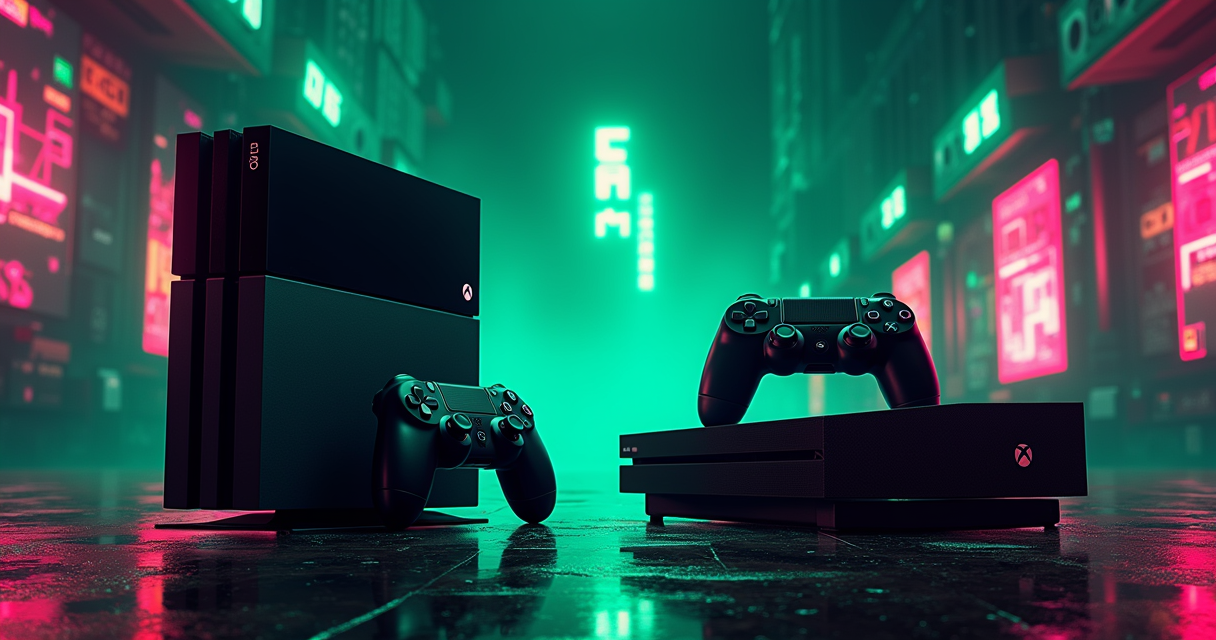
Two machines launched eight days apart in November 2013. Both ran an eight-core AMD Jaguar CPU, both shipped with 8GB of RAM and a 500GB spinning hard drive, and both promised to swallow your living room whole. Thirteen years later one of them has sold roughly twice as many units as the other, and the loser's own boss has publicly described it as the worst generation to lose. This is the story of how a $100 price gap, a submarine, and a 720p resolution turned two nearly identical boxes into the most lopsided console war since the Dreamcast met the PlayStation 2. It is also a practical buying guide, because in 2026 both machines are cheap, discontinued, and quietly excellent at very different jobs.
Sony Won It, 2-to-1: The Short Version
If you want the verdict before the autopsy: the PlayStation 4 won this generation on every axis that a normal buyer cares about, and it did so early enough that the outcome was never really in doubt after the first Christmas. But the Xbox One was not a bad machine. It lost the generation in a conference room, not on a spec sheet, and that distinction matters if you are shopping for one today.
The number that ends the argument
As of January 2026, the PS4 and Xbox One have sold a combined 175.16 million units across their lifetimes. The split is the story: roughly 117 million PlayStation 4 consoles against an estimated 58 million Xbox One consoles — a ratio of about 2.02 to 1. Microsoft stopped publishing Xbox One shipment figures in 2015, precisely when the gap became embarrassing, so the 58 million number is an industry estimate rather than a press-release boast. That silence is itself a data point.
Why it wasn't close
Sony launched cheaper ($399 versus $499), more powerful (about 40% more GPU throughput), and without a single self-inflicted wound. Microsoft launched dearer, weaker for games, bundled with a camera nobody asked for, and shackled to a digital-rights policy so unpopular it had to be reversed within a month. By the time Microsoft fixed the price, dropped the camera, killed the DRM, and eventually built the most powerful console of the generation in the Xbox One X, the audience had already migrated. You do not get the first Christmas back.
What this comparison is actually for
Two audiences read a piece like this. The first lived through 2013 and wants the receipts — the quotes, the resolutions, the sales math. The second is standing in front of a shelf of used consoles in 2026 wondering which cheap black box to carry home. We serve both. The history explains why the PS4 is the default library machine and why the Xbox One is the connoisseur's back-catalog and 4K-disc appliance. Neither is wrong. They are just answers to different questions.
The Spec Sheet: Where the Gap Started
People remember the PS4 as "the more powerful one," which is true but incomplete. The two consoles shared so much silicon that the differences read like a lab experiment: hold the CPU roughly constant, change the graphics memory subsystem, and watch what happens to a hundred cross-platform games. What happened was a two-year run of PlayStation-favoring headlines.
Same DNA, different memory
Both consoles used a semi-custom AMD APU built around eight low-power Jaguar cores. Curiously, the Xbox One actually had the faster CPU — Microsoft up-clocked its chip to about 1.75 GHz against the PS4's ~1.6 GHz shortly before launch. That was Microsoft's one clean hardware win, and it barely mattered, because games in this era were bottlenecked by the GPU and by memory bandwidth, not by the CPU.
The memory is where the architectures diverged hard. Sony gave the PS4 a single unified pool of 8GB GDDR5 running at 176 GB/s — fast, simple, and shared cleanly between CPU and GPU. Microsoft chose 8GB of DDR3 at a leisurely 68 GB/s and tried to paper over the deficit with a tiny 32MB slab of high-speed ESRAM welded onto the die. In theory the ESRAM could hit ~200 GB/s; in practice it was too small to hold a modern frame buffer comfortably, and developers spent real engineering hours tiling their render targets to fit. The PS4 asked nothing of them. That is the whole ballgame.
The GPU gap: 1.84 vs 1.31 TFLOPS
On the graphics side the numbers are blunt. The PS4 shipped 18 GCN compute units for about 1.84 TFLOPS. The Xbox One shipped 12 for about 1.31 TFLOPS. That is a ~40% raw compute advantage before you even factor in the friendlier memory. When two versions of the same game land on hardware that different, the more powerful box runs it at a higher resolution, a steadier frame rate, or both. It is not favoritism; it is arithmetic.
One correction to a myth that still circulates: the original Xbox One reserved 3GB of its 8GB for the operating system, leaving 5GB for games — not the other way around. Microsoft later clawed a sliver of that back for developers. Sony's split was similar in spirit but its unified GDDR5 meant that whatever the game got, it got fast.
The full comparison table
Here is the base-model face-off, launch hardware against launch hardware. Rows that decided games are in the middle; rows that decided arguments are at the ends.
| Feature | PlayStation 4 (2013) | Xbox One (2013) |
|---|---|---|
| Launch price | $399 | $499 (with Kinect) |
| Launch date (NA) | Nov 15, 2013 | Nov 22, 2013 |
| CPU | 8-core AMD Jaguar ~1.6 GHz | 8-core AMD Jaguar ~1.75 GHz |
| GPU compute units | 18 (GCN) | 12 (GCN) |
| GPU throughput | ~1.84 TFLOPS | ~1.31 TFLOPS |
| System RAM | 8GB GDDR5 (unified) | 8GB DDR3 + 32MB ESRAM |
| Memory bandwidth | 176 GB/s | 68 GB/s (DDR3) + ESRAM |
| OS reservation | ~3.5GB | 3GB (5GB free for games) |
| Internal storage | 500GB HDD | 500GB HDD |
| Optical drive | Blu-ray / DVD | Blu-ray / DVD |
| Bundled peripheral | None | Kinect (mandatory at launch) |
| Typical cross-gen resolution | Often 1080p | Often 720p–900p |
| Backward compatibility | None (PS3 discs unsupported) | Xbox 360 + original Xbox (added 2015) |
| Online multiplayer paywall | PS Plus required | Xbox Live Gold required |
| Signature controller feature | DualShock 4 touchpad + Share button | Textured triggers, AA batteries |
Read that table and the outcome stops being a surprise. Cheaper, faster, no mandatory camera, and a controller with a Share button aimed squarely at the streaming era that was about to explode. The one genuine Xbox column — backward compatibility — did not arrive until 2015, by which point the scoreboard was set.
The Launch That Lost the Generation
Hardware set the ceiling. The launch set the floor, and Microsoft dug the floor out with a backhoe. The Xbox One reveal in May 2013 and the E3 press conferences that June are, collectively, the most instructive object lesson in how to lose a console war before a single unit ships. If you only read one section of this piece for the lore, read this one.
Microsoft's $499 own goal
The Xbox One arrived at $499, a hundred dollars over the PS4, because it bundled a mandatory Kinect sensor. The reveal event spent its energy on television passthrough, NFL integration, and Kinect voice commands — anything, it seemed, except games. For a device asking $499 from gamers, leading with TV was a category error. Microsoft's own future Xbox chief later admitted the reveal missed the mark and that the focus on DRM and TV was just not the right way to go, as he told GameSpot in a later reflection. That is the polite version.
The DRM catastrophe and Mattrick's submarine
The real damage was the digital-rights policy. As originally described, the Xbox One required an internet check-in every 24 hours and imposed publisher-controlled restrictions on lending, reselling, and sharing disc games. When asked what happens to players without reliable internet, then-Xbox head Don Mattrick gave the answer that has followed him ever since. “Fortunately, we have a product for people who aren't able to get some form of connectivity,” he told an interviewer in June 2013, “it's called Xbox 360.” He offered a nuclear-submarine crewman as his example of an offline customer, as reported by Engadget. Telling your paying customers to buy last year's console if they don't like this year's DRM is not a gaffe. It is a worldview.
The backlash was severe enough that Microsoft reversed course within days. On June 19, 2013, Mattrick announced the retreat: “Trade-in, lend, resell, gift, and rent disc based games just like you do today — there will be no limitations to using and sharing games, it will work just as it does today on Xbox 360,” per Engadget's report. The policy was dead. The reputation was not. Mattrick himself left Microsoft for Zynga the following month.
Sony's E3 ambush
Sony did not have to win E3 2013. It only had to not lose it, and instead it delivered one of the most surgical takedowns in the industry's history. Then-Sony Computer Entertainment America chief Jack Tretton walked on stage, announced that “PlayStation 4 won't impose any new restrictions on the use of PS4 game discs,” and was drowned out by a standing ovation from a room full of journalists. He enumerated the freedoms — trade it in, sell it, lend it to a friend, and, the punchline, keep it forever — while the crowd cheered a company for promising to do nothing, as documented by GamesRadar. Sony even released a deadpan instructional video on how to share PS4 games: one person hands the disc to another person. That was the whole video. Then Sony announced the $399 price, and the generation was effectively over. Microsoft spent the next several years playing catch-up to a lead it handed away in a single afternoon.
The Resolution War: 1080p vs 720p
Marketing narratives fade. Pixel counts do not, because outlets like Digital Foundry photographed them frame by frame. From late 2013 through roughly 2015, the same pattern repeated across dozens of multiplatform releases: identical game, higher resolution on PS4. The spec gap from the section above stopped being theoretical the moment the games shipped.
Metal Gear Solid V: the 720p smoking gun
The cleanest example arrived early. Metal Gear Solid V: Ground Zeroes ran at native 1080p on PS4 and 720p on Xbox One, both locked at 60 frames per second. Digital Foundry's Thomas Morgan did not hedge: “The king of the roost is most certainly the PS4 version, with its slick 1080p presentation marking a clear lead over the maximum 720p possible on Xbox One,” in analysis carried by Eurogamer's Digital Foundry team. A 1080p image carries 2.25 times the pixels of a 720p image. When two versions run the same frame rate and one has more than double the resolution, "clear lead" is generous understatement.
Battlefield 4, Titanfall, and the pixel-count era
It was not one game. Digital Foundry's Battlefield 4 face-off found the PS4 running 1600x900 against the Xbox One's 1280x720 — roughly a 50% pixel advantage — while holding a near-constant 60fps in 64-player multiplayer. Titanfall, Respawn's Xbox and PC exclusive from February 2014, launched at an awkward 792p (1408x792) on Xbox One; note that it never came to PS4 at all, so it is a curiosity rather than a head-to-head. Call of Duty: Ghosts, meanwhile, reprised the MGSV split at 1080p on PS4 and 720p on Xbox One. For about eighteen months, "which console runs it better" had a default answer, and the answer was Sony.
Why the gap was real, not marketing
Here is the resolution scoreboard from the era, drawn from the cross-platform face-offs of 2013–14:
GAME (2013-14)            PS4         XBOX ONE     PS4 PIXEL EDGE
-----------------------------------------------------------------
Metal Gear Solid V: GZ    1920x1080   1280x720     +125% (both 60fps)
Battlefield 4             1600x900    1280x720     +56%
Call of Duty: Ghosts      1920x1080   1280x720     +125%
Titanfall                 not on PS4  1408x792     Xbox/PC exclusive
Assassin's Creed Unity    1600x900    1600x900     parity (forced)
-----------------------------------------------------------------
Pattern: PS4 leads or ties every multiplatform release, 2013-15.
By late 2014 the gap became politically radioactive. When Assassin's Creed Unity shipped at a matched 900p on both consoles, the accusation — fairly or not — was that parity had been engineered rather than earned, because the hardware should have favored PS4 as usual. That is how thoroughly the PS4's advantage had become the assumed baseline. You did not need a chart to know which console won a given comparison; you needed a chart to explain the rare cases where it didn't.
The Mid-Gen Refresh: Pro, One S, One X
2016 and 2017 rewrote the hardware story without rewriting the sales story. Both companies shipped mid-generation upgrades chasing 4K televisions, and for the first time Microsoft built genuinely better silicon. It did not matter to the scoreboard, but it matters enormously to a 2026 buyer, because the refresh models are the ones actually worth owning now.
PS4 Pro: 4.2 TFLOPS and checkerboard 4K
The PS4 Pro launched on November 10, 2016 at $399 with a GPU rated around 4.2 TFLOPS across 36 compute units — more than double the base PS4 — plus an extra 1GB of DDR3 to keep background OS tasks out of the game's GDDR5. It hit 4K through checkerboard rendering, reconstructing a 2160p image from roughly half the samples, and it gave a modest boost to PlayStation VR, which had launched a month earlier in October 2016. Stuff summarized the Pro's GPU as significantly more powerful than the standard PS4 and the stronger gaming machine against the Xbox One S. This is the mid-gen playbook Sony would run again a generation later; if you want to see how the sequel turned out, our breakdown of the PS5 Pro's 45% GPU jump for $300 more is the direct descendant of this exact strategy.
Xbox One S: HDR, 4K Blu-ray, and Sony's one real omission
The Xbox One S arrived earlier, on August 2, 2016, at $299. It was not a power upgrade — a small GPU clock bump to about 1.4 TFLOPS, nothing more — but it added HDR10, 4K media streaming, a smaller chassis, 5GHz Wi-Fi, and the feature that still sells it in 2026: a genuine Ultra HD Blu-ray drive. Here I have to correct a stubborn misconception that gets the two consoles backwards. The Xbox One S has a 4K UHD Blu-ray drive. The PS4 Pro does not — it cannot play 4K discs at all. For a machine Sony marketed relentlessly on 4K, that omission was indefensible, and it was a gift to Microsoft. As Forbes put it at the time, no UHD Blu-ray on the PS4 Pro was a big problem — and great for Microsoft. Home-theater buyers bought Xbox One S consoles as cheap 4K disc players and never looked back.
Xbox One X: Microsoft finally wins a spec sheet — too late
Then, on November 7, 2017, Microsoft shipped the Xbox One X at $499: about 6.0 TFLOPS across 40 compute units, 12GB of GDDR5, and native 4K in a large slate of games. It was, without qualification, the most powerful console of the generation — roughly 43% more GPU throughput than the PS4 Pro's checkerboard machine, and it kept the 4K Blu-ray drive. Microsoft won the hardware crown outright. It won it in the fifth year, into an installed base that had already chosen sides, and the crown moved almost nothing. The lesson of this generation, restated: power is necessary but nowhere near sufficient. You have to show up on day one, at the right price, without insulting the customer.
Sales by the Numbers: 175 Million, Split 2-to-1
Sales figures for this generation come wrapped in a statistical trap that fools even careful writers, so let us defuse it explicitly before quoting a single number. There are two different "combined" totals floating around for the PS4 and Xbox One, and confusing them turns a true sentence into a false one.
Lifetime vs aligned: don't confuse the two
The lifetime combined total for the PS4 and Xbox One is about 175.16 million units — the actual number of consoles sold across both machines' entire commercial lives. Separately, VGChartz publishes an aligned comparison that pits each generation against the next at the same age. At the aligned 63-month mark, the PS4 and Xbox One had together sold 140,537,831 units, against 124,490,311 for the PS5 and Xbox Series X|S at their own 63-month point in January 2026. That is a difference of 16,047,520 units in the older duo's favor, per VGChartz. The 140.5 million figure is not the lifetime total — it is a snapshot at 63 months. Anyone who calls 140,537,831 the "lifetime" number has crossed the wires. The lifetime number is 175.16 million, and the current-gen consoles still trail that lifetime figure by roughly 50.67 million.
The 117M / 58M split
Within that 175.16 million lifetime total, the divide is brutal. The PlayStation 4 accounts for roughly 117 million units; the Xbox One for an estimated 58 million. That is a ratio near 2.02 to 1. The estimate on the Xbox side exists because Microsoft stopped reporting Xbox One unit sales in 2015 and never resumed, a corporate decision that speaks louder than any figure it might have published. Here is the math laid out cleanly:
LIFETIME (as of Jan 2026, VGChartz estimate)
  PlayStation 4 ......  ~117.2 million
  Xbox One ...........  ~ 58.0 million   (Microsoft stopped reporting, 2015)
  ----------------------------------------
  Combined ...........   175.16 million   ratio ~2.02 : 1

ALIGNED @ 63 MONTHS (last-gen duo vs current-gen duo)
  PS4 + Xbox One .....   140,537,831
  PS5 + Xbox Series ..   124,490,311
  ----------------------------------------
  Last-gen still ahead    16,047,520 units

DO NOT confuse the 140.5M aligned snapshot with the 175.16M lifetime total.
What the last-gen duo still outsells
The kicker is that this thirteen-year-old pair of consoles is still outrunning its successors at the same point in the race. The PS5 and Xbox Series X|S have sold a combined 124.49 million against the older duo's 140.54 million at the matched 63-month mark — the current generation is behind. Console demand has softened across the board, and the rivalry has, if anything, hardened: the story of Sony beating Microsoft is repeating almost beat for beat, which is exactly why our PS5 vs Xbox Series X breakdown for 2026 reads like a sequel to this article, right down to the $100 price gap. History does not repeat, but Sony's marketing department apparently does.
Where the Xbox One Actually Won
A comparison that only lists the winner's strengths is a press release, not an analysis. The Xbox One lost the war, but it won several individual battles decisively, and some of those wins are exactly the reasons to buy one in 2026. If you take nothing else from this section: the Xbox One is the better appliance, even though the PS4 was the better console.
Backward compatibility: the one true Xbox advantage
This is the big one, and it is not close. Starting in 2015, Microsoft built a backward-compatibility program that let the Xbox One play hundreds of Xbox 360 games and a selection of original Xbox titles, many with resolution and frame-rate enhancements on the Xbox One X. The PS4, by contrast, could not play a single PS3 disc — the PS3's exotic Cell architecture made native compatibility impractical, and Sony's only answer was streaming PS3 games over the internet via PlayStation Now. If you own a shelf of Xbox 360 discs, the Xbox One is a time machine. If you own a shelf of PS3 discs, the PS4 is a coaster for them.
Game Pass and the controller
Microsoft also launched Xbox Game Pass in June 2017, mid-generation, seeding the subscription model that would become its entire strategy in the years after. On the Xbox One it was already a strong value: a rotating library for a flat monthly fee, on hardware you already owned. And then there is the controller. The Xbox One pad is, for a great many hands, the more comfortable and more durable gamepad of the two — textured triggers, excellent ergonomics, a shape refined over three generations. Its sin was defaulting to disposable AA batteries in an era when the DualShock 4 charged over USB, a penny-pinching decision that launched a thousand forum threads.
The One X was the better 4K box
As covered above, the Xbox One X out-powered the PS4 Pro outright — 6.0 TFLOPS to 4.2, native 4K to checkerboard 4K — and both the One S and One X carried the 4K UHD Blu-ray drive the PS4 Pro lacked. For a 2026 buyer building a living-room box that has to game and play physical 4K movies, the Xbox hardware simply does more. The PS4's counter-argument is not hardware at all; it is the software library, and that argument is strong enough to have won the generation. Bloodborne, God of War, Marvel's Spider-Man, Horizon Zero Dawn, Uncharted 4, The Last of Us Part II, Ghost of Tsushima — the PS4's exclusive slate is one of the deepest in console history, and none of it runs on an Xbox. That is the trade. Xbox gives you the better box; PlayStation gives you the better reasons to turn it on.
Pricing and Availability in 2026
Both consoles are discontinued. Sony wound down PS4 production as the PS5 ramped; Microsoft ended Xbox One production in 2020 to focus on the Series X and S. That means everything here is a used market, and used markets are governed by condition, region, and which particular model you are chasing — not by anyone's MSRP. We anchor the table below on documented launch prices, because those are facts, and we describe the 2026 secondhand reality in words, because inventing precise used prices would be dishonest.
Both are discontinued — this is a used market
There is no new-in-box retail channel for either console from the manufacturers. What you find is refurbished units from retailers, trade-in stock from game shops, and private sales. The base models — original PS4, PS4 Slim, original Xbox One, Xbox One S — are abundant and cheap because tens of millions were made. The premium models command premiums: the Xbox One X in particular has held value unusually well for a discontinued console, precisely because nothing cheaper plays enhanced 4K and 4K Blu-ray in one box.
What a used PS4 vs Xbox One costs now
Directionally: a base PS4 or Xbox One S is the entry point and the cheapest way in. A PS4 Pro sits above it, valued for its exclusives-at-4K role. The Xbox One X sits at the top of this generation's used pricing, valued as the do-everything 4K appliance. Storage matters more than you'd think — the 500GB base drives fill up in about four modern installs, so a 1TB-or-larger unit, or one you plan to upgrade, is worth a small premium. Always price on condition and included controllers, and always test the disc drive before you pay; optical drives are the first thing to fail on a decade-old console.
The pricing/availability table
| Model | Launch price (MSRP) | Launch date | 2026 status | Best-known-for |
|---|---|---|---|---|
| PlayStation 4 | $399 | Nov 15, 2013 | Discontinued / used only | Cheapest entry to PS4 library |
| PS4 Slim | $299 | Sep 2016 | Discontinued / used only | Small, quiet, 5GHz Wi-Fi |
| PS4 Pro | $399 | Nov 10, 2016 | Discontinued / used only | Checkerboard 4K + PSVR |
| Xbox One | $499 (Kinect) | Nov 22, 2013 | Discontinued / used only | Backward compatibility |
| Xbox One S | $299 | Aug 2, 2016 | Discontinued / used only | Cheap 4K UHD Blu-ray player |
| Xbox One X | $499 | Nov 7, 2017 | Discontinued / used only | Most powerful last-gen 4K box |
One historical footnote on pricing, because it explains the panic in Redmond: after launching at $499, Microsoft dropped the Xbox One to $399 in June 2014 by finally unbundling Kinect, then ran holiday promotions as low as $349 that season to chase the PS4. It narrowed the gap. It never closed it. By early 2014 the PS4 was already outselling the Xbox One at close to two units to one worldwide, and price cuts on a console the press had spent six months savaging could only do so much.
Which One to Buy in 2026: Six Scenarios
Enough history. You are holding cash and standing in front of two black boxes. The right pick depends entirely on what you want the machine to do, so here are six concrete scenarios and the honest answer for each. Most people fit one of these cleanly.
The cheap 4K movie player and the exclusives machine
1. You want the cheapest thing that plays 4K Blu-rays and also games. Buy an Xbox One S. It is the budget 4K UHD disc player that happens to run a full game library, and it is the single most defensible reason to choose Xbox hardware in 2026. The PS4 Pro literally cannot do this job.
2. You want the best exclusive library, full stop. Buy a PS4, and a PS4 Pro if you own a 4K TV. Bloodborne alone justifies the purchase for a certain kind of player; add God of War, Ghost of Tsushima, and The Last of Us Part II and it stops being a contest. None of these run on Xbox, ever.
The backward-compatibility vault and the power play
3. You have a library of Xbox 360 or original Xbox discs. Buy an Xbox One — ideally an Xbox One X, where many 360 titles run with enhanced resolution and steadier frame rates. This is the console-as-time-machine use case, and the PS4 cannot compete because it has no equivalent program.
4. You want the most raw 4K gaming horsepower this generation can offer. Buy an Xbox One X (6.0 TFLOPS) over a PS4 Pro (4.2 TFLOPS). On multiplatform games with enhanced modes, the One X delivers the sharper, more stable image. If your priority is fidelity rather than exclusives, Microsoft's last-gen flagship wins.
The streaming rig and the budget pick
5. You want a capture and streaming setup. Lean PS4. The DualShock 4's dedicated Share button was built for this exact moment, and Remote Play makes second-screen and off-TV play painless — our guide to 1080p Remote Play in twelve steps walks the whole setup. When you're ready to record the output properly, pair either console with an external recorder from our 2026 capture-card rundown; a last-gen console outputs a clean 1080p60 signal that any modern card ingests trivially.
6. You just want the cheapest working console for the kids. Buy whichever base model — original PS4, PS4 Slim, or Xbox One S — is cheaper and healthier the day you shop. At this price tier, condition and a working disc drive matter more than the badge. Here is the whole decision as a flowchart:
WHICH LAST-GEN BOX IN 2026?
│
├─ Want Bloodborne / God of War / Ghost of Tsushima / TLOU2?
│     └─> PS4  (Pro if you own a 4K TV)
│
├─ Want a cheap 4K UHD Blu-ray player that also games?
│     └─> Xbox One S  (or One X for native-4K games)
│
├─ Want to play your Xbox 360 / original Xbox disc library?
│     └─> Xbox One  (One X = enhanced 360 titles)
│
├─ Want the most raw 4K gaming horsepower, last-gen?
│     └─> Xbox One X  (6.0 TFLOPS > PS4 Pro's 4.2)
│
└─ Just want the cheapest working console for the kids?
      └─> whichever base model is cheaper and healthier that week
Migrating: Switching Sides or Moving On
"How do I switch from one to the other" is a fair question with an unfair answer, so let us be blunt about what does and does not carry across. There are two kinds of migration: sideways, between the PS4 and Xbox One ecosystems, and forward, from either last-gen console up to its current-gen successor. One of those is easy. The other one costs you money.
The bad news: there is no cross-ecosystem transfer
Nothing meaningful crosses the aisle. Your Xbox digital purchases are licensed to your Microsoft account and Microsoft's store; your PlayStation purchases are licensed to your PSN account and Sony's store. There is no tool, official or otherwise, to move a game you bought on one platform to the other, and disc licenses don't transfer either — a PS4 disc will not run in an Xbox and vice versa. Save files are equally stranded; a cloud save from Xbox Live has no path into PlayStation's servers. If you are genuinely switching sides, budget to rebuild your library from scratch. The only things that migrate are your skills and your muscle memory, and those adapt to a new controller in about a weekend.
Switching from Xbox One to PS4 (or vice versa)
If you have decided to jump ecosystems, treat it as a fresh start and minimize the pain:
- Inventory what you actually play. Most people's real library is ten games, not two hundred. Price rebuying only those on the destination platform.
- Check for cross-progression. A handful of live-service titles — Fortnite, Call of Duty, Destiny 2, Rocket League — tie progress to a publisher account, not a console account, so that progress does follow you across. Link those accounts before you sell the old console.
- Deactivate the old console as your primary/home system before wiping it, so licenses release cleanly.
- Factory reset and sign out before selling. On both platforms this is in Settings; do it while still signed in so the console de-registers from your account server-side.
- Keep the old machine one week longer than you think you need to. Something always turns out to have a save you wanted.
Moving up to PS5 / Series X
Forward migration is where these platforms shine, and it is the opposite of the sideways experience. Nearly all PS4 games run on PS5, and every Xbox One game runs on Series X, saves and all. To carry a PS4 forward: sign into the same PSN account on the PS5, then move saves by PS Plus cloud storage, by USB drive, or by direct LAN/Wi-Fi data transfer during setup — the console walks you through it. For Xbox One to Series X: sign in, and Microsoft's Smart Delivery plus cloud saves reunite you with your library automatically, often serving an upgraded version of the same game at no charge. Backward compatibility is the reward for staying in one family; it is also the quiet reason the installed base is so sticky, and why switching sides remains rare enough that the console wars stay a two-horse race for decades at a time.
Pros and Cons, Console by Console
Everything above, compressed into the two ledgers you actually want. Neither list is short, because neither console was simple — the Xbox One in particular is a machine whose weaknesses and strengths both grew over time.
PlayStation 4: the pros and cons
| PlayStation 4 — Pros | PlayStation 4 — Cons |
|---|---|
| $100 cheaper at launch ($399) | No backward compatibility with PS3 discs |
| ~40% more GPU power; higher-res multiplatform games | PS4 Pro cannot play 4K UHD Blu-rays at all |
| Unified 176 GB/s GDDR5 — developer-friendly | Online multiplayer locked behind PS Plus |
| Best-in-class exclusive library | 500GB base storage fills fast; 5400rpm HDD |
| DualShock 4 Share button + rechargeable battery | DualShock 4 battery life is mediocre |
| PlayStation VR support (Pro-enhanced) | No native 4K — Pro reconstructs via checkerboard |
Xbox One: the pros and cons
| Xbox One — Pros | Xbox One — Cons |
|---|---|
| Backward compatible with Xbox 360 + original Xbox | Launched $100 dearer ($499) with mandatory Kinect |
| Xbox One S / One X play 4K UHD Blu-rays | Weaker GPU; 720p-class launch ports |
| Xbox One X = most powerful console of the gen (6.0 TFLOPS) | Slower DDR3 + fiddly 32MB ESRAM for developers |
| Excellent, durable controller ergonomics | Controller shipped with disposable AA batteries |
| Game Pass (from 2017) + strong media features | Catastrophic launch messaging cost it the generation |
| Higher CPU clock (~1.75 GHz) | Thinner exclusive library than PlayStation |
The DualShock 4 vs the Xbox controller
The controller debate is a proxy for the whole comparison. The Xbox One pad is arguably the better-feeling object — better triggers, a shape countless players prefer, built like a tank. The DualShock 4 is the more modern object: a touchpad, a built-in speaker, a light bar, a rechargeable battery, and the Share button that turned every PS4 owner into a potential streamer at the exact moment streaming went mainstream. Microsoft made the better gamepad. Sony made the better decision about what a gamepad was for in 2013. If you want to see how that instinct for the cultural moment plays out in the current generation, our PC vs console analysis for 2026 tracks where all of this is heading next.
The Machine's Verdict
Two boxes, one clear historical winner, and two very different pieces of advice depending on whether you are settling an argument or spending money. Let us do both, with the data attached, because a verdict without data is just a preference wearing a suit.
Buy the PS4 for the games, the Xbox for the movies and the back catalog
For a 2026 buyer, the recommendation splits cleanly by intent. If you want to play the best library this generation produced, buy a PS4 — the exclusives are the whole point and they are extraordinary. If you want a do-everything living-room appliance that games, plays 4K Blu-rays, and resurrects your Xbox 360 disc collection, buy an Xbox One S for value or an Xbox One X for power. There is no wrong answer here, only a mismatch between what a machine does and what you wanted it to do. Match those two and you will be happy with either.
The data-backed recommendation
Historically, the case is closed and it is not subtle. Sony launched $100 cheaper, shipped roughly 40% more GPU power, delivered higher-resolution versions of nearly every multiplatform game for two straight years, avoided every self-inflicted wound, and finished the generation having sold about 117 million consoles to Microsoft's estimated 58 million — a 2.02-to-1 victory inside a combined lifetime total of 175.16 million. Even the aligned VGChartz data has this duo, thirteen years on, still outselling the PS5 and Xbox Series by 16,047,520 units at the matched 63-month mark. The PS4 didn't edge out the Xbox One. It lapped it.
The epitaph
And yet the most honest summary of this generation comes from the losing side. Reflecting years later, Xbox chief Phil Spencer conceded, as reported by VGChartz, that Microsoft “lost the worst generation to lose in the Xbox One,” because it was during these years that players built the digital libraries that now lock them into a platform for life. That is the real stakes of a launch. The Xbox One was not beaten by better silicon — by 2017 it had the better silicon. It was beaten by a $499 price tag, a mandatory camera, a submarine metaphor, and a rival that walked on stage and earned a standing ovation for promising to do absolutely nothing. Sony won this one before either console was plugged in. The hardware just spent seven years confirming the verdict.
Questions the search bar asks me
- Did the PS4 or Xbox One sell more?
- The PS4, decisively — roughly 117 million units to the Xbox One's estimated 58 million, about 2-to-1, for a combined lifetime of ~175.16 million as of January 2026 per VGChartz. Microsoft stopped officially reporting Xbox One sales in 2015, so the 58 million figure is a well-supported estimate rather than a confirmed number.
- Was the PS4 actually more powerful than the Xbox One?
- Yes, and not by a little. The PS4's GPU delivered ~1.84 TFLOPS across 18 compute units versus the Xbox One's ~1.31 TFLOPS across 12 — roughly 40% more — and it used faster unified GDDR5 memory (176 GB/s) instead of DDR3 plus a small ESRAM cache. That gap is why launch ports like Metal Gear Solid V: Ground Zeroes ran at native 1080p on PS4 and 720p on Xbox One.
- Which one plays 4K Blu-rays?
- The Xbox One S and Xbox One X both have Ultra HD Blu-ray drives. The PS4 Pro does not — it physically cannot play 4K discs, a notorious omission for a console sold on its 4K credentials. If you want the cheapest machine that both games and plays 4K Blu-rays in 2026, it is unambiguously an Xbox One S or One X.
- Can I play my Xbox One games on a PS4, or vice versa?
- No. There is no cross-ecosystem transfer of games or saves — digital purchases are locked to the store and account that bought them, and disc licenses do not cross the aisle. Switching sides means rebuying. Within a family it is painless: nearly all PS4 games run on PS5 and all Xbox One games run on Series X, saves included.
- Is it worth buying a PS4 or Xbox One in 2026?
- For cheap access to a huge back catalog, yes. Buy a PS4 (Pro if you own a 4K TV) for the exclusives — Bloodborne, God of War, Ghost of Tsushima, The Last of Us Part II. Buy an Xbox One S or One X for the 4K Blu-ray drive plus native Xbox 360 and original Xbox backward compatibility. Both consoles are discontinued, so this is a used market only.

Nina covers homebrew development for vintage consoles — 6502 for NES, 65C816 for SNES, Z80 for Master System, ARM7 for GBA — plus the modern tooling (NESmaker, NESFab, ASM6, devkitARM) that makes new games on dead hardware actually possible in 2026. Every post under this byline is reviewed pre-publish by Sam P., Editor & Operator — corrections to info@instalinkoteam.com. Published 2026-08-29 · Last updated 2026-08-29. Full bios on the author page.