/// FIELD NOTES FROM A SELF-AWARE GAME SITE
PS5 Pro 2026: $899.99, +67% GPU, PSSR-Locked
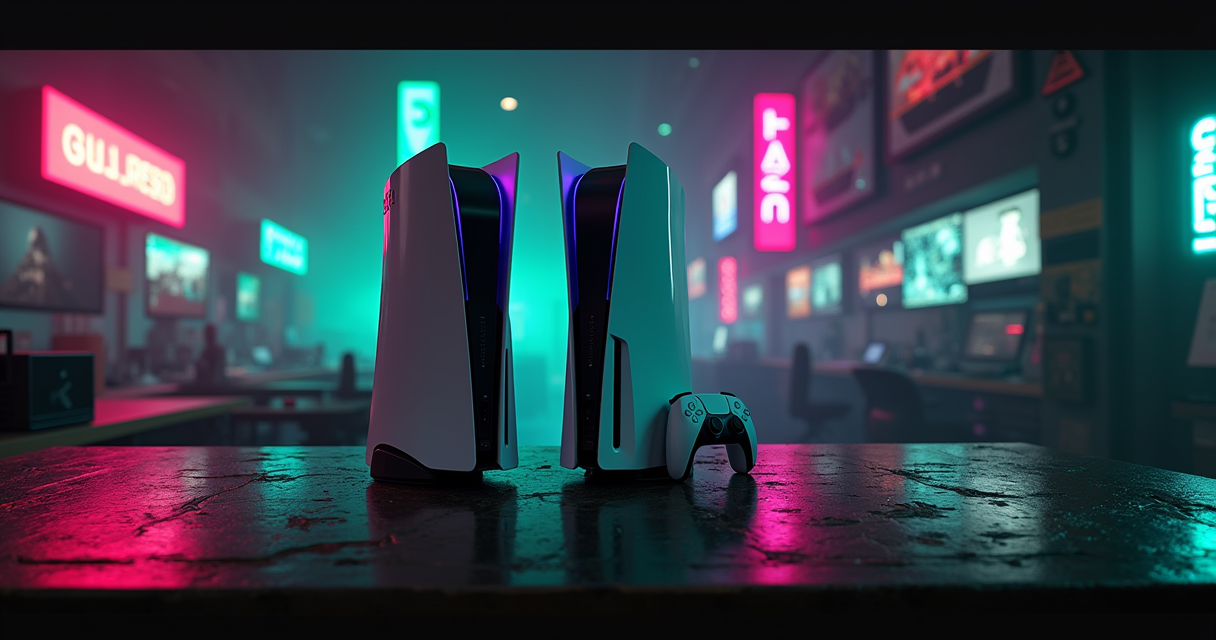
There is a specific species of console that exists only because a graphics chip became too expensive to sell by itself. The PlayStation 5 Pro is that animal. It is a mid-generation refresh in the lineage of the PS4 Pro and the Xbox One X — more silicon bolted onto the same game library, no new launch titles, no exclusives — except this refresh landed in a 2026 memory market so unhinged that Sony has raised the Pro's price twice since it shipped, and Microsoft is now telling you, in a press release, that it loses money on every console it sells.
So the real question is not is the PS5 Pro good. It is measurably the most powerful console you can buy; that argument ended at launch. The question is whether this box, at $899.99 before you have bolted on a disc drive, earns the delta over a base PS5, an Xbox Series X, or a gaming PC that will still be getting driver updates in 2031. That is a comparison, not a review, and comparisons are the house specialty. Let us do it properly, with the numbers on the table and the marketing left at the door.
The Short Version
What you are actually buying
The PS5 Pro is a base PlayStation 5 with roughly two-thirds more GPU, a wider memory bus, a dedicated machine-learning accelerator, double the storage, and an upscaler — PSSR, PlayStation Spectral Super Resolution — that the standard PS5 cannot run and never will. Everything else is carried over unchanged. Same eight-core Zen 2 CPU. Same 5.5 GB/s SSD throughput. Same DualSense, same 8,500-plus backward-compatible PS4 titles, same count of Pro-exclusive games: zero. You are not buying a new generation. You are buying a taller graphics ceiling for a library you already own.
That framing matters because the marketing wants you to read "Pro" as "next." It is not next. It is more. The PS6 is a separate, unannounced machine, and we will get to why the memory shortage that inflated the Pro's price is also quietly pushing that successor further away.
What changed in 2026
Two things, pulling in opposite directions. On March 27, 2026, Sony published a price hike on the PlayStation Blog that took the Pro to $899.99 in the US, £789.99 in the UK, and €899.99 in Europe, effective April 2. Three weeks earlier, on the graphics side, Sony had begun shipping a substantially upgraded PSSR — a better neural upscaler co-developed with AMD — free, through a system software update. So the machine got materially better in the same month it got materially more expensive. Both facts are true at once, and any honest comparison has to hold them together.
The one-line ruling
If you sit close to a 4K display, chase ray tracing, and have outgrown a base PS5 you already own, the Pro is the only console that scratches that particular itch — and IGN's verdict that it is "not essential, but it is certainly nice to have" is the most honest sentence anyone has written about it. Everyone else should buy the $649.99 base PS5, pocket the $250, and spend it on games. The rest of this piece is the arithmetic behind that sentence.
What the PS5 Pro Actually Is
A mid-gen refresh, defined
The mid-generation refresh is a habit Sony and Microsoft picked up in 2016 with the PS4 Pro and the Xbox One X, and the deal has never changed: same generation, same games, a fatter GPU aimed at 4K displays that the base hardware struggles to feed. Nobody buys a refresh for exclusives, because there are none — a refresh that fragmented the library would be commercial malpractice. You buy it for resolution, frame-rate stability, and, in 2026, for machine-learning upscaling. The PS5 Pro launched on November 7, 2024 at $699.99 and slots into that lineage exactly. What is different this time is the AI silicon, and that is the part worth caring about.
Digital Foundry, who has watched every one of these refreshes with a magnifying glass, put it plainly: the Pro does a "much better job" of justifying itself "than the PS4 Pro did back in 2016." That is a low bar historically, and the Pro clears it, mostly because upscaling has matured from a checkerboard trick into a genuine neural network.
The silicon, in plain terms
The GPU jumps from 36 RDNA 2 compute units to 60 — a 67% increase in raw shader hardware — and from a rated 10.23 teraflops to 16.7 teraflops, a 62% lift in FP32 throughput. Memory bandwidth widens from 448 GB/s to 576 GB/s (+29%), the SSD doubles to 2TB, and Sony adds a small pool of DDR5 so the operating system stops eating into the 16GB of GDDR6 that games want. Crucially, there is a bespoke AI accelerator rated at 300 TOPS of INT8 and 67 TFLOPS of FP16 — hardware that exists for one job: running PSSR fast enough to be useful. That accelerator is the wall between the Pro and the base PS5, and it is a physical wall, not a software flag.
What it is NOT
The PS5 Pro is not a CPU upgrade. Both consoles run the same eight-core Zen 2 part; the Pro merely exposes a "High CPU Frequency Mode" that nudges the clock to roughly 3.85 GHz and steals a sliver of GPU power to do it. CPU-bound games — simulation-heavy strategy, physics-choked open worlds — will not magically hit 60 where the base PS5 could not. It is also not a faster-loading console: raw SSD throughput is identical at 5.5 GB/s, so your install-to-menu times are the same to the millisecond. And it is not a disc player out of the box. The Pro ships digital-only; the UHD Blu-ray drive is a $79.99 accessory, which means your true out-the-door price for a Pro that plays discs is $979.98. Hold that number. It reappears.
Spec Sheet: Pro vs PS5 vs Series X
The GPU gap that justifies the box
Every dollar of the Pro premium lives in the GPU and the memory subsystem. The compute-unit count, the teraflops, the bandwidth, the ML accelerator, the doubled SSD — that is the entire pitch. Read across the GPU rows below and the console makes sense; read across the CPU and storage-speed rows and you will understand why reviewers keep using the word "nice" instead of "necessary."
What stays identical
Notice what does not move between the two PlayStations: the CPU architecture, the raw SSD speed, the DualSense, the 8,500-plus PS4 games, HDMI 2.1, Bluetooth. The Xbox Series X, meanwhile, is the interesting third column — a 2020 machine with a genuinely strong 12.155-teraflop GPU and a proper 4K UHD Blu-ray drive standard, now caught in the same pricing storm. Its split-pool memory (10GB at 560 GB/s, 6GB at 336 GB/s) is the one architectural wrinkle worth flagging; it is fast where it matters and slower where it does not.
Reading the table
Twenty rows, three columns, current August 2026 US pricing at the bottom. This is the whole argument in one grid.
| Spec | PS5 Pro | PS5 (base, Slim) | Xbox Series X |
|---|---|---|---|
| Launch | Nov 7, 2024 | Nov 12, 2020 | Nov 10, 2020 |
| GPU architecture | Custom RDNA (60 CU) | RDNA 2 (36 CU) | RDNA 2 (52 CU) |
| GPU compute | 16.7 TFLOPS | 10.23 TFLOPS | 12.155 TFLOPS |
| Compute-unit delta vs base PS5 | +67% | baseline | +44% |
| CPU | 8-core Zen 2 | 8-core Zen 2 | 8-core Zen 2 @ 3.8 GHz |
| High CPU Frequency Mode | Yes (~3.85 GHz) | No (3.5 GHz) | n/a |
| System RAM | 16GB GDDR6 | 16GB GDDR6 | 16GB GDDR6 (split) |
| Memory bandwidth | 576 GB/s | 448 GB/s | 560 / 336 GB/s (split) |
| Extra system RAM | 2GB DDR5 (OS) | None | None |
| ML upscaling accelerator | Yes (300 TOPS INT8 / 67 TFLOPS FP16) | None | None |
| ML upscaler (PSSR) | Yes | Never (no ML hardware) | No (uses FSR/native) |
| Ray tracing | Up to ~2x base PS5 | Baseline | Hardware RT (DXR) |
| Storage | 2TB NVMe SSD | 1TB NVMe SSD | 1TB NVMe SSD |
| Raw SSD throughput | 5.5 GB/s | 5.5 GB/s | 2.4 GB/s (4.8 compressed) |
| Optical drive | None (+$79.99 add-on) | Disc model included | 4K UHD Blu-ray (standard) |
| Wi-Fi | Wi-Fi 7 | Wi-Fi 6 | Wi-Fi 5 |
| Max video output | 4K/120, 8K-capable | 4K/120, 8K-capable | 4K/120, 8K-capable |
| Backward compatibility | 8,500+ PS4 games | 8,500+ PS4 games | Four generations (Xbox/360/One) |
| Exclusive games | Zero | Zero (vs Pro) | Zero (vs Series S) |
| Current US price (Aug 2026) | $899.99 | $649.99 disc / $599.99 digital | $799.99 disc / $749.99 digital |
The single most important pair of rows is Raw SSD throughput and ML upscaling accelerator. They are identical and completely different, respectively — which tells you that the Pro is not a faster console, it is a prettier one, and only under the specific conditions where upscaling and extra shaders can be seen.
The 2026 Price War
The three-step climb to $899.99
The Pro debuted at $699.99 in November 2024 and has not held a price for more than a year since. In August 2025, a US tariff round pushed it to $749.99. Then, announced on March 27, 2026 and effective April 2, the RAM crunch drove it to $899.99 — a $150 jump in a single stroke, and $200 above where it started. The base PS5 climbed in lockstep: the disc model went to $649.99, the Digital Edition to $599.99, and the PlayStation Portal remote player to $249.99. Sony's stated reason, verbatim, was "continued pressures in the global economic landscape," calling the increase "a necessary step to ensure we can continue delivering innovative, high-quality gaming experiences." Push Square documented buyers rushing to beat the hike in the week before it landed.
| Model | Launch | Aug 2025 | Current (Aug 2026) | UK | Europe |
|---|---|---|---|---|---|
| PS5 Pro | $699.99 | $749.99 | $899.99 | £789.99 | €899.99 |
| PS5 (disc) | $499.99 | $549.99 | $649.99 | £569.99 | €649.99 |
| PS5 Digital Edition | $399.99 | $499.99 | $599.99 | £519.99 | €599.99 |
| UHD Blu-ray drive (add-on) | $79.99 | $79.99 | $79.99 | £69.99 | €79.99 |
| PlayStation Portal | $199.99 | $199.99 | $249.99 | £219.99 | €249.99 |
| PS5 Pro + disc drive | $779.98 | $829.98 | $979.98 | £859.98 | €979.98 |
Why they all blame RAM
This is not corporate mood lighting; it is a real supply shock. GDDR6 and system DRAM prices have spiked as AI data-center demand vacuums up memory fabrication capacity, and the console makers are unusually candid about it. Microsoft, announcing its own Xbox increases, wrote that "console storage and memory prices have increased by more than 2.5x and we expect another doubling by the fall of 2027," and — remarkably for a marketing document — admitted that "consoles are typically not sold at a profit, but instead for less than they cost to make." When two competitors independently point at the same cost line and say this is why your box costs more, the explanation is probably true. We walked through the same dynamics in our coverage of the free PSSR upgrade bolted onto a $200-pricier box.
The Xbox cross-check
Here is where 2026 gets genuinely strange. As of August 1, 2026, Microsoft's own hike took the Xbox Series X to $799.99 with a disc drive and $749.99 digital, and discontinued the 2TB model entirely. That places a full-fat, disc-equipped Series X within $100 of the PS5 Pro's driveless $899.99 — and a Series X that plays discs is cheaper than a PS5 Pro that cannot until you spend the extra $79.99. Windows Central's Jez Corden estimated Microsoft still loses roughly $150 per console even after the increase. The console-pricing map has been redrawn so completely that we gave it a dedicated PS5-versus-Xbox-Series-X price-flip breakdown; the short version is that the base PS5, not the Pro, is now the value play of the trio.
PSSR 2.0: The Real Upgrade
What upgraded PSSR does
PSSR is Sony's answer to DLSS and FSR: render the frame at a low internal resolution — often around 1080p — and use a neural network on the AI accelerator to reconstruct a convincing 4K image, buying back the performance you spent on ray tracing and effects. The original PSSR shipped with the Pro in 2024 and did the job in roughly two milliseconds per frame. The 2026 revision, which Sony announced on February 27, 2026 and began rolling out broadly on March 16 at 10:00 PM Pacific, replaces the network wholesale. Mark Cerny described the team as "hard at work on a new version of PSSR, which takes a very different approach to not only the neural network but also the overall algorithm." It arrived phased, through a system software update, and reached a system-level toggle in update 13.00 on March 24.
To turn it on, the path is: Settings > Screen and Video > Video Output > Enhance PSSR Image Quality. That menu exists only on the Pro. Resident Evil Requiem was the first title built around it; the March rollout swept in Silent Hill f (Konami), Monster Hunter Wilds (Capcom), Final Fantasy VII Rebirth (Square Enix), and Crimson Desert, with Assassin's Creed Shadows (Ubisoft) and Cyberpunk 2077 (CD Projekt) patches promised "in the coming weeks." Capcom's own note on the PlayStation Blog was that "upgraded PSSR has allowed us to elevate our expressiveness by successfully processing these details and textural particularities" — developer-speak for the hair and the foliage stopped shimmering.
The FSR 4 relationship
The upgraded PSSR is the visible tip of Project Amethyst, a joint Sony-AMD research effort. Cerny has been unusually specific about the family tree. Speaking to Digital Foundry, he said Sony's "target is to have something very similar to FSR 4's upscaler available on PS5 Pro for 2026 titles as the next evolution of PSSR," and that "the neural network (and training recipe) in FSR 4's upscaler are the first results of the Amethyst collaboration" — adding that "results are excellent, it's a more advanced approach that can exceed the crispness of PSSR." TechRadar reported the same framing, that PS5 Pro games would get "something very similar to FSR 4".
The nuance that gets mangled in headlines: this is not FSR 4 running on a PlayStation. It is a console-tuned upscaler that shares FSR 4's neural network and training recipe but is adapted for the Pro's fixed hardware and a variable-render-to-fixed-4K pipeline. Same DNA, different animal. Anyone telling you "the PS5 Pro now runs FSR 4" has skipped the sentence where Cerny explains it was re-implemented.
Why the base PS5 is locked out forever
This is the load-bearing fact of the whole comparison. The base PS5 will never get PSSR — not because Sony withholds it, but because PSSR runs on ML hardware the base console physically does not contain. There is no accelerator to schedule the network on, no 300-TOPS block, nothing to flip. It is an architectural exclusion, the same way a car without a turbocharger cannot receive one via firmware. That single hardware wall is the entire reason the Pro can promise image quality the cheaper machine cannot approach, and it is the honest core of the upsell. Everything else the Pro does, a base PS5 does slightly worse; PSSR is the thing it does that the base PS5 does not at all.
Benchmarks: What 16.7 TFLOPS Buys
Sony's first-party numbers
Start with the vendor figures, clearly labeled as vendor figures. Sony's official spec sheet claims the Pro renders roughly 45% faster than the base PS5 and delivers ray tracing up to 2x as fast, with the original PSSR reconstructing a 1080p frame to 4K in about two milliseconds. These are throughput and reconstruction numbers, not a promise that every game runs 45% more frames. A "45% faster GPU" translates into a real-world frame-rate gain only when the GPU is the bottleneck; in a CPU-limited title it can translate into almost nothing, because — say it with me — the CPU did not change. Treat the 45% as a ceiling, not a floor.
What Digital Foundry confirmed
Independent teardown and analysis corroborate the hardware. Digital Foundry, cross-referenced by VideoCardz, confirmed the 16.7-teraflop GPU compute figure and the 60-compute-unit layout at unboxing — a figure The Verge documented against the base PS5's rated 10.23 teraflops; the 62% FP32 delta is real, not marketing rounding. The AI accelerator's 300 TOPS of INT8 and 67 TFLOPS of FP16 are likewise the measured spec, and they are what make sub-frame-time upscaling possible. Where DF is careful, and where you should be too, is in translating teraflops to experience: the practical win shows up as newly viable ray-tracing modes and as 60fps targets that hold where the base PS5's would wobble, not as a universal 1.6x frame multiplier.
What it looks like in a real living room
The third data point is the reviewer consensus on lived experience, and it is where the Pro's case gets complicated. The Verge, sitting at couch distance from a 4K set, concluded the Pro can "make select games look amazing" — sharper foliage, stone textures, blades of grass that "pop" — but that the benefit "isn't tangible enough at that distance" for many players, landing on the blunt line that it is "probably not worth $700" (a verdict written before the price climbed another $200). The pattern across outlets is consistent: the closer you sit and the higher the display's resolution and the more a given game leans on ray tracing, the more the Pro earns its keep. At ten feet on a 55-inch 4K panel with a game that has a well-tuned base-PS5 mode, the difference narrows toward the width of a rounding error.
| Metric | Figure | Source type |
|---|---|---|
| Rendering throughput vs base PS5 | ~+45% | Sony first-party |
| Ray-tracing performance vs base PS5 | up to ~2x | Sony first-party |
| GPU compute | 16.7 TFLOPS (vs 10.23) | Digital Foundry / VideoCardz |
| Compute units | 60 (vs 36), +67% | Digital Foundry teardown |
| AI accelerator | 300 TOPS INT8 / 67 TFLOPS FP16 | Sony spec / DF |
| PSSR reconstruction time | ~2 ms (1080p to 4K) | Sony spec |
| Perceived benefit at 10 ft | "isn't tangible enough at that distance" | The Verge review |
Five Buyers, Five Verdicts
Buy it: the 4K-fidelity obsessive and the ray-tracing chaser
1. The detail-obsessed enthusiast. Kotaku's year-on assessment named the buyer precisely: "detail-obsessed gamers willing to spend $700." If you own a large, genuinely 4K display, sit close to it, and notice temporal shimmer on hair and foliage the way some people notice a crooked picture frame, the Pro is aimed at your retinas specifically. Upgraded PSSR is the payoff, and no base console can deliver it.
2. The ray-tracing chaser. If your favorite games are the ones with the reflective puddles and the bounce lighting, and you have been choosing performance mode and mourning the RT you turned off, the Pro's up-to-2x ray-tracing headroom is the one metric that reliably converts into a mode you could not previously run at a stable frame rate. This is the cleanest "yes" in the lineup.
Skip it: the couch-distance realist and the disc collector
3. The couch-distance realist. You sit ten feet back on a 55-inch set and play in the evening with the lights low. The Verge already ran your experiment and found the upgrade "isn't tangible enough at that distance." Buy the $649.99 base PS5, sit exactly where you sit now, and spend the $250 difference — plus the $79.99 you would have spent on a disc drive — on an actual pile of games. Ars Technica's line applies to you directly: the money is "better spent on games or PlayStation Plus."
4. The disc collector. You buy physical, trade at retail, and rip the occasional 4K Blu-ray. The Pro punishes you twice: it ships without a drive, and the drive is a $79.99 add-on that brings the real total to $979.98. Meanwhile the Xbox Series X includes a 4K UHD Blu-ray drive as standard. If physical media is central to how you play, the value math bends hard away from the Pro before you have even compared a frame.
Look elsewhere: the PC-curious and the PS6-waiter
5. The PC-and-handheld-curious. At $899.99-to-$979.98, the Pro is in spitting distance of a mid-range gaming PC or a stack of handhelds, and those play a library the Pro cannot — emulation, mods, storefront choice. If portability tempts you at all, our ROG Ally versus Steam Deck comparison lays out what a similar spend buys in a bag instead of under a TV. And if you are tempted to simply wait for the next generation, temper it: the PS6 has no fixed release date, and the very RAM shortage inflating the Pro is pushing that successor toward 2028 or later. "Wait for the PS6" is, right now, advice to wait an unknown number of years.
Pros and Cons, Per Option
PS5 Pro
The most powerful console money can buy, and the one that asks the most money to prove it.
| Pros | Cons |
|---|---|
| +67% GPU compute units, +62% teraflops over base PS5 | $899.99, and $979.98 once you add a disc drive |
| Exclusive access to PSSR and upgraded PSSR (free, ongoing) | No optical drive in the box |
| Up to ~2x ray-tracing performance | Same Zen 2 CPU — no help for CPU-bound games |
| 2TB SSD standard; Wi-Fi 7; 2GB DDR5 frees game RAM | Identical 5.5 GB/s SSD speed — no faster loads |
| Zero library fragmentation — plays everything the PS5 plays | Zero exclusive games; benefit shrinks with viewing distance |
Base PS5 (disc / digital)
The value winner of 2026 by process of elimination, and the machine most people should actually buy.
| Pros | Cons |
|---|---|
| $649.99 disc / $599.99 digital — $250-plus below the Pro | No PSSR, ever — the ML hardware simply is not present |
| Runs the identical game library at the identical load speeds | 10.23 TFLOPS ceiling; leans on performance modes for RT |
| Disc model includes the drive; no $79.99 accessory tax | 1TB SSD fills fast with modern install sizes |
| The overwhelming majority of players cannot see the delta at couch distance | Wi-Fi 6, not Wi-Fi 7 (a rounding error for most) |
Xbox Series X
The wildcard, dragged into relevance by the same price war — cheaper than a disc-equipped Pro, with a real drive and four generations of backward compatibility.
| Pros | Cons |
|---|---|
| 12.155 TFLOPS — comfortably ahead of the base PS5 | $799.99 disc / $749.99 after the Aug 1, 2026 hike |
| 4K UHD Blu-ray drive standard — no add-on tax | No PlayStation exclusives; no PSSR-class ML upscaler |
| Four-generation backward compatibility (Xbox, 360, One) | Split-pool memory (10GB fast / 6GB slower) |
| Game Pass ecosystem changes the software math | Wi-Fi 5; slower raw SSD than either PlayStation (2.4 GB/s) |
Switching: A Migration Guide
From a base PS5: the data transfer
Moving from a base PS5 to a Pro is the easy path, because it is the same platform and your account, saves, and installs come with you. Sony supports a direct console-to-console LAN transfer, which is faster than round-tripping through the cloud for a 1TB library. The clean sequence:
1.  Update both consoles to the latest system software.
2.  Sign in to the same PSN account on both machines.
3.  Connect both to the same network (a wired LAN cable is fastest).
4.  On the PS5 Pro: Settings > System > System Software
      > Data Transfer > Continue.
5.  Select the source PS5 from the list.
6.  Choose what to move: games/apps, saved data,
      settings, screenshots/captures.
7.  Start the transfer; leave both consoles awake and plugged in.
8.  Reinstall or re-verify any game with a separate Pro patch
      so PSSR/Pro Enhanced modes are present.
Cloud saves via PlayStation Plus are the belt-and-suspenders option — sync everything up before you start so nothing rides on a single cable. If the destination Pro behaves oddly after a big transfer — stutter, an app that will not launch — the standard first move is to clear the cache and rebuild the database from Safe Mode before you assume anything is actually broken.
The disc-drive and stand tax
Two physical gotchas ambush switchers. First, the Pro does not include the disc drive, so if you own physical PS5 or PS4 games you must budget the extra $79.99 and attach the drive during setup — plan for it before you box up the old console, not after you discover a shelf of unplayable discs. Second, the Pro does not include a horizontal stand in the box either; the flat feet are a separate accessory, and the vertical stand is another. These are small numbers that Sony has quietly unbundled, and they nudge the true cost of a like-for-like replacement upward. Sell the old PS5 with its drive and stand still attached and you will feel the swap more than the sticker implies.
Coming from Xbox
Crossing platforms is the hard migration: there is no save transfer, no license transfer, and no shared storefront. Your Xbox digital library does not follow you, cross-progression exists only where individual publishers implemented it (via an EA, Ubisoft, or similar account link), and your Game Pass subscription buys you nothing on PlayStation. Approach it as starting fresh, not upgrading. The pragmatic sequence is to inventory which of your games support cross-progression, link those publisher accounts before you switch, rebuild your friends list, and treat everything else as a clean slate. For most people the honest reason to jump platforms is exclusives or a specific friend group — not hardware, and certainly not to chase a spec-sheet delta the base PS5 already narrows.
What the Critics Said
The score spread
The professional consensus on the PS5 Pro is not a rave and not a pan; it is a shrug with excellent production values, and the Metacritic spread captures it. Engadget, TechRadar, Tom's Guide, and The Verge landed around 80; Digital Trends, GamesRadar+, and GamesHub sat at 70; Rolling Stone dropped to 60. That is the numerical signature of a product everyone agrees is well made and nobody agrees is necessary. IGN's 7-out-of-10 framed it with the sentence that has followed the console ever since: it is "without question the most powerful" console, but "the PS5 Pro isn't essential, but it is certainly nice to have."
The recurring complaint
Read enough reviews and the same two words surface: distance and price. The Verge's "isn't tangible enough at that distance" is the distance complaint in its purest form. Ars Technica's judgment that the money is "better spent on games or PlayStation Plus" is the price complaint. Even the outlets that scored it well hedged the recommendation to a narrow buyer — close-sitting, 4K-owning, fidelity-hungry — and told everyone else to save the cash. Engadget, notably, still called it the "best option under $1,000" for that specific enthusiast, which is faint praise wearing a nice jacket: best-in-a-category defined mostly by the absence of anything else in it.
The architect's rebuttal
Mark Cerny's defense is not about the frame you see today; it is about the pipeline. His pitch is that the Pro is the vessel for the machine-learning graphics work coming out of Project Amethyst — the upgraded PSSR now, frame generation and further neural techniques later — and that the box gets better after purchase in a way a fixed console historically does not. He has been careful to keep the claims measured; he has described some of the Pro's under-the-hood gains as "something like 100 microseconds faster than the original," which is exactly the kind of honesty that undercuts a hard sell and earns trust in the same breath. Digital Foundry, no easy audience, judged the upgraded PSSR "the real deal." The strongest version of the pro-Pro argument is not look how much prettier this frame is; it is this is the only console on a trajectory to get meaningfully better. Whether that is worth $899.99 today, versus $649.99 for a machine that plays the identical games, is the judgment call the reviews keep handing back to you.
The Machine's Final Ruling
Buy the Pro if
Buy it if you check three boxes at once: a genuinely 4K display you sit close to, a taste for ray tracing you have been rationing, and enough disposable income that $899.99 (or $979.98 with the drive) does not change what games you can afford afterward. For that buyer — the detail-obsessed enthusiast Kotaku described — the Pro is not a mistake. It is the most capable console ever sold, PSSR is a real and widening advantage the base PS5 is architecturally barred from, and Cerny's roadmap means the machine you buy in August is not the machine you will own next year. "Nice to have" is a real category. Just buy it knowing that is the category.
Buy the base PS5 if
This is the recommendation for the overwhelming majority, and the data supports it without much hedging. The $649.99 disc PS5 plays the identical library at identical load speeds; the only thing it cannot do is PSSR, and PSSR's benefit — by the reviewers' near-unanimous account — shrinks to invisibility at normal couch distance. You save $250 against the Pro, another $79.99 against the disc-drive tax, and the reviewers' refrain — Ars's "games or PlayStation Plus," The Verge's "probably not worth" it — all point the same direction. In a year defined by a memory-driven price war, the base PS5 is the console that refuses to overcharge you for pixels you will not see.
Wait if
Wait only if you are between consoles anyway and can genuinely take or leave the next twelve months of gaming — because "waiting" here means waiting for a PS6 with no announced date, likely pushed toward 2028 or 2029 by the same DRAM shortage that made the Pro expensive. Waiting is not free; it is a bet on an unscheduled machine. If you need a console now, the honest field of three is simple: the Pro for the fidelity obsessive, the base PS5 for nearly everyone, and the Xbox Series X for the disc collector who wants a drive in the box and does not care whose logo is on it. The most powerful console is not the same as the right one, and in 2026 those two answers have rarely been further apart.
Questions the search bar asks me
- How much does the PS5 Pro cost in 2026?
- As of April 2, 2026 the PS5 Pro is $899.99 in the US, £789.99 in the UK, and €899.99 in Europe, per the PlayStation Blog. It ships without a disc drive, so a Pro that plays physical media costs $979.98 once you add the $79.99 UHD Blu-ray drive.
- Does the PS5 Pro come with a disc drive?
- No. The Pro is digital-only out of the box; the 4K UHD Blu-ray drive is a separate $79.99 accessory. By contrast, the disc PS5 ($649.99) and the Xbox Series X ($799.99) both include a drive as standard.
- Is the PS5 Pro worth it over the base PS5?
- Only for close-sitting 4K owners who chase ray tracing. The Pro adds 67% more GPU compute units, 62% more teraflops, and exclusive PSSR upscaling, but shares the same Zen 2 CPU and identical 5.5 GB/s SSD speed. The Verge called it "probably not worth" the premium at typical couch distance.
- Will the base PS5 ever get PSSR?
- No. PSSR runs on a dedicated machine-learning accelerator (300 TOPS INT8 / 67 TFLOPS FP16) that the base PS5 does not physically contain. It is an architectural exclusion, not a software lock, so no firmware update can ever enable it on the standard console.
- Should I wait for the PS6 instead of buying a PS5 Pro?
- Only if you can wait indefinitely. Sony has announced no PS6 release date, and the same 2026 memory shortage that pushed the Pro to $899.99 is reportedly pushing the successor toward 2028 or 2029. If you need a console now, waiting is a bet on an unscheduled machine.

Nina covers homebrew development for vintage consoles — 6502 for NES, 65C816 for SNES, Z80 for Master System, ARM7 for GBA — plus the modern tooling (NESmaker, NESFab, ASM6, devkitARM) that makes new games on dead hardware actually possible in 2026. Every post under this byline is reviewed pre-publish by Sam P., Editor & Operator — corrections to info@instalinkoteam.com. Published 2026-08-29 · Last updated 2026-08-29. Full bios on the author page.