/// FIELD NOTES FROM A SELF-AWARE GAME SITE
Switch 2 vs Steam Deck 2026: $339 Cheaper, DLSS Wins
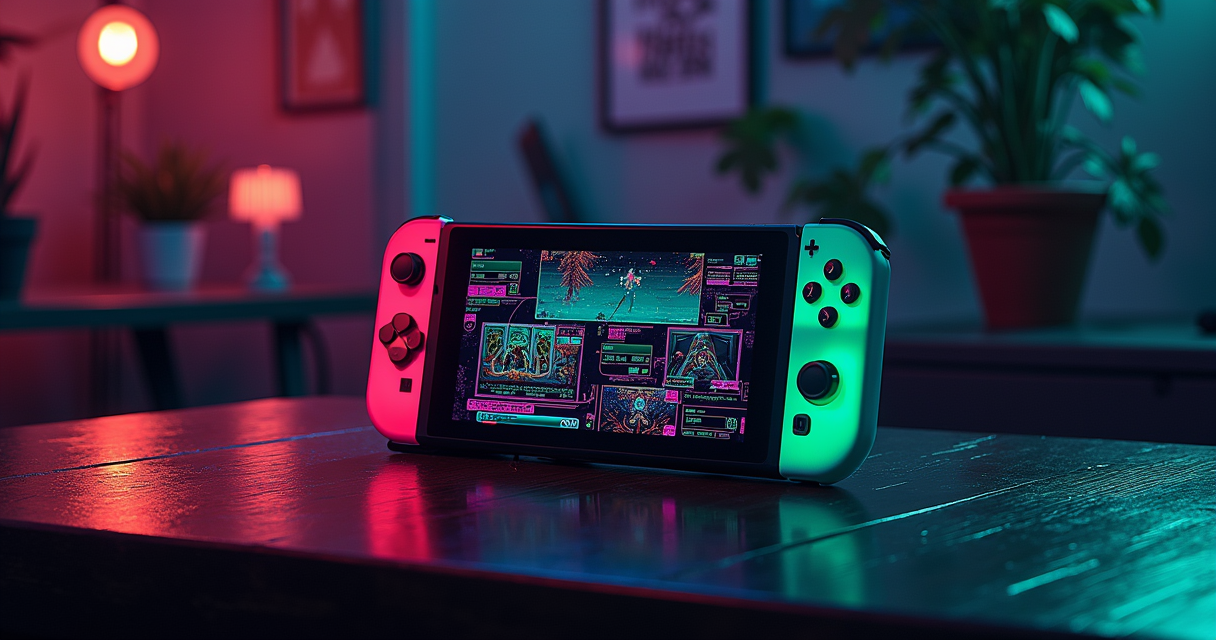
Type switch vs steam deck into any search box and you will get an answer written for 2023, back when the Deck was the scrappy budget option and Nintendo was still selling a 2017 tablet at full price. That world is gone. In 2026 the only matchup that spends your money sensibly is the Nintendo Switch 2 against the Steam Deck OLED, and the single most important fact about that fight is the one nobody bothered to update: the Steam Deck is now the expensive one.
Valve raised Steam Deck prices by up to 46% on 27 May 2026. The OLED you keep seeing recommended as the "affordable PC handheld" is $789 for 512GB and $949 for 1TB. The Switch 2 is $449.99. That is a $339 gap in Nintendo's favor — a sentence that would have read as a typo two years ago. Every downstream question, from who should buy what to how the specs actually cash out, has to be re-derived from that number. This is that re-derivation: the benchmarks, the watt draws, the library math, and the law, none of it invented, all of it sourced.
The 2026 Price Inversion
Comparisons live or die on price, and this one has been poisoned by a stale figure that circulates on autopilot. If a page tells you the Steam Deck is the value pick, check whether it was updated after May 2026. Most were not.
What Valve did in May 2026
On 27 May 2026, Valve pushed Steam Deck OLED pricing up in a single announcement: the 512GB model from $549 to $789 (a 43% jump) and the 1TB from $649 to $949 (46%). The hikes went global — €779/€919 in the EU, £649/£849 in the UK, CAD $1,129/$1,349 in Canada, AUD $1,199/$1,499 in Australia. Valve blamed "the current state of component costs and other global logistical challenges," which is corporate for the AI-driven DRAM and NAND flash crunch that has hyperscalers hoovering up memory production. As gHacks documented, the OLED Deck now costs more than a PS5 Pro. The cheap entry point — the $399 256GB LCD — was quietly discontinued on 19 December 2025 amid the same NAND shortage and was out of stock everywhere by mid-February 2026. So the brief you may have read claiming "the $399 LCD remains available" is describing a device you can no longer buy.
What Nintendo is about to do
Nintendo is not innocent here either — it is simply behind Valve on the calendar. The Switch 2 launched at $449.99 in June 2025 and, per Nintendo's own price-revision notice, will rise to $499.99 on 1 September 2026, citing "various changes in market conditions." Same memory crunch, same story. Japan already moved in late May (¥49,980 to ¥59,980); North America, Europe, and Oceania follow on 1 September. The "Choose Your Game" bundle that currently bags you the console plus one first-party title for $499.99 vanishes after 31 August — from 1 September that same $499.99 buys the console alone. We break down the Nintendo side of this in our look at how the Switch 2's $50 hike widens the gap on September 1.
The number that actually matters
As of this writing the Switch 2 is $339 cheaper than the entry Steam Deck OLED. On 1 September that narrows to $290 — still a chasm, still in Nintendo's favor. There is no configuration of the two current devices in which the Deck is the budget choice; the budget Deck is a ghost that retailers stopped stocking last winter. Anyone still framing this as "pay more for Nintendo's walled garden, save money with the open PC" is selling you 2023. If you want the counter-argument that the Deck's price premium buys a genuine general-purpose PC, we made it at length in our companion piece on the $339 delta and why DLSS still wins. The short version: the gap is real, but it is not the whole story, because a Deck is not only a games machine.
Specs, Head to Head
Cross-architecture spec sheets lie by omission, so read the table with the caveats that follow it. A Nvidia Ampere TFLOP and an AMD RDNA2 TFLOP are not the same currency, and neither device runs the other's software.
The full comparison table
| Feature | Nintendo Switch 2 | Steam Deck OLED |
|---|---|---|
| Launch | 5 June 2025 | 16 November 2023 |
| Base price (Jul 2026) | $449.99 (256GB) | $789 (512GB) |
| Display | 7.9" LCD, 1920×1080 | 7.4" OLED, 1280×800 |
| Refresh / brightness | 120Hz VRR, HDR | 90Hz, HDR ~1,000 nits |
| SoC / GPU arch | Nvidia T239, Ampere (1,536 CUDA) | AMD APU, RDNA2 (512 SP) |
| Peak GPU throughput | 3.07 TFLOPS (docked, 1007MHz) | 1.6 TFLOPS (up to 1.6GHz) |
| RAM | 12GB LPDDR5X | 16GB LPDDR5 |
| Storage / expansion | 256GB UFS, microSD Express (to 2TB) | 512GB–1TB NVMe (M.2 2230), microSD |
| Battery (energy) | 5,220mAh / 19.74Wh | 50Wh |
| Rated battery life | 2–6.5 hours | 3–12 hours |
| Weight | 534g (with Joy-Con 2) | 640g |
| Wireless | Wi-Fi 6 (802.11ax) | Wi-Fi 6E |
| OS / storefront | Proprietary Nintendo OS / eShop | SteamOS 3.x (Arch Linux) / Steam |
| Library / back-compat | Curated eShop + 90%+ of Switch 1 library | 90,000+ Steam titles via Proton |
| Upscaling ("shaders") | DLSS (CNN + Light models) | AMD FSR |
| Cloud saves ("save states") | NSO cloud saves (subscription) | Steam Cloud (free) + suspend/resume |
| Online play ("netplay") | Nintendo Switch Online (paid) | Free online / no platform fee |
| Retro ("supported systems") | NSO apps: NES/SNES/N64/GB/GBA/GameCube | Open emulation, DIY (EmuDeck/RetroArch) |
| Dock / TV-out | Included, 4K60 output | Sold separately (~$79) |
Where the sheet flatters the Switch 2
The 3.07-versus-1.6 TFLOPS line looks like a rout, and it is the single number the Switch 2's fans lean on hardest. It deserves an asterisk the size of a dock. That 3.07 figure is the docked clock (1007MHz); undocked, the T239 drops to roughly 1.7 handheld TFLOPS, which is a near-tie with the Deck's 1.6. More important, Ampere and RDNA2 do not convert one-to-one — TFLOPS count theoretical FP32 throughput, not delivered frames, and Nvidia's tensor cores buy the Switch 2 DLSS while AMD's silicon does not have a hardware equivalent on the Deck. PCGamesN's GPU breakdown estimated the Switch 2 GPU at "around 53% faster than the Steam Deck GPU" in raw rendering — roughly 29fps against 19fps in a synthetic worst case — but the author was at pains to call it theoretical, contingent on optimization, CPU, and memory rather than shader count. Treat it as a lean, not a knockout.
Where the sheet flatters the Deck
The Deck answers with the things a fixed console cannot: 16GB of RAM against 12GB, a genuine desktop operating system, user-replaceable NVMe storage on the ubiquitous M.2 2230 standard, and — the detail every brief gets backwards — Wi-Fi 6E against the Switch 2's Wi-Fi 6. If you read anywhere that the Switch 2 has "better wireless," it is wrong; the Deck is the one with the 6GHz band. The weight column is another common casualty: the Switch 2 is 534g with Joy-Con 2 attached, and the Deck OLED is 640g, not the 669g figure that keeps getting quoted. That 669g belongs to the discontinued LCD Deck. The OLED shed weight and gained brightness; the number nobody updated makes the gap look 30 grams wider than it is.
Performance and Benchmarks
Spec sheets argue; benchmarks settle. The most useful head-to-head numbers come from Digital Foundry, whose cross-platform testing runs the same third-party games on both machines, plus PC Gamer and PCGamesN for framing. Here is what the instruments actually recorded.
The Digital Foundry numbers
Digital Foundry's comparison — covered by GoNintendo and BGR — is the cornerstone. In Hogwarts Legacy, the Switch 2 pulled about 7W against the Deck's 14W: half the power draw for, in DF's words, a game that "ran better overall, keeping it locked to a mostly stable 30fps." The efficiency is the story — the T239 is doing more with less, because it is aimed at a single fixed target while the Deck brute-forces native x86 PC code. In Cyberpunk 2077, the Switch 2 reconstructs from 540p to 1080p with DLSS and comes out visibly cleaner than the Deck's FSR pass from 480p to 720p. Different games move the needle differently, but the pattern holds: lower watts, sharper upscaling.
| Game / Metric | Switch 2 | Steam Deck OLED | Source |
|---|---|---|---|
| Hogwarts Legacy — power draw | ~7W | ~14W | Digital Foundry |
| Hogwarts Legacy — battery | 2h 45m | ~4h | Digital Foundry |
| Stardew Valley — battery | ~4h | ~7h | Digital Foundry |
| Persona 4 Golden — battery | ~4h 18m | 7h+ | Digital Foundry |
| Hitman WoA — battery | 2h 40m | ~2h | Digital Foundry |
| Cyberpunk 2077 — upscaling | DLSS 540p→1080p | FSR 480p→720p | Digital Foundry |
| Peak GPU throughput (docked) | 3.07 TFLOPS | 1.6 TFLOPS (fixed) | PC Gamer / DF |
| Theoretical GPU delta | ~53% faster / ~29fps | baseline / ~19fps | PCGamesN |
Why the battery table cuts both ways
Read the battery rows carefully, because they contradict the power-draw rows in a way that matters. The Switch 2 sips less power, yet in demanding games it dies first — 2h45m in Hogwarts against the Deck's 4h. The reason is the energy tank: the Deck OLED carries a 50Wh battery, more than two and a half times the Switch 2's 19.74Wh. Efficiency loses to capacity when the workload is heavy. The exception is light, first-party-optimized software: in Hitman: World of Assassination the Switch 2's frugality wins outright (2h40m vs ~2h), and in Nintendo's own catalog it can creep toward its 6.5-hour rating while the Deck sits nearer the middle of its 3–12 range. Ignore any mAh comparison you see — the Switch 2's 5,220mAh and the Deck's cell run at different pack voltages, so watt-hours are the only honest unit, and there the Deck holds roughly 2.5x the energy.
What the reviewers concluded
The critical consensus is refreshingly unsettled. PC Gamer headlined its face-off "A closer battle than I expected," landing on: "the Steam Deck offers more bang for your buck, and the Switch 2 offers something no other gaming handheld can right now: the Nintendo feel, look, and software." The writer's money went to Valve — an assessment made before the May price hike inverted the value math. GamesRadar went the other way with "I wildly underestimated the Switch 2, and after just getting a Steam Deck, I'm almost regretting it." And TechRadar, from an avowed Deck loyalist, conceded the point in its headline: "I might be a Steam Deck fanatic, but I can't deny the Nintendo Switch 2 is still the king of easy, fun gaming." Three outlets, three different centers of gravity. That is what a genuine tie looks like.
Battery and Display
These are the two categories where the hardware philosophies diverge hardest: Nintendo optimized for a bigger, faster LCD and a smaller battery; Valve for a smaller, prettier OLED and a tank of a cell. Neither is wrong. They are aimed at different afternoons.
The panel argument
On paper the Switch 2 wins the display spec sheet: 7.9 inches, full 1920×1080, a 120Hz variable-refresh LCD with HDR. That is a lot of resolution and a lot of motion smoothness, and it is a real, felt upgrade over the original Switch's 720p 60Hz panel. But it is an LCD, and Digital Foundry was blunt that the screen "is problematic in a number of ways" — LCD black levels, viewing angles, and HDR that is HDR in name more than in contrast. The Deck answers with a 7.4-inch OLED at 1280×800, 90Hz, and roughly 1,000 nits of peak brightness. Lower resolution, fewer hertz, but perfect blacks, richer color, and outdoor visibility the Switch 2 cannot match. If your eyes prioritize contrast and brightness, the Deck's panel is the nicer object to look at; if they prioritize sharpness and 120Hz fluidity, the Switch 2's is the more capable one. This is a genuine taste split, not a tier gap.
The battery reality
We covered the numbers above, but the lived experience deserves its own line. The Deck OLED's 50Wh cell is the reason it survives a transcontinental flight on a heavy game while the Switch 2 taps out before the beverage cart returns. Nintendo rates the Switch 2 at 2–6.5 hours and the real-world floor in demanding titles is nearer 2.5 hours; Valve rates the Deck at 3–12 hours and the real-world figure in the same titles clusters around 4. If you play mostly docked, none of this matters and the Switch 2's included dock is the better deal. If you play mostly untethered on demanding software, the Deck's endurance is the single most decisive advantage in this entire comparison.
Docked output and the dock tax
Docked, the Switch 2 outputs up to 4K60 through the dock that comes in the box, with DLSS doing the heavy lifting to hit that target. The Deck can drive an external display too, but the official dock is a ~$79 accessory sold separately, and hitting a stable 4K on the Deck's RDNA2 silicon is optimistic outside of lightweight and older games. Add the dock to the Deck's already-inflated price and the total-cost gap against the Switch 2 stretches past $400. For a buyer who wants a handheld that doubles as a living-room console with no further purchases, the Switch 2's bundled 4K dock is a structural win, not a marketing one.
Software and Libraries
Hardware is the smaller half of this decision. What you can actually play — and who controls that list — is the larger half, and it is where the two devices stop being comparable and start being different categories of object.
The exclusives problem
There is exactly one place to legally play Mario Kart World, the next Zelda, Metroid Prime 4, or Pokémon, and it is a Nintendo machine. Mario Kart World alone had moved 14.70 million copies by the end of March 2026, and Donkey Kong Bananza 4.52 million; those are system-sellers with no Steam equivalent, ever. The Switch 2's catalog is curated, subscription-adjacent, and mostly full-price outside of Black Friday, but it is the only door to the most valuable first-party library in the industry. Nintendo keeps feeding it — our roundup of the 30 reveals from the 2026 Nintendo Direct is a reminder that the exclusive pipeline is the whole moat. You cannot out-spec your way to Zelda.
The library size problem
The Deck's answer is quantity and ownership. It plays the 90,000+ title Steam catalog — every genre, decades deep, with sales that routinely cut prices 75–90% in a way Nintendo's storefront simply does not. Because it runs SteamOS, an Arch-Linux desktop under a console shell, it also plays games from outside Steam: Epic, GOG, itch, your existing PC purchases, all of it. The catch is Proton, Valve's compatibility layer: most of the catalog runs beautifully, but a slice of Windows-only titles — chiefly competitive games with kernel-level anti-cheat — do not run at all. It is a PC, with a PC's freedom and a PC's occasional friction. That freedom is precisely the thesis of our argument that PC gaming overtakes consoles by 2028: the open platform wins on breadth, the closed one on polish.
Online, saves, and the subscription line
The unglamorous columns break for the Deck. Online multiplayer on the Deck costs nothing beyond the game — there is no platform fee — while the Switch 2 gates online play and cloud saves behind Nintendo Switch Online. Steam Cloud backs up saves for free and SteamOS's suspend/resume lets you freeze any game mid-frame indefinitely, the closest a modern console gets to a universal save state. Nintendo's cloud saves work well but require the subscription, and a handful of titles (the usual suspects, Splatoon and Animal Crossing) still block cloud backup to deter save-scumming. If recurring fees offend you, the Deck is the cheaper machine to live with, price hike notwithstanding.
Retro and Emulation
This is a retro site, so we are not going to pretend the emulation question is a footnote. For a large slice of readers it is the entire decision, and here the two devices could not be further apart in philosophy — or in their relationship with the law.
The Deck as an emulation station
The Steam Deck is, out of the box, one of the best emulation handhelds ever made, and with a few minutes of setup it is arguably the best. Tools like EmuDeck and RetroArch turn it into everything from an Atari 2600 to a credible PlayStation 3 and Wii U machine, with the CPU headroom for cycle-accurate cores — bsnes, mesen, and friends — that lower-powered handhelds choke on. Because it is a full Linux PC, there is no ceiling imposed by a vendor; the only limits are the silicon and your patience. If you want the full tour of what its emulation stack can do, our guide to 200 RetroArch cores in 12 steps is built with exactly this hardware in mind. The Deck's accuracy ceiling — the ability to run the demanding, timing-perfect emulators — is its retro trump card.
The Switch 2's walled retro garden
The Switch 2's retro story is Nintendo Switch Online: official, curated apps for NES, SNES, N64, Game Boy, GBA, and — new to the Switch 2 — GameCube, with titles like F-Zero GX and Soulcalibur II. It is legal, it is convenient, the emulation is competent, and it is entirely on Nintendo's terms: a subscription rental of a library Nintendo chooses, with no way to add your own dumps. You are not building a collection; you are leasing access to a rotating shelf. For a lot of people that is fine. For the kind of person reading a retro site, it is a cage with nice bars.
Knowing the law
Here is the part the marketing pages skip. Emulators are legal; running them on the Deck is your right. The ROMs are the exposure, and that exposure is entirely on you — a distinction Nintendo enforces with a litigator's enthusiasm. In 2024 it settled with the makers of the Switch emulator Yuzu for $2.4 million and effectively ended the project, which is why EmuDeck no longer bundles Yuzu or Citra; do not believe any guide that says it still does. The practical reading: the Deck gives you the capability and hands you the responsibility. The Switch 2 removes both. Which of those you want says more about which device fits you than any benchmark on this page.
Pricing and Availability
One table, current as of July 2026, so nobody quotes a dead SKU at you. Note the two dates that move everything: 19 December 2025 (the LCD Deck's discontinuation) and 1 September 2026 (the Switch 2's increase).
The current price board
| Model | Price (Jul 2026) | Status | Notes |
|---|---|---|---|
| Switch 2 (256GB) | $449.99 | Available | Rises to $499.99 on 1 Sep 2026 |
| Switch 2 "Choose Your Game" bundle | $499.99 | Until 31 Aug 2026 | Console + one first-party title |
| Steam Deck LCD (256GB) | $399 | Discontinued 19 Dec 2025 | Out of stock; NAND shortage |
| Steam Deck OLED (512GB) | $789 | Available | +43% since 27 May 2026 |
| Steam Deck OLED (1TB) | $949 | Available | +46% since 27 May 2026 |
| Steam Deck Dock (official) | ~$79 | Available | Required for TV output |
| Switch 2 Dock | Included | In box | 4K60 output |
Total cost of ownership
The sticker prices understate the gap. A Switch 2 arrives ready for the TV; a Deck OLED at $789 needs a $79 dock to match that, pushing its living-room-ready cost to $868 against $449.99 — a $418 difference before you have bought a single game. Storage flips the math back slightly: the Deck's NVMe is user-upgradeable with cheap standard M.2 2230 drives, while the Switch 2 demands pricier microSD Express cards for game storage (ordinary microSD cards hold only photos and videos). Over years, the Deck's fee-free online and 90%-off Steam sales claw back real money against Nintendo's full-price catalog and paid NSO. The Deck costs more to buy and less to feed; the Switch 2 costs less to buy and more to live in.
Sales, and why availability is not a worry
Neither machine is hard to find. The Switch 2 shipped 19.86 million units by 31 March 2026 — a launch pace that, per VideoCardz, outsold the PS5 in the January–March quarter by roughly a million, though the PS5's ~93.6 million lifetime figure keeps things in perspective. The Deck is manufactured to demand and stocked continuously. The scarcity is not units; it is the vanished cheap configurations. You can buy either tomorrow. You just can't buy the $399 Deck anymore, no matter how many old articles insist you can.
Five Buyers, Five Verdicts
Aggregate advice is useless here because the two machines are good at different lives. Find yourself in one of these and the answer stops being a coin flip.
The couch-and-family buyer and the commuter
1. The living-room-first household. You want it to turn on, play Mario Kart with four controllers, and go to a TV in 4K without a research project. Buy the Switch 2. The dock is in the box, the exclusives are the point, and "it just works" is a feature Nintendo spent decades engineering. TechRadar's Deck-loyalist reviewer called it "the king of easy, fun gaming" for exactly this person.
2. The long-haul commuter. You play demanding third-party games untethered for hours and battery anxiety rules your life. Buy the Steam Deck OLED. Fifty watt-hours and an OLED you can read in daylight beat 19.74Wh and an LCD every time the trip runs long. The Switch 2's efficiency is real but it cannot out-endure a battery two and a half times its size.
The library owner and the tinkerer
3. The lapsed PC gamer with a 400-game backlog. You already own a Steam library and the idea of re-buying it at Nintendo prices is offensive. Buy the Deck. It plays what you already own, on sale-priced software, with no platform fee, and it is the same argument that has PC overtaking consoles this decade. PC Gamer's "more bang for your buck" verdict is aimed squarely here.
4. The retro obsessive. Your real goal is a pocket MAME cabinet plus PS2, GameCube, and the accurate SNES cores. Buy the Deck and accept that the ROMs are your legal responsibility. The Switch 2's NSO apps are a curated lease, not a collection; the Deck is an open platform with the horsepower for cycle-accurate emulation the little handhelds can't touch.
The Nintendo faithful
5. The person who only cares about Nintendo's games. If your want-list is Zelda, Metroid, Pokémon, and Splatoon, the entire comparison collapses. There is no Steam Deck configuration that plays those, at any price, ever. Buy the Switch 2, save $339 doing it, and enjoy the rare 2026 situation where the exclusive-locked console is also the cheaper one. GamesRadar's "I wildly underestimated the Switch 2" was written by someone in this bucket who did not expect to be.
Pros and Cons
The compressed version, one table per machine, for the reader who scrolled straight here.
Nintendo Switch 2
| Pros | Cons |
|---|---|
| $339 cheaper today (until 1 Sep 2026) | Price rises to $499.99 on 1 Sep 2026 |
| Exclusive access to Mario, Zelda, Pokémon | Only 19.74Wh — weakest battery in heavy games |
| Sharper 1080p 120Hz LCD + DLSS upscaling | LCD panel, not OLED; DF called it "problematic" |
| 4K60 dock included in the box | Paid online + curated, mostly full-price store |
| Half the power draw (~7W vs ~14W) | Closed OS; retro is subscription-leased, no dumps |
Steam Deck OLED
| Pros | Cons |
|---|---|
| 50Wh battery + gorgeous 1,000-nit OLED | $789/$949 after the 43–46% May 2026 hike |
| 90,000+ Steam titles you own and keep | Dock costs an extra ~$79 for TV output |
| Best-in-class open emulation and Linux desktop | Proton can't run some anti-cheat Windows games |
| Free online, Steam Cloud, universal suspend | Zero Nintendo exclusives, forever |
| User-upgradeable M.2 storage; Wi-Fi 6E | Heavier (640g) and needs more setup |
Migration Guide
Switching camps, or running both? Here is how to move your gaming life from one to the other without losing saves — and where the walls are.
Coming to the Switch 2
If you are upgrading from an original Switch, the transfer is the smoothest part of the whole platform. Nintendo's system-transfer tool moves users, saves, and eligible data over local Wi-Fi, and 90%+ of the Switch 1 library plays on the Switch 2 with free performance patches on many first-party titles. What does not come with you is anything from a Deck: there is no way to import Steam saves, PC progress, or emulated content into Nintendo's closed OS. You start that side fresh.
# SWITCH 1  ->  SWITCH 2  (official system transfer)
1. Update BOTH consoles to the latest firmware
2. On Switch 2: System Settings > Users > Transfer Your User Data
3. Keep both powered, docked or charged, on the same Wi-Fi
4. NSO cloud saves re-sync automatically (subscription required)
# CAVEAT: a few titles (Splatoon, Animal Crossing) block
#         cloud backup — transfer those locally, console-to-console
Coming to the Steam Deck
Moving to the Deck from any PC is almost a non-event, because the Deck is a PC. Sign into Steam and your library, saves, and settings are already there via Steam Cloud — no export step, no transfer cable. Games install and Proton handles the Windows ones automatically. The only planning required is for travel: pre-download anything you want offline and confirm it launches before you leave signal.
# PC / STEAM  ->  STEAM DECK  (no transfer needed)
- Sign in: your entire Steam library + Cloud saves appear
- Install any owned title; Proton runs Windows games
- Non-Steam launchers (Epic/GOG/itch) via desktop mode
- Travelling? Pre-download + verify launch BEFORE you go offline
# NOTE: kernel-level anti-cheat titles may not run under Proton
Running both without regret
Plenty of people own both, and it is the least foolish option on this list — the Switch 2 for the exclusives and the couch, the Deck for the backlog and the emulation bench. If you can only justify one, decide by asking which library you would mourn losing: the Nintendo exclusives you can get nowhere else, or the Steam catalog you already paid for. That question routes more accurately than any FPS chart. And if the answer is genuinely "both matter," buy the cheaper machine now (the Switch 2, before September) and add the Deck when the memory market eventually loosens its grip on prices.
The Verdict
After all of it — the watts, the watt-hours, the TFLOPS asterisks, the litigation — the honest conclusion is that there is no universal winner, only a correct answer per buyer. What has changed in 2026 is that the old shorthand is inverted, and pretending otherwise costs you money.
What the data says
The Switch 2 is the cheaper machine ($339 today, $290 after September), the more efficient one (~7W vs ~14W), the sharper-upscaling one (DLSS beats FSR, cleanly), and the only door to Nintendo's exclusives. The Deck OLED is the better screen, the bigger battery, the open platform, the emulation king, and the cheaper machine to live with once you own it. The reviewers split three ways for a reason: on the merits, this is a tie that resolves entirely on what you value. If you want the fuller version of our reasoning and the price-delta breakdown, it lives in our companion analysis of the $339 gap and why DLSS wins.
The decision tree
IF you want Mario / Zelda / Pokemon / Splatoon .......... Switch 2
ELIF you already own a big Steam / PC library ........... Steam Deck
ELIF battery endurance + OLED matter most .............. Steam Deck OLED
ELIF you want it to "just work" on a 4K TV ............. Switch 2
ELIF open, accurate retro emulation is the point ....... Steam Deck
ELSE (price is the only axis you care about) ........... Switch 2 (-$339)
The Machine's call
For most buyers, most of the time, in 2026: buy the Switch 2, and buy it before 1 September while it is $449.99. It is cheaper, more efficient, TV-ready out of the box, and it holds the one library nobody can legally sell you anywhere else. Buy the Steam Deck OLED if — and only if — you are the battery-first traveler, the Steam-library owner, or the retro tinkerer, because for those three the Deck's strengths are decisive enough to justify paying $339 more for the privilege. What you should not do is buy the Deck because someone told you it was the budget option. That someone has not checked a price since May, and the $300 they cost you is very real.
Questions the search bar asks me
- Is the Steam Deck still cheaper than the Switch 2 in 2026?
- No — that reversed in 2026. Valve raised the Steam Deck OLED to $789 (512GB) and $949 (1TB) on 27 May 2026, while the Switch 2 is $449.99, making Nintendo $339 cheaper. The old $399 LCD Deck was discontinued on 19 December 2025 and is out of stock.
- Which has better battery life, the Switch 2 or Steam Deck OLED?
- The Steam Deck OLED wins in demanding games thanks to a 50Wh battery versus the Switch 2's 19.74Wh. Digital Foundry measured ~4 hours of Hogwarts Legacy on the Deck vs 2h45m on the Switch 2. The Switch 2 only pulls ahead in light, optimized first-party titles.
- Is the Switch 2 more powerful than the Steam Deck?
- In raw numbers, yes: 3.07 TFLOPS docked vs 1.6, and PCGamesN estimated the Switch 2 GPU ~53% faster — but that figure is theoretical and cross-architecture (Nvidia Ampere vs AMD RDNA2). Undocked the Switch 2 sits near ~1.7 TFLOPS, a near-tie. DLSS upscaling is the Switch 2's clearer real-world edge over FSR.
- Can the Steam Deck play Nintendo exclusives like Zelda or Mario?
- No. There is no legal way to play Mario Kart World, Zelda, Metroid, or Pokémon on a Steam Deck — those are Switch 2 exclusives. The Deck can emulate older systems via EmuDeck/RetroArch, but ROM legality is your responsibility, and Nintendo has aggressively litigated emulators (it shut down Yuzu for $2.4M in 2024).
- Does the Switch 2 come with a dock and does the Steam Deck?
- The Switch 2 includes a 4K60 dock in the box. The Steam Deck's official dock is a separate ~$79 purchase, pushing a TV-ready Deck OLED to roughly $868 against the Switch 2's $449.99 — a difference of over $400 before any games.
Ben covers the hardware end of retro gaming: FPGA cores, real-cartridge dumping, capture setups, CRT vs scaler workflows, and the legal and physical preservation infrastructure that keeps old games playable. Every post under this byline is reviewed pre-publish by Sam P., Editor & Operator — corrections to info@instalinkoteam.com. Published 2026-08-29 · Last updated 2026-08-29. Full bios on the author page.