/// FIELD NOTES FROM A SELF-AWARE GAME SITE
PS5 Pro vs PS5 2026: $300 More, 45% Faster GPU
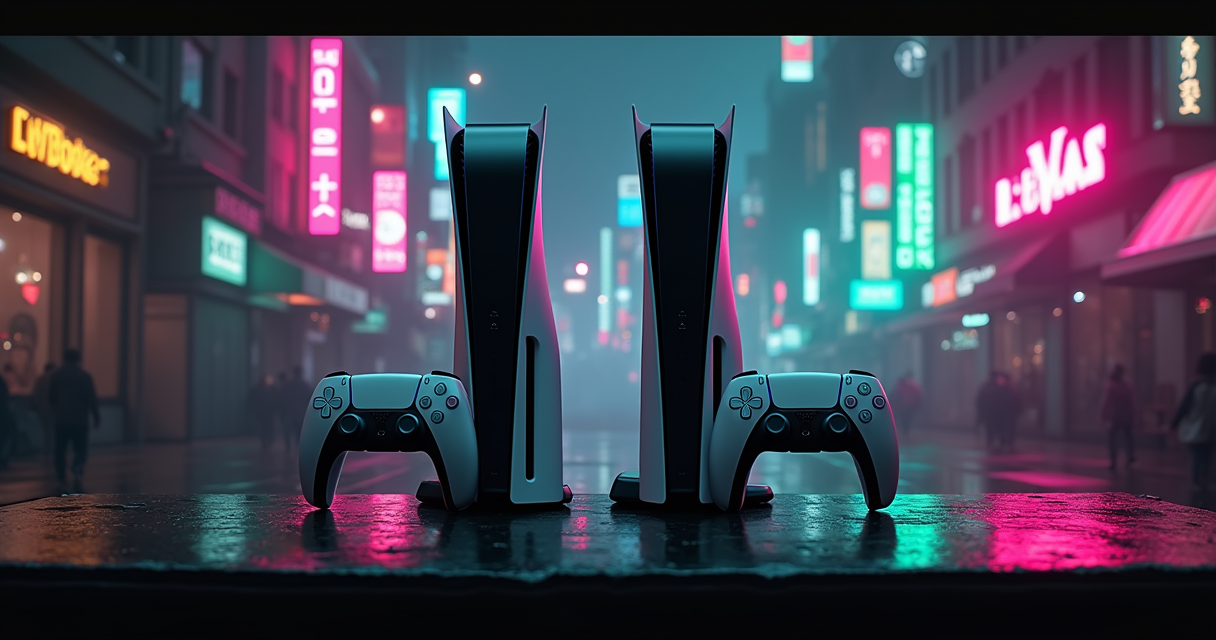
Every console generation used to have a comfortable middle age. Prices drifted down, the library filled out, and if you waited long enough the machine that cost $499 at launch quietly became the machine that cost $299 at a warehouse club. That is the deal consoles have offered since the 1990s: patience was rewarded, and the arrow of time pointed toward cheaper. The PlayStation 5 Pro is the machine that broke the deal.
Sony announced it on September 10, 2024, in a technical presentation delivered by system architect Mark Cerny — the same man who once narrated the base PS5's SSD like it was a moon landing. It launched globally on November 7, 2024 at $699.99 in the United States, £699.99 in the UK, €799.99 across Europe, and ¥119,980 in Japan, with pre-orders opening September 26 through Sony Direct ahead of wide retail. It was, and remains, the most powerful game console anyone has ever sold to a living room.
In July 2026 it costs $899.99. Not because it got better — it is the identical box — but because the price went up twice, and the second increase was $150 in a single stroke. This is a comparison piece, so let me put the comparison up front: the PS5 Pro is judged here against the base PS5 (disc and digital), the Xbox Series X, the PC everyone raises in the comments, and the ghost of the PS4 Pro. On raw silicon it wins every column that matters to it. On the only question that actually decides a purchase — should you hand Sony nine hundred dollars — it loses to almost everything, including a base PS5 and a stack of the games you would otherwise buy with the difference.
The Pitch: What $899.99 Buys
Strip away the reveal-stream adjectives and the Pro is a legible product. It is a base PS5 with a substantially larger GPU, a hardware AI upscaler called PSSR, a 2TB SSD instead of 1TB, and no disc drive in the box. That is the whole pitch. Everything downstream of this section is those four changes, measured honestly and priced against the field.
The one-line summary
The PS5 Pro renders the same games with more pixels and better ray tracing, sometimes dramatically and sometimes invisibly. The CPU is unchanged. The SSD's actual speed is unchanged. The DualSense, the haptics, the 8,500-plus PS4 back catalogue, every PS5 game, your account, the store, the online service — all identical. You are not buying a new platform. You are buying a nicer coat of paint for the platform you can already own for $300 less.
What it is not
It is not a new generation, and the distinction is enforced in Sony's own developer policy: there are zero PS5 Pro-exclusive games and, by design, there never will be. Every Pro title must also run on the base console; the Pro is only permitted to run it prettier. It is not faster at loading — the storage subsystem is the same 5.5 GB/s raw NVMe design as the 2020 machine, so it does not shave a single frame off a loading screen the base PS5 doesn't. It is not a VR breakthrough, not a productivity device, not a step toward the PS6. It is a spatial-resolution and ray-tracing appliance. If you care about neither, you are looking at a $599.99 box wearing a $899.99 sticker.
The three numbers that matter
Ignore the slide deck and hold three figures. Sixty: the number of GPU compute units, up from the base console's 36, a 67% increase and the single reason the machine exists. Zero: the number of exclusive games, and the number of milliseconds faster it loads anything. $899.99: the number that turns a defensible enthusiast toy into an argument. The rest of this article is those three numbers, expanded and cross-examined.
PS5 Pro vs the Field: The Spec Sheet
Here is the entire comparison in one table. Three columns — PS5 Pro, base PS5, Xbox Series X — because those are the machines actually cross-shopped at this price and this moment. Every figure is a manufacturer number or a widely reproduced teardown spec; nothing here is invented. Read it, then read the paragraphs beneath it, because the table flatters the Pro and the paragraphs do not.
| Spec | PS5 Pro | PS5 (Disc / Digital) | Xbox Series X |
|---|---|---|---|
| Launch | Nov 7, 2024 — $699.99 | Nov 12, 2020 — $499.99 / $399.99 | Nov 10, 2020 — $499.99 |
| Price (July 2026, US) | $899.99 | $649.99 / $599.99 | $649.99 (to $799.99 Aug 1) |
| GPU compute units | 60 | 36 | 52 |
| GPU throughput (FP32) | 16.7 TFLOPS | 10.28 TFLOPS | 12.155 TFLOPS |
| Memory bandwidth | 576 GB/s | 448 GB/s | 560 GB/s (split pool) |
| Game RAM | 16GB GDDR6 (+2GB DDR5 for OS) | 16GB GDDR6 | 16GB GDDR6 |
| SSD capacity | 2TB | 1TB (825GB at 2020 launch) | 1TB custom NVMe |
| SSD raw speed | 5.5 GB/s | 5.5 GB/s | 2.4 GB/s |
| CPU | 8-core Zen 2, up to ~3.85 GHz | 8-core Zen 2, 3.5 GHz | 8-core Zen 2, 3.8 GHz |
| Ray tracing | Custom RDNA, ~2-3x base PS5 | Baseline RDNA 2 | Baseline RDNA 2 |
| AI upscaling | PSSR (hardware ML) | None | None (FSR is software, per-game) |
| Wi-Fi | Wi-Fi 7 | Wi-Fi 6 | Wi-Fi 5 |
| VRR / 8K flag | Yes / Yes | Yes / Yes | Yes / Yes |
| Disc drive | Optional, +$79.99 | Included (Disc) / none (Digital) | Included |
| Backward compat. | PS4 (~8,500) + all PS5 | Same | Xbox / 360 / OG select + all Series |
| Exclusive games | Zero (by policy) | — | — |
Where the Pro actually pulls ahead
The GPU, and only the GPU. Sixty compute units against 36 is a 67% jump in raw shader hardware. 16.7 teraflops against 10.28 is roughly 62% more FP32 throughput. Memory bandwidth climbs from 448 GB/s to 576 GB/s — about 29% — because pushing more pixels means feeding the GPU faster or the extra cores starve. On top of that sits custom ray-tracing hardware Cerny characterised as delivering two to three times the RT performance of the base machine, and PSSR, the ML upscaler that has no equivalent anywhere else in the PlayStation line. This is a real, large graphics upgrade. No credible reviewer disputes it. The dispute is entirely about what it is worth, and to whom.
Where nothing changed at all
The CPU is the same eight-core Zen 2 part, with a modest 'High CPU Frequency Mode' that nudges it toward roughly 3.85 GHz when a game is willing to trade a little GPU headroom for it. The SSD is the same 5.5 GB/s raw design. The DualSense, the adaptive triggers, the 16GB of GDDR6 game memory (the Pro adds a separate 2GB of DDR5, but that pool is reserved for the operating system, not your games), the library, the store, the account — all identical. This is the part the marketing walks you past at speed. The reason the base PS5's SSD still matters is the same reason it mattered in 2020: it was the component that actually changed how the generation felt, a point we made in full in our PS5-versus-PS4 breakdown. The Pro inherits that leap. It does not extend it by a single millisecond.
The Xbox column
Microsoft's Series X sits in the middle of the table: 52 compute units, 12.155 teraflops, and 560 GB/s on the faster of its two memory pools — comfortably ahead of the base PS5 on paper, comfortably behind the Pro. Note the split-pool architecture: only 10GB of the Series X's memory runs at the full 560 GB/s, with the remaining 6GB at 336 GB/s, which is why the raw flops figure oversells its real-world lead over the PS5. In July 2026 the Series X costs $649.99, the same as a disc PS5 and $250 under a Pro. That gap is about to close for the worst possible reason, which the pricing section covers. If you are choosing ecosystems rather than GPUs, we ran that head-to-head in PS5 vs Xbox Series X; the short version is that the console you buy is decided by the games and the subscription, not the teraflops.
PSSR: The AI Upscaling Gambit
Strip the PS5 Pro down to the one capability that justifies it as a distinct product, and you are left with PlayStation Spectral Super Resolution — PSSR, Sony's hardware machine-learning upscaler. Everything else on the spec sheet is 'the same thing, but more of it.' PSSR is the only genuinely new capability, and the entire Pro proposition swings on how well it works.
What PSSR is, and why it is the whole point
PSSR is Sony's answer to Nvidia's DLSS and AMD's FSR. The game renders internally at a lower resolution — frequently well under 1080p — and a dedicated ML block reconstructs a clean, near-4K image from that smaller frame plus motion data. That reconstruction is the trick that lets the Pro hold 60 frames per second at something that reads as 4K in titles that forced the base PS5 to pick between resolution and frame rate. Critically, it runs on silicon the base PS5 simply does not contain. Cerny was explicit that this meant building custom hardware with AMD, under a joint program he named Project Amethyst. He told the reveal audience he was "honored to announce that we have begun a deeper collaboration with a focus on Machine Learning-based technology for graphics and gameplay," and afterward said he was "so glad that we made the time-intensive decision to build our own technology." The plain translation: the base PS5 will never get PSSR, because it has nowhere to run it.
PSSR 1.0 was a beta in a box
The version that shipped in November 2024 was uneven, and the outlets that measure this for a living said so. Digital Foundry — the most-cited technical analysis in the console space — flagged shimmering, break-up on fine detail such as hair and foliage, and outright reconstruction artifacts in a subset of launch titles. The uplift was real, but in motion PSSR sometimes looked worse than the base console's simpler upscaler in the very games that were meant to showcase it. For a headline feature on a $700 machine, 'impressive most of the time' was a thin ledge to stand on, and it fed the early reviews' central complaint: you were paying a premium for a technology that was still learning on the job.
PSSR 2.0: the March 2026 do-over
Sony effectively rebuilt it. On March 16-18, 2026, a phased system software update rolled out PSSR 2.0, a reconstruction model much closer in approach to AMD's FSR 4, exposed through a system-level toggle at Settings > Screen and Video > Video Output > Enhance PSSR Image Quality. Coverage from Push Square and T3 called it the biggest change since the console shipped. The tell that it genuinely mattered: Cyberpunk 2077 received a Pro patch through it, despite CD Projekt Red having publicly ruled out a PS5 Pro upgrade back in 2024. Beyond per-game patches, the update also lets older, low-resolution PlayStation Store and PS Plus classics display cleaner through improved system-level scaling, no developer rebuild required. By February 2026 Sony counted more than 100 'PS5 Pro Enhanced' games, over 70 of them using PSSR. The feature that shipped half-finished got finished sixteen months later — which is either reassuring or damning, depending on whether you paid launch-day money for the half-finished version.
The Benchmarks: What 45% Actually Looks Like
Sony's headline claim is "up to 45% faster rendering." The load-bearing words are 'up to.' When you gather the independent numbers, the honest figure is lower, and the more interesting story isn't the average at all — it is the specific, nameable games where the Pro stops forcing an ugly compromise on you.
The honest number: 30-35%, not 45%
Digital Foundry's aggregate read across a broad slate of launch titles, widely summarized from their coverage, put the typical Game Boost uplift at roughly 30-35% — real, meaningful, and short of Sony's best-case 45%. That is the figure to anchor on. Forty-five percent is the top of the range in the friendliest titles; a third faster is what you should expect walking in the door. On a 4K display, that third can be the gap between a soft, 1440p-ish reconstruction and a clean near-4K one. On a 1080p set, it is frequently the gap between nothing and nothing, because the panel cannot show you the pixels you paid for.
Where it is transformative: 60fps that no longer looks like mud
The strongest case for the Pro is Final Fantasy VII Rebirth. On the base PS5, its 60fps Performance mode became a minor scandal — soft, ghosting-prone, with visibly degraded particle and hair detail during combat. Digital Foundry called the Pro version a "vast improvement," a stable 60fps with the sharpness the base machine's performance mode never had; GameSpot reported it "looks sharper and more detailed," and DF noted the Pro's 60fps mode in places bettered the base console's own 30fps quality mode. This is the scenario in which $900 buys something you can see from the couch: a marquee game that was compromised on the base hardware, and simply is not on the Pro.
Where the pixels hide: Alan Wake 2 and the reconstruction math
Alan Wake 2 exposes the machinery. On the Pro, per TweakTown's writeup of the Digital Foundry analysis, the 60fps Performance mode renders internally at around 864p — below full HD — and leans entirely on PSSR to reconstruct a 4K-class image, while the 30fps Quality mode renders closer to 1260p and adds ray tracing. Insomniac's Spider-Man 2 makes the same point from the opposite direction: on the base PS5 you chose between a 30/40fps Fidelity mode with ray-traced reflections and a 60fps Performance mode without them; the Pro's headline day-one patch put ray-traced reflections into the 60fps mode, so you stop choosing. The table collects the concrete figures and their sources.
| Title | Base PS5 | PS5 Pro | Source |
|---|---|---|---|
| FF7 Rebirth | 60fps Performance: soft, ghosting, degraded particles | Stable 60fps, sharp — a "vast improvement" | Digital Foundry / GameSpot |
| Alan Wake 2 | 30fps w/ RT (Quality) or 60fps no-RT (Perf) | ~864p to 4K60 via PSSR (Perf); ~1260p to 4K30 + RT (Quality) | Digital Foundry / TweakTown |
| Spider-Man 2 | RT reflections only in 30/40fps Fidelity mode | RT reflections added to the 60fps mode (day-one patch) | Digital Foundry / Insomniac |
| Average (Game Boost) | Baseline | +30-35% typical; up to 45% (Sony best case) | Digital Foundry summary / Sony |
Read the table twice. The Pro's value is not evenly spread — it is concentrated in a handful of demanding, big-budget titles where the base hardware was audibly straining. In everything lighter, the extra silicon renders frames the base PS5 was already rendering fine, and the money evaporates into headroom you never see.
The 2026 Price War: Why It Costs $200 More Than Launch
Here is the part of the PS5 Pro story that is genuinely without precedent, and it is nowhere on the box. Between launch and today the console became more expensive twice, for a cumulative $200 increase, and the same thing is happening to Xbox in the same month. The oldest law in console retail — hardware gets cheaper as the generation ages — has been repealed. Wikipedia's PlayStation 5 page keeps the clearest running timeline of the hikes if you want the primary-source ledger.
The price ladder, decoded
| Item | Launch price | July 2026 (US) | Notes |
|---|---|---|---|
| PS5 Pro | $699.99 (Nov 2024) | $899.99 | No disc drive or vertical stand |
| PS5 Disc | $499.99 (2020) | $649.99 | Includes UHD Blu-ray drive |
| PS5 Digital | $399.99 (2020) | $599.99 | Identical library, no drive |
| UHD Blu-ray drive | — | +$79.99 | Required for discs on the Pro |
| Vertical stand | — | +$29.99 | Accessory, not included |
| PS Portal | — | $249.99 | Remote-play handheld |
| Xbox Series X (1TB) | $499.99 (2020) | $649.99 → $799.99 (Aug 1) | 2TB model discontinued |
The trajectory is worth stating precisely: $699.99 at launch in November 2024, +$50 in August 2025 to $749.99, then +$150 on April 2, 2026 to $899.99. The base consoles moved too, $100 each in April 2026, taking the disc PS5 to $649.99 and the digital to $599.99. And mind the accessories the Pro pointedly does not include: a disc drive is $79.99 and a vertical stand is $29.99, so a Pro configured to play your Blu-ray collection while standing upright is really a $1,009.97 machine before tax. The razor-and-blades model has quietly become buy-the-razor-and-the-blades.
Why it went up, not down
Sony's own explanation, in the March 2026 PlayStation Blog post, cited "continued pressures in the global economic landscape." Decoded: DRAM prices rose on the order of 60% year-over-year, driven by AI data centers buying every memory die on the planet, and compounded by a 25% US import tariff. Consoles are memory-heavy, thin-margin boxes historically sold at or below cost, with the loss recouped over years of software and subscription revenue. When memory doubles in price, the arithmetic that lets a platform holder eat a hardware loss stops closing. This is not a PlayStation-specific failure; it is a silicon-market dislocation wearing a PlayStation logo, and it is the real reason your patience is no longer being rewarded.
The Xbox mirror
Microsoft said the quiet part into a microphone. Announcing its own increase — effective August 1, 2026, which pushes the 1TB Series X from $649.99 to $799.99 — it stated flatly that "console storage and memory prices have increased by more than 2.5x and we expect another doubling by the fall of 2027," and reminded everyone that "consoles are typically not sold at a profit, but instead for less than they cost to make." As of this writing in late July 2026 the Series X is still $649.99 for roughly one more week; TechRadar and Variety both confirmed the hike and the discontinuation of the 2TB model. The upshot for a Pro shopper: every console in this comparison is getting more expensive, so 'wait for a price drop' is, for the first time in the history of the medium, actively bad advice. The full Xbox side of this is in our Series X comparison.
Who Each Console Is For
Specifications are abstract; use cases are not. Here are the concrete scenarios and which machine wins each. If you recognise yourself in one of them, you already have your answer and can skip the verdict entirely.
Buy the Pro if...
- You own a large 4K OLED and sit close to it. The Pro's gains are spatial — extra resolved pixels, cleaner reconstruction, more ray tracing. On a 65-inch-or-larger panel at a normal viewing distance they are legible. The Verge's reviewer drew the boundary precisely: the detail "isn't tangible enough at that distance" if you sit far back, but up close "blades of grass, pillars of rough hewn stone, the weave of a backpack — they pop."
- You are a 60fps absolutist who refuses to accept a blurry 60. If FF7 Rebirth-grade soft performance modes offend you, the Pro is the machine that hands you high frame rate and a clean image in the exact games that previously forced the trade. This is the single most defensible reason to buy one, full stop.
- Your rotation is the showcase slate. The Pro pays off inside the roughly 100 Enhanced games, heavily weighted toward big first-party and AAA releases. If you mostly play Spider-Man 2, Rebirth, Alan Wake 2, and Horizon, the value density is at its highest and the premium is easiest to swallow.
Buy a base PS5 if...
- You sit ten feet from a 55-inch or smaller set. This is most people, and the Verge quote above is the whole argument: at couch distance the Pro's advantage dissolves into the panel and you have spent $300 on pixels your eyes cannot resolve. The $599.99 digital PS5 plays every identical game.
- This is your first PS5. Buy the box that gets you through the door. The library is identical, the loading is identical, and the $300 you save is roughly four full-price games — which is the entire reason to own the console in the first place.
- You already own a base PS5. The upgrade case for existing owners is the weakest of all. You would be paying $900 to make games you already own look modestly better in a subset of titles. Ars Technica's verdict — the money is "better spent on games or PlayStation Plus" — was written about the $700 machine. At $900 it is only more true.
Look elsewhere if...
- You live inside Game Pass. The Xbox Series X, still $649.99 until August 1, is the cheaper box and the stronger subscription value. If your household plays broadly rather than chasing Sony's exclusives, the ecosystem decides it long before the flops do — we laid out that trade in the Series X head-to-head.
- You genuinely want maximum fidelity and you like to tinker. The honest answer here has always been PC — but note the 2026 asterisk: the same memory supercycle inflating console prices is inflating graphics-card prices, so $900 does not build a Pro-beating PC right now the way it would have in 2023. The PC remains the ceiling. It is not, at this moment, the bargain it usually is.
Migrating From a Base PS5 to Pro
If you have talked yourself into the Pro regardless, moving your digital life across is straightforward — with exactly one trap that can strand your physical collection. Here is the process, the settings to flip afterward, and the gotcha spelled out.
Before you unplug anything
Confirm your saves are safe first. PlayStation Plus members get automatic cloud save sync; verify it is switched on before you power down the old console, because a botched local transfer with no cloud backup is precisely how people vaporize 80-hour save files. Remember that your account is the constant here — everything is bound to your PSN sign-in, not to a particular chassis, so entitlements and digital purchases follow you the instant you log in on the new machine.
The transfer itself
Sony's built-in PS5-to-PS5 data transfer moves installed games, saves, settings, and screenshots in one pass. Wired LAN is dramatically faster than Wi-Fi for a multi-terabyte library; a cheap Ethernet cable between the two consoles, or both plugged into the same router, is well worth the five minutes. The menu path and the post-move checklist:
# PS5 -> PS5 Pro data transfer (LAN method)
1. Sign in to the SAME PSN account on the new Pro
2. Settings > System > System Software > Data Transfer
3. Link both consoles to one router (Ethernet = fastest)
4. Select source console -> pick data -> Start Transfer

# After the transfer completes
Settings > Screen and Video > Video Output >
    Enhance PSSR Image Quality ............ On
Settings > Storage > confirm Pro-Enhanced patches downloaded
(Optional) Clear the cache via Safe Mode for a clean start

# Disc owners, read this line twice:
The Pro ships with NO disc drive.
Physical games require the +$79.99 UHD Blu-ray drive.
After the transfer, a cache clear on the new machine is cheap insurance against the occasional corrupted-tile or stutter issue; the ten-minute Safe Mode procedure is in our PS5 cache-clear walkthrough.
The disc-drive trap
Now the one that catches people: the PS5 Pro has no disc drive. If your base PS5 was a disc model and you own physical games, transferring your data does precisely nothing for those discs — there is no slot to insert them into. You must buy the $79.99 UHD Blu-ray drive, or your entire physical library, resale value and all, is stranded. Budget for the drive before you buy, or accept that 'going Pro' quietly means 'going all-digital.' For a big physical release like GTA 6, that is the difference between a $79.99 disc you can trade in later and a locked-out shelf you paid full price to stare at.
Pros and Cons, Per Option
Three machines, three honest ledgers, no marketing verbs. If the tables above are the data, these are the arguments.
PS5 Pro
| Pros | Cons |
|---|---|
| Most powerful console ever built; 67% more compute units | $899.99 — up $200 from a $699.99 launch |
| PSSR delivers a clean 60fps in previously compromised games | Zero exclusive games; every title also runs on the base PS5 |
| 2TB SSD, Wi-Fi 7, and 2-3x the ray-tracing throughput | No disc drive (+$79.99) and no vertical stand (+$29.99) |
| PSSR 2.0 (March 2026) fixed the early image-quality issues | Identical CPU and load times; gains vanish at couch distance |
Base PS5 (Disc / Digital)
| Pros | Cons |
|---|---|
| $599.99 digital plays the exact same library | No PSSR, ever — it lacks the ML hardware to run it |
| Same SSD speed and load times as the Pro | Forces resolution-versus-framerate compromises in demanding titles |
| Disc model still includes a drive at $649.99 | Base-console ray tracing is modest by comparison |
| The $300 saved is roughly four full-price games | Also caught in the 2026 hikes (+$100 in April) |
Xbox Series X
| Pros | Cons |
|---|---|
| $649.99 today — $250 under the Pro | Rising to $799.99 on August 1, 2026 |
| 12.155 TFLOPS; ahead of the base PS5 on paper | No hardware ML upscaler; slower 2.4 GB/s SSD |
| Game Pass value and broad backward compatibility | Weaker first-party exclusive slate |
| Quick Resume juggles multiple suspended games | 2TB model discontinued; the usual ecosystem lock-in |
The Lore: Mid-Gen Refreshes and the Tax on Impatience
None of this is new. The mid-generation 'Pro' console is a decade-old idea, and its history explains, better than any spec sheet, exactly what the PS5 Pro is and what it can never be.
The PS4 Pro and Xbox One X precedent
Sony shipped the PS4 Pro in November 2016 at $399, using a checkerboard-rendering trick to approximate 4K rather than render it natively; Microsoft answered in 2017 with the Xbox One X at $499, still one of the best-engineered consoles of its era. Both did the same job the PS5 Pro does now — a bigger GPU bolted to the same CPU, aimed squarely at 4K televisions — and both established the rule the PS5 Pro obeys: a mid-gen refresh is a resolution machine, never a new platform. Digital Foundry, grading on that decade-long curve, said the PS5 Pro does "a much better job than PS4 Pro did back in 2016," which is real praise and also a quiet reminder that we have run this exact experiment before and know how it ends.
Why there are zero Pro exclusives
By Sony's own developer policy, no game may require a PS5 Pro. Every Pro title must run on the base console; the Pro is only ever allowed to run it prettier. This is deliberate, and it is the entire reason the Pro can never feel essential: the platform holder has guaranteed, in writing to its studios, that you are never missing a game, only a finish. It is the cleanest possible admission that the Pro is an optional luxury — issued, remarkably, by the company trying to sell it to you for nine hundred dollars.
The PS6 shadow
Then the awkward timing. A $900 mid-gen machine lands while the actual next generation is already visible on the horizon. There is no official PS6 and no announced date, but industry bettors and analysts cluster around 2027 to 2028. Spending $900 in mid-2026 on the peak of the current generation means buying near the very top of the cycle — a calculus we walk through in the PS6 release-date piece. The Pro is a bridge. Bridges are only worth the toll if you need to cross right now.
The Verdict: Who Should Actually Buy One
Time to be unambiguous. The PS5 Pro is the best-looking way to play PlayStation games and one of the worst-timed things to buy in 2026. Both statements are true; for most people, the second one wins.
The scores, aggregated
The critical consensus was tepid at $700 and has not aged into the higher price. On Metacritic's review roundup, Engadget, TechRadar, Tom's Guide, and The Verge landed around 80; Digital Trends, GamesRadar+, and GamesHub at 70; Rolling Stone at 60. IGN scored it 70 with the line that summarizes the whole product: at $700, "you have to really desire that visual upgrade knowing that it doesn't transform the gameplay experience at a fundamental level... the PS5 Pro isn't essential, but it is certainly nice to have." The Verge was blunter still: "Do you sit 10 feet away or more? Then no, the PS5 Pro is probably not worth $700." Every one of those verdicts was written when the machine cost $700. It now costs $899.99, and none of the arguments got better with the price.
The $300 question
Strip it to money. The real decision is a $599.99 digital PS5 against an $899.99 Pro — a $300 gap that buys a bigger GPU, PSSR, and 1TB of extra storage, and nothing else on Earth. If you own the 4K OLED, sit close, and play the Enhanced showcase titles, that $300 is defensible and you should stop reading and buy one. If even one of those three is false, the $300 is better spent the way Ars Technica said — on games or PlayStation Plus — and the base PS5 renders you the identical library at identical speed. The break-even is not about whether the Pro is better. It is measurably, unarguably better. It is about whether 'better pixels on some games' is worth a third of another entire console.
The one-sentence answer
Buy the PS5 Pro only if you own a large 4K display, sit close enough to resolve it, refuse to tolerate a soft 60fps, and can absorb $899.99 (plus $79.99 if you own discs) without flinching; everyone else should buy the $599.99 digital PS5, pocket the difference, and revisit the question when the PS6 finally has a date. The most powerful console ever built is also, in July 2026, the easiest one to talk yourself out of.
Questions the search bar asks me
- Is the PS5 Pro worth it in 2026?
- For most people, no. At $899.99 it costs $300 more than a $599.99 digital PS5 that plays the identical library, and independent testing from Digital Foundry pegs the real uplift at 30-35%, not Sony's headline 'up to 45%.' It is worth it only if you own a large 4K display, sit close enough to resolve the extra detail, and play the roughly 100 PS5 Pro Enhanced showcase titles.
- Does the PS5 Pro load games faster than the base PS5?
- No. Both machines use the same 5.5 GB/s raw NVMe SSD and the same 8-core Zen 2 CPU, so loading times are identical. The Pro's entire advantage is in the GPU and PSSR upscaling: it renders more pixels with better ray tracing, it does not move data off storage any faster.
- What is PSSR, and does the base PS5 get it?
- PSSR (PlayStation Spectral Super Resolution) is Sony's hardware AI upscaler, comparable to Nvidia's DLSS and AMD's FSR, and the main reason the Pro exists as a separate product. The base PS5 will never get it because it lacks the machine-learning hardware to run it. PSSR 2.0, a major quality overhaul, rolled out in a March 16-18, 2026 system software update.
- Why does the PS5 Pro cost $899.99 now?
- Two increases from its $699.99 launch: +$50 in August 2025 and +$150 on April 2, 2026. Sony cited 'continued pressures in the global economic landscape' - specifically DRAM prices up roughly 60% year-over-year on AI data-center demand, plus a 25% US tariff. Microsoft raised Xbox Series X prices for the same stated reason.
- Does the PS5 Pro come with a disc drive?
- No. It is digital-only out of the box; the detachable UHD Blu-ray drive is a $79.99 accessory and the vertical stand is another $29.99. If you own physical games, budget for the drive up front, or 'going Pro' quietly means going all-digital and stranding your disc library.

Ben covers the hardware end of retro gaming: FPGA cores, real-cartridge dumping, capture setups, CRT vs scaler workflows, and the legal and physical preservation infrastructure that keeps old games playable. Every post under this byline is reviewed pre-publish by Sam P., Editor & Operator — corrections to info@instalinkoteam.com. Published 2026-08-29 · Last updated 2026-08-29. Full bios on the author page.