/// FIELD NOTES FROM A SELF-AWARE GAME SITE
PlayStation 6 Release Date: No Date Set, 2028 the Bet
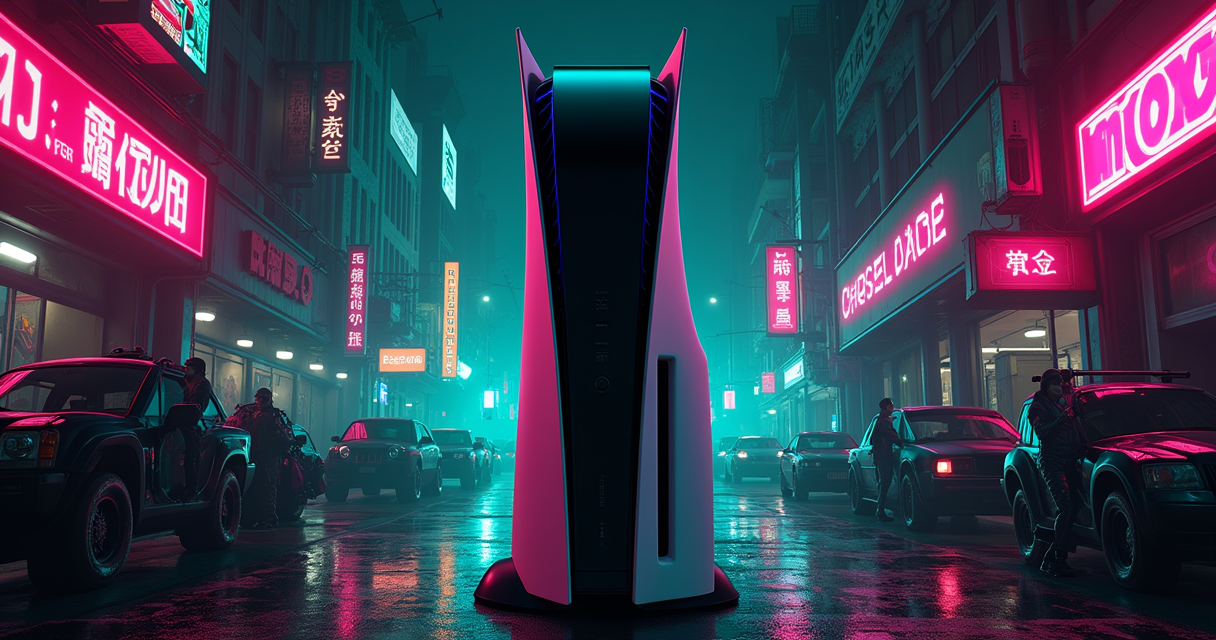
Here is the PlayStation 6 release date, stated with total precision: nobody knows. Not the analysts, not the leakers, and — by its own admission — not Sony. On May 8, 2026, president and CEO Hiroki Totoki stood on an earnings call and said, out loud, that the launch timing and the price of the next console are “not yet decided.” That is not marketing coyness protecting a reveal date. For once, it is the literal truth.
What follows is the honest version of “everything we know,” which is mostly a catalogue of everything Sony has refused to say, wrapped around one very large and very boring supply-chain problem: the world has run out of cheap memory. Strip away the render-farm mockups and the YouTube countdown timers and you are left with a single question that decides the whole thing. Can Sony build a console people can afford before the DRAM market calms down? Right now the answer is drifting from “2027” toward “2028,” and the smart money has moved with it.
The Status: No Date, No Price, No Name
Nothing has been announced, full stop
As of mid-July 2026, the PlayStation 6 has not been shown, named, dated, or priced. There is no box art, no logo, no spec sheet on a Sony server. Everything you have read — and everything below — is either an educated reading of the company's public financial statements or a leak of documents that are, in some cases, three years old. The Wikipedia entry for the console is a monument to hedged sourcing, and that is exactly the posture the subject deserves.
“Undecided” is a statement, not a dodge
When a platform holder wants to hide a launch date, it says nothing at all. It does not schedule the topic into an investor call and then decline to answer. Totoki's admission that Sony has “not yet decided on at what timing we will launch the new console, or at what prices” (as reported by VGChartz) is a different animal. It is a company telling its own shareholders that the variables are still moving. Read it next to the rest of his commentary — memory costs, bill-of-materials pressure, “changing business models” — and it stops sounding like secrecy and starts sounding like a hazard warning.
What we can actually anchor to
Three things are solid. One: the PS5 shipped 93.7 million units as of March 2026, with its most recent quarter down 46.4% year over year — the signature of a mature console late in its cycle, not a struggling one. Two: the memory market is on fire, and consoles are memory-hungry boxes. Three: every credible timeline now lives inside the 2027–2029 band. Everything else is interpretation, and most of the confident-sounding interpretation is a leak wearing a press release's clothes.
What Sony's CEO Actually Said
The quote, in full context
On Sony's fiscal Q4 earnings call, Totoki was asked about the next console. His answer, verbatim: “We have not yet decided on at what timing we will launch the new console, or at what prices.” He then did the thing executives almost never do — he explained the mechanism. Rising memory prices, he said, would “increase the cost to manufacture consoles, which would have big impact on consoles,” and he warned that “the memory price is also expected to be very high FY 2027, because there will still be a shortage of supply” (via Video Games Chronicle).
“Changing business models” is the real tell
The line that should make hardware buyers uneasy is this one: Sony “would like to think about various simulations, including changing business models to come up with the best solution and strategy.” Translated out of investor-speak, that is a company openly wondering whether the traditional playbook — sell the box near cost, make it back on software and services — even survives a world where the box itself is expensive to build. Subscription-forward tiers, a cloud-first SKU, a harder digital push: all of it is on the table precisely because the memory invoice says it has to be.
What Sony did lock in
One concrete detail escaped the call. For the rest of calendar 2026, Sony has already secured the memory volume it needs and has broadly agreed the pricing. That protects the current PS5 and PS5 Pro through the holiday quarter. It says nothing reassuring about 2027 — which is, inconveniently, the exact year a 2027-launch PS6 would need cheap RAM to exist.
The RAM Shortage Is the Whole Story
AI ate the memory supply
You cannot understand the PS6 timeline without understanding what happened to DRAM. Through 2025 and into 2026, AI data centers began consuming high-bandwidth memory at a scale that reordered the entire market. Fabs prioritized the pricier AI-grade parts and throttled standard DRAM and NAND. The result: memory prices surged roughly 90% in Q1 2026 versus Q4 2025, and SK Hynix has told customers to expect the crunch to persist through late 2027. This is not a blip. It is the defining cost input for every device with a memory controller, and a game console is nothing if not a memory controller with ambitions.
A console is a memory box with a GPU bolted on
Leaked specifications put the PS6 at roughly 30GB of GDDR7 — nearly double the PS5's 16GB, and on a newer, scarcer, more expensive memory type. That is the single line item most exposed to the shortage. It is telling that industry insider KeplerL2 has floated the possibility of Sony trimming the pool from 30GB to 24GB specifically to hold down cost. When engineers start discussing cutting the memory budget of an unreleased console, you are watching a bill-of-materials fight in real time.
Why this delays hardware instead of merely raising prices
Here is the logic that turns a cost problem into a calendar problem. Sony can eat a modest loss per unit at launch; it always has. What it cannot do is ship into a market that refuses to pay $700-plus while simultaneously losing a fortune on every box. If memory normalizes by 2028, a 2028 launch is dramatically cheaper to build and easier to price than a 2027 one. Waiting is not indecision — it is arithmetic. The same pressure already reshaped the current lineup: see how the PS5 Pro's price climbed to $899 in 2026 as component costs bit into a console that launched at $699.
2027 vs. 2028: The Two Camps
The reporting has split into two coherent factions, plus a prediction market quietly betting against both optimists. Here is the current state of the forecast, source by source.
| Source | Predicted window | Basis |
|---|---|---|
| KeplerL2 (leaker) | Holiday 2027 | Silicon “manufacturing-ready” by Q2 2027 |
| Engadget (2023 AMD deck leak) | Fall 2027 – early 2028 | Leaked production schedule; mid-2027 mfg start |
| Bloomberg (Feb 2026 report) | 2028 or 2029 (under review) | Global memory shortage |
| Embracer-tier analysts | 2028 or 2029 | DRAM prices, elevated BOM |
| Ampere Analysis (Harding-Rolls) | End of 2028 at the earliest | All-digital pivot + component costs |
| Kalshi (prediction market) | ~21.5% chance of a reveal before 2027 | Live odds, May 19, 2026 |
The 2027 camp: KeplerL2 and the leak ecosystem
The optimists have a spokesperson. KeplerL2, whose PS5 Pro leaks landed well ahead of the reveal, insists the schedule holds: “Both Xbox, PS6 and PS handheld are still [on] track for Holiday 2027” (via Vice). The supporting evidence is a leaked 2023 AMD presentation, surfaced by Engadget, showing manufacturing beginning mid-2027 for a fall-2027-to-early-2028 window. The weakness is obvious: that deck is three years old and predates the memory crisis entirely.
The 2028–2029 camp: the analysts and the accountants
The pessimists have the balance sheets. A Bloomberg report in February 2026 said Sony was “considering pushing back” the launch to 2028 or even 2029 over the memory shortage. Publisher-side analysts, including voices tied to Embracer Group, have told Notebookcheck they now plan around a 2028-or-2029 release, citing DRAM pricing and tariffs. Ampere Analysis has gone furthest, reading Sony's hardware and media moves as pointing to “end of 2028 at the earliest.”
The prediction market splits the difference — downward
Kalshi, where people put money on outcomes rather than hot takes, has drifted the same way. The market's odds that Sony announces the PS6 before 2027 slid from about 25.6% on April 7 to roughly 21.5% by May 19, 2026. When real capital is 4-to-1 against even a reveal in the next 18 months, a 2027 launch starts to look like a very brave position.
Historical Context: The Seven-Year Rhythm
Sony's clock runs on roughly seven years
PlayStation transitions are not random. They cluster around a five-to-seven-year cadence that has stretched over time, and the last two generations landed exactly seven years apart. That pattern is the strongest structural argument for 2027 — and the reason the leaker camp exists at all.
| Console | NA launch | Launch price (US) | Gap vs. predecessor |
|---|---|---|---|
| PlayStation | Sep 9, 1995 | $299 | — |
| PlayStation 2 | Oct 26, 2000 | $299 | 5 years |
| PlayStation 3 | Nov 17, 2006 | $499 / $599 | 6 years |
| PlayStation 4 | Nov 15, 2013 | $399 | 7 years |
| PlayStation 5 | Nov 12, 2020 | $499 / $399 | 7 years |
| PlayStation 6 | 2027–2029 (est.) | Undecided | 7–9 years |
PlayStation launch cadence (North America):

  PS1  Sep 1995
  PS2  Oct 2000   (+5 years)
  PS3  Nov 2006   (+6 years)
  PS4  Nov 2013   (+7 years)
  PS5  Nov 2020   (+7 years)
  ----------------------------------------
  PS6  = PS5 + 7  -> Holiday 2027   [leaker camp]
       = PS5 + 8  -> Holiday 2028   [analyst camp / base case]
       = PS5 + 9  -> 2029           [memory-crisis worst case]
The Ito rule: six to seven years
Sony's former hardware chief, Masayasu Ito, told Game Informer around the PS5's launch that the console's lifecycle was expected to run six to seven years. Do the addition: 2020 plus six is 2026 (now behind us), plus seven is 2027. By Sony's own historical framing, 2027 is the earliest plausible date, not the likeliest one — a distinction the countdown-clock crowd tends to skip.
Why the pattern might finally break
Every prior transition happened in a normal component market. This one won't. The seven-year rhythm assumes Sony can buy memory at sane prices when it needs to ramp production; in 2027, on current forecasts, it can't. History is a strong prior right up until the one input that history quietly assumed stops holding. For context on how large these leaps normally are, our breakdown of the PS5 versus PS4 generational jump shows why Sony treats a new console as a decade-defining bet rather than a routine refresh.
The Hardware: Orion, RDNA 5, and 30GB of GDDR7
Orion and Canis: the leaked codenames
The leak ecosystem has settled on two codenames: Orion for the home console and Canis for a companion handheld. The rumored silicon is a custom AMD Zen 6 CPU paired with an RDNA 5 GPU on a roughly 280mm² die, with 52 of 54 compute units enabled at around 3GHz, fed by ~30GB of GDDR7 on a 160-bit bus for about 640 GB/s of bandwidth. Every number in that sentence is unconfirmed and should be read with the skepticism it earns.
| Component | PS5 (2020) | PS5 Pro (2024) | PS6 (rumored) |
|---|---|---|---|
| CPU | Zen 2, 8-core @ 3.5GHz | Zen 2, 8-core | Zen 6 (custom) |
| GPU architecture | RDNA 2 | RDNA 2 (custom) | RDNA 5 |
| Compute units | 36 CU | 60 CU | 52 of 54 CU (~3GHz) |
| Memory | 16GB GDDR6 | 16GB GDDR6 (+2GB DDR5) | ~30GB GDDR7 (160-bit) |
| Memory bandwidth | 448 GB/s | 576 GB/s | ~640 GB/s |
| Raster vs. base PS5 | 1x | ~1.45x | ~3x |
| Ray tracing vs. base PS5 | 1x | ~2x | ~6–12x |
PS5 and PS5 Pro columns are Sony's published specifications. The PS6 column is leaked and unconfirmed — primarily the 2023 AMD deck surfaced by Engadget and details attributed to KeplerL2. Memory type is standardized GDDR7 (JEDEC).
Cerny's “simulation” and Project Amethyst
The most authoritative hardware hint came not from a leaker but from PS5 architect Mark Cerny. In the October 2025 Project Amethyst reveal — Sony and AMD's joint machine-learning graphics effort — Cerny described new techniques that “only exist in simulation right now, but the results are quite promising,” adding that he is “really excited about bringing them to a future console in a few years' time” (via VGC). “In simulation” and “a few years' time” are not the words of a man shipping hardware in eighteen months. The three headline breakthroughs — Neural Arrays, Radiance Cores, and Universal Compression — are the natural successors to the ML upscaling Sony already deploys; see our coverage of the PSSR 2 upscaling update for where that lineage stands today.
What “triple the PS5” actually buys you
Engadget's read of the leaked deck pegs the PS6 at roughly 3x the PS5's rasterization, about 2x the PS5 Pro, and 6–12x in ray tracing — a genuine generational leap, with the path-tracing gains being the real story. The catch is the same deck's mandate: deliver that at PS5-class pricing and lower power draw. In 2023, before AI ate the memory market, that looked plausible. In 2026, holding both performance and price is the hardest promise Sony has made to itself.
Price: Why $599 Is Already Optimistic
The numbers on the table
Pricing rumors span a wide, nervous range. The 2023 AMD deck implied targeting PS5 parity — the $499 digital reference point. KeplerL2 has suggested something closer to $600. Worst-case chatter has reached £700, roughly $880, if component costs run hot. The consistent thread from insiders is that Sony is fighting to protect a ~$599 launch price and views anything north of that as a market-shrinking event.
The PS5 already got more expensive
The backdrop makes $599 look aspirational. Across 2025 and 2026, tariffs and component costs pushed the current lineup up, not down: the standard PS5 sits at $649.99 (disc) and $599.99 (digital), with the PS5 Pro at $899.99 after its April 2026 adjustment. When your outgoing console already sells for $599 digital, launching its successor at the same number — in a worse memory market — is a formidable ask.
The math that scares Sony
Bloomberg's Jason Schreier, on the Spawncast podcast, put the demand-side risk bluntly: a near-term launch would be “insane,” because “the idea of a more expensive console now… Who wants that? Other than maybe the hardcore tech aficionados who will buy anything these companies make, I'm not sure how much of a market there would be for a PlayStation 6 next year.” That is the whole delay case in one sentence — the wider rumor mill is well catalogued by roundups like Digital Trends, but Schreier's point is the load-bearing one: an expensive console into a satisfied install base is a hard sell no marketing budget fixes.
The All-Digital Tell
Sony is winding down discs
The most concrete recent signal isn't a spec — it's a media strategy. Reporting through 2026 indicates Sony is winding down physical disc production as it pivots the platform toward digital distribution. On its own, that's a distribution footnote. Placed next to an unannounced console, analysts read it as a design constraint.
What Ampere reads into it
Ampere Analysis's Piers Harding-Rolls treats the disc wind-down as evidence the PS6 lands “end of 2028 at the earliest,” most likely with an all-digital base model and an optional disc add-on for backward compatibility — the same modular approach Sony already sells on the current generation. In his framing, the media roadmap “telegraphs quite a lot of information” about both the timing and the shape of the hardware.
Why a diskless base makes a 2028 launch cheaper
A drive-free base model is not just a convenience play; it is a bill-of-materials decision. Removing the optical drive trims cost at exactly the moment memory is inflating everything else, and it lets Sony hit an aggressive price without gutting the silicon. Sony has already run this experiment — the disc-less PS5 Pro shipped with the drive as a $79.99 accessory. Expect the PS6 to formalize that split from day one.
The Competition: Xbox, Switch 2, and the Clock
The next Xbox is stuck in the same mud
Sony is not delaying in a vacuum. The next Xbox — rumored codename in the “Project Helix” family with an even larger ~36GB memory pool — faces identical memory headwinds, and KeplerL2's Holiday 2027 claim covers both platforms. Microsoft's parallel bet on a premium, PC-adjacent box is the mirror image of Sony's dilemma; our look at the Series X versus Series S gap in 2026 shows how quickly memory and tariff pressure reshaped even the current Xbox pricing.
Switch 2 already proved the affordable path
The counter-example is instructive. Nintendo shipped the Switch 2 on June 5, 2025 at $449.99 (rising to $499.99 from September 2026) and moved roughly 19.86 million units — outpacing the PS5 over the comparable window. Nintendo's lesson is that a moderately priced machine into a hungry market prints money. Sony's problem is that its market is not hungry yet, and its machine will not be moderately priced.
The real competitor is the PS5 itself
Here is the uncomfortable truth for the countdown crowd: the PS6's fiercest rival is the console already under your television. The PS5 Pro is the deliberate mid-generation stopgap that lets Sony stretch this cycle, and the marquee software — including Grand Theft Auto VI, due on PS5 in late 2026 — gives players no reason to jump. When the current box runs everything that matters, “wait” is not a hardship. It is the rational default, for Sony and for you.
Predictions: The Next 6 to 12 Months
By the end of 2026: still silence
Do not expect a reveal this year. The prediction markets agree, pricing a pre-2027 announcement at roughly one-in-five. Concretely:
- No hardware unveiling before 2027. Sony holds the reveal until it can name a price it is willing to defend, and the FY2027 memory forecast makes that impossible to promise in 2026.
- The delay narrative hardens. Expect at least one more analyst house to formally move its model from 2027 to 2028, following Ampere and the Embracer-tier voices already there.
Through 2027: a tease, not a launch
2027 is more likely to bring a technology tease than a console:
- A Project Amethyst / next-gen tech showcase arrives before any product reveal — ML graphics and ray-tracing demos that set the stage without committing to a date.
- The all-digital base model gets confirmed once Sony does reveal, with an optional disc drive priced as an accessory, mirroring the current generation.
- If a 2027 launch happens at all, it is a paper launch — tiny supply, holiday-only, aimed at enthusiasts, exactly the “hardcore tech aficionados” Schreier named. A real, broad rollout waits for memory relief.
The wildcards
Two things could move the whole board. If the DRAM shortage eases faster than SK Hynix's late-2027 guidance, the 2027 camp gets its opening back. And if Sony genuinely acts on Totoki's “changing business models” line — a cloud-heavy or subscription-anchored SKU — the very concept of a single “release date” could fragment into a staggered rollout. Watch the memory-price index more closely than any leaker.
The Verdict: Bet on Holiday 2028
The base case
Weigh the evidence and the needle settles on Holiday 2028. The 2027 case rests almost entirely on one leaker and a three-year-old AMD slide drafted before the memory market inverted. The 2028 case is carried by Sony's own CEO refusing to commit, a documented 90% DRAM spike, a shortage forecast running into late 2027, multiple analyst houses, and a prediction market drifting away from any near-term reveal. That is not a close call dressed up as one.
The risk to the base case
The honest caveat: this is a supply-chain forecast, and supply chains surprise people. A faster memory recovery pulls the date toward late 2027; a deeper or longer crunch pushes it into 2029. The one outcome the evidence does not support is a confident, broad, affordably priced PS6 in 2027. Anyone selling you that date is selling you the 2023 deck, not the 2026 reality.
What to do with this information
Nothing urgent. Buy the console you want now — a standard PS5 or, if you chase fidelity, the Pro — on the assumption its successor is at least two holidays away and will arrive pricier than the internet is promising. When Sony finally does name a date, the first number to check is not the teraflops. It is the price, because in this generation, the price is the release date.
Questions the search bar asks me
- When is the PlayStation 6 coming out?
- There is no official date. On May 8, 2026, Sony CEO Hiroki Totoki said the launch timing is 'not yet decided.' Leaker KeplerL2 maintains Holiday 2027, but analysts (Ampere, Embracer-tier) and a February 2026 Bloomberg report now lean toward 2028 or 2029, blaming the global memory shortage. The most defensible bet is Holiday 2028.
- How much will the PS6 cost?
- Unannounced. A leaked 2023 AMD deck implied PS5-parity pricing (~$499 digital), KeplerL2 has suggested closer to $600, and worst-case rumors reach £700 (about $880). Insiders say Sony is fighting to protect a ~$599 launch price, but the RAM shortage is inflating the bill of materials against that goal.
- Why might the PS6 be delayed to 2028?
- A global RAM shortage driven by AI data-center demand. DRAM prices rose roughly 90% in Q1 2026 versus Q4 2025, and SK Hynix expects the crunch through late 2027. The PS6 reportedly needs ~30GB of GDDR7, and Totoki warned memory will be 'very high' in FY2027 — making a cheap 2027 launch very hard to build.
- Will the PS6 have a disc drive?
- Probably not built in. Ampere Analysis's Piers Harding-Rolls reads Sony's wind-down of physical disc production as pointing to an all-digital base model with an optional disc add-on for backward compatibility, arriving 'end of 2028 at the earliest.' It mirrors how the current PS5 Pro sells its drive as a $79.99 accessory. Nothing is officially confirmed.
- How powerful will the PS6 be?
- Per a leaked 2023 AMD presentation (via KeplerL2 and Engadget): roughly 3x the base PS5's rasterization, about 2x the PS5 Pro, and 6–12x in ray tracing. Rumored silicon is a custom AMD Zen 6 CPU and RDNA 5 GPU (~52 of 54 CU near 3GHz) with ~30GB of GDDR7 at about 640 GB/s. All of it is unconfirmed leak data.

Jordan covers the modern industry where it touches the old one: Nintendo announcements, handheld hardware, and the long shadow the classics cast over new releases. Every post under this byline is reviewed pre-publish by Sam P., Editor & Operator — corrections to info@instalinkoteam.com. Published 2026-08-29 · Last updated 2026-08-29. Full bios on the author page.