/// FIELD NOTES FROM A SELF-AWARE GAME SITE
PS5 Pro vs PS5 2026: 45% Faster GPU, $300 More
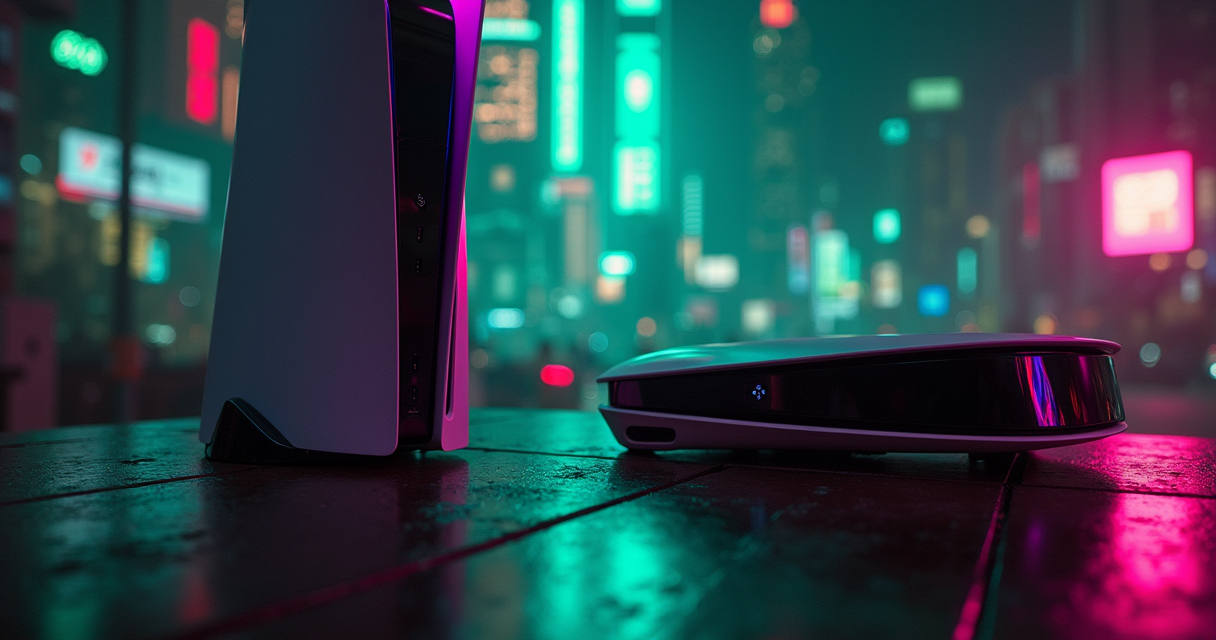
Let us start with the uncomfortable arithmetic, because it is the whole story. In November 2024 the PlayStation 5 Pro arrived at $699.99. By August 2025 it was $749.99. As of April 2, 2026 it is $899.99 — a machine that has been made 29% more expensive without a single transistor being added to it. The base PS5, meanwhile, sits at $649.99 with a disc drive or $599.99 without one. So the question is not really "is the PS5 Pro better than the PS5?" It plainly is. The question is whether roughly 45% more rasterization and a genuinely clever upscaler are worth a $250–$300 premium on hardware that shares a CPU with the cheaper box. That is the comparison. Everything below is us doing the math so you do not have to.
The Verdict, Up Front
We are not going to make you scroll 6,000 words for the recommendation. Here it is, then we will spend the rest of the article showing our work.
The one-sentence answer
Buy the PS5 Pro if you own a 4K/120Hz television or OLED monitor, you play graphically demanding first- and third-party titles from the enhanced list, and the difference between a reconstructed 1440p image and a PSSR-sharpened one is something your eyes and your wallet both notice. Buy — or simply keep — the base PS5 if you game on a 1080p or 1440p panel, you mostly play competitive or indie titles that already run at a locked 60, or you are an existing PS5 owner hoping the Pro will deliver a generational leap. It will not. Digital Foundry's Richard Leadbetter put it plainly: "In real terms, those hoping that PS5 Pro will turn CPU-limited 30fps titles into super-smooth 60fps experiences will be disappointed."
The $250–$300 question
The delta is the entire debate. Compared digital-to-digital — the honest match, since the Pro has no disc drive — you are paying $899.99 against $599.99, a flat $300 premium. Compared to the disc-based base PS5 at $649.99, the gap narrows to $250. Add the $79.99 disc drive to a Pro if you want physical media and the all-in figure lands near $980, close to double the base PS5 Digital. That premium buys real hardware, but it is a premium for polish, not for a new class of experience. The base PS5 still runs every PS5 game. Nothing is Pro-exclusive.
Who this comparison is for
If you have never owned a current-gen PlayStation and you have a high-end display, the calculus is easier — buy once, buy the best, skip the eventual upgrade itch. If you already own a launch PS5 or a Slim and you are eyeing the Pro as a mid-generation refresh, the calculus is harder, and the honest answer is usually "no." We agree with the broad critical consensus here: the Pro is best-in-class hardware and questionable value for the mainstream. Whether that describes you is what the next ten sections are for. For the wider platform picture, our PS5 vs Xbox Series X breakdown covers where Sony's box sits against Microsoft's in 2026.
Pricing & Availability
Pricing is where the PS5 Pro story stopped being a hardware story and became an economics story. Two hikes in eight months turned a $699.99 enthusiast console into a $899.99 one, and the base PS5 came along for the ride.
The two-hike timeline (2024 → 2025 → 2026)
The Pro launched globally on November 7, 2024 at $699.99 as digital-only hardware. On August 21, 2025, Sony raised US prices citing tariff pressure — the Pro went to $749.99, and the base consoles climbed too. Then, effective April 2, 2026, Sony did it again. Per the official PlayStation Blog announcement, the company wrote: "With continued pressures in the global economic landscape, we've made the decision to increase the prices of PS5, PS5 Pro, and PlayStation Portal remote player globally." The Pro took a $150 jump to $899.99; the base PS5 and Digital Edition each rose $100; even the Portal streaming handheld went up $50. CNBC and Tom's Hardware both documented the move. This is the rare console that is a worse deal every year it exists.
The disc-drive tax
Here is the detail people forget: the PS5 Pro has no disc drive at all. It is digital-only hardware by design. If you want to play a physical Blu-ray, insert a 4K UHD movie, or resell a game the old-fashioned way, you buy the detachable Ultra HD Blu-ray Disc Drive as an accessory. It launched at $79.99, and 2026 retail coverage frequently cites it nearer $99. So the true "I want everything" Pro is $899.99 plus roughly $80–$100, landing between $980 and $1,000. That is a meaningful psychological line to cross for a console whose games you can buy, physically, and play on a $649.99 base unit with the drive already inside.
Current pricing, at a glance
| Configuration | Launch price | Aug 2025 | Current (Jul 2026) | Disc drive? |
|---|---|---|---|---|
| PS5 Pro (digital) | $699.99 | $749.99 | $899.99 | No — $79.99 add-on |
| PS5 Pro + disc drive | ~$779.98 | ~$829.98 | ~$979.98–$999 | Detachable accessory |
| PS5 (disc) | $499.99 | $549.99 | $649.99 | Built in |
| PS5 Digital Edition | $449.99 | $499.99 | $599.99 | No |
| Pro premium (digital vs digital) | $250 | $250 | $300 | — |
Availability, mercifully, is no longer the problem it was in 2020. Both consoles are widely in stock in mid-2026, which — combined with the price creep — has softened demand. Reports of double-digit sales declines against prior years suggest the market has noticed that $899.99 asks a lot of a mid-generation refresh. If you want the definitive spec-and-price reference maintained over time, the Wikipedia PlayStation 5 Pro entry tracks the changes, and TechRadar's ongoing comparison is a reasonable second source.
Specs, Head to Head
The spec sheet is where the Pro earns its name. This is a real hardware upgrade, not a firmware unlock. But read it carefully, because the improvements are concentrated in exactly one place — the GPU — and conspicuously absent in another — the CPU.
GPU: the 67% compute-unit jump
The headline number is compute units. The base PS5 has 36; the Pro has 60. That is a 67% increase in raw shader hardware, which Sony's own materials trumpet. Clocked at up to roughly 2.18GHz, those 60 CUs work out to approximately 16.7 TFLOPS of FP32 throughput, versus the base PS5's 10.28 TFLOPS. A caveat for the pedants, and we are pedants: Sony never officially quoted a TFLOPS figure for the Pro; 16.7 is a community calculation from the CU count and clock, and TFLOPS across different architectures is a famously slippery metric. What Sony did claim is more useful — about 45% faster rendering and 2–3x faster ray tracing, the latter thanks to a beefed-up ray-tracing pipeline borrowed from newer RDNA generations. The Pro's GPU is best understood as RDNA 2's foundation with selected RDNA 3/4 features grafted on, particularly for ray traversal and machine-learning inference.
Memory, storage, and the DDR5 trick
Both consoles carry 16GB of GDDR6. The Pro runs it faster — 18 Gbps for roughly 576GB/s of bandwidth, against the base PS5's 14 Gbps and 448GB/s, a 28% uplift that matters enormously for a bandwidth-hungry GPU. The subtle win is a second pool: the Pro adds 2GB of DDR5 dedicated to the operating system and background tasks, which frees up more of that fast GDDR6 for the game itself. Storage doubles from 1TB to 2TB of NVMe SSD, and both consoles accept M.2 expansion drives in the internal slot. If your library is 4K-texture-heavy, that 2TB fills up fast enough that you will still want the expansion, but it is a genuine convenience over the base unit.
Connectivity, size, and the boring-but-real stuff
The Pro supports Wi-Fi 7 against the base PS5's Wi-Fi 6, with Bluetooth 5.1 on both — a difference that matters mostly for low-latency streaming and cloud play rather than local gaming. Physically, the Pro is the larger box at roughly 388 × 89 × 216mm and about 3.1–3.2kg, versus the Slim's 358 × 97 × 224mm and ~3.1kg; it is taller and narrower, with the same familiar fin-and-fan cooling. Backward compatibility is identical on paper — both play the same catalogue of 8,500+ PS4 titles — but the Pro layers Game Boost on top, nudging frame rates and resolutions upward on a curated set of legacy games. Here is the full matrix.
| Specification | PS5 Pro | Base PS5 (Slim) | Delta |
|---|---|---|---|
| GPU compute units | 60 CUs | 36 CUs | +67% |
| GPU throughput (calc.) | ~16.7 TFLOPS | 10.28 TFLOPS | +62% |
| GPU architecture | Custom RDNA (RDNA 2 + RDNA 3/4 features) | Custom RDNA 2 | Newer RT + ML |
| Rendering (Sony claim) | ~45% faster | Baseline | +45% |
| Ray tracing | 2–3x throughput | Baseline | Up to 3x |
| ML upscaling | PSSR + upgraded PSSR (2026) | None (FSR/checkerboard/TAA) | Pro-exclusive |
| GDDR6 memory | 16GB @ 18 Gbps (576GB/s) | 16GB @ 14 Gbps (448GB/s) | +28% bandwidth |
| System memory | +2GB DDR5 (OS) | None comparable | Frees GDDR6 |
| Storage | 2TB NVMe SSD | 1TB NVMe SSD | 2x |
| M.2 expansion | Yes | Yes | Tie |
| Disc drive | None ($79.99 add-on) | Built in (disc SKU) | Base wins |
| Wi-Fi | Wi-Fi 7 | Wi-Fi 6 | Pro newer |
| Bluetooth | 5.1 | 5.1 | Tie |
| Display output | Up to 4K/120, 8K, VRR | Up to 4K/120, 8K, VRR | Tie (Pro sustains higher) |
| PS4 back-compat | 8,500+ (+ Game Boost) | 8,500+ | Pro enhances |
| Dimensions | 388 × 89 × 216mm | 358 × 97 × 224mm | Pro taller |
| Launch date / price | Nov 7, 2024 / $699.99 | Nov 12, 2020 / $499.99 | — |
| Price (Jul 2026) | $899.99 | $649.99 / $599.99 | +$250–$300 |
Notice what does not appear in that table: a new CPU. Both consoles use effectively the same eight-core Zen 2 processor, with the Pro clocking marginally higher in a special high-frequency mode. That single omission explains almost every disappointment you will read about in the benchmarks section. You cannot spend your way out of a CPU wall with GPU silicon, and Sony did not try.
What PSSR Actually Is
If the GPU is why the Pro exists on the spec sheet, PSSR is why it exists in practice. PlayStation Spectral Super Resolution is Sony's answer to NVIDIA's DLSS and AMD's FSR — a machine-learning upscaler that reconstructs a sharp 4K image from a lower internal resolution — and it is the single feature that most consistently justifies the Pro's price for the people it suits.
How spectral super resolution works
Rather than rendering natively at 4K, which is punishingly expensive, a PSSR-enabled game renders internally at something like 1080p to 1440p and then hands the frame to a trained neural network that reconstructs it up to 4K, pixel by pixel, using motion vectors and learned detail. The result, when it works, is an image sharper than the base PS5's older reconstruction techniques (checkerboarding, FSR 2, temporal anti-aliasing) at a lower rendering cost — which is what frees up the headroom for higher frame rates or ray tracing. Critically, this is dedicated silicon: the Pro's GPU includes machine-learning hardware the base PS5 simply does not have, which is why PSSR is genuinely Pro-exclusive and cannot be patched onto the cheaper console. Push Square's explainer describes it as an AI library that analyzes game images pixel by pixel as it upscales them, and that is the honest one-line summary.
The 2026 upgraded PSSR (Project Amethyst)
Here is where the popular "PSSR launched in a March 2026 firmware update" claim gets the timeline backwards, and we want to be precise. PSSR shipped with the console in November 2024. What arrived in early 2026 was an upgraded PSSR — a different neural network and algorithm derived from Sony's Project Amethyst partnership with AMD, closely related to the FSR 4 lineage. Architect Mark Cerny told TechRadar the new model is "something like 100 microseconds faster than the original," and that the saved time let Sony add an "Enhance PSSR Image Quality" toggle that can "force-upgrade all PSSR-supported games." The community has taken to calling this PSSR 2.0; Sony does not officially, but the shorthand is fair. Resident Evil Requiem was among the first titles built for it, with Assassin's Creed Shadows, Silent Hill f, and Monster Hunter Wilds folded into support through the spring.
Where PSSR wins and where it fails
PSSR is not magic, and the Pro's first year exposed its rough edges. When it works — Final Fantasy VII Rebirth and Stellar Blade are the reference showcases — it turns a soft, blurry 60fps performance mode into something genuinely crisp, and it is the closest a console has come to DLSS-class reconstruction. When it fails, you get shimmering, ghosting on fine detail like foliage and hair, and artefacts that the older, dumber techniques handled more gracefully. The upgraded 2026 model demonstrably reduced those failures, which is exactly why the retroactive "Enhance Image Quality" force-upgrade matters: it improves games whose developers moved on months ago. If you are the sort of person who reads pixel-counting analysis for fun, PSSR is the feature you are buying. If you cannot see the difference between reconstructed 1440p and native-ish 4K from your couch, you are paying $300 for a technology your eyes will not cash.
Benchmarks: Real Numbers
Marketing says 45% faster. Reality says "it depends on the game, and sometimes on nothing you can see." We pulled figures from three independent bodies of analysis — Digital Foundry's testing, wccftech's early analysis, and gamepressure's comparison coverage — plus community capture testing. The pattern is remarkably consistent: games that were GPU-bound or visually soft on the base console gain the most; games bottlenecked by the CPU gain almost nothing.
The GPU-bound wins
Spider-Man 2 is the clean example of the Pro's best case. On the base PS5 you choose between a 4K/30 fidelity mode with ray tracing and a 60fps performance mode that dials ray tracing back. On the Pro, that compromise largely evaporates — you get 4K, ray tracing, and a locked 60 simultaneously. Alan Wake 2 is subtler: the internal render resolutions are actually similar between the two machines (roughly 846p in the 60fps mode, 1260p in the 30fps mode), but the Pro swaps FSR 2 for PSSR and stabilises frame times through the game's heaviest lighting scenes, so the image is cleaner and the pacing steadier even when the raw pixel count is close. That nuance matters: some of the Pro's benefit is not "more pixels" but "better-reconstructed and more consistent" pixels.
The CPU wall
Now the disappointment. Dragon's Dogma 2 is the poster child for a CPU-bound game — its cities drag the base PS5 below 30fps because the simulation, not the graphics, is the bottleneck. The Pro helps, with community captures showing roughly 10–15 fps higher in performance mode, but it cannot deliver a locked 60 in those crowds because the same Zen 2 CPU is doing the same struggling. Digital Foundry measured the same ceiling elsewhere: Cyberpunk 2077 gains only about 10% in CPU-limited areas, and Baldur's Gate 3 lands in the 6–10% range in its heaviest scenes. This is Leadbetter's warning made concrete — the Pro is a GPU upgrade attached to a last-generation CPU, and no amount of PSSR fixes a simulation bottleneck. If your favorite games stutter because of physics, AI, or draw calls rather than resolution, the Pro is the wrong tool.
Boost Mode and the back catalogue
The quietly excellent story is unpatched and legacy games. Through Game Boost, titles that never received a Pro patch often run better anyway. Digital Foundry found Metaphor: ReFantazio effectively locks to 60fps in Boost Mode, and Silent Hill 2's performance mode sheds its stutters for a near-locked 60 with only rare dips. For anyone with a large existing library, this is a real if unglamorous benefit — the Pro is frequently the best way to play games that Sony and their developers have long since stopped optimizing. Here is the game-by-game summary.
| Game | Base PS5 issue | PS5 Pro result | Verdict |
|---|---|---|---|
| Spider-Man 2 | Fidelity vs 60fps tradeoff | 4K + RT + locked 60 | Big win |
| FF7 Rebirth | Blurry 60fps performance mode | PSSR-sharpened, crisp | Big win |
| Alan Wake 2 | Soft FSR 2, frame dips | PSSR, steadier pacing | Moderate win |
| Dragon's Dogma 2 | Sub-30 in cities (CPU) | ~10–15 fps higher, still not locked | Partial |
| Cyberpunk 2077 | CPU-limited zones | ~10% uplift | Marginal |
| Baldur's Gate 3 | Act 3 CPU load | ~6–10% uplift | Marginal |
| Silent Hill 2 | Traversal stutter | Near-locked 60 (Boost) | Win (unpatched) |
| Metaphor: ReFantazio | Uneven frame rate | Locked 60 (Boost) | Win (unpatched) |
If you capture footage of these differences to compare them yourself, note that the Pro's cleaner 4K60 output is exactly the kind of signal worth recording properly — our PS5 4K60 capture-card walkthrough covers doing it in OBS without compression artefacts muddying the comparison.
Game Support in 2026
A Pro is only as good as its enhanced library, and the "only 50 games" complaint that dogged the 2024 launch has aged. The list has more than doubled — but the quality and consistency of those enhancements still varies wildly.
The enhanced-games list, counted
At launch in November 2024, roughly 50 titles carried the PS5 Pro Enhanced badge. By mid-2026, the trackers tell a different story: Push Square's running list and Newsweek's PSSR roundup both put the count around 106–113 enhanced games, including the first titles built for the upgraded PSSR 2.0 model. That is steady growth, though it is worth remembering the base PS5 library is in the thousands — enhanced games remain a curated slice, not the whole menu. If a game you love is not on the list, the Pro runs it identically to the base console apart from whatever Boost Mode can scrape back.
The studios doing the work
The heavy lifting has come from a predictable set of studios. CD Projekt Red brought Cyberpunk 2077: Phantom Liberty up to Pro spec; Capcom enhanced Resident Evil Village and, later, Resident Evil Requiem as a PSSR 2.0 showcase; Guerrilla's Horizon Forbidden West was an early flagship. Sony's own studios — Insomniac, Guerrilla, Naughty Dog — treated the Pro as a first-class target, which is why first-party games tend to show the cleanest gains. Third-party support is broader now but spottier in quality; a Pro patch is not a guarantee of a transformative result, as the marginal Cyberpunk and Baldur's Gate numbers above demonstrate.
PS4 back-compat and Game Boost
Both consoles play the same 8,500-plus PS4 catalogue, but the Pro's Game Boost can push select PS4 titles to higher, steadier frame rates and resolutions than the base hardware manages. For a certain kind of buyer — someone maintaining a decade-deep PlayStation library — this is a genuine draw, because it improves games that will never see another official patch. It is also the least-marketed feature Sony ships, which tells you something about where the company thinks the money is. Speaking of maintenance: if either console starts stuttering in ways the hardware cannot explain, our PS5 cache-clear guide is the first thing to try before you blame the silicon.
Five Real-World Use Cases
Specs are abstract. Here are five concrete profiles, each with a recommendation and the reasoning behind it. Find yourself in the table, then read the paragraph that matches.
| # | Who you are | Buy this | Why |
|---|---|---|---|
| 1 | 4K/120Hz OLED owner, AAA player | PS5 Pro | PSSR + RT + high frame rates land exactly where your display can show them |
| 2 | 1080p/1440p gamer | Base PS5 | Pro's 4K reconstruction is wasted; save $250–$300 |
| 3 | Existing base PS5 owner | Keep your PS5 | No generational leap; CPU is shared; not worth the double-buy |
| 4 | Competitive / indie / backlog player | Base PS5 | Those games already hit locked 60; Pro adds nothing you'll feel |
| 5 | First console, wants best, high-end TV | PS5 Pro | Buy once, buy top; skip the mid-gen upgrade regret |
Cases 1 and 5: the Pro makes sense
If you already own a good 4K/120Hz television or a high-refresh OLED and your play diet is graphically ambitious single-player games — the Horizons, the Final Fantasies, the ray-traced open worlds — the Pro is the console built for you specifically. Its entire value proposition is turning "choose fidelity or frame rate" into "have both," and that only pays off on a display capable of resolving the difference. Case 5 is the same logic from a different start: if you are buying your first current-gen PlayStation and you have the display and the budget, buying the Pro once is cheaper and less annoying than buying a base PS5 now and upgrading later. The double-buy is the expensive path.
Cases 2 and 4: the base PS5 is the smart money
If your panel tops out at 1080p or 1440p, the Pro is actively wasteful — PSSR's reconstruction to 4K is a benefit your screen physically cannot display, so you would be paying a $300 premium for pixels that never reach your eyes. Buy the base PS5 and spend the difference on the games themselves. The same is true if you mostly play competitive shooters, fighting games, or indies: those titles are engineered to hit a locked 60 (or higher) on base hardware already, and the Pro's advantages simply do not apply. There is no esports title that plays meaningfully better on a Pro.
Case 3: the upgrade nobody needs
The hardest sell, and the one Sony most wants to make, is the existing PS5 owner. The honest answer is to keep what you have. You already own a console that runs every PS5 game. The Pro will make some of them sharper and steadier, but it will not unlock a single game you cannot already play, and it will not fix the CPU-bound stutter in your worst-performing titles. Spending $899.99 to re-buy a machine you functionally already own, for a polish-tier upgrade, is the definition of diminishing returns. If you are itching to spend money on the hobby, a better display or an SSD upgrade will do more for your experience than the Pro will.
Pros & Cons, Console by Console
Every comparison eventually needs the blunt ledger. Here is ours, with no attempt to pretend either console is flawless.
PS5 Pro: the ledger
| PS5 Pro pros | PS5 Pro cons |
|---|---|
| 67% more GPU compute units (60 vs 36) | $899.99 — up 29% from launch after two hikes |
| ~45% faster rendering, 2–3x ray tracing | Same Zen 2 CPU — no help for CPU-bound games |
| PSSR + upgraded 2026 model (DLSS-class) | No disc drive; $79.99–$99 accessory to add one |
| 2TB SSD, 28% more memory bandwidth | Enhanced list (~110) is a slice of the library |
| Game Boost improves unpatched titles | Zero exclusive games — nothing you can't play on base |
| Wi-Fi 7, best-in-class console image quality | PSSR still shimmers/ghosts in some titles |
Base PS5: the ledger
| Base PS5 pros | Base PS5 cons |
|---|---|
| $599.99 digital / $649.99 disc — $250–$300 cheaper | 10.28 TFLOPS — visibly weaker in demanding titles |
| Runs 100% of PS5 games, no exceptions | No PSSR; older FSR/checkerboard reconstruction |
| Disc drive built into the disc SKU | 1TB storage fills quickly with 4K assets |
| Smaller, lighter, cheaper to replace | Fidelity-vs-frame-rate compromises remain |
| Same CPU, controller, OS, and services | Wi-Fi 6 rather than Wi-Fi 7 |
| The value play in 2026 by a wide margin | Also caught the 2025/2026 price hikes |
The tie-breakers
Strip away the numbers and two facts decide most purchases. First: there are no Pro-exclusive games and there never will be — Sony has committed to feature parity, so the base PS5 is never locked out of content. Second: the CPU is shared, which caps how transformative the Pro can ever be. Those two truths are why we keep landing on the same place — the Pro is a luxury refinement of a console you can buy for $300 less, not a new console. Buy the refinement only if you will actually perceive it.
Migrating From Base PS5 to Pro
Decided the Pro is for you? Good news: moving from a base PS5 is one of the least painful hardware migrations in gaming, because it is the same operating system, the same account, the same everything — just faster silicon. Here is how to do it without losing a save.
Data transfer, step by step
Sony's built-in Data Transfer tool moves your entire library, saves, and settings over your local network. Wired is dramatically faster than Wi-Fi; if you can put both consoles on the same Gigabit switch for an hour, do it.
PS5 -> PS5 Pro data transfer
1. Sign in to the SAME PSN account on both consoles.
2. Connect both to the same network (Ethernet strongly preferred).
3. On the Pro: Settings > System > System Software > Data Transfer.
4. Select the old PS5 as the source device.
5. Choose what to move: games & apps, saved data, settings, screenshots.
6. Start transfer. ~1TB over Gigabit LAN = roughly 30-90 minutes.
7. After transfer, re-download any PS5 Pro Enhanced patches
   (Pro versions are separate downloads for many games).
8. Optimize output:
   Settings > Screen and Video > enable 4K, 120Hz, VRR
   Settings > (per-game) > enable "Enhance PSSR Image Quality"
9. Verify saves loaded, then factory-reset the old console before resale.
Cloud saves via PlayStation Plus are the belt-and-suspenders backup — sync everything up before you start, so a failed transfer costs you nothing. The whole process, patch re-downloads included, is usually an evening's work rather than a weekend's.
What to do with your old console
Do not let the old PS5 rot in a closet. A factory-reset base PS5 in good condition retains real resale value, and offloading it recovers a meaningful chunk of the Pro's premium — sell the base unit for a few hundred dollars and the effective cost of the Pro upgrade drops accordingly. Alternatively, keep it as a second console in another room; because your account and cloud saves are shared, you can continue a game upstairs on the Pro and pick it up downstairs on the base PS5 with only a save-sync in between. Remember to deactivate the old console as your primary system in account settings if you resell it.
When NOT to migrate
Reverse the whole exercise if any of these are true: your display is 1080p or 1440p, your most-played games are CPU-bound or already locked at 60, or the $300 delta represents a real budget strain. In those cases the correct migration is no migration. And if you are weighing the Pro against building or buying a gaming PC instead — a fair question at these prices — read the next section before you transfer a single byte.
The Gaming-PC Question
At $899.99, the PS5 Pro has priced itself into direct comparison with entry-level gaming PCs, and that comparison deserves an honest answer rather than a tribal one.
Price-to-performance in 2026
On raw price-to-performance, the Pro still wins against a PC at the same price point — this is the one context where the $899.99 sticker looks reasonable. A prebuilt PC that matches the Pro's effective gaming output, with a comparable GPU, fast NVMe storage, and a Windows license, generally costs more than $899.99 in 2026, and it will not come with Sony's first-party catalogue, DualSense haptics, or the guarantee that games are optimized for exactly one hardware target. A console's fixed spec is a real engineering advantage: developers tune for one machine, and it shows. For a fuller treatment of where the two platforms are actually heading — spoiler, the crossover math favors PC by 2028 — see our PC vs console 2026 analysis.
What the Pro can't do that a PC can
The asterisks are large, though. A PC uncaps frame rate — the Pro is still, at heart, targeting 60 with occasional 120 modes, whereas a comparable PC pushes well past that on the right monitor. A PC plays every storefront, runs mods, doubles as a work machine, and upgrades piecemeal rather than in $900 generational lumps. And a PC's DLSS 4-class upscaling is, frankly, ahead of even the upgraded PSSR. The Pro's counter is simplicity: no driver roulette, no settings tuning, no shader compilation stutter — you turn it on and it works. That is worth something, and for a lot of buyers it is worth exactly the premium. If your streaming and remote-play habits matter to the decision, the Pro's Wi-Fi 7 and our PS Remote Play setup guide are part of that convenience story.
The Machine's Verdict
We have shown the work. Here is the ruling, delivered without the marketing department in the room.
Buy the Pro if…
You own a 4K/120Hz display capable of resolving the difference, you play the graphically demanding games that populate the ~110-title enhanced list, and you either have no current PS5 or you genuinely value best-available console image quality enough to pay for it. In that lane, the Pro delivers exactly what it promises: PSSR-sharpened 4K, ray tracing without the frame-rate penalty, a 2TB drive, and the quiet luxury of Boost Mode fixing games nobody else will patch. Digital Foundry's bottom line, which we endorse, is that if you have the money and you want the most capable console on the market, this is it. It is, unambiguously, the best PlayStation you can buy.
Buy (or keep) the base PS5 if…
You are almost everyone else. If your screen is 1080p or 1440p, if you already own a PS5, if your library leans competitive or indie, or if $300 is a number that matters to you — and it should — the base PS5 at $599.99 to $649.99 is the correct purchase. It runs every game the Pro runs. Nothing is exclusive. The gap is polish, and polish is not worth a 50% price increase for most people. Sony's own launch line for the Pro was that it is "the most visually impressive way to play games on PlayStation." Note the careful phrasing: the most impressive way to play the same games. That is the whole review in nine words.
The bottom line
The PS5 Pro is a triumph of engineering wrapped in a failure of value timing. The hardware is real — 67% more compute, a legitimately clever upscaler, doubled storage — but two price hikes in eight months pushed it to $899.99, and the shared Zen 2 CPU caps how far that GPU power can carry you. For the enthusiast with the right display and the right games, it is a defensible, even delightful, $300. For everyone else, it is the most expensive way to play games you can already play. Decide which one you are with this.
DECISION TREE — PS5 Pro vs PS5 (2026)
if own_base_PS5 and want == "generational leap":
    keep PS5            # the Pro will not deliver one
elif display in ("1080p", "1440p"):
    buy PS5 Digital     # $599.99 — Pro's 4K/PSSR is wasted here
elif games are mostly CPU_bound or locked_60:
    buy/keep PS5        # shared CPU = no meaningful gain
elif want == "best console image quality" and library in enhanced_list:
    buy PS5 Pro         # $899.99 — this is its lane
elif first_console and display == "4K/120Hz OLED":
    buy PS5 Pro         # buy once, skip the double-buy
else:
    buy PS5; spend the $300 delta on games
The best console Sony has ever made is also the worst-priced. Both of those things are true, and which one governs your purchase depends entirely on the television you are going to plug it into. Choose accordingly.
Questions the search bar asks me
- Is the PS5 Pro worth it over the base PS5 in 2026?
- It depends on your display and your library. At $899.99 versus $599.99–$649.99, you pay a $250–$300 premium for roughly 45% more rasterization and PSSR upscaling. It is worth it if you own a 4K/120Hz set and play the ~110 enhanced games; it is not worth it if you chase a generational leap, because Digital Foundry's Richard Leadbetter warns the Pro will not turn CPU-limited 30fps titles into 60fps ones.
- How much more powerful is the PS5 Pro than the base PS5?
- The Pro has 60 GPU compute units versus 36 — a 67% increase — for roughly 16.7 TFLOPS against the base PS5's 10.28. Memory bandwidth rises 28% (576GB/s vs 448GB/s via 18Gbps GDDR6), and Sony claims about 45% faster rendering and 2–3x faster ray tracing. Real-world uplift is smaller because the CPU is nearly identical.
- Does the PS5 Pro have a disc drive?
- No. The Pro is digital-only hardware. The detachable Ultra HD Blu-ray drive is a separate $79.99 accessory (2026 retail listings often cite around $99), which pushes a disc-capable Pro to roughly $980–$1,000 all-in — nearly double the base PS5 Digital's $599.99.
- What is PSSR and did it improve in 2026?
- PSSR (PlayStation Spectral Super Resolution) is Sony's machine-learning upscaler, shipped with the console in November 2024. An upgraded version — derived from the Project Amethyst partnership with AMD and informally called PSSR 2.0 — rolled out around March 2026. Architect Mark Cerny told TechRadar it is 'something like 100 microseconds faster than the original,' enabling an 'Enhance PSSR Image Quality' toggle.
- How many games are PS5 Pro enhanced?
- Roughly 50 titles were enhanced at the November 2024 launch. By mid-2026, Push Square and Newsweek tracked around 106–113 PS5 Pro Enhanced games, including Cyberpunk 2077: Phantom Liberty, Horizon Forbidden West, Resident Evil Village, and Resident Evil Requiem as an early PSSR 2.0 showcase.

Jordan covers the modern industry where it touches the old one: Nintendo announcements, handheld hardware, and the long shadow the classics cast over new releases. Every post under this byline is reviewed pre-publish by Sam P., Editor & Operator — corrections to info@instalinkoteam.com. Published 2026-08-29 · Last updated 2026-08-29. Full bios on the author page.