/// FIELD NOTES FROM A SELF-AWARE GAME SITE
PS4 vs Xbox One 2026: 175M Sold, Sony Won It 2:1
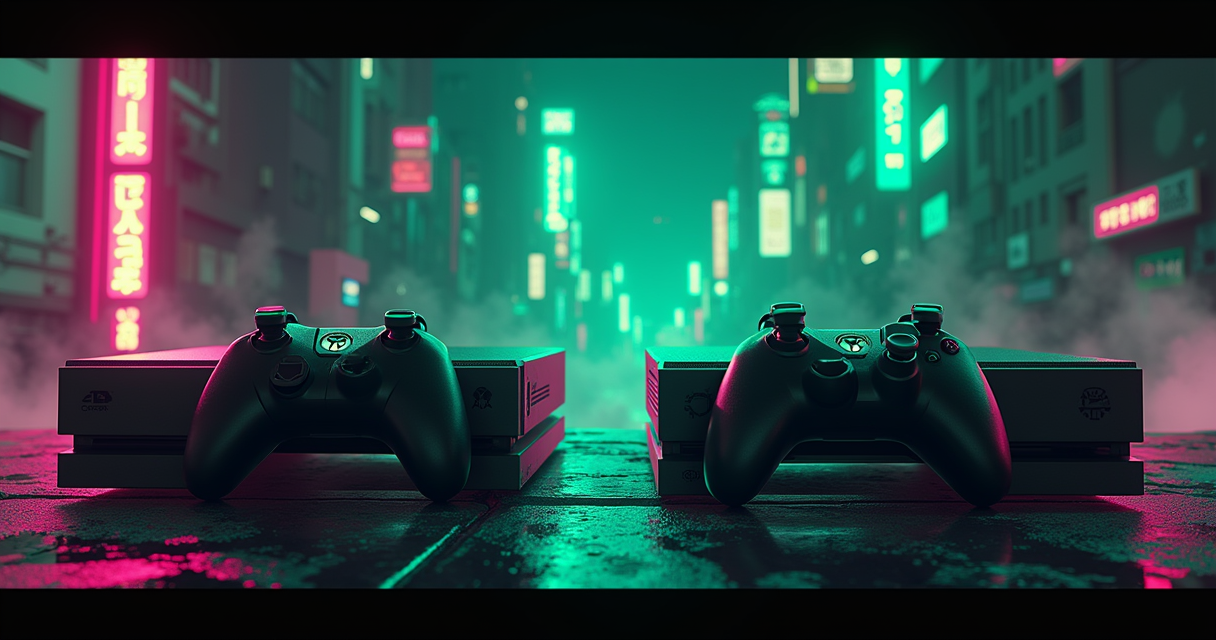
Hardware is supposed to die on a schedule. A console launches, peaks, gets a mid-generation refresh, and then quietly surrenders its shelf space to whatever comes next. The PlayStation 4 and Xbox One never read that memo. In January 2026 — more than twelve years after they went on sale, and five years into the lifespan of their successors — the two machines are still outselling the PS5 and Xbox Series X|S as a combined generation. Per VGChartz's month-by-month tracking, the legacy pair holds a 16,047,520-unit lead over the newer generation at the equivalent point in each cycle, and that lead actually grew by 589,333 units in a single month.
So this is not a nostalgia piece. People are still buying these consoles, still choosing between them, and still asking the only question that matters: which one was actually better, and which one should you put on your shelf in 2026? The answer is more interesting than the fanboys on either side will admit. Sony won the war — decisively, roughly two to one — but Microsoft built the more powerful machine and the better movie player. Both things are true. Let's do this properly.
The Short Version, for People Who Won't Scroll
You came here for a verdict, and I respect that. Here it is before the 6,000 words of evidence, because a good argument should survive being spoiled.
The one-sentence answer
The PlayStation 4 won the generation on sales, price, exclusives, and momentum; the Xbox One X won the spec sheet and remains the better living-room media box thanks to a 4K Ultra HD Blu-ray drive the PS4 Pro never got. If you buy on library and value, PS4. If you buy on raw power and 4K disc playback, Xbox One X. Everyone else, keep reading — the tie-breakers are where it gets good.
Who should buy which in 2026
For a 2026 buyer treating these as second consoles or budget legacy machines, the split is clean. A PS4 Slim is the cheapest way into the single best exclusive library of the 2010s. A PS4 Pro is for someone who wants that library sharpened for a 4K TV. An Xbox One S is a shockingly good, cheap 4K Blu-ray player that also plays games. An Xbox One X is the enthusiast pick — the most powerful console of its era and a legitimate home-theater component. If you already own a PS5 or Series X, note that this rivalry has a direct sequel worth reading before you commit: our breakdown of the PS5 versus Xbox Series X in 2026 shows how little the fundamental dynamic has changed.
The numbers that settle it
Combined lifetime sales of the PS4 and Xbox One reached 175.16 million units, making this the most successful console generation in history. Within that number, the PS4 accounts for roughly 117.2 million and the Xbox One for somewhere around 55 million — a gap Microsoft itself later confirmed in court filings, admitting the PS4 sold "more than twice as many" units. On power, the Xbox One X's 6 teraflops beat the PS4 Pro's 4.2, and its 12GB of RAM beat the Pro's 8GB. Two scoreboards, two different winners. That tension is the whole story.
The Spec Sheet, Line by Line
Before opinion, arithmetic. Because both consoles evolved across three hardware tiers — a 2013 launch model, a 2016 slim/budget model, and a 2016–2017 power refresh — a single-column comparison would lie by omission. The table below tracks the whole family. Where a spec differs between the base unit and the refresh, both are noted.
| Feature | PlayStation 4 family | Xbox One family |
|---|---|---|
| Launch date (NA) | Nov 15, 2013 | Nov 22, 2013 |
| Launch price | $399 | $499 (Kinect bundled) |
| Base CPU | 8-core AMD "Jaguar" x86 | 8-core AMD "Jaguar" x86 |
| Base GPU compute | 1.84 TFLOPS | 1.31 TFLOPS |
| Base memory | 8GB unified GDDR5 (fast) | 8GB DDR3 + 32MB ESRAM (slower main pool) |
| Typical launch resolution | Often native 1080p | Often 900p or 720p, upscaled |
| Budget model | PS4 Slim (2016) | Xbox One S (2016) |
| Budget model floor price | ~$300 | ~$250 |
| Power refresh | PS4 Pro (Nov 2016) | Xbox One X (Nov 7, 2017) |
| Refresh price | $399 | $499 |
| Refresh CPU clock | 2.1 GHz | 2.3 GHz |
| Refresh GPU | 4.2 TFLOPS Polaris (36 CUs @ 911 MHz) | 6.0 TFLOPS (40 CUs @ 1172 MHz) |
| Refresh RAM | 8GB GDDR5 | 12GB GDDR5 |
| Refresh memory bandwidth | 218 GB/s | 326 GB/s |
| Native 4K gaming | Checkerboard / upscaled | Native 4K in many titles |
| 4K Ultra HD Blu-ray | No (Pro has no UHD drive) | Yes (One S and One X) |
| HDR support | Yes (across the family) | Yes (across the family) |
| 5 GHz Wi-Fi | Added with Slim/Pro | Added with Xbox One S |
| VR support | PlayStation VR | None shipped |
| Backward compatibility | Select PS2 (emulated), streaming | Xbox 360 + original Xbox (curated list) |
| Refresh dimensions | 12.8 x 11.6 x 2.1 in | 11.8 x 9.4 x 2.4 in |
| Refresh weight | 7.2 lb | 8.4 lb |
| Est. lifetime sales | ~117.2 million | ~55 million |
Base consoles: PS4 vs Xbox One (2013)
At launch, the PS4 was simply the better-engineered games machine, and the reasons were structural rather than cosmetic. Sony committed to a unified pool of 8GB GDDR5 — fast memory shared freely between CPU and GPU. Microsoft, hedging its bets on an all-in-one entertainment box, went with 8GB of slower DDR3 propped up by a tiny 32MB slab of ESRAM that developers had to babysit like a temperamental cache. On paper the GPUs told the same story: 1.84 teraflops for the PS4 against 1.31 for the Xbox One, a roughly 40% advantage that our launch-era sources, including Tom's Guide's original comparison, put at "about 50% more powerful" in real GPU throughput.
The two CPUs were near-identical 8-core AMD Jaguar parts — low-power laptop-class cores that both machines leaned on far too hard by the end of the generation. That shared CPU weakness is why, a decade on, the framerate ceilings on both consoles feel so similar despite the GPU gap. But in 2013 the GPU and memory advantage handed Sony an immediate, visible lead that Microsoft spent years apologizing for.
The mid-gen refresh: PS4 Pro vs Xbox One X
Then the plot flipped. The PS4 Pro arrived in November 2016 at $399 with a 4.2-teraflop Polaris GPU and the same 8GB of GDDR5, using a clever checkerboard-rendering trick to approximate 4K. A year later the Xbox One X landed on November 7, 2017 at $499 and made the Pro look timid: 6 teraflops, 12GB of GDDR5, and 326 GB/s of memory bandwidth against the Pro's 218. CNET's full spec comparison lays it out without mercy: on every headline number that matters for pushing pixels, the One X won. This is the same pattern Sony would later run in reverse — if you want the modern parallel, our look at the PS5 Pro's 67% GPU jump for a $250 premium is the direct descendant of the Pro-vs-One-X arms race.
The slim models and the specs nobody reads
The unglamorous middle tier is where the value actually lived. The PS4 Slim and Xbox One S both dropped in 2016, and the One S quietly out-featured its Sony counterpart in two ways that mattered for a living room. First, it added a 4K Ultra HD Blu-ray drive — a full home-theater feature the PS4 Pro never received. Second, per hardware breakdowns of the revision, the One S introduced 5 GHz Wi-Fi support, upgrading from the original Xbox One's 2.4 GHz-only radio. Neither spec sells a console on a marketing slide, but both are the kind of thing you notice at 11pm when your dual-band router is congested or you slot in a 4K disc. Pricing-wise the Xbox One S fell as low as $250 and the PS4 Slim to around $300, which made the S the cheapest respectable 4K movie player on the market for a stretch.
The Power Gap: Teraflops Meet Reality
Teraflops are a seductive number and a dishonest one. They tell you the theoretical ceiling of a GPU and nothing about the game running on it. So instead of trusting the marketing, look at what independent testing actually measured across three eras of this generation.
Launch era: the 900p problem
The base Xbox One's memory bottleneck produced the single most-cited fact of the entire generation: multiplatform games routinely ran at lower resolution on Xbox One than on PS4. Where the PS4 hit native 1080p, the Xbox One frequently landed at 900p or 720p and upscaled the difference. Call of Duty: Ghosts became the emblem of this — a launch title running 1080p on Sony's box and a widely mocked 720p on Microsoft's. The controversy got so heated that when Ubisoft locked Assassin's Creed Unity to 900p on both machines in 2014, players accused Microsoft of paying for "parity" to hide the gap. It probably didn't, but the fact that the accusation was believable tells you everything about the launch-window power narrative.
Refresh era: 4.2 versus 6 teraflops
The Xbox One X's advantage over the PS4 Pro was real and measurable, not marketing. With 43% more compute and 50% more RAM, third-party games consistently ran at higher native resolutions and with better texture detail on the One X. Coverage from outlets tracking the mid-gen face-offs noted that the PS4 Pro simply lacked the memory headroom for the top-tier, PC-quality texture packs the One X could load, producing visibly sharper images in direct comparison. The 326 GB/s versus 218 GB/s bandwidth gap is the unglamorous reason why: texture streaming lives and dies on bandwidth, and the One X had a third more of it.
Where the teraflops didn't matter
And yet. Digital Foundry — the outlet that turned console pixel-counting into a science — documented an awkward trend late in the generation: a handful of games actually ran better on the weaker PS4 Pro than on the more powerful Xbox One X, thanks to Sony-favored engine optimization and developers targeting the larger install base first. Raw power buys you a ceiling, not a guarantee. And none of it touched the exclusives: God of War, Bloodborne, The Last of Us Part II, and Marvel's Spider-Man ran only on Sony hardware, and no teraflop count on Microsoft's side could conjure them. Power settled the multiplatform screenshots. It never settled the library.
The Sales War That Won't End
If power was Microsoft's scoreboard, sales were Sony's, and Sony ran up the score.
117 million versus 55 million
The PS4 sold roughly 117.2 million units over its life. The Xbox One — Microsoft stopped reporting hardware numbers in 2015, so we work from estimates and legal disclosures — landed somewhere around 55 million. That is not a narrow loss. It is a two-to-one drubbing, and it was set in motion at the 2013 reveal, when Microsoft announced a $499 price (Kinect bundled, non-negotiable), an always-online check-in requirement, and restrictions on used games. Sony countered with a $399 price, no DRM theatrics, and a now-legendary E3 stage moment devoted to celebrating the physical game disc. Microsoft reversed the DRM policy within a week. The damage was already structural.
The court documents that spilled the numbers
The most authoritative admission came not from a press release but from a legal filing. During Microsoft's regulatory fight to acquire Activision Blizzard, its own court documents conceded that Sony had sold "more than twice as many" consoles as Xbox last generation. The same filings, as The Gamer reported, went further and described Xbox Game Pass as Microsoft's "competitive response" to its own "failure in the console wars." When a company writes the word failure about its own hardware in a legal document to a regulator, the debate is over. That is not a fan argument; that is a sworn characterization.
Still winning in 2026
Here is the part that borders on absurd. As of January 2026 — Month 63 in the current console cycle — the PS4 and Xbox One as a combined generation still sit 16,047,520 units ahead of the PS5 and Xbox Series X|S at the equivalent milestone, with the newer pair having reached 140,537,831 units. The gap even widened by 589,333 units in January 2026 alone, and across the trailing twelve months the legacy consoles moved 6.90 million more units than their successors. The combined 175.16-million figure was first hit back in January 2019; the new generation is only now closing on it, years behind schedule. Console generations used to end. This one refuses. It's the kind of momentum that makes the endless speculation about a PlayStation 6 arriving in 2028 feel almost premature — the last generation hasn't finished dying.
Pricing and Availability in 2026
Neither console is manufactured new anymore. That changes the buying calculus entirely: you are shopping a used and old-stock market, and launch MSRP is now a historical reference point rather than a price tag. Here's the full pricing picture across the family.
| Model | Launch MSRP | 2026 status | What you're paying for |
|---|---|---|---|
| Xbox One (2013) | $499 | Used only | The DRM-era launch box; avoid unless cheap |
| PS4 (2013) | $399 | Used only | Entry into Sony's exclusive library |
| Xbox One S (2016) | as low as $250 | Discontinued / used | 4K UHD Blu-ray, 5 GHz Wi-Fi, cheap |
| PS4 Slim (2016) | as low as $300 | Discontinued / used | Smallest, cheapest PS4 library machine |
| PS4 Pro (2016) | $399 | Discontinued / used | 4.2 TFLOPS, upscaled 4K, no UHD drive |
| Xbox One X (2017) | $499 | Discontinued / used | 6 TFLOPS, native 4K, 4K UHD Blu-ray |
What launch prices still tell you
The $100 launch gap — PS4 at $399, Xbox One at $499 — was the opening blow of the whole war, and it's worth understanding why it existed. Microsoft bundled the Kinect sensor and refused to sell the console without it, which added cost and, worse, added GPU overhead reserved for a camera most players never wanted. Sony shipped a cheaper, more focused box. The lesson generalized: on pure price-to-value, PlayStation has consistently undercut Xbox, a pattern that survives right into the current generation.
The 2026 used market
Because production has ended, condition and bundle matter more than model year. An Xbox One X in good shape commands a premium among enthusiasts precisely because it's the most powerful box and a competent 4K player — scarcity props up its price. A PS4 Slim, by contrast, is abundant and cheap, which makes it the rational budget entry to Sony's catalog. My blunt advice: buy the cheapest healthy unit of whichever ecosystem's library you want, and don't pay collector prices for a machine you intend to actually use.
The hidden 4K Blu-ray tax
One quiet cost asymmetry: if 4K disc playback matters to you, the PS4 side of the aisle can't deliver it at all — not the Pro, not the Slim, not any of them. You'd need a separate 4K Blu-ray player, which erases the Pro's price advantage. On the Xbox side, that capability is baked into both the One S and One X for free. It's the single most underrated line item in this entire comparison.
Which One Belongs on Your Shelf
Specs and sales are abstractions. Here are concrete buyers and the machine each one should actually get.
The home-theater and 4K-movie buyer
Winner: Xbox One S or Xbox One X. If your console doubles as the beating heart of a living-room setup, this isn't close. Both play 4K Ultra HD Blu-ray discs; the PS4 Pro plays none. As Forbes' AV specialist John Archer put it, "4K Blu-ray delivers simply the best picture quality the AV world can currently offer" — and only one of these two console families can play it. For a cinephile, the Xbox One S is arguably the best value 4K player ever sold, games included.
The exclusives-first player
Winner: PS4 (Slim or Pro). Sony's first-party output this generation was the strongest in the industry: God of War, Bloodborne, Horizon Zero Dawn, The Last of Us Part II, Ghost of Tsushima, and Marvel's Spider-Man. Microsoft's exclusive slate, by comparison, was thin for most of the generation. If you're buying a legacy console to experience the games that defined the era, you are buying a PlayStation. There is no honest argument otherwise.
The backward-compatibility collector
Winner: Xbox One. This is Microsoft's genuine, under-celebrated triumph. The Xbox One runs a large curated library of Xbox 360 and even original Xbox titles, many with resolution and framerate enhancements on the One X. The PS4's backward compatibility is comparatively anemic — select PS2 titles as emulated re-releases and a streaming service, but nothing like Microsoft's disc-and-digital catalog. For a retro-minded collector, the Xbox One is three consoles in one box. If your goal is broader multi-system retro coverage, though, a dedicated emulation setup outperforms both — our clean RetroArch cores setup guide covers the machines these consoles can't touch.
The budget and couch-multiplayer buyer
Winner: PS4 Slim. Cheapest entry, biggest install base among your friends, and the deepest catalog of couch and online multiplayer. The Xbox One S is a close runner-up and wins if your friend group is Xbox-native — ecosystem lock-in is real, and the console that matches your friends' consoles is worth more than any spec.
The tinkerer and streamer
Winner: tie, leaning PS4. Both machines support remote streaming and capture, but Sony's Remote Play ecosystem is more mature and more useful in 2026 for playing your library off-console. If you want to pipe a legacy console to a laptop or handheld, start with our walkthrough on getting PlayStation Remote Play running at 1080p. For capture-card workflows, both consoles output cleanly over HDMI, so the deciding factor is which library you're streaming.
The one-console household
Winner: it depends on the TV. Standard 1080p TV and a love of story-driven games? PS4 Slim. A 4K HDR TV and a desire for the sharpest possible image plus movie playback? Xbox One X. This is the cleanest fork in the whole guide.
What the Critics and the Courts Said
I don't ask you to trust my read alone. Here's what named, verifiable sources actually said — and I'm quoting only wording I could confirm, because inventing a critic's words is the one sin this trade doesn't forgive.
The power reviewers
On the Xbox One X's headline feature, Forbes' John Archer was unequivocal in his 2017 review, writing that "4K Blu-ray delivers simply the best picture quality the AV world can currently offer" — the exact capability the PS4 Pro omitted. Digital Foundry's frame-by-frame analysis across dozens of multiplatform titles reached the broader conclusion that the One X's extra compute and memory produced sharper textures and higher native resolutions than the Pro could match, while also honestly flagging the exceptions where Sony-favored optimization let the weaker Pro pull ahead. Independent testing, in other words, confirmed the One X was the more powerful box — and confirmed that "more powerful" didn't win every single screenshot.
The verdict of history — from Microsoft's own lawyers
The most damning citation is Microsoft's. In legal filings submitted during the Activision Blizzard acquisition review, the company stated that Sony "has sold more than twice as many" consoles, and characterized Game Pass as its "competitive response" to "Xbox's failure in the console wars." When your own regulatory defense uses the word failure about your hardware, no rebuttal from a forum poster carries more weight. These are the words of the losing party, entered into an official record.
The industry data
And the sales data keeps compounding the point. VGChartz's January 2026 tracking — a widely cited independent estimator — puts the combined PS4/Xbox One generation at 175.16 million lifetime, still 16,047,520 units ahead of the current generation at the same age, and still gaining. That's not a critic's opinion; it's a running scoreboard, and it has read the same way for a decade: the PS4 was the runaway commercial victor, and the generation as a whole simply won't cede its record.
Switching Sides: A Migration Guide
Say you're jumping ecosystems — moving from a PS4 to an Xbox One, or the reverse, or graduating either one to a current-gen box. Console-to-console migration is not like syncing two phones. Here's what actually carries over and what evaporates.
PS4 to Xbox One (or the reverse)
The hard truth: almost nothing transfers directly between the two ecosystems. Digital game purchases are locked to the platform you bought them on — a game bought on PlayStation Store does not exist on your Xbox account, and vice versa. Save files, trophies/achievements, DLC, and subscriptions are all ecosystem-bound. Cross-buy exists only for a small set of titles the publisher explicitly enabled. In practice, switching sides means rebuying anything you want to keep playing, so treat it as starting fresh, not migrating.
What genuinely carries over
The things that do survive a switch are account-level and publisher-level, not platform-level: your progress in cross-progression-enabled games (think Fortnite, Call of Duty, Rocket League, Minecraft) that tie saves to a publisher account rather than a console account; and any friends who use those same cross-platform services. Physical discs also "transfer" in the trivial sense that you can resell them and rebuy on the other platform — small comfort, but real.
The migration checklist
Whether you're switching sides or moving to a PS5 or Series X, run this sequence before you wipe or sell the old console:
MIGRATION CHECKLIST (run in order)

1. Sign in and confirm which account owns your
   digital library (PSN or Xbox account).
2. Enable cloud saves and force a full sync:
     - PS4: Settings > Application Saved Data
       Management > Upload to Online Storage
     - Xbox One: saves auto-sync to the cloud
       when signed in and online.
3. Note cross-progression games: link each one
   to its PUBLISHER account (Epic, Activision,
   Ubisoft, Mojang), NOT the console account.
4. Record active subscriptions and renewal dates
   (PS Plus / Xbox Game Pass) before cancelling.
5. Back up screenshots/clips to USB or the cloud.
6. For a same-family upgrade (PS4 -> PS5), use
   the built-in data transfer over LAN or USB.
7. For a cross-family switch, accept that digital
   purchases DO NOT move. Budget to rebuy.
8. Deactivate the old console as your primary
   device before selling it.
9. Factory reset ONLY after every sync completes.
The single most common migration disaster is skipping step 8 and step 9's ordering — people factory-reset before the cloud sync finishes and lose saves that were never uploaded. Do it in order.
Pros and Cons, Tabulated
The whole argument, compressed. Two tables, no hedging.
PlayStation 4
| Pros | Cons |
|---|---|
| Best exclusive library of the generation | PS4 Pro has no 4K Blu-ray drive |
| $100 cheaper at launch ($399 vs $499) | Weaker backward compatibility than Xbox |
| Superior base hardware (1.84 TFLOPS, 8GB GDDR5) | Pro's 4.2 TFLOPS trails the One X's 6 |
| PlayStation VR support | Pro RAM stuck at 8GB vs One X's 12GB |
| Sold ~117M — the network-effect winner | Checkerboard 4K, not always native |
| Mature Remote Play ecosystem | Digital purchases locked to PSN |
Xbox One
| Pros | Cons |
|---|---|
| Xbox One X is the most powerful console of its era (6 TFLOPS) | Launched $100 more, with forced Kinect |
| 4K Ultra HD Blu-ray on One S and One X | Base model's 900p/720p resolution deficit |
| 12GB RAM + 326 GB/s bandwidth on One X | Weak first-party exclusive lineup |
| Best-in-class backward compatibility (360 + OG Xbox) | Slower DDR3 + ESRAM base memory design |
| One S added 5 GHz Wi-Fi; great cheap 4K player | Microsoft's own filings call it a "failure" |
| Physically smaller One X (11.8 x 9.4 x 2.4 in) | Sold roughly half as many units (~55M) |
The tie-breakers
Notice the shape of it: the PlayStation cons are mostly about the Pro trailing the One X on power, while the Xbox cons are mostly about strategy and library. That's the generation in miniature. Sony lost some benchmark bars and won the war; Microsoft won the benchmark bars and lost the war. If your tie-breaker is "what will I actually play," Sony. If it's "what will look and sound best in my home theater," Microsoft.
The Final Call
Time to stop hedging and rule.
The data-backed recommendation
For most people, most of the time, the PlayStation 4 is the correct answer, and the data doesn't leave much room to argue. It won on price, it won on the exclusive library that defined the decade, and it won on sales by a factor of two — a margin Microsoft conceded in writing to a regulator. The generation sold 175.16 million units combined and Sony took the lion's share. If you're buying one legacy console and you want the games history actually remembers, buy a PS4 — a Slim if you're on a 1080p set, a Pro if you've got a 4K TV and want the sharpest version Sony offers.
The contrarian case for Xbox One
But the contrarian case is stronger than the sales gap suggests, and I'd be a coward not to make it. The Xbox One X is the better machine — 6 teraflops, 12GB of RAM, 326 GB/s of bandwidth, native 4K, and a 4K Blu-ray drive Sony never matched. If you value hardware and home-theater capability over exclusive software, or you're a backward-compatibility collector who wants 360 and original Xbox games in one enhanced box, the Xbox One is the smarter buy and it isn't particularly close. Microsoft lost the war of libraries. It won the war of engineering, and the One X is the trophy.
Where this rivalry goes next
The tragedy and the comedy of it is that nothing was learned. The exact same dynamic replayed one generation later: Sony undercut on price and out-shipped Microsoft, while Microsoft leaned on power and services. If you want to watch history rhyme, read our current-gen breakdown of the PS5 versus Xbox Series X, where Sony is again $100 cheaper and again winning — and the mid-gen power play repeats too, as detailed in our PS5 Pro analysis. The PS4 and Xbox One aren't just the best-selling generation in history. They're the template. And judging by January 2026's sales charts, they're not done teaching the lesson yet.
Questions the search bar asks me
- Did the PS4 or Xbox One win the generation?
- The PS4, decisively. It sold roughly 117.2 million units to the Xbox One's ~55 million — a two-to-one margin Microsoft itself confirmed in Activision-acquisition court filings, admitting Sony sold 'more than twice as many' consoles and calling Xbox's result a 'failure in the console wars.'
- Is the Xbox One X or PS4 Pro more powerful?
- The Xbox One X, clearly. It packs 6 teraflops of GPU compute versus the PS4 Pro's 4.2, 12GB of RAM versus 8GB, and 326 GB/s of memory bandwidth versus 218 GB/s (per CNET's spec comparison). It delivered higher native resolutions and sharper textures on most multiplatform games.
- Which console is better for 4K movies?
- The Xbox One — both the One S and One X include a 4K Ultra HD Blu-ray drive, while the PS4 Pro has no UHD disc drive at all. Forbes called 4K Blu-ray 'simply the best picture quality the AV world can currently offer,' and only Microsoft's consoles can play it natively.
- Are the PS4 and Xbox One still worth buying in 2026?
- Yes, as budget or legacy machines. Combined they hit 175.16 million lifetime units and, per VGChartz, still lead the PS5/Xbox Series generation by 16,047,520 units at the same point in the cycle as of January 2026 — the most successful console generation ever, and it's still selling.
- Can I transfer my games and saves between PS4 and Xbox One?
- No. Digital purchases, DLC, trophies, and achievements are locked to each ecosystem, so switching sides means rebuying. Only cross-progression titles tied to a publisher account (Fortnite, Call of Duty, Minecraft) carry progress across, and even then saves sync via the publisher, not the console.

Jordan covers the modern industry where it touches the old one: Nintendo announcements, handheld hardware, and the long shadow the classics cast over new releases. Every post under this byline is reviewed pre-publish by Sam P., Editor & Operator — corrections to info@instalinkoteam.com. Published 2026-08-29 · Last updated 2026-08-29. Full bios on the author page.