/// FIELD NOTES FROM A SELF-AWARE GAME SITE
PS5 vs Xbox Series X 2026: $100 Cheaper, Sony Wins
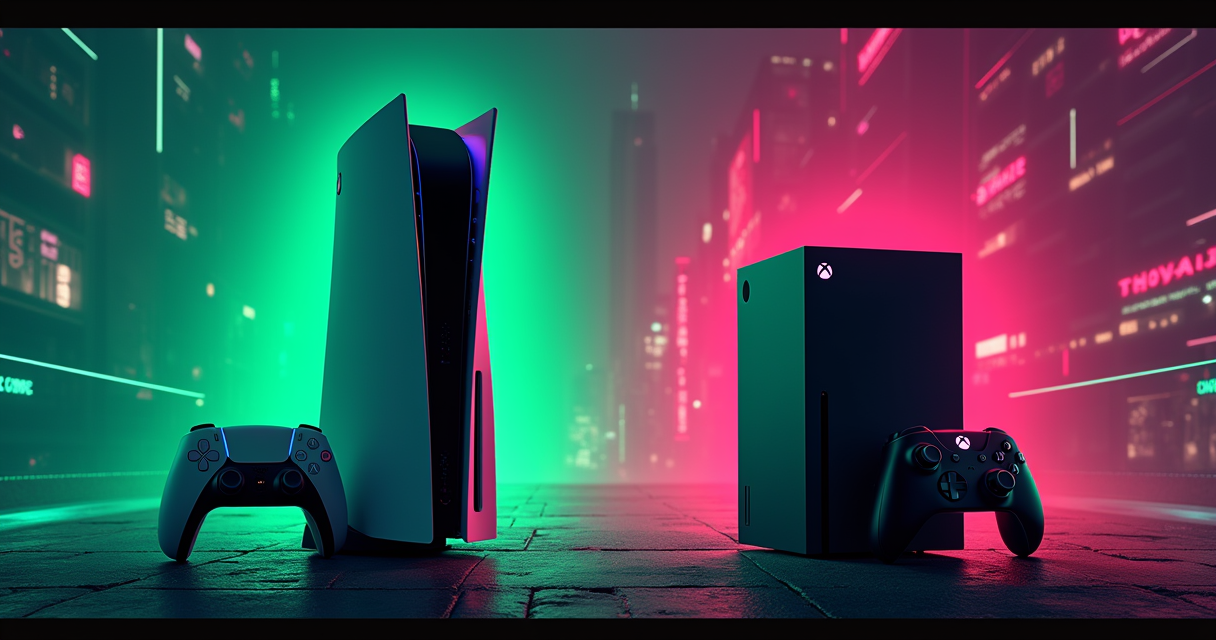
There is a particular kind of reader who still types PS5 vs Xbox Series X into a search bar in the summer of 2026, and I have grown fond of them. They are not asking a lazy question. They are asking the hardest console question of the generation, because these two machines are the most architecturally similar flagship rivals ever shipped: the same AMD Zen 2 eight-core CPU, the same RDNA 2 graphics family, the same 16 GB of GDDR6, both launched in the same week of November 2020 at the same $499. A fight this evenly matched was never going to be settled by a spec sheet. It was going to be settled by a hundred small decisions — a controller here, a subscription there, a hundred dollars, a quieter fan — and that is exactly where we have ended up.
So this is not a launch-day hot take reheated. It is where the two boxes actually sit after five and a half years, two waves of tariff-driven price hikes, a PS5 Pro, and a Microsoft hardware strategy that spent 2026 quietly rearranging the furniture. Let me give you the answer first, then spend the next six thousand words earning it.
The Verdict, Before You Scroll
The one-sentence answer
Buy the PS5. At $549.99 for the disc model it is a full $100 cheaper than the $649.99 Xbox Series X; it loads games off a genuinely superior SSD; it ships with the best controller anyone has made this century; and it has outsold the Xbox nearly three-to-one — roughly 93 million units to 34 million. If you are buying one console in 2026 and you have no specific reason to do otherwise, that is the console. Everything below this line is the specific reasons.
What the spec sheet won't tell you
Now the part the fanboys hate to hear: the Xbox Series X is the better-engineered box in several measurable ways. It has more raw compute (12.155 teraflops to the PS5's 10.28), more usable storage, four console generations of backward compatibility, a fan so quiet that reviewers reached for the word "whisper", and Game Pass — still the single best value in the medium. If Sony did not exist, nobody would be embarrassed to own a Series X. It is not losing this fight because it is bad. It is losing because it finishes second in nearly every category a mass-market buyer actually weighs.
The honest caveat
The thing no thumbnail will admit: in the only test that matters — running the same game on your television — these consoles are a tie. Not "close." A tie. The teraflop gap that dominated the 2020 marketing wars produces differences you need a frame counter and a still-frame comparison to see. So the real decision is not "which is more powerful." It is "whose ecosystem do you want to live inside for the next five years," and that is a question about controllers, subscriptions, exclusives, and price — not silicon. Read on for the full ledger.
The Spec Sheet: Two AMD Boxes, Different Bets
The same parts, arranged differently
Both consoles are, underneath the plastic, cousins from the same AMD family reunion: a custom eight-core, sixteen-thread Zen 2 CPU bolted to an RDNA 2 GPU, fed by 16 GB of GDDR6, all fabricated on TSMC's 7 nm process. Microsoft and Sony were handed nearly identical Lego bricks and asked to build a games machine. What they built diverged in three places: how wide they made the graphics chip, how they wired the memory, and how fast they made the storage. Those three forks explain every real-world difference you will ever notice.
Reading the numbers honestly
Microsoft chased peak throughput: a physically larger GPU with more cores running at a locked clock, and a headline teraflop number to put on the box. Sony chased speed and responsiveness: a smaller GPU clocked aggressively high, and the fastest consumer SSD on the market by a wide margin. Neither was wrong. They were bets on what the generation would reward, and the generation — as generations do — refused to reward either decisively. Here is the whole matchup on one screen.
| Specification | PlayStation 5 (Disc) | Xbox Series X |
|---|---|---|
| Launched | Nov 12, 2020 | Nov 10, 2020 |
| CPU | 8-core AMD Zen 2 @ 3.5 GHz (variable) | 8-core AMD Zen 2 @ 3.8 GHz (3.6 GHz w/ SMT) |
| GPU architecture | Custom RDNA 2 | Custom RDNA 2 |
| GPU compute | 10.28 TFLOPs | 12.155 TFLOPs |
| Compute units / clock | 36 CUs @ up to 2.23 GHz (variable) | 52 CUs @ 1.825 GHz (fixed) |
| Memory | 16 GB GDDR6 (unified) | 16 GB GDDR6 (split pool) |
| Memory bandwidth | 448 GB/s across the pool | 560 GB/s (10 GB) + 336 GB/s (6 GB) |
| SSD (raw) | 5.5 GB/s | 2.4 GB/s |
| SSD (compressed) | ~8–9 GB/s (Kraken) | 4.8 GB/s (BCPack) |
| Internal storage | 825 GB (~667 GB usable) | 1 TB (~802 GB usable) |
| Storage expansion | Standard M.2 NVMe Gen4 slot | Proprietary Storage Expansion Card |
| Optical drive | 4K UHD Blu-ray | 4K UHD Blu-ray |
| Max output | 4K @ 120 fps, 8K support | 4K @ 120 fps, 8K support |
| Upscaling | PSSR (PS5 Pro only) / FSR | FSR (FidelityFX Super Resolution) |
| Signature feature | DualSense haptics & adaptive triggers | Quick Resume |
| Backward compatibility | PS4 | Xbox One, 360, Original Xbox |
| Launch price (disc) | $499.99 | $499.99 |
| Price, July 2026 (disc) | $549.99 | $649.99 |
| Units sold (2026) | ~93 million (Sony official) | ~34 million (independent est.) |
What the table is quietly telling you
Scan the rows and a pattern emerges that no press release phrased this bluntly: Microsoft wins the compute and storage rows, Sony wins the SSD and controller rows, and everything else is a dead heat down to the same Blu-ray drive and the same 120 fps ceiling. There is no knockout blow anywhere in that table. There is only a scorecard, and the scorecard is close enough that price and taste become the tiebreakers. Hold that thought — it is the whole article in miniature.
Raw Power: The Teraflop Lead That Never Shows Up
52 wide and slow vs 36 narrow and fast
The Xbox Series X GPU packs 52 compute units running at a fixed 1.825 GHz, which multiplies out to 12.155 teraflops. The PS5 runs 36 compute units at a variable clock that boosts up to 2.23 GHz, landing at 10.28 teraflops. On paper that is an 18 percent compute advantage for Microsoft, and in 2020 that number did an enormous amount of marketing work. It is a real difference. It is also, in practice, one of the most oversold numbers in consumer electronics, because teraflops measure theoretical peak arithmetic, not the messy business of feeding that arithmetic with geometry, textures, and draw calls fast enough to keep it busy.
Sony's clock-speed gamble
Sony's decision to run a narrower GPU at a much higher, variable clock was the bolder engineering call. A chip clocked at 2.23 GHz pushes pixels, rasterizes triangles, and clears the render pipeline faster per unit than a chip at 1.825 GHz, which partly claws back the raw compute deficit in the parts of the frame that are clock-bound rather than compute-bound. The catch is that Sony's clock is not fixed — a SmartShift power budget shuffles wattage between CPU and GPU, and the GPU throttles fractionally under pathological load. In five years of shipping games, that throttling has never produced a headline, which tells you how conservative the design margins were.
The memory wiring nobody mentions
The subtler difference is the RAM. The PS5 gives developers a single 16 GB pool at a uniform 448 GB/s — simple, predictable, easy to program. The Series X splits its memory: 10 GB runs at a fast 560 GB/s and 6 GB runs at a slower 336 GB/s. When a game's working set fits neatly in the fast pool, Xbox's bandwidth edge is real and shows up in demanding ray-traced scenes. When it does not, developers fight the split, and the theoretical advantage leaks away into engineering overhead. This is why the extra teraflops so rarely translate into a visible win: the box that is easier to extract performance from often ends up matching the box that is harder, and "easier to program" is not a number that fits on a poster. If you care about where console silicon sits against a gaming PC, our breakdown of the 120 fps console ceiling versus 240 fps on PC puts these figures in the wider context.
The SSD Gap: 5.5 vs 2.4 GB/s Where It Counts
The one spec that is not close
If the GPU fight is a photo finish, the storage fight is a blowout — in Sony's favor. The PS5's custom SSD moves 5.5 GB/s of raw data and roughly 8–9 GB/s once the dedicated Kraken decompression hardware gets involved. The Xbox Series X manages 2.4 GB/s raw and 4.8 GB/s compressed through its BCPack pipeline and Velocity Architecture. That is not a rounding error. Sony's drive is more than twice as fast on the raw figure, and it is the single most lopsided line on the entire spec sheet. Microsoft engineered a very good SSD. Sony engineered a genuinely exotic one and made it the beating heart of the machine.
What that buys you in a real living room
In practice the gap shows up as faster cold-boot loads, snappier fast-travel, and smoother texture streaming as you sprint through a dense open world — the moments where a game has to haul gigabytes off disk on a deadline. It is not a night-and-day, one-console-loads-and-the-other-hangs situation; both are dramatically faster than the mechanical-drive PS4 and Xbox One that came before, and a five-second load versus an eight-second load is not going to reorder anyone's life. But across hundreds of loading screens over a console's lifetime, the PS5 is measurably and repeatably quicker, and that quickness is one of the few real-world advantages that flows directly and unambiguously from a spec-sheet number. When your PS5's storage starts feeling sluggish, incidentally, it is usually the database and not the drive — our PS5 cache-clear walkthrough covers the safe-mode fix.
Storage capacity: Xbox's quiet win
Here the ledger flips. The Series X ships with 1 TB of NVMe storage, about 802 GB of it usable after the OS takes its cut. The PS5's 825 GB nets out to roughly 667 GB usable — a meaningful shortfall in an era when a single flagship install can eat 150 GB. Expansion tells the same story with a twist: the PS5 uses a bog-standard M.2 NVMe Gen4 slot, so you can drop in any compatible drive at commodity prices, while the Xbox requires a proprietary Storage Expansion Card that historically carried a price premium for the convenience of plug-and-play. So Xbox gives you more room out of the box; Sony gives you cheaper room later. Pick your poison, but do not pretend either console ships with enough storage for a modern library — neither does.
Benchmarks: What Digital Foundry Actually Found
The multiplatform face-offs
The most reliable performance data for these two boxes does not come from Sony or Microsoft; it comes from Digital Foundry, which has spent five years running the same games on both machines frame by frame. Their aggregate finding across hundreds of cross-platform titles is unglamorous and consistent: the two consoles are near-identical, trading small advantages that depend far more on how a given studio optimized its engine than on the underlying hardware. The Series X occasionally holds a marginally sharper image or a slightly higher dynamic resolution in demanding, ray-traced scenes, cashing in that memory-bandwidth edge. The base PS5 frequently returns the favor in high-frame-rate modes, where its variable-refresh behavior tends to hold a steadier line. Neither pattern is a rout. Both are the kind of difference you find with a magnifying glass.
The acoustic test, which Xbox wins outright
There is one benchmark the Series X wins cleanly, and it is the one your ears run. Independent teardown testing — including the widely cited Hardware Busters thermal-and-noise comparison — measures the Series X at roughly 39–43 dBA under full load against a PS5 disc model that sits closer to 45–50 dBA in intense scenes, often accompanied by audible coil whine. Digital Foundry put it more memorably in review, writing that "Series X is quiet to the point where breaking out the noise meter is a pointless exercise because the console's acoustics merge into the background noise of my living room." The tradeoff is heat: the Xbox runs a hotter SoC precisely because it keeps that fan relaxed. If your console lives in a bedroom or a small apartment, this is not a footnote — it is a legitimate reason to choose the Xbox.
The community consensus
Cross-reference the enthusiast forums — the ResetEra face-off threads, the NeoGAF technical breakdowns, the endless Reddit "which version should I buy" posts — and the crowd has arrived at the same verdict as the professionals, which almost never happens. The consensus is that on a base-console-to-base-console basis there is no console you should buy for performance, because there is no repeatable performance winner. The PS5 Pro changed that calculus at the top of the stack, but the Pro is a different, pricier animal; we broke down whether its silicon justifies the premium in our PS5 Pro versus base PS5 comparison. For the standard boxes, the honest 2026 conclusion is that game-by-game optimization matters more than the spec sheet, full stop.
The Intangibles: DualSense vs Quick Resume
The DualSense: the controller everyone copies
If the silicon is a tie, the tiebreaker Sony reaches for is the thing in your hands. The DualSense's adaptive triggers — motors that can stiffen and resist under your fingers — and its high-fidelity haptics are not a gimmick that wore off; they are the one genuinely novel piece of consumer game hardware this generation, and the industry's response tells the story. Everyone is copying it. TIME ran the headline "DualSense Controller Is Best Reason to Get a PlayStation 5" and meant it, describing haptics that "provide a tangible sense of connection" no prior controller delivered. Drawing a bowstring in a game and feeling the trigger fight back, or feeling the distinct texture of Astro walking across metal versus sand, is the sort of thing that sounds like marketing until it is in your hands and then never leaves your memory.
Quick Resume: the feature PC still doesn't have
Microsoft's answer is a software trick, and it is a superb one. Quick Resume suspends multiple games in a system-level frozen state and lets you jump between them in seconds, landing exactly where you left off — no menus, no reload, no save-and-quit ritual. GameSpot called it "a (literal) game changer"; TechRadar found it "as seamless as you hoped," clocking a jump from Alan Wake to No Man's Sky to Tell Me Why in 26 seconds. It is a feature high-end gaming PCs, for all their horsepower, still do not offer. Paired with a Game Pass library where you are constantly sampling new titles, it changes the texture of how you use the console — less "boot up the one game I own," more "flick between six."
The tiebreaker nobody admits to
Kotaku was right to note that Quick Resume has wrinkles — some titles occasionally force a full restart after updates — but it works reliably enough to be a daily-driver luxury. So here is the honest framing of the intangibles: the DualSense makes individual moments in individual games feel better, while Quick Resume makes the act of owning and juggling a library feel better. One is about immersion, the other about convenience. Which you weigh more heavily is a genuine personality test, and it is a far better basis for choosing a console than an 18 percent teraflop gap you will never see.
Price & Availability: The 2025–2026 Hike Escalator
Launch prices versus today
Both consoles launched in November 2020 at $499 for the disc model, with a $399 digital PS5 and a $299 disc-free Xbox Series S rounding out the range. That parity did not survive contact with the 2025 economy. Sony raised the standard PS5 to $549.99 in August 2025, citing a "challenging economic environment." Microsoft went further and hiked the Series X to $649.99 by October 2025 — a total $150 climb from its launch price and the second increase of that year alone. The net result is the $100 gap that headlines this article, entirely in Sony's favor.
| Model | Launch price (Nov 2020) | Price (July 2026) | Change |
|---|---|---|---|
| PS5 (Disc) | $499.99 | $549.99 | +$50 |
| PS5 (Digital) | $399.99 | $499.99 | +$100 |
| PS5 Pro | N/A (launched late 2024) | $749.99 | — |
| Xbox Series X (Disc) | $499.99 | $649.99 | +$150 |
| Xbox Series S | $299.99 | Raised (2025 hikes) | Up |
The tariff era, explained without the corporate-speak
Both companies blamed "macroeconomic" conditions, which is the polite industry translation of "tariffs and component costs." The candid version, reported across the business press, is that shifting import duties on hardware assembled in Asia, plus stubborn memory and logistics costs, made holding the line impossible. Consoles have historically dropped in price as they age; this generation broke that rule and marched the opposite direction. Whatever else you take from this section, take this: if you are waiting for a price cut, the last two years suggest you are waiting for a train that has been cancelled.
The 2TB discontinuation, and what's actually on shelves
Here is where the internet got the story wrong, so let me be precise. In mid-2026 Microsoft discontinued the 2 TB special-edition Series X and raised prices again, prompting a wave of "Xbox is dead" headlines. The company was blunt in response: "Xbox Series X|S hardware production has not ceased, and new stock will go out to retailers at its usual cadence." One premium SKU retired; the console did not. The 1 TB Series X remains the flagship you can walk into a store and buy. Read past the doom thumbnails — the machine is on shelves, it is just more expensive than the box that beats it. Microsoft's longer-term hardware ambitions increasingly point at handhelds and cloud, a story we track in our piece on the Xbox handheld's slipping release date.
Library & Value: Exclusives vs the Game Pass Machine
Sony's first-party wall
The single most durable reason the PS5 outsells the Xbox almost three-to-one is not the SSD or the controller. It is the library. Sony's first-party studios ship the prestige, system-selling exclusives — the marquee single-player productions that people buy a console specifically to play — and it has done so with a consistency Microsoft has not matched this generation. For a household buying one box, the calculus is brutally simple: the exclusives you cannot get elsewhere live disproportionately on PlayStation, and no amount of raw compute closes that gap.
Game Pass: the value counterweight
Microsoft's rebuttal is economic, and it is a strong one. Game Pass Ultimate turns the "$70 per game" model on its head, handing you a large rotating library plus day-one access to first-party releases for a monthly fee. The value math is real: if you play broadly, one subscription replaces a shelf of purchases. The service has been on a rollercoaster, though. Microsoft spiked Ultimate from $19.99 to $29.99 a month in late 2025, hemorrhaged subscribers, and then cut it back to $22.99 in April 2026 after new Gaming CEO Asha Sharma conceded it had become "too costly." A quieter concession came attached: new Call of Duty titles no longer hit Game Pass on day one, arriving instead about a year later. Game Pass is still the best value in console gaming. It is no longer the unqualified steal it was at launch.
The "99% of games" claim, examined
You will see a figure circulating — sourced to a YouTube comparison referencing a community survey — that 99 percent of games are "available" on PS5 versus 90 percent on Xbox. Treat that number the way you would treat any statistic that cannot name its methodology: skeptically. The more interesting and verifiable truth is that Microsoft has spent this generation dismantling the very concept of an Xbox exclusive, shipping its own first-party titles onto the PS5. "Availability" is a strange axis to grade on when one platform holder is actively porting its crown jewels to the competitor. Where Xbox genuinely wins on library breadth is backward compatibility: four generations of it, from the Original Xbox through the 360 and Xbox One, much of it auto-enhanced with higher frame rates and Auto HDR. That is a real, if backward-looking, advantage — and it echoes the previous console war we chronicled in PS4 vs Xbox One, where Sony also won on exclusives.
Which Box Fits You: 6 Buyer Profiles
The PS5 buyers
Most people reading this are one of the first two profiles, so start here.
- The single-console exclusives household. You are buying one machine, you want the prestige single-player games, and you want the controller everyone talks about. This is the default case, it is the majority case, and the answer is the PS5. The $100 saving is the tip.
- The immersion chaser. You are the person who replays a game just to feel the adaptive triggers again, who noticed the haptics in Astro's Playroom and never stopped noticing. The DualSense is a daily luxury the Xbox controller — excellent, conventional, dependable — simply does not attempt. Buy the PS5 and never look back.
The Xbox buyers
These are the profiles where the Series X is not a compromise but the correct answer.
- The subscription-first breadth gamer. You play widely, finish little, and love sampling. Game Pass at $22.99 a month plus Quick Resume is built precisely for you, and it will save you real money against buying a dozen $70 titles a year.
- The noise-sensitive / small-space owner. Bedroom setup, thin apartment walls, a partner who sleeps while you play. The Series X's 39–43 dBA acoustic profile against the PS5's coil-whine-prone 45–50 dBA is a genuine quality-of-life win. The quiet console is the Xbox.
- The backward-compatibility archivist. Your heart lives in the Xbox 360 and Original Xbox catalogs. Nothing Sony sells touches four generations of auto-enhanced backward compatibility. This is Xbox's moat, and for you it is the whole decision.
The edge cases
- The frame-rate maximalist who already owns a PC. If you have a capable gaming rig, the honest advice is that neither base console is a performance upgrade — buy whichever ecosystem holds the exclusives you cannot get on PC, and if that is Sony's, consider the PS5 Pro instead. If you are weighing consoles against portable PCs entirely, our Switch 2 versus Steam Deck breakdown covers the handheld side of that fork.
Switching Sides: Migrating Between the Two
What actually transfers, and what doesn't
Let me kill the fantasy immediately: your library does not come with you. Digital games purchased on PlayStation are licensed to PlayStation, and the same is true of Xbox; crossing the fence means rebuilding your collection from zero unless a given title is on a service or storefront that spans both. Save data is nearly as locked — there is no universal export that hands your 80-hour campaign to the other console. What does travel is anything built on cross-progression: live-service and cross-play titles that tie your progress to a publisher account rather than a platform account. If your gaming life is spent in those, migration is nearly painless. If it is spent in single-player platform exclusives, migration means starting over.
The step-by-step
Before you sell anything, work this checklist in order. It is the difference between a clean move and a lost save file.
MIGRATION CHECKLIST (do NOT skip step 1)

1. INVENTORY cross-progression titles
   - Fortnite, Call of Duty, Destiny 2, Diablo, most live-service games
   - These carry over via your publisher/Epic/Activision account
   - Everything else likely does NOT transfer

2. LINK publisher accounts on the OLD console
   - Sign in to each game, confirm progress is cloud-bound
   - Note your account emails/usernames

3. BACK UP saves you cannot move
   - PS Plus cloud saves / Xbox cloud saves keep them safe
   - They will NOT open on the other brand, but preserve them anyway

4. SETTLE the subscription math
   - Cancel/downgrade the service you are leaving
   - Xbox: Game Pass Ultimate ($22.99/mo, Apr 2026)
   - PlayStation: PS Plus tier of your choice

5. ON THE NEW console
   - Sign in to the SAME publisher accounts from step 2
   - Cross-progression titles restore automatically
   - Re-download / repurchase platform-exclusive games

6. ONLY NOW sell or trade the old box
Selling or repurposing the old box
Once your cross-progression titles are confirmed on the new console and your cloud saves are backed up, the old machine is safe to move on — but do a full factory reset and deregister it from your account first, so the next owner does not inherit your payment methods or your library. A common and smarter play than selling is keeping the old console: given how cheaply used units and their exclusives can be had, many people end the migration owning both, using the PS5 for Sony's exclusives and the Xbox for Game Pass and backward compatibility. That is not a cop-out. Given the price of admission relative to the years of use, two consoles is a defensible answer — and it is the only way to stop choosing.
Pros and Cons, Laid Bare
PlayStation 5 — the ledger
Strip away the tribalism and the PS5's balance sheet is the stronger one for most buyers, but it is not without red ink.
| PS5 Pros | PS5 Cons |
|---|---|
| $100 cheaper at $549.99 | Less usable storage (~667 GB) |
| Far faster SSD (5.5 GB/s raw) | Louder fan, occasional coil whine |
| DualSense haptics & adaptive triggers | Backward compat limited to PS4 |
| Deepest first-party exclusive library | PS Plus paywalls online play |
| ~93M sold — the safe ecosystem bet | No Game Pass-equivalent day-one value |
| Cheap standard M.2 storage expansion | Physically large, awkward to shelve |
Xbox Series X — the ledger
The Xbox's sheet is full of genuine strengths that keep losing to "but Sony has the games and it is cheaper."
| Xbox Series X Pros | Xbox Series X Cons |
|---|---|
| More raw compute (12.155 TFLOPs) | $100 more expensive at $649.99 |
| Whisper-quiet (39–43 dBA) | Slower SSD (2.4 GB/s raw) |
| More usable storage (~802 GB) | Proprietary, pricier storage expansion |
| Four generations of backward compat | Thinner slate of true exclusives |
| Game Pass + Quick Resume | Game Pass value dented by 2025 hikes |
| Runs hot but stays silent doing it | Microsoft no longer reports sales — a bad sign |
Where they tie
Do not lose the draws in the noise of the wins. Both consoles play the same 4K@120 output, carry the same 4K UHD Blu-ray drive, run the same Zen 2 CPU, ship the same 16 GB of GDDR6, and deliver — per every serious frame-analysis outfit — effectively identical multiplatform performance. If your entire decision hinges on "which runs my cross-platform games better," the answer is neither, and you should choose on price, controller, subscription, and library instead. Those are the rows that actually move.
The Machine's Final Ruling
Buy the PS5 if…
You want one console, you want the exclusives, you want the best controller in the business, and you would like to spend a hundred dollars less doing it. That describes the overwhelming majority of buyers, which is exactly why the PS5 has sold nearly three of itself for every Xbox. It is the default, and defaults are defaults for reasons. There is no shame in buying the obvious thing when the obvious thing is correct.
Buy the Xbox Series X if…
You live in Game Pass, you treasure a quiet room, you have a deep library of older Xbox titles you refuse to abandon, or you simply value convenience — Quick Resume, more storage, four generations of backward compatibility — over Sony's exclusives and that hundred-dollar saving. These are not consolation prizes. They are real advantages held by a genuinely excellent machine that had the misfortune of launching against a slightly more excellent one at a lower price.
The bottom line
Run the decision through the tree below and you will land where the data lands.
DECISION TREE — PS5 vs Xbox Series X (2026)

Do you want one console for the big exclusives?
  └─ YES ──────────────────────────────► PS5  ($549.99)
  └─ NO ↓

Is your library mostly Game Pass / sampling?
  └─ YES ──────────────────────────────► XSX  (Game Pass $22.99/mo)
  └─ NO ↓

Noise-sensitive room, or deep 360/OG Xbox catalog?
  └─ YES ──────────────────────────────► XSX  ($649.99)
  └─ NO ↓

Everything else / still undecided?
  └─────────────────────────────────────► PS5
     Cheaper, faster SSD, best controller,
     safest ecosystem bet (~93M vs ~34M sold)
The Xbox Series X is the better-cooled, better-stocked, more compute-rich box, and Microsoft engineered it with real care. But a console is not a benchmark you frame on the wall; it is a five-year relationship with a library, a controller, and a price. On those terms the PS5 wins — not because the Xbox is bad, but because Sony took the tie on silicon and broke it everywhere a human being actually feels the difference. Cheaper, faster to load, better in the hand, and backed by the games people cross the street to buy. The scoreboard already knows: nearly three PS5s sold for every Series X. The Machine concurs.
Questions the search bar asks me
- Is the PS5 or Xbox Series X more powerful in 2026?
- On paper the Xbox Series X wins — 12.155 teraflops and 52 compute units versus the PS5's 10.28 teraflops and 36 units. In practice Digital Foundry's frame-by-frame testing finds them near-identical across multiplatform games, and the PS5's 5.5 GB/s SSD (vs 2.4 GB/s) offsets Xbox's compute edge. Call it a tie.
- Which console is cheaper right now?
- The PS5 disc model is $549.99 and the Xbox Series X is $649.99 as of July 2026, making the PS5 $100 cheaper. Both rose from a shared $499.99 launch price through two rounds of 2025 tariff-driven hikes — the PlayStation Blog confirmed $549.99 in August 2025 and Tom's Hardware confirmed the Xbox's $649.99 in October 2025.
- Is Microsoft discontinuing the Xbox Series X?
- No — only the 2 TB special-edition Series X was discontinued (effective August 1, 2026). Microsoft stated plainly that "Xbox Series X|S hardware production has not ceased, and new stock will go out to retailers at its usual cadence." The standard 1 TB Series X remains on sale despite the "Xbox is dead" headlines.
- How many units has each console sold?
- Sony has officially reported roughly 93 million PS5 units cumulatively as of March 31, 2026. Microsoft no longer breaks out Xbox sales publicly, but independent trackers like VGChartz estimate Xbox Series X|S at around 34 million — a lead of nearly three-to-one for PlayStation.
- Which has better value — exclusives or Game Pass?
- The PS5 wins on first-party exclusives and ships the DualSense's adaptive triggers, which TIME called "the best reason to get a PlayStation 5." The Xbox counters with Game Pass Ultimate ($22.99/month after an April 2026 cut from a $29.99 hike) and four generations of backward compatibility. Note Xbox increasingly ships its own exclusives to PS5, blurring the library gap.

The Machine is STARESBACK.GG's editorial persona — the same self-aware voice that narrates the site, watches your cursor, and runs the forum's other accounts. Every post under this byline is reviewed pre-publish by Sam P., Editor & Operator — corrections to info@instalinkoteam.com. Published 2026-08-29 · Last updated 2026-08-29. Full bios on the author page.