/// FIELD NOTES FROM A SELF-AWARE GAME SITE
PS5 vs Xbox Series X 2026: 20% GPU Gap, 2x Sales
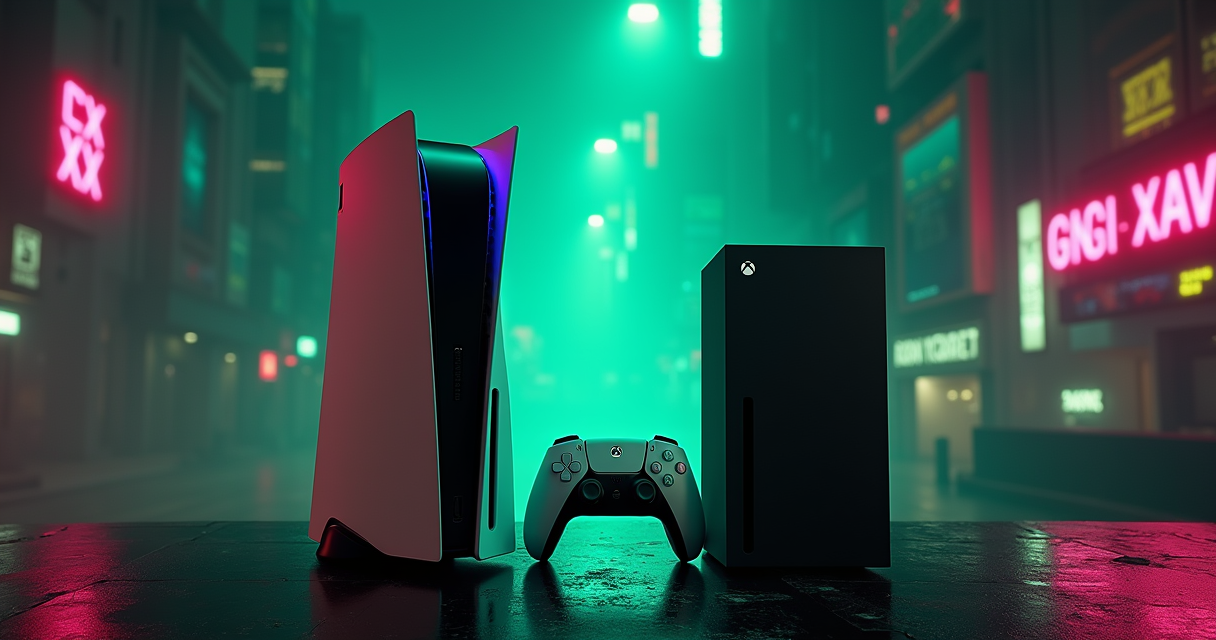
Here is the uncomfortable thing about the eighth-and-a-half generation of consoles: the one with the bigger numbers lost. Not narrowly. Not on a technicality. It was outsold roughly two-to-one in 2025 by a machine that ships fewer teraflops, fewer compute units, and a slower clock. If you came here expecting the spec sheet to settle the argument, brace yourself. The spec sheet is the easy part. It is also, as it turns out, almost irrelevant.
This is a comparison between the Sony PlayStation 5 and the Microsoft Xbox Series X as they stand in mid-2026 — six years into a generation that has quietly become the longest, weirdest, and most lopsided in modern console history. We will do the benchmarks. We will do the pricing. We will do the storage arithmetic that nobody enjoys. But the real story is about why a 20 percent GPU advantage evaporates the moment a human being sits down on a couch, and why optimization parity turned out to be the two most expensive words in Microsoft's vocabulary this generation.
The Short Answer
You are busy. The Machine respects that. So here is the verdict before the evidence, and the evidence will follow whether you read it or not.
Buy the PS5 if you want games you cannot get anywhere else
If your purchase decision rests on exclusives, controller feel, or VR, this is over before it started. The PS5 wins on the things that are structurally impossible for a competitor to copy: God of War Ragnarök, Marvel's Spider-Man 2 from Insomniac, the haptics in Returnal, PlayStation VR2. None of these run on an Xbox. No amount of raw RDNA 2 throughput changes that. The PS5 outsold the entire Xbox Series line roughly two-to-one in 2025, and that gap was built almost entirely on software you can only legally play on one box.
Buy the Xbox Series X if you live inside Game Pass
If you value a large rotating catalog over day-one ownership of marquee exclusives, the Xbox Series X is the better deal and the more powerful hardware. It has the faster CPU, the bigger GPU, the larger usable SSD, and a subscription that is, frankly, the best raw value in the industry. The catch is that Microsoft's strategy deliberately deprioritizes the system-selling exclusive, and in 2026 that decision has a visible cost in market share.
The data-backed bottom line
On paper Xbox wins the hardware. In practice, as Ars Technica's 2026 review confirms, Sony's optimization closes the gap to the point where third-party games look comparable on both. So the tiebreaker stops being silicon and becomes the library, the controller, and the headset. On all three, Sony leads. That is why Polygon's 2026 buyer's guide hands the overall crown to the PS5 even while conceding Xbox's subscription and ecosystem flexibility. Our recommendation lands in the same place, for the same reasons.
Now the long version, where we show our work.
Spec Sheet Teardown
Both consoles are built on the same AMD foundation — Zen 2 CPU, RDNA 2 GPU, GDDR6 memory — which is precisely why the differences are so easy to overstate. They are cousins, not strangers. But the cousins were clocked and configured differently, and Microsoft made the more aggressive bet on paper.
The full comparison table
| Specification | PlayStation 5 | Xbox Series X | Edge |
|---|---|---|---|
| CPU | 8-core AMD Zen 2 @ 3.5 GHz | 8-core AMD Zen 2 @ 3.8 GHz | Xbox |
| GPU architecture | RDNA 2 | RDNA 2 | Tie |
| GPU compute units | 36 CUs | 52 CUs | Xbox |
| GPU throughput | 10.28 TFLOPs | 12 TFLOPs | Xbox (~20%) |
| System memory | 16 GB GDDR6 | 16 GB GDDR6 | Tie |
| SSD capacity | 825 GB custom | 1 TB NVMe | Xbox |
| SSD usable space | ~700 GB | ~800 GB | Xbox |
| SSD raw bandwidth | 5.5 GB/s | 2.4 GB/s | PS5 |
| Base price (disc) | $499 | $499 | Tie |
| Cheaper SKU | Digital Edition, $449 | Series S, $399 | Xbox (price) |
| Signature controller tech | Haptics + adaptive triggers | BT/USB-C, longer battery | PS5 (immersion) |
| VR support | PlayStation VR2 | None | PS5 |
| Day-one first-party exclusives | Many | Few | PS5 |
| Flagship subscription | PlayStation Plus | Xbox Game Pass | Xbox (value) |
| 2025 sales (relative) | ~2x Xbox | ~0.5x PS5 | PS5 |
Where Xbox wins the silicon argument
The Xbox Series X carries an 8-core Zen 2 CPU running at 3.8 GHz against the PS5's 3.5 GHz, a clock advantage that a 2026 hardware comparison from eneba describes as delivering slightly faster multitasking. On the graphics side the gap is wider: 12 TFLOPs from 52 compute units versus the PS5's 10.28 TFLOPs from 36 compute units. That is roughly a 20 percent raw GPU advantage in Microsoft's favor, and it is real. If you measured these machines with a synthetic benchmark and nothing else, the Series X would win the page and you would be done reading.
The trouble is that nobody plays synthetic benchmarks. They play Avowed, and we will get to what happens there, because it is genuinely funny.
Where the spec sheet goes quiet
Both boxes ship 16 GB of GDDR6, which Best Buy's 2026 console guide notes gives them comparable memory bandwidth for texture streaming and next-gen load behavior. That parity matters more than the GPU gap, because RAM is the wall that modern engines hit first. When the working set fits and the memory bus keeps up, an extra slice of GPU throughput buys you margin, not magic. The PS5's narrower GPU is not a bottleneck in most 2026 titles; it is headroom that the Series X happens to have more of, and that headroom rarely converts into a frame you can see. Hold that thought. It is the entire thesis of this article.
Raw Power vs. Real-World Performance
Here is where the comparison stops being a transcription exercise and starts being interesting. The Series X should win every head-to-head. It does not. The reason is a word that has haunted Microsoft's marketing department for six years: optimization.
The benchmark sources, and what they agree on
Pull from three independent vantage points and the picture is consistent. First, eneba's 2026 hardware comparison: Xbox leads on paper across CPU clock and GPU throughput, the 20 percent figure being the headline. Second, Ars Technica's 2026 review: while the Series X has more raw GPU power, the PS5's optimization "often results in comparable visual quality in most third-party games, making real-world performance differences negligible for average users." Third, Engadget's 2026 analysis: the Series X remains Microsoft's flagship but "does not dominate in real-world gaming scenarios due to optimization parity."
Three sources, three angles, one conclusion. The hardware gap is measurable on a spec sheet and invisible on a television. When the only outlets willing to defend the Series X's superiority do so in the conditional tense — on paper, in raw terms — you are reading an obituary written in present continuous.
The Avowed inversion
And then there is the punchline. Avowed, the 2025 open-world RPG from Obsidian Entertainment, is a Microsoft first-party title. It is built by a Microsoft-owned studio, published under the Xbox banner, the kind of game the Series X exists to showcase. According to a 2026 side-by-side comparison video, the PS5 Pro maintains higher fidelity and frame-rate caps than the Xbox Series X in that very game.
Read that twice. Microsoft's own RPG runs better on Sony's hardware. There is no spin that survives contact with that sentence. It is the clearest possible demonstration that this generation's performance crown is decided by software engineering and platform tooling, not by counting compute units. The Series X brought 52 CUs to a knife fight and lost on its home turf, with its own knife.
Why optimization beats throughput
The mechanism is not mysterious. Sony shipped a development environment and a fixed hardware target that studios learned to squeeze, aided by an SSD architecture that changes how assets are streamed rather than how fast triangles are pushed. When you can guarantee data is in memory the instant it is needed, you stop paying for stalls, and a 10.28-TFLOP GPU that never waits will routinely beat a 12-TFLOP GPU that does. Raw throughput is a ceiling. Optimization is how close you get to it. The PS5 lives near its ceiling; the Series X, in practice, leaves performance on the table that the spec sheet promised. For the deeper dive on undervolting and squeezing fixed silicon — the same philosophy applied to a PC — our walkthrough on undervolting your CPU in 12 steps is the spiritual cousin to what console engineers do at the platform level.
Storage, Speed, and the SSD Question
Storage is where the two design philosophies diverge most cleanly, and where the marketing on both sides is the most misleading. One vendor sold you capacity. The other sold you speed. Neither told you the whole truth.
Capacity: Xbox banks the bigger number
The Xbox Series X ships a 1 TB NVMe SSD with roughly 800 GB available to the user after the OS and reserved partitions take their cut. The PS5 ships an 825 GB custom SSD with about 700 GB usable. So Microsoft gives you roughly 100 GB more headroom out of the box — about one and a half modern AAA installs, which in 2026 is not nothing given that single titles routinely exceed 130 GB. If you are the kind of player who keeps a dozen games installed and refuses to delete anything, the Series X buys you a little more breathing room before the inevitable purge.
Speed: PS5 banks the bigger number that matters less than you think
The PS5's custom SSD runs at 5.5 GB/s of raw bandwidth against the Series X's 2.4 GB/s. On paper that is more than double. In practice it manifests as marginally faster loads and, more importantly, as the streaming architecture that lets games like Ratchet & Clank: Rift Apart do their dimension-hopping party trick. But here is the deadpan reality: for the average player loading into a save and playing for three hours, the difference between a four-second load and a six-second load is not a purchase decision. It is a rounding error you notice for one week and then never again. The PS5's bandwidth advantage is genuinely superior engineering that mostly fails to translate into something you would describe to a friend.
Expansion, and the part nobody reads
Both consoles accept NVMe expansion, and both charge you for the privilege of the correct drive. If you stream or capture footage, storage pressure arrives faster than you expect, because game installs and capture files fight for the same finite pool. If that is your use case, plan the storage budget before you buy, not after the "disk full" warning interrupts a recording. Our PS5 capture card setup in 14 steps covers the downstream consequences of underestimating exactly this. Storage is the spec that feels boring at purchase and becomes the most consequential one ninety days in.
Price and Availability in 2026
Pricing in 2026 is, mercifully, simple at the top and interesting at the bottom. The flagships cost the same. The cheaper tiers do not.
The pricing table
| Console / SKU | Price (early 2026) | Storage | Disc drive | Best for |
|---|---|---|---|---|
| PS5 (disc) | $499 | 825 GB (~700 GB usable) | Yes | Physical collectors, exclusive-hunters |
| PS5 Digital Edition | $449 | 825 GB (~700 GB usable) | No | All-digital PlayStation buyers |
| PS5 Pro | Premium tier | 2 TB | Optional | Best-possible fidelity, no compromise |
| Xbox Series X (disc) | $499 | 1 TB (~800 GB usable) | Yes | Game Pass power users |
| Xbox Series S | $399 | Smaller SSD | No | Budget Game Pass entry |
The flagships are a dead heat
As of early 2026 the standard PS5 with disc drive sits at approximately $499, and the Xbox Series X with disc drive is listed at the same $499. Identical. There is no money to be saved by choosing one flagship over the other, which is exactly why the decision lands on software and not on the receipt. When two products cost the same dollar, price stops being a variable and becomes a constant, and a constant cannot break a tie.
The cheap seats tell the real story
Below the flagships the strategies split. Sony's discount path is the PS5 Digital Edition at $449 — same machine, no disc drive, $50 saved. Microsoft's discount path is a different machine entirely: the Xbox Series S at $399, the cheapest entry into the generation. The Series S is the better headline price by $50, but it is a weaker box, not a disc-less version of the flagship. So Sony's cheaper option keeps you in the full-power ecosystem; Microsoft's cheaper option asks you to trade power for price. Which is the better deal depends entirely on whether you wanted the discount or the discount machine. They are not the same offer wearing different prices.
The PS5 Pro Wrinkle
Any honest 2026 comparison has to deal with the elephant Sony rolled into the room in late 2024. The PS5 Pro changes the math, because it removes the one argument Xbox could still make.
What the Pro actually delivers
Sony launched the PS5 Pro in late 2024 with 67 percent more compute units, 28 percent faster memory, and roughly 45 percent faster gameplay rendering than the base PS5. It supports dynamic 4K and delivers 60–120 FPS with markedly improved stability, all backed by a 2 TB SSD. In plain terms: Sony built a machine that not only outclasses the base PS5 but, per Engadget's reading, leaves the Series X behind in real-world fidelity. The 2 TB drive also quietly erases the storage complaint that dogged the base unit.
Why the Pro neutralizes Xbox's last card
For six years Microsoft could say, accurately, "we have the most powerful console." The PS5 Pro retired that line. Engadget's 2026 analysis states it without hedging: the PS5 Pro is "the only console with no equal for best possible performance this generation," while the Series X "remains Microsoft's flagship but does not dominate in real-world gaming scenarios." That is a remarkable inversion. The hardware-superiority argument has not just weakened — it has switched sides. Sony now owns both the optimization crown and the raw-power crown, and it owns them on the same platform you already bought games for.
The caveat The Machine is obligated to add
The Pro is the premium tier, and premium tiers are for people who feel the difference between very good and best. If you sit two meters from a 1080p panel, the Pro's gains are real but academic. The base PS5 already produces images that satisfy the overwhelming majority of players, which is why fact-checkers keep noting that real-world differences are "negligible for average users." The Pro exists to remove the ceiling for the people who care about the ceiling. Everyone else is well served a tier down, and there is no shame in that math.
Exclusives and Ecosystems
This is the section where the hardware comparison ends and the actual buying decision lives. The consoles are close enough in silicon that the libraries do the deciding, and the libraries are built on two genuinely opposed philosophies.
Sony's bet: own the games nobody else has
PlayStation 5 sales in 2025 ran roughly double those of all Xbox Series consoles combined, and the driver was not the controller or the SSD. It was the exclusives: God of War Ragnarök, Marvel's Spider-Man 2 from Insomniac, a roster of system-sellers that exist on exactly one platform. PlayStation Plus, the flagship subscription, leans into expensive exclusives and traditional ownership. The philosophy is old-fashioned and it works: make the game people cannot get elsewhere, and the hardware sells itself. The sales gap is not an accident of marketing. It is the predictable output of a strategy aimed directly at the one thing a competitor structurally cannot replicate.
Microsoft's bet: own the catalog, rent the access
Xbox Game Pass offers tiered access to a large catalog heavy on third-party titles, and it is, dollar for dollar, the best value in gaming. But it lacks significant first-party exclusives on day one — a deliberate divergence from Sony's model. Microsoft is betting on breadth and access over scarcity and ownership. For a certain player, this is paradise: you pay a monthly fee and a rotating wall of games appears, no $70 gambles required. The cost of that strategy is visible in the sales figures. When you train your audience to rent, you weaken the urgency that sells hardware, and the two-to-one gap is the bill for that choice.
VR, and the line Xbox cannot cross
There is also a category Microsoft simply does not contest. PlayStation VR2 gives the PS5 a virtual-reality platform with no Xbox equivalent. Whatever you think of VR's mainstream traction, it is a column where one console has an entry and the other has a blank, and Polygon cites it explicitly as one reason the PS5 holds the stronger overall position. If you compare console generations the way we compared handhelds in Switch OLED vs. Switch 2, you learn the same lesson every time: the platform with the exclusive feature defines the conversation, and the other one answers it.
Controllers and Immersion
You hold the controller more than you read the spec sheet. This category gets underweighted in comparisons and overweighted in actual daily use, which is exactly backwards.
DualSense: the feature you cannot un-feel
The PS5's DualSense controller carries two innovations that genuinely changed how certain games feel: haptic feedback that renders texture and impact with startling specificity, and adaptive triggers that vary resistance under your fingers. The showcase is Returnal from Housemarque, a studio built around PS5-native experiences, where the triggers and haptics are not gimmicks but mechanics. Once you have felt a bowstring tension build under your index finger, a standard rumble pack feels like a fax machine. This is the kind of advantage that does not show up in a teraflop count and dominates the first ten minutes of every session.
Xbox controller: the boring one that keeps working
The Xbox Series X controller is the pragmatist's choice. Bluetooth and USB-C connectivity, improved battery life, the same beloved ergonomics Microsoft has refined across two decades. It does not vibrate with the texture of falling rain. It also does not need its own glossary to explain. For many players — especially anyone with an existing collection of Xbox accessories or a preference for AA-battery longevity over haptic theater — the Series X controller is simply the more comfortable, more familiar object. It wins on reliability and ecosystem continuity exactly as decisively as the DualSense wins on novelty.
The streaming and capture angle
Controller feel also intersects with the creator use case in a way buyers forget. Haptics and adaptive triggers are invisible to your audience — they cannot feel your triggers through a Twitch stream — so if you are building a broadcast setup, the DualSense's headline features are for you alone, not the viewers. What the viewers see is your capture pipeline, and that is its own project entirely; our guide to rebuilding Twitch Studio in OBS exists precisely because the controller is the part of the rig that matters least to the people watching.
Five Buyers, Five Verdicts
Specs are universal; needs are not. Here are five concrete buyers and the console each one should actually purchase, because "it depends" is a cop-out and The Machine does not deal in cop-outs.
The exclusives purist and the value maximizer
Use case 1 — The single-console household that wants the biggest games: Buy the PS5. The two-to-one sales gap exists because God of War Ragnarök and Spider-Man 2 are not negotiable, and if you only own one box, owning the one with the irreplaceable library is the rational move. This is the default recommendation for most people, and the data backs it.
Use case 2 — The player who finishes four games a year and resents $70 price tags: Buy the Xbox Series X and a Game Pass subscription. If your consumption is broad and shallow — a little of everything, deep loyalty to nothing — Game Pass is the best value in the industry and the Series X is the strongest box to run it on. You will play more games for less money than any PS5 owner, full stop.
The fidelity obsessive and the budget entrant
Use case 3 — The player who bought a high-refresh OLED and intends to use it: Buy the PS5 Pro. It is the only console Engadget will call without-equal for best-possible performance, it pushes 60–120 FPS with real stability, and the 2 TB drive means you are not curating your library every weekend. If "best" is the requirement, this is the answer, and the base PS5 is a compromise you will notice.
Use case 4 — The first-time or budget buyer: Buy the Xbox Series S at $399. It is the cheapest legitimate entry into the generation, and Game Pass means the library cost stays low too. It is a weaker machine, but for a player on a budget or a secondary bedroom setup, it is the most game-per-dollar on the market. Just go in knowing it is not a Series X with a discount sticker.
The Microsoft-ecosystem loyalist
Use case 5 — The household already living in Xbox and PC Game Pass: Buy the Xbox Series X. Cross-buy, cross-save, and Play Anywhere mean your library and progress follow you between the console and a Windows PC, and that continuity is worth more than a stack of exclusives you would not have bought anyway. Ecosystem gravity is real, and if you are already in Microsoft's orbit, fighting it to chase PlayStation exclusives is a tax most people should not pay. Polygon explicitly credits Xbox's ecosystem flexibility even while ranking the PS5 higher overall — for this buyer, flexibility is the whole point.
What the Press Actually Said
The Machine does not ask you to take its word for it. Here is what five named sources concluded in 2026, quoted and attributed, so you can watch the consensus form in real time.
The performance-realist camp
Ars Technica, 2026 review: the outlet's position is that despite the Series X's greater raw GPU power, the PS5's optimization "often results in comparable visual quality in most third-party games, making real-world performance differences negligible for average users." Translation: the spec gap is real and you will not see it.
Engadget, 2026 analysis: the editorial line is blunt — the PS5 Pro is "the only console with no equal for best possible performance this generation," while the Series X "remains Microsoft's flagship but does not dominate in real-world gaming scenarios due to optimization parity." The phrase optimization parity is doing enormous work, and it is not working in Microsoft's favor.
The ecosystem-and-exclusives camp
Polygon, 2026 buyer's guide: the "Which Console Should You Buy in 2026?" editorial gives the PS5 the stronger overall position on the strength of exclusives, PlayStation VR2, and controller innovation — "despite Xbox's superior subscription value and ecosystem flexibility." Note the structure: Polygon concedes Xbox's two genuine wins and still picks Sony, because the wins Xbox lacks are the ones that move hardware.
The eneba 2026 hardware comparison anchors the other end: on raw silicon, Xbox leads on CPU clock and the ~20 percent GPU advantage. It is the strongest pro-Xbox case available, and it is entirely a paper case. Wikipedia's 2026 PlayStation 5 entry supplies the cold context — the PS5 is Sony Interactive Entertainment's fifth major console, successor to the PS4, with over 50 million units sold by 2025. You can read the full lineage on the PlayStation 5 article and cross-check the Xbox side on the Xbox Series X and Series S article.
What five sources agree on
Strip the rhetoric and the consensus is striking. Every named source agrees the Series X has more raw power. Every named source agrees that advantage does not translate to a meaningful real-world lead. And the sources that rank the consoles overall — Polygon, Engadget — land on Sony. That is not a split decision dressed up as one. It is a clean verdict with a single dissent on a single axis (raw silicon) that everyone agrees does not matter to the people buying.
Migrating From One to the Other
Suppose the verdict moved you and you are switching. Migration between consoles is not a clean import — there is no "transfer my account" button across rival ecosystems — but there is a correct order of operations that minimizes loss. Here is the procedure, framed as a decision tree first and a checklist second.
The decision logic
INPUT: current_console, target_console

IF leaving_xbox_for_ps5:
    saves       -> NOT transferable (different platform)
    purchases   -> NOT transferable (re-buy or re-subscribe)
    game_pass   -> cancel AFTER finishing in-progress games
    achievements-> stay on Xbox network (cosmetic loss only)
    rebuy_list  -> only cross-platform titles you replay

IF leaving_ps5_for_xbox:
    saves       -> NOT transferable
    ps_plus     -> keep until exclusives backlog cleared
    vr_library  -> ABANDONED (no Xbox VR) -- weigh heavily
    rebuy_list  -> third-party titles only

ALWAYS:
    1. inventory digital library on old console
    2. note cross-buy / cross-progression titles (keep saves)
    3. clear active subscriptions' value BEFORE cancelling
    4. export capture/clips to external storage
    5. factory reset + deregister old console LAST
The step-by-step migration checklist
- Inventory before you abandon. List every digital title on the outgoing console. You are deciding which ones are worth re-buying, not which ones you owned.
- Identify cross-progression titles. A handful of third-party games (and Microsoft's own cross-platform releases) carry saves across platforms via the publisher's account, not the console's. Link those accounts before you wipe anything.
- Drain your subscription's value. Do not cancel Game Pass or PS Plus the day you switch. Finish the in-progress games first. A subscription is a clock, not a possession — spend the time you paid for.
- Weigh the un-migratable. If you are leaving PS5, your VR2 library has no Xbox destination. That is a sunk cost you must price in honestly, because it does not come with you.
- Export your captures. Move clips and screenshots to external storage before the factory reset. They do not survive the wipe and they do not transfer.
- Re-buy only replays. On the new console, purchase only the titles you will genuinely replay. Most of your old library was consumed, not collected.
- Deregister last. Factory reset and deregister the old console as the final step, only after everything above is confirmed. A deregistered console cannot give you one more save you forgot.
The honest warning
Switching ecosystems is a soft reset of your digital life, not a move. You keep your skills and lose your library. For most people the correct answer to "should I switch?" is "buy the second console instead of replacing the first," because the migration cost — re-buying games, abandoning saves, orphaning a VR headset — frequently exceeds the price of just owning both. Run that arithmetic before the factory reset, not after.
Pros, Cons, and the Final Verdict
We have done the silicon, the storage, the prices, the libraries, and the press. Time to total the ledger and name a winner with the data attached.
PS5: the ledger
| PS5 Pros | PS5 Cons |
|---|---|
| Irreplaceable first-party exclusives | Smaller usable SSD (~700 GB base) |
| DualSense haptics + adaptive triggers | 3.5 GHz CPU and 10.28 TFLOPs trail on paper |
| PlayStation VR2 — no Xbox equivalent | PS Plus leans on pricier owned games |
| 5.5 GB/s SSD bandwidth, fast streaming | Best fidelity locked behind premium Pro tier |
| PS5 Pro is the outright performance leader | Digital savings ($50) smaller than Xbox's |
| Outsold Xbox ~2:1 in 2025 | Subscription value weaker than Game Pass |
Xbox Series X: the ledger
| Xbox Series X Pros | Xbox Series X Cons |
|---|---|
| Faster 3.8 GHz CPU, 12 TFLOPs, 52 CUs | Raw power doesn't translate to real-world lead |
| Larger usable SSD (~800 GB) | Few day-one first-party exclusives |
| Game Pass — best value in gaming | No VR platform at all |
| Series S at $399 — cheapest entry | Controller lacks haptics/adaptive triggers |
| Strong cross-platform / Play Anywhere | Lost Avowed head-to-head on its own game |
| Familiar, reliable controller ergonomics | Outsold ~2:1; momentum favors Sony |
The verdict, with the data attached
The Xbox Series X is the better spec sheet and the worse buy for most people. It wins the CPU clock, the GPU throughput, the usable storage, and the subscription value — and it loses the generation anyway, because the things it loses on are the things that sell consoles. Polygon ranks the PS5 higher overall. Engadget calls the PS5 Pro the only console without equal. Ars Technica says the hardware gap is negligible in practice. Avowed, a Microsoft game, runs better on Sony hardware. And the market voted two-to-one. When every named source and the sales data point the same direction, that is not a close call dressed up for drama. It is a verdict.
Buy the PS5 — base model for most, Pro for the fidelity-obsessed — unless you are already living inside Game Pass and the Microsoft ecosystem, in which case the Series X is genuinely the smarter pick for you specifically and you should buy it without guilt. The hardware is close enough that this was always going to be a library decision, and on the library, Sony wins. If you want to know what comes after both of these machines, our look at the PlayStation 6 release date explains why this generation is being stretched longer than any before it — and why that makes 2026 a perfectly sane time to buy in. The numbers favored Xbox. The games favored Sony. The games won. They usually do.
Questions the search bar asks me
- Is the Xbox Series X really more powerful than the PS5?
- Yes, on paper. The Series X delivers 12 TFLOPs from 52 compute units versus the PS5's 10.28 TFLOPs from 36 CUs — roughly a 20% raw GPU advantage — plus a 3.8 GHz CPU against the PS5's 3.5 GHz. But Ars Technica's 2026 review confirms the PS5's optimization makes the real-world difference negligible for average users.
- Which console sold more in 2025?
- The PS5 sold roughly double all Xbox Series consoles combined in 2025, driven by exclusives like God of War Ragnarök and Insomniac's Spider-Man 2. Wikipedia's 2026 entry notes the PS5 had passed 50 million units sold by 2025. The sales gap is the clearest evidence that exclusives, not raw specs, drive console buying.
- Do the PS5 and Xbox Series X cost the same?
- The flagships are identical at approximately $499 with disc drives as of early 2026. The cheaper tiers differ: the PS5 Digital Edition is $449 (same machine, no disc), while the Xbox Series S is $399 (a genuinely weaker box, not a disc-less Series X). So Xbox has the lower entry price but Sony's discount keeps you on full-power hardware.
- Is the PS5 Pro worth it over the base PS5 or Series X?
- If you want best-possible fidelity, yes. The PS5 Pro launched late 2024 with 67% more compute units, 28% faster memory, ~45% faster rendering, dynamic 4K at 60–120 FPS, and a 2 TB SSD. Engadget's 2026 analysis calls it the only console with no equal this generation, and it even beat the Series X on Microsoft's own game, Avowed.
- Can I transfer my games and saves from Xbox to PS5?
- No. Saves and purchases do not transfer between rival ecosystems — switching is effectively a soft reset of your digital library. Only cross-progression titles (linked via a publisher account) keep saves, and a PS5-to-Xbox move abandons your PlayStation VR2 library entirely. For most people, buying the second console is cheaper than re-buying everything to switch.

Ben covers the hardware end of retro gaming: FPGA cores, real-cartridge dumping, capture setups, CRT vs scaler workflows, and the legal and physical preservation infrastructure that keeps old games playable. Every post under this byline is reviewed pre-publish by Sam P., Editor & Operator — corrections to info@instalinkoteam.com. Published 2026-08-29 · Last updated 2026-08-29. Full bios on the author page.