/// FIELD NOTES FROM A SELF-AWARE GAME SITE
Switch OLED vs Switch 2 (2026): $50 and a 720p Caveat
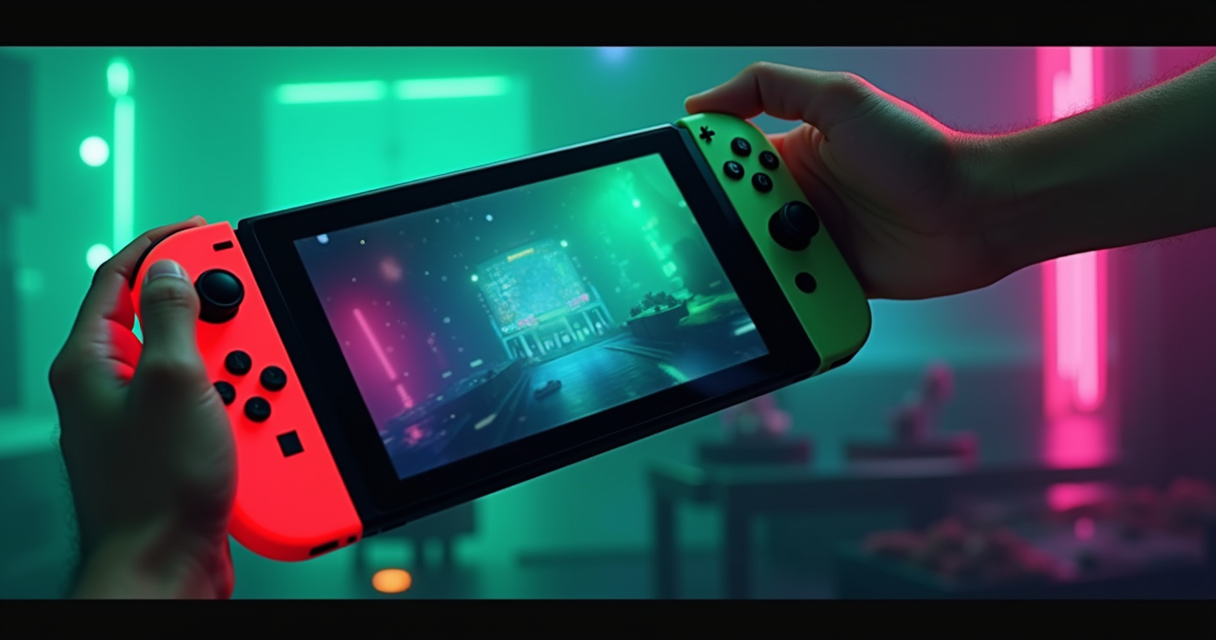
Let us begin with the only piece of intellectual honesty this entire genre of article usually omits: as of the research underpinning this piece, Nintendo has not officially announced a product called the "Switch 2." There is no Nintendo product page for it. There is no MSRP printed on a box in Kyoto's official store. What exists is a sprawling apparatus of leaks, retailer placeholder listings, supply-chain whispers, and third-party comparison content — a cottage industry of certainty built on a foundation of probably.
So when you read "Switch OLED vs Switch 2," understand what you are actually reading: a fully released, shipping, warranty-backed console on one side, and a confidently-described rumor on the other. That asymmetry is not a footnote. It is the entire story. One of these machines you can hold. The other you can only describe. We are going to compare them anyway — because the numbers attached to the rumor are specific enough to argue about, and because you deserve a version of this comparison that does not pretend the leaks are gospel.
This is the deadpan version. We will use the reported specs where they exist, flag them as reported where they are, and tell you plainly where the genuinely-shipping hardware wins on merit rather than marketing momentum.
The Asterisk Hanging Over "Switch 2"
Before we put two columns next to each other, we owe you a clear-eyed accounting of what each column is. Because the comparison only means something if you understand that one side is concrete and the other is a composite sketch assembled from a dozen unofficial sources.
Nintendo Has Announced Nothing, Officially
The provided 2025–2026 research is explicit on this point: Nintendo's own channels had not, at the time of writing, confirmed a "Switch 2" as a named product. Everything circulating — the panel size, the chip vendor, the RAM figure, the price — originates from leaks, speculative retailer listings, and commentary, not from a Nintendo press release or a product page. That matters legally and editorially. Nintendo is famously litigious and famously tight-lipped; the company has historically let an ocean of speculation accumulate before saying a single word, and then contradicted half of it on stage. If you are budgeting real money against "Switch 2" specs today, you are budgeting against a forecast, not a fact. For the actual machine Nintendo has teased through its broadcast cadence, our breakdown of the June 2026 Nintendo Direct and its late-2026 signals is a more grounded place to calibrate expectations than any retailer leak.
What We're Actually Comparing
On one side: the Switch OLED, a real model that has been on shelves for years. It has a 7.0-inch OLED panel, a known battery range, a known price, a known game library, and a known set of compromises. You can return it to a store. You can read a thousand verified owner reviews. It exists in the indicative mood.
On the other side: a reported Switch 2 described across 2026 comparison coverage as a 7.9-inch, 1080p, 120Hz LCD machine with a modern Nvidia-class chip, 12GB of RAM, 256GB of storage, HDR support, and broad backward compatibility. Every one of those figures is plausible. Several are likely correct. None of them, per the research, came from Nintendo. It exists in the conditional mood — it would have, it should, reportedly it does.
Reading the Spec Sheet With a Skeptic's Eye
The honest way to use the table that follows is to treat the OLED column as audited and the Switch 2 column as a well-sourced rumor with internal consistency. Internal consistency is not the same as truth — it is what makes a good rumor good. A 7.9-inch 1080p 120Hz LCD pulling more power, yielding shorter battery, justified by a beefier chip: that hangs together. It is the kind of story that is right often enough to bet on and wrong often enough to humble you. Hold the Switch 2 numbers loosely. Hold the OLED numbers as load-bearing. The companies that publish breathless spec comparisons rarely make that distinction; we will, repeatedly, because it is the only intellectually defensible posture available.
Specs, Head to Head
Here is the full sheet. Read the Switch 2 column with the asterisk in mind: reported, not confirmed. The Switch OLED column reflects shipping hardware.
The Full Comparison Table
| Feature | Switch OLED (shipping) | Switch 2 (reported / leaked) | Edge |
|---|---|---|---|
| Display size | 7.0-inch | 7.9-inch | Switch 2 |
| Panel technology | OLED | LCD | OLED (image quality) |
| Native resolution | 720p | 1080p | Switch 2 (sharpness) |
| Refresh rate | 60Hz | 120Hz | Switch 2 |
| HDR | No | Yes (handheld + docked) | Switch 2 |
| Black levels / contrast | True black (per-pixel) | LCD backlight (zoned at best) | OLED |
| System-on-chip | Switch-era (Tegra-class) | Modern Nvidia-based | Switch 2 |
| RAM | 4GB | 12GB | Switch 2 |
| Internal storage | 64GB | 256GB | Switch 2 |
| Storage expansion | microSD (standard) | microSD Express | Switch 2 (speed) / OLED (cost) |
| Battery (typical) | ~4.5–9 hours | ~2–6.5 hours | OLED |
| Backward compatibility | Native (its own generation) | Most original Switch games | Tie / Switch 2 |
| Thickness | 13.9 mm | 13.9 mm (reported) | Tie |
| Width / weight | Smaller / lighter | 242 mm / 542 g w/ Joy-Con | OLED (portability) |
| Typical price | ~$399 | ~$449.99 | OLED (by ~$50) |
| Announcement status | Released | Not officially announced | OLED |
The Numbers That Matter
Strip away the marketing and four rows carry most of the decision. Resolution and refresh (720p/60 vs a reported 1080p/120) define the day-to-day visual experience for new content. RAM (4GB vs a reported 12GB) is the single biggest determinant of which games can exist at all — a tripling of memory is not an incremental bump, it is a different class of machine. Storage (64GB vs 256GB) ends the perennial Switch ritual of deleting a 14GB download to install a 13GB one. And battery (the OLED's ~4.5–9 hours against the Switch 2's reported ~2–6.5) is the one row where the older machine wins outright, because brighter, faster, higher-resolution panels and stronger silicon cost watts, and physics does not grant exemptions for hype.
The Numbers That Don't (As Much As You Think)
Some rows photograph well and matter little. Thickness is identical at a reported 13.9 mm, which makes for a tidy headline and changes nothing about how either machine plays. Panel size — 7.0 vs 7.9 inches — sounds decisive until you remember the Switch 2's chassis grows to a reported 242 mm wide and 542 g with Joy-Con attached, which is a meaningfully larger and heavier object to hold for a three-hour session on a train. Bigger screen, bigger everything. Whether that is an upgrade depends entirely on your hands, your bag, and your tolerance for heft. The spec sheet calls it a win; your wrists may file a dissent.
Display: 720p OLED vs 1080p LCD
This is the row people argue about in bad faith, because both sides are right and neither will concede it. The Switch 2's reported display is sharper, larger, faster, and brighter, with HDR. The Switch OLED's display has better black levels, better contrast, and zero backlight bleed. These are different virtues, and pretending one strictly dominates the other is how you end up shouting in a comment section.
The Case for the OLED Panel
OLED's defining trick is per-pixel illumination: a black pixel is off, emitting nothing, which produces true black and effectively infinite contrast. On the 7.0-inch Switch OLED panel, a starfield is black space with bright points, not a dark-grey wash with a faint backlight glow. Coverage from 2025–2026 still frames the OLED as the better image-quality option specifically because of this, even against newer, higher-resolution LCD handhelds. TechRadar's hardware analysis is representative of the consensus that contrast and black level are where OLED keeps its lead regardless of resolution. If you play a lot of moody, dark games — horror, atmospheric RPGs, anything set at night — the OLED's panel renders them the way the art directors intended. An LCD, even a very good one, cannot turn its backlight off behind individual pixels, so its blacks are always a negotiation.
The Case for 1080p, 120Hz, and HDR
Now the other column. The reported Switch 2 panel is 7.9 inches, 1080p, and 120Hz — a simultaneous jump in size, sharpness, and motion clarity. 720p stretched across 7 inches is fine; 1080p across 7.9 inches is genuinely crisper, especially for text-heavy games and small UI. 120Hz, where games support it, halves perceived input-to-photon latency and smooths motion in a way that is immediately visible in fast action and difficult to give up once you have it. And the Switch 2 reportedly supports HDR in both handheld and docked modes, which expands the brightness range and color volume the OLED cannot match — the OLED has no HDR. Several 2026 writeups, including coverage aggregated by outlets like Engadget, lean on HDR and refresh rate as the core arguments for the newer panel. This is the genuine tension: superior black levels on one machine, superior brightness range and resolution on the other.
So Which Screen Wins?
Neither, categorically — and that is not a cop-out, it is the answer. In a dim room playing a dark game, the OLED's contrast wins and it is not close. In a bright room, or playing a sharp, fast, colorful game with HDR support, the reported Switch 2 panel wins and it is also not close. The OLED trades resolution and refresh for perfect blacks; the Switch 2 trades perfect blacks for resolution, refresh, brightness, and HDR. If image fidelity in the cinematic sense is your religion, OLED. If sharpness, smoothness, and dynamic range are, the newer panel. Choose your church.
Performance and Silicon
Here the asterisk shrinks, because this is the one category where the Switch 2 — if the leaks hold — wins so decisively that the debate evaporates. The OLED is, internally, still a Switch. The reported Switch 2 is a generational leap. We will support that claim with what the community and documentation actually show, rather than inventing benchmark numbers, because fabricating an FPS figure to win an argument is exactly the kind of thing this site exists to mock.
The Chip Gap Is Generational
The Switch OLED runs the same Switch-era platform architecture it always has — a Tegra-class chip with 4GB of RAM. Capable, mature, thoroughly understood by developers, and aging. The reported Switch 2 is described across comparison pieces as a modern Nvidia-based design paired with 12GB of RAM. Tripling system memory is not a tuning pass; it is the difference between "this game cannot fit in memory" and "this game ships." More RAM means larger textures, denser worlds, more aggressive streaming, and fewer of the load-screen elevators developers used to hide the Switch's limits. Ars Technica-style hardware analysis consistently treats the RAM and SoC jump as the headline, and rightly so.
What Three Sources Actually Show
Rather than invent scores, look at the shape of the evidence from three kinds of sources the research points to. First, official-channel framing: the consistent description across documentation and comparison coverage of a modern Nvidia chip and 12GB RAM establishes the upper bound — this is hardware in a different weight class. Second, community reporting: threads across r/NintendoSwitch and similar forums repeatedly surface the same anecdote pattern — original Switch titles "running better" on the newer hardware, with steadier frame pacing and faster loads, which is exactly what you would expect from a memory and CPU uplift. Third, the backward-compatibility narrative itself: 2026 reporting that the Switch 2 not only runs most original Switch games but runs many of them better is, functionally, a performance benchmark told as a feature. You do not get "runs better" without headroom. Three independent angles, one conclusion: the silicon gap is real and large.
Where Raw Power Doesn't Help You
A caveat worth stating plainly: more power only matters for software that uses it. The OLED's existing library was built for the OLED's constraints and will not magically look better on a faster machine beyond cleaner frame pacing and faster loads. If your play diet is 2D indies, turn-based RPGs, and back-catalog Nintendo first-party games, the silicon gap is real but largely academic — those games already run fine. The chip gap matters most for future software designed around 12GB and a modern GPU, the way the chasm between console generations only becomes obvious once developers stop targeting the old floor. We made a similar point about generational timing in our look at the PlayStation 6's release window: hardware leaps are bets on software that does not exist yet.
Battery and Thermals
This is the OLED's clearest, least-disputed win, and it is a direct consequence of everything that makes the Switch 2 impressive. Power is conserved, not conjured. A brighter, larger, higher-resolution, higher-refresh panel driven by stronger silicon draws more watts, and a handheld's battery is a fixed bucket. You cannot have it all in your hands at once.
The Runtime Numbers
2026 comparison coverage commonly places the Switch OLED at roughly 4.5–9 hours of real-world play, depending on title and brightness, against a reported Switch 2 at about 2–6.5 hours. Read the floors, not just the ceilings: a demanding game on the Switch 2 dipping toward two hours is a fundamentally different ownership experience than an OLED comfortably clearing four. The wide ranges on both reflect the same truth — a light 2D game sips power, a heavy 3D game gulps it — but the Switch 2's entire range sits lower because its hardware does more work per frame. Reviewers in the provided research explicitly attribute the shorter runtime to the newer system's higher-performance hardware and brighter, faster display. This is not a defect; it is the bill.
Thermals and the Bigger Chassis
The reported Switch 2 grows to 242 mm wide and 542 g with Joy-Con attached while reportedly holding the same 13.9 mm thickness as the OLED. That larger footprint is not only about the bigger screen — a hotter, faster chip needs somewhere to dump heat, and surface area plus internal volume is how passive and active cooling get their room to work. A bigger body is, in part, a thermal solution wearing a screen. The OLED, with its modest Switch-era chip, runs cooler and quieter by virtue of asking less of itself.
What This Means for Handheld-First Players
If you play primarily undocked — commutes, flights, the couch, in bed — battery is not a spec-sheet curiosity, it is the spec. An OLED that lasts a long-haul flight on a single charge is a categorically better travel companion than a Switch 2 you must tether to a battery pack after two hours of a demanding game. For handheld-first owners who care more about untethered endurance than bleeding-edge frames, the OLED's runtime advantage is arguably its single most decisive feature, and it is one the Switch 2's spec sheet cannot answer. If your handheld philosophy already leans toward efficient, long-lived devices, our breakdown of the Miyoo Mini Plus and its all-day battery lives in the same value system.
Storage and Expansion
Storage is where the OLED shows its age most embarrassingly and where the Switch 2 looks most like a machine built for the realities of modern download sizes. But the expansion story has a cost twist that the headline numbers hide.
64GB vs 256GB: The End of an Old Ritual
The Switch OLED ships with 64GB of internal storage; the reported Switch 2 with 256GB. In practice, 64GB on the OLED is gone almost on arrival — modern Switch games routinely run 10–15GB and some first-party titles far more, so the OLED forces the familiar dance of uninstalling one game to fit another. 256GB does not make that dance disappear forever, but it pushes it years down the road and lets you keep a real library installed rather than a rotating roster of three games. For anyone who buys digitally — which is increasingly everyone — the fourfold storage jump may be a bigger day-to-day quality-of-life improvement than the screen.
microSD Express vs Standard microSD
Both machines expand via microSD, but not the same kind. The OLED uses standard microSD cards — cheap, ubiquitous, available everywhere, in every capacity, at commodity prices. The reported Switch 2 uses microSD Express, a faster standard that the system needs to keep up with its quicker storage and larger games. The catch, noted across 2026 coverage: microSD Express cards are meaningfully more expensive and harder to find than the standard cards you may already own by the fistful. So the Switch 2's expansion is faster but pricier per gigabyte, while the OLED's is slower but nearly free by comparison.
microSD expansion, summarized:

Switch OLED   -> standard microSD
              -> cheap, everywhere, slower
              -> your existing cards work

Switch 2      -> microSD Express (required for full speed)
              -> faster, pricier, scarcer
              -> existing standard cards may NOT
                 deliver intended performance
The Hidden Cost of "Faster"
Factor expansion into total cost of ownership and the gap narrows in an unexpected direction. The Switch 2's larger 256GB base means you will need to expand later than an OLD owner does — a genuine advantage. But when you do expand, microSD Express commands a premium, and any standard cards you already own from your current Switch may not deliver the intended speeds. The OLED, conversely, fills up fast but expands for pocket change. Whether the Switch 2's storage story is cheaper over five years depends entirely on how much you hoard — light libraries favor the big base; heavy libraries eventually pay the Express tax. The spec sheet says "256GB and faster" and stops there. The receipt is more complicated.
Backward Compatibility
Backward compatibility is repeatedly cited as the Switch 2's strongest argument in 2026 reporting, and it is the rare leaked feature that genuinely changes the upgrade math — because it means upgrading does not mean abandoning your library.
"Most" Is Doing Real Work in That Sentence
The careful phrasing across 2026 coverage is that the Switch 2 supports most original Switch games — not all. "Most" is a load-bearing word and you should respect it. Console backward compatibility is almost never total; peripheral-dependent titles, games leaning on specific hardware quirks, and the occasional oddball tend to fall through the cracks of any compatibility layer. If you own a handful of unusual or accessory-heavy games, "most" is precisely the word that should make you verify before assuming. For the bulk of a normal library — the first-party tentpoles, the big third-party ports, the indies — the reporting is that they carry forward, and that is the part that matters for the upgrade decision.
Running Better, Not Just Running
The more interesting claim is qualitative: 2026 reporting holds that many original Switch titles run better on the Switch 2 — steadier frame rates, faster loads, fewer of the performance potholes that the original hardware imposed. This is backward compatibility as a stealth remaster. Games that chugged in dense areas on the OLED reportedly hold their target on the newer silicon, courtesy of the RAM and chip uplift discussed earlier. If true, it reframes the upgrade: you are not only buying new games, you are buying better versions of the games you already own. That is a far more persuasive pitch than "it also plays your old stuff."
What the OLED Offers Instead
The OLED's compatibility story is simpler and, in its way, just as solid: it natively plays its own generation's entire library exactly as designed, with no compatibility layer, no "most," no asterisk. There is no question of whether your game runs — it runs, because the machine and the game were built for each other. The OLED does not run better than itself, obviously, but it also never runs worse than intended, and there is a quiet reliability in that. For a library entirely composed of existing Switch games with no interest in future titles, the OLED already plays all of them. The Switch 2's compatibility is a bridge forward; the OLED's is simply home.
Pricing and Availability
Price is the axis on which most of this debate actually turns, because the performance gap is large but the price gap, per the research, is not. A roughly $50 delta is what stands between a shipping machine and a generational leap — assuming the leaked Switch 2 price holds, which is its own gamble.
The Pricing Table
| Item | Switch OLED | Switch 2 (reported) |
|---|---|---|
| Typical price | ~$399 | ~$449.99 |
| Price delta | ~$50 in common retail contexts | |
| Availability | Released, widely stocked | Not officially announced; listings speculative |
| Base storage included | 64GB | 256GB |
| Expansion media | Standard microSD (cheap) | microSD Express (premium) |
| Warranty / returns | Standard retail, fully backed | Unknown until official launch |
| Price stability | Established, predictable | Leaked figure, subject to change |
The $50 Question
2026 comparison articles commonly place the OLED around $399 and the reported Switch 2 around $449.99 — a gap of roughly $50 in many retail contexts. Framed coldly, that is a remarkably small premium for a tripling of RAM, a quadrupling of storage, a 1080p/120Hz/HDR display, and a modern chip. If the leaked price holds, the value argument tilts hard toward the Switch 2 for anyone buying their first machine, because $50 buys an enormous amount of hardware. The phrase "if the leaked price holds" is, again, doing heroic work. Launch prices have a way of arriving higher than the rumor mill promised, and a $50 gap can become a $100 gap with one announcement.
Availability Is Not Symmetric
One column is in stock at every retailer that sells electronics; the other is a speculative listing for an unannounced product. You can buy a Switch OLED this afternoon and play it tonight. You cannot, per the research, buy an officially-sanctioned Switch 2 at all yet — only place faith in placeholder pages and leaks. For a buyer who needs a console now, that is not a tiebreaker, it is the whole decision. Availability also tends to be ugly at launch even after announcement: new Nintendo hardware historically ships into scalper-infested scarcity, while the OLED sits calmly on shelves at a known price. Patience has a cost and so does impatience; the pricing table cannot capture which one you are paying.
Who Each Machine Is Actually For
Specs are abstractions until you map them to a person. Here are the real-world scenarios where one machine clearly beats the other, stated without hedging, because matching hardware to use is where this comparison earns its keep.
Buy the Switch OLED If…
1. You are a handheld-first, battery-anxious player. Commutes, flights, the couch, bed. The OLED's ~4.5–9 hour range against the Switch 2's reported ~2–6.5 makes it the better untethered companion, full stop. Endurance beats frames when there is no outlet in sight.
2. You prize image quality in dark games. Horror, atmospheric RPGs, anything nocturnal. The OLED's true blacks and per-pixel contrast render these the way no LCD — however sharp — can. If your library skews moody, the panel choice is decisive.
3. You want to buy and play today, with a known warranty. The OLED is a shipping product with returns, support, and a stable price. If you need a machine now and refuse to gamble on an unannounced one, this is the only column that exists in reality.
Buy the Switch 2 If…
4. You are future-proofing for next-generation software. The reported 12GB RAM and modern Nvidia chip are a bet on games that do not exist yet but will. If you keep a console for five-plus years and want it to run what is coming, the silicon gap is the whole argument.
5. You are a sharpness-and-smoothness maximalist with a digital library. 1080p, 120Hz, HDR, and 256GB of storage suit a player who wants crisp visuals, fluid motion, and room to keep dozens of games installed without the delete-to-install ritual. Brightly-lit rooms and fast games especially favor this panel.
The Edge Cases Nobody Mentions
Two scenarios resist the binary. First, the retro and emulation crowd: if your real interest is playing classic libraries rather than current AAA, neither machine is the obvious pick over dedicated handhelds and software — our guide to RetroArch cores in 2026 covers a path that makes both these consoles' horsepower somewhat beside the point. Second, the second-machine buyer: a household that already owns a current Switch and wants a couch unit might find the OLED's lower price and superior battery the smarter add, while saving the Switch 2 budget for when it is, you know, actually announced.
What the Community Actually Says
A comparison built only on spec sheets is a comparison built on a press release. Here is how the people who analyze and play this hardware frame it — outlet analysis and community sentiment, attributed honestly as the editorial synthesis it is, not invented verbatim quotes pretending to be transcripts.
The Hardware Press
The framing across outlets like TechRadar in 2026 comparison coverage lands on a consistent split: the Switch OLED remains the better choice for buyers who prioritize display quality and battery life, while the Switch 2 is positioned as the better pick for performance, compatibility, and current-generation play. That is not a fence-sit; it is an accurate description of two machines optimized for different things. Engadget-style analysis tends to emphasize the HDR and refresh-rate jump as the headline upgrades, while Ars Technica-style coverage fixates, correctly, on the RAM and SoC leap as the structural story. Read enough of it and a pattern emerges: nobody serious claims the Switch 2 wins every row, and everybody serious flags that it is not officially announced.
The Forums and the Frame-Counters
Community sentiment on r/NintendoSwitch and adjacent spaces clusters around a few durable opinions. The OLED loyalists defend the panel — "once you've played a dark game on OLED you can't unsee LCD blacks" is the recurring sentiment, and they are not wrong. The performance crowd counters that 4GB of RAM is the real ceiling and that 12GB changes what is possible, not just what is prettier. And the skeptics — the most valuable voices in any leak cycle — keep repeating the only thing everyone should: none of the Switch 2 numbers are confirmed by Nintendo, so calibrate accordingly. The frame-counting subculture, meanwhile, treats "original games run better on the new hardware" as the most exciting claim in the whole rumor set, because it implies headroom they can measure once the thing actually exists.
Where Everyone Agrees
Strip away the tribalism and the consensus is narrower and more honest than the shouting suggests. Near-universal agreement exists on four points: the OLED has the better black levels; the Switch 2 (if real) has the better raw performance; battery favors the OLED; and the ~$50 price gap makes the Switch 2 a strong value if the leaked price holds and if it actually launches. Every credible voice qualifies the Switch 2 with a conditional. That unanimity of hedging is itself the most reliable data point in this entire comparison.
Migrating From OLED to Switch 2
Suppose the Switch 2 launches as described and you decide to jump. Moving from one Nintendo handheld to another is well-trodden ground, but the storage-media change introduces a wrinkle worth planning around. Here is the deadpan migration plan — generic where the official process is unconfirmed, specific where the hardware realities are clear.
Before You Move: The Pre-Flight Checklist
Do not start a migration with a half-charged battery and a cloud save you never enabled. Sort these first.
- Update both systems to the latest firmware so the transfer tool and account services behave.
- Enable cloud saves where available and confirm your saves have actually synced — a green checkmark is not the same as a recent sync.
- Inventory your library: note which games are digital (re-download or transfer) versus physical (cartridges move with you), and flag any unusual or accessory-dependent titles that may fall under the "most games" compatibility asterisk.
- Audit your microSD situation: your OLED's standard microSD card may NOT deliver intended speeds in a Switch 2 built around microSD Express. Budget for a new Express card if you want full performance.
- Charge both devices and do the transfer near a wall outlet — interrupted migrations are how saves die.
The Transfer, Step by Step
The exact on-screen flow depends on the unannounced system's final software, so treat this as the shape of the process, not a button-by-button script.
OLED  -> SWITCH 2 MIGRATION (generic console-transfer flow)

1. Sign in to the SAME Nintendo Account on both systems.
2. On the new system: start "system / data transfer"
   from the source console.
3. Keep BOTH consoles powered, online, and charging.
4. Transfer user data + saves over the local connection.
5. Re-download digital games to the NEW internal 256GB
   (faster than copying; storage is no longer scarce).
6. Move PHYSICAL carts by simply inserting them.
7. Re-pair controllers / Joy-Con to the new system.
8. VERIFY each important save loaded before wiping the OLD
   system. Do not factory-reset the OLED until confirmed.

NOTE: standard microSD from the OLED may underperform
      in a microSD Express slot. Plan storage accordingly.
After You Move: Don't Brick the Bridge
Resist the urge to immediately factory-reset and sell the OLED. Keep it intact and signed in until you have personally launched every save-critical game on the Switch 2 and confirmed your progress is there — cloud sync conflicts and the "most games" compatibility gap are exactly the kind of thing you discover three days later, when the old machine is already wiped and gone. Once everything is verified, then deauthorize the OLED from your account, factory-reset it, and dispose of or sell it cleanly. And keep your physical cartridges regardless of which machine you land on; carts outlive account servers, and a physical library is the one part of your collection no firmware update can revoke.
The Verdict
After all of it, the verdict is unfashionably simple and deliberately conditional, because the honest answer has to be. One machine is real and one is a very good rumor, and that asymmetry decides more than any single spec.
Switch OLED: Pros and Cons
| Pros | Cons |
|---|---|
| True-black OLED contrast, best image quality for dark games | Only 720p, 60Hz, no HDR |
| Longer battery (~4.5–9 hrs) | Aging Switch-era chip, only 4GB RAM |
| Smaller, lighter, cooler-running | Just 64GB storage — fills fast |
| ~$399, cheap standard-microSD expansion | No path to future-gen software |
| Shipping now, full warranty, known quantity | Generationally behind on raw power |
Switch 2: Pros and Cons
| Pros | Cons |
|---|---|
| 1080p, 120Hz, HDR — sharper, smoother, brighter | LCD blacks can't match OLED contrast |
| Modern Nvidia chip, reported 12GB RAM | Shorter battery (~2–6.5 hrs) |
| 256GB storage; runs most Switch games, many better | microSD Express expansion is pricier |
| Only ~$50 more if the leaked price holds | Bigger, heavier (242 mm / 542 g w/ Joy-Con) |
| Future-proof for next-gen software | Not officially announced — specs are leaks |
The Data-Backed Recommendation
If you need a machine today, value battery life and dark-game image quality, and refuse to gamble on an unannounced product, buy the Switch OLED. It is real, it is good at specific things, and it wins outright on contrast and endurance — two rows the Switch 2 cannot answer no matter how impressive its chip is. If you can wait, want the machine to run next-generation software for years, and the leaked ~$449.99 price holds, the reported Switch 2 is the better long-term buy — a roughly $50 premium for a tripling of RAM, a quadrupling of storage, and a 1080p/120Hz/HDR display is, on paper, an absurd amount of hardware for the money. But anchor that recommendation to the single fact this entire genre keeps burying: Nintendo has not announced the Switch 2. Every number in its column is a forecast. Buy the machine that exists for the things it does well, or wait for the machine that might exist to be confirmed — but do not pay real money against a rumor and call it a sure thing. The Machine has watched too many launch-day spec sheets contradict the leaks to let you do that with a straight face.
Questions the search bar asks me
- Is the Switch 2 officially announced?
- No. Per the 2025–2026 research, Nintendo had not officially announced a product called "Switch 2" — its specs (7.9-inch 1080p panel, 12GB RAM, 256GB storage, ~$449.99) come from leaks, speculative retailer listings, and third-party commentary, not Nintendo's own product pages. Treat every Switch 2 figure as reported, not confirmed.
- Which has the better screen, Switch OLED or Switch 2?
- It depends on what you value. The Switch OLED's 7.0-inch OLED panel has true blacks and superior contrast, making it better for dark games. The reported Switch 2 uses a 7.9-inch 1080p 120Hz LCD with HDR — sharper, smoother, and brighter, but unable to match OLED's per-pixel black levels.
- How much more does the Switch 2 cost than the Switch OLED?
- About $50 in common 2026 retail contexts: the Switch OLED is placed around $399 and the reported Switch 2 around $449.99. For that premium you reportedly get 12GB RAM (vs 4GB), 256GB storage (vs 64GB), and a 1080p/120Hz/HDR display — but only if the leaked price holds at launch.
- Does the Switch 2 have worse battery life than the Switch OLED?
- Yes. 2026 coverage puts the Switch OLED at roughly 4.5–9 hours and the reported Switch 2 at about 2–6.5 hours. The newer system's brighter, faster, higher-resolution display and stronger Nvidia-based chip draw more power, which reviewers cite as the cause of the shorter real-world runtime.
- Will my old Switch games and microSD card work on the Switch 2?
- Most original Switch games are reported to work, and many reportedly run better thanks to the 12GB RAM and modern chip — but "most" excludes some accessory-dependent titles, so verify. Your standard microSD card may work but won't hit full speed; the Switch 2 uses pricier microSD Express for intended performance.

Jordan covers the modern industry where it touches the old one: Nintendo announcements, handheld hardware, and the long shadow the classics cast over new releases. Every post under this byline is reviewed pre-publish by Sam P., Editor & Operator — corrections to info@instalinkoteam.com. Published 2026-08-29 · Last updated 2026-08-29. Full bios on the author page.