/// FIELD NOTES FROM A SELF-AWARE GAME SITE
Retroid Pocket 2026: 6 Models Ranked, $244 RP6 Wins
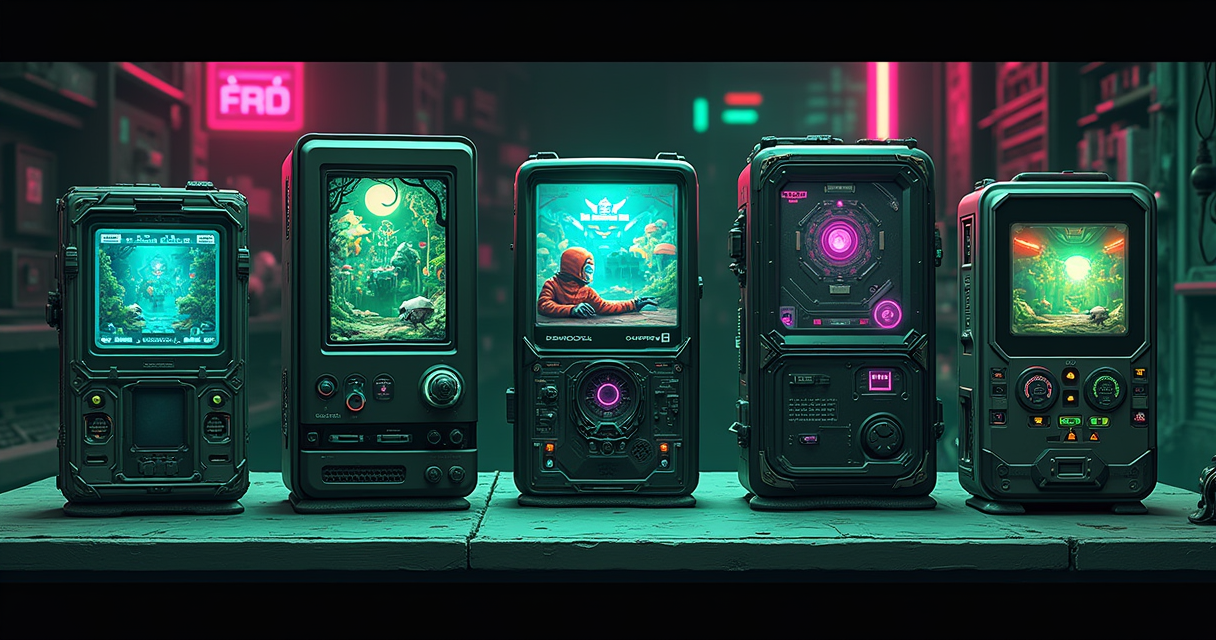
There is no single Retroid Pocket. There is a genus — a sprawling, self-cannibalizing family of Android handhelds from a Shenzhen outfit that ships a new model roughly every time you finish setting up the last one. In 2026 the family tree has six branches worth arguing about: the flagship Pocket 6, the workhorse Pocket 5, the 4:3 specialist Pocket Nova, the clamshell Pocket Flip 2, the pocket-square Pocket Mini V2, and the Pocket G2 — which is dead, and whose corpse turns out to be the most instructive object in the entire catalogue.
The most-asked question in every handheld forum is not are these any good — they are — but which one, and the honest answer requires holding six devices, three chip generations, and a decade of shifting prices in your head at once. That is what this comparison is for. So let us state the holding before the reasoning, the way a court does before it buries you in footnotes: the Pocket 6 at an effective $244 is the one to buy, and it is not especially close. Everything after this sentence is the reasoning — the Geekbench numbers, the battery figures, the price archaeology, the driver politics, and the two macroeconomic forces (a DRAM shortage and a Qualcomm hike) that quietly turned a cheap hobby into a rolling budgeting exercise across 2026.
First, the legal throat-clearing, because The Machine reads the citations you scroll past. Running Genesis, PlayStation, and GameCube software on hardware that Sega and Sony never sold you is not a crime; it is, per Sony Computer Entertainment, Inc. v. Connectix Corp., 203 F.3d 596 (9th Cir. 2000), modestly transformative and fair. The emulators are legal. The BIOS dumps and the ROMs are your problem. Retroid ships you a competent Android tablet wearing grips; what you pour into it is between you and your conscience, and nothing in this article changes that.
The 2026 Lineup: Six Pockets, One Crunch
Before you can compare Retroid Pockets you have to agree on which ones exist, which is harder than it sounds when the manufacturer treats its own product page like a whiteboard and revises it monthly. Here is the state of play in August 2026, stripped to essentials.
The six models that matter
Pocket 6 — the flagship: Snapdragon 8 Gen 2, a 5.5-inch 1080p AMOLED at 120Hz, active cooling, an effective $244. Pocket 5 — the value workhorse: Snapdragon 865, 5.5-inch 1080p OLED at 60Hz, now 12GB standard, $209. Pocket Nova — the 4:3 specialist with a 4.5-inch 1280x960 120Hz AMOLED and a flagship-class chip in an unusual package, $239. Pocket Flip 2 — the clamshell, from $179 to $219 depending on which silicon you pick. Pocket Mini V2 — the near-square 3.92-inch pocketable at a $179 floor. And Pocket G2 — discontinued on March 16, 2026, five months after launch, included here as a warning rather than a recommendation. Retroid's own store still fronts the survivors: the Pocket 6 from $244.00, the Pocket 5 historically from $199.00, and the Pocket Mini V2 from $179.00. That store page, not any review, is your source of truth on which colorways and memory tiers are in stock this week.
What a Retroid Pocket actually is
Strip the grips off and every device on this list is an Android tablet. That is the single most important sentence in this article, so read it twice. There is no Retroid operating system, no proprietary emulation layer, no FPGA doing cycle-accurate witchcraft. You get Android 13 (or Android 15 on the late G2), you sideload RetroArch and a pile of standalone emulators — Dolphin for GameCube and Wii, a standalone PlayStation 2 emulator for the heavy sixth-gen stuff, DuckStation-class cores for PS1 — and the hardware simply decides how high the ceiling goes. This matters because it means the emulator feature set (save states, netplay, rewind, shaders, run-ahead) is identical across the whole family. What differs is horsepower, screen shape, and how much of your wallet the 2026 component market extracts on the way out.
The thesis: same software, different compromises
So the comparison is not really RetroArch-versus-RetroArch; the software is a constant. It is a comparison of four decisions Retroid made six different ways. First, which SoC, ranging from a 2020 Snapdragon 865 to a 2023 Snapdragon 8 Gen 2. Second, which panel: 16:9, 4:3, or near-square; 60Hz or 120Hz; OLED or AMOLED. Third, which body: slab, clamshell, or mini. And fourth, which price tier the RAM and chip markets would allow at the moment it shipped. Get those four axes straight and the entire confusing lineup collapses into a decision tree with the Pocket 6 at the top of it. The rest of this piece walks the tree, branch by branch, with the numbers to justify each turn.
Specs Head-to-Head: The Full Table
Here is the whole family on one grid. The G2 column is retained as a headstone, not an option — it is discontinued, but its numbers explain the others by contrast. Rows cover silicon, panels, cooling, connectivity, the practical emulation ceiling, and the software features that every Android device shares.
The comparison table
| Feature | Pocket 6 | Pocket 5 | Pocket Nova | Mini V2 | Pocket G2 † |
|---|---|---|---|---|---|
| SoC (process) | Snapdragon 8 Gen 2 (4nm) | Snapdragon 865 (7nm) | QCS8550 IoT (4nm) | Snapdragon 865 (7nm) | Snapdragon G2 Gen 2 |
| GPU | Adreno 740 | Adreno 650 | Adreno 740 | Adreno 650 | Adreno A22 |
| RAM / storage (base) | 8GB / 128GB | 12GB / 128GB | 8GB / 128GB | 6GB / 128GB | 8GB / 128GB |
| Display | 5.5" 1920x1080 AMOLED | 5.5" 1080p OLED | 4.5" 1280x960 AMOLED | 3.92" 1240x1080 AMOLED | 5.5" 1080p AMOLED |
| Refresh | 120Hz | 60Hz | 120Hz | 60Hz | 60Hz |
| Aspect ratio | 16:9 | 16:9 | 4:3 | ~near-square | 16:9 |
| Battery / charging | 6000mAh / 27W | 5000mAh / no fast | 5000mAh / 27W | 4000mAh | 5000mAh |
| Cooling | Active fan | Passive | Active fan | Active fan | Passive |
| Android version | 13 | 13 | 13 | 13 | 15 |
| Wi-Fi / BT / video-out | Wi-Fi 7 / 5.3 / 4K60 DP | Wi-Fi 6 / 5.1 / yes | Wi-Fi / BT / yes | Wi-Fi 6 / 5.1 / yes | Wi-Fi 6 / 5.4 / 1080p |
| Weight | ~320g | ~280g | ~255g | ~215g | ~280g |
| Practical emulation ceiling | Wii / select Switch | PS2 / Wii (lighter) | PS2 (2D-focused) | PS2 (lighter) | PS2 / select Switch |
| RetroArch + save states | Yes | Yes | Yes | Yes | Yes |
| Netplay | Yes (RetroArch) | Yes (RetroArch) | Yes (RetroArch) | Yes (RetroArch) | Yes (RetroArch) |
| Shaders / upscaling | Yes, high headroom | Yes, moderate | Yes, high (2D) | Yes, moderate | Yes, moderate |
| Geekbench 6 single-core | ~1,985 | ~1,176 | ~1,900 (8 Gen 2 class) | ~1,176 | ~1,780 |
| Price (Aug 2026) | $244 | $209 | $239 | $179 | Discontinued |
How to read the silicon row
The SoC row is the only one that changes the answer, so spend your attention there. The Pocket 6 runs the Snapdragon 8 Gen 2 (Qualcomm part SM8550, 4nm), the same 2023 flagship phone chip whose Adreno 740 GPU has, at this point, years of driver work behind it from the Android phone ecosystem. The Pocket 5 and Mini V2 both run the Snapdragon 865, a competent 2020 part that tops out at heavy PS2 and cannot be argued past it. The Nova is the oddity: its QCS8550 is, in the words of Notebookcheck's reviewer, an IoT version of the Snapdragon 8 Gen 2 — the same Adreno 740 silicon, repackaged for industrial modules, which is precisely why the Nova punches at flagship weight from inside a 4.5-inch body. The dead G2 used the Snapdragon G2 Gen 2, a gaming-specific chip whose raw GPU sat only 8–10% behind the Adreno 740 but whose drivers, as we will see, were the whole problem. Two chips share the Adreno 740 here (Pocket 6, Nova); two share the aging Adreno 650 (Pocket 5, Mini V2). That split predicts almost everything else.
Displays, and the 4:3 outlier
Displays are the second-most-decisive row. Four of the six are 16:9 or near it; the Nova alone commits to 4:3, a 1280x960 panel that matches the native shape of nearly everything before the sixth console generation. If your library is SNES, Genesis, PS1, and 2D arcade, a 4:3 screen fills edge to edge where a widescreen slab pillarboxes with black bars on either side. Refresh rate splits the same way the silicon does: the Pocket 6 and Nova run 120Hz panels, which matters less for 30-and-60fps retro content than for Android UI smoothness and the handful of high-refresh native games. The Pocket 5, Mini V2, and G2 sit at 60Hz, which is entirely adequate for emulation and only feels dated next to their pricier siblings.
Save states, netplay, shaders, and accuracy
Note how boring the bottom of the table is, and why that is good news. Save states: yes, everywhere. Netplay: yes, everywhere, because it is a RetroArch feature riding on whatever Wi-Fi radio the device carries (the Pocket 6's Wi-Fi 7 trims latency; nothing else in the group does it better). Shaders: yes, everywhere — CRT masks, scanline presets, and NTSC composite filters are GLSL and Slang files that run on any of these GPUs. What scales with silicon is not whether a shader runs but how many you can stack over a 3x internal-resolution upscale before the frame-time graph turns into a heartbeat monitor. One caveat the table cannot show: none of these devices is cycle-accurate. Android emulation trades a frame or two of latency and the occasional edge-case glitch for speed and compatibility. If bit-perfect accuracy and lowest-possible lag are your religion, that is the FPGA world's promise, not Qualcomm's — a distinction we return to when we reach the rivals.
Why Everything Got Pricier: RAM and Qualcomm
You cannot compare 2026 Retroid prices without understanding why every number in the pricing table wears an asterisk. Two separate supply shocks hit the lineup four months apart, and both are documented in the manufacturer's own statements rather than analyst speculation.
The DRAM spike
The first shock was memory. Through late 2025 and into 2026, LPDDR5X pricing climbed as fabs redirected capacity toward the high-bandwidth memory that AI-server GPUs consume by the truckload. Retroid felt it first on the Pocket 6. On March 2, 2026, the base 8GB/128GB model went up $15 to $244, and the 12GB/256GB tier was quietly killed. Retroid's Andy Walker put it plainly via Android Authority: The recent surge in memory pricing has reached a level that we are unfortunately unable to absorb. Steam Deck HQ's Shawn Wilkins framed it as an industry condition rather than a Retroid failing: The increasingly difficult RAM shortage continues to impact hardware companies across the industry. He was right. This was pass-through, not gouging, and every handheld maker was living the same spreadsheet.
The Qualcomm hike
The second shock was silicon, and the Nova was the first handheld anywhere to name it out loud. Qualcomm signaled chipset price increases taking effect September 1, 2026, and Retroid moved ahead of the date: on August 6, 2026, the Pocket Nova's base 8GB/128GB configuration rose $10 to $239, with the 12GB tier climbing to $279 and translucent variants carrying a further small premium. Retroid attributed the change to rising Qualcomm chipset and raw material costs. VideoCardz called the Nova one of the first handhelds hit by new Qualcomm chipset costs, and it will not be the last: this is the leading edge of a broad 2026 handheld price wave, not a one-off blip. When the manufacturer raises a device's price a few weeks before its supplier's own increase even takes effect, that tells you how thin the margins in this category already are.
The body count: the G2 and the vanishing 12GB tier
Supply shocks leave casualties, and this one left two clear ones. The first was the Pocket G2, discontinued on March 16, 2026, barely five months after preorders opened. GamesRadar's headline captured the mood: Weeks after the Steam Deck disappeared, Retroid discontinues Pocket G2 due to ongoing fluctuations in memory pricing. Retroid told buyers it would return when market conditions allow and pointed them at the Pocket 5 instead. As Retro Handhelds' Andrew observed, the G2's deeper trouble was that it never really seemed to fit anywhere in Retroid's lineup, wedged between the Pocket 5 and Pocket 6 with almost no daylight on either side. The second casualty was the Pocket 6's 12GB tier, which vanished in March and returned in June 2026 — but as a 12GB/128GB unit, storage halved from the original 12GB/256GB, at the same $279. If you want the full autopsy on the dead G2, we ran it in our Pocket 6 versus a $219 corpse breakdown; the short version is that the G2 died of being priced into a gap that did not exist.
Performance: Benchmarks and Emulation Ceilings
Marketing sells you teraflops; The Machine sells you frame rates on the games you will actually run, plus how long the battery lasts while you run them. Here are the numbers, sourced from published reviews and community testing rather than a Retroid slide.
Geekbench and raw throughput
Start with synthetic. The Pocket 6 posts a Geekbench 6 single-core score of roughly 1,985. The Pocket 5 and Mini V2, both Snapdragon 865, land near 1,176. That is a ~69% single-core uplift, not the tidy 50% you sometimes see quoted — the gap is bigger than the round number suggests, and the GPU delta is close to 2x. The discontinued G2 sat at roughly 1,780: about 50% up on the 865 but 10% shy of the true 8 Gen 2, with a GPU that trailed the Adreno 740 by that same 8–10%. Those numbers matter because they set expectations you can feel in your hands: the Pocket 6 is the only device here that clears the bar for demanding sixth- and seventh-generation systems with headroom to spare. For the head-to-head against its own predecessor, we broke out every emulator core in our Pocket 6 versus Pocket 5 silicon comparison, and the gap is wider than a single Geekbench figure lets on.
Emulation ceilings, system by system
Translating benchmarks into ceilings, on the Pocket 6: GameCube runs at 3x native resolution — enough for the traditional torture test, F-Zero GX, and for Rogue Squadron, both long treated as the hardest things Nintendo's little cube ever asked of an emulator. Wii is practical on the heavy hitters (Galaxy, Xenoblade, Donkey Kong Country Returns). PlayStation 2 lands at 1.5x–2x, with God of War II around 2.5x and Gran Turismo 4 playable. Dreamcast, PSP, and PS1 all upscale cleanly to 4x. Nintendo Switch runs select titles and is entirely driver-dependent. RPCS3 (PS3) and Xbox 360 are slideshows on every device in this article — do not let anyone sell you otherwise. The Nova, despite its smaller body, matches the Pocket 6's GPU class: RetroDodo's reviewer scaled some PS2 games by 3 or 4x with filters, and frame rates wouldn't drop at all, running Midnight Club 3 at 3x on that 4:3 panel. The 865 devices (Pocket 5, Mini V2) top out at heavy PS2 with far less headroom, and the dead G2, per Steam Deck HQ's Noah Kupetsky, did PSP at 4x and PS2 at 2.5x but rendered PS3 not enjoyable.
Battery, heat, and the Turnip driver catch-22
Endurance splits along the same lines as everything else. The Pocket 6's 6000mAh cell delivers roughly 4.5 hours of mixed emulation, 8–10 hours on light SNES and Game Boy Advance, and only 2.5–3 hours when you pin it at full performance for PS2 and GameCube — the price of that Adreno 740 running hot behind an active fan. The Mini V2's smaller 4000mAh battery manages 4–6 hours; the Pocket 5 and Nova sit at 5000mAh. But raw silicon is not the whole story, and here is the wrinkle that benchmarks hide: the Adreno 740's Switch and heavy-Vulkan performance depends on Turnip, the open-source Adreno driver, to fix glitches Qualcomm's stock drivers introduce. Turnip is mature on the 8 Gen 2 because that chip has shipped in millions of phones for years; on the G2's newer Adreno A22 it was immature, so enabling it tanked performance — a catch-22 that gutted the G2's practical ceiling despite competitive raw numbers. HandheldRank was blunt: on Switch, the RP6 wins here, and it's not close. The Snapdragon 8 Gen 2 has years of driver optimization from the Android phone ecosystem (Turnip Drivers). The same immaturity broke ordinary apps on the G2: some major Android apps straight-up don't work. Netflix games? Nope. Certain big Android games? Nope. Fortnite? Nope. As they summarized the wager, the RP6 has proven silicon. The G2 Gen 2 is the gamble.
Pricing and Availability in August 2026
Prices in this category are not stable enough to memorize, so here is the full ledger with launch prices, the October 2025 cuts, and the 2026 hikes, every figure traceable to reporting rather than rumor.
The pricing table
| Model (config) | Launch | Launch price | Aug 2026 price | Status |
|---|---|---|---|---|
| Pocket 6 (8/128) | Oct 27, 2025 | $209 preorder / $229 retail | $244 | In stock (+$15 Mar 2) |
| Pocket 6 (12/128) | Oct 2025 (was 12/256) | $259 preorder | $279 | In stock (storage halved) |
| Pocket 5 (12/128) | Sept 2024 | $219 → $199 | $209 | In stock (12GB +$10 Jul 14) |
| Pocket Flip 2 (SD865) | Apr 2025 | $229 → $209 | $219 | In stock (12GB +$10 Jul 14) |
| Pocket Flip 2 (Dimensity) | Apr 2025 | $199 → $179 | ~$179 | In stock (budget tier) |
| Pocket Nova (8/128) | Jun 26, 2026 preorder | $229 | $239 | In stock (+$10 Aug 6) |
| Pocket Nova (12/128) | Jun 26, 2026 | $269 | $279 | In stock (translucent ~$274) |
| Pocket Mini V2 | May 2025 | $199 → $179 | $179 | In stock |
| Pocket G2 (8/128) | Oct 28, 2025 preorder | $199 → $219 | — | Discontinued Mar 16 |
October 2025's cuts, 2026's hikes
The whiplash is the story. In October 2025, Retroid ran a permanent price cut across the older line: the Snapdragon Pocket Flip 2 dropped from $229 to $209, the Pocket 5 from $219 to $199, and the Pocket Mini V2 from $199 to $179. That was the cheap era, and it lasted about five months. By March 2026 the Pocket 6 was climbing on RAM; by July the Pocket 5 and Flip 2 clawed their $10 back — but this time with a 12GB standard configuration, so buyers got more memory for the money, per Engadget's reporting, and Retroid even upgraded unshipped 8GB orders to 12GB free of charge during the transition. By August the Nova took its Qualcomm surcharge. The net across ten months: cuts, then hikes, landing roughly where they started but with better RAM and a thinner catalogue.
What is actually in stock
Availability, plainly: the Pocket 6, Pocket 5, Pocket Nova, Pocket Flip 2, and Pocket Mini V2 are all buyable from Retroid's store as of this writing. The Pocket G2 is not, and may never be again at its old price; Retroid's own guidance is to buy the Pocket 5 in its place. The Nova only began shipping in late July 2026, so real-world stock, lead times, and firmware maturity are still settling into place. Treat Retroid's store page as the live source of truth on configuration and color, because it changes more often than any review can keep up with — the translucent Nova variants, for instance, appear and vanish with individual production batches, and the 12GB Pocket 6 has already come and gone once.
Which Pocket Fits Which Player
A comparison that ends in a single recommendation is lazy, because you are not the average buyer. Here are the concrete scenarios and the model each one points to — six of them, because the lineup genuinely spreads that wide.
The PS2/GameCube maximalist
You want F-Zero GX at 3x, God of War II holding its frames, and the option to poke at select Switch titles when the drivers cooperate. This is the Pocket 6, full stop. It is the only device here whose GPU and driver maturity clear the sixth-generation bar with room to spare, and it is — per Retro Game Corps' Russ — even at $245 the most affordable Snapdragon 8 Gen 2 handheld on the market. The 12GB RAM model provides more headroom for PC gaming, and it's a bummer that it's discontinued. If your library lives at PS2, GameCube, and Wii, nothing cheaper in the Retroid family will satisfy you for long, and you will resent having saved $35 to $60 within a fortnight.
The 4:3 purist and the pocket minimalist
Two distinct players share a section because both want a shape, not just power. The Pocket Nova is for the 4:3 purist: someone whose heart lives in the SNES, PS1, and 2D-PS2 era, who wants those libraries filling a square panel instead of pillarboxed into a widescreen slab. RetroDodo called its screen the most beautiful 4:3 display I have seen on a handheld and the device the last 4:3 handheld emulator you will need to buy — and with the Adreno 740 inside, it upscales 2D and light 3D without breaking a sweat. The Pocket Mini V2, by contrast, is for the minimalist who prizes 215 grams and a near-square 3.92-inch AMOLED that disappears into a jacket pocket; it tops out at lighter PS2 but nails everything up to Dreamcast in a form factor none of the others can match.
The commuter, the tinkerer, and the gift-buyer
The Pocket Flip 2 is the commuter's pick: the clamshell hinge protects the screen inside a bag and folds shut like a DS, and you can choose the Snapdragon 865 tier or a cheaper Dimensity 1100 edition depending on budget. The Pocket 5 is the tinkerer's default — now 12GB standard, a proven 865, a genuine OLED, and video-out for TV sessions, all at $209; HandheldRank's Phil Retro framed its only real weakness precisely: the problem isn't the device; it's the neighborhood it lives in, meaning it is a genuinely good handheld standing next to a great one. And the gift-buyer who wants to hand someone a working retro machine for the least money should look at the $179 Mini V2 or, if the recipient is a true beginner who will never leave the 16-bit era, the budget rivals we cover below. That is six players, six answers, and only one of them is the flagship.
Pros and Cons, Model by Model
Every device on this list is a bundle of trade-offs. Here they are, unsentimentally, with no thumb on the scale.
The pros-and-cons table
| Model | Pros | Cons |
|---|---|---|
| Pocket 6 | Fastest silicon (GB6 ~1,985), 120Hz 1080p AMOLED, mature Turnip drivers, Wi-Fi 7, best PS2/GC/Switch ceiling | Design called "dull," 12GB tier storage halved to 128GB, Android 13 not 15, ~2.5–3h at full tilt |
| Pocket 5 | Cheapest in-house 1080p OLED, now 12GB standard, proven SD865, video-out | 60Hz only, 2020-era chip, no fast charge, lives in the Pocket 6's shadow |
| Pocket Nova | Best 4:3 1280x960 120Hz AMOLED, Adreno 740, active fan, PS2 3–4x with filters | 4:3 is a niche, IoT-grade QCS8550, Android 13, already price-hiked, 4.5" is small |
| Pocket Flip 2 | Clamshell protects the screen, two chip tiers, travel-friendly | Hinge adds bulk, SD865 ceiling, costs more than the slab it clones |
| Pocket Mini V2 | Tiny (215g), near-square 1240x1080 AMOLED, $179 floor, active cooling | 6GB RAM, 4000mAh (4–6h), SD865 ceiling, 3.92" cramped for PS2 |
| Pocket G2 † | Was cheap, hall sticks, newest Android (15) | Discontinued, immature drivers, Fortnite/Netflix apps broke, "never fit anywhere" |
Reading the flagship and the workhorse
The Pocket 6's cons are real but soft. RetroDodo's Brandon Saltalamacchia scored it 8.4/10 and still complained that Retroid have played it too safe to turn heads and that a $250 device should have something unique, or look/does something different. He is right that it is boring. He also wrote that a 5.5" AMOLED display makes the device feel incredibly modern, that the panel is a beautiful display, one I simply cannot fault, and — the line that reframes the whole category — that this is not a retro handheld; this is a high-end Android games console. Boring and excellent are not mutually exclusive. The Pocket 5's cons are structural rather than fixable: it is a fine machine whose every spec is bettered by a device costing $35 more, which is a hard place for any product to live and sell.
The specialist, the clamshell, and the corpse
The Nova's cons all flow downstream from a single decision: 4:3. If that shape is your religion, the cons evaporate and you are holding a device RetroDodo rated 9.7/10; if it is not, the small 4.5-inch panel and the niche aspect ratio are dealbreakers no amount of Adreno 740 can undo. The Flip 2 pays a bulk-and-cost tax for its hinge that only frequent travelers will judge worthwhile. And the G2 is the cautionary tale that gives the whole lineup its moral: as Retro Handhelds' Ban concluded, if it were my money, would I buy the G2? No — a verdict the market ratified by discontinuing it three weeks after that review went up. Kupetsky's kinder framing at Steam Deck HQ, that the G2 was let down only by the next handheld coming so soon, amounts to the same thing.
Migrating From an Old Handheld
Most buyers are not coming from nothing; they are upgrading from a Miyoo, an Anbernic, or an older Retroid. Moving your library is mostly mechanical, but the operating-system jump has one conceptual trap worth naming before you start copying files.
From a Linux handheld to Android
If you are coming from a Miyoo Mini or an Anbernic running a Linux distribution like muOS or Knulli, understand that a Retroid Pocket is a different animal. Your old device booted straight into a frontend; the Retroid boots into Android, and you choose a frontend on top of it — RetroArch, or a launcher that shells out to standalone emulators for the heavy systems. This is more setup and more power in equal measure. It also means your muscle memory for save formats mostly carries over, because RetroArch uses the same core names and the same .srm and .state conventions on both platforms. What does not carry over is your per-device configuration; you will rebuild those from scratch, and you should, because a Linux handheld's control map and video settings will not suit a 1080p Android slab. Budget an evening and do it once, properly.
Moving ROMs, saves, and configs
The mechanical steps, in order:
- On the Retroid, install RetroArch and update your cores first — do not copy anything until the cores exist. Our RetroArch core install walkthrough covers this end to end.
- Pull the microSD from your old handheld, or connect it, and copy your ROM folders into the Retroid's Roms/ directory, keeping the per-system subfolders intact.
- Copy your saves. RetroArch battery saves (.srm) and save states (.state) live under the saves folder; drop them where the new RetroArch expects them and the matching cores will find them automatically.
- Re-add your BIOS files to the BIOS/ folder. RetroArch will not warn you they are missing until a core silently fails to boot a game.
- Scan your ROM directory to build playlists, then set per-core video and input options fresh — do not import a Linux device's config blob and expect it to behave.
# Typical Retroid (Android) layout after installing RetroArch
/sdcard/
  Roms/
    snes/        # .sfc .smc
    psx/         # .chd  (convert .bin/.cue first)
    ps2/         # .chd .iso
    gamecube/    # .rvz  (shrinks a 1.4 GB ISO to ~1 GB)
    saves/       # .srm battery saves + .state save states
  RetroArch/
    config/      # per-core + per-game overrides live here
    shaders/     # .glslp / .slangp presets
  BIOS/          # scph5501.bin, gc/ipl.bin -- YOUR problem, not ours

# Bulk-move from a PC over USB-C (adb, developer mode on):
adb push ./snes/. /sdcard/Roms/snes/
adb push ./saves/. /sdcard/Roms/saves/
# Or drag folders over MTP. It is slower and it will lie about the ETA.
Rebuilding save states, netplay, and shaders
Once the files are in place, the features light up the same way on any Retroid because they are RetroArch features, not hardware ones. Save states bind to hotkeys under Settings then Input; set a save-state combo, a load-state combo, and a slot-increment key, and never lose progress in a game that never had a save system. Netplay lives in the main menu — host or join by IP or through the relay server, and the Pocket 6's Wi-Fi 7 radio shaves latency, though every model in the family can play. Shaders load from Settings then Shaders; the CRT-Royale and NTSC presets are the ones worth the GPU budget, and the Pocket 6 and Nova have the most headroom to stack them over a 3x upscale. If a shader tanks your frame rate, drop to a lighter scanline preset before you blame the silicon — the fault is almost always the shader, not the chip.
The Competition: Odin 2, Steam Deck, Miyoo
Retroid does not sell in a vacuum, and pretending otherwise would be dishonest. Three rivals bracket the lineup on price and philosophy, and each one wins a specific argument the Retroids lose.
AYN Odin 2 Portal ($249)
The Odin 2 Portal is the Pocket 6's closest natural enemy. Its base model runs $249 — five dollars over the Pocket 6 — and packs the same Snapdragon 8 Gen 2 and Adreno 740, but wraps them around a larger 7-inch 1080p 120Hz OLED and a colossal 8000mAh battery, with Pro and Max tiers at $369 and $449 for more storage and RAM. If you value screen real estate and endurance over pocketability, the Portal is the better big-screen buy, and its silicon ceiling is identical to the Pocket 6's — same chip, same drivers, same Turnip story. The Retroid's counterargument is size and weight: 320 grams and 5.5 inches versus a 7-inch tablet you will not slip into a jacket pocket. Pick your body; the guts are twins.
Steam Deck OLED ($789)
The Steam Deck OLED plays an entirely different sport. It is x86, it runs a real desktop-class Linux, and after its May 27, 2026 price change the 512GB model sits at $789 — more than three Pocket 5s stacked together. For native PC gaming and the highest emulation ceiling money can buy in a handheld, it wins outright; for the retro-first buyer who only wants PS2 and GameCube in a 300-gram Android package, it is wild overkill at nearly triple the price. The Deck is what you buy when emulation is a happy side effect of wanting a portable PC. The Retroids are what you buy when emulation is the entire point and you would rather not pay for a Windows-class machine to get it.
The $54 Miyoo and the FPGA purists
At the opposite pole sits the Miyoo Mini Plus at around $54 — a device that will never touch PS2 but will run everything up to its PS1 ceiling beautifully for the price of one AAA game. If your library stops at the fifth generation, our Miyoo Mini Plus deep dive makes the case that you can skip the Retroid tax entirely and never look back. And for the accuracy zealots who consider any Android emulator a compromise on principle, the FPGA world is a separate religion with its own scripture: the ongoing MiSTer FPGA scene chases the cycle-accuracy and sub-frame latency the Snapdragons cannot promise, at a price and a complexity the Retroids do not demand of you. Different tools, different vows, different buyers — and only you know which congregation you belong to.
The Verdict: What to Buy in 2026
Ten months of price whiplash, two documented supply shocks, and one discontinued corpse later, the recommendation is the same one from the top of this page — now with the full weight of the reasoning behind it.
The data-backed pick
Buy the Pocket 6 at $244. It posts the only flagship-class Geekbench score in the family (~1,985), it is the only device whose driver maturity clears the Switch and Wii bar in actual practice rather than on paper, and it is — even after the March hike — the cheapest Snapdragon 8 Gen 2 handheld you can buy, a fact Retro Game Corps confirmed and the Odin 2 Portal only ties by five dollars. RetroDodo's 8.4/10 and its own reviewer calling the thing dull are not contradictions; a boring appliance that does its job better than anything near its price is exactly what most buyers should want, and exactly what most buyers talk themselves out of. The one caveat worth stating twice: if you crave the 12GB tier, know that it now ships with 128GB of storage rather than the original 256GB, at $279.
The value and specialist picks
If $244 is a genuine stretch, the Pocket 5 at $209 — now 12GB standard, real OLED, video-out — is the value pick, held back only by living next door to a better sibling. If you worship the 4:3 aspect ratio, the Pocket Nova at $239 is a genuine 9.7/10 specialist with a flagship GPU crammed behind the prettiest square panel in the category; just understand you are buying a shape and an IoT-grade chip, and a price that already went up once and may again. Neither is a mistake. Both are simply second choices to the Pocket 6 for the general buyer who has not already picked a side.
Who should wait or buy used
Two groups should hold their wallets. If your library ends at PS1, skip the entire lineup and spend $54 on a Miyoo Mini Plus — the Retroid tax buys you nothing you will use. And if you are cost-sensitive and patient, understand that 2026 is a bad year to buy at the top: the Qualcomm hike that hit the Nova on August 6 is the leading edge of a broader wave, and prices on the newest silicon are more likely to rise than fall through the back half of the year. The dead G2 is the whole lesson compressed into one product: in a supply-shocked market, the safe, proven, faintly boring choice is the one still standing when the exciting one sells out and never comes back. Buy the Pocket 6. Ignore the corpse's newer Android version. Proven silicon wins the crunch, every time.
Questions the search bar asks me
- Which Retroid Pocket should I buy in 2026?
- The Pocket 6 at an effective $244. It posts the family's only flagship-class Geekbench 6 single-core score (~1,985), has the mature Snapdragon 8 Gen 2 drivers needed for Switch and Wii, and is the cheapest 8 Gen 2 handheld on the market per Retro Game Corps. If you specifically want a 4:3 screen, the Pocket Nova at $239 is the specialist pick instead.
- Why did the Retroid Pocket 6 go up to $244?
- Retroid raised the base 8GB/128GB model $15 on March 2, 2026, citing the DRAM shortage. Andy Walker of Retroid said the memory-price surge had reached a level the company was 'unable to absorb.' The same event killed the 12GB/256GB tier, which returned in June 2026 as a 12GB/128GB unit (storage halved) at $279.
- Is the Retroid Pocket G2 still available?
- No. It was discontinued on March 16, 2026 due to 'ongoing fluctuations in memory pricing,' as GamesRadar reported, and Retroid now steers buyers to the Pocket 5. Beyond price, its Snapdragon G2 Gen 2 chip had immature drivers that broke apps like Fortnite and Netflix games and hurt heavy emulation, so it is no real loss.
- Can Retroid Pockets emulate PS2 and Switch?
- PS2, yes: the Pocket 6 runs it at 1.5x-2x native, with God of War II around 2.5x and Gran Turismo 4 playable. Switch is select-titles-only and driver-dependent, working best on the Pocket 6 via Turnip drivers. RPCS3 (PS3) and Xbox 360 are slideshows on every model in the lineup, including the flagship.
- What is the difference between the Pocket Nova and Pocket 6?
- The Nova is a 4:3 handheld: a 4.5-inch 1280x960 120Hz AMOLED driven by an IoT-grade QCS8550 (a repackaged 8 Gen 2). The Pocket 6 is 16:9: a 5.5-inch 1080p 120Hz AMOLED with the full Snapdragon 8 Gen 2. Nova is $239 and suits 2D and light-3D purists; the Pocket 6 is $244 with a higher overall ceiling.

Ben covers the hardware end of retro gaming: FPGA cores, real-cartridge dumping, capture setups, CRT vs scaler workflows, and the legal and physical preservation infrastructure that keeps old games playable. Every post under this byline is reviewed pre-publish by Sam P., Editor & Operator — corrections to info@instalinkoteam.com. Published 2026-08-29 · Last updated 2026-08-29. Full bios on the author page.