/// FIELD NOTES FROM A SELF-AWARE GAME SITE
Retroid Pocket 2026: RP6 at $244 vs the $229 Nova
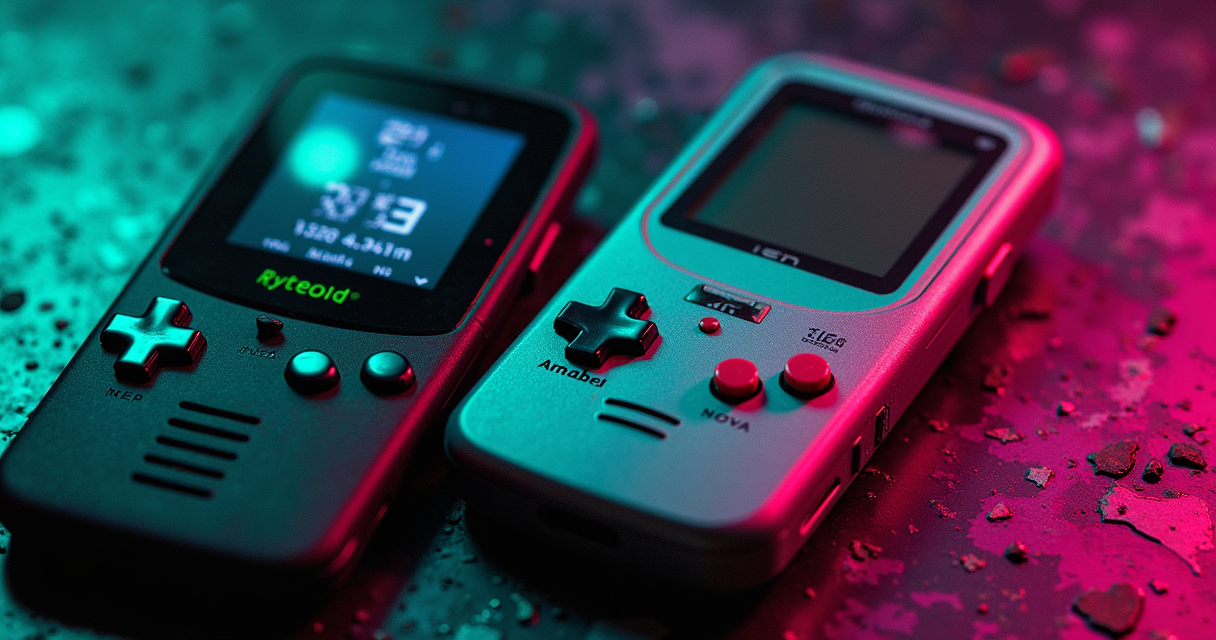
Retroid spent the back half of 2025 and the first half of 2026 doing the one thing most of this industry avoids: shipping hardware on a schedule you could set a watch by. On October 27, 2025 the company pulled the sheet off two devices at once — the Retroid Pocket 6 and the Retroid Pocket G2 — and by July 2026 it had added a third headliner, the Retroid Pocket Nova, plus a shrunken Pocket Mini V2 and a Pocket 5 that has quietly slid into the clearance bin. Five devices. One store page. Five completely different arguments about what a pocket emulator is supposed to do.
This is a comparison, not a press release, so here is the thesis up front: in mid-2026 the Pocket 6 is still the default answer, the Nova is the interesting answer, the G2 is the answer that already expired, and the two stragglers are for people who know exactly why they want them. The complicating factor — the thing that turned a tidy product ladder into a pricing mess — is a global memory shortage that rewrote every number on this page. We will get to the $244.
The 2026 Retroid Lineup, Decoded
Five devices, one confusing family tree
The Retroid Pocket family is not a clean ladder where each rung costs more and does more. It is a set of overlapping bets. The Pocket 6 is the flagship: Qualcomm's Snapdragon 8 Gen 2, a 5.5-inch 1080p AMOLED at 120Hz, a 6,000mAh battery, Hall-effect sticks and triggers, and an active fan. The Pocket G2 launched the same day at a lower price on a stranger chip, inside what is essentially the old Pocket 5 shell. The Pocket Nova, revealed in June 2026, throws out the widescreen panel entirely for a 4.5-inch 4:3 AMOLED and calls that the entire point. The Pocket Mini V2 shrinks a 2020 flagship into something smaller than your phone. The Pocket 5 is last year's hero, now on sale.
If you only remember one sentence from this article, make it this one: four of these five devices run Qualcomm silicon that is between one and six years old, and the emulation ceiling is set almost entirely by that chip. Everything else — screen shape, battery size, Hall sensors, the color of the translucent shell — is texture. Important texture. But texture.
What "Retroid Pocket" means in 2026
These are Android handhelds. Not FPGA boxes, not custom Linux firmware appliances — Android devices running standalone emulators (Dolphin for GameCube and Wii, AetherSX2 or its NetherSX2 fork for PS2, DuckStation for PS1, PPSSPP for PSP) alongside RetroArch for everything 2D. That has two consequences worth stating flatly. First, you get save states, run-ahead, shaders, and netplay because the emulators provide them, not because Retroid built anything special. Second, none of this is cycle-accurate the way a MiSTer core is; it is fast, convenient approximation. If you want hardware-exact 8- and 16-bit behavior, that is a different class of machine at a different price, and no amount of Snapdragon horsepower changes the distinction.
The upside of Android is obvious the moment you hold one: Wi-Fi, a Play Store, streaming apps, controller mapping, and a device that boots into a launcher instead of a config file. Retroid's whole pitch is "the emulation is handled, now go play." For most people that pitch is correct.
The DRAM crunch is the plot, not the footnote
Here is the thing every other roundup buries at the bottom. The single most important event in the 2026 Retroid lineup is not a product — it is a memory shortage. LPDDR5X contract prices spiked as suppliers redirected wafers toward high-bandwidth memory for AI servers, and Retroid, a small company buying in small volumes, could not absorb it. On March 2, 2026 the Pocket 6's price went up and its best configuration went away. Two weeks later the G2 sold out and stayed out. As Time Extension put it when the line launched, "the future of Retroid is here" — nobody mentioned the future would cost fifteen dollars more by spring.
Spec-for-Spec Comparison Table
Reading the table
Below is the full spread across all five devices. A few cells read "—" because Retroid has not published the figure or, in the Nova's case, because no independent unit had shipped when this went to press; I would rather leave a blank than invent a number. Note the four rows at the bottom — accuracy, save states, netplay, shaders — are effectively identical across the line, because they are features of the emulators, not the hardware.
| Spec | Pocket 6 | Pocket G2 | Pocket Nova | Mini V2 | Pocket 5 |
|---|---|---|---|---|---|
| Announced | Oct 27 2025 | Oct 27 2025 | Jun 2026 | 2026 | Sept 2024 |
| SoC | Snapdragon 8 Gen 2 | Snapdragon G2 Gen 2 | Qualcomm QCS8550 (8 Gen 2 IoT) | Snapdragon 865 | Snapdragon 865 |
| GPU | Adreno 740 | Adreno (G2 Gen 2) | Adreno 740 @ 680MHz | Adreno 650 | Adreno 650 |
| RAM | 8 / 12GB LPDDR5X | 8GB LPDDR5X | 8 / 12GB LPDDR5X | 6GB | 8GB LPDDR4X |
| Storage | 128 / 256GB UFS 3.1 | 128GB UFS 3.1 | 128GB UFS 3.1 | — | 128GB |
| Display | 5.5" 1920×1080 120Hz AMOLED (16:9) | 5.5" 1080p 60Hz AMOLED (16:9) | 4.5" 1280×960 120Hz AMOLED (4:3) | 3.92" AMOLED | 6.0" 1080p 60Hz AMOLED (16:9) |
| Battery | 6,000mAh | 5,000mAh | 5,000mAh | 4,000mAh | — |
| Charging | 27W | — | 27W | — | — |
| OS (at launch) | Android 13 | Android 15 | Android 13 | Android | Android |
| Sticks / triggers | Hall-effect + Hall triggers | 3D Hall-effect + analog triggers | — | — | — |
| Connectivity | Wi-Fi 7, BT 5.3 | Wi-Fi 6, BT 5.4 | Wi-Fi 7, BT 5 | Wi-Fi 6 | — |
| Video out | 4K DisplayPort (USB-C) | — | — | — | via dock |
| Cooling | Active fan | Cooling listed | Active fan | Passive | Passive |
| Weight | — | 280g | 255g | — | 280g |
| Launch price | $209 / $259 (pre-order) | $199 (2-wk) → $219 | $229 / $269 | — | $199 |
| Price (Jul 2026) | $244 (8GB; 12GB axed) | ~$219, sold out | $229–$274 | On sale | Sale-only |
| Emulation ceiling | GameCube / PS2 / Wii, lighter Switch | PS2 / PSP, light Switch | GameCube / PS2 / PSP, lighter Switch | PS2 / PSP | PS2 / PSP |
| Accuracy model | Emulator-level (not FPGA) | Emulator-level | Emulator-level | Emulator-level | Emulator-level |
| Save states | Yes (per emulator) | Yes | Yes | Yes | Yes |
| Netplay | RetroArch / emulator | RetroArch / emulator | RetroArch / emulator | RetroArch | RetroArch |
| Shaders | RetroArch, GPU-bound | RetroArch (60Hz cap) | RetroArch, GPU-bound | RetroArch (limited) | RetroArch |
Where the headliners diverge
Read across the top three columns and the shape of the decision appears. The Pocket 6 wins battery (6,000mAh vs 5,000), resolution (1080p vs 960p), refresh at its native res, and screen size (5.5" vs 4.5"). The Nova wins aspect ratio (4:3, the only one in the family) and, at $229, undercuts the Pocket 6's current $244. The G2 wins nothing outright anymore, which is exactly the problem we document in the pricing section. One genuinely strange detail: the cheapest headliner, the G2, shipped on Android 15, while the flagship Pocket 6 and the new Nova both shipped on Android 13. Newer is not always more expensive in Retroid's world — and note the G2's panel is only 60Hz to the Pocket 6's 120Hz, so the newer OS came bundled with the older screen.
The two you can mostly ignore
The Pocket Mini V2 (Snapdragon 865, 6GB RAM, 3.92-inch AMOLED, 4,000mAh, Wi-Fi 6) and the Pocket 5 (Snapdragon 865, 6-inch 1080p 60Hz AMOLED) both run the 2020-vintage 865. That chip is still a capable PS2/PSP machine and a flawless everything-below-that machine, but it is not in the GameCube-at-3x conversation. They exist for size (the Mini) and price (the discounted 5). If you're weighing the 5 against the 6, we did the full teardown in our Pocket 5 vs 6 breakdown — the short version is roughly 70% more CPU for about $45 more, and in mid-2026 that is not a close call.
The Silicon: Three Snapdragons
Snapdragon 8 Gen 2: a 2022 flagship in a 2026 shell
The Pocket 6's Snapdragon 8 Gen 2 (Qualcomm's SM8550, Adreno 740 GPU) is the chip that powered the Galaxy S23 generation. In phone terms it is old. In handheld emulation terms it is close to the ceiling of what Android can do, because the bottleneck for Dolphin and AetherSX2 has always been single-thread throughput and driver maturity, not raw core count. A 2022 flagship with years of Adreno driver optimization behind it beats a 2024 mid-ranger every time. This is why reviewers keep describing the Pocket 6 as punching well above a $244 device: you are getting last-cycle flagship silicon at a price flagships never sold for.
The G2 Gen 2: Qualcomm's weird handheld chip
The Pocket G2 runs the Snapdragon G2 Gen 2, part of Qualcomm's dedicated gaming-handheld "G-series." It is genuinely a strong performer — Ban at Retro Handhelds measured its single core at roughly 50% faster than the Snapdragon 865 but about 10% behind the 8 Gen 2, with a GPU landing 8–10% shy of the Adreno 740. The problem is the drivers. Its newer GPU lacks the 8 Gen 2's years of optimization, so some Switch titles glitch on the stock drivers, and the third-party Turnip Vulkan workaround is an imperfect trade rather than a clean fix. Ban's verdict on the chip was blunt: "The G2 is a major improvement, but still falls just behind an 8 Gen 2 despite being too close for comfort pricing."
The Nova's QCS8550: same GPU, industrial badge
The Nova's chip is the Qualcomm QCS8550, which Notebookcheck's Habeeb Onawole accurately described as "an IoT version of the Snapdragon 8 Gen 2." Same Adreno 740 GPU, here clocked at 680MHz, same silicon family — just sold under Qualcomm's embedded part number, which manufacturers can buy on different volumes and lifecycles. Functionally, expect Pocket-6-class emulation from the Nova, gated only by its smaller 5,000mAh battery and the thermal headroom of a smaller chassis (Retroid put an active fan in it for exactly that reason). If cycle-exact accuracy is your religion rather than speed, none of these three chips change the calculus — Android emulation is approximation, and that conversation lives on FPGA hardware, not here.
Benchmarks: What Each Chip Runs
GameCube and Wii (Dolphin)
The Pocket 6's headline act is GameCube. Across reviews the 8 Gen 2 runs Dolphin comfortably at 2–3x native resolution on typical titles — and in head-to-head testing against the pricier Odin 2 Portal, GameCube and Wii output was described as effectively identical at 2x native. That tells you the chip, not the price tag, is what matters: the same Adreno 740 shows up in the far more expensive competition. Anything in the GameCube and Wii libraries is, in practice, a solved problem on this hardware, and the Nova's identical GPU inherits the same ceiling.
PS2, PSP, and the PS3 wall
For PS2 the Pocket 6 upscales most titles cleanly through AetherSX2 or the NetherSX2 fork, though RetroDodo's Brandon put a realist's caveat on it: "PS2 performance was great if you don't mind tinkering between upscaling settings." The G2 lands a notch below. Noah Kupetsky at Steam Deck HQ found it "handles PSP games at 4x resolution well and PS2 at 2.5x resolution comfortably," but hit the ceiling above that — PS3 emulation, he wrote plainly, "was not enjoyable." That PS3 wall is real on every device here; none of this silicon is an RPCS3 machine, and pretending otherwise is how people end up disappointed.
Switch, apps, and battery under load
For Switch emulation the more powerful, more mature 8 Gen 2 pulls decisively ahead of the G2 — HandheldRank's verdict was "the RP6 wins here, and it's not close," and the same review flagged the G2's app compatibility gaps bluntly ("Netflix games? Nope… Fortnite? Nope"). On battery, keep expectations honest: RetroDodo measured the Pocket 6 at "around 4.5 hours" under real-world load, with lighter 8- and 16-bit content stretching considerably longer. The Nova and G2, on smaller 5,000mAh cells, will land proportionally lower. If you do long, heavy sessions away from a charger, the Pocket 6's extra 1,000mAh is not a spec-sheet flex — it is real minutes of play.
The $244 Question: The DRAM Crunch
March 2, 2026: the day the 12GB died
The Pocket 6 launched with pre-order pricing of $209 (8GB/128GB) and $259 (12GB/256GB), retail set at $229 and $279. That lasted about four months. On March 2, 2026, Retroid raised the 8GB model to $244 — a $15 bump — and discontinued the 12GB configuration. Android Authority's Andy Walker quoted the company directly: "The recent surge in memory pricing has reached a level that we are unfortunately unable to absorb," and, on the top tier, "under the new supplier costs, we cannot continue offering the 12GB configuration at a reasonable price." The announcement promised existing 12GB orders would still ship at the original price. Months later, The Gadgeteer's headline said the quiet part out loud: "Retroid Pocket 6 Is Now $244, Four Months In."
The G2's disappearing act
The same squeeze ended the G2 entirely. It launched at $199 for the first two weeks of pre-orders (the GC, 16Bit, and Black colorways shipping October 29, 2025; Turquoise and Yellow following November 5) and settled at $219 retail — and then, on March 16, 2026, Retroid marked it Sold Out and did not bring it back, citing the same memory-pricing crisis. Retro Handhelds noted the G2 "never really seemed to 'fit' anywhere in Retroid's lineup" to begin with, wedged between the Pocket 5 and 6 with barely any price gap; the same announcement nudged the entry-level Pocket Classic to $149. It is a grim outcome for a device every reviewer already told you not to buy over its sibling. We tracked the whole saga in our Pocket 6 vs G2 comparison: $244 for the one you want, versus a sold-out $219 for the one you don't.
The Nova arrives into a broken market
The Nova launched in July 2026 at $229 for 8GB and $269 for 12GB, with the translucent shells (Ice Blue, Crystal, Watermelon, Clear Purple) costing $5 more — $234 and $274. Notice what that means: Retroid managed to ship a new 12GB configuration at $274 in the same season it killed the Pocket 6's 12GB tier. Different chip, different memory allocation, different timing on the DRAM contracts. If you owned a Pocket Mini V1 through Retroid's official Shopify store, there is a $3 loyalty discount at checkout with code V1SAVE3 — a rounding error, but an on-brand one. Here is the full money picture:
| Configuration | Debut | Launch price | Price (Jul 2026) | Availability |
|---|---|---|---|---|
| Pocket 6 (8GB / 128GB) | Oct 27 2025 | $209 pre / $229 retail | $244 | In stock |
| Pocket 6 (12GB / 256GB) | Oct 27 2025 | $259 pre / $279 retail | Discontinued Mar 2026 | Scarce / limited return |
| Pocket G2 (8GB / 128GB) | Oct 28 2025 | $199 (2 wks) → $219 | ~$219 | Sold out Mar 16 2026 |
| Pocket Nova (8GB / 128GB) | Jul 2026 | $229 / $234 translucent | $229–$234 | Pre-order, ships late Jul |
| Pocket Nova (12GB / 128GB) | Jul 2026 | $269 / $274 translucent | $269–$274 | Pre-order |
| Pocket Mini V2 | 2026 | — | On sale | In stock |
| Pocket 5 (8GB) | Sept 2024 | $199 | Sale-only | Clearance |
Screens and the 4:3 Heresy
Why widescreen was always wrong for retro
Every console before the sixth generation output a 4:3 image. The NES, the SNES, the Genesis, the PlayStation, the N64, the Game Boy Advance's near-3:2 — all of it was designed for a squarish screen. Put that content on a 16:9 panel and you have two bad options: stretch it (wrong, and ugly) or pillarbox it (correct, and wasteful, because you're now paying for glass you cannot use). For years the good 4:3 handhelds were cheap and low-resolution — the Miyoo Minis and RG35XX-class devices, whose appeal we catalogued in our Miyoo Mini Plus writeup — while the powerful devices were all widescreen. The Nova is Retroid's attempt to end that trade-off.
The Nova's 4.5-inch 4:3 gamble
The Nova's panel is a 4.5-inch AMOLED at 1280×960 — a true 4:3 ratio, 120Hz, 500 nits, a claimed 100,000:1 contrast, roughly 150% sRGB coverage, and about 355 PPI. The math is the point: 960 vertical pixels integer-scale cleanly to 240p content (that's 4x, no black bars, no interpolation blur) and give near-perfect scaling to PS1- and PS2-era 4:3 output. Engadget's Lawrence Bonk noted the resolution "happens to be a great fit for PS2 and GameCube games," and called out the obvious: "the best part, however, is the price." The Gadgeteer went further, crowning it the "Best Retro Handheld of 2026." I will add the caveat both of those pieces had to: as of early July 2026 no independent unit had shipped, so every performance claim about the Nova is a projection from its chip, not a measurement.
1080p at 120Hz on the Pocket 6
The Pocket 6's counter-argument is a bigger, sharper, faster screen: 5.5 inches, 1920×1080, 120Hz, and — reviewers agree — the best display in its price class. RetroDodo said the "5.5-inch AMOLED display makes the device feel incredibly modern." For modern Android games, Switch emulation, and anything natively widescreen, the Pocket 6's panel is straightforwardly better. For a library that is mostly 4:3, the Nova's smaller square screen wastes fewer pixels. This is the cleanest fork in the entire lineup: what does your library actually look like? Widescreen and modern, buy the 6; square and retro, the Nova was built for you.
Which Retroid Fits Your Shelf
The GameCube/PS2 maximalist and the modern-emulation user
Two profiles, one answer. If your dream is Metroid Prime, F-Zero GX, and God of War II at the highest resolution a handheld can manage, or if you also want to sideload Switch emulators and play modern Android games, the Pocket 6 is the pick — most powerful chip, biggest battery, best and largest screen, 4K DisplayPort out to a TV, and an active fan to hold clocks under load. Everything above the PS2/GameCube tier lives or dies on the 8 Gen 2, and the 6 has it in the most mature, best-cooled package Retroid sells.
The 8/16-bit purist and the couch-to-TV player
If 90% of your play is NES through PS1 — 2D sprites, 4:3 art, pick-up-and-play — the Nova is engineered for exactly you: a square AMOLED that integer-scales 240p and does not waste a single row of pixels on letterboxing. And if you mostly dock to a television and use the handheld as a secondary screen, note that the Pocket 6 is the one with confirmed 4K DisplayPort output over USB-C; the couch-to-TV player should weight that heavily, because it is a genuine feature gap, not a spec-sheet tie.
The traveler, the collector, and the gift-buyer
The traveler who wants the smallest thing that still plays PS2 should look at the Pocket Mini V2 — Snapdragon 865, 3.92-inch AMOLED, smaller than a phone, and light enough to forget in a jacket pocket. The collector who already owns a Pocket 5 or a Mini and just wants the newest toy should weigh whether a $244 Pocket 6 or a $229 Nova meaningfully changes their day; often it does not, and the honest answer is "keep what you have until the DRAM market calms down." The gift-buyer on a fixed budget is the one scenario where a discounted Pocket 5 makes real sense — a known-good emulator for someone who will never flash a Turnip driver in their life.
Pros and Cons, Device by Device
The flagship and its stillborn sibling
The Pocket 6's cons are almost entirely external — a price hike and a discontinued RAM tier forced by the DRAM market, not by any flaw in the device. RetroDodo scored it 8.4/10 and titled the review "A Perfect, Yet Slightly Dull Android Handheld," complaining that "Retroid have played it too safe to turn heads" and that "a $250 device should have something unique." The G2's cons, by contrast, are structural: it exists in the shadow of a barely-more-expensive device that beats it on every axis that matters.
The Nova, strictly on paper
Every Nova "pro" below is a projection and every "con" is a caveat until units ship and reviewers get hands on them. On paper it is the most interesting device Retroid has made in a year; in practice, buying an unreviewed launch is a leap of faith, and the table reflects that honestly rather than pretending otherwise.
| Device | Pros | Cons |
|---|---|---|
| Pocket 6 | Fastest, most mature chip in class; 6,000mAh; 5.5" 1080p 120Hz AMOLED; Hall sticks + triggers; 4K DisplayPort out; active cooling | Now $244 (+$15); 12GB axed; 16:9 pillarboxes 4:3 games; shipped on Android 13; "plays it too safe" |
| Pocket G2 | Cheap entry to ~PS2/PSP; AMOLED; 3D Hall sticks; shipped Android 15 | G2 Gen 2 driver immaturity (Turnip is a trade-off); 60Hz panel; app-compat gaps; sold out since Mar 16 2026 |
| Pocket Nova | Only 4:3 AMOLED at the price; 8 Gen 2-class QCS8550; active fan; integer-scales 240p; $229 start | Unreviewed at launch; 5,000mAh (not 6,000); smaller 4.5" screen; IoT-badged chip; no confirmed video-out |
| Pocket Mini V2 | Tiny and pocketable; SD865 fine to ~PS2; Wi-Fi 6 | 2020-era chip; 4,000mAh; not a GameCube machine |
| Pocket 5 | Large 6" 1080p screen; cheap on sale; dock video-out | 2020 SD865; 60Hz panel; "value crisis" against the 6 and G2 |
Migrating Without Losing Saves
Back up before you touch anything
Because these are Android devices, migration is a file-copy problem, not a black art. The one rule: back up first, ideally to a computer over USB-C with adb or by pulling the microSD. Your saves, save states, memory-card images, and RetroArch configuration all live as ordinary files. Move them intact and the new device behaves like the old one on the first boot.
Moving saves, states, and RetroArch configs
The shape of the job, using adb over USB (paths are illustrative — Android 13+ scoped storage often relocates app data under /sdcard/Android/data/, so verify each app's actual folder before trusting these):
# 1. Back up from the OLD Retroid over USB-C (adb) or by pulling the microSD
adb pull /sdcard/RetroArch/saves    ./backup/retroarch-saves
adb pull /sdcard/RetroArch/states   ./backup/retroarch-states
adb pull /sdcard/RetroArch/config   ./backup/retroarch-config
adb pull /sdcard/Dolphin            ./backup/dolphin       # GameCube/Wii + memory cards
adb pull /sdcard/AetherSX2/memcards ./backup/ps2-memcards  # PS2 memory cards

# 2. Set up the NEW device, then restore the same files
adb push ./backup/retroarch-saves   /sdcard/RetroArch/saves
adb push ./backup/retroarch-states  /sdcard/RetroArch/states
adb push ./backup/retroarch-config  /sdcard/RetroArch/config
# Standalone emulators keep separate save trees -- copy each app folder too.
RetroArch is the easy case: its saves, states, and config folders are portable across any Android device, so if you drive most of your 2D libraries through it, the migration is nearly instant. If you're rebuilding RetroArch from scratch on the new device rather than copying it wholesale, our RetroArch cores setup guide walks the core downloads step by step. Standalone emulators — Dolphin, AetherSX2/NetherSX2, PPSSPP, DuckStation — each keep their own save trees; copy those separately or you will lose your memory cards.
Drivers, BIOS, and the legal part
Two gotchas. First, GPU drivers: if you are moving to the G2, budget time to test Turnip Vulkan drivers against the Switch titles that glitch on stock — and accept it may be a compromise rather than a cure; the 8 Gen 2 devices generally need no such fiddling. Second, BIOS and ROMs: emulators themselves are legal — U.S. courts settled that in Sony Computer Entertainment v. Connectix, 203 F.3d 596 (9th Cir. 2000), and the parallel Bleem litigation — but the copyrighted BIOS images some emulators require (PS1, PS2) and the games themselves are not. Dump them from hardware you own. The device is legal; what you put on it is your responsibility, and no amount of "abandonware" folklore changes the copyright status of a game whose rightsholder still exists.
The Verdict: What to Buy
Buy the Pocket 6 (this is the default)
Absent a specific reason to do otherwise, buy the Pocket 6 at $244. It has the fastest and most driver-mature chip, the biggest battery, the best and largest screen, 4K output, active cooling, and the broadest emulation ceiling in the family. The reviewers back it — RetroDodo's 8.4/10, HandheldRank calling it "the safer long-term bet if you care about Switch and PC emulation" — even as they gently ding it for being conservative. The $15 hike stings on principle, but $244 for last-generation flagship silicon is still the best value in Android emulation right now, and "slightly dull but excellent" is a fine thing for a tool to be.
Buy the Nova if your library is 4:3
Buy the Nova ($229) if — and only if — most of what you play predates widescreen, and you are comfortable being an early adopter of an unreviewed device. Its QCS8550 should deliver near-Pocket-6 performance from the same Adreno 740, and its 4:3 AMOLED is genuinely the only screen in this price bracket built for the retro library. Bonk's line holds: "the best part… is the price." Just go in knowing you are trusting a spec sheet, not a stack of reviews, and that the first firmware is always the worst firmware.
Skip the G2; ignore the stragglers unless the price is right
Do not chase the G2, and not only because it is sold out. Even when you could buy it, the reviewers who tested it steered you away: Ban's verdict was "if it were my money, would I buy the G2? No," and Kupetsky called it "a fantastic handheld, let down only by the next handheld from Retroid coming so soon." The Pocket 5 and Mini V2 are worth owning only at a discount, or for the Mini's specific pocketability. Here is the whole decision in one block:
Which Retroid in mid-2026?
|
+- GameCube/PS2 at max res + biggest battery?    -> Pocket 6, 8GB, $244   [default pick]
+- Library is mostly 4:3 (NES..PS1, GBA, arcade)? -> Pocket Nova, $229     [unreviewed launch]
+- Smallest body, up to ~PS2, true pocket carry?  -> Pocket Mini V2 (SD865)
+- Hard budget, fine with 2020-era silicon?       -> Pocket 5 on sale
+- Need 12GB RAM for heavy Android games?          -> Gone. The DRAM crunch took it; buy 8GB.
Retroid shipped an embarrassment of options in nine months, then a memory shortage reshuffled all of them. Cut through the noise and the answer is boring and correct: the Pocket 6 for power, the Nova for 4:3, and a healthy skepticism toward anything the DRAM market has already priced into a corner.
Questions the search bar asks me
- Is the Retroid Pocket 6 still worth it at $244?
- Yes — it remains the best value in Android emulation in mid-2026. The $15 hike (to $244 on March 2, 2026) was forced by the LPDDR5X shortage, not any flaw; you still get a Snapdragon 8 Gen 2, a 6,000mAh battery, and a 5.5-inch 1080p 120Hz AMOLED. RetroDodo scored it 8.4/10.
- Why was the 12GB Retroid Pocket 6 discontinued?
- The 2026 DRAM crunch. Retroid told Android Authority on March 2, 2026 that 'the recent surge in memory pricing has reached a level that we are unfortunately unable to absorb,' and that it 'cannot continue offering the 12GB configuration at a reasonable price.' Existing 12GB orders shipped at the original price; the tier returned only in limited supply.
- Is the Retroid Pocket Nova better than the Pocket 6?
- It depends on your library. The Nova ($229) has the only 4:3 AMOLED in its class — ideal for pre-widescreen games — and a Snapdragon 8 Gen 2-class QCS8550. But the Pocket 6 ($244) has a bigger 1080p screen, a larger 6,000mAh battery, 4K output, and, crucially, actual reviews; the Nova had not shipped to reviewers as of early July 2026.
- Can you still buy the Retroid Pocket G2 in 2026?
- Not easily. The G2 launched at $199 (rising to $219) in late October 2025 but was marked Sold Out on March 16, 2026 amid the memory-pricing crisis and has not returned to regular stock. Even reviewers who tested it steered buyers elsewhere — Retro Handhelds' Ban wrote, 'if it were my money, would I buy the G2? No.'
- Does the Retroid Pocket Nova's 4:3 screen actually matter?
- For a retro library, yes. Nearly every console before the PS3/Xbox 360 era output 4:3, so a 1280×960 panel integer-scales 240p content at 4x with no black bars and no blur. Engadget's Lawrence Bonk noted the resolution 'happens to be a great fit for PS2 and GameCube games,' and The Gadgeteer called the Nova the 'Best Retro Handheld of 2026.'

Casey writes about speedrunning, tool-assisted runs, and the strange engineering of going fast in old games. Every post under this byline is reviewed pre-publish by Sam P., Editor & Operator — corrections to info@instalinkoteam.com. Published 2026-08-29 · Last updated 2026-08-29. Full bios on the author page.