/// FIELD NOTES FROM A SELF-AWARE GAME SITE
Retroid Pocket 6 vs G2 2026: 120Hz Costs $25 More
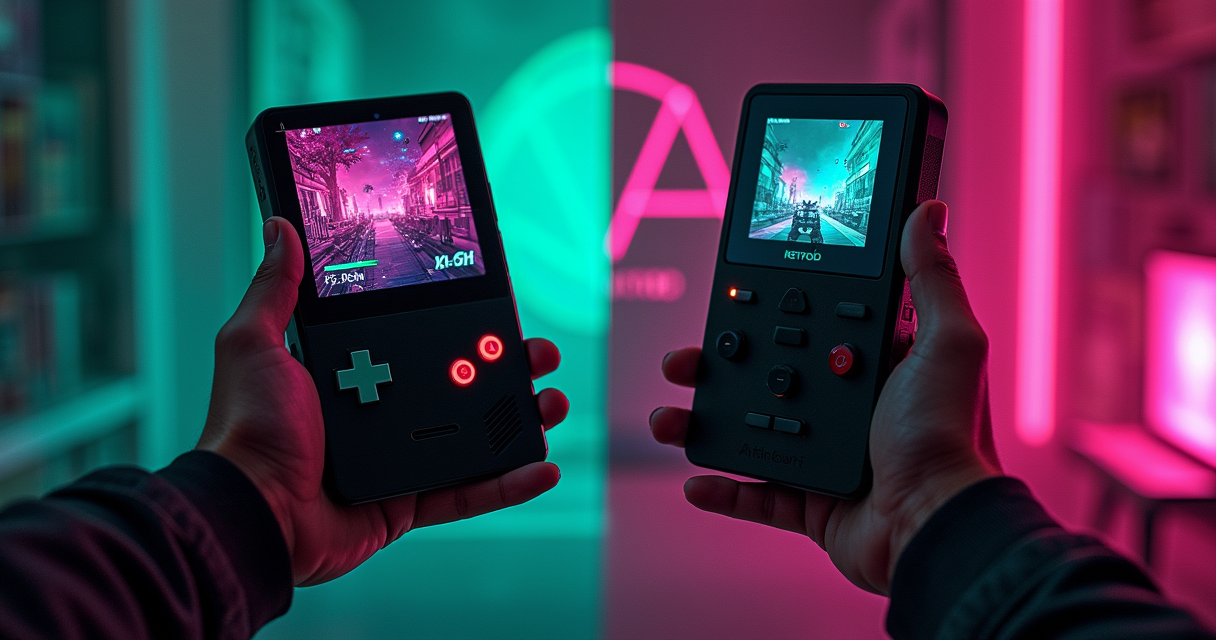
There is a specific flavor of buyer's remorse that only exists in the Android retro-handheld aisle, and Retroid spent the back half of 2025 engineering it on purpose. On October 27, 2025, the company unveiled two handhelds in the same breath, the Pocket 6 and the Pocket G2, and opened preorders on both immediately. One was the delayed flagship. The other was the value flagship. They launched ten dollars apart. Doing that to your own catalogue is either supreme confidence or a small act of self-sabotage, and the honest answer is that it is a little of each.
This piece is filed under Retroid Pocket, but in practice the 2025 to 2026 decision is a three-way fight. On one side sits the Pocket 6, running a Qualcomm Snapdragon 8 Gen 2 behind a 5.5-inch 120Hz AMOLED panel. Across from it is the Pocket G2, the first handheld anywhere to ship the mid-range Snapdragon G2 Gen 2, paired with a 60Hz OLED and a price that undercuts the 6. Hovering behind both is last year's Pocket 5, Snapdragon 865, still on sale, and stubbornly relevant. Where the clamshell form factor matters, the Flip 2 earns a mention too. We are going to put real numbers on all of them, and we did the tighter head-to-head separately in our Pocket 6 vs G2 breakdown if you only care about those two.
The complication is that you cannot write an honest Retroid comparison in 2026 using fixed prices, because Retroid did not use fixed prices. The lineup absorbed two hikes in roughly six months, the top-spec Pocket 6 was discontinued outright, and the Pocket 5 and Flip 2 got a RAM transplant and a fresh sticker. If you want the short version before the long one: the G2 is the rational purchase, the Pocket 6 is the enthusiast's indulgence, and the global memory market is the villain in every chapter. Now the long version.
The 2025–2026 Retroid Pocket Lineup
What Retroid actually shipped
Both devices were revealed on October 27, 2025, with preorders live the same night. Retroid set the Pocket 6 preorder at $209 for the 8GB/128GB model and $259 for the 12GB/256GB model, with regular pricing reported at $229 and $279 respectively. The Pocket G2 preordered at $199 for its first two weeks and then settled at a $219 regular price. Shipping told a different story for each: the G2 moved fast, with Black, GameCube, and 16-bit colorways shipping on October 29, 2025 and Turquoise and Yellow following on November 5. The Pocket 6, by contrast, would not begin shipping until January 2026 at the earliest, which is a strange thing to do to a flagship you announced alongside a cheaper sibling that ships in 48 hours.
Android Authority's Nick Fernandez, covering the launch, described the G2 as the "first gaming handheld to ship with Qualcomm's mid-range Snapdragon G2 Gen 2," and openly floated that the pair "might be value kings." That is the correct read. When a manufacturer prices its second-best device within ten dollars of its best one, it is telling you something about where the value actually lives. You can read the full launch coverage at Android Authority.
Why this is really Pocket 6 versus G2
Strip away the marketing and the two 2025 devices are near-twins. Both use a 5.5-inch, 1080p, OLED-family panel. Both start with 8GB of RAM and 128GB of storage. Both take microSD, both run Android with Retroid's launcher over the top, both carry Wi-Fi 6, both have active cooling. Only three axes actually move between them: the chipset, the refresh rate (120Hz on the 6, 60Hz on the G2), and the price. That is an unusually clean comparison by handheld standards, where devices normally differ on a dozen incompatible dimensions at once. Here you are buying, quite literally, a faster chip and double the refresh rate for a premium that started at ten dollars and has since grown.
The RAMpocalypse subtext
Every price in the paragraphs above has an asterisk, because 2026 was the year memory pricing went vertical. In March 2026, Retroid raised the Pocket 6 8GB by $15 to $244 and discontinued the 12GB model entirely. In July 2026, it bumped the Pocket 5 and Flip 2 by $10 while upgrading their base RAM to 12GB. Android Authority's Andy Walker summed up the March move bluntly: "The global component pricing crunch has claimed yet another victim." We ranked where each device lands after all that turbulence in our four-handhelds-ranked guide, but the through-line for this comparison is simple: the gap between the Pocket 6 and the G2 widened over 2026, from ten dollars to twenty-five, without the hardware changing at all.
Spec Sheet: Pocket 6 vs G2 vs 5
The full hardware table
Here is the whole thing on one screen. Every number below is drawn from Retroid's listings and hands-on coverage from Android Authority, Notebookcheck, Retro Handhelds, and RetroDodo; the emulation-capability rows follow in the next table.
| Spec | Pocket 6 | Pocket G2 | Pocket 5 |
|---|---|---|---|
| Chipset | Snapdragon 8 Gen 2 | Snapdragon G2 Gen 2 | Snapdragon 865 |
| GPU | Adreno 740 | Adreno A22 | Adreno 650 |
| CPU layout | 1+4+3, up to ~3.2 GHz | 1+4+3 (2.8 / 2.57 / 1.9 GHz) | 1+3+4, up to 2.84 GHz |
| Display size | 5.5-inch | 5.5-inch | 5.5-inch |
| Resolution | 1080p (FHD) | 1080p (FHD) | 1080p (FHD, ~400 PPI) |
| Refresh rate | 120 Hz | 60 Hz | 60 Hz |
| Panel | AMOLED | OLED | AMOLED |
| RAM (2026) | 8GB (12GB discontinued Mar 2) | 8GB | 12GB base (was 8GB, Jul 2026) |
| Storage | 128GB + microSD | 128GB + microSD | 128GB/256GB + microSD |
| Battery | 6,000 mAh | 5,000 mAh | 5,000 mAh |
| Weight | ~320 g | ~280 g | ~280 g |
| Rated runtime | ~4.5 h mixed heavy use | up to ~16 h light emulation | ~G2-class |
| Dimensions | 210 x 87 x 17 mm | ~same 5.5-inch chassis | ~same 5.5-inch chassis |
| Connectivity | Wi-Fi 6, Bluetooth | Wi-Fi 6, active cooling | Wi-Fi 6, Bluetooth 5.1 |
| First shipped | Jan 2026 (earliest) | Oct 29 / Nov 5, 2025 | 2024–2025 |
| Launch price | $229 (8GB) / $279 (12GB) | $199 promo / $219 retail | $199 (8GB) |
| Price (mid-2026) | from $244 (8GB only) | $219 | $209 (12GB) |
The display gap that costs $25
Look hard at that table and the single most defensible reason to pay the Pocket 6 premium is the row marked refresh rate. Both the 6 and the G2 use OLED-family panels at the same size and resolution, so blacks are inky and colors pop on both. What the Pocket 6 adds is 120Hz, and it matters in exactly two contexts: high-frame-rate Android games, and the buttery smoothness of the launcher and menus. For 8-bit, 16-bit, and most 32-bit emulation, which caps at the original hardware's frame rate anyway, a 60Hz OLED shows you the identical image. You are not buying a better retro picture with the 6; you are buying a better modern picture and a slicker UI. RetroDodo's Brandon Saltalamacchia praised the 6's panel plainly: "A 5.5-inch AMOLED display makes the device feel incredibly modern. The brightness, the sharpness and the fast refresh rate add to the experience."
What the spec sheet hides
Two things the table cannot show you. First, ergonomics: reviewers repeatedly note the Pocket 6 is a competent but conservative design. Saltalamacchia's verdict headline called it "Perfect Pocketable Power, But Undeniably Boring," and dinged it for a "mediocre product design," no fingerprint reader, no trigger-locking shoulder buttons, and an off-centered USB-C port. Second, weight: the 6's larger 6,000 mAh battery makes it ~40 g heavier than the 280 g G2, a difference your wrists will register during a long session. Notebookcheck's launch writeup, which you can read via its Pocket 6 release article, pegged the device at 210 x 87 x 17 mm and "around 320 g."
The Silicon: 8 Gen 2 vs G2 Gen 2
The weird chip in the G2
The most interesting engineering story in this comparison is the G2's brain. The Snapdragon G2 Gen 2 is part of Qualcomm's dedicated gaming-handheld G-series rather than a repurposed phone SoC, and the Pocket G2 was its debut vehicle. Its layout is a familiar 1+4+3 arrangement: one Kryo Gold Plus prime core at 2.8 GHz, four Kryo Gold performance cores at 2.57 GHz, three Kryo Silver efficiency cores at 1.9 GHz, feeding an Adreno A22 GPU. Pocket Retro Gaming titled its review "Weird Snapdragon, Great Results," which captures the vibe: this is not a chip anyone had benchmarked to death before it arrived, and it punched above the price bracket it landed in.
The 8 Gen 2 is the known quantity
The Pocket 6's Snapdragon 8 Gen 2 has no mystery to it. It was a genuine flagship phone SoC in 2023, it is a known, well-characterized part, and its Adreno 740 GPU is a serious piece of graphics silicon that has been powering high-end Android emulation for a couple of years. Buying the Pocket 6 is buying a proven ceiling. Buying the G2 is buying a newer, cheaper, more efficient chip that gets you most of the way there. We drilled into exactly how much of the way in our Pocket 6 vs Pocket 5 comparison, which frames the same 8 Gen 2 against last year's 865.
Adreno 740 vs Adreno A22, and why efficiency wins battery
The GPU delta is the real separator, and it cuts both ways. The Adreno 740 in the Pocket 6 has more raw headroom, which shows up when you push resolution multipliers or the heaviest 3D emulation. But the G2's newer, mid-range Adreno A22 was designed for the handheld power envelope, and it is why a device with a smaller 5,000 mAh battery can post far longer runtimes than the 6,000 mAh Pocket 6. Efficiency is a spec too; it just does not get a headline. When you see the G2 clock up to roughly 16 hours on lighter systems while the Pocket 6 lands near 4.5 hours under mixed heavy load, the chip and the 60Hz panel are doing that work together.
Benchmarks: What the Numbers Say
CPU: Geekbench 6
Start with single-thread CPU, because emulation loves fast single cores. In Geekbench 6 single-core, the numbers cited across launch coverage line up like this: the Pocket 5 (Snapdragon 865) sits around 1,210; the Pocket G2 (G2 Gen 2) around 1,887; and the Pocket 6 (8 Gen 2) around 2,005, with a multi-core figure near 5,331. Do the arithmetic and two facts fall out. First, the G2 delivers roughly a 55% single-core uplift over the Pocket 5, which is a generational leap for a budget device. Second, and more importantly for this comparison, the G2 lands within about 6 to 10 percent of the far pricier Pocket 6 on single-core. Retro Handhelds' reviewer, Ban, framed it as the G2 being "50% over the 865 and 10% below the 8 Gen 2." That 10 percent is the crux of the entire decision.
GPU: 3DMark Wild Life
Graphics is where the Pocket 6 earns back some of its premium. In 3DMark Wild Life Extreme, the Pocket 5 scores around 1,283 and the Pocket 6 posts about 3,711, a 189% increase. The G2 sits between them: reviewers reported its GPU as "closer to twice as performant as the 865" while falling only "8 to 10 percent behind the Adreno 740" of the 8 Gen 2 in the tests where the two were closest. In a separate stress run, Retro Handhelds clocked the G2 at 94.95% stability with a peak of 3,032. Different 3DMark tests and configs produce different absolute numbers, so treat these as directional rather than as a single leaderboard, but the shape is consistent: the G2 is dramatically faster than the Pocket 5 on GPU and modestly behind the Pocket 6.
The 10 percent that costs you
Aggregated across three-plus sources, the honest summary is this. The G2 gives you roughly 90 to 95 percent of the Pocket 6's real-world emulation performance. Hands-on testing has credited the G2 with around 2.3x GPU gains and 55% CPU gains over the Pocket 5, plus up to 16 hours of full-speed emulation on lighter systems, all while undercutting the 6 on price. Ban's conclusion at Retro Handhelds was pointed: "The G2 is a major improvement, but still falls just behind an 8 Gen 2 despite being too close for comfort pricing." Asked whether he would spend his own money on it, he answered his own question: "If it were my money, would I buy the G2? No." That is a reviewer talking about the top of the range, though; for most buyers, the arithmetic points the other direction.
Emulation Reality, System by System
The safe zone: up to GameCube and PS2
For everything from the Atari 2600 through the PlayStation 1, Nintendo 64, Dreamcast, and PSP, all three devices are, functionally, done. There is no game in those libraries that a Snapdragon 865 cannot handle, so the G2 and the Pocket 6 clear them without breaking a sweat, and with resolution to spare. RetroDodo's Pocket 6 review put concrete multipliers on it: "Gamecube at 3x native resolution, Dreamcast at 4x, PSP at 4x (which takes up the entire screen) and PS1 at 4x, making your retro games look incredibly crispy on this AMOLED display." The G2 runs the same systems at high multipliers too; the Pocket 6 simply has more overhead before it sweats. If your library tops out at PS2 and GameCube, the extra silicon in the 6 is insurance you are unlikely to cash in.
The Switch question
Switch emulation is where the Pocket 6 draws its cleanest line. Notebookcheck noted that early G2 reviews "showcase strength in Nintendo Switch and Wii U emulation," and the G2 genuinely handles a slice of the Switch catalogue. But the Pocket 6, with the Adreno 740 and, critically, more RAM headroom, is the stronger Switch machine for the money; a locked 60fps in Mario Kart 8 Deluxe has been described as one of the cleanest Switch experiences on Android in this price class. The caveat is brutal and current: with the 12GB Pocket 6 discontinued, 8GB is now the ceiling, and Switch titles eat RAM. The community consensus is to treat post-2005 systems as a bonus rather than the reason you buy, and to buy for the PS2-and-below libraries you will actually play daily.
The upscaling and shaders dividend
The reason a fast chip matters even for old games is not frame rate; it is what you layer on top. CRT shaders, scanline emulation, high internal resolution multipliers, and run-ahead latency reduction all cost GPU and CPU cycles. Here is where the software features line up, because all three devices run the same Android emulation stack, so save states, netplay, and shaders are identical features, differentiated only by horsepower.
| Capability | Pocket 6 | Pocket G2 | Pocket 5 |
|---|---|---|---|
| Save states | Yes | Yes | Yes |
| RetroArch netplay | Yes (chip-gated) | Yes | Yes |
| CRT / upscale shaders at 1080p | Ample headroom | Comfortable | Comfortable |
| PS1 / N64 / DC / PSP | Flawless, up to 4x | Flawless | Flawless |
| GameCube / Wii | 2x–3x, few drops | Strong, mostly full-speed | Playable, more compromises |
| PlayStation 2 | 2x–3x, few drops | Mostly full-speed | Selective |
| 3DS / Wii U | Strong | Good | Selective |
| Switch (Mario Kart 8 etc.) | Best in class for price; RAM-gated | Playable in cases | Very selective |
| Practical accuracy | Software-defined (same cores) | Same | Same |
If you want to actually load those cores onto whichever device you pick, our RetroArch cores setup walkthrough covers the whole install in about half an hour.
Pricing and Availability in 2026
The moving target
Retroid's 2026 pricing is a case study in component-cost pass-through. The company was explicit about why. In March, its statement read: "The recent surge in memory pricing has reached a level that we are unfortunately unable to absorb," and elsewhere it cited "ongoing shortages and sharply rising costs for both RAM and storage." Here is the current lay of the land, drawn from Retroid's own goretroid.com storefront and 2026 reporting.
| Model | Launch (2025) | Promo / preorder | Price (mid-2026) | RAM / storage | Ships |
|---|---|---|---|---|---|
| Pocket 6 (8GB) | $229 | $209 | from $244 | 8GB / 128GB | Jan 2026+ |
| Pocket 6 (12GB) | $279 | $259 | Discontinued (Mar 2, 2026) | 12GB / 256GB | — |
| Pocket G2 | $219 | $199 (2 weeks) | $219 | 8GB / 128GB | Oct 29 / Nov 5, 2025 |
| Pocket 5 | $199 | — | $209 (post Jul 14) | 12GB base / 128GB | Available |
| Pocket Flip 2 | — | — | $219 (post Jul 14) | 12GB base | Available |
| Older catalogue | — | — | from $199 / $179 / $139 | Varies | Available |
The 12GB that no longer exists
The most consequential line in that table is the strikethrough. On March 2, 2026, Retroid raised the Pocket 6 8GB by $15 to $244 and killed the 12GB/256GB variant. Retroid's reasoning, as reported by Android Authority's Andy Walker, was that "under the new supplier costs, we cannot continue offering the 12GB configuration at a reasonable price." Time Extension dubbed the whole saga the "RAMpocalypse," and its coverage of the discontinuation is worth reading for the full context. The practical fallout: the exact configuration most enthusiasts wanted for Switch and Android AAA headroom is gone, leaving buyers with an 8GB ceiling and a higher price than launch.
The rest of the catalogue
Retroid did not stop adjusting. In July 2026, it raised the Pocket 5 and Flip 2 by $10, to starting prices of $209 and $219, but softened the blow by upgrading the base memory to 12GB and even honoring the bump for already-placed unshipped orders. Engadget's writeup of the Pocket 5 and Flip 2 change notes the July 14 deadline for the old pricing. The net effect is a compressed, slightly pricier lineup where the Pocket 5 at $209 now costs nearly as much as the G2 at $219, which reshapes the value math considerably. Retroid's storefront also keeps older models around at from $199, from $179, and from $139 tiers, so there is a genuine budget on-ramp if the flagships feel indulgent.
Which One Fits Your Use Case
If your library tops out at PS2 or GameCube
Buy the G2. This is the largest group of real buyers, and for them the G2 is the correct answer without much debate. You get 90-plus percent of the Pocket 6's emulation performance, the same gorgeous OLED at the same resolution, and up to roughly 16 hours of battery, for $25 less. The 10 percent GPU gap the benchmarks reveal simply does not manifest in games that ran on 2001 hardware. Every dollar of the Pocket 6 premium here buys you overhead you will never touch.
If you chase the top of the range
Buy the Pocket 6. If your interest is Switch emulation, high-resolution PS2 and GameCube with heavy shaders, or Android AAA games like Diablo Immortal that RetroDodo tested at around 4.5 hours of battery, the 8 Gen 2 and its Adreno 740 are the ceiling in this bracket. The 120Hz panel is a real bonus for native Android titles. Just make peace with the 8GB limit now that the 12GB model is dead, and accept that you are paying flagship money for the last 10 percent of performance.
If battery life and travel come first
Buy the G2. The efficiency story is decisive here. A 5,000 mAh battery driving an efficient mid-range chip and a 60Hz panel simply lasts longer than a heavier 6,000 mAh device pushing 120Hz and a flagship SoC. For flights, commutes, and multi-day trips without a charger, the lighter, longer-lasting G2 is the pragmatic pick.
If you already own a Pocket 5
Think hard, then probably wait or jump to the 6. The G2 is a sidegrade in CPU class for a Pocket 5 owner; you would gain GPU and efficiency but not transform your library. The Pocket 6 is the real upgrade, with roughly 67% more single-core and 189% more GPU in the benchmarks, plus the 120Hz screen. If your 865 still runs everything you play, the correct move in a price-spiking market may be to keep it another year.
If you want a clamshell, or the cheapest possible entry
Consider the Flip 2, or the older catalogue. The Flip 2 exists for people who want a pocketable, screen-protecting clamshell and are willing to pay $219 for the 12GB version. And if you just want to play PS1 and Game Boy Advance libraries as cheaply as possible, Retroid's from-$139 tier, or a fundamentally different device entirely, may serve you better. We laid out the ultra-budget end of the hobby in our Miyoo Mini Plus rundown, which hits a very different price and ambition.
Pros and Cons, Device by Device
Retroid Pocket 6
| Pros | Cons |
|---|---|
| Fastest chip in the lineup (8 Gen 2, Adreno 740) | Now $244 and climbing; premium widened over 2025 |
| 120Hz AMOLED, best modern-game and UI feel | 12GB model discontinued; 8GB is the ceiling |
| Best Switch and high-res PS2/GC in class | Heaviest (~320 g); ~4.5 h under heavy mixed use |
| Large 6,000 mAh battery | "Undeniably boring" design; off-center USB-C, no fingerprint reader |
Retroid Pocket G2
| Pros | Cons |
|---|---|
| ~90-95% of Pocket 6 emulation for $25 less | 60Hz panel; less smooth for native Android games |
| Debut of the efficient Snapdragon G2 Gen 2 | ~10% behind the 8 Gen 2 on CPU and GPU |
| Up to ~16 h battery; lighter at ~280 g | Stick placement draws "crab claw" ergonomic gripes |
| Shipped on time (Oct/Nov 2025) | Priced "too close for comfort" to the flagship |
Retroid Pocket 5
| Pros | Cons |
|---|---|
| Proven Snapdragon 865; handles up to PS2/GC/PSP | Now $209 with July 2026 hike, nearly G2 money |
| Same 5.5-inch 1080p AMOLED, 60Hz | Oldest chip; weakest for Switch/Android AAA |
| 12GB base RAM after the July upgrade | A sidegrade, not an upgrade, from itself |
| Frequently discounted below flagship pricing | Superseded by two newer chips in the range |
Migrating to a Pocket 6
Back up everything first
Whether you are coming from a Pocket 5, a G2, or another Android handheld, the migration is fundamentally a data-transfer job, because all of these devices run the same Android emulation stack. The golden rule: back up your saves, save states, and per-game configuration before you touch the new device. The exact folders vary by frontend, but the common locations look like this, and the fastest path is a USB cable with the device in file-transfer mode plus adb.
# Back up your emulation data before switching devices
# (folder names vary by frontend; these are the common ones)

/sdcard/RetroArch/saves/     <- SRAM battery saves (.srm)
/sdcard/RetroArch/states/    <- save states (.state, .state1 ...)
/sdcard/RetroArch/config/    <- per-core and per-game overrides
/sdcard/Android/data/        <- standalone emulator data (Dolphin, etc.)

# Fast copy over USB with adb (device in File Transfer mode):
adb pull /sdcard/RetroArch/saves   ./rp-backup/saves
adb pull /sdcard/RetroArch/states  ./rp-backup/states
adb pull /sdcard/RetroArch/config  ./rp-backup/config
The restore, step by step
Once the backup exists, the restore is mechanical. Follow it in order and you will not lose a single battery save.
- Set up the new Pocket 6, complete Android onboarding, and connect Wi-Fi.
- Install your frontend of choice (RetroArch and any standalone emulators like Dolphin or a Switch emulator).
- Copy your ROM library back to the microSD card or internal storage.
- Push your
saves,states, andconfigfolders back into the matching paths. - Re-scan your ROM directories so the launcher rebuilds its playlists and box art.
- Re-map controls once; button layouts differ slightly between Retroid models.
- Spot-check three or four games across systems to confirm saves and per-game overrides carried over.
When not to bother
The unglamorous truth: if you are on a Pocket 5 and your library stops at PS2, migrating to a G2 is not worth the afternoon. The performance class barely moves, and you will spend hours rebuilding a setup for a marginal gain. Migration makes sense when you are chasing a capability you do not currently have, namely the Pocket 6's Switch headroom, its 120Hz panel, or its higher resolution multipliers with heavy shaders. If none of those describe your play, the best migration is no migration.
The Verdict
Buy the G2 if you are honest about what you play
For the overwhelming majority of buyers, the Pocket G2 at $219 is the correct purchase, and the data says so without much hedging. It delivers roughly 90 to 95 percent of the Pocket 6's real-world emulation, the same 5.5-inch 1080p OLED, dramatically better battery life, and a lighter chassis, for $25 less than the flagship. The benchmark gap is real but concentrated in the top 10 percent of workloads that most people never run. Even a reviewer who personally passed on it, Retro Handhelds' Ban, conceded the broader point with "If you liked the Retroid Pocket 5, you'll like the Retroid Pocket G2."
Buy the Pocket 6 if you want the ceiling and the screen
The Pocket 6 at $244 is the enthusiast's device, and there is no shame in that. If you specifically want the best Switch emulation in the price bracket, the smoothest 120Hz native-Android experience, or the extra GPU overhead for high-resolution PS2 and GameCube with the works, the 8 Gen 2 earns its keep. Just go in clear-eyed: the 12GB model is dead, 8GB is your permanent ceiling, and you are paying a widening premium for the last slice of performance in a market where memory prices are the story.
The Machine's call
Retroid built two excellent handhelds and then priced them ten dollars apart, and the 2026 memory crunch pushed that gap to twenty-five while quietly deleting the one Pocket 6 configuration serious buyers actually wanted. That leaves an unusually clean recommendation. Default to the G2. It is the rational, efficient, better-value machine, and for anything up to PS2 and GameCube you will never feel the difference. Step up to the Pocket 6 only if Switch, 120Hz, or maximum shader headroom is a named requirement rather than a nice-to-have. And keep the Pocket 5 on the table strictly as a discount play, because at $209 with 12GB it is now too close to the G2 to justify the older chip. In a year where the villain is the RAM market, the smart money buys exactly the performance it will use, and not one benchmark point more.
Questions the search bar asks me
- Is the Retroid Pocket 6 worth $25 more than the G2?
- For most people, no. The G2 delivers about 90-95% of the Pocket 6's real-world emulation, the same 5.5-inch 1080p OLED, and longer battery, for $25 less ($219 vs $244 in mid-2026). The 6 is worth it only for its 120Hz panel, best-in-class Switch emulation, and extra GPU headroom, which benchmarks put roughly 10% ahead of the G2.
- Why was the 12GB Retroid Pocket 6 discontinued?
- Retroid killed the 12GB/256GB model on March 2, 2026, and raised the 8GB to $244, citing "ongoing shortages and sharply rising costs for both RAM and storage." Android Authority quoted Retroid saying it "cannot continue offering the 12GB configuration at a reasonable price," leaving 8GB as the only Pocket 6 option.
- What chipset is in the Retroid Pocket G2?
- The Snapdragon G2 Gen 2 with an Adreno A22 GPU, in a 1+4+3 core layout (2.8 / 2.57 / 1.9 GHz). The Pocket G2 was the first handheld anywhere to ship it. Benchmarks show roughly a 55% single-core CPU uplift over the Pocket 5's Snapdragon 865, landing about 10% behind the Pocket 6's Snapdragon 8 Gen 2.
- Can the Retroid Pocket 6 emulate the Nintendo Switch?
- Yes, and it is the best Switch machine in this price class, with titles like Mario Kart 8 Deluxe reported at a locked 60fps. The catch is that the 12GB model is discontinued, so 8GB of RAM is now the ceiling and Switch games are RAM-hungry. The community advice is to treat post-2005 systems as a bonus, not the reason to buy.
- Should I upgrade from a Pocket 5 to a G2 or Pocket 6?
- Skip the G2; it is a sidegrade in CPU class for a Pocket 5 owner. The Pocket 6 is the real jump, with benchmarks showing about 67% more Geekbench 6 single-core and 189% more 3DMark Wild Life Extreme GPU, plus a 120Hz screen. If your 865 still runs everything you play, holding another year is defensible in a price-spiking market.

Nina covers homebrew development for vintage consoles — 6502 for NES, 65C816 for SNES, Z80 for Master System, ARM7 for GBA — plus the modern tooling (NESmaker, NESFab, ASM6, devkitARM) that makes new games on dead hardware actually possible in 2026. Every post under this byline is reviewed pre-publish by Sam P., Editor & Operator — corrections to info@instalinkoteam.com. Published 2026-08-29 · Last updated 2026-08-29. Full bios on the author page.