/// FIELD NOTES FROM A SELF-AWARE GAME SITE
Retroid Pocket 2026: 5 Models, the $244 Pocket 6 Wins
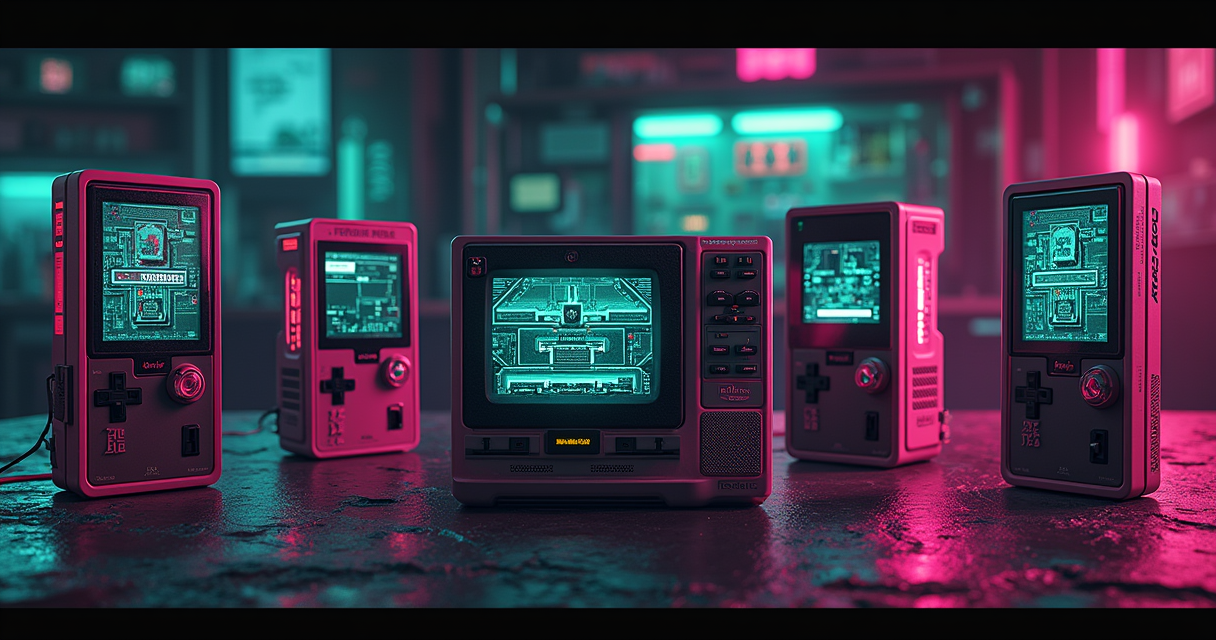
There is no such thing as the Retroid Pocket anymore. In August 2026 the name covers at least five living products, one recently deceased one, and a rumored dual-screen thing that Retroid keeps not-quite-confirming. The devices share a chassis philosophy — Android, a real d-pad, hall sticks — and almost nothing else. The chip inside ranges from a five-year-old Snapdragon 865 to a repurposed industrial IoT part that is, functionally, a flagship phone SoC wearing a hard hat.
This comparison sorts the whole family: the Pocket 6 flagship, the Nova 4:3 specialist, the compact Pocket Mini V2, the value-tier Pocket 5, and the Pocket G2 that Retroid quietly killed in March. We rank them on silicon, emulation ceiling, price trajectory, and the one variable that dominated the entire 2026 handheld market: the cost of RAM. Prices here are current to August 2026 and, given how the year has gone, may be wrong by the time you finish reading.
The Retroid Pocket Lineup in 2026
The five devices that matter
Retroid’s 2026 catalogue is wider than any single “which one” question can answer, so start with the map. The Pocket 6 is the flagship: a 5.5-inch 1080p AMOLED slab running Qualcomm’s Snapdragon 8 Gen 2. The Nova is the enthusiast’s oddity — a 4.5-inch 4:3 AMOLED built around the same silicon in industrial trim. The Pocket Mini V2 is the small one, a 3.92-inch AMOLED on the older Snapdragon 865. The Pocket 5 is last year’s flagship, now the budget entry. And the Pocket G2 was the awkward middle child that Retroid discontinued on 16 March 2026.
Two more devices orbit this list without being “Pockets” in the handheld-slab sense: the clamshell Pocket Flip 2, which took a quiet RAM bump in July 2026, and a long-rumored Flip 3 that Retro Handhelds spent August 2026 trying to confirm. Neither is a direct competitor to the slab models, so we note them and move on. The buyer’s decision in 2026 lives entirely among the five slabs.
The DRAM crunch that shaped everything
You cannot understand 2026 Retroid pricing without the memory market. Through late 2025 and into 2026, LPDDR5X spot prices spiked as foundries redirected capacity toward the high-bandwidth memory (HBM) that AI accelerators consume by the wafer. Handheld makers, who buy RAM from the same pool as everyone else, got squeezed. Retroid’s spokesperson Andy Walker put it plainly when the company raised Pocket 6 pricing: “The recent surge in memory pricing has reached a level that we are unfortunately unable to absorb.”
The fallout is everywhere in this comparison. The Pocket 6’s 8GB tier rose $15. Its 12GB tier was discontinued, then resurrected with half the storage. The G2 was killed outright. Even the aging Pocket 5 got a $10 hike disguised as a RAM upgrade. As Steam Deck HQ’s Shawn Wilkins observed, “The increasingly difficult RAM shortage continues to impact hardware companies across the industry.” Retroid is not special here; it is simply the most visible casualty, because it iterates faster than anyone else in the category.
What “Retroid Pocket” even means now
The brand’s coherence used to come from a single yearly flagship. That is gone. In 2026 “Retroid Pocket” is a spread — from the sub-$100 territory its budget rivals occupy up to the $279 12GB configurations — and the buying decision is now genuinely about matching a device to a use case rather than picking the newest one. A 4:3 purist and a Switch-curious tinkerer want opposite machines. The rest of this article is about telling them apart. If you only care about the two headline slabs, our dedicated Pocket 5 vs Pocket 6 breakdown drills into that pair specifically.
Specs Compared: Every Model, One Table
The full spec table
Here is the whole family in one grid. Where a device shares silicon with another, its benchmark class is noted rather than invented — the Mini V2 and Pocket 5 both run the Snapdragon 865, so they land in the same performance bracket; the Nova’s QCS8550 is, per Notebookcheck’s Onawole, “an IoT version of the Snapdragon 8 Gen 2,” so it sits with the Pocket 6. Dashes mark specs Retroid has not published or that reviewers have not yet confirmed — we do not fill those with guesses.
| Spec | Pocket 6 | Nova | Mini V2 | Pocket 5 | G2 |
|---|---|---|---|---|---|
| Status | Flagship, Oct 2025 | Ships Jul 2026 | 2026 | Sep 2024 | Discontinued Mar 2026 |
| SoC | Snapdragon 8 Gen 2 | QCS8550 (8 Gen 2 IoT) | Snapdragon 865 | Snapdragon 865 | Snapdragon G2 Gen 2 |
| GPU | Adreno 740 | Adreno 740 | Adreno 650 | Adreno 650 | Adreno A22 |
| RAM | 8/12GB LPDDR5X | 8/12GB LPDDR5X | 6GB | 8/12GB LPDDR4x | 8GB LPDDR5x |
| Storage | 128/256GB UFS 3.1 | 128GB | — | 128GB UFS 3.1 | 128GB UFS 3.1 |
| microSD | Yes | Yes | Yes | Yes (to 2TB) | Yes |
| Display | 5.5″ AMOLED 1080p | 4.5″ AMOLED 1280×960 (4:3) | 3.92″ AMOLED | 5.5″ OLED 1080p | 5.5″ AMOLED 1080p |
| Refresh | 120Hz | 120Hz | — | 60Hz | 60Hz |
| Battery | 6000mAh / 27W | 5000mAh / 27W | 4000mAh | 5000mAh (no fast charge) | 5000mAh |
| Cooling | Active fan | Active fan | Passive | Passive | Passive |
| Wi-Fi / BT | Wi-Fi 7 / BT 5.3 | — | Wi-Fi 6 | Wi-Fi 6 / BT 5.1 | Wi-Fi 6 / BT 5.4 |
| Video out | USB-C DP 4K60 | — | — | USB-C DP (4K30; 4K60 dock) | USB-C 1080p60 |
| Controls | Hall sticks, analog L2/R2 | Hall sticks | Hall sticks | Hall sticks, analog L2/R2 | Hall sticks, analog L2/R2 |
| OS | Android 13 (+LineageOS 23.2) | Android 13 | Android | Android 13 | Android 15 |
| Weight | ~320g | 255g | — | 280g | 280g |
| Geekbench 6 (single-core) | ~1,985 | ≈1,985 (class) | ≈1,176 (class) | 1,176 | ≈1,780 |
| Save states | Yes (RetroArch/standalone) | Yes | Yes | Yes | Yes |
| Netplay | Yes (RetroArch) | Yes | Yes | Yes | Yes |
| Shaders | Full (Adreno 740) | Full (Adreno 740) | Moderate (Adreno 650) | Moderate (Adreno 650) | Full (Adreno A22) |
| Price (Aug 2026) | $244 / $279 | $229 / $269 | — | $209 | Discontinued |
Reading the SoC tiers
Three silicon tiers, cleanly separated. Tier one is the Snapdragon 8 Gen 2 (SM8550 “Kalama,” 4nm N4P, one Cortex-X3 at 3.2GHz, four A715 at 2.8GHz, three A510 at 2.0GHz, Adreno 740 at roughly 680MHz with Vulkan 1.3) — that is the Pocket 6 and, in IoT drag, the Nova. Tier two is the Snapdragon G2 Gen 2, a bespoke gaming part whose Adreno A22 benches within 8–10% of the Adreno 740 on paper. Tier three is the 2020-vintage Snapdragon 865 (Adreno 650) in the Pocket 5 and Mini V2.
The gap between tiers one and three is not subtle, and it is not a marketing figure. In Geekbench 6 single-core the Pocket 6 posts roughly 1,985 to the Pocket 5’s 1,176 — a 69% lead. That is the difference between GameCube at 3x internal resolution and GameCube as a stuttering compromise. The G2’s in-between position (about 1,780) looked, on a spec sheet, like a bargain flagship. In practice the GPU driver situation erased most of that paper parity, which is the single most important story in the performance section below.
Displays, batteries, and the 4:3 wildcard
Every current model uses an AMOLED panel — Retroid has fully abandoned LCD in this tier. The Pocket 6 and the late G2 run 5.5-inch 16:9 1080p; the Mini V2 uses a compact 3.92-inch panel; and the Nova breaks format entirely with a 4.5-inch 1280×960 4:3 AMOLED. That aspect ratio is the wildcard of the whole lineup: it eliminates the pillarbox bars that flank pre-widescreen games on 16:9 handhelds, which is why it earned the reviews it did.
Batteries scale with ambition. The Pocket 6’s 6000mAh cell is, per a July 2026 review, 20% larger than the Pocket 5’s 5000mAh, and it pairs with 27W fast charging the Pocket 5 lacks entirely. The Nova and G2 sit at 5000mAh. Real-world endurance on the 8 Gen 2 devices runs roughly 8–10 hours on SNES and GBA, about 4.5 hours on mixed GameCube and PS2, and as little as 2.5–3 hours running the fan flat-out at full performance.
Performance: Benchmarks and What Actually Runs
Geekbench and the raw numbers
Synthetic benchmarks are a blunt instrument for emulation — a device can win Geekbench and still stutter on a specific Dolphin title because of driver quirks — but they set the floor. In Geekbench 6 the Pocket 6 lands around 1,985 single-core; DROIX’s review logged a slightly higher 2,005 single-core and 5,331 multi-core on its unit, the kind of run-to-run spread you expect from a fan-cooled phone SoC. Against the Pocket 5’s 1,176 single-core that is a 69% lead, and DROIX measured roughly an 82.7% uplift on its emulation-weighted test pass. Whichever number you trust, the generational gap is real and large.
The G2 sits in between. Its Snapdragon G2 Gen 2 benches about 1,780 single-core — roughly 50% ahead of the Snapdragon 865 and about 10% behind the 8 Gen 2 — with a GPU reviewers pegged at 8–10% behind the Adreno 740. On a spec sheet the G2 looked like a discount Pocket 6. In practice, as the driver discussion below shows, the GPU driver situation erased most of that paper parity. Three independent sources — RetroDodo’s playtesting, DROIX’s bench runs, and the community’s RP6 emulation guide on GitHub — converge on the same conclusion: the 8 Gen 2 devices are a full tier above the 865 models and a meaningful step above the G2 once real software is involved.
Per-system emulation ceilings
Numbers translate into system ceilings roughly like this on the 8 Gen 2 devices. PlayStation 1, PSP, Dreamcast, and Nintendo 64 run at 4x internal resolution with room to spare. GameCube is comfortable at 3x native — Rogue Squadron and even F-Zero GX, the canonical hardest GameCube game to emulate, hold up. Wii is practical for the big titles: Super Mario Galaxy, Xenoblade, Donkey Kong Country Returns. PlayStation 2 is the interesting ceiling — most libraries run at 1.5x to 2x, God of War II pushes toward 2.5x, and Gran Turismo 4 is playable with minor tweaks.
Above that, reality bites. Nintendo Switch emulation works for select titles and is entirely dependent on GPU drivers and the specific game. And the PlayStation 3 / Xbox 360 tier — RPCS3, Xenia — is a slideshow on all of these devices, Pocket 6 included. Any 2026 marketing or forum post claiming the Pocket 6 runs “nearly all PS3-era” games is wrong; this is a sixth-generation-and-earlier machine with a Switch bonus, not a seventh-gen emulator. Read the per-system tables in that GitHub guide before you set expectations, because the hype consistently overstates the PS2-and-above ceiling.
The Turnip driver catch-22
Here is the single most important performance fact in this comparison, and it is on no spec sheet. The Adreno 740 in the Pocket 6 and Nova benefits from years of open-source Vulkan driver work — the “Turnip” Mesa drivers — hardened by the Android phone ecosystem. You can swap in a community-tuned Turnip build to fix a glitchy PS2 or Switch title and gain frames. The G2’s Adreno A22, a brand-new gaming part, had no such maturity. HandheldRank’s verdict on Switch was direct: “The RP6 wins here, and it’s not close. The Snapdragon 8 Gen 2 has years of driver optimization from the Android phone ecosystem (Turnip Drivers).”
The catch-22 went further. The G2’s new SoC also broke ordinary Android apps: “Netflix games? Nope. Certain big Android games? Nope. Fortnite? Nope,” per the same review. So the G2’s 8–10% GPU deficit on paper became a much larger real-world gap the moment you tried to run anything that leaned on drivers or app compatibility. This is precisely why raw benchmarks mislead, and why the Pocket 6 and Nova — the two devices sharing the same driver-blessed Adreno 740 — are the safe long-term bets. Silicon you can benchmark; driver ecosystems you have to live with.
Pricing and Availability: A Moving Target
The pricing table
Retroid’s 2026 pricing is a timeline, not a number. The table below tracks each configuration from launch to its August 2026 street price. Read it as a record of the RAM crisis in real time — nearly every line moved in the same direction for the same reason.
| Model / config | Launch price | Aug 2026 | Availability & notes |
|---|---|---|---|
| Pocket 6 — 8GB/128GB | $209 preorder → $229 | $244 (listed $249) | +$15 on 2 Mar 2026; in stock |
| Pocket 6 — 12GB/256GB | $259–$279 | Discontinued | Killed 2 Mar 2026 (RAM) |
| Pocket 6 — 12GB/128GB | — | $279 | Returned Jun 2026, storage halved |
| Pocket 6 — Amazon 3rd-party | — | ~$359 | Marketplace markup (Notebookcheck) |
| Nova — 8GB/128GB | $229 | $229 | Ships since late Jul 2026 |
| Nova — 12GB | $269 | $269 | — |
| Pocket 5 | $199 (Sep 2024) | $209 | +$10 & 12GB bump, Jul 2026 |
| Pocket Mini V2 | — | — | Compact tier (SD865) |
| Pocket G2 — 8GB/128GB | $199 → $219 | Discontinued | Killed 16 Mar 2026 (RAM) |
Why the 12GB models keep vanishing
The 12GB configurations are the crisis’s clearest casualties. Retroid launched the Pocket 6 with a 12GB/256GB tier at $259–$279, discontinued it on 2 March 2026 alongside the $15 hike to the 8GB model, then brought “12GB” back in June — but as a 12GB/128GB SKU, storage halved, still at $279. Android Authority described the RAM returning “at the cost of storage.” Retro Game Corps’ Russ summed up the buyer’s frustration: “Even at $245 it’s the most affordable Snapdragon 8 Gen 2 handheld on the market. The 12GB RAM model provides more headroom for PC gaming, and it’s a bummer that it’s discontinued.”
The same force retired the G2 entirely. On 16 March 2026, roughly two weeks after the Pocket 6 shuffle, Retroid pulled the G2 — the listing read “Sold Out” within minutes — citing “ongoing fluctuations in memory pricing” and recommending buyers pick up a Pocket 5 instead. GamesRadar’s headline captured the mood: “Weeks after the Steam Deck disappeared, Retroid discontinues Pocket G2 due to ongoing fluctuations in memory pricing.” When a company recommends its own year-old device as the replacement for a newer one, you are watching a supply chain, not a product roadmap.
Marketplace markups and the $359 problem
Official pricing is only half the story. Because Retroid sells primarily direct from goretroid.com in batches, stock gaps get filled by third-party marketplace listings at a premium. A 2026 Notebookcheck report found the Pocket 6 listed on Amazon for $359 — a $115 markup over the $244 direct price. That spread is the practical tax on impatience: buy direct and wait for a restock, or pay resellers. The lesson for every device here is to price-check the official store first, because in 2026 the delta between channels can exceed the price difference between two entirely different models. A $359 Amazon Pocket 6 is worse value than a $269 12GB Nova, and both are the “same” silicon.
Emulation Accuracy: Save States, Netplay, Shaders
Save states and RetroArch on Android
Because every current Retroid runs Android, the software stack — and therefore the accuracy story — is essentially identical across the line. You install RetroArch and/or standalone cores (DuckStation, AetherSX2/NetherSX2, Dolphin, Eden or Citron for Switch), and save states, rewind, fast-forward, and per-core options come with the territory. The hardware differences change how many rewind frames you can buffer and how aggressively you can run shaders, not whether the features exist. If you are new to configuring cores, our RetroArch cores walkthrough covers the setup that applies to any of these handhelds.
Accuracy, in the emulation sense, is a function of the core, not the Retroid. A cycle-accurate SNES core like bsnes runs identically on a Pocket 6 and a desktop; the Pocket 6 just has the headroom to run it without frame drops. The practical accuracy advantage of the 8 Gen 2 devices is that they can afford accurate-but-heavy cores where the Snapdragon 865 models push you toward faster, looser ones. On a Pocket 5 you sometimes trade accuracy for playable frame rates; on a Pocket 6 you rarely have to choose.
Netplay and local link
RetroArch netplay works on all of these devices over Wi-Fi, and here the connectivity spec finally matters: the Pocket 6’s Wi-Fi 7 radio gives it more low-latency headroom than the Pocket 5’s Wi-Fi 6 or the G2’s, though for retro netplay the bottleneck is almost always the other player’s connection, not the handset. Local multiplayer via linked instances — think GBA link-cable games emulated across two devices — is supported through RetroArch’s netplay and per-core link options.
What none of these do as a first-class feature is cloud-console-style remote play; that is a use case for a Steam Deck or a phone, and if it is your priority you are reading the wrong comparison. Retroid handhelds are local-first emulation machines with netplay as a bonus, not streaming boxes. Treat the Wi-Fi generation as a tiebreaker, not a headline feature.
Shaders and the AMOLED question
Shaders are where the GPU tiers separate. The Adreno 740 devices (Pocket 6, Nova) can stack heavy CRT-geometry shaders — Royale, Mega Bezel — on top of upscaled internal resolutions without dropping frames. The Adreno 650 devices (Pocket 5, Mini V2) run lighter shaders comfortably but choke if you combine a demanding shader with aggressive upscaling. There is a subtlety on the panels, too: CRT shaders were designed for the emissive, per-pixel contrast of exactly the kind of AMOLED panels Retroid now ships across the line, so a good scanline shader on the Nova’s 4:3 AMOLED looks closer to a real Trinitron than it has any right to.
The Nova’s 4:3 panel deserves its own note. RetroDodo’s Brandon Saltalamacchia called it “the most beautiful 4:3 display I have seen on a handheld,” and for the pre-widescreen library — SNES, Genesis, PS1, GameCube in 4:3 — it eliminates the black pillarbox bars that flank those games on the 16:9 Pocket 6. That is a genuine accuracy-of-presentation advantage, not a marketing line. A shader-heavy 4:3 game filling a native 4:3 AMOLED is the closest a 2026 handheld gets to the CRT it is imitating.
Who Each Model Is Actually For
The 4:3 purist and the do-everything buyer
The 4:3 purist — buy the Nova. If your library tops out at the PlayStation 2 and skews toward 4:3 systems, the Nova’s 1280×960 panel is the single best presentation in this class. Saltalamacchia’s 9.7/10 Nova review called it “the last 4:3 handheld emulator you will need to buy,” and noted he could “natively scale some PS2 games by 3 or 4x with filters, and frame rates wouldn’t drop at all.” The catch is 16:9 content — PSP and widescreen Switch titles feel, in his words, “a little cramped.”
The do-everything default — buy the Pocket 6. If you want one device that plays 16:9 content properly, streams to a 4K TV, runs demanding Android games, and dabbles in Switch emulation, the Pocket 6 is the all-rounder. It is also, at $244, the cheapest way into Snapdragon 8 Gen 2. RetroDodo’s 8.4/10 Pocket 6 review called it a device that “packs some serious power in a very small formfactor.”
The minimalist, the budget player, and the TV gamer
The pocket-a-real-pocket minimalist — the Mini V2. The 3.92-inch Mini V2 exists for people who want an AMOLED emulator that genuinely disappears into a jacket pocket and who cap their ambitions at Dreamcast, PSP, and below. Its Snapdragon 865 is five years old but more than sufficient for 2D and fifth-generation 3D.
The budget-conscious player — the Pocket 5. Now $209 with a 12GB RAM bump, the Pocket 5 remains, in HandheldRank’s Phil Retro’s phrase, “a fantastic gaming machine” undone only by its neighbors: “The problem isn’t the device; it’s the neighborhood it lives in.” For GBA, SNES, PS1, and light GameCube, it is a lot of handheld for the money.
The couch and TV gamer. Both the Pocket 6 (DisplayPort 4K60 over USB-C) and Pocket 5 (4K30 typical, 4K60 via the official dock) drive an external display. The Pocket 6’s cleaner 4K60 output and stronger GPU make it the better living-room emulator, especially with a Bluetooth controller. This is exactly the use case where the G2’s 1080p60-only output would have held it back.
The Switch-curious tinkerer
The tinkerer who wants Switch and custom ROMs. If you intend to chase Switch emulation, swap Turnip drivers, and flash a custom OS, the Pocket 6 is the only sensible choice in the family. Its Adreno 740 has the mature driver ecosystem the G2 lacked, and as of 1 July 2026 it is officially supported by LineageOS 23.2 — Android 16 under the hood versus the stock Android 13, four full releases newer. The coverage was candid about why that matters: given Retroid’s “poor history with software updates, you probably won’t get many” from the factory, so the community OS is the real longevity play.
Pros and Cons, Model by Model
The flagship pair
The Pocket 6 and Nova share silicon and split on form factor. The Pocket 6 is the versatile 16:9 flagship; the Nova is the 4:3 specialist that outscored it in reviews precisely because it does one thing perfectly rather than everything well. Neither is a mistake; they are answers to different questions.
The value and compact tier
The Pocket 5 and Mini V2 both ride the Snapdragon 865. The Pocket 5 is the value all-rounder; the Mini V2 trades screen size and battery for genuine pocketability. Buy into this tier only if you are certain you do not need 8 Gen 2 — the gap is 69% in single-core and larger in practice.
The one you can’t buy
The G2 is included for completeness and as a cautionary tale: a device with good paper specs, killed by the RAM market and hamstrung by driver immaturity before it died. Retro Handhelds’ Ban was blunt in review — “If it were my money, would I buy the G2? No” — and colleague Andrew noted it “never really seemed to ‘fit’ anywhere in Retroid’s lineup.”
| Model | Pros | Cons |
|---|---|---|
| Pocket 6 | Cheapest 8 Gen 2 at $244; 120Hz 1080p AMOLED; 6000mAh/27W; Wi-Fi 7; 4K60 out; mature Turnip drivers; official LineageOS | “Played it too safe” (RetroDodo); 12GB tier flaky; ~320g; fan audible in Sport mode |
| Nova | Best-in-class 4:3 AMOLED; 8 Gen 2-class speed; 255g; 9.7/10 reviews; $229; PS2 at 3–4x with filters | Cramped for 16:9 and PSP; ~3–5h typical battery; IoT-grade SoC; video-out unconfirmed |
| Pocket 5 | $209 with 12GB; 5.5″ 1080p OLED; solid to light GameCube; DisplayPort video-out | Snapdragon 865 is five years old; 60Hz; no fast charge; “outpaced by its own shadow” |
| Mini V2 | Truly pocketable 3.92″ AMOLED; SD865 handles 2D/PS1/PSP; genuinely light | Small screen; 4000mAh; limited ceiling; sparse review data |
| G2 | Snapdragon G2 Gen 2; Android 15; Bluetooth 5.4; was $219 | Discontinued; immature Adreno A22 drivers; breaks some Android apps; “never fit anywhere” |
Migrating Between Retroid Pockets
Back up saves, states, and ROMs first
Moving between Android-based Retroids is mostly a file-copy exercise, because RetroArch and the standalone emulators use predictable directory trees. The golden rule: back up before you wipe anything, and verify file counts on both ends. The cleanest method is adb from a PC with USB debugging enabled, though a microSD swap or a Wi-Fi file manager works too.
# On the OLD device (Pocket 5 or G2): Settings > enable USB debugging, connect a PC
adb pull /sdcard/RetroArch/states ./rp-backup/states     # instant save states
adb pull /sdcard/RetroArch/saves  ./rp-backup/srm        # per-game SRAM (.srm)
adb pull /sdcard/Retroid/saves    ./rp-backup/standalone # standalone-emu saves

# On the NEW device (Pocket 6 or Nova): install the same emulators, then restore
adb push ./rp-backup/states     /sdcard/RetroArch/states
adb push ./rp-backup/srm        /sdcard/RetroArch/saves
adb push ./rp-backup/standalone /sdcard/Retroid/saves

# Verify the counts match BEFORE you wipe the old device:
adb shell ls /sdcard/RetroArch/states | wc -l
The two directories that actually hold your progress are RetroArch’s states folder (instant save states) and its saves folder (per-game .srm battery memory — the “in-cartridge” saves). Standalone emulators like DuckStation and AetherSX2 keep their own save trees; copy those separately. ROMs themselves are just files — drop them back into your ROMs folder and re-scan.
From Pocket 5 to Pocket 6
This is the common upgrade path, and it is painless because the silicon jump does not change the file layout. Copy your states, saves, and ROMs across, reinstall the same emulators, and re-point your frontend (ES-DE or the built-in launcher) at the ROMs directory. The one thing worth redoing from scratch: per-core resolution and shader settings. The Pocket 6’s Adreno 740 can run internal resolutions and shaders the Pocket 5 could not, so inheriting the 865’s conservative settings leaves performance on the table. Our Pocket 5-to-6 upgrade guide lists the specific per-system bumps worth making.
From a dead G2 to the Nova (or anywhere)
G2 owners are Retroid’s stranded users — the company recommended the Pocket 5 as the successor, but the more natural upgrade for a retro-focused player is the Nova. The migration is identical in mechanics: pull the RetroArch trees off the G2, push them to the Nova. The only wrinkle is aspect ratio. Games you configured for the G2’s 16:9 panel will want their aspect and integer-scale settings revisited on the Nova’s 4:3 display — which is the entire point of moving to the Nova, so spend ten minutes in each core’s video options making the 4:3 systems fill the panel properly.
How They Stack Up Against Non-Retroid Rivals
Odin 2 Portal — the direct threat
The AYN Odin 2 Portal is the Pocket 6’s closest competitor and, on paper, its superior: the same Snapdragon 8 Gen 2 and Adreno 740, but wrapped around a 7-inch 1080p 120Hz OLED and an enormous 8000mAh battery, for a base price of $249 (it took the same $10 mid-2026 bump as everything else). Retro Catalog testing found GameCube and Wii performance in Dolphin “identical” between the two at 2x. So why does the Pocket 6 still win on value? Because it is smaller, genuinely pocketable, and $244 — a few dollars under the Odin’s base — which keeps Retro Game Corps’ “most affordable 8 Gen 2 handheld” claim technically true. The Odin is the pick if you want the bigger screen and battery and do not care about pocketability.
Steam Deck OLED and Switch 2 — different leagues
People cross-shop these, so let us be clear: the Steam Deck OLED, after a 27 May 2026 price hike, is $789 for the 512GB model — more than three times the Pocket 6, and a fundamentally different device. It is an x86 PC that emulates everything a Retroid does and also runs your native Steam library; it is also far larger, heavier, and not something you slide into a pocket. If you want native PC gaming, buy the Deck; if you want a pocketable emulator, buy the Retroid. We break the Deck down against Nintendo’s latest in our Switch 2 versus Steam Deck comparison, and the short version is that neither is really trying to be a Retroid.
The budget floor and FPGA purism
Below the Retroids sits the budget floor — the sub-$60 Miyoo Mini Plus and its Linux-handheld cousins, which do 2D and PS1 beautifully and nothing above it. If your library is SNES, Genesis, GBA, and PS1, you can spend a fifth of a Pocket 6’s price; our Miyoo Mini Plus game-list breakdown maps exactly where that ceiling lands. At the opposite extreme is FPGA purism — the MiSTer platform recreates original hardware at the gate level for cycle-perfect, lag-free accuracy, and the MiSTer Multisystem 2 packages it without a DE10 stack. That is for the accuracy obsessive who considers even the Pocket 6’s software emulation a compromise. The Retroids live in the sensible middle: more capable than the budget floor, more convenient and far cheaper than a PC handheld, and more flexible — if less “perfect” — than FPGA.
Is Any of This Legal? The Emulation Question
Sony v. Connectix and why emulators are legal
The emulators these devices run are legal, and the case law is old and settled. In Sony Computer Entertainment, Inc. v. Connectix Corp., 203 F.3d 596 (9th Cir. 2000), the Ninth Circuit held that Connectix’s Virtual Game Station — a PlayStation emulator for the Mac — was protected fair use, calling the product “modestly transformative.” Reverse-engineering a console’s BIOS to build a compatible emulator, including the intermediate copying required to do it, was lawful. That precedent is why RetroArch, Dolphin, and DuckStation exist without living in legal fear.
ROMs, BIOS, and keys — the part that isn’t
The emulator is legal; the content is where it gets complicated. A game ROM is copyrighted. Downloading one you do not own is infringement, full stop, regardless of whether the cartridge is “abandonware” or the publisher is defunct — abandonment is not a defense in US copyright law. Ripping your own cartridges and discs to play on a Retroid is the defensible path; there is no blanket statutory “backup” right for games, but personally dumping media you own is the posture the community operates on. Console BIOS files and, for newer systems, decryption keys carry the same copyright status as the ROMs themselves.
What Retroid ships (and doesn’t)
Retroid ships these handhelds clean: Android, the frontend, and no games or BIOS files preloaded. That is deliberate and legally necessary — a device shipping with copyrighted ROMs would be a lawsuit magnet, and the whole category depends on staying on the right side of the Connectix line. Any seller offering a Retroid “with 10,000 games included” is selling you infringement and a support headache in one box. Buy the hardware clean, supply your own dumps, and the entire stack stays lawful.
The Verdict: Which Retroid Pocket to Buy
The default pick — Pocket 6 at $244
For most buyers the Pocket 6 is the answer, and the reasoning is unglamorous: at $244 it is the cheapest gateway to Snapdragon 8 Gen 2, it plays the widest range of content properly, it drives a 4K TV at 60Hz, it has the only mature driver and custom-ROM ecosystem in the family, and it is the model everything else is measured against. RetroDodo’s 8.4/10 knock — that Retroid “played it too safe to turn heads” and that “a $250 device should have something unique” — is a fair critique of its ambition, not its competence. Boring and correct is still correct. Get the 8GB model; the 12GB tier’s storage-halved, may-not-ship status makes it poor value in 2026.
The specialist picks — Nova and Mini V2
If your heart is in the 4:3 era, the Nova is the better device, full stop — it outscored the Pocket 6 in reviews (9.7 to 8.4) by being the finest pre-widescreen presentation money can buy at $229, and The Gadgeteer called it the best retro handheld of 2026. Buy it if you will live in SNES, Genesis, PS1, and GameCube and can tolerate cramped PSP. The Mini V2 is the niche pick for pocketability above all else. And the Pocket 5, at $209, remains the honest budget answer for anyone who does not need 8 Gen 2 and will not miss 120Hz.
What to skip — and what to wait for
Skip the G2: it is discontinued, and even in stock it was the wrong call against a $25-more Pocket 6 with better drivers. Skip the 12GB Pocket 6 configuration on current terms. And if you can wait, watch the memory market and the rumored Pocket Flip 3 — a genuine DRAM-price thaw could reset this entire pricing table, and Retroid’s dual-screen ambitions could reshape the lineup again. But you can wait forever chasing the next device. In August 2026, the Pocket 6 at $244 is the machine to buy, and the Nova at $229 is the one to buy instead if you already know exactly what you want. As Steam Deck HQ’s Noah Kupetsky said of the doomed G2, the tragedy of a good Retroid is often just “the next handheld coming so soon.”
Questions the search bar asks me
- What is the best Retroid Pocket in 2026?
- For most buyers the Pocket 6 at $244 wins — it is the cheapest Snapdragon 8 Gen 2 handheld on the market and the most versatile, scoring 8.4/10 at RetroDodo. If your library is mostly 4:3 systems up to PS2, the $229 Nova is the better device and was reviewed at 9.7/10 as “the best retro handheld of 2026.”
- Why did the Retroid Pocket 6 get more expensive?
- The 2026 DRAM shortage. On 2 March 2026 Retroid raised the 8GB Pocket 6 by $15 to $244 and discontinued the 12GB/256GB tier, with the company stating the memory-price surge had “reached a level that we are unfortunately unable to absorb.” A 12GB/128GB version later returned at $279 with half the storage.
- Is the Retroid Pocket G2 still available?
- No. Retroid discontinued the G2 on 16 March 2026, citing “ongoing fluctuations in memory pricing,” and the listing sold out within minutes. The company recommended the Pocket 5 as a fallback, though the Nova is the more natural upgrade for retro-focused players.
- Can the Retroid Pocket 6 run Switch or PS3 games?
- Switch, yes — but only select titles, and performance depends heavily on Turnip GPU drivers. PS3 and Xbox 360 (RPCS3, Xenia) run as a slideshow on every Retroid, Pocket 6 included. It is a sixth-generation-and-earlier machine: PS2 at 1.5–2x, GameCube at 3x, and PSP/PS1/Dreamcast at 4x.
- Nova or Pocket 6 — which should I buy?
- Both use Adreno 740-class silicon and run the same libraries, so it is a form-factor choice. Buy the $229 Nova for its best-in-class 4:3 AMOLED and pocketable size if your library is pre-widescreen; buy the $244 Pocket 6 for 16:9 games, 4K60 video-out, demanding Android games and Switch emulation.
Ben covers the hardware end of retro gaming: FPGA cores, real-cartridge dumping, capture setups, CRT vs scaler workflows, and the legal and physical preservation infrastructure that keeps old games playable. Every post under this byline is reviewed pre-publish by Sam P., Editor & Operator — corrections to info@instalinkoteam.com. Published 2026-08-29 · Last updated 2026-08-29. Full bios on the author page.