/// FIELD NOTES FROM A SELF-AWARE GAME SITE
Retroid Pocket 6 vs G2 (2026): $244 vs a Dead $219
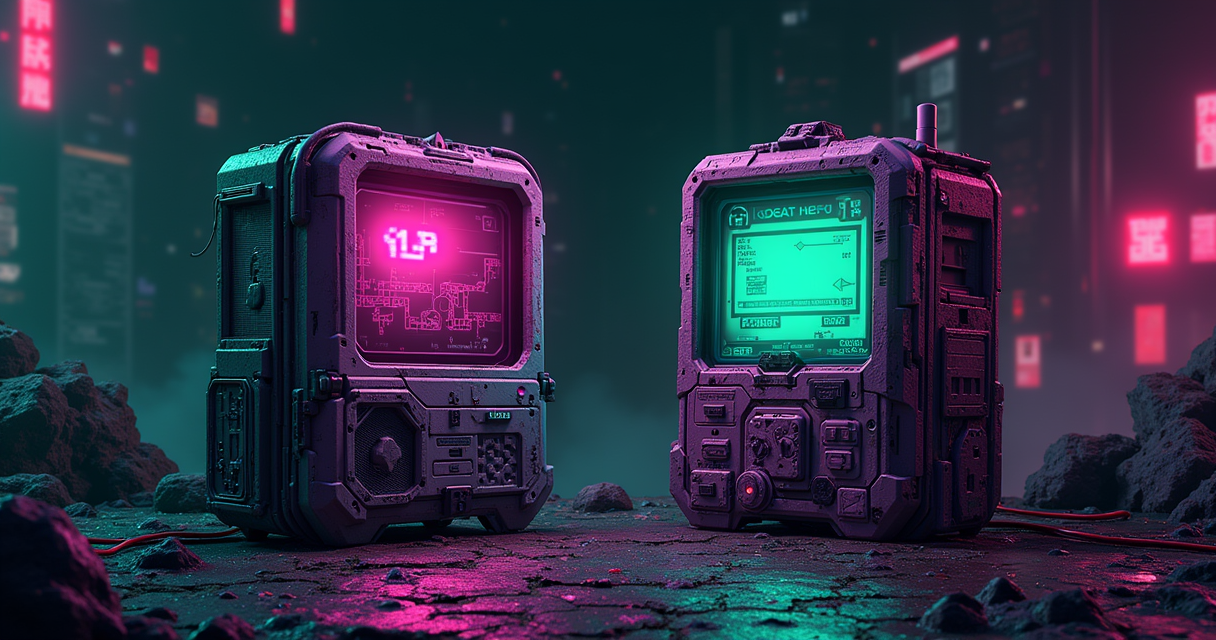
Two Retroid handhelds, one 5.5-inch AMOLED panel shared between them, and a $25 gap on the spec sheet. That is the comparison as most listings present it. It is also a lie of omission, because one of these two devices is a product you can buy and the other is a product Retroid killed. Everything below is written with that fact in the foreground, not buried in a footnote where the affiliate copy prefers it.
The Verdict, Up Front
The comparison you typed into a search bar has already been settled by a warehouse. As of July 2026, the Retroid Pocket 6 sells for $244 (listed at $249) and the Retroid Pocket G2 sells for exactly nothing, because you cannot buy one from Retroid. The company pulled the G2 from its own store on March 16, 2026 — roughly five months after it launched — and as of this writing it has not returned. So on the most basic level, Pocket 6 vs G2 is a fight between a device and a memory.
That does not make the question pointless. The G2 still exists in the wild, at a handful of third-party retailers and across the secondhand market, where its $219 retail price, cooler-running chip, and lighter shell make it a genuinely tempting orphan. And the reason it died — a global spike in memory prices that also forced Retroid to raise the Pocket 6's price and temporarily kill its 12GB model — is the single most important fact about buying either device in 2026. This is not a spec-sheet duel. It is a snapshot of a supply chain eating a product line.
The one-sentence answer
If you want the short version: buy the Pocket 6. Not because it is dramatically better at everything — it is not — but because it is the one you can actually purchase, it has the faster and far better-supported chip for anything harder than PlayStation 2, and its driver stack is years more mature. The G2 was the more interesting device and, arguably, the better raw value at $219. It is also discontinued, which is a hard flaw to design around.
Why this comparison is really an autopsy
The rest of this article does two things. First, it treats the G2 as a live option — because for anyone willing to buy secondhand, it is one — and tells you precisely where it beats the Pocket 6 and where it collapses. Second, it explains the economics that killed it, because those same economics are why the Pocket 6 costs $15 more than it did at launch, why its 12GB configuration vanished, and why it then reappeared in a worse form. You are not choosing between two products in a vacuum. You are choosing a position in a lineup that Retroid itself keeps rearranging in real time.
The 2026 DRAM Crunch That Killed the G2
Every honest Retroid comparison written in 2026 has the same villain, and it is not a rival brand. It is the price of LPDDR5X memory. Through late 2025 and into 2026, memory fabricators shifted capacity toward high-bandwidth memory (HBM) for AI-server accelerators, and the mobile-grade DRAM that goes into handhelds became scarce and expensive. Retroid builds to thin margins and sells largely direct, and it could not absorb the increase. The result was a cascade of price hikes and discontinuations across the entire Pocket line — and the G2 was the first thing thrown overboard.
What actually happened on March 16
On March 16, 2026, at roughly 9 PM EDT, the Retroid Pocket G2's product listing flipped to Sold Out and stayed there. Outlets including Notebookcheck, Android Authority, and Pocket Tactics reported it as a discontinuation, and Retroid's own explanation was blunt. Speaking to Android Authority's Andy Walker about the parallel Pocket 6 changes, the company said the recent surge in memory pricing had "reached a level that we are unfortunately unable to absorb," and that it "cannot continue offering the 12GB configuration at a reasonable price." The same wave of decisions that raised the Pocket 6's price and cut its high-memory tier is what ended the G2 outright. This was not a quiet end-of-life for an aging product. It was a five-month-old device pulled mid-run because the bill of materials moved underneath it.
The Pocket 6 didn't escape either
It would be comforting to assume the Pocket 6 sailed through untouched. It did not. The RP6 launched on October 27, 2025 at pre-order prices of $209 (8GB/128GB) and $259 (12GB/256GB), with retail pricing set at $229 and $279. On March 2, 2026 — two weeks before the G2 died — Retroid raised the 8GB model by $15 to $244 and discontinued the 12GB/256GB configuration entirely. The Gadgeteer summarized it in a headline four months into the device's life: the Pocket 6 was now $244. The 12GB option limped back in June 2026, but as a 12GB/128GB part at $279, not the original 12GB/256GB. If you have been comparing prices across a few weeks and getting different numbers, this is why. The prices are a moving target because the memory market is one.
The G2 never really fit the lineup
There is a second reason the G2 was the one to die, and it is not purely economic. Retro Handhelds, covering the discontinuation, observed that the G2 "never really seemed to 'fit' anywhere in Retroid's lineup." It sat between the older Pocket 5 below it and the Pocket 6 above it, separated from both by only a small price gap — we ran the full Pocket 5 versus Pocket 6 math elsewhere, and the G2 was jammed into the seam between them. When memory prices forced Retroid to trim, the device with the least distinct reason to exist went first. The slot it vacated is now filled by the Retroid Pocket Nova, a $229 4:3-screened machine we cover in our Pocket 6 versus Nova breakdown. Read that sequence carefully and a pattern emerges: the G2 was not killed for being bad. It was killed for being redundant during a shortage.
Specs, Head to Head
Here is the full spec comparison. Two rows in it are traps that most tables get wrong, so read the notes underneath before you draw conclusions. The "supported systems" and "save states / netplay / shaders" rows are identical between the two devices, because those are functions of the emulator software, not the hardware. Both run the same Android emulators. The silicon only decides how high you can push accuracy, resolution, and shaders before the frame rate breaks.
The full comparison table
| Feature | Retroid Pocket 6 | Retroid Pocket G2 |
|---|---|---|
| Released | Oct 27, 2025 | Oct 28, 2025 |
| Launch price (8/128) | $209 pre-order → $229 retail | $199 pre-order → $219 retail |
| Price (July 2026) | $244 (listed $249) | Discontinued — secondhand only |
| Availability | On sale | Pulled March 16, 2026 |
| SoC | Snapdragon 8 Gen 2 (TSMC 4nm, 2022) | Snapdragon G2 Gen 2 (4nm-class) |
| GPU | Adreno 740 (~680 MHz) | Adreno A22 |
| RAM | 8GB or 12GB LPDDR5X | 8GB LPDDR5X |
| Storage | 128GB or 256GB UFS 3.1 + microSD | 128GB UFS 3.1 + microSD |
| Display | 5.5" AMOLED 1920×1080 | 5.5" AMOLED 1920×1080 |
| Refresh rate | 120 Hz | 60 Hz |
| Battery | 6000 mAh / 27W | 5000 mAh |
| Video out | USB-C DisplayPort, up to 4K60 | USB-C DisplayPort |
| Android version | 13 | 15 |
| Wi-Fi / Bluetooth | Wi-Fi 7 / BT 5.3 | Wi-Fi 6 / BT 5.4 |
| Sticks / triggers | Hall-effect / analog L2-R2 | Hall-effect / analog L2-R2 |
| Cooling | Active fan | Cooling solution listed |
| Weight | 320 g | 280 g |
| Dimensions | 210.4 × 86.6 × 17.2 mm | 199.2 × 78.5 × 15.6 mm |
| Supported systems (software) | Identical — same Android emulators | Identical — same Android emulators |
| Save states / netplay / shaders | Yes (emulator-level) | Yes (emulator-level) |
| Comfortable emulation ceiling | Switch (select), PS2 ~2x, GC 3x | PS2 ~2.5x, GC, PSP 4x; Switch unstable |
| Geekbench 6 single-core | ~1,985 | ~+50% over SD865 (≈10% below RP6) |
Reading the table: what matters, what's marketing
Three rows decide this comparison and the rest are footnotes. The SoC and GPU rows decide everything above PlayStation 2. The refresh rate row (120Hz vs 60Hz) decides how the menus and lighter systems feel in the hand. The availability row decides whether you can buy the thing at all, and it is the one the marketing never puts up top. Everything else — the 40-gram weight difference, Wi-Fi 7 versus Wi-Fi 6, Bluetooth 5.3 versus 5.4 — is real, measurable, and will not change your day.
The specs that actually diverge (and the inversions)
Note the inversions, because they are the fun part. The cheaper, discontinued G2 ships Android 15; the pricier, current Pocket 6 ships Android 13. The G2 is the lighter and smaller device by 40 grams and roughly 11 millimeters of length. Both use Hall-effect analog sticks and analog L2/R2 triggers — this is not a Pocket 6 exclusive, whatever a spec sheet implies — and both ship with a cooling solution, though the Pocket 6's is an active fan sized for the hotter 8 Gen 2. The only memory-tier advantage the Pocket 6 holds is the optional 12GB variant, and as covered above, that variant has been discontinued and revived once already this year. If a comparison hands the Pocket 6 a clean sweep, it has not been paying attention.
The Silicon: 8 Gen 2 vs G2 Gen 2
This is where the marketing wants you to get the wrong idea, so slow down. The Pocket 6 runs a Qualcomm Snapdragon 8 Gen 2, a flagship phone chip from late 2022 with the Adreno 740 GPU. The G2 runs a Qualcomm Snapdragon G2 Gen 2, a newer part from Qualcomm's dedicated handheld-gaming G-series, with an Adreno A22 GPU. Yes, the Retroid Pocket G2 runs a Snapdragon G2 Gen 2; the naming is a coincidence, and it is the least confusing thing about this pairing.
"Newer" is not "faster"
The instinct is to assume the newer chip wins. It does not. Both are 4nm-class TSMC parts, so the process-node bragging is a wash — nobody gets to claim a manufacturing advantage here. What separates them is tier: the 8 Gen 2 was a top-of-the-line phone SoC, and the G2 Gen 2 is a mid-tier gaming SoC built to a price. Ban of Retro Handhelds, who measured both, put the G2 Gen 2's single-core performance at roughly 50% above the Snapdragon 865 (the chip in the older Pocket 5) but about 10% below the 8 Gen 2. The "newer" chip is measurably slower than the "older" one in the device it is being compared against. That is the whole ballgame, stated in one sentence.
Adreno 740 vs Adreno A22
The GPU story runs parallel. The G2 Gen 2's Adreno A22 is a real step up from the Pocket 5's Adreno 650 — roughly twice the graphics muscle of the 865, by the same measurements — but it lands, in Ban's testing, "8 to 10% behind the Adreno 740" in the Pocket 6. So on paper the Pocket 6 holds a high-single-digit to low-double-digit lead in both CPU and GPU. That gap is not enormous. In many retro workloads you will never see it. But it is real, it is consistent, and it points the same direction every time: up, toward the older chip.
The driver moat
Raw numbers undersell the Pocket 6's actual advantage, which is software, not silicon. The Adreno 740 has been in flagship phones since 2022, which means it has years of driver optimization behind it — including the open-source Turnip Vulkan drivers that the emulation community leans on for demanding systems. As HandheldRank put it, the 8 Gen 2 "has years of driver optimization," while "the G2's newer GPU lacks that maturity." A newer GPU with immature drivers is a liability, not a feature, and it is the reason the next section reads the way it does.
Benchmarks and Real-World Performance
Synthetic scores set the ceiling; reviewers tell you where the floor is. Here is what three independent testers actually measured, alongside the numbers, because a comparison that cites only one source is a press release with extra steps.
The synthetic numbers
In Geekbench 6, the Pocket 6 posts a single-core score of roughly 1,985. For scale, the Pocket 5's Snapdragon 865 scores about 1,176 on the same test, which makes the 8 Gen 2 around 69% faster than the previous Retroid flagship — not the "~50%" some spec briefs claim. The G2 Gen 2, measured at about 50% over that same 865, lands in the neighborhood of 1,760 single-core: strong, clearly a generational jump over the Pocket 5, and still roughly 10% shy of the Pocket 6. On the GPU side, the Adreno 740's 8-to-10% lead over the A22 holds across synthetic graphics tests. None of this is close enough to be dramatic, and none of it favors the G2.
What three reviewers actually measured
Numbers in isolation lie, so here are the humans. Ban at Retro Handhelds ran the G2 hard and concluded, in the plainest verdict in this entire article: "If it were my money, would I buy the G2? No." Noah Kupetsky at Steam Deck HQ was warmer on the hardware but reached a similar place, calling the G2 a device "let down only by the next handheld coming so soon" — that next handheld being the Pocket 6 — while measuring genuinely good numbers: PSP at 4x native, PS2 around 2.5x, and PS3 emulation that was "not enjoyable." On the Pocket 6 side, Brandon Saltalamacchia at RetroDodo scored it 8.4/10, with PS2 running at 1.5x to 2x native and GameCube at 3x, and called it "a perfect, yet slightly dull Android handheld" that "played it too safe to turn heads."
The Turnip catch-22 (where the G2 breaks)
Now the specific failure mode. On Nintendo Switch emulation, HandheldRank is unambiguous: "The RP6 wins here, and it's not close." The reason is the driver moat from the previous section, and it manifests on the G2 as a genuine catch-22. On the G2's stock GPU drivers, Switch titles glitch visually; switching to Turnip drivers fixes the glitches but tanks performance to unplayable, because Turnip is not yet optimized for the A22. There is no configuration where the G2 does Switch well. The same immaturity leaks into ordinary Android apps: HandheldRank's list of what breaks on the G2 reads like a shrug — "Netflix games? Nope. Certain big Android games? Nope. Fortnite? Nope." Their bottom line is the one to remember: "The RP6 is the safer long-term bet if you care about Switch and PC emulation."
Emulation, System by System
Enough abstraction. Here is how the two devices behave per platform, because "more powerful" means nothing until it means Metroid Prime at 3x runs and God of War II does not stutter. One structural note first: both machines run the same emulators — RetroArch plus standalone cores like NetherSX2, Dolphin, PPSSPP, and the various 3DS and Switch forks — so if you are setting either up from scratch, our RetroArch cores walkthrough applies identically to both.
Everything up to PS2: the G2's home turf
Through the sixth generation, these devices are close, and the G2 is genuinely excellent. PS1, PSP, Dreamcast, and the 8- and 16-bit libraries run at 4x internal resolution on either machine with power to spare; both are wild overkill for anything up to the Sega Saturn. PS2 is the interesting line. Kupetsky measured the G2 pushing PS2 at roughly 2.5x native, while Saltalamacchia measured the Pocket 6 at 1.5x to 2x on his test titles — different reviewers, different games, different tolerance for the odd dropped frame, so do not read that as the G2 beating the Pocket 6. Read it as both being strong PS2 machines. For a buyer whose ceiling is PS2, the G2's lighter body and cooler chip are, if anything, the nicer package. This is precisely the tier where losing the G2 stings.
GameCube, Wii, and 3DS
One step up, the Pocket 6's headroom starts to matter. RetroDodo ran GameCube at 3x native on the Pocket 6, with games like F-Zero GX comfortable around 2x, and 3DS titles upscaled cleanly. The G2 handles GameCube too, but with less margin — you will spend more time in the per-game settings, dialing upscaling down to hold a stable frame rate, exactly the "tinkering" both camps' reviewers flag. Wii is playable on both with the usual motion-control caveats. Neither device is a magic bullet here; the Pocket 6 simply gives you more slack before you have to compromise.
Switch and the hard ceiling
Switch is where the two diverge for good, and it is covered above: the Pocket 6 runs a curated set of Switch titles thanks to mature drivers, and "wins, and it's not close." The G2's driver situation makes Switch a frustrating non-starter. Above Switch, both devices hit the same wall — PS3 (RPCS3) and Xbox 360 emulation are a slideshow on either, and if that is your goal, neither of these is your device. The Pocket 6 is a sixth-generation-and-earlier machine that dabbles in Switch; the G2 is a sixth-generation-and-earlier machine that does not. Buy accordingly.
Display, Battery, and I/O
The two devices share a panel and diverge on nearly everything around it. This is the section where the Pocket 6 earns its price premium in ways that have nothing to do with the chip.
120Hz vs 60Hz on the same panel
Both use the same 5.5-inch 1920×1080 AMOLED, and it is a lovely display on either device — Saltalamacchia said the Pocket 6's screen "makes the device feel incredibly modern" and called it one he "simply cannot fault," with no tearing and no light bleed. The difference is refresh rate: the Pocket 6 runs it at 120Hz, the G2 at 60Hz. For emulating fixed-60Hz and fixed-50Hz consoles, that gap is mostly cosmetic — a PS2 game does not care about your panel's ceiling. Where 120Hz earns its keep is the Android front-end, high-refresh native Android games, and the general sense that the menus glide. It is a quality-of-life upgrade, not a performance one, and you should price it as such.
6000mAh vs 5000mAh
The Pocket 6 carries a 6000mAh cell with 27W charging; the G2 carries 5000mAh. On the Pocket 6, RetroDodo measured around 4.5 hours of mixed use, stretching to 6–8 hours on light 2D systems and dropping to 2.5–3 hours under full-tilt PS2 and GameCube loads. The G2's smaller battery feeds a lower-power chip, so real-world endurance lands in a broadly similar band despite the 20% capacity deficit — a cooler, slower SoC is easier on a battery. The Pocket 6's advantage is the larger reserve plus faster top-ups; neither device is an all-day machine at full performance, and anyone who tells you otherwise is quoting the SNES number.
Video out and the desktop question
The Pocket 6 confirms USB-C DisplayPort output up to 4K at 60fps, which turns it into a passable living-room emulation box with a controller and a dock. The G2, built on the Pocket 5's chassis and I/O, also does DisplayPort-over-USB-C, though it is the less-documented of the two and you should not expect it to match the Pocket 6's 4K60 headroom. If TV-out is central to your plan, the Pocket 6 is the safer pick — and if you are seriously building a docked, big-screen setup, honestly consider whether a dedicated Batocera box serves you better than either handheld. A phone chip driving a 4K panel is a compromise; a mini-PC is not.
Software, Drivers, and the Android Inversion
Here is the single strangest line on the spec sheet: the cheaper, discontinued device runs the newer operating system. The G2 ships Android 15; the Pocket 6 ships Android 13. This surprises people, so it is worth explaining rather than hand-waving.
Why the cheaper device runs newer Android
The Android version a Retroid handheld ships with is tied to the board-support package for its specific SoC, not to the device's market position or price. The G2 Gen 2 is a newer Qualcomm part, and it arrived with a newer Android base image; the 8 Gen 2, despite being the more powerful chip, launched on an older BSP that Retroid built the Pocket 6 around. In practice, the version gap changes very little for emulation — RetroArch and the standalone cores behave the same across Android 13 and 15 — but it is a useful reminder that "newer software" and "faster hardware" are separate axes, and the G2 quietly wins the first while losing the second. It is the kind of inversion that makes a spec sheet interesting and a buying decision harder.
The emulator stack is identical (and legal)
This is why the "supported systems," "save states," "netplay," and "shaders" rows in the table are identical: those are features of the emulators, and both devices run the same ones. Save states, RetroArch netplay, and shader passes from a simple scanline to a full CRT-Royale stack are available on both; the only difference is that the Pocket 6's extra GPU headroom lets you stack heavier shaders at 120Hz before the frame rate sags. And since we are on the subject: the emulators themselves are legal. The governing precedent is Sony Computer Entertainment, Inc. v. Connectix Corp., 203 F.3d 596 (9th Cir. 2000), in which the Ninth Circuit found Connectix's PlayStation emulator "modestly transformative" and its reverse-engineering a fair use. The software is settled law. The ROMs of games you do not own are the liability, and that liability is identical on both devices, because — say it with me — it is the same software.
Pricing and Availability
Pricing is the most volatile part of this comparison, so here it is laid out with dates, because a single number is useless when the number keeps moving.
The price history that matters
| Configuration | Launch (Oct 2025) | Mid-2026 | Status |
|---|---|---|---|
| Pocket 6 — 8GB / 128GB | $209 pre → $229 retail | $244 (listed $249) | On sale |
| Pocket 6 — 12GB / 256GB | $259 pre → $279 retail | — | Discontinued Mar 2, 2026 |
| Pocket 6 — 12GB / 128GB | Not offered | $279 | Revived Jun 2026 |
| Pocket G2 — 8GB / 128GB | $199 pre → $219 retail | Secondhand only | Discontinued Mar 16, 2026 |
What you'll actually pay in mid-2026
New, from Retroid, your only option is a Pocket 6: $244 for 8GB/128GB (the listing shows $249), or $279 for the revived 12GB/128GB. The 256GB configuration is gone for now. The G2 is not sold new by Retroid at all; if you want one, you are shopping third-party leftover stock or the secondhand market, where you should expect to pay somewhere around its $219 retail price — sometimes less for used, occasionally more from a scalper trading on scarcity, which would be a comedy given the device is a discontinued mid-tier handheld. Do not pay a premium for an orphan. The whole appeal of the G2 is that it was cheap.
The wider point: the roughly $25–$30 gap the spec sheets advertise is a snapshot of a market in motion. Both devices are more expensive than they were at launch or, in the G2's case, unavailable entirely. Budget for the number in front of you today, not the one a comparison article quoted in January.
Who Each One Is For
Specs are inputs; use cases are the output. Here is who each device actually suits, framed as the buyers most likely to be reading this.
Buy the Pocket 6 if…
You want Switch or lean toward the demanding end. If your library includes select Switch titles, heavier GameCube and Wii, or you simply want the most driver-proof machine for the next few years, the Pocket 6 is the only correct answer — HandheldRank's "safer long-term bet" line exists for you. You want a docked, big-screen setup. The confirmed 4K60 DisplayPort output makes the Pocket 6 the better couch machine of the two. You want to buy something new, today, with a warranty. This is the decisive one: the Pocket 6 is purchasable and supported, and the G2 is neither. For most people asking this question in 2026, that ends the discussion.
Hunt down a G2 if…
Your ceiling is PS2 and you value a light, cool, cheap machine. The G2 at $219 is a superb sixth-generation-and-earlier handheld — PSP at 4x, PS2 around 2.5x, a lovely AMOLED, 40 grams lighter than the Pocket 6, and a chip that runs cooler because it is asking less of itself. If you will never touch Switch, you are not missing the thing the G2 can't do. You are a tinkerer who enjoys an orphan. There is a specific pleasure in adopting a discontinued device and squeezing it dry, and the G2 rewards it. Just buy it secondhand at or below its old retail price, go in knowing the software support ended early, and read Kupetsky's warm-but-cautious Steam Deck HQ review before you commit.
Consider neither if…
You mostly stream. If your real plan is PS5 Remote Play or cloud gaming, the emulation ceiling barely matters — any modern Retroid drives a stream fine, and you should read our 1080p Remote Play setup before spending flagship money on horsepower you won't use (the Pocket 6's 120Hz is the only real streaming edge here). You want a 4:3 retro machine or a docked powerhouse. The Retroid Pocket Nova's 4:3 screen is a better fit for pre-widescreen libraries, and a Batocera mini-PC is a better fit for a permanent living-room rig. These are the two use cases where the Pocket-6-versus-G2 question is the wrong question entirely, and pretending otherwise would just be selling you a handheld.
Migrating From a G2 (or Any Older Pocket)
Say you already own a G2 — or a Pocket 5, or a Pocket 4 Pro — and you are stepping up to the Pocket 6. Because these are all Android devices running the same emulators, migration is a file-copy job, not a reinstall-and-reconfigure marathon. Here is how to move everything that matters without losing a single save.
The data you actually need to move
Four things: your ROMs, your emulator saves (the in-game battery/memory-card files), your save states (the emulator snapshots), and your configs (control mappings, per-core settings, shader presets). ROMs are usually on the microSD card, so if both devices share one, that part migrates by moving the card. Saves and states are the ones people lose, because RetroArch and each standalone emulator store them in their own folders. Copy those folders explicitly and you keep your progress; skip them and you start every game over. Note that standalone emulators — NetherSX2 for PS2, Dolphin for GameCube — keep their saves in their own directories, separate from RetroArch, so back those up individually.
Step by step
- On the old device, enable Developer Options and USB debugging, or just mount its storage to a PC.
- Back up RetroArch's
saves,states, andconfigfolders, plus each standalone emulator's own save folder. - Move the microSD card (or copy the ROM library) to the Pocket 6.
- Install the same emulators on the Pocket 6 and restore the backed-up folders into matching paths.
- Re-scan your ROM directories in RetroArch, then spot-check one save and one save state per system before you wipe the old device.
The illustrative adb version, run from a PC with the old device connected (paths are examples — confirm yours):
# Back up from the OLD device (G2 / Pocket 5)
adb pull /sdcard/RetroArch/saves   ./backup/saves
adb pull /sdcard/RetroArch/states  ./backup/states
adb pull /sdcard/RetroArch/config  ./backup/config
# Standalone emulators keep their own saves - grab them too
adb pull /sdcard/Android/data/xyz.aethersx2.android ./backup/ps2

# Restore to the NEW device (Pocket 6)
adb push ./backup/saves   /sdcard/RetroArch/saves
adb push ./backup/states  /sdcard/RetroArch/states
adb push ./backup/config  /sdcard/RetroArch/config
adb push ./backup/ps2     /sdcard/Android/data/xyz.aethersx2.android
Verify before you factory-reset the old unit. A save state that opens on the G2 is not guaranteed to open on the Pocket 6 if the emulator version differs, so test, do not assume. This is the one place a five-minute check saves you a lost playthrough.
The Final Call
Two pros/cons ledgers, then the recommendation with its one honest caveat.
Pros and cons, both devices
| Retroid Pocket 6 — Pros | Retroid Pocket 6 — Cons |
|---|---|
| Faster 8 Gen 2 + Adreno 740, ~10% ahead in CPU/GPU | Now $244, up $15 from launch |
| Mature Turnip drivers; wins Switch "and it's not close" | Runs Android 13 — older than the G2 |
| 120Hz AMOLED, 6000mAh, confirmed 4K60 output | Heavier (320g) and runs hotter |
| Optional 12GB tier; actually in stock | "Slightly dull"; 12GB config keeps vanishing |
| Retroid Pocket G2 — Pros | Retroid Pocket G2 — Cons |
|---|---|
| $219, lighter (280g), cooler-running chip | Discontinued March 16, 2026 — secondhand only |
| Android 15; excellent up to PS2 (2.5x) | ~10% slower CPU, GPU 8–10% behind Adreno 740 |
| Same lovely 5.5" AMOLED; 60Hz is fine for retro | Switch unstable; the Turnip catch-22 |
| Genuinely strong value at launch | App breakage; no driver history; never fit the lineup |
The recommendation, with the caveat
For anyone buying new, this is not close: the Retroid Pocket 6 at $244 is the only rational purchase. It is faster where it counts, it is the safe bet for Switch and PC emulation, and — the argument that ends every other argument — it is a device Retroid still sells and supports. The G2 lost this comparison not on the bench but at the warehouse.
Here is the caveat the data earns. If you find a Retroid Pocket G2 secondhand, at or below its old $219, and your library genuinely stops at PS2, you are not making a mistake. You are buying the lighter, cooler, cheaper machine that reviewers liked right up until the moment its successor and the memory market ganged up on it. Ban would not spend his own money on it; you might reasonably spend a smaller amount of yours. Just go in clear-eyed: you are adopting an orphan, the software support ended early, and the reason it is cheap is the reason it is discontinued. For everyone else — which is almost everyone — buy the Pocket 6, and check the price the day you order it, because in 2026 that number does not hold still.
Questions the search bar asks me
- Can I still buy the Retroid Pocket G2 in 2026?
- Not new from Retroid. The G2 was pulled from sale on March 16, 2026 — about five months after its October 2025 launch — officially because of the 2026 memory-price surge, and it has not returned as of July 2026. Your only options are leftover third-party stock or the secondhand market, ideally at or below its old $219 retail price.
- Is the Pocket 6's Snapdragon 8 Gen 2 really faster than the G2's newer G2 Gen 2?
- Yes. Despite being a 2022 phone chip, the 8 Gen 2 measures roughly 10% faster in single-core than the G2 Gen 2, and its Adreno 740 GPU sits about 8–10% ahead of the G2's Adreno A22 (Retro Handhelds testing). Both are 4nm-class parts, so the G2 being 'newer' buys it nothing on the bench.
- Which one is better for Nintendo Switch emulation?
- The Pocket 6, decisively — HandheldRank's verdict is 'The RP6 wins here, and it's not close.' The 8 Gen 2 has mature Turnip drivers, while the G2's newer GPU does not: its stock drivers glitch Switch titles, and switching to Turnip fixes the glitches but drops performance to unplayable.
- Why does the cheaper G2 run newer Android than the flagship Pocket 6?
- Because the Android version is tied to each chip's board-support package, not to price or market position. The G2 Gen 2 shipped on Android 15's base image while the 8 Gen 2 launched on Android 13. It changes almost nothing for emulation — RetroArch and the standalone cores behave the same on both.
- Is it legal to emulate games on these handhelds?
- The emulators are legal. In Sony Computer Entertainment, Inc. v. Connectix Corp., 203 F.3d 596 (9th Cir. 2000), the Ninth Circuit found a PlayStation emulator 'modestly transformative' and its reverse-engineering a fair use. What creates liability is ROMs of games you do not own — and that risk is identical on both devices, because they run the same software.

Casey writes about speedrunning, tool-assisted runs, and the strange engineering of going fast in old games. Every post under this byline is reviewed pre-publish by Sam P., Editor & Operator — corrections to info@instalinkoteam.com. Published 2026-08-29 · Last updated 2026-08-29. Full bios on the author page.