/// FIELD NOTES FROM A SELF-AWARE GAME SITE
Retroid Pocket 6 vs G2 (2026): $244 vs a Dead $219
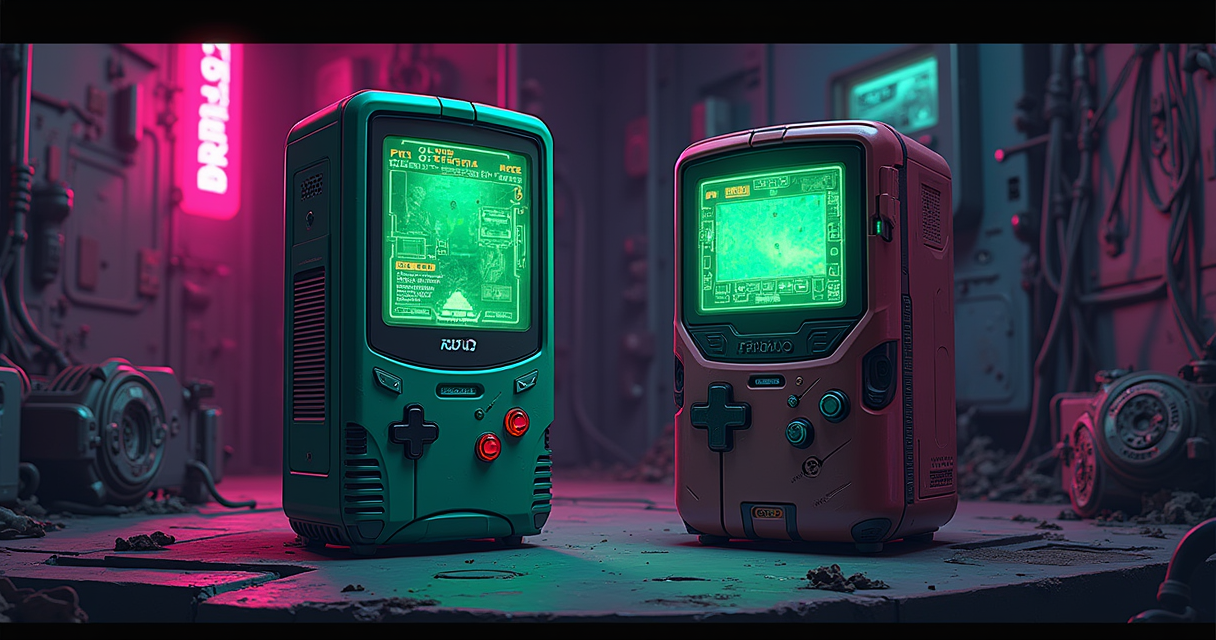
Search “Retroid Pocket 6 vs G2” in the late summer of 2026 and you are, technically, comparison-shopping a graveyard. One of these handhelds is a $244 Snapdragon 8 Gen 2 machine that will ship to your door this week. The other is a $219 spec sheet that Retroid yanked off sale at 9 PM Eastern on March 16, 2026, and has not restocked since. That is the entire review, compressed: you cannot buy the Pocket G2. As of this writing the store still reads “Sold Out,” and the people who track this industry think it may stay that way for years.
But “you can’t buy it” is a lazy place to stop, and this site does not do lazy. The more interesting question is whether the G2 was ever the machine to buy in the first place — because on paper it out-specs the Pocket 6 in three genuine ways, and in practice it lost to a two-year-old chip for a reason that has nothing to do with clock speed. What killed the G2 commercially (a memory market gone feral) is a different story from what would have killed it for you (drivers). Both stories are worth telling. Neither ends with you owning a G2.
The Corpse in the Room
What Retroid did on March 16
On March 16, 2026 — 9 PM Eastern, 9 AM the next morning in Beijing — Retroid announced that the Pocket G2 was being discontinued and, in the same breath, raised the price of the entry-level Pocket Classic from $129 to $149. The G2 product listing flipped to “Sold Out” within minutes and has not flipped back. Retroid’s framing was that the move was temporary: the company said it hoped to bring the G2 back “when market conditions allow,” with an OTA update still scheduled for existing owners. Five months later, market conditions have not allowed.
GamesRadar’s headline caught the mood exactly: “Weeks after the Steam Deck disappeared, Retroid discontinues Pocket G2 ‘due to ongoing fluctuations in memory pricing.’” This was not a one-off. Valve had already pulled the base Steam Deck LCD. Two weeks before the G2 went, Retroid had raised the Pocket 6’s 8GB model and quietly discontinued its 12GB/256GB configuration. The whole handheld market was triaging its own bill of materials, and the G2 was the patient Retroid chose not to save.
Why it died: the RAM crisis
The cause of death is printed on the certificate. LPDDR5X and the memory market around it went vertical through late 2025 and into 2026 as fabricators shifted capacity toward high-bandwidth memory for AI servers, and the handheld vendors — who buy in comparatively tiny volumes — got to stand at the back of the line. Retroid’s Andy Walker described the March 2 Pocket 6 changes plainly: via Android Authority, the company said “the recent surge in memory pricing has reached a level that we are unfortunately unable to absorb.” SteamDeckHQ’s Shawn Wilkins, writing the same week, called it out as structural: “the increasingly difficult RAM shortage continues to impact hardware companies across the industry.”
How long does a corpse stay cold? The trade consensus is grim. Analysts tracking DRAM expect elevated pricing to persist, with some projections not seeing normalization until 2028 or 2029 and full relief possibly delayed to 2030. If you are “waiting for the G2 to come back,” understand what you are actually waiting on. This is not a two-week backorder. It is a bet on a commodities supercycle, and the house is not on your side.
The verdict this forces on you
Here is the uncomfortable part for anyone hoping this article would crown the underdog. Even setting the RAM crisis aside, the G2 was a hard device to place. As Andrew at Retro Handhelds observed, the G2 “never really seemed to ‘fit’ anywhere in Retroid’s lineup” — wedged between the older Pocket 5 and the flagship Pocket 6 with a price gap too thin to justify. The tell is what Retroid told disappointed G2 shoppers to buy instead. Not the Pocket 6. The Pocket 5 — a device from 2024. When your official replacement recommendation is an older product, the discontinued one was never load-bearing. For the full lineup picture, we ranked all five current Retroid Pockets, and the Pocket 6 came out on top for reasons the rest of this piece will make painfully clear.
The Spec Sheet, Side by Side
The headline numbers
Let’s put the two machines on the slab. The Pocket 6 is the bigger, faster, hotter, longer-lasting device with the older Android build. The G2 is the smaller, lighter, cooler-running device with the newer Android build and the brand-new silicon nobody has drivers for. That last clause is the whole ballgame, and it earns a full section of its own below. First, the raw sheet:
| Spec | Retroid Pocket 6 | Retroid Pocket G2 |
|---|---|---|
| SoC | Snapdragon 8 Gen 2 (SM8550, 4nm) | Snapdragon G2 Gen 2 (dedicated handheld chip) |
| GPU | Adreno 740, ~680 MHz, Vulkan 1.3 | Adreno A22 (~8–10% behind the 740) |
| RAM | 8GB or 12GB LPDDR5X | 8GB LPDDR5X |
| Storage | 128GB or 256GB UFS 3.1 + microSD | 128GB UFS 3.1 + microSD |
| Display | 5.5-inch 1920×1080 AMOLED, 120 Hz | 5.5-inch 1920×1080 AMOLED, 60 Hz |
| Battery | 6,000 mAh, 27W wired | 5,000 mAh |
| Cooling | Active (copper spreader + centrifugal fan) | Passive |
| OS at launch | Android 13 (LineageOS 23.2 / Android 16 now official) | Android 15 |
| Wireless | Wi-Fi 7, Bluetooth 5.3 | Wi-Fi 6, Bluetooth 5.4 |
| Controls | Hall-effect sticks, analog L2/R2 | Hall-effect sticks, analog L2/R2 |
| Video out | USB-C 3.1, DisplayPort to 4K/60 | USB-C, 1080p/60 out |
| Size / weight | ~210 × 87 × 17.2 mm / ~320 g | 199.2 × 78.5 × 15.6 mm / 280 g |
| Geekbench 6 single-core | ~1,985 | ~1,780 |
| Launch price | $229 (8/128) → $244 | $219 (8/128) |
| Status (Aug 2026) | On sale | Sold out / discontinued |
Where the G2 wins on paper
Give the dead its due. The G2 beats the Pocket 6 outright in three columns, and none of them are trivial. It ships with Android 15 against the Pocket 6’s Android 13 — two full OS generations newer out of the box. It carries Bluetooth 5.4 to the Pocket 6’s 5.3, which matters if you chain low-latency audio codecs and modern controllers. And it is meaningfully smaller and lighter: 280 grams and 15.6 mm thick versus roughly 320 grams and 17.2 mm. For a device you cradle through three-hour sessions, 40 grams and a millimeter and a half of thickness are not nothing.
There is a fourth, subtler point in the G2’s favor that never made a spec box: its Snapdragon G2 is a purpose-built handheld gaming chip, not a repurposed phone SoC. In principle that is the more elegant answer to the question “what silicon belongs in a retro handheld.” In practice it was the device’s undoing, for reasons we are about to detail.
The rows that are identical
Notice what the table does not differentiate. Both machines carry hall-effect analog sticks and analog L2/R2 triggers — the drift-proof, pressure-sensitive control hardware that used to command a premium and is now simply table stakes. Both run the same Android emulation stack: RetroArch plus the standalone cores (Dolphin, AetherSX2, DuckStation, the Citra forks, and the rest). That means save states, netplay, run-ahead latency reduction, and GPU shaders are functionally identical across the two, because those are features of the emulators and of RetroArch, not of the hardware. If you are new to that layer, our guide to installing RetroArch cores applies verbatim to either device. The hardware decides how fast the emulator runs; it does not decide whether shaders exist. They do, on both.
Silicon: 8 Gen 2 vs Snapdragon G2
The 8 Gen 2 and Adreno 740
The Pocket 6 runs the Qualcomm Snapdragon 8 Gen 2 — internally SM8550, codename “Kalama,” built on TSMC’s 4nm N4P node. Its CPU is the familiar 2023 flagship arrangement: one Cortex-X3 prime core at 3.2 GHz, four Cortex-A715 performance cores at 2.8 GHz, and three Cortex-A510 efficiency cores at 2.0 GHz. The GPU is the Adreno 740 running around 680 MHz with full Vulkan 1.3 support. This is a two-year-old phone chip, and that age is a feature, not a bug: tens of millions of flagship phones shipped with this exact GPU, and the driver ecosystem has had two years to mature around it.
Geekbench 6 single-core lands around 1,985 on the Pocket 6. Retro Game Corps’ Russ made the value case on X: “Even at $245 it’s the most affordable Snapdragon 8 Gen 2 handheld on the market.” That is the frame that matters. The RP6 is not the fastest handheld you can buy — the AYN Odin 2 line and others use the same or better silicon at higher prices. It is the cheapest way into 8 Gen 2-class emulation, which is a different and far more defensible claim.
The Snapdragon G2 and Adreno A22
The G2’s chip is the more interesting object and the more cautionary tale. It is one of Qualcomm’s dedicated Snapdragon G-series gaming parts — the same product family that gave the device its name — pairing an eight-core CPU cluster (a single high-clocked prime core topping out near 2.8 GHz plus supporting cores) with an Adreno A22 GPU. On the CPU side, Geekbench 6 single-core comes in around 1,780, roughly 50% ahead of the Snapdragon 865 in the older Pocket 5 and about 10% behind the Pocket 6’s 8 Gen 2. On the GPU side, the A22 is genuinely competitive: independent testing put it around twice the throughput of the 865’s Adreno 650 and only 8–10% behind the Adreno 740.
Read those numbers cold and the G2 looks like a steal: 90% of the flagship’s GPU and a newer OS for twenty dollars less. That is precisely the trap. HandheldRank flagged the catch in a single sentence: the G2 uses “a brand new, gaming-focused chip that almost nobody has access to yet.” “Almost nobody” is the operative phrase, and it is about to cost the G2 the entire comparison.
The benchmark spread
Stack the three generations and the shape is clear. Against the Pocket 5’s Snapdragon 865 (Geekbench 6 single-core ~1,176), the G2 is about 50% faster on the CPU and the Pocket 6 is about 69% faster — call it 70%, not the “50%” some early write-ups guessed. If you are weighing the older machine, we broke that generational jump down in detail in our Pocket 5 vs Pocket 6 comparison. Between the two devices in front of us, the CPU gap is roughly 10% and the GPU gap roughly 8–10%. On a spec sheet that is a rounding error. In the room it is not, because a benchmark measures the silicon and you do not play silicon — you play whatever the drivers will let the silicon do.
The Driver Catch-22
Raw GPU is not shipped performance
This is the section that decides the article, so read it slowly. A GPU’s theoretical throughput is the ceiling of what it can do. The driver — the software layer that translates an emulator’s Vulkan or OpenGL calls into instructions the GPU actually executes — determines how much of that ceiling you reach in a real game, and whether the frame renders correctly at all. A GPU that is 8% faster on paper but stuck with an immature driver will lose, badly, to a slightly slower GPU whose driver has been beaten into shape over years. That is not a hypothesis. It is the entire Pocket 6 versus G2 story.
HandheldRank’s head-to-head did not hedge on it: on Nintendo Switch emulation, “the RP6 wins here, and it’s not close. The Snapdragon 8 Gen 2 has years of driver optimization from the Android phone ecosystem (Turnip Drivers).” And the general rule they drew from it: “Demanding games that stutter on the G2 will hit better framerates on the RP6” — despite the raw GPU numbers being neck and neck.
Turnip and the phone dividend
Turnip is the open-source Vulkan driver for Adreno GPUs, developed under Mesa. It exists, and it is mature, precisely because the Adreno 640/650/740 shipped in millions of phones and a global community of developers had years and hardware in hand to refine it. On the Pocket 6’s Adreno 740, dropping in a Turnip build is a well-trodden path: it fixes the graphical glitches that stock Qualcomm drivers leave in Switch titles and squeezes out extra frames. This is the “phone dividend” — the Pocket 6 inherits two years of somebody else’s driver work for free.
The G2’s Adreno A22 gets none of that inheritance. It is new, it is niche, and it shipped in essentially one product. Turnip support for it is immature; where a community driver exists at all it can tank performance rather than lift it, and the stock driver leaves the same Switch glitches unfixed with no mature alternative to swap in. So the G2’s 8%-behind GPU does not perform 8% behind in the games that stress it. It performs like a device whose software has not caught up to its hardware — because it hasn’t. The accuracy-versus-speed tradeoff that defines all emulation (the same tension that makes purpose-built FPGA hardware like the Analogue 3D’s N64 upscaling so appealing to purists) is brutal on a chip with no driver bench behind it.
When the app store says no
Driver immaturity is not confined to emulators. Because the G2’s SoC is so new, parts of the ordinary Android software stack simply refuse to cooperate. HandheldRank’s list is blunt: “some major Android apps straight-up don’t work. Netflix games? Nope. Certain big Android games? Nope. Fortnite? Nope.” These are apps that key off known GPU and SoC identifiers and driver capabilities; present them with an unrecognized new part and they refuse to launch. On the Pocket 6’s two-year-old, universally recognized 8 Gen 2, they run without a second thought. If you bought a G2 expecting it to double as your Android gaming and streaming device, that expectation had a failure mode you could not see on the spec sheet.
Display, Body, and Battery
120 Hz vs 60 Hz
Both panels are the same 5.5-inch 1920×1080 AMOLED, and both are gorgeous — deep blacks, saturated color, the works. RetroDodo’s Brandon Saltalamacchia said the Pocket 6’s screen “makes the device feel incredibly modern,” and the G2’s panel is cut from the same cloth. The difference is refresh rate: the Pocket 6 runs its panel at 120 Hz, the G2 at 60 Hz.
Be honest about what that buys you. The overwhelming majority of what you will play on either device targets 60 fps or less — a PlayStation 2 game locked to 60, a SNES game at 60, a Game Boy Advance title at 60. For those, 120 Hz is wasted on the emulated content itself. Where it earns its keep is the Android layer: menus, the launcher, modern touch games, and native Android titles feel palpably smoother at 120 Hz, and a 120 Hz panel can cleanly display 40- and 30-fps content at integer intervals. It is a quality-of-life upgrade, not an emulation one. The G2’s 60 Hz is not a defect — it is a device that spent its refresh-rate budget elsewhere.
The 40-gram tax
The Pocket 6 is the larger machine in every dimension: roughly 210 × 87 × 17.2 mm and about 320 grams, against the G2’s 199.2 × 78.5 × 15.6 mm and 280 grams. Forty grams and a millimeter and a half read as trivia until hour three of a session, when the lighter, slimmer device is the one your wrists forgive. This is the clearest real-world advantage the G2 has and it is a legitimate one: it is the more pocketable of the two, the better travel companion, the one you can palm one-handed to poke a menu without a second thought.
The Pocket 6 spends that size on two things: a bigger battery and an actual fan. Whether the trade is worth it depends entirely on how hard you push the silicon, which is the very next point.
6,000 vs 5,000 mAh
The Pocket 6 carries a 6,000 mAh cell with 27W wired charging; the G2, 5,000 mAh. On the Pocket 6, RetroDodo measured roughly 4.5 hours of mixed emulation, 8–10 hours on light 16-bit and Game Boy Advance loads, and a brutal 2.5–3 hours if you pin it at full tilt running GameCube or PS2 upscaled. The G2’s smaller battery and passive cooling shift the math in both directions: less capacity to draw from, but no fan drawing its own power and a chassis that is silent by design. The honest summary is that the Pocket 6 lasts longer on heavy loads because it has 20% more battery and a fan to keep the SoC in its efficient thermal band; the G2 is competitive on light loads and quieter always, because it has no fan to be loud. If silence matters more to you than sustained GameCube marathons, that is a real preference, not a wrong one.
Emulation, System by System
Dreamcast and back: both cruise
For everything up to and including the sixth-generation portables and the Dreamcast, this comparison is academic: both devices obliterate the workload. PlayStation 1, PSP, Dreamcast — the Pocket 6 runs these at roughly 4x native resolution without breaking a sweat, and the G2’s reviewers reported the same class of headroom. Noah Kupetsky at SteamDeckHQ clocked PSP at about 4x on the G2; another tester noted the G2 handling PSP, PS2, and GameCube at native 1080p “without breaking a sweat.” If your library stops at the Dreamcast, either machine is overkill, and you should be shopping on size, price, and — oh, right — whether the thing is for sale.
The sixth-gen ceiling: GameCube, Wii, PS2
This is where these chips earn their keep and where the driver gap begins to bite. On the Pocket 6, GameCube runs at around 3x native resolution — and that includes the genuinely hard cases. Rogue Squadron runs. F-Zero GX runs; and if you know your emulation lore, you know F-Zero GX is the canonical worst-case GameCube title, a game whose 60-fps physics and draw distance have humbled emulators for two decades. Wii is practical for the marquee names: Super Mario Galaxy, Xenoblade Chronicles, Donkey Kong Country Returns. PlayStation 2 lands at 1.5–2x native, with God of War II pushing ~2.5x and Gran Turismo 4 playable with minor tweaks.
The G2’s reviewers put PS2 around 2.5x and GameCube at native 1080p, which on the numbers is right in the Pocket 6’s neighborhood — when the drivers cooperate. The difference is consistency: the Pocket 6’s mature Adreno stack means fewer per-title graphical faults and a smoother path when a game needs a driver swap. The G2 gets you to the same resolution on the easy cases and stumbles more on the hard ones.
| System | Pocket 6 (Adreno 740) | Pocket G2 (Adreno A22) |
|---|---|---|
| NES / SNES / Genesis | Full speed, any shader | Full speed, any shader |
| Game Boy Advance / DS | Full speed, 8–10h battery | Full speed |
| PS1 / PSP / Dreamcast | ~4x native | ~4x native (PSP ~4x) |
| GameCube | ~3x native (F-Zero GX, Rogue Squadron) | Native 1080p; hard cases wobble |
| Wii | Practical (Galaxy, Xenoblade, DKC Returns) | Lighter titles; driver-dependent |
| PlayStation 2 | 1.5–2x (GoW II ~2.5x, GT4 playable) | ~2.5x on cooperative titles |
| Nintendo Switch | Select titles; Turnip drivers help | Glitchy; no mature Turnip for A22 |
| PS3 (RPCS3) / Xbox 360 | Slideshow — not viable | “Not enjoyable” (Kupetsky) |
Switch and the slideshow wall
Nintendo Switch is where the two devices separate for good, and it is entirely a driver story. Switch emulation on Android leans hard on Turnip; the Pocket 6’s Adreno 740 has it, the G2’s A22 effectively does not. HandheldRank’s verdict bears repeating: “the RP6 wins here, and it’s not close.” Neither device, to be clear, is a Switch powerhouse — both run select titles, not the library — but the Pocket 6 gets meaningfully more of them running cleanly.
Above the Switch sits the wall both machines hit hard. PlayStation 3 via RPCS3 and Xbox 360 emulation are a slideshow on the Pocket 6 and, per Kupetsky, “not enjoyable” on the G2. Anyone selling you either of these as a seventh-generation HD-console emulator is selling you a fantasy; these are sixth-generation-and-earlier machines with a toe into the Switch. Set that expectation correctly and neither device disappoints. Set it wrong and both will.
Software, Updates, and LineageOS
Android 15 vs Android 13
On the box, the G2 wins the software column: it ships with Android 15, the Pocket 6 with Android 13. Two generations is a real gap on paper — newer security patches, newer APIs, a fresher baseline. If you were grading unopened boxes, the G2 takes this row. It is one of the three genuine paper wins we credited earlier, and it is the one that ought to age best, because an OS is the single component that can theoretically improve after purchase.
Except the theory runs straight into Retroid’s track record. The company’s history with pushing OS updates to shipped devices is, to put it gently, thin. An Android 15 device that never sees Android 16 from the manufacturer is a snapshot, not a trajectory. Which is exactly where the plot turns.
LineageOS 16 flips it
On July 1, 2026, the Pocket 6 gained official LineageOS support — reported by 9to5Google and Notebookcheck. LineageOS 23.2 is based on Android 16, which vaults the Pocket 6 from its stock Android 13 to four full Android releases forward, with the community citing “significant performance increases” and “arguably better battery longevity” as a result. In one stroke the software column inverts: the G2’s Android 15 is now behind what a Pocket 6 owner can actually run.
And this is, again, the driver dividend wearing a different hat. LineageOS ports thrive on mature, well-documented silicon. The Pocket 6’s 8 Gen 2 is a known quantity to custom-ROM developers; the G2’s bespoke chip is not. LineageOS development is reportedly underway for the RP5, G2, Nova, and the AYN Odin family — but “underway” on an obscure new SoC is a very different promise from “shipped and official” on a flagship phone chip. The Pocket 6 got there first for the same structural reason it wins everywhere else.
Retroid’s update rap sheet
Temper the LineageOS enthusiasm with the reason it matters so much. 9to5Google was candid that “updates are not something that the company is particularly great at,” and that “given Retroid’s poor history with software updates, you probably won’t get many” from Retroid itself. The takeaway is not “Retroid is bad” — it is that on either device your long-term software fate rests with the community, and the community can only build on silicon it understands. That is a structural argument for the Pocket 6 and a structural warning against the G2, independent of who is currently selling what.
Pricing and Availability
The pricing table
Prices on these devices are a moving target because the RAM crisis kept moving them. Here is the timeline that matters, verified against Retroid’s own store and the trade press:
| Config | Launch price | 2026 status & price |
|---|---|---|
| Pocket 6 — 8GB / 128GB | $209 pre-order / $229 retail | $244 (raised Mar 2, 2026); on sale |
| Pocket 6 — 12GB / 256GB | $279 | Discontinued Mar 2, 2026 |
| Pocket 6 — 12GB / 128GB | — | Returned Jun 2026 at $279 (storage halved; not guaranteed to ship) |
| Pocket G2 — 8GB / 128GB | $199 early-bird / $219 retail | Discontinued Mar 16, 2026; sold out |
| Pocket Classic — 6GB / 128GB | $129 | $149 (raised Mar 16, 2026) |
| Context: AYN Odin 2 Portal | $249 base | Same 8 Gen 2 class, larger 7-inch screen |
The 12GB ghost SKU
The Pocket 6’s memory options tell the RAM-crisis story in miniature. It launched with a sensible ladder: 8GB/128GB at the bottom, 12GB/256GB up top. On March 2, 2026, Retroid raised the 8GB model $15 and deleted the 12GB/256GB entirely. In June it brought 12GB back — but as a 12GB/128GB configuration at the same $279, storage quietly halved to keep the price from climbing further, and even then reported as no longer guaranteed to ship. Retro Game Corps’ Russ mourned the original: the 12GB model “provides more headroom for PC gaming, and it’s a bummer that it’s discontinued.” For pure emulation, 8GB is plenty; the 12GB headroom only pays off for heavy Android and PC-streaming multitasking.
What you can actually buy
Cut through all of it and the availability picture is stark. Today you can buy a Pocket 6 8GB/128GB for $244, shipping now. You can maybe get a 12GB/128GB for $279 if the stock gods smile. You cannot buy a Pocket G2 at any price through official channels, and the gray-market units that surface are not a plan. When Retro Game Corps calls the Pocket 6 “the most affordable Snapdragon 8 Gen 2 handheld on the market,” the comparison set is other purchasable devices — the AYN Odin 2 Portal at $249, the Steam Deck OLED up at $789 after its own May 2026 hike. The G2 is not in that set. It is in the museum.
Five Buyers, Five Verdicts
The emulation-first buyer and the Android gamer
1. The pure retro emulator (up to Dreamcast/PSP). If your library tops out at PS1, PSP, and Dreamcast, both devices are wild overkill and the decision collapses to price and availability — which means the Pocket 6, because it is the one you can buy. Honestly, a cheaper device would serve you; see exactly where the Pocket 6 sits against the rest of the range in our Retroid lineup ranking.
2. The GameCube/PS2/Wii chaser. This is the Pocket 6’s home turf: 3x GameCube, 1.5–2x PS2, practical Wii, and a mature driver stack that keeps the hard cases (F-Zero GX, Rogue Squadron) honest. The G2 reaches similar resolutions on cooperative titles but wobbles on the demanding ones. Pocket 6, decisively.
3. The Android-native gamer. If you want the device to also run Fortnite, Netflix games, and big Play Store titles, this is a Pocket 6-only proposition — those apps “straight-up don’t work” on the G2’s unrecognized SoC. The 120 Hz panel is a genuine bonus here, since native Android games can actually use it.
The traveler and the tinkerer
4. The commuter who values pocketability. Here, and maybe only here, the G2 was the better design: 280 grams, 15.6 mm, no fan noise on a quiet train. If Retroid were still selling it and your library stayed below the sixth-gen ceiling, it was a legitimately nicer object to carry. But “were” is load-bearing — you cannot buy it, so the practical pick is a Pocket 6 you learn to live with, or the older, smaller Pocket 5.
5. The custom-ROM tinkerer. If you intend to flash LineageOS, run Turnip driver builds, and generally live in the modding layer, the Pocket 6 is the only rational choice. Its 8 Gen 2 is a first-class citizen in the custom-ROM and Vulkan-driver world; the G2’s chip is a stranger there. Official LineageOS 23.2 (Android 16) already landed on the Pocket 6; the G2’s port is “underway” with no promises.
The docked, big-screen player
6. The living-room docker. Both devices output video over USB-C, but the Pocket 6’s DisplayPort-to-4K/60 is the stronger pipe against the G2’s 1080p/60. Plug either into a TV with a Bluetooth controller and you have a competent living-room emulation box; if that is the plan, a desktop-class front-end changes the experience entirely, and our Batocera install walkthrough is the natural next step. The Pocket 6’s extra thermal headroom and battery also make marathon docked sessions less of a compromise.
Migrating Off a Dead G2
If you already own a G2
Suppose you bought a G2 before March 16 and you are now eyeing the Pocket 6. First: you do not have to switch. The G2 is discontinued, not bricked; it will keep doing what it did the day you bought it, and Retroid said an OTA update was still scheduled to roll out. The case for moving is not urgency — it is the driver ceiling. If you keep bouncing off glitchy Switch titles, apps that refuse to launch, or the hard GameCube cases, the Pocket 6 solves those specific problems. If you don’t hit them, keep your lighter, slimmer device with a clear conscience.
Because both machines run Android and the same emulator stack, migration is refreshingly boring — there is no proprietary save format to convert and no walled garden to escape. You are copying files between two Android devices, nothing more.
Moving saves and ROMs
The mechanics are a straight file transfer. RetroArch keeps its battery saves, save states, and configuration in known folders; the standalone emulators (Dolphin, AetherSX2, DuckStation) each keep their own. The clean approach is to pull the whole userdata set off the G2 and drop it onto the Pocket 6, then reinstall the same emulators and point them at the copied folders.
The clean-setup checklist
A no-surprises migration, in order:
1. On the G2: update every emulator, then close them (flush saves to disk).
2. Copy these off the G2 (USB-C to PC, or microSD swap):
     /storage/emulated/0/RetroArch/saves/           # SRAM battery saves
     /storage/emulated/0/RetroArch/states/          # save states
     /storage/emulated/0/RetroArch/config/          # per-core configs, remaps
     /Android/data/org.dolphinemu.dolphinemu/       # GameCube + Wii saves
     /Android/data/xyz.aethersx2.android/           # PS2 memory cards
     /Android/data/com.github.stenzek.duckstation/  # PS1 memory cards
     ROMs/   BIOS/                                  # game + BIOS folders
3. On the Pocket 6: install RetroArch + the same standalone cores.
4. Copy the folders back into the identical paths.
5. Load each core once; verify a save state boots before you trust it.
6. Re-scan your ROM directory to rebuild playlists.
7. Optional: install Turnip drivers + flash LineageOS 23.2 for the 8 Gen 2 dividend.
Step 7 is the one the G2 could never offer you. Everything above it is identical on both machines — which is exactly why leaving the G2 costs you nothing but the transfer time and gains you a driver ecosystem that actually exists. If you are rebuilding your emulator set from scratch anyway, our RetroArch cores guide covers the clean install end to end.
Pros and Cons, Tallied
Pocket 6: the ledger
| Pocket 6 Pros | Pocket 6 Cons |
|---|---|
| Mature Adreno 740 + Turnip drivers | Larger and ~40g heavier (320g) |
| 120 Hz AMOLED panel | Ships on dated Android 13 (mitigated by LineageOS) |
| 6,000 mAh + active cooling for long heavy sessions | Fan is audible under load (“Sport” mode) |
| Runs mainstream Android apps (Fortnite, Netflix games) | 12GB/256GB SKU gone; 12GB return is storage-halved |
| Official LineageOS 23.2 (Android 16); DP 4K/60 out | Price crept from $229 to $244 |
| Actually purchasable at $244 | Not the fastest 8 Gen 2 device, just the cheapest |
Pocket G2: the ledger
| Pocket G2 Pros | Pocket G2 Cons |
|---|---|
| Smaller, lighter (280g), slimmer (15.6mm) | Discontinued — you cannot buy it |
| Newer Android 15 out of the box | Immature Adreno A22 drivers; no mature Turnip |
| Bluetooth 5.4 | Switch emulation loses “and it’s not close” |
| Purpose-built handheld SoC | Major Android apps refuse to run |
| Silent passive cooling | Smaller 5,000 mAh battery, 60 Hz panel |
| Was $20 cheaper than the RP6 | Never “fit” the lineup; return date unknown |
The asymmetry that settles it
Read the two ledgers together and the shape is unmistakable. The G2’s pros are real but small — grams, a Bluetooth point release, an OS version that LineageOS just neutralized. Its cons are structural and large: no drivers, no apps, no stock. The Pocket 6’s cons all amount to “it’s a bit big and it went up $15”; its pros amount to “everything works and you can buy it.” This is not a close ledger dressed up as one. It is a lopsided one, and the RAM crisis only tilted it further.
The Machine’s Verdict
The recommendation
Buy the Retroid Pocket 6, 8GB/128GB, for $244. This is not a close call, and the availability asterisk is the least of the reasons. Even in a world where the G2 was fully stocked at $219, the Pocket 6 would still be the pick for anyone who cares about GameCube’s hard cases, Switch emulation, mainstream Android apps, or the modding layer — because a mature driver ecosystem beats an 8%-faster GPU every day of the week. HandheldRank framed the choice as the Pocket 6 being “the safer long-term bet if you care about Switch and PC emulation” versus the G2 as “the faster way to get a solid handheld in your hands.” In August 2026 even that consolation is gone: the G2 is not a fast way to get anything, because it is not a way to get anything.
The counterfactual
Give the defense its closing statement. Had the memory market stayed sane, the G2 had a real constituency: the traveler who never emulates past the Dreamcast and prizes 40 fewer grams and a silent chassis. For that person the G2 was a genuinely nicer object — and the reviewers who spent time with it were not cruel, only resigned. Ban at Retro Handhelds landed on “if it were my money, would I buy the G2? No,” and Kupetsky called it a fine device “let down only by the next handheld coming so soon.” That is the G2’s epitaph: not a bad machine, just one with nowhere to stand, in a lineup where the Pocket 6 above it and the Pocket 5 below it left it no room to exist. If you want the smaller device Retroid still sells, the Pocket 5 is the honest fallback — the same one Retroid itself now recommends, and the one we measured against the Pocket 6 in our Pocket 5 vs 6 breakdown.
The bigger picture
Step back and the G2’s death is not really about one handheld. It is a memory-market casualty report. Retroid’s own statement — “the recent surge in memory pricing has reached a level that we are unfortunately unable to absorb” — is the epitaph for a whole cohort of 2026 hardware, and the analysts warning that DRAM may not normalize before 2028–2030 are telling you the G2’s empty listing is a preview, not an exception. Underneath all of it sits the quiet fact that makes any of these machines legal to love: emulation itself is settled law. The Ninth Circuit held in Sony Computer Entertainment v. Connectix that a clean-room emulator is “modestly transformative” and fair use. You have the right to run your libraries on the best available hardware. In 2026, the best available hardware in this bracket is the one that is actually available. Buy the Pocket 6. The G2 is a beautiful idea you can no longer act on — a $219 ghost haunting a $244 answer.
Questions the search bar asks me
- Can you still buy the Retroid Pocket G2 in 2026?
- No. Retroid discontinued it on March 16, 2026, and the store listing went to Sold Out within minutes. As of August 2026 it remains unavailable; Retroid says it may return when market conditions allow, but analysts expect DRAM prices to stay elevated, possibly through 2028-2030.
- Is the Retroid Pocket 6 or the G2 faster?
- On raw silicon they are close: the G2's Adreno A22 sits about 8-10% behind the Pocket 6's Adreno 740, and Geekbench 6 single-core is roughly 1,780 (G2) versus 1,985 (Pocket 6). But shipped driver maturity, not raw GPU, decides real emulation, and there the Pocket 6 wins, per HandheldRank, 'and it's not close.'
- Why does the Pocket 6 emulate Switch better than the G2?
- Driver maturity. The Pocket 6's Snapdragon 8 Gen 2 shares its Adreno 740 with millions of phones, so the open-source Turnip Vulkan drivers are mature; the G2's brand-new Snapdragon G2 and Adreno A22 have immature drivers, so Switch titles glitch and some Android apps (Fortnite, Netflix games) refuse to launch entirely.
- How much does the Retroid Pocket 6 cost in 2026?
- $244 for the 8GB/128GB model as of mid-2026, up from a $229 launch after the March 2, 2026 RAM-driven hike. A 12GB/128GB version returned in June 2026 at $279 but is not guaranteed to ship. Retro Game Corps calls the Pocket 6 the most affordable Snapdragon 8 Gen 2 handheld on the market.
- Should I buy the Pocket 6 or wait for the G2 to come back?
- Buy the Pocket 6. The G2's return depends on a memory market that may not normalize before 2028-2030, and even at price parity the Pocket 6 is the better emulator thanks to mature drivers. If you want smaller and cheaper, Retroid itself points G2 shoppers to the older Pocket 5, not a G2 restock.

The Machine is STARESBACK.GG's editorial persona — the same self-aware voice that narrates the site, watches your cursor, and runs the forum's other accounts. Every post under this byline is reviewed pre-publish by Sam P., Editor & Operator — corrections to info@instalinkoteam.com. Published 2026-08-29 · Last updated 2026-08-29. Full bios on the author page.