/// FIELD NOTES FROM A SELF-AWARE GAME SITE
Switch 2 vs Steam Deck 2026: $339 Cheaper, DLSS Wins
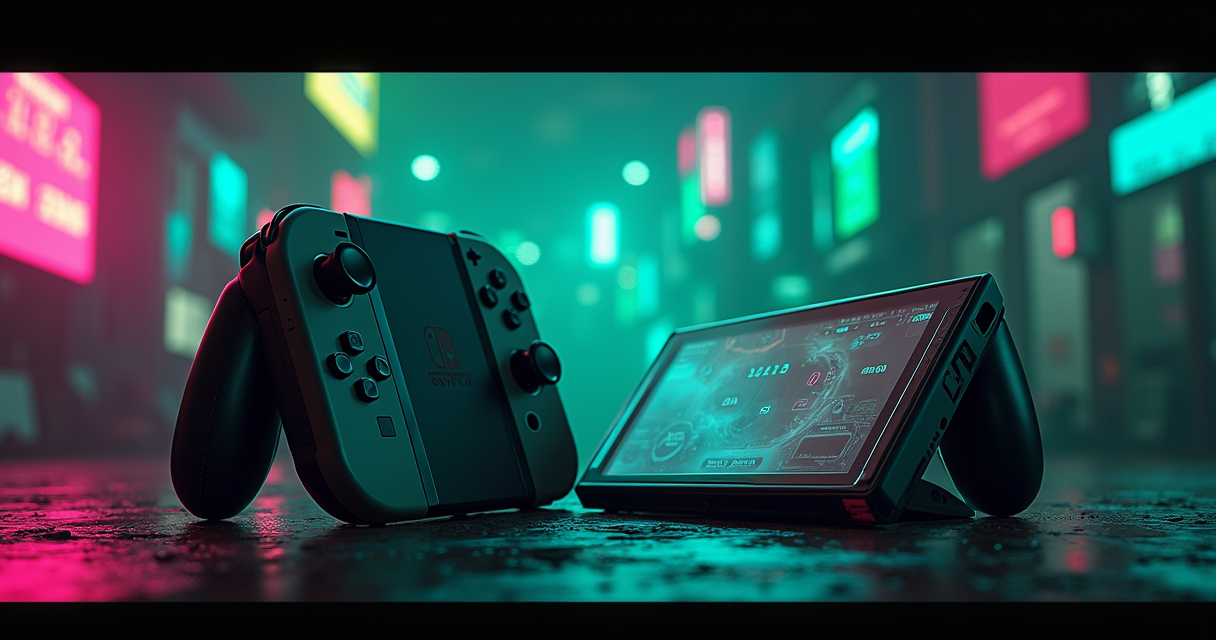
For most of a decade, “Switch or Steam Deck?” was a non-question. One is a locked appliance that plays Mario and asks nothing of you. The other is a Linux PC folded into a lunchbox that plays almost anything, provided you are willing to read a wiki. They were never really shopping against each other. Then, in May 2026, Valve did something that turned a shrug into an actual argument: it raised the entry price of the Steam Deck OLED to $789. Nintendo, meanwhile, is still selling the Switch 2 for $449.99. The premium enthusiast machine became the expensive one; the family toy became the bargain. The categories inverted.
This is the part where most outlets tell you “it depends on what you want.” True, and useless. This piece does the opposite: it puts the two devices on the same bench, cites the numbers to their sources — Digital Foundry, PC Gamer, TechRadar, Nintendo's own price-revision page, Valve's own store — and tells you which one is the correct purchase for six specific people. If you are a retro-gaming reader, there is a spoiler you already suspect and I will confirm with evidence: for emulating the previous forty years of consoles, this is not close. For playing the next forty years of Nintendo, it is not close in the other direction.
All prices are U.S. MSRP as of publication (August 2026), with the September 1 Switch 2 increase flagged wherever it changes the math. Let us start with the number that made this comparison interesting again.
The $339 Inversion
The single most important fact in this comparison is not a benchmark. It is an arithmetic accident of the 2026 memory market, and it reframes everything that follows.
What Valve did in May 2026
On May 27, 2026, Valve raised the price of every Steam Deck OLED SKU. The 512GB model went from $549 to $789; the 1TB model went from $649 to $949. Valve's stated reason, verbatim, was the “current state of component costs and other global logistical challenges” — corporate for the AI-driven DRAM and NAND shortage that has been inflating the price of every device with memory in it, from the PS5 to the Xbox Series X. The increase was global: roughly €779/€919 in the Eurozone, £649/£849 in the UK, C$1,129/C$1,349 in Canada, and AU$1,199/AU$1,499 in Australia.
Worse for bargain hunters, the cheap door was already bricked shut. The $399 LCD Steam Deck — the model that made “$400 gaming PC” a real sentence — was discontinued on December 19, 2025, another casualty of the NAND crunch, and was out of stock worldwide by mid-February 2026. As of this writing there is no such thing as a sub-$500 new Steam Deck. The floor is $789, and it is printed on Valve's own store page for anyone who wants to check my arithmetic.
What Nintendo is doing on September 1
Nintendo is not innocent here — it is merely slower. The Switch 2 launched at $449.99 on June 5, 2025, and Nintendo has confirmed a U.S. increase to $499.99 effective September 1, 2026, citing “various changes in market conditions” over the “medium to long term” — the same DRAM story wearing a kimono. Japan already took its hit, moving from ¥49,980 to ¥59,980 on May 25, 2026. If you have been tracking how these hikes ripple across Nintendo's own lineup, the Switch OLED-versus-Switch 2 gap resets on that same September 1 date, which is not a coincidence so much as a coordinated response to the memory market.
So the timing produces two different gaps depending on when you read this. Today, at $449.99 versus $789, the Switch 2 is $339 cheaper than the cheapest new OLED Steam Deck. After September 1, at $499.99 versus $789, it is $289 cheaper. Either way, the direction is the shock: the Nintendo machine is the value pick, and the PC handheld is the luxury one. If you have been away from this hobby since 2023, read that twice.
Why the flip matters more than the numbers
Price is not just a line item; it is the thing that decides who each machine is even for. At $549, the Deck was an impulse-adjacent buy for anyone with a Steam library. At $789 it is a considered purchase, the kind you justify to yourself and possibly to a spouse. That shoves the Deck further into the enthusiast corner it already occupied and hands Nintendo the entire mainstream — which, given a combined Switch install base of 172.96 million against the Deck's estimated 5.6 million, was never really in doubt. We will return to those figures. For now, hold the frame: in 2026, the open machine costs a $339 premium over the closed one. Everything below is the story of what that premium buys — and what it doesn't.
Specs, Head to Head
Two handhelds, two philosophies, two silicon vendors. Here is the full board. Figures come from Nintendo's and Valve's official specifications and from Digital Foundry's teardown-level coverage; where a number is cross-architecture and therefore misleading, I flag it directly rather than let it sit on the table pretending to mean something.
The full spec sheet
| Spec | Nintendo Switch 2 | Steam Deck OLED (512GB) |
|---|---|---|
| U.S. launch price | $449.99 (→ $499.99 Sep 1, 2026) | $549 (→ $789, May 27, 2026) |
| Release date | June 5, 2025 | Nov 16, 2023 (OLED) |
| Display | 7.9-inch LCD, 1080p | 7.4-inch OLED, 1280×800 |
| Refresh / HDR | 120Hz VRR, HDR10 | 90Hz, HDR (1000-nit peak) |
| SoC | Nvidia T239 (Ampere, Samsung 8nm) | AMD “Sephiroth” APU (6nm) |
| CPU | 8× Arm Cortex-A78C, ~1 GHz | 4× Zen 2 / 8 threads, up to 3.5 GHz |
| GPU (docked / handheld) | 3.07 / 1.71 TFLOPS FP32 | 1.6 TFLOPS FP32 |
| Upscaling | Nvidia DLSS | AMD FSR |
| RAM | 12GB LPDDR5X | 16GB LPDDR5 |
| Storage (base) | 256GB UFS | 512GB NVMe (M.2 2230) |
| Expandable storage | microSD Express (required) | microSD + swappable M.2 2230 |
| Battery | 5,220mAh / 19.7Wh | 50Wh |
| Weight | ~534g (with Joy-Con 2) | ~640g |
| Wi-Fi | Wi-Fi 6 | Wi-Fi 6E |
| Operating system | Nintendo proprietary | SteamOS 3 (Arch Linux + KDE) |
| Docked output | up to 4K/60 (DLSS) | up to 1080p/1440p (dock, no DLSS) |
| Controls | Detachable Joy-Con 2 (magnetic, mouse mode) | Fixed pad, 2× trackpads, gyro |
| Backward compatibility | ~90% of Switch 1 (translation layer) | Any x86 Windows/Linux software |
| Homebrew / sideloading | Locked (no public exploit, mid-2026) | Open (Flatpak, AppImage, any binary) |
| First-party exclusives | Yes (Mario, Zelda, Metroid…) | None |
Reading the TFLOPS trap
The spec sheet says the Switch 2 outputs 3.07 TFLOPS docked and the Deck outputs 1.6, and a lazy reader concludes the Switch 2 is nearly twice as powerful. It is not. That number is FP32 throughput across two different architectures — Nvidia Ampere versus AMD RDNA 2 — and cross-architecture TFLOPS comparisons are the horoscopes of hardware journalism: technically numeric, predictively worthless. The docked figure also flatters the Switch 2 because it only hits 3.07 when plugged into the wall; unplugged, in your hands, it clocks down to 1.71 TFLOPS, which is within rounding distance of the Deck's 1.6.
More importantly, the Deck runs native, unoptimized PC code — the same x86 binaries a desktop runs — while the Switch 2 runs code hand-tuned by developers for one fixed target with a lighter DLSS profile. A theoretical GPU proxy from PCGamesN, benchmarking the nearest desktop stand-ins (an RTX 3050 for the Switch 2's silicon against an RX 6600 for the Deck's), put the Switch 2 GPU roughly 53% ahead on paper — about 29 fps to 19 fps — but the operative word is theoretical. In the handheld form factor the two trade blows depending entirely on how well a given game is ported. Hold that thought until the benchmarks section, where actual measured numbers replace the arithmetic.
Screens: OLED HDR vs 120Hz VRR
This is the one spec line where reasonable people genuinely disagree, because the two panels optimize for different senses. The Deck's 7.4-inch OLED delivers true blacks, a 1000-nit HDR peak, and the kind of contrast that makes a dark game like Hollow Knight look like it is lit from inside the device. The Switch 2's 7.9-inch LCD is larger and runs at 120Hz with variable refresh rate and HDR10 — smoother in motion, brighter in a sunlit room, but LCD, with LCD's grey-black floor.
Digital Foundry, no friend to marketing copy, called the Switch 2 panel “problematic in a number of ways,” specifically its HDR implementation and motion handling. If you play mostly in a dim room and value image quality, the OLED wins outright. If you play on a bright train and value fluidity, the 120Hz LCD is the better tool. It is a real trade, not a knockout — and notably, it is the only spec category where the cheaper machine does not simply lose to the more expensive one on paper. The Deck bought its screen advantage; the Switch 2 rented smoothness instead. For a deeper baseline on either device's silicon lineage, Wikipedia's Steam Deck hardware entry is the least-editorialized reference going.
Pricing and Availability
Because price is now the headline, it deserves a table of its own rather than a single line buried in the spec sheet. The following are MSRP figures pulled from Nintendo's and Valve's official regional stores as of August 2026.
The regional price board
| Market | Switch 2 | Deck OLED 512GB | Deck OLED 1TB | Cheapest-Deck premium |
|---|---|---|---|---|
| United States | $449.99 | $789 | $949 | +$339 |
| United Kingdom | £395.99 | £649 | £849 | +£253 |
| Australia | AU$699.99 | AU$1,199 | AU$1,499 | +AU$500 |
Outside those three markets: the Deck OLED is €779/€919 in the Eurozone and C$1,129/C$1,349 in Canada. The Switch 2 sits at ¥49,980 in Japan, where Valve does not sell the Deck through official local channels at all — a small but real availability moat in Nintendo's home territory. Remember that on September 1, 2026 the U.S. Switch 2 climbs to $499.99, the Eurozone to €499.99, and Canada to C$679.99, shrinking every “premium” figure above by roughly fifty dollars-equivalent. Even after that, the Deck is the pricier machine in every market on the board.
The hidden costs nobody advertises
MSRP is not the total. The Switch 2 uses microSD Express — not the ordinary microSD you have in a drawer — and it is effectively mandatory, because 256GB of UFS storage evaporates the moment you install two modern games; microSD Express cards command a premium precisely because the Switch 2 created the demand. Retro and NSO access is a subscription: Nintendo Switch Online plus the Expansion Pack runs $79.99 per year, and it is the only legitimate way to touch the classic library. That is a recurring cost with no end date.
The Deck's hidden costs run the other direction — optional, one-time, and mostly avoidable. A dock for TV output is roughly $79 if you want the official one, less for third-party. Beyond that, the Deck's storage is user-swappable (a $40 M.2 2230 SSD triples your capacity in ten minutes with a screwdriver), and its retro library costs exactly nothing in subscription because you supply your own dumps. Over a three-year ownership window, the Switch 2's $79.99/year subscription quietly erases a chunk of its $339 hardware advantage — roughly $240 of it, if you keep NSO the whole time.
Where the cheap entry went
It is worth stating plainly, because 2024-era buying guides still lie about it: the $399 Steam Deck does not exist anymore. The LCD 256GB model that anchored every “best value handheld” list was discontinued on December 19, 2025 and cleared out of stock by February 2026. If a comparison you are reading still quotes $399 or $549 for a Steam Deck, it was written before the May 2026 hike and is describing a machine you can no longer buy new. The living Deck lineup is two OLED models, $789 and $949, full stop. That single discontinuation is what turned this from a “$99 gap” comparison in mid-2025 into a “$339 gap” comparison today.
Performance and Benchmarks
Enough theory. Here is what happens when both machines run the same game, measured by people with capture cards and power meters rather than spec sheets. Digital Foundry did most of the heavy lifting; PC Gamer and PCGamesN corroborate from different angles.
The Digital Foundry measurements
| Title / test | Switch 2 | Steam Deck OLED | Source |
|---|---|---|---|
| Hogwarts Legacy — power draw | ~7W | ~14W | Digital Foundry |
| Hogwarts Legacy — battery | 2h45m | ~4h | Digital Foundry |
| Stardew Valley — battery | ~4h | ~7h | Digital Foundry |
| Persona 4 Golden — battery | ~4h18m | 7h+ | Digital Foundry |
| Hitman: World of Assassination — battery | 2h40m | ~2h | Digital Foundry |
| Cyberpunk 2077 — upscaling | DLSS 540p→1080p | FSR 480p→720p | Digital Foundry |
| GPU compute (docked) | 3.07 TFLOPS | 1.6 TFLOPS | spec / DF |
| GPU compute (handheld) | 1.71 TFLOPS | 1.6 TFLOPS | spec / DF |
| Theoretical GPU proxy (RTX 3050 vs RX 6600 stand-ins) | ~29 fps | ~19 fps | PCGamesN |
The pattern is unmistakable and, once you see it, obvious: the Switch 2 does more with dramatically less power. Seven watts against fourteen on the same Hogwarts Legacy scene is not a rounding error; it is the Switch 2 being a fixed-target console with a lighter DLSS pass, and the Deck being a general-purpose PC brute-forcing the same frame at twice the draw. Digital Foundry's own summary was that the “Switch 2 ran Hogwarts Legacy better overall, keeping it locked to a mostly stable 30fps” — a clean win for the cheaper box on that title.
DLSS vs FSR, and what “docked 4K” really means
The upscaling row is where the Switch 2's Nvidia heritage earns its keep. In Cyberpunk 2077, the Switch 2 reconstructs 1080p from a 540p internal resolution using DLSS; the Deck reconstructs 720p from 480p using FSR. DLSS, being a trained neural upscaler rather than FSR's spatial one, produces a visibly cleaner result from a higher base — the Switch 2's image simply holds together better in motion. Docked to a TV, the T239 will push a DLSS-reconstructed image up toward 4K/60 in supporting titles, something the Steam Deck's dock cannot do at all because there is no DLSS in the AMD pipeline and no docked clock headroom to spare.
Be precise about what that means, though, because “native 4K” is doing marketing work it has not earned. The Switch 2 is not rendering 4K; it is rendering something far lower and letting DLSS reconstruct toward 4K. That is genuinely impressive and genuinely better than the Deck on a television — but it is reconstruction, not native pixels, and heavy titles still target 1080p-class internals. For living-room play, the verdict is nonetheless clean: the Switch 2 is the more console-like device on a TV, and it is the cheaper one, which is a rough afternoon for Valve.
What the reviewers concluded
The measured numbers explain why 2026's review consensus landed where it did — surprised. PC Gamer titled its head-to-head “a closer battle than I expected”, ultimately leaning Deck for raw flexibility while conceding the Switch 2 delivers “the Nintendo feel, look, and software” that no PC handheld replicates. GamesRadar went further with the blunt headline “I wildly underestimated the Switch 2.” PCWorld, exasperated at the framing itself, declared the whole matchup “a dumb argument” — because, in its view, the two machines answer different questions. Digital Foundry's screen critique (“problematic in a number of ways”) keeps the Switch 2 honest, and you can read DF's full breakdown via Nintendo Life. Four outlets, one throughline: the performance gap is smaller and the price gap is larger than anyone predicted in 2023.
Battery and Portability
A handheld you cannot hold or cannot keep charged is a bad handheld regardless of TFLOPS. This is the category where the two machines' philosophies collide most physically.
Runtimes, game by game
Look back at the battery rows and a rule emerges: on light indies, the Deck's enormous 50Wh pack runs roughly 1.5× to 2× longer than the Switch 2's 19.7Wh — about 7 hours to 4 on Stardew Valley, 7-plus to 4h18m on Persona 4 Golden. That is the Deck's battery mass simply out-lasting a smaller cell. But flip to a heavy AAA title and the picture inverts in a way that surprises people: on Hogwarts Legacy the efficient Switch 2 manages 2h45m to the Deck's ~4h, and on Hitman: World of Assassination the Switch 2 actually edges ahead, 2h40m to roughly 2h, because at 7 watts it is sipping where the Deck gulps 14.
The honest summary: the Deck wins battery on light and mid games by a comfortable margin thanks to raw capacity, while the Switch 2's efficiency claws the gap shut — and occasionally closes it — on the heaviest titles. Neither machine is a marathon runner on demanding games; both want a power bank in your bag for a cross-country flight. If your library skews toward indies and JRPGs, the Deck's larger cell is the safer bet for untethered hours.
Weight, size, and the hand test
The Switch 2 weighs about 534 grams with Joy-Con 2 attached; the Deck weighs roughly 640 grams. That 106-gram delta does not sound like much until hour three of a handheld session, when it is the difference between a device that disappears in your hands and one that reminds your wrists it exists. The Switch 2 is also narrower and its magnetic Joy-Con 2 detach for tabletop or separated play — a genuinely different ergonomic mode the fixed-slab Deck cannot offer.
The Deck answers with grip. Its larger body has fuller handgrips, two trackpads, and gyro, which for certain genres — strategy, shooters, anything that wants a mouse — is transformative rather than cosmetic. It is heavier because it is a PC; it is more comfortable for long twin-stick sessions because it was shaped by people who expected long twin-stick sessions. Lighter-and-modular versus heavier-and-grippier is, like the screen, a real trade rather than a winner.
Charging and the 19.7Wh problem
The Switch 2's efficiency is its saving grace, because 19.7Wh is a small tank. In practice, real-world handheld runtime on demanding games lands in the 2-to-3-hour range, and the machine leans on its low draw to stretch that. The Deck's 50Wh cell is the opposite approach — brute capacity, higher draw, longer average sessions — and it charges over standard USB-C PD like the Switch 2 does, so neither has a charging-standard advantage. If your use case is “long sessions away from an outlet,” the Deck's tank wins on average; if it is “short bursts, maximum portability, lightest bag,” the Switch 2's efficiency and 534-gram frame win. Match the battery philosophy to how you actually play, not to the bigger number.
The Two Libraries
Hardware decides how a game runs. The library decides whether the game exists on your machine at all — and this is where the two platforms stop being comparable and start being opposites.
Nintendo's moat: games you cannot buy elsewhere
The Switch 2's entire strategic advantage is exclusivity, and it is airtight. Mario Kart World has already moved 14.70 million copies; Donkey Kong Bananza another 4.52 million. Zelda, Metroid, Pokémon, Splatoon — none of these are purchasable or legitimately playable on a Steam Deck through any official channel, because Nintendo does not sell them there and Switch emulation collapsed (more on that in the next section). Even third-party marquee titles are landing as Switch 2 showcases, like the Elden Ring: Tarnished Edition arriving August 28 as a Switch 2 exclusive cut, and Nintendo's Direct pipeline keeps feeding the moat — the 2026 Direct's Ocarina of Time remake reveal is the kind of thing that simply has no Steam equivalent.
Polygon captured why this generation stings for PC purists more than past ones: the Switch 2 is “closer to the technical cutting edge than Nintendo has been since the GameCube and Game Boy Advance in 2001.” The exclusives are no longer running on embarrassing hardware you can wave away — they run well, and they run only here.
Steam's 21,694 Verified titles
The Deck's counter-argument is breadth so vast it is hard to hold in your head. As of the 2026 data, Steam listed 21,694 Deck-Verified titles — games Valve has certified run properly on the hardware — and that number is a floor, not a ceiling, because “Playable” and unrated-but-working titles stretch the real catalog far higher, before you even reach the entire back-catalog of PC gaming that predates the Verified program. Add Proton, mod support, desktop mode, and the ability to install non-Steam launchers, and the Deck's library is effectively “most of what has ever shipped on a PC.”
Engadget, naming the Deck among the best handhelds even at its new price, praised its “best balance of price, performance and usability” while conceding the aging OLED model “shows its age in 2026.” That is the Deck's library pitch in one line: nothing else touches its breadth, but you are paying $789 for a machine whose silicon debuted in 2022. You can read Engadget's Switch 2 review for the other side of that coin.
The attach-rate and install-base gap
Scale is not close, and it matters for a reason beyond bragging rights: install base determines what developers prioritize. The combined Nintendo Switch platform reached 172.96 million units with 1.416 billion software units sold and a 9.2-game attach rate — an ecosystem so established that publishers build around it by default. The Switch 2 alone sold 3.5 million units in its first four days, the fastest home-console launch in history, and hit 19.86 million by March 31, 2026, outpacing even the PS5 in the January-March quarter.
The Steam Deck's estimated installed base is 5.6 million — against Valve's roughly 1.62 million shipped in its 2022 debut year as the baseline. That is not a failure; it is a healthy enthusiast platform, and its influence outruns its size: Linux hit an all-time-high 5.33% of the Steam Hardware Survey in March 2026, an achievement tied almost entirely to Deck ownership. But 5.6 million versus 172.96 million is the reason the Switch gets day-one third-party ports and the Deck gets Proton compatibility layers. One platform is a market; the other is a beloved niche with outsized cultural reach.
Emulation and Retro Gaming
Here is the section a retro-gaming reader came for, and here is where the $339-cheaper machine loses so decisively it is almost unkind. If your goal is the previous forty years of consoles, the comparison is over before it starts.
The emulation feature table
| Capability | Nintendo Switch 2 | Steam Deck OLED |
|---|---|---|
| Retro platform reach | NES–N64 + GameCube (NSO rental only) | NES → PS2/GameCube/Wii/Wii U/PSP/Saturn/Dreamcast |
| Emulator choice | None (Nintendo-curated) | RetroArch, EmuDeck, RetroDECK, standalone cores |
| Emulation accuracy | Fixed, per-title | Selectable — up to cycle-accurate (bsnes, Mesen) |
| Save states | Suspend point (1 per game) + rewind | Unlimited, per-slot |
| Rewind / RunAhead | Rewind on select NSO titles | RunAhead (latency reduction) + rewind |
| Netplay | First-party online only | RetroArch netplay, ad-hoc + rollback |
| Shaders / filters | None | CRT, LCD-grid, scanline, xBRZ, Royale |
| Homebrew | Locked (no public exploit, mid-2026) | Open — Flatpak, AppImage, any binary |
| Cost of retro library | NSO + Expansion Pack $79.99/yr | Free (you supply your own dumps) |
Every row favors the Deck, and most favor it categorically rather than marginally. The Deck is an open Linux PC, so it runs the entire emulation stack the community has built over two decades: EmuDeck to install and configure everything, RetroArch and RetroDECK to run it, standalone emulators like Dolphin and PCSX2 for the demanding systems. Retro Game Corps' Steam Deck emulation starter guide remains the canonical walkthrough, and it is long precisely because the Deck can do so much. If you want to go core-deep, our own RetroArch cores walkthrough and Batocera setup guide both target exactly this hardware.
Why the Deck's CPU wins where TFLOPS lose
This is the counterintuitive part, and it is important. In pure GPU benchmarks the Switch 2 often leads — but emulation is not a GPU-bound problem for the systems retro players care about most. Emulating a PlayStation 2 or a GameCube is a CPU single-thread problem: the emulator must simulate a foreign processor cycle by cycle, and that punishes weak per-core performance. The Deck's four Zen 2 x86 cores running up to ~3.5 GHz demolish the Switch 2's eight Arm Cortex-A78C cores at ~1 GHz for exactly this workload. The Switch 2's GPU advantage is irrelevant when the bottleneck is a CPU trying to be a different CPU.
So the machine that loses the on-paper spec war wins the emulation war twice over: once because it is open and can run the emulators at all, and again because its x86 CPU is architecturally suited to the job. The Switch 2 could not emulate a PS2 well even if Nintendo permitted it — which brings us to the fact that Nintendo does not permit it, or anything else.
The law and the lore
Since this site is written by someone who knows both, here is the legal reality, because it is routinely mangled online. Emulators are legal. U.S. courts settled this a quarter-century ago: Sony v. Connectix (2000) and Sony Computer Entertainment v. Bleem upheld emulation and the reverse-engineering required to build an emulator as fair use. What is illegal is distributing copyrighted ROMs and BIOS files — the software, not the emulator. Dump your own cartridges and discs from hardware you own and you are on the settled side of the line.
The Switch's own emulation scene is a graveyard, which is why “just emulate Switch games on the Deck” is not a real answer in 2026. Yuzu settled with Nintendo for $2.4 million in March 2024 and shut down; Ryujinx ceased development late in 2024. There is no reliable, maintained Switch or Switch 2 emulator on any hardware, and the Switch 2 homebrew scene is a locked box — community forums mid-2026 openly discourage even discussing exploits. The Deck's dominance is over the previous forty years of consoles, not over current Nintendo. Nobody is playing Mario Kart World on a Steam Deck.
Switch 2's NSO GameCube counteroffer
Nintendo's answer to all of this is a rental counter, and credit where due, it is a nicer one than before. The Switch 2 added GameCube to Nintendo Switch Online as a Switch 2-exclusive tier, launching with Wind Waker, F-Zero GX, and Soulcalibur II, and expanding through 2026 with Super Mario Sunshine, Pokémon XD: Gale of Darkness, Luigi's Mansion, and more. It runs these at roughly double resolution with modern conveniences, and it is legitimate and effortless.
But read the terms. It is curation, not a library: you play what Nintendo chooses to offer, when they offer it, for as long as you keep paying $79.99 a year, with a single suspend point and rewind instead of unlimited save states, and no shaders, no netplay of your choosing, no CD-based systems, no anything Nintendo did not make. It is a well-made rental. The Deck is ownership. For a retro enthusiast, that distinction is the entire ballgame.
Five Real-World Use Cases
Specs are abstract; people are not. Here is who should buy which, mapped to how you actually live, followed by the three calls that are genuinely hard.
Who should buy which
| You are… | Buy | Because |
|---|---|---|
| A living-room-first player who wants 4K/60 on the TV with zero setup | Switch 2 | DLSS docked output the Deck's dock can't match, and it's cheaper |
| A retro / emulation enthusiast | Steam Deck | 40 years of consoles, CRT shaders, unlimited save states, x86 CPU |
| A Nintendo-exclusive chaser (Mario, Zelda, Metroid) | Switch 2 | These games exist nowhere else, legally or reliably |
| A PC gamer with a large Steam library and mods | Steam Deck | Proton, desktop mode, 21,694 Verified titles, your existing purchases |
| A parent buying a first console or a gift | Switch 2 | Cheapest ($449.99), simplest, safest, most exclusives kids want |
| A commuter who wants maximum untethered indie hours | Steam Deck | 50Wh cell → ~7h on Stardew vs ~4h, though the Switch 2 is lighter |
| A tinkerer who enjoys the machine as a project | Steam Deck | Open Linux PC, swappable SSD, endless configuration |
The retro case, decided
If retro gaming is your primary use, stop reading and buy the Steam Deck. There is no version of this where the Switch 2 is the right tool: it cannot run community emulators, its CPU is wrong for the demanding systems, it offers a paid rental instead of a library, and it has no shaders or user-configurable netplay. The Deck's $339 price premium is, for this buyer, the cost of admission to the only device on the shelf that actually does the job — and it does the job better than any handheld before it. This is the one use case with zero ambiguity.
The family and commuter cases
The family case is the Deck's worst matchup and the Switch 2's best. A parent wants the cheapest machine that plays the games children actually ask for, boots without a wiki, and survives a backpack. That is the Switch 2 on every axis — $339 less, plug-and-play, and holder of the exclusives a nine-year-old has heard of. The Deck's openness is a liability here, not a feature.
The commuter case is closer and depends on genre. If you play indies and JRPGs on the train, the Deck's 50Wh battery delivers the longer average session (~7 hours on light titles), but the Switch 2 is 106 grams lighter and its efficiency keeps demanding games competitive. My read: indie-heavy commuters lean Deck for endurance; anyone prioritizing a lighter bag and shorter bursts leans Switch 2. It is the rare case where I would tell you to weigh the machine in your hand before deciding.
Migration Guide
Suppose you already own one and the $339 flip — or the emulation gap — has you eyeing the other. Here is how to move without losing your mind or your saves.
Switch 2 → Steam Deck
You are moving from an appliance to a PC, so budget an afternoon, not a minute.
- Buy the 512GB OLED at minimum ($789); if you plan to store a large emulation library, the 1TB ($949) or a cheap M.2 2230 SSD upgrade saves grief later.
- Boot into SteamOS, sign into Steam, and reinstall your existing PC purchases — anything you already own on Steam is now free to play here via Proton.
- Switch to Desktop Mode (power menu → Switch to Desktop) to install anything non-Steam.
- For retro, install EmuDeck from Desktop Mode; it configures RetroArch, Dolphin, PCSX2, and the folder structure for you.
- Dump your own cartridges and discs from hardware you own, and drop the files into the EmuDeck ROM folders (see below).
- Accept that your Nintendo exclusives do not come with you. They stay on the Switch 2. There is no legitimate migration path for Mario, and pretending otherwise wastes your time.
Steam Deck → Switch 2
This direction is easier because you are moving toward simplicity, but you give up openness.
- Buy before September 1, 2026 to lock the $449.99 price rather than $499.99 — a real $50 saving on the same hardware.
- Buy a microSD Express card immediately; the 256GB internal storage is not enough for two modern games, and ordinary microSD will not do.
- Rebuy the games you want. There is no library transfer; your Steam purchases do not port to Nintendo's store. This is the tax of the walled garden.
- If you want classic games, subscribe to NSO + Expansion Pack ($79.99/yr) for the GameCube/N64/SNES/NES rental library.
- Keep the Deck. Do not sell it. It remains your emulation and PC machine; the Switch 2 is a complement, not a replacement, and anyone who tells you to consolidate to one device has not thought about what each does.
The EmuDeck folder you'll actually use
Ninety percent of Deck emulation friction is people not knowing where files go. EmuDeck creates this structure; put your legally dumped files in the matching folders and the emulators find them automatically:
~/Emulation/
├── roms/
│   ├── snes/     # .sfc .smc  -> bsnes / Snes9x
│   ├── n64/      # .z64 .n64  -> Mupen64Plus-Next / ParaLLEl
│   ├── gc/       # .rvz .iso  -> Dolphin
│   ├── ps2/      # .chd .iso  -> PCSX2
│   └── psp/      # .iso .cso  -> PPSSPP
├── bios/         # you supply these, from your own hardware
├── saves/
└── storage/      # save states, unlimited slots
Pros and Cons
The tally, stripped of nuance, for readers who scroll to the scoreboard. Nuance is above; this is the summary.
Switch 2, tallied
| Pros | Cons |
|---|---|
| $339 cheaper than the cheapest Deck ($449.99) | Walled garden: no sideloading, no homebrew (mid-2026) |
| Best-in-class first-party exclusives | 19.7Wh battery: short runtimes on heavy AAA |
| DLSS docked output up to 4K/60 | microSD Express required, and it's pricey |
| Lowest power draw (~7W) and lightest (~534g) | Retro = $79.99/yr NSO rental, not ownership |
| 120Hz VRR panel, larger 7.9-inch screen | LCD, not OLED; DF calls the screen “problematic” |
| Plug-and-play; guaranteed per-title optimization | Rises to $499.99 on September 1, 2026 |
| Detachable Joy-Con 2 with mouse mode | ~90% backward compatible, not 100% |
Steam Deck OLED, tallied
| Pros | Cons |
|---|---|
| Open Linux PC: install anything, any launcher | $789 entry after the May 2026 hike (+$339) |
| 21,694 Verified titles + entire PC back-catalog | Heavier (~640g); more setup and tinkering |
| Best emulation machine ever shipped (40 years of consoles) | No official Nintendo games, ever |
| True OLED HDR panel, 1000-nit peak | Docked output weaker; no DLSS |
| 50Wh battery: ~2× runtime on light games | $399 LCD entry discontinued; no cheap door left |
| Desktop mode, Proton, mods, swappable SSD | SteamOS learning curve; some anti-cheat lockouts |
| You own your library outright | 2022-era silicon; Engadget notes it “shows its age” |
The dealbreakers
Most rows above are trade-offs, but three are dealbreakers that override everything else. For the Switch 2, the dealbreaker is the walled garden: if you want emulation, sideloading, or ownership, no amount of price advantage rescues it, because it structurally cannot do those things. For the Deck, there are two dealbreakers — the $789 price for a budget-minded buyer, and the total absence of Nintendo exclusives for a Nintendo fan. If any of those three describe you, the decision is already made and the rest of the spec sheet is noise.
The Verdict
Two machines, two correct answers, and — for once — a genuine price story tilting the default. TechRadar, reviewing the Switch 2, still called the Deck “the king of easy, fun gaming,” while other reviewers admitted they “wildly underestimated” Nintendo's box. Both reactions are right, because these devices are not really the same product. Here is how to choose without agonizing.
If you want the cheaper, simpler machine
Buy the Switch 2. At $449.99 (through August 31) it is $339 less than the cheapest new Steam Deck, it plays Nintendo's exclusives that exist nowhere else, it outputs DLSS-reconstructed 4K on your TV, it weighs less, and it draws a fraction of the power. IGN's 7-of-10 verdict — “bigger and better in every sense” — is the accurate ceiling: this is a very good console, not a revelation, and The Verge's caveat that it “doesn't feel like the kind of generational leap” is the accurate floor. For the mainstream buyer, the family, the Nintendo fan, and the living-room-first player, it is the right purchase and now also the cheaper one. That combination is what makes 2026 strange.
If you want the open machine
Buy the Steam Deck OLED, and pay the $339 premium with clear eyes about what it buys: the entire history of PC and console gaming on one device you actually own. For the emulation enthusiast, the PC gamer with a deep Steam library, the modder, and the tinkerer, nothing else on the market does the job, and the Deck does it better than any handheld before it. Just know you are buying a 2022-era, $789 enthusiast device in a year when memory prices made it expensive — and that no exploit or emulator is going to hand you Mario. If you are cross-shopping the broader handheld field, the ROG Xbox Ally line is the other open-PC option worth a look before you commit.
The decision tree
Stripped to logic, the whole 6,000 words collapses to this:
if wants_nintendo_exclusives or budget < 550 or gifting_to_a_child:
    buy Switch 2            # $449.99, plug-and-play, DLSS on the TV
elif wants_emulation or owns_large_steam_library or will_tinker:
    buy Steam Deck OLED     # $789, open, 40 years of consoles
elif primarily_docked_4k_60:
    buy Switch 2            # DLSS reconstruct; the Deck dock can't
else:
    buy Switch 2            # cheaper, simpler, lighter -- the 2026 default
The tiebreaker goes to the Switch 2 in 2026, and that is the sentence I did not expect to write when Valve shipped the Deck at $399 in 2022. Not because it is the better machine in the abstract — it is not; the Deck does vastly more — but because being $339 cheaper, simpler, and lighter is exactly what the mainstream buyer this comparison is really about actually needs. The Deck remains the enthusiast's correct answer and the retro player's only answer. It just costs a premium to be right now, and Nintendo, of all companies, is the one selling value. The upside-down, indeed.
Questions the search bar asks me
- Is the Switch 2 really cheaper than the Steam Deck in 2026?
- Yes. As of August 2026 the Switch 2 is $449.99 while the cheapest Steam Deck OLED (512GB) is $789 after Valve's May 27, 2026 hike — a $339 gap. The Switch 2 rises to $499.99 on September 1, 2026, narrowing the gap to $289, but it remains the cheaper machine.
- Which is better for emulation and retro gaming?
- The Steam Deck, decisively. It's an open Linux PC running EmuDeck/RetroArch across NES through PS2, GameCube, Wii, PSP, Saturn and Dreamcast, with unlimited save states, CRT shaders and netplay. Its x86 Zen 2 CPU also handles CPU-bound systems like PS2 far better. The Switch 2 has no public homebrew and offers only Nintendo's curated NSO rental.
- Does the Switch 2 actually output 4K?
- Docked, it targets up to 4K/60 — but via Nvidia DLSS reconstruction from a lower internal resolution, not native 4K pixels. It still beats the Steam Deck on a TV, whose dock has no DLSS and caps around 1080p/1440p. Handheld, the two GPUs are within about 0.1 TFLOPS of each other (1.71 vs 1.6).
- How much better is the Steam Deck's battery?
- On light games, roughly 1.5x to 2x. Digital Foundry measured ~7h vs ~4h on Stardew Valley and 7h+ vs ~4h18m on Persona 4 Golden, thanks to the Deck's 50Wh cell versus the Switch 2's 19.7Wh. On heavy AAA titles the efficient Switch 2 closes or even reverses the gap (2h40m vs ~2h on Hitman).
- Can the Steam Deck play Nintendo games like Mario Kart World?
- No, not legally or reliably. Nintendo exclusives are the Switch 2's moat, and Switch emulation collapsed after Yuzu's $2.4M settlement in March 2024 and Ryujinx's shutdown in late 2024. The Deck's strength is the previous 40 years of consoles, not current Nintendo — nobody is playing Mario Kart World's 14.70M-selling release on a Deck.
Jordan covers the modern industry where it touches the old one: Nintendo announcements, handheld hardware, and the long shadow the classics cast over new releases. Every post under this byline is reviewed pre-publish by Sam P., Editor & Operator — corrections to info@instalinkoteam.com. Published 2026-08-29 · Last updated 2026-08-29. Full bios on the author page.