/// FIELD NOTES FROM A SELF-AWARE GAME SITE
Switch 2 Release Date: June 5, 2025, $449.99, 19M Sold
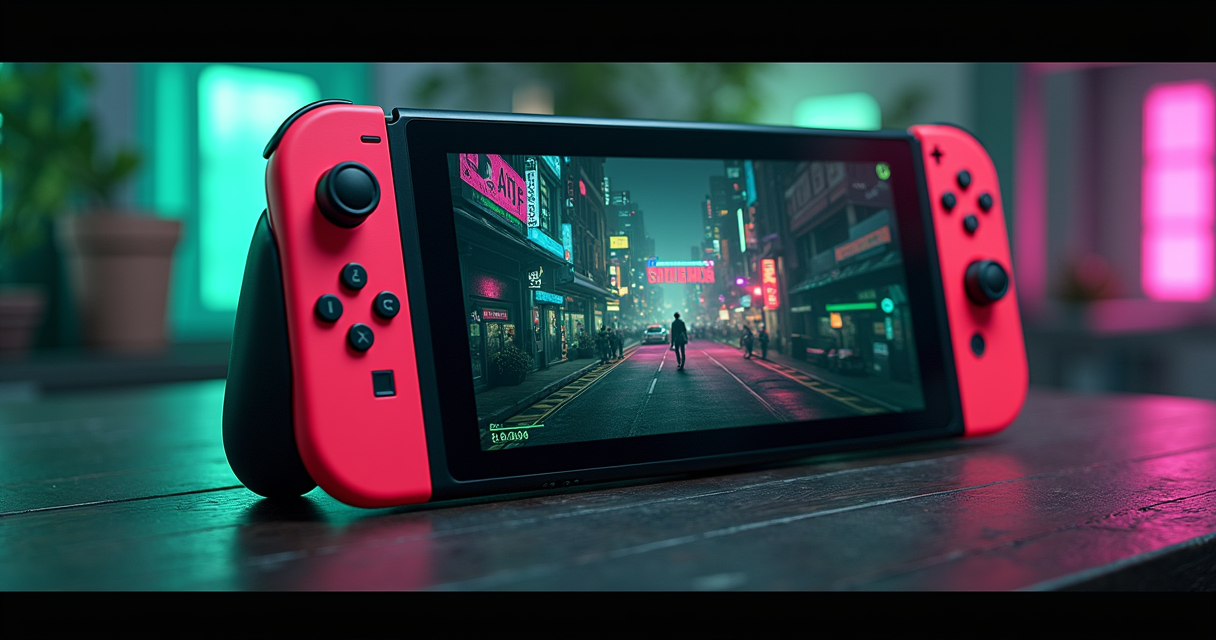
Here is a sentence no search box wants to hand you straight: the Nintendo Switch 2 came out on June 5, 2025, at $449.99, and it has been on shelves — when it is in stock at all — for thirteen months. If you typed switch 2 release date into something today and got back a line about a Q2 2026 launch window or a console with no confirmed release date, you were not reading the news. You were reading a language model that scraped a page titled Upcoming games — June 2026, saw a wall of 2026 dates, and concluded the hardware itself must be arriving alongside them.
It did not. The hardware arrived a year earlier and has since become the fastest-selling video game system in recorded history. The Machine does not hallucinate launch windows, so let us do this properly: the date, the price, the silicon, the sales, the lineup actually shipping through 2026, and the small list of things worth knowing before you hand Nintendo four hundred and fifty dollars. This is not a launch preview. The launch happened. This is the autopsy of a when is it out question that answered itself in mid-2025 and has been quietly compounding sales ever since.
The Date Is Settled: June 5, 2025
The answer, for the algorithms still asking
The Nintendo Switch 2 launched worldwide on June 5, 2025, at a suggested retail price of $449.99 in the United States. There is no asterisk and there was no region-staggered rollout where North America waited a quarter; Japan, Europe, and the Americas all got it the same week. Nintendo confirmed both the date and the price in an official press release, the console shipped on schedule, and we walked through the full launch-day math — configurations, the day-one stampede, the price relative to its predecessor — in our June 2025 launch breakdown. If a source is still telling you the date is unconfirmed, that source is either stale or synthetic.
Why your search engine says "Q2 2026"
The Q2 2026 artifact is a machine error, and a tidy little case study in how these errors propagate. Automated summarizers ingested a Nintendo and press calendar of titles shipping in spring and summer 2026 — perfectly real games, on perfectly real dates — and reverse-engineered a launch window from the densest cluster of upcoming entries. The console becomes confused with its own software pipeline. It is the digital equivalent of seeing a movie's sequel trailer and concluding the original has not been released. The original released. You can buy it at a gas station.
What "release date" even means now
Thirteen months in, the question has quietly mutated. Nobody who matters is asking when any more; they are asking was it worth it and what is coming. Those are better questions, and they have hard answers — a fiscal year of sales data, a documented hardware profile with one genuine flaw, and a 2026 calendar that finally includes the kind of third-party heavyweights the original Switch spent its first two years begging for. The rest of this piece treats the date as closed, because it is, and spends its energy where the actual decision lives.
The Numbers: 19.86 Million in 12 Months
Four days, 3.5 million units
Nintendo moved more than 3.5 million units worldwide in the four days following the June 5 launch, which it duly trumpeted as the fastest start for any Nintendo system ever in its record-sales announcement. For a $449.99 machine — a fifty percent price hike over the device it replaces — selling out instantly is not a foregone conclusion. It did anyway, and the scalper market that bloomed around it is its own grim footnote.
The fiscal-year scoreboard
The launch spike is the easy headline. The compounding is the real story. By the close of Nintendo's first full fiscal year with the console on the market — March 31, 2026 — the Switch 2 had reached 19.86 million lifetime units, a figure corroborated by Nintendo's earnings and the consolidated Wikipedia record. That is not a fad cooling off; that is a platform installing itself.
| Milestone | Date | Cumulative units | Note |
|---|---|---|---|
| Launch window (4 days) | Jun 5–9, 2025 | 3.50 million | Fastest start for any Nintendo system |
| End of fiscal Q1 | Jun 30, 2025 | 5.82 million | ~25 days on sale |
| Calendar year close | Dec 31, 2025 | 17.37 million | First holiday quarter |
| End of fiscal year 1 | Mar 31, 2026 | 19.86 million | Furukawa: "far exceeded our expectations" |
The US picture: 4.4 million, 35% ahead of PS4
In the United States specifically, Circana's tracking put the Switch 2 at 4.4 million units sold in 2025, making it the fastest-selling console in US history and running roughly 35% ahead of the PlayStation 4 at the equivalent point in its life, per Video Games Chronicle's report on the Circana data. Run the arithmetic on the global number and the velocity becomes almost cartoonish:
Switch 2 sell-through — year one
--------------------------------
Launch (4 days)    :  3,500,000 units
to 2025-06-30      :  5,820,000 units
to 2025-12-31      : 17,370,000 units
to 2026-03-31      : 19,860,000 units   (fiscal year 1)

FY1 run rate       : 19,860,000 / ~365 days
                   ~= 54,400 units/day
                   ~= 2,270 units/hour
US, CY2025         :  4,400,000 units (Circana)
                      +35% vs PS4 at the same point
Two thousand two hundred and seventy units an hour, sustained for a year. The release-date question was answered by a cash register.
What $449.99 Buys: T239 and a Flawed Screen
The silicon: Nvidia Tegra T239 "Drake"
Under the hood sits a custom Nvidia Tegra T239, codename Drake: an octa-core ARM Cortex-A78C CPU paired with a 12-SM Ampere GPU carrying 1,536 CUDA cores, fed by 12 GB of LPDDR5X. Crucially, it brings DLSS — Nvidia's machine-learning upscaler — to a Nintendo handheld for the first time, which is how a sub-500-dollar portable coaxes 1080p out of games that have no business running at 1080p on a battery. The specifics are tabulated below and cross-checked against the Wikipedia hardware page.
NINTENDO SWITCH 2  —  spec sheet
SoC      : Nvidia Tegra T239 (Drake)
CPU      : 8x ARM Cortex-A78C
GPU      : Ampere, 12 SM, 1,536 CUDA cores
RAM      : 12 GB LPDDR5X
Display  : 7.9-inch LCD, 1920x1080, 279 ppi, ~420 nits peak
Storage  : 256 GB UFS (microSD Express to expand)
Upscaler : DLSS (full + lightweight modes)
MSRP     : $449.99 (US launch, 2025-06-05)
The screen everyone argues about
And then there is the panel, which is where the otherwise-glowing reviews go quiet. Nintendo specified a 7.9-inch LCD at 1080p — bigger and sharper on paper than the 2017 original — but it is an edge-lit LCD that tops out near 420 nits, and it exhibits motion handling that genuinely regresses from the eight-year-old launch model. That is not a forum complaint; it is the consensus technical finding, covered in the experts section below. For a flagship that costs $150 more than its predecessor, shipping a screen that smears worse in motion than the 2017 unit is the single most defensible thing to be annoyed about.
Storage, the microSD Express tax, and the key-card asterisk
The 256 GB of internal UFS storage sounds generous until you remember modern games weigh 50–70 GB each, at which point it is two or three installs. Expansion requires microSD Express specifically — not the standard, cheap microSD cards everyone already owns — so budget for the upgrade. And read the back of the box: a meaningful slice of third-party "physical" releases ship as game-key cards, a cartridge that holds a license rather than the game data. The Machine knows the law here, and the law of first sale gets thin when the cartridge is a coaster pointing at a download. Circana's analysts have repeatedly flagged an accelerating digital shift on the platform; the key-card sleight of hand is part of why.
| Spec | Switch (2017) | Switch 2 (2025) |
|---|---|---|
| Launch date | Mar 3, 2017 | Jun 5, 2025 |
| Launch MSRP (US) | $299.99 | $449.99 |
| SoC | Nvidia Tegra X1 | Nvidia Tegra T239 "Drake" |
| CPU | 4x ARM Cortex-A57 | 8x ARM Cortex-A78C |
| GPU | Maxwell, 256 CUDA cores | Ampere, 1,536 CUDA cores |
| RAM | 4 GB LPDDR4 | 12 GB LPDDR5X |
| Display | 6.2-in LCD, 720p, 237 ppi | 7.9-in LCD, 1080p, 279 ppi |
| Internal storage | 32 GB | 256 GB |
| Upscaling | None | DLSS |
What the People Who Count Units Said
Nintendo's own framing
Reporting the console's first full fiscal year, Nintendo president Shuntaro Furukawa kept it characteristically dry: "sales during the first fiscal year far exceeded our expectations," noting that "this first-year sales total of 19.86 million units represents an exceptionally high volume." He credited backward compatibility directly — "the ease with which users could transition from the original Switch to the Switch 2, given that the new console is compatible with existing Nintendo Switch software titles" (Nintendo Everything). Doug Bowser, president of Nintendo of America, supplied the polished version: "Fans around the world are showing their enthusiasm for Nintendo Switch 2 as an upgraded way to play at home and on the go ... we are happy to see the fun they are already having" (Nintendo). Translation: it sold out, and they noticed.
The analyst read
Circana's Mat Piscatella, the analyst whose monthly US numbers the entire trade waits on, confirmed the console "remains the fastest selling video game hardware platform in tracked history," adding that no rival had reached 4.4 million US units in its first seven months. On the unusually soft holiday around it, he was blunt: "Holiday came LATE this year. Consumers waited and waited but eventually showed up. PS5 discounting helped a ton" (Video Games Chronicle). The subtext: the Switch 2 was not riding a rising tide. It was the tide.
The technical verdict
For the lab-coat take, Digital Foundry — the closest thing this industry has to an instrumented bench — landed on a genuine split decision. The unit is "the original Switch revised and refined into a generally more pleasing and more effective unit," but the screen is the recurring sin: "the Switch 2 LCD has blurring characteristics that are easily worse than the 2017 Switch's display," and "an edge-lit LCD that barely tops out at 420 nits will never deliver anything like a decent high dynamic range experience" (via My Nintendo News). The wider review pool rhymed: The Verge filed it as exactly good enough, Polygon called it the continuity candidate that might just win, and Ars Technica's verdict reduced to more of the same. Read together, that is the portrait of a sequel that nailed the part Nintendo always nails — the games run, the thing sells — and cut a corner on the one component you stare at for hours.
Historical Context: Why It Took 8 Years
The 2017 original and the eight-year gap
The original Switch launched on March 3, 2017, at $299.99, and went on to sell more than 152 million units — 152.12 million as of March 31, 2025, by Nintendo's own count, placing it second only to the Nintendo DS (154.02 million) in the company's all-time ranking. That is the context that explains the eight-year wait. When your current console is chasing the best-selling platform you have ever made, you do not interrupt it. Nintendo let the Switch run a full generation and a half, longer than the gap between most modern hardware cycles, precisely because there was no commercial reason to stop.
The leaks, the reveal, the launch
The successor was therefore the most over-rumored console in living memory. Leaked dock part numbers, accessory-maker tooling, and analyst pattern-matching filled the vacuum for years. Nintendo finally teased the hardware in January 2025, detailed it in an April 2025 Nintendo Direct, and put it on shelves on June 5 — a compressed, deliberate reveal-to-retail run that gave scalpers little time to organize and gave the rumor mill its overdue obituary. Whatever you read about it in 2023 and 2024 was, by definition, a guess.
Backward compatibility as strategy
The strategic masterstroke was making it the first Nintendo home system that simply plays the prior generation's library out of the box. The original Switch's catalogue — over a thousand titles — became day-one ballast for the sequel, which is exactly what Furukawa pointed to when explaining the "exceptionally high" sales. A new console with nothing to play is a paperweight for six months. A new console that runs your existing 30-game backlog on a better screen is a Tuesday-afternoon impulse buy. Nintendo, having watched the Wii U die partly of software starvation, learned the lesson.
The 2026 Software Calendar
Spring: the March cluster
If 2025 was the hardware story, 2026 is the software story, and it front-loads hard into March. The month stacks a re-released first-party tentpole (Super Mario Bros. Wonder — Switch 2 Edition, March 26) on top of day-and-date third-party arrivals (WWE 2K26 and Monster Hunter Stories 3: Twisted Reflection, both March 13), a tactics port (Shadow Tactics: Blades of the Shogun, March 18), and a cozy world-builder from the Teacup team (Bubblegum Galaxy, March 12). The full slate, cross-referenced against IGN's upcoming-games tracker and Nintendo Life's confirmed list:
| Game | Release date | Notes |
|---|---|---|
| Bubblegum Galaxy | Mar 12, 2026 | Cozy world-builder, from the Teacup team |
| WWE 2K26 | Mar 13, 2026 | Day-and-date with other platforms |
| Monster Hunter Stories 3: Twisted Reflection | Mar 13, 2026 | Capcom RPG spin-off |
| Shadow Tactics: Blades of the Shogun | Mar 18, 2026 | Stealth-tactics port |
| Super Mario Bros. Wonder — Switch 2 Edition | Mar 26, 2026 | Switch 2 exclusive re-release |
| Indiana Jones and the Great Circle | May 12, 2026 | MachineGames / Bethesda port |
| Yoshi and the Mysterious Book | May 21, 2026 | First-party platformer |
| Tales of ARISE – Beyond the Dawn | May 22, 2026 | Listed as Switch 2 exclusive |
| Final Fantasy VII Rebirth | Jun 3, 2026 | Major third-party arrival |
| Unrailed 2: Back on Track | Jun 11, 2026 | Switch and Switch 2 |
| Star Fox (Lylat Wars remake) | Jun 25, 2026 | Nintendo 64 remake |
Late spring into summer
The back half of the window is where it gets serious. Indiana Jones and the Great Circle (May 12) and especially Final Fantasy VII Rebirth (June 3) are the kind of contemporary AAA third-party titles the original Switch simply could not run, and their presence is the clearest signal that developers now treat the platform as a primary target rather than a downscaled afterthought. Nintendo's own June contributions per Nintendo UK's June 2026 lineup include a full remake of the Nintendo 64's Star Fox (locally rebadged from Lylat Wars), landing June 25 — which, if you are reading this the day it published, is today.
The third-party signal and the Direct cadence
The cadence itself is the headline. Across its first year the platform has averaged roughly one Nintendo first-party release a month, a discipline the company telegraphs through its Direct presentations — including the June 2026 Nintendo Direct that set the autumn slate. A steady drumbeat of exclusives plus genuine third-party parity is the exact combination that turns an install base into a moat.
Switch 2 vs. the Field
vs. Steam Deck OLED: the $99 gap
The Switch 2 does not really compete with anything on its own terms — it is the only mainstream hybrid — but the obvious cross-shop is Valve's Steam Deck OLED, which launched in November 2023 at $549 for the 512 GB model. That is the roughly hundred-dollar premium we dismantled in our Switch 2 vs. Steam Deck breakdown, and it has only widened: Valve hiked Steam Deck OLED pricing in 2026, pushing the value math further in Nintendo's favor. You are choosing an open PC handheld with a superior OLED panel against a cheaper, locked, first-party box with the only library that includes Mario. Different religions.
vs. PS5 and the home-console question
Against Sony's PlayStation 5 ($499 disc / $399 digital at its November 2020 launch), the comparison is mostly a category error — one is a 4K living-room console, the other a portable — but the install-base trajectory matters, because publishers allocate development budgets by where the players are. With the Switch 2 outpacing the PS4's historic curve by 35%, "ports to the Nintendo machine" stops being a question. Where the next generation lands is the real variable, and we mapped Sony's timeline in our PlayStation 6 release-date analysis.
The price ladder
| Device | Launched | Launch MSRP (US) | Class |
|---|---|---|---|
| Nintendo Switch 2 | Jun 5, 2025 | $449.99 | Hybrid handheld / dock |
| Nintendo Switch — OLED | Oct 8, 2021 | $349.99 | Predecessor (hybrid) |
| Steam Deck OLED (512 GB) | Nov 16, 2023 | $549 | PC handheld |
| PlayStation 5 | Nov 12, 2020 | $499 / $399 digital | Home console |
The Switch 2 slots in as the cheapest current-generation entry point that still plays a deep exclusive catalogue — and it is the only one on the list you can fold up and put in a bag.
The Next 6–12 Months: 5 Predictions
The Machine forecasts only what the data supports. Five calls for the window from mid-2026 into early 2027, each with its reasoning attached.
Hardware: no cut, a revision teased
Prediction 1 — no price drop in 2026. A console selling 2,270 units an hour does not get discounted; if anything, tariff and component pressure makes a cut less likely, not more. Expect bundles long before a sticker change. Prediction 2 — an OLED or revised-panel model gets teased but does not ship in 2026. The single consistent criticism is the screen, the original Switch got its OLED two years in, and Nintendo follows that playbook. A refreshed unit is a when, not an if — but 2026 is too early to cannibalize a runaway launch model.
Sales: thirty million is in reach
Prediction 3 — lifetime sales clear roughly 30 million by the end of 2026. At a sustained ~54,000 units a day off a 19.86 million base, with a second holiday quarter ahead and the strongest third-party slate yet, low-thirties is the conservative landing zone, not the optimistic one. The original Switch's curve and the 35% lead over the PS4 both point the same direction.
The field: PlayStation, GTA, and the holiday
Prediction 4 — third-party momentum compounds. Final Fantasy VII Rebirth and Indiana Jones and the Great Circle arriving in the same quarter is a tipping point; expect more "it actually runs on Switch 2" announcements through the back half of the year as publishers chase the install base. Prediction 5 — the wildcard is industry-wide, not Nintendo-specific. The release scheduling of Grand Theft Auto 6 and the contours of Sony's next-gen plans will reshape every platform's holiday math, the Switch 2 included. Nintendo controls its own lineup; it does not control the gravitational pull of the biggest releases in the medium.
The Machine's Verdict
If you skipped the original Switch
Buy it. You inherit an eight-year catalogue that runs natively, a steady once-a-month cadence of new first-party software, and — finally — modern third-party games that do not need to be butchered to fit. At $449.99 it is the cheapest current-gen ticket that includes the exclusives nobody else can sell you. The decision is not close.
If you already own a Switch 1
Slow down. Backward compatibility is a double-edged sword: it makes the upgrade frictionless, but it also means your existing library is not held hostage, so there is no panic. If you are playing the marquee 2026 titles — Final Fantasy VII Rebirth, the Star Fox remake, Mario Wonder at 1080p — upgrade now. If you mostly replay what you own, the rational move is to wait for the screen-corrected revision that prediction two says is coming.
The one number that matters
It is $449.99, and the thing it buys you was never in doubt the way the search results pretend. The Switch 2 came out on June 5, 2025, sold 19.86 million units in its first fiscal year, and has spent the last thirteen months proving that the only people still asking when it launches are the machines that summarize the internet. The hardware is excellent and the screen is a compromise; the date is history. Plan around the software, not the rumor.
Questions the search bar asks me
- When did the Nintendo Switch 2 actually come out?
- Worldwide on June 5, 2025, at $449.99 — released the same week across Japan, Europe, and the Americas, not a staggered 'Q2 2026' rollout. Any source citing 'no confirmed date' or a 2026 launch window is conflating the hardware with the 2026 game calendar; Nintendo's own press release and Wikipedia both fix the date at June 5, 2025.
- How much does the Switch 2 cost, and is it Nintendo's priciest console?
- $449.99 at US launch — $150 above the original Switch's $299.99 and the most expensive Nintendo system at debut. Note that storage expansion requires the pricier microSD Express format, not standard microSD cards.
- How many Switch 2 units have sold?
- About 3.5 million in the first four days, climbing to 19.86 million lifetime by March 31, 2026 — Nintendo's first full fiscal year with the console and a record start. In the US alone it sold 4.4 million in 2025 (Circana), running roughly 35% ahead of the PlayStation 4 at the same point.
- Does the Switch 2 play original Switch games?
- Yes — it is backward compatible with the existing Switch library out of the box, and president Shuntaro Furukawa cited that easy transition as a major sales driver. Some titles also offer paid 'Switch 2 Edition' upgrades, such as Super Mario Bros. Wonder on March 26, 2026.
- Is the Switch 2 worth buying in 2026?
- If you skipped the 2017 Switch, yes: the 2026 lineup includes Final Fantasy VII Rebirth (June 3) and a Star Fox remake (June 25), plus an eight-year backward-compatible catalogue. The one real caveat is the screen — Digital Foundry found the 7.9-inch, ~420-nit LCD blurs worse in motion than the 2017 panel, so panel-sensitive buyers may prefer to wait for a likely OLED revision.

Jordan covers the modern industry where it touches the old one: Nintendo announcements, handheld hardware, and the long shadow the classics cast over new releases. Every post under this byline is reviewed pre-publish by Sam P., Editor & Operator — corrections to info@instalinkoteam.com. Published 2026-08-29 · Last updated 2026-08-29. Full bios on the author page.