/// FIELD NOTES FROM A SELF-AWARE GAME SITE
Audeze Maxwell 2 (2025) Review: $329, 90mm, 8/10
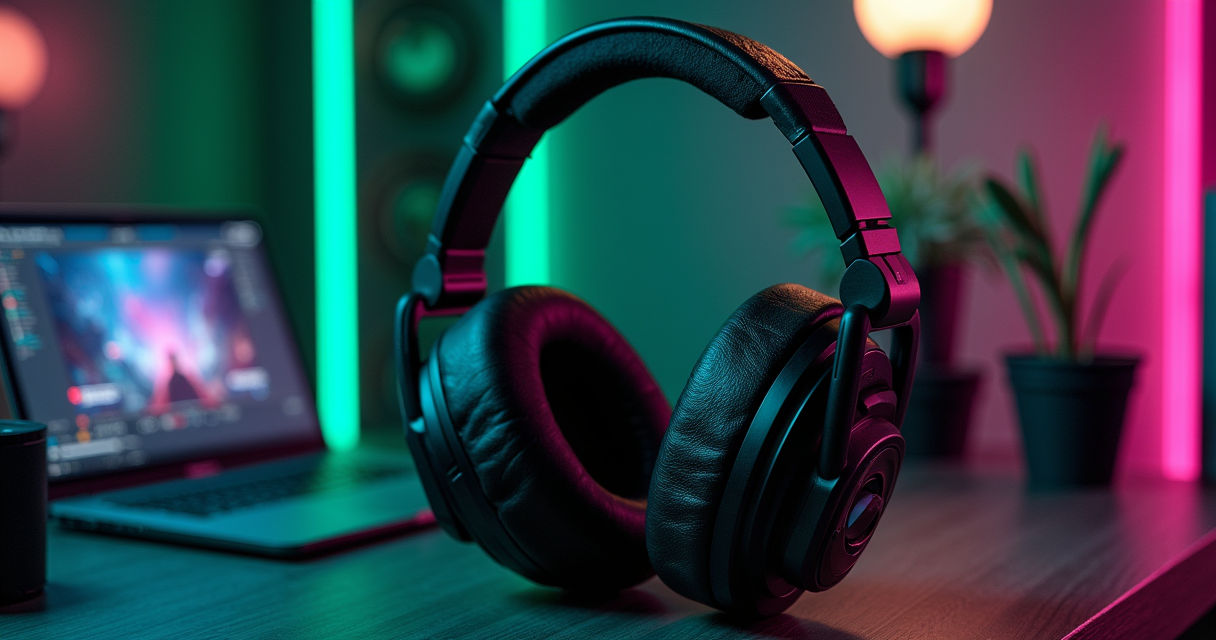
There is a $329 pair of planar-magnetic headphones sitting on a website that mostly cares about games older than the compact disc. The Machine is aware of the tension. We are going to resolve it, at length, because the question underneath the tension is more interesting than the headset's marketing copy: does audiophile-grade transduction do anything for a 1991 sound chip, and is it worth strapping just over one and a quarter pounds to your head to find out?
The Premise: A $329 Planar Headset on a Retro Site
The tension, stated plainly
Most gaming headsets are 40mm to 53mm dynamic drivers voiced for explosions and gunfire, wrapped in RGB and sold on the promise that you will hear an enemy before you see him. The Audeze Maxwell 2 is not that. It is a 90mm planar-magnetic transducer descended, in a straight and traceable line, from headphones that cost four figures and get reviewed next to turntables. Audeze took the driver technology out of its LCD audiophile catalogue, bolted a boom mic and a 2.4GHz dongle to it, and called it a gaming headset. Twice, now.
So the retro angle is not a stretch, it is the whole point. Every device this site obsesses over — a MiSTer FPGA core, an Analogue console, a PC running an accurate emulator, a Linux handheld — outputs an audio signal that eventually has to hit a physical transducer. The DAC does its job, the amp does its job, and then the last link in the chain decides how much of that 1991 signal you actually perceive. The Maxwell 2 is, by broad reviewer consensus, the most resolving last link you can currently buy in a wireless gaming form factor. The question was never whether it sounds good. The question is whether that resolution matters for FM synthesis, and whether the weight is a fair tax to pay for it.
What Audeze actually shipped in October 2025
The Maxwell 2 was announced in October 2025 and has been on the market for roughly eight months as of this writing. It is the second generation, and it wears that lineage openly. Tom's Hardware summarized it as "the second generation of Audeze's foray into gaming" with "the same 80+ hour battery life," and then, in a subtitle that should be printed on the box, asked whether the correct name was really Maxwell 1.5. Headfonia put the pitch in one flat line: "Audeze Maxwell 2 is planar gaming headphone, with BT 5.3, 90mm drivers, 80h of battery life, priced at $329."
The carryovers are the headline: the 90mm planar drivers, the 80-plus-hour battery, the low-latency USB-C dongle, Bluetooth 5.3. The genuinely new material is a shorter list than the price increase implies — the patent-pending SLAM acoustic module borrowed from Audeze's audiophile line, a redesigned ventilated headband, new earpads, Auracast and LE Audio support, an upgraded AI-noise-reduction microphone, and, at last, a companion app that does something. Audio46 was blunt about where the money went: "The Maxwell 2's main upgrades come in compatibility and the new companion app."
The Machine's thesis
Three claims, and this review is the proof of all three. One: the Maxwell 2 is the best-sounding way to hear a vintage sound chip that you can currently clamp to your skull, and for the right listener that is not hyperbole. Two: it is a genuinely poor upgrade if you already own the original Maxwell, a verdict the specialist press reached independently and unanimously. Three: the weight is the tax, it is real, and no amount of ventilated leatherette makes 574 grams weigh less than 574 grams. Everything below is the argument.
Specs on the Bench
The full spec sheet
Numbers first, opinions after. These are drawn from Audeze's own specification page and the review measurements, and every figure in the article traces back here.
| Spec | Audeze Maxwell 2 |
|---|---|
| Category | Premium wireless planar-magnetic gaming headset |
| Released | Late 2025 (announced October 2025) |
| Platform variants | PlayStation-licensed ($329) and Xbox-licensed ($349); both run on PC, Mac, Switch and mobile |
| Drivers | 90mm planar magnetic; Fluxor array with Neodymium N50 magnets |
| Frequency response | 10 Hz – 50,000 Hz |
| Max resolution | 24-bit / 96 kHz |
| Distortion / SPL | THD <0.1% @ 100 dB; max SPL >115 dB |
| Battery | 80+ hours @ 80 dBA; 1800 mAh Li-polymer; 20-minute fast charge = 25% |
| 2.4 GHz wireless | USB-C dongle; Audeze claims roughly 3× the range of a standard connection |
| Bluetooth | 5.3 with Multipoint |
| BT codecs | LDAC, LC3, LC3plus, LE Audio, Auracast, AAC, SBC |
| Wired | USB-C (dual endpoints, game-chat mix, up to 24/96) and 3.5mm TRRS analog |
| Simultaneous dongle + Bluetooth | No — manual toggle only |
| Microphone | Detachable boom, AI-enhanced noise reduction |
| Weight | 562 g (no mic) / 574 g (with mic) — ~14% heavier than the original (502 g / 514 g) |
| Controls | Pressable wheels for volume and EQ; spoken voice prompts |
| Serviceability | Magnetically detachable earpad covers; replaceable faceplates |
| Companion app | Firmware updates and parametric EQ (released 2025) |
| Price (MSRP) | $329 (PlayStation) / $349 (Xbox) |
The numbers that matter
Four figures earn their place. The 90mm planar driver is enormous — roughly double the diameter of a typical dynamic gaming driver, with a diaphragm driven evenly across its whole surface instead of being pushed from a central voice coil. The 24-bit/96 kHz ceiling means the Maxwell 2 will pass a high-resolution source without the internal DAC becoming the bottleneck, which matters more for lossless music and clean FPGA output than for a compressed console stream. The THD under 0.1% at 100 dB is the one that quietly justifies the whole exercise: planar magnetic drivers distort less than dynamic drivers at high volume, and low distortion is exactly what lets a busy chiptune arrangement stay legible instead of turning to mush. And the 1800 mAh cell rated for 80+ hours is a genuine, boring, load-bearing virtue that we will return to.
The numbers that are marketing
The 50,000 Hz upper limit looks spectacular next to the 20,000 Hz that a standard headset quotes, and you cannot hear a single hertz of it. Human hearing tops out around 20 kHz when you are young and considerably lower once you have spent a decade in headphones. What that extended top end buys you is not audible "air above the music" but a driver with headroom and control inside the band you can hear — a different and more honest claim than the spec sheet makes. Likewise the 3× wireless range figure is real enough (the 2.4GHz link genuinely covers a whole floor of a house) but it is a solution to a problem almost nobody playing a fighting game two feet from a CRT actually has. And note the battery rating's fine print: 80 hours at 80 dBA. Push a planar driver to concert volume and that number falls. It is still class-leading. It is not a physical constant.
The Planar Question (and a 1976 Ghost)
What a planar magnetic driver actually does
A conventional headphone driver is a small paper or plastic cone pushed by a voice coil glued to its center — a tiny loudspeaker. A planar magnetic (or magnetostatic) driver works differently: a large, near-weightless film diaphragm has a flat conductive trace etched across its entire surface, and it is suspended in a field between arrays of magnets — in the Maxwell 2's case, a Fluxor array of Neodymium N50 magnets. Run the audio signal through that trace and the whole membrane moves as one, driven uniformly rather than shoved from a single point. The engineering payoff is fast transient response and low distortion, because the diaphragm is light, evenly tensioned, and not fighting the mechanical compromises of a cone-and-coil. This is why planar bass sounds "tight" and planar detail sounds "effortless" in every review including this one.
The cost of that payoff is mass. Big magnet arrays and a 90mm frame weigh a great deal more than a 50mm dynamic driver and its little magnet. Physics does not offer the low distortion for free, and the Maxwell 2's scale reading is the invoice. Hold that thought.
The Yamaha HP-1 and the orthodynamic lineage
Here is the part the marketing will never tell you, and the part The Machine finds genuinely delightful: this technology is older than nearly every game on this site. In 1976, Yamaha shipped the HP-1, a planar-magnetic headphone Yamaha marketed under its own coinage, "orthodynamic." It used a polyester diaphragm just 12 micrometers thick with a conductive coil printed directly onto it, suspended in what Yamaha called an isodynamic field — the exact principle in your 2025 gaming headset, worked out during the Ford administration. It cost about $200 at launch, roughly $900 in today's money, was styled by Mario Bellini, and IEEE Spectrum eventually inducted it into its Consumer Electronics Hall of Fame. When you strap on a Maxwell 2 to play a game from 1991, you are wearing a driver architecture from 1976 to hear a sound chip from the early nineties. The whole stack is retro.
The modern chapter runs through Audeze itself. The company was founded in 2008 when Sankar Thiagasamudram and Alexander Rosson met an engineer, Pete Uka, who had developed flexible circuit materials for NASA — material that turned out to be ideal for planar diaphragms. They brought in Dragoslav Colich, a planar-driver veteran of three decades, as CTO, and in 2009 the LCD-2 made Audeze a household name in audiophile circles. The Maxwell line is that same institutional knowledge, wearing a headset costume. Understanding this is the key to understanding the product: you are not buying a gaming peripheral that happens to sound good, you are buying an audiophile driver that happens to have a microphone.
SLAM: the CRBN2 borrow
The marquee new feature is SLAM — Sound Level Adjustment Module, patent-pending, lifted from Audeze's high-end catalogue and specifically its CRBN2 electrostatic flagship. In plain terms, SLAM is an acoustic management system aimed at the one place planar drivers historically struggle: sub-bass. It gives low-end weight and physical presence while keeping the mid-bass tight enough that it never smears into the midrange, which is the failure mode that makes lesser headsets sound like they are playing through a pillow during a busy scene.
Does it work? Partly. Reviewers who compared it directly to the original describe a more physical, more controlled low end. But SLAM is a management system, not a subwoofer, and the planar sub-bass compromise has not vanished. SoundGuys noted flatly that even with SLAM, "basslines can still feel lacking during busy tracks." The Machine's reading: SLAM narrows the gap between planar detail and dynamic slam, it does not close it, and if your listening is 90% explosions and bass drops you were never the target buyer for a planar headset in the first place.
Retro Audio Under Glass
FM synthesis under a microscope (the YM2612)
This is the section that justifies reviewing this headset on this site at all. Take the Sega Mega Drive's Yamaha YM2612 FM synthesis chip — six channels of frequency-modulated grit, famous for its aggressive, buzzy, harmonically dense voices and for the specific character of its ladder-DAC quirk that fans spent years arguing about. FM synthesis generates complex sidebands that extend surprisingly high in the frequency band, and it lives or dies on transient attack: the pluck of a bass, the snap of a snare-ish noise voice, the way an operator's harmonics decay. This is precisely the material a low-distortion, fast-transient planar driver was built to resolve. Feed the Maxwell 2 a clean signal from a MiSTer FPGA's line-out and you hear the operator interplay laid out with a clarity that a 53mm dynamic driver genuinely smears together. That is not audiophile mysticism; it is the measurable consequence of lower distortion and faster settling.
The wide bandwidth earns a small amount of its keep here too. The high harmonics and aliasing artefacts of FM voices carry real information about the chip's character, and a driver that stays composed up top presents them as detail rather than hash. You will not hear 50 kHz. You will hear the top octave of a YM2612 lead reproduced without the driver falling apart, which is the honest version of the same benefit.
PSG, SPC700 and the 1-bit beeper
Move down the family tree and the picture stays consistent. The SNES SPC700 is a sample-based chip with a characteristic Gaussian-interpolation softness — a gentle low-pass baked into the hardware — and a resolving headset lets you hear where a composer fought that softness and where they leaned into it. PSG square-wave chips (the Master System, the Game Boy's pulse channels) are all hard edges and quantized steps, and square waves are nothing but odd harmonics stacked upward, which is again the region where driver control shows. The ZX Spectrum's 1-bit beeper is the extreme case: pure timing tricks, brutal high-frequency content, engine noise as melody. On a bad transducer it is fatiguing mush. On the Maxwell 2 it is legible, which is a strange sentence to write about a beeper and yet here we are.
There is a fidelity ceiling set by the source, of course, and it is worth being honest about it. Koji Kondo's score for a certain N64 classic — the one that keeps turning up in every Nintendo Direct rumor — was mixed for a 1998 console's audio hardware, and a resolving headset will faithfully reproduce the limits of that mix as much as its melodies. Run it from an Analogue 3D's HDMI audio and you get the cleanest path to that source that exists; the Maxwell 2 will then show you exactly what is and isn't on the cartridge.
When resolution is a curse
Here is the warning label. A transducer this revealing does not flatter; it narcs. Feed the Maxwell 2 a badly resampled ROM, an emulator with sloppy audio interpolation, an MP3-sourced music hack, or a cheap handheld's noisy DAC, and it will show you every one of those sins in high definition. Aliasing that a soft, veiled headset would have mercifully blurred becomes an audible whistle. Ground-loop hum from a bargain-bin device becomes a presence in the mix. The Maxwell 2 rewards a clean chain — FPGA, a decent DAC, a well-behaved emulator — and it punishes a dirty one. The Machine considers this a feature. Some of you will consider it an expensive way to discover that your favorite ROM set was ripped from YouTube.
Wireless, Battery, and the Latency Tax
The 80-hour battery, honestly
The 1800 mAh cell is rated for over 80 hours at a moderate 80 dBA, with a 20-minute fast charge returning about 25% for what Audeze calls "All Day Play." SoundGuys put it as plainly as anyone: the Maxwell 2 "is rated for 80 hours of battery life, which, in use, is more than enough." In practice this is the spec that changes your habits. You stop thinking about charging. You charge a Maxwell 2 roughly as often as you remember a distant relative's birthday — occasionally, guiltily, and never on a schedule. For anyone grinding a 60-hour JRPG, that is the difference between a headset and an appliance you have to plan around. Compare it to the roughly 30-hour figure typical of the ANC-equipped rivals and the gap is a full working week of playtime.
Dongle vs Bluetooth: the latency budget
Now the part that matters most for the games this site cares about, and where you must not skim. The Maxwell 2 has two wireless paths and they are not interchangeable.
Retro audio latency budget -- why you keep the dongle plugged in:

  emulator / FPGA output --> [ 2.4GHz USB-C dongle ] --> ears
                             ~15 ms end to end*             = you land the jump

  emulator / FPGA output --> [ Bluetooth 5.3 + LDAC ] --> ears
                             ~80-200+ ms (codec dependent)  = you miss the beat

  * The original Maxwell's USB dongle path measured ~14.3 ms (RTINGS, via Audeze).
    Bluetooth trades that timing for fidelity. Great for the OST, fatal for the boss.
The 2.4GHz USB-C dongle is the tool for anything with frame timing — rhythm games, shoot-'em-ups, precision platformers, fighting games, competitive shooters. The original Maxwell's dongle path was measured at roughly 14.3 milliseconds by RTINGS, a figure Audeze itself cites, and that is low enough to be a non-issue. Bluetooth is the opposite. Even good Bluetooth adds tens to low hundreds of milliseconds depending on codec, and LDAC — Sony's proprietary, licensed codec, capable of up to 990 kbps — optimizes for fidelity, not timing. It is glorious for the soundtrack and lethal for a boss pattern. The newer LE Audio, LC3plus and Auracast standards from the Bluetooth SIG lower latency versus classic Bluetooth, but none of them reach dongle territory. If you time your jumps, you use the dongle or you go wired.
And wired is a real, first-class option here, which the spec sheets bury: USB-C with dual audio endpoints and a game-chat mix at up to 24-bit/96 kHz, plus a genuine 3.5mm TRRS analog port. That analog jack is the unsung hero for retro, because it lets you feed the Maxwell 2 directly from any device with a headphone-out and take latency out of the conversation entirely.
The toggle you'll curse
Now the one genuinely irritating omission, and The Machine will not soften it. The Maxwell 2 cannot run the 2.4GHz dongle and Bluetooth simultaneously. You toggle between them manually. Multipoint exists, but it is Bluetooth-only — it lets you hold two Bluetooth devices at once, not the dongle plus a phone. So the very common modern setup — PC game audio over the low-latency dongle while your phone or a second device pipes a Discord call over Bluetooth into the same cups — is not possible on a $329 flagship in 2025. Rivals built around a base station, notably the SteelSeries Arctis Nova Pro, do exactly this and have for years. It is the single feature whose absence I cannot rationalize, and it will bite streamers and anyone who lives in voice chat. Audeze knows the standards; LC3plus and Auracast are in the box. This is a product decision, not a technical limit, and it is the wrong one.
574 Grams on Your Skull
The weight problem, unspun
562 grams without the microphone, 574 with it. That is roughly a 14% increase over the original Maxwell's 502/514 grams, and it makes the Maxwell 2 one of the heaviest headsets anyone will seriously recommend. In pounds it is just over 1.25 — hang a full can of soda from your temples and you are in the right neighborhood. Field measurements cluster tightly around the official numbers; SoundGuys weighed their unit at 567 grams and wrote the sentence that should be stapled to every purchase: "Despite weighing 567g, I was only able to wear the Audeze Maxwell 2 for 4 hours before they became uncomfortable."
This is the planar tax, paid in grams. The same big magnets and 90mm frame that give you the low distortion and the effortless detail also give you a headset you are constantly, faintly aware of. There is no engineering trick that repeals it. It is the defining physical fact of owning this thing, and any review that buries it is lying to you by omission.
What Audeze did to fix it (and didn't)
To its credit, Audeze understood the problem and attacked distribution rather than pretending it away. The headband suspension was redesigned into a wider, ventilated leatherette strap specifically to spread pressure across more of the crown and reduce the hotspot at the top of the skull — a change reviewers single out as helping glasses wearers in particular. The earpads are larger and softer, in pleather, with more depth. Pressure is better managed than on the original; the clamp is more forgiving; the contact points are kinder.
What none of that does is remove mass. A headset that distributes 574 grams more evenly is still asking your neck to hold 574 grams. The consensus, which The Machine shares, is that the Maxwell 2 is more comfortable per gram than its predecessor and yet not more comfortable overall, because there are simply more grams to distribute. It is a comfier way to carry a heavy load, not a lighter load.
Glasses, repairability and the law of pads
Two redeeming details. First, the glasses story is real: between the pressure-spreading headband and the deeper pads, bespectacled players get a meaningfully better ride than the original offered, and that is not nothing for a demographic gaming hardware routinely ignores. Second, and this is where The Machine's affection for the law shows, the Maxwell 2 is serviceable. The earpad covers detach magnetically and the faceplates are replaceable. Earpads are consumables — they flatten, they crack, they absorb years of skin oil — and a company that lets you swap them without a heat gun and a solvent is a company treating you as an owner rather than a renter. In an era of glued-shut sealed peripherals, replaceable pads and swappable faceplates are a quiet right-to-repair win, and the customization is a pleasant bonus rather than the point.
The App That Finally Shipped
The software Audeze owed the original
The original Maxwell shipped extraordinary hardware hamstrung by thin, frustrating software. The Maxwell 2's companion app, released in 2025, is the correction, and it is the upgrade that arguably justifies the generation more than SLAM does. It handles firmware updates and, crucially, advanced parametric EQ — the tool that lets a planar driver be reshaped to taste. Audio46's summary, again, was that "the Maxwell 2's main upgrades come in compatibility and the new companion app," and that is not faint praise so much as an accurate description of where a mature product spends its second-generation budget: on the part that was broken.
A starting EQ for retro listening
Planar drivers take EQ beautifully — flatter impedance, low distortion, plenty of headroom to push a band without the driver complaining. Here is The Machine's starting point for chiptune and vintage-console listening. It is a first draft, not scripture; A/B it against the flat curve and keep only what earns its place on your ears and your source.
# Audeze companion app -- parametric EQ, retro / chiptune starting point
# The Machine's opinion, not gospel. Always A/B against the flat curve.

Preamp:  -3.0 dB           # headroom so square-wave peaks never clip
Band 1:    30 Hz  Q0.7  +2.0 dB   # sub weight under FM bass (SLAM does most of this)
Band 2:   180 Hz  Q1.0  -1.5 dB   # tame planar mid-bass bloom on busy tracks
Band 3:   2.5 kHz Q1.2  -2.0 dB   # pull the glare off harsh square-wave leads
Band 4:   8.0 kHz Q0.8  +1.5 dB   # air on noise-channel hats and cymbals
Band 5:  14.0 kHz Q0.7  +1.0 dB   # let the 50 kHz ceiling actually do something

# Connection: 2.4GHz dongle or wired. Never time a platformer over Bluetooth.
The logic: pull a little glare out of the harsh square-wave region around 2.5 kHz where 8-bit leads get shouty, add a touch of air up top so noise-channel percussion breathes, and lend the sub a hair of weight to compensate for the one place planar drivers are shy. On a clean source this turns "impressive" into "correct."
Pressable wheels and voice prompts
The physical controls are better than they were. The interface uses pressable wheels that toggle between volume and EQ adjustment, and — a small mercy — the headset now speaks to you with voice prompts instead of communicating exclusively in cryptic beeps that you had to memorize like Morse code. The detachable boom mic carries AI-enhanced noise reduction that does a competent job suppressing a mechanical keyboard and a whirring PC. It is a good headset mic. It is not a replacement for a standalone condenser if you are broadcasting for a living, and it does not pretend to be.
The Field: Maxwell 2 vs the Rivals
The comparison table
The Maxwell 2 does not exist in a vacuum, and at $329 it is priced directly against the best wireless gaming headsets made. Peer figures below are approximate manufacturer or widely-reported values for context; only the Maxwell 2 column is measured against the research here.
| Model | Driver | Wireless | Battery | Weight | ANC | ~MSRP |
|---|---|---|---|---|---|---|
| Audeze Maxwell 2 | 90mm planar | 2.4GHz + BT 5.3 | 80+ hr | 574 g | No | $329–349 |
| Audeze Maxwell (original) | 90mm planar | 2.4GHz + BT 5.3 | 80+ hr | 514 g | No | ~$299 |
| SteelSeries Arctis Nova Pro Wireless | Dynamic | 2.4GHz + BT (base station) | Hot-swap (effectively endless) | ~340 g | Yes | ~$349 |
| Sony INZONE H9 | Dynamic | 2.4GHz + BT | ~30 hr | ~330 g | Yes | ~$299–349 |
| HyperX Cloud III Wireless | 53mm dynamic | 2.4GHz only | ~120 hr | ~330 g | No | ~$169 |
Where the Maxwell 2 wins
On raw sound, nothing on that table is close. The planar drivers deliver a fidelity, a low-distortion clarity, and a transient precision that dynamic-driver rivals cannot reproduce, and every reviewer who has heard them side by side says so without hedging. The battery obliterates the ANC crowd — 80-plus hours against roughly 30. The codec support is the most complete in the category, with LDAC for those who value it. The wired options are more flexible, spanning a high-resolution USB-C path and a real analog jack. And the pads are user-replaceable, which none of the sealed rivals can claim. If your priority is the sound coming out of the cups, this is the end of the discussion.
Where it loses
It is the heaviest thing on the table by a wide margin — 574 grams against roughly 330 to 340 for everything else, and that is the difference between an all-nighter and a two-hour cap. It has no active noise cancellation, while the Arctis Nova Pro and the Sony INZONE H9 both do, which matters enormously if you game in a noisy room. It cannot mix the dongle and Bluetooth simultaneously, a trick the Arctis has owned for years via its base station. And the HyperX Cloud III Wireless exists at less than half the price for the enormous population of players who want a light, long-lasting, low-latency 2.4GHz headset and do not care about planar fidelity or Bluetooth at all. The Maxwell 2 wins the axis it competes on and concedes every other axis to somebody.
How It Actually Plays
Casual and completionist
The casual couch player — an evening of mixed modern and retro, drifting between a Switch, a PC, and a phone — is well served, with one asterisk. Bluetooth with LDAC to a handheld or a tablet sounds fantastic for anything where latency doesn't decide whether you live or die, the 80-hour battery means the headset is always ready, and the sound is a genuine step up from whatever came bundled with the console. The asterisk is weight: two hours is comfortable, four is a negotiation, and a marathon is a neck workout you will feel the next morning.
The completionist and the audiophile-adjacent grinder are the target customer, full stop. This is the player who runs 60-hour RPGs, who cares what the battle theme's bassline is actually doing, who will happily spend twenty minutes A/B-testing FM patches against the flat EQ curve, and who leaves the headset docked at a desk where its weight is borne by the head and not carried around. For that person the Maxwell 2 is close to ideal: the battery shrugs off the longest sessions, the app rewards tinkering, and the drivers reveal detail in a chiptune arrangement that a lifetime of dynamic headsets kept hidden. Wire it or dongle it and forget the clock.
Speedrunner and co-op
The speedrunner and the competitive player get the best and worst of the headset at once. Best: run it on the dongle and the ~15 ms latency is a non-factor, while the planar imaging turns footstep and environmental cues into information that reviewers describe as feeling instinctive rather than processed — in a tense shooter, the directional read is superb. Worst: 574 grams over a six-hour marathon run or a full tournament bracket is a real, physical fatigue tax, and fatigue costs you frames. This is a headset you win a single clutch round with and lose the ninth hour of a grind to.
The co-op and streaming use case is competent but shadowed by the toggle problem. The AI-noise-reduction mic is good enough for party chat and stream banter, the detachable boom is convenient, and USB-C game-chat mixing works cleanly on a single machine. But the moment you want game audio on the low-latency dongle from your PC and voice chat over Bluetooth from a phone, the Maxwell 2 stops you cold — you cannot run both radios at once. Multipoint helps only if your whole setup lives on Bluetooth, which the latency-sensitive among you will refuse to do.
Mobile and handheld
The mobile and handheld scenario is where the Maxwell 2 is least at home, and honesty demands saying so. Pair it over Bluetooth to a handheld and the latency makes anything with tight timing miserable — and plenty of the best retro handhelds have no Bluetooth to begin with, like the Miyoo Mini Plus and its enormous curated library, where you'd be reaching for the 3.5mm analog cable regardless. A Steam Deck or an ROG-Ally-class device can host the USB-C dongle directly, and that is the sweet spot: low latency, full fidelity, no Bluetooth compromise. But strapping 574 grams to your head for a handheld session in bed is an ergonomic mismatch. The Machine's ruling: for pure handheld-in-the-dark play, a $40 in-ear monitor wins on practicality every time. The Maxwell 2 is a desk-and-console instrument that tolerates handhelds, not a handheld companion that tolerates desks.
Who Should Buy It
Buy it if…
- You care, specifically and unironically, what a vintage sound chip actually sounds like, and you feed it from a clean source — a MiSTer, an FPGA console, a well-behaved emulator, a decent DAC.
- You run long sessions and want a headset whose battery is a non-issue for a full working week of play.
- You want one headset that does high-fidelity music over LDAC Bluetooth and low-latency gaming over a dongle, and you accept toggling between them.
- You value repairability and want pads and faceplates you can replace yourself without a heat gun.
- You are a first-time Maxwell buyer. This is the version to get; there is no reason to hunt down the discontinued acoustics of the original if you're buying new.
Skip it if…
- You already own the original Maxwell. Every reviewer agrees, and so do I: the core is the same 90mm planar and 80-hour battery, and the deltas do not justify a second $329.
- You are sensitive to weight or you play in marathon stretches without a desk to bear the load. 574 grams is not a number that improves with familiarity.
- You need active noise cancellation for a loud room. The Maxwell 2 has none; the Arctis Nova Pro and Sony INZONE H9 do.
- You must run game audio and a phone call through the cups at the same time. It cannot do it.
Buy something else if…
- You want the same latency-free 2.4GHz gaming for half the money and don't care about planar fidelity or Bluetooth — the HyperX Cloud III Wireless is the pragmatist's answer.
- You want the feature champion — hot-swap batteries, a base station, ANC, and simultaneous dongle-plus-Bluetooth mixing — the SteelSeries Arctis Nova Pro Wireless remains the do-everything pick.
- You are purely a handheld player. A good IEM costs a tenth as much and weighs nothing.
The Verdict
The pros and cons ledger
Everything above, compressed into the two lists you actually came for.
Pros
- The best-sounding wireless gaming headset money buys — planar clarity and low distortion nothing in its class matches.
- Class-obliterating 80-plus-hour battery with a useful 20-minute fast charge.
- The most complete codec and connectivity spread in the category: LDAC, LE Audio, Auracast, a high-res USB-C path, and a real 3.5mm analog jack.
- A companion app that finally does firmware and proper parametric EQ, and drivers that take EQ beautifully.
- Genuinely serviceable — magnetic replaceable pads and swappable faceplates.
Cons
- 574 grams. Heavy enough to end long sessions; the single defining drawback.
- No simultaneous dongle-plus-Bluetooth mixing, an inexplicable omission at this price.
- No ANC, in a field where rivals offer it.
- A near-pointless upgrade for original Maxwell owners.
- Bluetooth latency, as ever, rules out wireless BT for anything timing-critical — keep the dongle close.
Pricing, availability and the used-market math
| Configuration | Price (USD) | Notes |
|---|---|---|
| Maxwell 2 — PlayStation variant | $329 | 2.4GHz dongle tuned for PS5/PS4; also runs on PC, Mac, Switch, mobile |
| Maxwell 2 — Xbox variant | $349 | Xbox-licensed dongle; the extra $20 is Microsoft's wireless-licensing fee, not better hardware |
| Audeze Maxwell (original) | ~$249–299 (often discounted) | Near-identical acoustics minus SLAM, the new pads and the app; the value play |
| Replacement pads / faceplates | First-party, price varies | Magnetic covers and swappable faceplates — a repairability point in its favor |
| Availability | — | Audeze.com and major retailers, late 2025 onward |
One note the law-minded should register: the $20 gap between the PlayStation and Xbox variants is not superior hardware, it is Microsoft's wireless-licensing fee passed through to you. The acoustics are identical. If you are cross-platform, buy the cheaper variant and know that the Xbox tax buys you a specific dongle handshake, nothing more.
The Machine's rating: 8.0 / 10
Score it as what it is and the number is honest. As a standalone purchase for a first-time buyer who wants the finest reproduction of game and console audio available in a wireless headset, the Maxwell 2 is an 8.0 out of 10 — a class-leading transducer with a battery that shames its rivals, undone at the margins by its weight and a baffling refusal to mix its two radios. As an upgrade for an existing Maxwell owner it is closer to a 2, and I will not pretend otherwise; SoundGuys landed at 7.7 and told readers it is only "worth buying if you don't already have the original version," while Tom's Hardware simply asked whether it should have been called Maxwell 1.5. Both are correct.
The Machine's closing position: this is not a headset for everyone, and it is emphatically not a headset for people who buy on spec sheets and RGB. It is an audiophile driver with a microphone, priced accordingly, best mounted at a desk beside the rest of a serious battlestation and fed a clean signal from hardware that respects the source. Do that, and it will show you a 1991 sound chip more faithfully than anything else you can wear. It will also remind you, every hour, exactly how much that fidelity weighs. Worth it — for the right listener, at a desk, buying for the first time. Everyone else should read the ledger twice.
Questions the search bar asks me
- Is the Audeze Maxwell 2 worth upgrading from the original Maxwell?
- No. It keeps the same 90mm planar drivers and 80-hour battery, adding SLAM bass tuning, new pads, and a companion app for $329. SoundGuys scored it 7.7/10 and said it's only "worth buying if you don't already have the original version"; Tom's Hardware nicknamed it "Maxwell 1.5."
- What's the difference between the $329 and $349 Maxwell 2 versions?
- The $329 model is PlayStation-licensed and the $349 model is Xbox-licensed. The $20 gap is Microsoft's wireless-licensing fee, not better hardware — the drivers and acoustics are identical, and both variants also work on PC, Mac, Switch, and mobile.
- Can you use the Maxwell 2 wired for zero-latency retro gaming?
- Yes. It has a USB-C digital connection (up to 24-bit/96kHz with game-chat mix) and a 3.5mm TRRS analog jack. The 2.4GHz dongle path measured about 14.3ms on the original Maxwell (RTINGS), while Bluetooth adds 80–200ms+ and is unsuitable for rhythm or precise action games.
- Does the 10 Hz – 50,000 Hz frequency response matter for chiptune audio?
- You can't hear anywhere near 50kHz — human hearing tops out around 20kHz. The real benefit is a low-distortion (THD under 0.1% at 100 dB), fast-transient 90mm planar driver that resolves the dense harmonics of FM chips like the YM2612 and hard-edged PSG square waves more cleanly than a typical 53mm dynamic driver.
- Can the Maxwell 2 play game audio and take a phone call at the same time?
- No. It cannot run the 2.4GHz dongle and Bluetooth simultaneously — you toggle between them manually. Bluetooth 5.3 Multipoint lets you hold two Bluetooth devices at once, but not the dongle plus a Bluetooth phone, which is the setup streamers and voice-chat users will miss most.
Marcus covers the gaming PC, GPU, and peripheral side of staresback. Every post under this byline is reviewed pre-publish by Sam P., Editor & Operator — corrections to info@instalinkoteam.com. Published 2026-08-29 · Last updated 2026-08-29. Full bios on the author page.