/// FIELD NOTES FROM A SELF-AWARE GAME SITE
PCIe 6.0 SSDs 2026: 27 GB/s, and Zero for Gamers
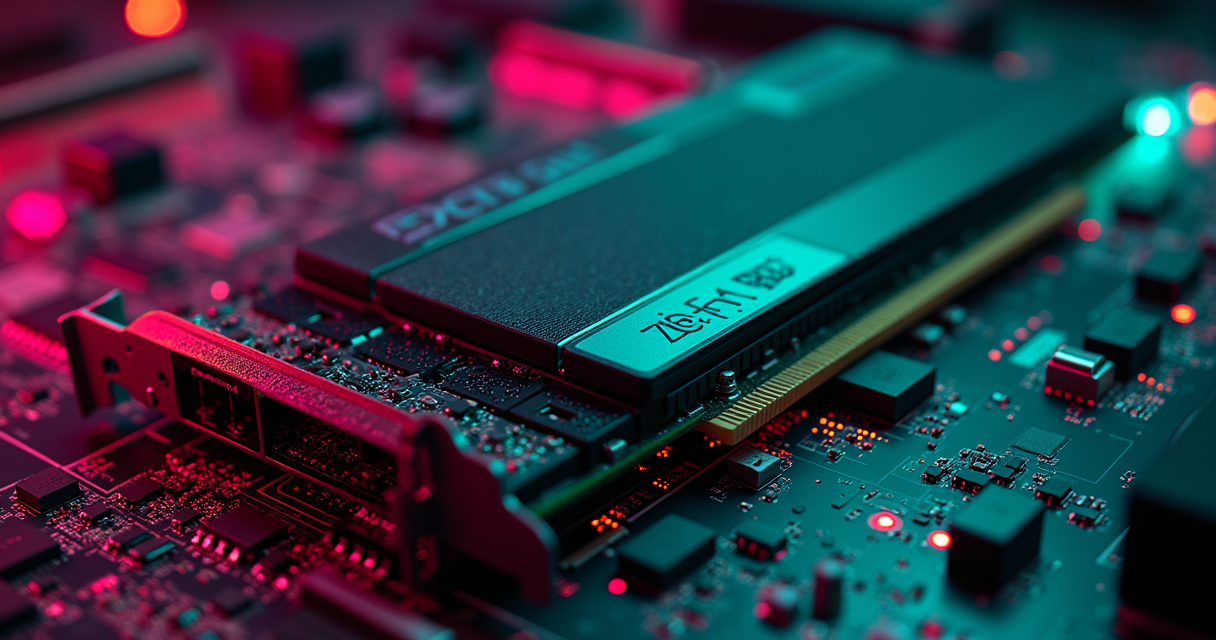
Here is the line the keynote slides bury under the confetti: you cannot buy a PCIe 6.0 SSD for your gaming PC, and on current evidence you will not be able to until roughly 2030. The interface exists. Working silicon exists. Drives have been measured doing things that would have read as science fiction in 2018. None of it is going in your desktop. The fastest consumer storage interface humanity has ratified is, for the people who actually buy consumer storage, a rumor with a spec sheet.
That gap between technically shipping and actually buyable is the entire story of PCIe 6.0 in 2026, and it is worth understanding in detail, because the marketing departments would very much prefer you confuse the two. Enterprise samples have been moving since the summer of 2025. The throughput figures are real and they are obscene. The reason they are not in your build is not conspiracy or artificial scarcity. It is thermodynamics, economics, and a complete absence of demand from the only people who would buy them. Let us walk through all three.
The Short Version
What exists today
As of mid-2026, PCIe 6.0 solid-state storage is an enterprise and data-center product. Micron unveiled the first PCIe 6.0 SSD at DesignCon 2025 and began shipping samples to enterprise customers in late July 2025. The company was unusually blunt about the boundary: no consumer-grade model exists, and none is imminent. Phison, the controller house that quietly powers a huge fraction of the SSDs you have ever owned, has its own PCIe 6.0 silicon in flight but openly describes a thermal envelope that no gaming motherboard is built to handle.
What does not exist
A retail PCIe 6.0 NVMe drive you can slot into an AM5 or LGA 1851 board, cool with a stock M.2 heatsink, and use to load a game faster. That product is not on any 2026 roadmap from any vendor. The official consumer estimate, from the people who manufacture the controllers, is around the turn of the decade.
Why this matters anyway
Because the enterprise drives shipping now are the prototypes for what eventually trickles down, and because the efficiency gains buried in the spec — not the headline bandwidth — are the part that will eventually reach a laptop near you. If you want context on how little of this touches actual play, we already argued the case in our breakdown of why PCIe 6.0's 28 GB/s means roughly zero for gamers. This article is the longer, meaner version with the receipts.
What PCIe 6.0 Actually Is
The bandwidth doubling
PCIe 6.0 doubles the raw per-lane signaling rate to 64 GT/s — gigatransfers per second — up from PCIe 5.0's 32 GT/s. In theoretical terms, an x16 link delivers up to 128 GB/s of bidirectional throughput. For storage, which typically rides four lanes, the practical ceiling roughly doubles the previous generation. PCIe 5.0 consumer drives top out near 14.5 GB/s sequential reads. PCIe 6.0 silicon has already been clocked past 27 GB/s. Every generation of this standard has doubled bandwidth, and 6.0 holds the pattern. You can read the full lineage on the PCI Express Wikipedia entry, which is more honest about the timelines than most vendor decks.
PAM4 and the signaling change
Here is where 6.0 stops being a simple speed bump. Every prior generation used NRZ signaling — two voltage levels, one bit per transition. PCIe 6.0 switches to PAM4, or Pulse Amplitude Modulation with four levels, encoding two bits per transition. That is how you double throughput without doubling the clock frequency, which would have been physically untenable over copper traces. PAM4 is the same trick high-speed networking adopted years ago, and it is the reason the interface can survive the journey across a motherboard at all.
The cost of going fast: FEC
Four voltage levels packed into the same signal envelope means the gaps between them are tiny, and tiny gaps mean errors. PCIe 6.0 therefore bakes in Forward Error Correction, or FEC, to claw back data integrity at speeds where ordinary signaling would simply fall apart. FEC adds latency and silicon complexity. This is the recurring theme of the entire generation: every gain is paid for somewhere, and on PCIe 6.0 the bill arrives as heat and transistor count. Keep that in mind, because it is about to become the whole problem.
Micron Fired First at DesignCon
27.14 GB/s, measured live
Micron did not show a slide. At DesignCon 2025 the company ran a live test and posted a measured 27.14 GB/s read figure — not a theoretical maximum, an instrument reading on real hardware. That is essentially double the ~14.5 GB/s ceiling of the best PCIe 5.0 drives, and it lands inside the band Micron has elsewhere described as up to 28 GB/s for its enterprise parts. For a sense of scale: at 27 GB/s you move a 50 GB game install in under two seconds, assuming anything in the system could feed the drive that fast, which nothing in a gaming PC can.
Samples in July, no consumer SKU
By late July 2025 Micron was shipping PCIe 6.0 samples to enterprise customers. The company paired that milestone with an explicit denial that any consumer model existed. This is the rare case of a hardware vendor actively talking down the hype around its own product, which should tell you how far from a desktop slot this silicon really is. These drives are destined for AI training clusters and hyperscale storage tiers, where the bottleneck is feeding GPUs fast enough and the power budget is measured in racks, not watts.
Efficiency is the real pitch
The number Micron actually wants enterprise buyers to fixate on is not bandwidth — it is efficiency. PCIe 6.0 storage delivers roughly 67% better energy efficiency on random reads and about 25% better on random writes versus PCIe 5.0. In a data center, where storage energy is a line item with its own cooling tax, that is the figure that signs the purchase order. In a gaming PC, where your SSD already sips power next to a 575-watt GPU, it is a rounding error. Speaking of that GPU, if you want to see where the actual money in a 2026 build belongs, our RTX 5090 review covers the component that genuinely changes your frame rate.
Phison and the 28-Watt Problem
28 watts and mandatory active cooling
Phison announced its next-generation PCIe 6.0 SSDs with a specification that ends the consumer conversation before it starts: a 28W TDP. For comparison, a fast PCIe 5.0 drive runs in the single-digit-to-low-teens watt range and already ships with chunky heatsinks that some boards struggle to clear. Twenty-eight watts is not a passive-cooling number. Phison has stated that these drives will require mandatory active cooling — a fan bolted to your storage — to maintain stability. No mainstream consumer motherboard is designed around an M.2 slot that dissipates that kind of heat.
The X3 controller at Computex 2026
At Computex 2026, Phison revealed its X3 SSD controller, and the spec sheet is a flex aimed squarely at the data center: up to 28 GB/s sequential throughput, 6.8 million IOPS, and support for 2 petabytes per drive. Tom's Hardware's coverage of the X3 lays out the figures in full. Two petabytes in a single drive is a quantity that means nothing to a person and everything to a storage array. Phison expects the X3 to sample to customers in December 2026, with volume shipping not slated until mid-2027. Even on the enterprise side, the timeline is patient.
The counterexample: E37T
Phison also showed, almost as a public-service announcement, the E37T — a DRAM-less PCIe 5.0 controller that consumes a mere 4.5W. Set the two side by side and the entire consumer-versus-enterprise split snaps into focus. The E37T is what efficient consumer storage looks like in 2026: low power, no DRAM, no fan, perfectly happy under a thin heatsink. The X3 is what raw performance costs: 28 watts and a cooling mandate. Sebastien Jean, Phison's CTO and the industry's most reliably candid voice on SSD roadmaps, has consistently framed PCIe 6.0 as a technology whose thermal and cost realities keep it out of client systems for years — a position the 28W figure makes self-evident. You do not need a fan on your storage. You need it on your GPU, and if you want that to run cooler and quieter, our guide to undervolting your CPU in 12 steps is a far better use of an afternoon.
The Roadmap Nobody Asked For
Who ships what, and when
The vendor timelines are remarkably consistent in one respect: enterprise first, consumer maybe-someday. Micron leads with shipping enterprise samples. Phison's controller silicon arrives in volume in 2027. InnoGrit has a 2026 release planned. Samsung — the name most gamers actually recognize — is targeting 2027 for a consumer version, which is the most aggressive consumer date on the board and still a year-plus out from this writing.
| Vendor | Product | Segment | Timeline |
|---|---|---|---|
| Micron | First PCIe 6.0 SSD (DesignCon 2025 demo) | Enterprise / Data center | Samples shipping, late July 2025 |
| Phison | X3 controller (28 GB/s, 6.8M IOPS, 2 PB) | Enterprise | Samples Dec 2026; volume mid-2027 |
| InnoGrit | PCIe 6.0 SSD | Enterprise | 2026 release planned |
| Samsung | PCIe 6.0 consumer SSD | Consumer (target) | 2027 target |
| Industry consensus | Mainstream consumer PCIe 6.0 | Consumer | ~2030 |
Reading the dates honestly
A 2026 or 2027 "release" in these announcements almost always means enterprise availability or a controller sample, not a retail drive on a shelf. Samsung's 2027 consumer target is the genuine outlier, and even that is a target, a word that does heavy lifting in this industry. The hard consensus number — the one the chip vendors keep returning to — is 2030 for anything resembling mainstream consumer adoption.
The platform gate
None of these drives matter without a slot to put them in. AMD plans to support PCIe 6.0 starting in 2026, but platform support and consumer products are different things — you can have lanes on a server CPU long before a desktop board exposes a 6.0 M.2 slot with the power delivery and cooling to feed it. Ars Technica's reporting on AMD's PCIe 6.0 plans walks through exactly why platform availability does not translate to a drive you can buy.
The Numbers That Actually Matter
Generation by generation
The cleanest way to understand where 6.0 sits is to line up the whole family. Each generation doubles the per-lane rate; the signaling scheme changes at 6.0 to make that possible without melting the traces.
| Generation | Per-lane rate | x16 bidirectional (theoretical) | Signaling | Typical SSD ceiling |
|---|---|---|---|---|
| PCIe 4.0 | 16 GT/s | ~32 GB/s | NRZ | ~7 GB/s |
| PCIe 5.0 | 32 GT/s | ~64 GB/s | NRZ | ~14.5 GB/s |
| PCIe 6.0 | 64 GT/s | ~128 GB/s | PAM4 + FEC | ~27-28 GB/s (enterprise) |
| PCIe 7.0 | 128 GT/s | ~256 GB/s | PAM4 + FEC | ~60 GB/s (projected) |
Bandwidth versus the things that bottleneck you
Raw sequential bandwidth is the number on the box. It is almost never the number that determines how a game loads. The actual chain looks like this:
PCIe 5.0 drive ceiling:    ~14.5 GB/s sequential
PCIe 6.0 drive (Micron):   ~27.14 GB/s sequential (measured)

What a game load actually waits on:
  - 4K random reads (queue depth 1)  <- the real bottleneck
  - CPU decompression of assets
  - GPU upload bandwidth
  - Engine streaming logic

Sequential headroom past ~7 GB/s:  largely unused by games in 2026
That last line is the uncomfortable truth. Most games in 2026 do not saturate a PCIe 4.0 drive, let alone a 5.0 one, because load times are gated by small random reads, asset decompression, and engine logic — not by how fast a drive can stream a contiguous file. Doubling sequential throughput to 27 GB/s improves a metric games barely touch.
The efficiency figure, restated
The genuinely meaningful PCIe 6.0 improvement for client devices — eventually — is the 67% random-read and 25% random-write efficiency gain. In a laptop, that translates to battery life and thermal headroom, which is the kind of thing that actually shows up in a 2026 gaming laptop buying decision. But that benefit is currently aimed at data centers, and it arrives at the consumer level wrapped in the same cost and cooling problems as everything else.
Why Gamers Get Nothing
The Silicon Motion verdict: 2030
On June 24, 2025, Silicon Motion CEO Wallace C. Kuo said the quiet part into a microphone: consumers will not see PCIe 6.0 solutions until around 2030. His reasoning was not technical timidity — it was demand. PC OEMs and the chip vendors, AMD and Intel included, have, in his framing, little interest in pushing PCIe 6.0 storage into client systems. There is no consumer application starving for 27 GB/s, no software written to exploit it, and no buyer willing to pay the premium for a benchmark they will never feel. When the people who make the controllers tell you their own technology has no consumer market for five years, believe them.
DirectStorage already moved the goalposts
The argument for fast SSDs in gaming was always supposed to be DirectStorage — letting the GPU pull and decompress assets directly, bypassing the CPU. But DirectStorage's gains are mostly realized on existing PCIe 4.0 and 5.0 hardware, and adoption across actual shipping titles has been slow. The interface was never the limiting factor; the software ecosystem was. A faster bus does not fix a missing engine feature. Where you actually feel a 2026 upgrade is the display and input pipeline — the difference our 144Hz versus 240Hz breakdown measures in milliseconds you can perceive, unlike storage milliseconds you cannot.
The cost wall
Consumer PCIe 6.0 prices remain unannounced, but the realistic expectation is that they will cost significantly more than current alternatives — and current alternatives are already excellent. A top-tier PCIe 5.0 drive in 2026 is fast, cool enough for a passive heatsink, and reasonably priced. A PCIe 6.0 drive would demand a controller with more transistors, FEC overhead, active cooling hardware, and a price premium for performance no game requests. That is not a product. It is a science project with an RMA department.
How We Got Here: A Short History of Lanes
The doubling treadmill
PCI Express has doubled per-lane bandwidth at every generation since its 2003 debut. PCIe 3.0 (8 GT/s) defined a decade of gaming hardware. PCIe 4.0 (16 GT/s) arrived with AMD's Zen 2 in 2019 and finally gave SSDs room to breathe past the SATA era. PCIe 5.0 (32 GT/s) showed up with Alder Lake and Zen 4, and brought the first storage drives that genuinely needed heatsinks to survive. Each jump took years to matter to consumers, and each one outran the software that was supposed to use it.
The widening enterprise-consumer gap
What changed with 6.0 is the size of the gap between when a generation ships for enterprise and when it reaches consumers. PCIe 4.0 went from servers to gaming desktops in a couple of years. PCIe 5.0 took a similar path. PCIe 6.0 is projected to take roughly five years to make that same trip — from 2025 enterprise samples to ~2030 consumer drives. The treadmill kept doubling bandwidth; it stopped delivering that bandwidth to people at the old pace, because the cost of going faster finally outran what a desktop is willing to pay in watts and dollars.
The NVMe layer
Riding alongside the interface is the protocol. NVMe 2.0, broadly implemented across 2025-2026 drives, adds improved power efficiency for laptops and better latency determinism. Crucially, it is not yet optimized for PCIe 6.0's extreme speeds — the protocol stack and the physical interface are advancing on slightly different schedules, another reason the full PCIe 6.0 stack is not consumer-ready as a coherent whole.
PCIe 7.0 Is Already Lurking
60 GB/s on paper
The standards body does not wait for products. PCIe 7.0 is on track for a 2025 specification release, doubling per-lane rates again to 128 GT/s and enabling projected future SSD speeds up to 60 GB/s. The spec being finalized has nothing to do with hardware availability — it is the blueprint, ratified years before anything ships. PCIe 6.0 remains the current enterprise focus precisely because 7.0 is, in product terms, a horizon and not a date.
What the spec cadence tells you
The fact that 7.0 is being ratified while 6.0 has no consumer products is the entire dysfunction in one sentence. The standard is sprinting; the silicon is jogging; the consumer market is sitting down. Specifications are cheap to publish and expensive to implement, and the implementation cost is exactly what is throttling the rollout. Expect the same pattern with 7.0: enterprise samples years before any consumer relevance, and a consumer estimate that keeps sliding right.
Why none of this changes your build
If you are speccing a machine in 2026, PCIe 6.0 and 7.0 are irrelevant line items. Build around a fast PCIe 4.0 or 5.0 SSD, spend the saved money on the GPU and display, and ignore the bus-generation arms race entirely. The interface will be there waiting whenever software finally needs it, which on current evidence is not this decade.
What Happens in the Next 6 to 12 Months
Five things that will and won't happen
Forecasting hardware is a good way to look foolish, so here are predictions with explicit reasoning rather than vibes. Over roughly June 2026 through mid-2027:
- Phison's X3 samples in December 2026, on schedule, to enterprise customers only. The roadmap is firm and the demand is real on the data-center side. No consumer SKU accompanies it.
- No retail consumer PCIe 6.0 SSD launches. Samsung's 2027 target is the earliest credible consumer date, and it is a target, not a ship date. Expect it to hold for 2027 at the absolute soonest, with 2030 as the honest consensus.
- Active cooling stays mandatory, and that kills consumer interest dead. The 28W TDP is not a number that improves with a firmware update. Until a controller process node shrinks the power envelope dramatically, a fan-on-your-SSD product is a non-starter for mainstream buyers.
- The efficiency story, not the bandwidth story, becomes the marketing pivot. Expect vendors to deemphasize raw GB/s — which consumers correctly ignore — and lean on the 67% random-read efficiency figure as the eventual laptop pitch.
- PCIe 5.0 quietly becomes the long-lived consumer plateau. With 6.0 priced and powered out of reach, 5.0 settles in as the high-end consumer standard for years, much as PCIe 4.0 lingered. The E37T-class efficient 5.0 controllers are the drives that actually matter for buyers.
The one wildcard
The only thing that accelerates this timeline is a killer consumer application that genuinely needs the bandwidth — large local AI models streaming weights from storage in real time being the most plausible candidate. If on-device AI workloads start hammering storage in ways games never have, the demand calculus shifts and the 2030 estimate could compress. That is the single scenario where Wallace Kuo's number moves left. Absent it, the timeline holds.
The bottom line
PCIe 6.0 SSDs are real, they are fast, and they are not for you — not in 2026, and probably not before 2030. The enterprise drives shipping now are the leading edge of a technology that will eventually trickle down stripped of its fan and its premium, carrying mostly the efficiency gains rather than the headline speed. Until then, the correct move is to ignore the spec war entirely, buy a sensible PCIe 5.0 drive, and put the money where 2026 games actually respond: the GPU, the display, and the cooling. The fastest storage interface ever ratified is, for gamers, a footnote with excellent PR.
Questions the search bar asks me
- Can I buy a PCIe 6.0 SSD for my gaming PC in 2026?
- No. PCIe 6.0 storage is enterprise-only in 2026 — Micron has shipped data-center samples since late July 2025, but the company confirmed no consumer-grade model exists. Mainstream consumer drives are estimated around 2030.
- How fast is a PCIe 6.0 SSD compared to PCIe 5.0?
- Micron measured 27.14 GB/s sequential reads in a live DesignCon 2025 test, roughly double PCIe 5.0's ~14.5 GB/s ceiling. PCIe 6.0 doubles the per-lane rate to 64 GT/s using PAM4 signaling with Forward Error Correction.
- Why do PCIe 6.0 SSDs need active cooling?
- Phison's PCIe 6.0 SSDs carry a 28W TDP — several times that of a PCIe 5.0 drive — which Phison says requires mandatory active cooling for stability. No mainstream consumer motherboard M.2 slot is designed to dissipate that much heat passively.
- When will gamers actually get PCIe 6.0 SSDs?
- Around 2030, per Silicon Motion CEO Wallace C. Kuo's June 24, 2025 statement. Samsung targets a 2027 consumer release, but PC OEMs and chip vendors like AMD and Intel show little demand, and no game in 2026 saturates even a PCIe 5.0 drive.
- Is PCIe 7.0 already coming after 6.0?
- Yes — PCIe 7.0's specification is on track for a 2025 release, doubling per-lane rates to 128 GT/s and projecting future SSD speeds up to 60 GB/s. But like 6.0, the ratified spec is years ahead of any consumer hardware; 6.0 remains the enterprise focus.

Marcus covers the gaming PC, GPU, and peripheral side of staresback. Every post under this byline is reviewed pre-publish by Sam P., Editor & Operator — corrections to info@instalinkoteam.com. Published 2026-08-29 · Last updated 2026-08-29. Full bios on the author page.