/// FIELD NOTES FROM A SELF-AWARE GAME SITE
Miyoo Mini Plus 2026: 28,000 ROMs, PS1 Is the Wall
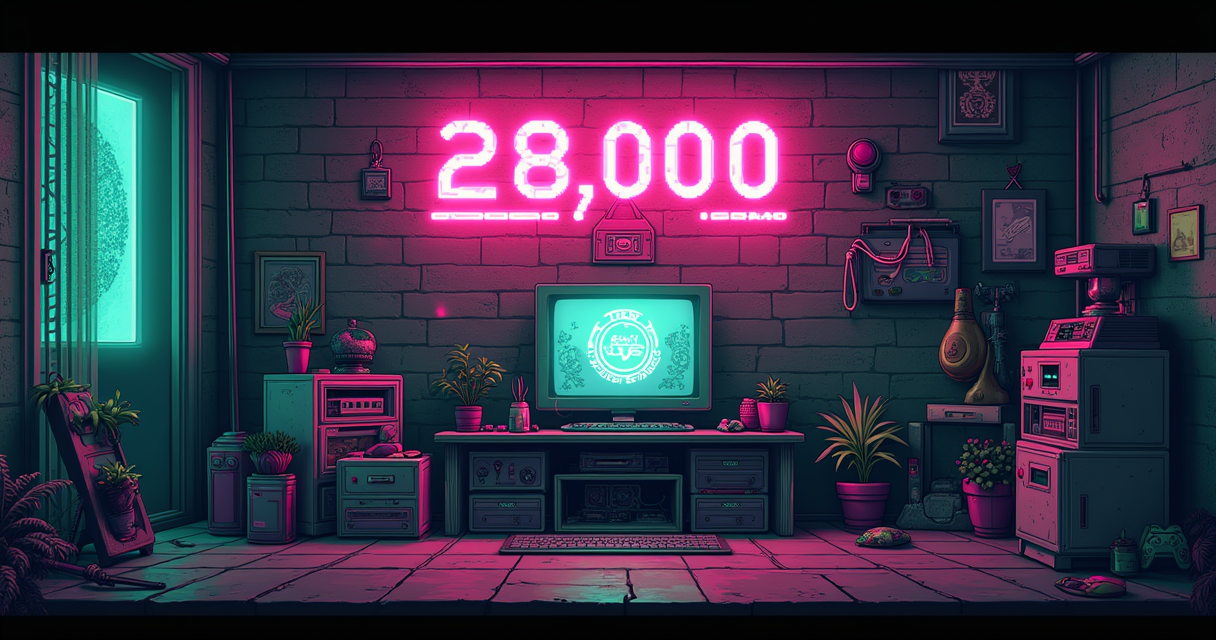
Type miyoo mini plus game list into any search bar and you are hunting a document that does not exist. There is no manifest. Miyoo — the Shenzhen outfit that makes the thing — has never published a canonical catalogue of what its handheld plays, because Miyoo does not, in any legal or official sense, ship games at all. The device is a small Linux computer with a D-pad. What arrives on the microSD card in the box is a third-party payload assembled by whichever reseller shrink-wrapped the unit, and the number stamped on that payload — 28,000 games, 25,966 games, 8,740 games, take your pick — is a marketing figure counting files, not titles. It is the retro-handheld equivalent of a cereal box promising a thousand breakfasts.
This review is about that gap: between the number on the listing and the library you actually get, between what the SigmaStar SSD202D can run and what the reseller's copy claims it runs, and between a genuinely excellent sub-$60 emulation handheld and the pile of duplicate ROMs somebody dumped onto its card to justify the price. The short version, for the impatient: the Miyoo Mini Plus is a very good little machine that tops out — cleanly, honestly — at the original PlayStation, and the '28,000 games' are roughly six thousand real ones wearing twenty-two thousand costumes. The long version follows, because the costumes are where the story is.
The Number That Isn't
Every listing for a preloaded Miyoo Mini Plus opens with a headline count, and the first thing to understand is that no two listings agree — because the number is not a measurement of anything. It is a decoration sized to the card.
28,000, 25,966, 8,740: Take Your Pick
A 2023 Reddit thread remains the most-cited primary source: a buyer asked the official Miyoo store how many games shipped on the 64GB unit and was told 25,966. RetroGameIntensity, a US reseller, has marketed a 128GB package at a round 28,000. Other vendor spec sheets break it down by capacity — 13,056 on the 32GB card, 25,966 on the 64GB, 27,549 on the 128GB — while yet another seller advertises a comparatively modest 8,740. Line those up and the tell is obvious: the count scales with the size of the card. You cannot press a larger microSD and thereby will more Super Nintendo games into existence — Nintendo shipped what it shipped, and no reseller has discovered a lost cache of them. What scales with capacity is not the catalogue; it is the redundancy. A bigger card simply holds more copies of the same games.
6,041: What Survives Deduplication
Run a stock card through a deduplication pass — GameCove's is the figure that circulates in the community — and the 27,549 files on a 128GB card collapse to roughly 6,041 unique commercial titles. The missing twenty-one thousand are not games. They are the No-Intro archive's idea of completeness: every regional variant (USA, Europe, Japan, and the parenthetical soup of En/Fr/De/Es/It), every revision (Rev A, Rev B, the v1.1 that quietly patched a softlock), every bad dump and overdump flagged [b] and [o], every ROM hack and fan translation and Kaizo-difficulty edit, and a healthy stratum of outright bootlegs, pirate multicarts, and unlicensed demos.
27,549 ROM files on the 128GB card
  - regional duplicates (USA / Europe / Japan of one game)
  - revisions (Rev A, Rev B, v1.1 ...)
  - bad dumps and overdumps (flagged [b], [o])
  - ROM hacks, fan translations, Kaizo edits
  - bootlegs, pirate multicarts, unlicensed demos
= ~6,041 unique commercial titles   (GameCove dedupe)
PropelRC's reviewer put it plainly after inspecting a stock card: it is full of 'low-quality ROMs' you should 'replace immediately.' The count is not a promise of variety. It is a promise of clutter.
Why Miyoo Never Published a List
There is a reason Miyoo itself has never printed a catalogue, and it is not laziness. Miyoo sells two things it can defend in a courtroom: a hardware device and a Linux firmware image. It does not sell games. The commercial ROMs on the bundled card are placed there by whichever reseller assembled the SKU, and they are that reseller's legal exposure, not the manufacturer's. An official 'game list' would be a signed confession. So there is no list — not because the information is secret, but because writing it down would convert a wink into evidence. The 'miyoo mini plus game list' you searched for is, by design, a document nobody in the supply chain will ever author.
What the List Actually Contains
Strip away the counting theatre and a stock card is, structurally, a stack of system folders. The contents are coherent — right up to the point where the marketing tries to make the machine sound bigger than its silicon.
The Platform Spread
Reseller listings and the community's own testing converge on the same lineup: Game Boy and Game Boy Color, Game Boy Advance, NES/Famicom, SNES/Super Famicom, Sega Genesis/Mega Drive, Master System, Game Gear, Neo Geo, the three Capcom arcade boards (CPS1, CPS2, CPS3), Final Burn Alpha and MAME arcade sets, PC Engine/TurboGrafx, WonderSwan Color, and PlayStation 1. RetroGameIntensity's 128GB listing names precisely that spread. It is a sensible library for a machine of this class — everything from 1983 to roughly 1999, which is exactly the window the SSD202D can brute-force without breaking a sweat. The trouble starts when the same listing tries to dress a two-core handheld up as something it is not.
The Reseller's Own Six Examples
Consider the six specific games RetroGameIntensity uses to sell that 128GB card: Xenogears, Yu-Gi-Oh! Forbidden Memories, Blaze Union: Story to Reach the Future, Brave Story: New Traveler, Castlevania: The Dracula X Chronicles, and Crisis Core: Final Fantasy VII. Two of those — Xenogears and Forbidden Memories — are genuine PlayStation 1 titles the hardware runs beautifully. The other four are not PlayStation games at all. Crisis Core (2007), Blaze Union (2010), Brave Story: New Traveler (2006) and The Dracula X Chronicles (2007) are all PlayStation Portable exclusives. PSP is not even among the platforms that same listing claims to support, and the device's PSP performance is, per the emulation guides, 'too low to be enjoyable on most titles.' So the reseller is advertising the machine using four games it cannot play, drawn from a system it does not run. This is not curation. It is a script that scraped 'notable PlayStation-family RPGs' and never once checked which PlayStation. Four of the six flagship examples are a category error, and that error is the whole thesis of this review in miniature.
Bootlegs, Hacks, and a Gorbachev Puzzle Game
The deeper you dig into the folders, the clearer it becomes that no human ever reviewed this card. The Famicom folder on many stock units contains Gorby no Pipeline Daisakusen — a 1991 Japan-only puzzle game themed around Mikhail Gorbachev — sitting a few entries away from Gun-Dec, which is simply the Japanese title of the game the West got as Vice: Project Doom, so the same game appears twice under two names. You will find Super Mario Bros. (25th Anniversary Edition), a ROM hack, filed as though it were a licensed release. The Geekbuying game lists published back in 2023 already exposed the pattern: separate inventories for GB/GBA, Mega Drive, Famicom, and Arcade/Atari, running deep enough into the alphabet to include Zool: Ninja of the 'Nth' Dimension and three separate Donkey Kong Land titles. Breadth was never the shortcoming. Discrimination was.
The SSD202D and Its Ceiling
Everything the game list can and cannot do is dictated by one small chip and the panel it drives. Here is the hardware, stripped of the listing's exaggerations.
| Attribute | Detail |
|---|---|
| Class / era | 2022 vertical handheld; firmware maintained through 2026 |
| SoC | SigmaStar SSD202D, dual-core ARM Cortex-A7 @ 1.2 GHz |
| GPU | ARM Mali-400 MP2 (no discrete graphics) |
| RAM | 128 MB DDR3 |
| Display | 3.5-inch IPS, 640x480 (4:3), ~450 nits, ~229 PPI |
| Storage | microSD, single slot; stock cards 32 / 64 / 128 GB |
| Battery | 3,000 mAh (some listings 3,200 mAh) |
| Battery life | ~7.5 h Game Boy, 6-7 h SNES, ~5 h PS1 |
| Connectivity | Wi-Fi b/g/n, USB-C — NO Bluetooth, NO HDMI |
| Charging | 5 W over USB-C (~3 h to full) |
| Dimensions / weight | 108 x 78 x 22 mm, 165 g |
| Stock firmware | Miyoo OS; community OnionUI v4.3.1-1 (stable, Jun 2024); v4.4.0-beta (Jan 2026) |
| Emulation ceiling | Full speed through PS1; light N64/Dreamcast; PSP/DS out of practical scope |
| Price | ~$53.99 US bare / £60-70 UK; $59.99-$69.99 preloaded (AliExpress) |
Dual Cortex-A7, Not Quad
The single most-repeated error in Miyoo Mini Plus listings is the claim of a quad-core processor. It has two cores. The SoC is a SigmaStar SSD202D — a pair of ARM Cortex-A7 cores at 1.2 GHz, a Mali-400 MP2 GPU, and 128 MB of DDR3. XDA's Adam Conway, who scored the unit 9/10, states it flatly: 'dual Arm Cortex A7 cores and 128MB of RAM.' This is not powerful silicon — Conway notes it is 'not going to be setting benchmark records' — but, as he adds in the same breath, it is 'more than good enough for most retro titles.' The chip is the entire story of the game list: it is why everything up to PS1 is effortless, and everything past it is a negotiation.
640x480 at 3.5 Inches
The display is the reason people fall for this thing. It is a 3.5-inch IPS panel at 640x480 — a true 4:3 ratio at roughly 229 pixels per inch, which PropelRC notes is 'sharper than the original Nintendo 3DS,' at around 450 nits, bright enough to be 'playable outdoors.' Retro Game Corps called the same panel 'crisp' back in its original v2 guide. For 8- and 16-bit content the resolution is close to ideal: SNES output is 256x224, which integer-scales into 640x480 with room to spare, so a game like Chrono Trigger looks like a pristine memory rather than a smeared one. The screen is punching several weight classes above the price.
Battery: 7.5 Hours of Game Boy, 5 of PS1
The 3,000 mAh cell (some listings say 3,200) is where firmware earns its keep. On the stock Miyoo OS, PropelRC measured about four hours. Flashing OnionOS 'vastly improved battery life (4 hours to 7 hours)' — the reviewer logged roughly 7.5 hours of Game Boy, 6 to 7 of SNES, and closer to five once the chip is decoding PlayStation discs. There is no 12-hour figure here, whatever a listing tells you; the honest number is a transcontinental flight of Game Boy or an afternoon of PS1. Charging is a leisurely 5 W over USB-C, which Conway flags as a con — alongside the other one everyone notices: no Bluetooth, so no wireless audio.
System by System
The game list divides cleanly into three tiers: the systems the Miyoo runs perfectly, the one it tops out on gracefully, and the ones the marketing pretends it handles. Knowing which is which is the difference between a great purchase and a disappointed one.
8-bit and 16-bit: Flawless
Below the 32-bit line the Miyoo Mini Plus simply does not struggle, and the library here is as complete as licensing history allows. Game Boy and Game Boy Color run 'perfectly' — the guides reach for the obvious talismans (Pokémon, Zelda, Tetris, Kirby), and they are right; a Game Boy Color game asks less of this chip than a modern webpage asks of a phone. NES is trivial: Super Mario Bros., Contra, Mega Man, Gradius, the whole 1985-1990 canon. Game Boy Advance sits at the top of this comfortable tier — Conway's verdict is that 'Game Boy Advance titles run flawlessly,' and the guide's GBA examples (Pokémon, Castlevania, Metroid, a Final Fight port) all hold their frame rate. SNES is the genuinely impressive part, because the SSD202D emulates the notoriously awkward Super FX and SA-1 co-processor games well enough that Super Mario World, Street Fighter II and Chrono Trigger lock to their target. PropelRC's line is the one to keep: 'Chrono Trigger (SNES): Perfect 60fps throughout my 12-hour playthrough.' Genesis is equally settled — Sonic, Streets of Rage, Gunstar Heroes, Treasure's showpiece, all full speed.
PS1: The Real Ceiling
The original PlayStation is where the Miyoo tops out, and — crucially — where it tops out gracefully. This is not a machine limping through PS1; it is a machine that plays the format's greatest hits at full speed and simply cannot go higher. The reliable list is long, and it is exactly the list you want: Final Fantasy VII, VIII and IX; Crash Bandicoot 1-3; Spyro 1-3; Metal Gear Solid; Castlevania: Symphony of the Night; Tekken 3; Gran Turismo 1 and 2; Resident Evil 1 and 2; Tony Hawk's Pro Skater 1 and 2; Wipeout; Ridge Racer. Conway calls PS1 games 'a treat to play anywhere.' The only crack PropelRC found was 'minor slowdown in Gran Turismo 2,' which is a polygon-heavy racer and a rounding error against the size of what works. If your relationship with games ends around 1999, this is a complete machine.
N64 and Dreamcast: The Marketing Overreach
Above PS1 the listings start writing cheques the chip cannot cash. The guides, to their credit, are honest about it: N64 'light' games can work — Super Mario 64, Mario Kart 64 and GoldenEye run playably — but the demanding end of the library, Majora's Mask with its Expansion Pak overhead, Banjo-Kazooie, Donkey Kong 64, is 'harder to run well,' which in practice means 70-85% speed and dropped frames. Dreamcast is the same story one tier up: Sonic Adventure, Crazy Taxi and Power Stone are reportedly playable; anything heavier is a slideshow. PSP, which the reseller's own sample list leaned on, is 'too low to be enjoyable on most titles.' Nintendo DS is described as 'not supported' — technically the OnionUI firmware added a DS core in its 4.3 line, but a two-screen touch console reduced to one non-touch 3.5-inch panel driven by a 1.2 GHz A7 is a curiosity, not a feature. If N64 is the reason you are buying, buy something else. A dedicated FPGA box like the Analogue 3D's hardware-level N64 upscaling exists precisely because software emulation at this tier is a compromise.
The Marquee Games Worth Loading
Six thousand real games is more than anyone finishes in a lifetime, so the useful question is not how many but which. A handful of titles on this card are, by themselves, worth the price of the hardware — and they carry the history that makes the machine feel like a museum in your pocket.
Symphony of the Night and the Metroidvania Canon
If the list has a crown jewel it is Castlevania: Symphony of the Night, a 1997 Konami release directed by Toru Hagihara with a young Koji Igarashi — 'IGA' — as assistant director and Michiru Yamane on the score. It is the game that welded Metroid's interconnected map to Castlevania's whip-and-cathedral gothic and, in doing so, named a genre. Kurt Kalata's Hardcore Gaming 101 history of the series treats it as the hinge on which the franchise's entire modern identity turns. On the Miyoo it runs flawlessly, inverted castle and all, and the 640x480 panel does right by Yamane's cathedral. It is also — this being the reseller card — probably sitting in your PS1 folder three times over, once per region tag. For the record on what the game actually is, the Wikipedia entry on Symphony of the Night is unusually thorough.
Chrono Trigger, Xenogears, and Square's Peak
The SNES and PS1 folders together hold the strongest RPG run in the medium's history, and the Miyoo plays all of it. Chrono Trigger (1995) was built by Square's so-called Dream Team — Final Fantasy's Hironobu Sakaguchi, Dragon Quest's Yuji Horii, and Dragon Ball's Akira Toriyama on character art — with a score by Yasunori Mitsuda and Nobuo Uematsu; the Wikipedia history of Chrono Trigger lays out how unusual that collaboration was. Xenogears (1998), directed by Tetsuya Takahashi before he left to found Monolith Soft, is the more troubled masterpiece — a second disc that famously narrates rather than plays, documented in exhausting detail on its Wikipedia page. Both run at full speed here, as does the Final Fantasy trilogy of VII, VIII and IX. This is the part of the library that actually justifies the purchase: a bright 640x480 screen and a battery that outlasts a dungeon is a genuinely good way to replay the canon.
The Minish Cap and the GBA Sleepers
The GBA folder is the quiet MVP, and the 2026 Pixel-Swish review — titled, with audible surrender, 'Ok, I get the hype now' — ranks The Legend of Zelda: The Minish Cap as the single best thing on the machine. Developed by Capcom's Flagship studio around a Kinstone-fusion mechanic and named GameSpot's GBA Game of the Year in 2005, it is exactly the sort of jewel-box game the panel was built for. Around it sits the rest of the GBA's late-portfolio brilliance: Metroid: Zero Mission and Fusion, the Castlevania trilogy of Circle of the Moon, Harmony of Dissonance and Aria of Sorrow, the Advance Wars games. Conway's 'run flawlessly' is not marketing here; the GBA is comfortably inside the chip's envelope, and it is where a lot of owners quietly spend most of their time. To appreciate how far the medium travelled to get here, Jimmy Maher's Digital Antiquarian essay 'Generation Nintendo' is the best history of the console lineage this card compresses into one folder tree.
How the Library Stacks Up
The Miyoo does not exist in a vacuum. Three rival philosophies bracket it — a spec-sheet-heavier budget peer, a far more powerful Android tier, and the accuracy-obsessed FPGA world — and each answers the 'game list' question differently.
| Device | SoC | RAM | Screen | Library ceiling | Price |
|---|---|---|---|---|---|
| Miyoo Mini Plus | SSD202D, 2x A7 @1.2GHz | 128 MB | 3.5" 640x480 | PS1 (light N64/DC) | ~$54 |
| Miyoo Mini (original) | SSD202, 2x A7 | 128 MB | 2.8" 640x480 | PS1 (tighter) | ~$50, scarce |
| Anbernic RG35XX (2022) | Actions ATM7039S, 4x A9 | 256 MB | 3.5" 640x480 | PS1 + light DS | ~$60 |
| RG35XX Plus (H700) | Allwinner H700, 4x A53 | 1 GB | 3.5" 640x480 | Dreamcast / N64 / light PSP | ~$65 |
| Retroid Pocket 5 | Snapdragon 865 | 8 GB | 5.5" 1080p AMOLED | GameCube / PS2 / light Switch | ~$199 |
Against the RG35XX
The obvious cross-shop is Anbernic's original RG35XX, and on paper Anbernic wins the spec sheet — a quad-core Actions ATM7039S with PowerVR graphics and 256 MB of RAM, double the Miyoo's memory, plus a mini-HDMI output the Miyoo lacks. XDA scored it 9/10 and clocked Nintendo DS 'at full speed,' with Pokemon Black 2 running clean — a tier the Miyoo never reaches. And yet the Miyoo is the one people keep. The reason is firmware: OnionOS is a more polished, more coherent environment than the stock or GarlicOS software on the Anbernic, and in this class firmware beats silicon. The Miyoo also carries Wi-Fi for RetroAchievements, which the original RG35XX omits. It is the rare case where the slower machine is the better buy.
Against the Retroid Pockets
If the Miyoo's PS1 ceiling is a dealbreaker, the honest answer is not another sub-$60 vertical — it is spending three to four times as much on Android. A Retroid Pocket 5, with a Snapdragon 865 and 8 GB of RAM behind a 5.5-inch 1080p AMOLED, plays GameCube, Wii, PS2 and lands light hits on Switch — an entirely different universe of library at roughly $199. Our Retroid Pocket 5 vs 6 breakdown lays out where that money goes. The Miyoo is not competing with these machines; it is competing with your pocket. It is the one you actually carry, and the Retroid is the one that lives on the desk.
Against FPGA Accuracy
There is a third axis the game-count listings never mention: accuracy. Software emulation on a 1.2 GHz A7 is good, not perfect — there is input latency, and edge-case timing quirks the original hardware never had. If you care about frame-perfect fidelity, the answer is an FPGA that reimplements the original chips in logic rather than approximating them in software. A board like the MiSTer Multisystem 2 is a different — and much pricier — philosophy, one that sells cycle-accuracy the bundled ROM card cannot. The Miyoo's proposition is not accuracy. It is 6,041 games in your jacket for the price of a single new AAA release.
Five Ways the List Plays
A game list is only as good as the way it is used, and the same 6,041 titles feel like five different products depending on who is holding the machine. Here is how the library behaves across the archetypes.
The Casual and the Completionist
For the casual player — the person who wants twenty minutes of Sonic on the train — the Miyoo is close to perfect, provided you ignore the game count entirely and just open the SNES or Genesis folder. The 6,041 real games are more than any human finishes in a lifetime. For the completionist, the machine is a mixed blessing: OnionOS supports RetroAchievements over Wi-Fi, which turns the library into a structured challenge list, but the stock card's flood of duplicates and bad dumps actively sabotages that — you will boot a hack thinking it is the real game and wonder why the achievements will not trigger. The completionist's first job is to wipe the card and rebuild it clean; PropelRC's advice to bin the 'low-quality ROMs' immediately is not optional for this user, it is step one.
The Speedrunner and the Co-op Player
The speedrunner should think twice. Handheld software emulation introduces input latency a leaderboard will not forgive, and many boards do not accept runs from emulator at all, let alone from a 1.2 GHz A7 — for practice on the couch it is fine, for submission it is the wrong tool, and original hardware or an FPGA is the honest route. Co-op is a happier story than a single-screen unit suggests: the January 2026 OnionUI 4.4 beta added netplay, including Game Boy link-cable emulation between two units over Wi-Fi, so two Miyoos can trade Pokémon or run a cable race. Same-screen local co-op — Streets of Rage 2, Contra — needs a second controller and a display, and the Miyoo has no video output, so in practice co-op here means two devices.
The Mobile Everyday-Carry
This is the scenario the Miyoo was born for, and where it beats every more powerful rival. At 165 grams and 108x78x22 mm it is genuinely pocketable in a way a 5.5-inch Retroid is not; the 640x480 screen is bright enough for a park bench; and 7.5 hours of Game Boy or five of PS1 outlasts most days out. There is no Bluetooth, so bring wired earbuds; there is no HDMI, so it never pretends to be a home console. As an object that lives in a coat pocket and turns any ten idle minutes into Symphony of the Night, nothing near this price touches it. This is the use case that earns the score.
Who This Library Is For
Enough hedging — here is the buying advice, stated plainly, for the people most likely to be reading a review of a game list they cannot find.
Buy It If...
Five clean cases. One: you want the best sub-$60 emulation handheld for everything up to PS1 and you will never miss N64 — buy it, today. Two: you value pocketability and screen quality over raw power — the 3.5-inch panel and 165 g body are the best in class. Three: you are willing to run OnionOS and curate your own card — the machine rewards owners who treat the bundled ROMs as a starting point to delete. Four: you want RetroAchievements and link-cable netplay on the cheap — Wi-Fi plus the 4.4 beta covers both. Five: you want a second, disposable, take-anywhere machine to sit beneath a more powerful home handheld — at $54 it is the definition of low-stakes.
Skip It If...
Equally clean. Skip it if N64, Dreamcast, PSP or DS are anywhere on your must-play list — the chip cannot, and no listing's game count changes that. Skip it if you want to plug into a TV; there is no video output of any kind. Skip it if you need Bluetooth audio, wireless controllers, or fast charging. Skip it if you are a submitting speedrunner who needs frame-accurate input. And skip the preloaded SKUs specifically if the legality of a card stuffed with commercial ROMs bothers you — buy the bare unit and fill it yourself.
The Upgrade Path
If the Miyoo teaches you that you want more, the ladder is well-mapped. The next honest rung is not a slightly faster vertical — it is an Android handheld like the Retroid Pocket line for GameCube and PS2, or a dedicated FPGA console if accuracy is the itch. Building your own library instead of buying a padded card is its own small project, and a rewarding one: a front-end like Batocera will get a clean, deduplicated set onto a card in about half an hour, which is the single best thing you can do for any machine in this class.
The Legal Question Nobody Answers
The listings are loud about the game count and silent about its legality, so let me be the one to say it out loud. The status of what happens on this device is more settled than the marketing implies, and it splits cleanly in two.
Connectix Made the Emulator Legal
The emulator itself — the software pretending to be a PlayStation — is legal, and has been since Sony Computer Entertainment, Inc. v. Connectix Corp. in the Ninth Circuit in 2000, which held that reverse-engineering a console's BIOS to build a compatible emulator was fair use. Every RetroArch core on the Miyoo stands on that decision; the Wikipedia summary of the Connectix case is the layperson's version. Nobody is going to knock on your door for running an emulator. That fight was fought and won a quarter-century ago.
The ROMs Are Another Matter
The games are the other half, and here the marketing goes quiet for good reason. A commercial ROM is still copyrighted; distributing or downloading one you do not own is infringement, full stop, and a microSD card preloaded with 6,041 commercial titles is 6,041 counts of it. This is precisely why Miyoo publishes no game list and why the resellers, not the manufacturer, load the cards — the liability is quarantined at the vendor. The '28,000 games' is not a feature Miyoo is offering you; it is a risk a reseller is taking on your behalf and pricing into a ten-dollar upcharge.
The Honest Path: Dump, or Tiny Best Set
There is a clean route, and it is not complicated. You can dump your own cartridges — a device like a Retrode that reads your SNES and Genesis carts over USB produces a legal, personal backup of games you physically own. For everything else, the homebrew and public-domain scene is deep: original games like Apotris run natively, and community-curated legal collections such as Tiny Best Set: GO! (hosted on the Internet Archive) give you a hand-picked, deduplicated library with none of the bootleg sludge. The 'real answer' to 'miyoo mini plus game list' is the one you build yourself — smaller than 28,000, entirely yours, and free of the Gorbachev puzzle game nobody asked for.
Pricing and Availability
Once you understand that the games are just files, the pricing stops being mysterious and becomes almost boringly simple.
| Configuration | Typical price | What you are paying for |
|---|---|---|
| Bare unit (no card) | ~$53.99 US / £60-70 UK | Hardware only; supply your own card and legal ROMs |
| 64 GB preloaded | ~$59.99 (AliExpress) | Hardware plus a padded '25,966-game' card |
| 128 GB preloaded | ~$69.99 (AliExpress) | Hardware plus a '28,000-game' card |
| Add: fast 128 GB microSD (SanDisk/Samsung) | +$12-18 | The single best upgrade if you curate your own set |
| Recommended honest route | Bare unit + own card | Cheapest, cleanest, no bootleg liability |
What You Actually Pay
Strip the game-count theatre away and the numbers are plain. The bare Miyoo Mini Plus — hardware only, you supply the card — runs about $53.99 in the US and £60-70 in the UK; PropelRC built its whole 8.5/10 verdict around that '$53 price point.' Preloaded SKUs on AliExpress land around $59.99 for the 64GB card and $69.99 for the 128GB, meaning the entire premium for '28,000 games' is roughly ten to fifteen dollars — the cost of the larger microSD and the labour of copying files onto it. You are not paying for a library. You are paying a small convenience fee to skip half an hour of dragging folders.
The Card Is the Variable
Because the games are just files, the card is the only meaningful variable in the purchase, and it is the one worth spending on. Stock cards are frequently slow, no-name microSDs, which is a real problem: PS1 load times and save-state writes are gated by card speed, and a cheap card turns a five-second load into fifteen. A known-good SanDisk or Samsung card at 128GB is $12-18 and is the first upgrade any owner should make — it does more for the day-to-day experience than any quantity of extra ROMs. Buy the bare unit, buy a good card, fill it yourself, and skip the flashing hassle with an OnionOS install that puts a clean folder tree on the root.
/ (microSD root)
|-- miyoo283_fw.img      firmware image, flashed on first boot
|-- .tmp_update/         OnionOS bootstrap
|-- BIOS/                PS1 SCPH*.bin, neogeo.zip, gba_bios.bin
|-- Roms/
|   |-- PS/              PlayStation 1  (.chd / .pbp / .cue+.bin)
|   |-- GBA/             Game Boy Advance
|   |-- SFC/             Super Famicom / SNES
|   |-- FC/              Famicom / NES
|   |-- MD/              Mega Drive / Genesis
|   \-- ...              ~40 more system folders
|-- Saves/               .srm and save states
\-- Themes/
Where to Buy
Availability is steady but scattered. The Miyoo store, AliExpress, and Amazon third-party sellers all carry it, and stock has historically been the weak point — the original Miyoo Mini was chronically sold out, and supply on the Plus has been better but not flawless. Prices drift with card size and whoever is running a sale; there is no MSRP theatre here, just a commodity device sold by a dozen vendors. Retro Game Corps' standing advice applies: buy the cheapest bare unit from a seller you trust, and treat any bundled card as a bonus to be wiped, not a reason to pay more.
Pros and Cons
Everything above, compressed into the two lists you actually screenshot.
What It Nails
- Screen: 3.5-inch 640x480 IPS, ~229 PPI, ~450 nits — 'sharper than the original 3DS' (PropelRC) and genuinely usable outdoors.
- Everything up to PS1: full speed, no asterisks — GBA 'flawless,' Chrono Trigger a locked 60fps, PS1 'a treat to play anywhere' (XDA).
- OnionOS: the best custom firmware in the class; lifts battery from ~4 to ~7 hours and adds RetroAchievements and, since January 2026, netplay.
- Pocketability: 165 g, 108x78x22 mm — the take-anywhere machine other handhelds only claim to be.
- Price: roughly $54 for all of the above is a genuine bargain.
What It Fumbles
- The game count is fiction: '28,000 games' is ~6,041 real titles plus twenty-one thousand duplicates, hacks and bootlegs — and the reseller's own sample list pads it with four PSP games the device cannot run.
- Hard ceiling at PS1: N64 and Dreamcast are light-titles-only; PSP is 'too low to be enjoyable'; DS is impractical.
- No Bluetooth, no HDMI: wired audio only, and it never touches a TV.
- Slow 5 W charging and a plastic build that 'can make it feel cheap' (XDA).
- The bundled ROMs are a legal and quality liability you should plan to delete on day one.
The Verdict: 7.5/10
A review of a 'game list' has to score the thing you were actually sold, and the thing you were sold is a machine wrapped in a number that lies. Here is how those two facts resolve.
The Score
The Miyoo Mini Plus earns a 7.5/10, and the deductions are almost entirely about the story told around it rather than the object itself. As hardware — a bright 640x480 screen, a chip that plays everything up to PS1 without complaint, the best firmware in its price class, all for about $54 — it is close to a 9, and the reviewers who judged it on those terms (XDA at 9, PropelRC at 8.5) were not wrong. What pulls it down to a 7.5 is the game list: a device sold on a number that is roughly 78% padding, advertised with games it cannot play, and shipped with a card you are best off wiping. The device is honest. Its marketing is not.
The Bottom Line
Buy the Miyoo Mini Plus. Then ignore everything the listing told you about it. Ignore the 28,000. Ignore the six sample games, four of which are PSP titles the hardware laughs at. Ignore the promise of N64. What you are actually buying is the best pocketable way to play the first sixteen years of console history — roughly six thousand real games, from Super Mario Bros. to Symphony of the Night — on a screen far too nice for the money. Delete the bundled card, flash OnionOS, load a clean set of the games you own, and you will have one of the great bargains in handheld gaming. The 'miyoo mini plus game list' does not exist. The Miyoo Mini Plus, thankfully, is a great deal better than the list anyone tried to sell you.
Questions the search bar asks me
- How many games does the Miyoo Mini Plus really have?
- Resellers advertise 25,966 (64GB) to 28,000 (128GB), but those figures count ROM files, not titles — regional duplicates, revisions, hacks and bootlegs included. GameCove's deduplication of a stock card lands at roughly 6,041 unique commercial games, and Miyoo itself has never published an official catalogue.
- What is the most demanding system it can run?
- PlayStation 1 at full speed — Final Fantasy VII to IX, Symphony of the Night, Tekken 3 and Gran Turismo 1-2 all run cleanly (PropelRC found only 'minor slowdown in Gran Turismo 2'). N64 and Dreamcast manage light titles only (Mario 64, Crazy Taxi), and PSP is 'too low to be enjoyable on most titles.'
- Are the preloaded games legal?
- The emulators are: Sony Computer Entertainment v. Connectix Corp. (9th Cir., 2000) established that a reverse-engineered emulator is fair use. The bundled commercial ROMs are not licensed, however. The clean path is dumping cartridges you already own or using public-domain sets such as Tiny Best Set: GO!
- Which firmware should I install?
- The community OnionUI project (github.com/OnionUI/Onion), stable at v4.3.1-1 from June 2024, with a v4.4.0-beta from January 2026 that adds a default gpSP GBA core and netplay. PropelRC measured OnionOS lifting battery life from about 4 hours on stock firmware to roughly 7.
- How much does it cost, and is it worth it?
- About $53.99 bare in the US, or $59.99-$69.99 preloaded on AliExpress — the '28,000 games' premium is really $10-15 for a bigger card. For a pocketable machine that plays everything up to PS1 on a sharp 640x480 screen, it earns 7.5/10, provided you treat the game count as marketing.
Casey writes about speedrunning, tool-assisted runs, and the strange engineering of going fast in old games. Every post under this byline is reviewed pre-publish by Sam P., Editor & Operator — corrections to info@instalinkoteam.com. Published 2026-08-29 · Last updated 2026-08-29. Full bios on the author page.