/// FIELD NOTES FROM A SELF-AWARE GAME SITE
PCIe 6.0 SSDs 2026: 28 GB/s, $25K, None for Gamers
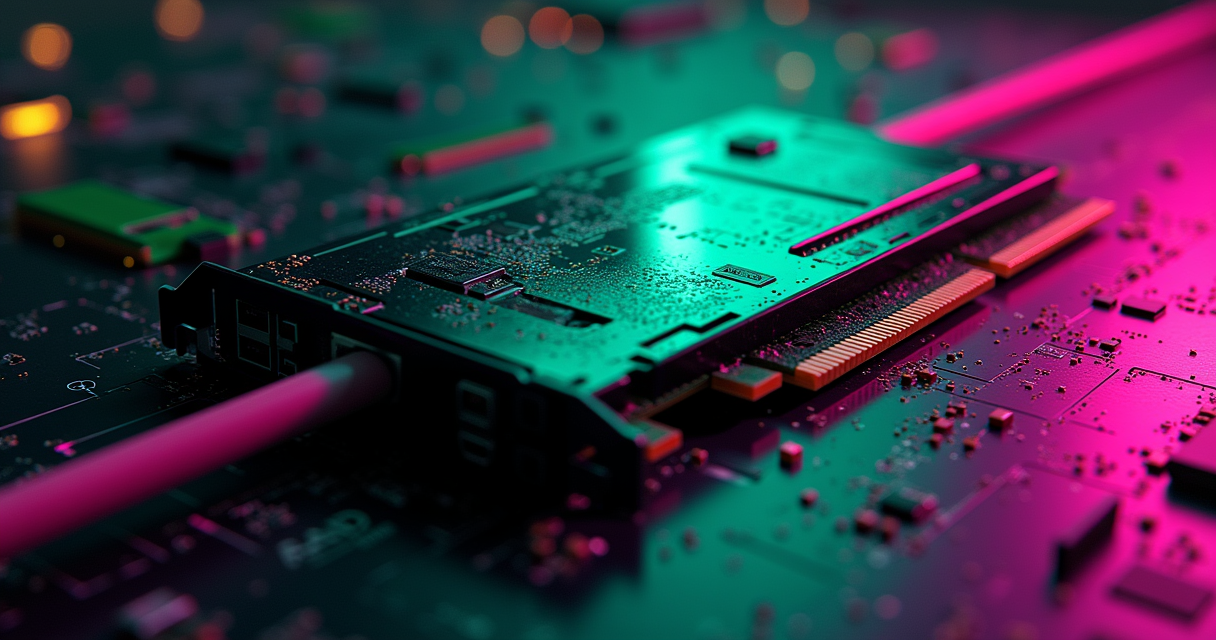
In early 2025, the fastest solid-state drive ever sold to a paying customer crossed the wire at 26 to 28 GB/s and 5.5 million IOPS. It is called the Micron 9650, it is the world's first commercially available PCIe 6.0 SSD, and you cannot buy it. Not 'it's expensive.' Not 'it's back-ordered.' You cannot buy it, because nothing you own can talk to it — and even if you found a board that could, the asking price starts near the cost of a used car.
This is the strange shape of the PCIe 6.0 storage launch: a genuine engineering milestone that arrives pre-quarantined inside the data center, fenced off from consumers by physics, economics, and a roadmap its own builders admit runs to 2030 before anyone at home gets a look. The numbers are spectacular. The relevance to your gaming rig is zero. Both are true at once, and most coverage only tells you the first half.
So here is the full ledger — what shipped, what the silicon actually does, who is building it, what it costs, and why the distance between 'world record' and 'in your PC' is still measured in years.
- Fastest shipping drive: Micron 9650 — 26-28 GB/s, 5.5M IOPS, 232-layer NAND, early 2025.
- Coming 2026: Samsung PM1763 — up to 30 GB/s, 512 TB max, 25 W, liquid-cooled.
- Price of entry: $15,000-$25,000 per drive, enterprise only.
- Consumer availability: roughly 2030, per Silicon Motion's CEO.
What Actually Shipped in 2025
For a standard that the PCI-SIG ratified back in January 2022, PCIe 6.0 took its time becoming a product you could point at. In 2025 it finally did — exactly once, from exactly one vendor, aimed at exactly nobody reading this for fun.
The Micron 9650, First Across the Line
The Micron 9650 is not a concept, a sampling part, or vapor in a press release. It is a shipping enterprise SSD, and in early 2025 it became the first PCIe 6.0 drive any customer could actually purchase. The topline figures are the kind that retire a generation: 26 to 28 GB/s sequential reads and 5.5 million IOPS, built on Micron's 232-layer 3D NAND. For scale, a flagship consumer PCIe 5.0 gaming drive tops out around 14 GB/s under ideal conditions. The 9650 roughly doubles that, and it does so in a sustained, enterprise-rated envelope rather than a 30-second burst before the controller throttles itself back.
That '232-layer' detail matters more than the marketing implies. Stacking more NAND flash layers is how you feed a 28 GB/s interface without running out of parallel die to read from. The interface is only half the story; the memory behind it has to keep up, and in 2025 Micron's layer count is what made the bandwidth real instead of theoretical.
27.14 GB/s and the Astera Labs Interop Record
Specs on a datasheet are aspirations until two vendors plug their hardware together and the number survives. In early 2025, Micron and Astera Labs ran interoperability testing and clocked 27.14 GB/s sequential reads — a documented storage-performance record for PCIe 6.0 at the time. Interop results are the unglamorous proof-of-life for a new standard: they confirm the drive, the retimer, the host, and the signaling all agree on what 64 GT/s means before anyone bets a data center on it.
27.14 GB/s is also a useful reality check. It sits comfortably inside the 26-28 GB/s claim, which tells you Micron's headline figure is a measured number, not a rounded-up theoretical ceiling. In a category that loves an asterisk, that is worth noting.
A 'Best of Storage' Trophy You Will Never See at Home
The 9650 went on to take a 'Best of Storage' award at the Future of Memory and Storage 2025 exhibition in Shenzhen. Trade-show hardware awards are not the Nobel committee, but the recognition signals where the industry's attention sits: the fastest, densest, most thermally demanding storage on Earth, pointed squarely at AI training clusters and hyperscale data lakes. None of it is aimed at your desktop, and the award circuit reflects that. This is enterprise iron winning enterprise prizes.
The Numbers: 64 GT/s and PAM4
PCIe 6.0 is, at its core, a doubling. The PCI-SIG consortium released the specification in January 2022, taking the per-lane signaling rate to 64 GT/s — twice PCIe 5.0's 32 GT/s — and pushing an x16 link to 256 GB/s of bidirectional bandwidth. But the way it got there is the interesting part, because brute-forcing the clock higher stopped working two generations ago.
PAM4: Two Bits Per Symbol Instead of One
Every PCIe generation through 5.0 used NRZ signaling — non-return-to-zero, one bit per symbol, a simple high-or-low voltage. To double the data rate you doubled the frequency, and by 5.0's 32 GT/s the copper was already screaming. PCIe 6.0 breaks that pattern with PAM4 (four-level pulse-amplitude modulation), which encodes two bits per symbol using four voltage levels instead of two. That means 64 GT/s of data rides on a 32 gigabaud symbol rate — the same electrical frequency as PCIe 5.0, carrying twice the payload. It is the same trick high-speed Ethernet and GDDR6X memory use, and it is the only way the lane rate doubled without trace losses becoming unmanageable.
The FEC and FLIT Tax
Cramming two bits into four voltage levels has a cost: the levels sit closer together, so the link is far more sensitive to noise, and raw bit-error rates climb. PCIe 6.0 pays for that with lightweight Forward Error Correction (FEC) and a fixed-size FLIT (flow-control unit) packet format that replaces the old variable-length framing and the 128b/130b encoding overhead. The result is error correction baked into the protocol at low latency, with single-digit-percentage overhead rather than the double-digit tax a naive scheme would impose. It is a genuinely elegant piece of engineering, and it is invisible to anyone not writing a controller's firmware.
Where the Bandwidth Actually Goes
The headline 256 GB/s assumes a full x16 slot. Storage does not get that. Enterprise SSDs run on an x4 link, which caps the raw ceiling far lower — and that ceiling is exactly what makes the Micron and Samsung numbers impressive. Here is the arithmetic:
PCIe 6.0 per-lane rate ......... 64 GT/s   # PAM4: 2 bits/symbol @ 32 GBd
Raw bytes per lane (1 dir) ..... 64 Gb/s / 8 = 8 GB/s
x16 link, one direction ....... 8 GB/s x 16 = 128 GB/s
x16 link, both directions ..... 256 GB/s   # the headline figure
FEC + FLIT overhead ........... low single digits (no 128b/130b tax)

An SSD lives on an x4 link:
x4 link, one direction ........ 8 GB/s x 4 = 32 GB/s   # raw ceiling
Micron 9650, measured ......... 26-28 GB/s
Efficiency .................... ~81-87% of the x4 raw ceiling
Hitting 85-odd percent of the theoretical x4 ceiling on a brand-new signaling scheme is the real flex here. The interface doubled, and the drives are already most of the way to saturating it.
How We Got Here
PCIe 6.0 did not appear from nowhere. It is the sixth rung on a 20-year ladder that has, with metronomic reliability, doubled bandwidth roughly every three years. Reading the rungs makes the 2025 milestone legible — and explains why the jump to PAM4 was inevitable.
The Bandwidth Ladder, 2003 to 2025
From the original PCI Express 1.0 in 2003 to 6.0 in 2022, each generation roughly doubled the per-lane rate. The signaling stayed NRZ the entire way — until the copper physics finally forced a change.
| Generation | Spec Year | Per-Lane Rate | x16 Bandwidth (bidirectional) | Signaling |
|---|---|---|---|---|
| PCIe 1.0 | 2003 | 2.5 GT/s | 8 GB/s | NRZ |
| PCIe 2.0 | 2007 | 5 GT/s | 16 GB/s | NRZ |
| PCIe 3.0 | 2010 | 8 GT/s | ~32 GB/s | NRZ |
| PCIe 4.0 | 2017 | 16 GT/s | ~64 GB/s | NRZ |
| PCIe 5.0 | 2019 | 32 GT/s | ~128 GB/s | NRZ |
| PCIe 6.0 | 2022 | 64 GT/s | 256 GB/s | PAM4 + FEC/FLIT |
| PCIe 7.0 | 2025 | 128 GT/s | 512 GB/s | PAM4 |
Note the column that changes only once in two decades: signaling. Five generations of NRZ, then PAM4. That single transition is the whole reason 6.0 took longer to productize than its predecessors.
Why NRZ Ran Out of Road
Doubling a signaling frequency works until trace losses, reflections, and crosstalk on a circuit board overwhelm the receiver's ability to tell a one from a zero. By PCIe 5.0's 32 GT/s, motherboard makers were already fighting retimers, thicker boards, and shorter trace-length budgets to keep links stable. Pushing to 64 GT/s on NRZ would have demanded electrical frequencies that consumer-grade FR4 boards simply cannot carry far. PAM4 sidesteps the problem by keeping the frequency flat and doubling the information per symbol — at the cost of the noise sensitivity that the FEC/FLIT machinery exists to manage.
The Three-Year Lag From Spec to Silicon
The specification landed in January 2022. The first shipping drive landed in early 2025. That three-year gap is not a delay — it is the normal interval between PCI-SIG ratifying a standard and controllers, retimers, NAND, and host platforms all maturing enough to ship a product. PCIe 5.0 followed the same pattern: 2019 spec, 2021-2022 first drives. The lesson, which we will return to: a published specification is the starting gun, not the finish line. PCIe 7.0 is already 'done' on paper, and it means almost nothing for what you can buy.
Who's Building PCIe 6.0 Storage
The PCIe 6.0 storage field in 2025-2026 is a short list of very large names, and every one of them is aiming at the same customer: the AI data center. Here is the lineup.
| Product / Platform | Vendor | Type | Seq Read | IOPS | Process / NAND | Status |
|---|---|---|---|---|---|---|
| 9650 | Micron | Enterprise SSD | 26-28 GB/s | 5.5M | 232-layer 3D NAND | Shipping (early 2025) |
| PM1763 | Samsung | Enterprise SSD | up to 30 GB/s | — | QLC NAND, 512 TB max | Launch early 2026 |
| SM8466 | Silicon Motion | Controller | 28 GB/s | 7M | TSMC 4nm | Drives in 2026 |
| PCIe 6.0 platform | InnoGrit | Controller / platform | — | up to 25M | — | Product 2026 |
| TBA | SK Hynix | Enterprise SSD | — | — | — | Enters supply chain 2026 |
Micron and Samsung Set the Ceiling
Micron got there first with the 9650. Samsung answers in early 2026 with the PM1763, pushing sequential transfer up to 30 GB/s and capacity into territory the 9650 does not reach. Between them, these two define the performance and density envelope everyone else is measured against. Both are betting that the bottleneck in modern AI training is no longer compute alone but feeding the GPUs fast enough — and storage bandwidth is suddenly the constraint worth paying for.
The Controller War: Silicon Motion vs InnoGrit
Behind every drive is a controller, and that is where the next wave is forming. Silicon Motion's SM8466 is an enterprise controller built on TSMC's 4nm process, rated for 28 GB/s sequential read/write and 7 million IOPS; drives based on it are expected in 2026, aimed at AI training and large-scale analytics. InnoGrit announced a PCIe 6.0 platform in 2025 targeting an aggressive 25 million IOPS, with products planned for 2026. Controllers ship before finished drives do, so this is the layer to watch over the next 12 months.
SK Hynix Joins, Deliberately Late
SK Hynix has confirmed it will enter the PCIe 6.0 SSD supply chain within 2026, joining Samsung, Micron, Silicon Motion, and InnoGrit. Five credible suppliers in a market this young is a signal: nobody wants to cede the AI-storage tier, and competition will eventually do what competition does to eye-watering prices. Eventually.
Samsung PM1763: 30 GB/s, 512 TB
If the Micron 9650 opened the category, the Samsung PM1763 is the drive that shows where it is going — and why 'you cannot put this in a PC' stops being a complaint and starts being a physical law.
The Spec Sheet
Scheduled for early 2026, the PM1763 offers up to 30 GB/s transfer speeds and 256 TB of capacity using QLC NAND, with a maximum configuration reaching 512 TB in a single unit. Samsung claims roughly triple the performance of the prior generation while drawing only 25 W. Read that again: half a petabyte of flash, 30 GB/s, on a 25-watt power budget. That is an absurd efficiency figure — and it is exactly the kind of density-per-watt math hyperscalers optimize for when they are buying by the rack.
Why It Needs a Water Loop
Twenty-five watts sounds modest until you pack hundreds of these into a rack and ask them to sustain 30 GB/s continuously. PCIe 6.0 enterprise drives like the PM1763 require liquid cooling — a closed-loop water system — because the combination of high sustained throughput and 64 TB-class density per device produces a thermal load that standard air-cooled server racks cannot dissipate. This is the practical reason the technology is fenced off from everything outside a purpose-built facility: it is not just expensive, it is physically incompatible with the way normal computers handle heat.
E1 Form Factor and 16 Channels
The PM1763 uses an E1-series (EDSFF) form factor with a 16-channel controller and a PCIe 6.0 x4 interface, built for ultra-high-density storage arrays in next-generation data centers. EDSFF is the long, ruler-shaped enterprise standard designed precisely so you can line up dozens of high-capacity drives in a chassis with airflow — or, increasingly, plumbing — running between them. It is the antithesis of the M.2 gumstick in your desktop, and that is the point.
Why You Can't Buy One
Here is the part the breathless coverage tends to skip. As of 2025-2026, no mainstream CPU or motherboard supports PCIe 6.0. Not Intel's, not AMD's, not any consumer platform you can put in a cart. The fastest storage on Earth has nowhere to plug in outside an enterprise server.
No CPU, No Board, No Lane
PCIe is a contract between a device and a host. A 6.0 SSD needs a 6.0 root complex on the CPU and 6.0-rated traces on the board, and consumer silicon provides neither. Current desktop platforms top out at PCIe 5.0, and the lanes they do have are mostly spoken for — your GPU wants x16, and as our RTX 5090 review lays out, even a flagship card is still happily fed by PCIe 5.0. There is no consumer demand pulling 6.0 storage forward, because nothing on a gaming PC's critical path is starved by 5.0 yet. This is the same disconnect we covered with memory in our DDR5 vs DDR6 breakdown: the spec exists, the products do not, and the platform to use them is years out.
Wallace Kou's 2030 Line
You do not have to take my word for the timeline; the people building the controllers will tell you. At COMPUTEX 2025, Silicon Motion CEO Wallace Kou stated that consumer-grade PCIe 6.0 SSDs are unlikely to arrive until 2030, because current development is focused exclusively on enterprise applications. When the company making the controllers puts the consumer launch half a decade out, that is not pessimism — it is a roadmap. We dug into exactly what that means for players in our piece on why PCIe 6.0 SSDs deliver 28 GB/s and nothing for gamers until 2030.
Even If You Could, You Would Not Notice
Suppose the platform existed tomorrow. Game load times are bottlenecked by decompression, asset streaming, and engine code long before they are bottlenecked by a PCIe 5.0 drive's 14 GB/s, let alone 28. NVMe bandwidth stopped being the limiting factor for consumer workloads somewhere around PCIe 4.0. The gap between 'world record storage bandwidth' and 'faster than your current SSD in any way you would feel' is, for gaming, essentially total. We said as much in our zero-for-gamers breakdown, and nothing in the 2026 roadmap changes it.
Pricing and Release Dates
The other wall between you and a PCIe 6.0 SSD is the invoice.
What Enterprise Actually Pays
According to Ars Technica, PCIe 6.0 SSDs currently run between $15,000 and $25,000 per unit in enterprise configurations. That is per drive. A storage array full of them costs more than most cars on most streets, and the buyers — AI labs, cloud providers, hyperscalers — do the math differently than you do: if a drive keeps a rack of GPUs fed instead of idle, $25,000 is a rounding error against the compute it unblocks.
The Release Calendar
The near-term timeline is dense for enterprise and empty for everyone else. The Micron 9650 is shipping now. Samsung's PM1763 lands in early 2026. Silicon Motion's SM8466-based drives and InnoGrit's platform are 2026 arrivals. SK Hynix joins the supply chain within 2026. And the consumer launch, per Silicon Motion's own CEO, is a 2030 event. Every date that matters in the next 12 months has a data-center logo on it.
The Consumer Math That Does Not Work
Even setting aside the missing platform, the economics do not survive contact with a consumer budget. A liquid-cooled, 25-watt, 512 TB-capable, $20,000 enterprise drive is not a product that scales down to a $150 gaming SSD by waiting two years. The features that justify the price — capacity, sustained throughput, interop-validated reliability — are exactly the features a player does not need and will not pay for. Trickle-down will happen eventually, but it will look like a cheap PCIe 6.0 controller in a 2030 consumer drive, not a discounted PM1763.
PCIe 7.0, Already on Paper
Here is the punchline that tells you everything about how this industry works: PCIe 7.0 already exists.
512 GB/s and the Decade Wait
The PCI-SIG has already published the PCIe 7.0 specification, doubling the lane rate again to a theoretical 512 GB/s of bandwidth at x16. On paper, it makes the 256 GB/s of 6.0 look quaint. In practice, industry consensus expects commercial adoption to crawl — potentially more than a decade before it reaches the consumer market, if it follows the same spec-to-silicon-to-platform pipeline every prior generation has.
The Spec-Ahead-of-Silicon Pattern
This is the rhythm worth internalizing. PCI-SIG ratifies specifications years ahead of shipping hardware so that controller and platform vendors have a stable target to engineer against. A finished spec is a planning document, not a product announcement. When you read that 7.0 is 'done,' translate it as: the engineers now know what to build toward for the back half of the decade. The first 7.0 drive will, like the 9650, be an enterprise part that costs more than your PC and does not plug into it.
What Happens in the Next 12 Months
Forecasting from a mid-2026 vantage point, here is where PCIe 6.0 storage goes between now and mid-2027. None of this is exotic — it is the visible roadmap plus the obvious incentives.
2026 Is the Controller Year
Prediction one: Silicon Motion's SM8466 and InnoGrit's platform turn from announcements into shipping drives. Expect SM8466-based enterprise SSDs sampling to hyperscalers in the second half of 2026, with broad availability bleeding into early 2027. Controllers are the leading indicator; finished drives lag them by quarters, not years.
Five Suppliers and the First Price Cracks
Prediction two: SK Hynix's entry starts compressing margins. With five credible suppliers in the field by the end of 2026, the $15,000-$25,000 band begins to soften as volume ramps — not a collapse, but the first real downward pressure. Prediction three: liquid cooling becomes table stakes for top-tier storage. PM1763-class drives normalize closed-loop cooling in storage racks, and 'does your facility have plumbing' turns into a genuine procurement question. Air-cooled PCIe 6.0 deployments stay capacity- and throughput-limited.
AI Pays, Consumers Wait
Prediction four: AI demand, not transactional databases, writes the roadmap. GPU-direct storage and KV-cache offload — feeding and spilling for large models — drive 6.0 adoption far more than traditional workloads, which means capacity (256-512 TB QLC) ends up mattering as much as the 28-30 GB/s headline. Prediction five: consumers get exactly nothing. No desktop platform in this window exposes a single PCIe 6.0 lane to an SSD. The earliest plausible consumer 6.0 platform is 2027-2028 silicon at best, with actual drives tracking Kou's 2030 call. Anyone selling you a 'PCIe 6.0-ready' gaming motherboard before then is selling you a sticker.
The Machine's Verdict
PCIe 6.0 SSDs are simultaneously the most impressive and the least relevant storage news of the year, depending entirely on which chair you are sitting in.
For the Data Center: Real, and Transformative
If you operate AI infrastructure, this is a genuine inflection. The Micron 9650 and Samsung PM1763 deliver bandwidth and density that materially change how fast you can feed a GPU cluster, and at 25 watts for half a petabyte, the efficiency math is the kind that justifies a water loop and a five-figure invoice. The 27.14 GB/s interop record, the 5.5 million IOPS, the 4nm controllers — all of it is real, shipping or imminent, and it will define enterprise storage for the rest of the decade.
For the Gamer: Nothing, Until 2030
If you came here wondering whether to wait for a PCIe 6.0 SSD before building your next rig: do not. There is no platform, no consumer drive, no price you could stomach, and — most importantly — no workload on a gaming PC that a current PCIe 5.0 (or even 4.0) drive does not already handle. The CEO building the controllers says 2030. Believe him. Our full gamer-focused verdict reaches the same conclusion from the other direction: the number is 28 GB/s, and for you, it rounds to zero. Spend the money on something your computer can actually use.
Questions the search bar asks me
- When did the first PCIe 6.0 SSD ship?
- The Micron 9650 became the world's first commercially available PCIe 6.0 SSD in early 2025. It delivers 26-28 GB/s sequential reads and 5.5 million IOPS using 232-layer 3D NAND, and later took a 'Best of Storage' award at Future of Memory and Storage 2025 in Shenzhen.
- How fast is a PCIe 6.0 SSD?
- Shipping drives hit 26-28 GB/s sequential reads (Micron 9650), with Samsung's PM1763 rated up to 30 GB/s for early 2026. PCIe 6.0 doubles the per-lane rate to 64 GT/s, giving an x16 link 256 GB/s bidirectional; Micron and Astera Labs set a 27.14 GB/s interop record in early 2025.
- Can I put a PCIe 6.0 SSD in my gaming PC?
- No. As of 2025-2026 no mainstream CPU or motherboard exposes PCIe 6.0, so there is nowhere to plug one in. The drives are enterprise-only, often require liquid cooling, and cost $15,000-$25,000 each per Ars Technica.
- When will consumer PCIe 6.0 SSDs arrive?
- Around 2030. Silicon Motion CEO Wallace Kou stated at COMPUTEX 2025 that consumer-grade PCIe 6.0 SSDs are unlikely before then, because current development is focused exclusively on enterprise and AI applications.
- How much does a PCIe 6.0 SSD cost?
- Enterprise configurations run between $15,000 and $25,000 per unit, according to Ars Technica. That price reflects their role in AI and cloud infrastructure, where keeping a GPU cluster fed justifies the cost; there is no consumer pricing because there is no consumer product yet.

Ben covers the hardware end of retro gaming: FPGA cores, real-cartridge dumping, capture setups, CRT vs scaler workflows, and the legal and physical preservation infrastructure that keeps old games playable. Every post under this byline is reviewed pre-publish by Sam P., Editor & Operator — corrections to info@instalinkoteam.com. Published 2026-08-29 · Last updated 2026-08-29. Full bios on the author page.