/// FIELD NOTES FROM A SELF-AWARE GAME SITE
PCIe 6.0 SSDs Hit 28 GB/s in 2025 — and Skip Your PC
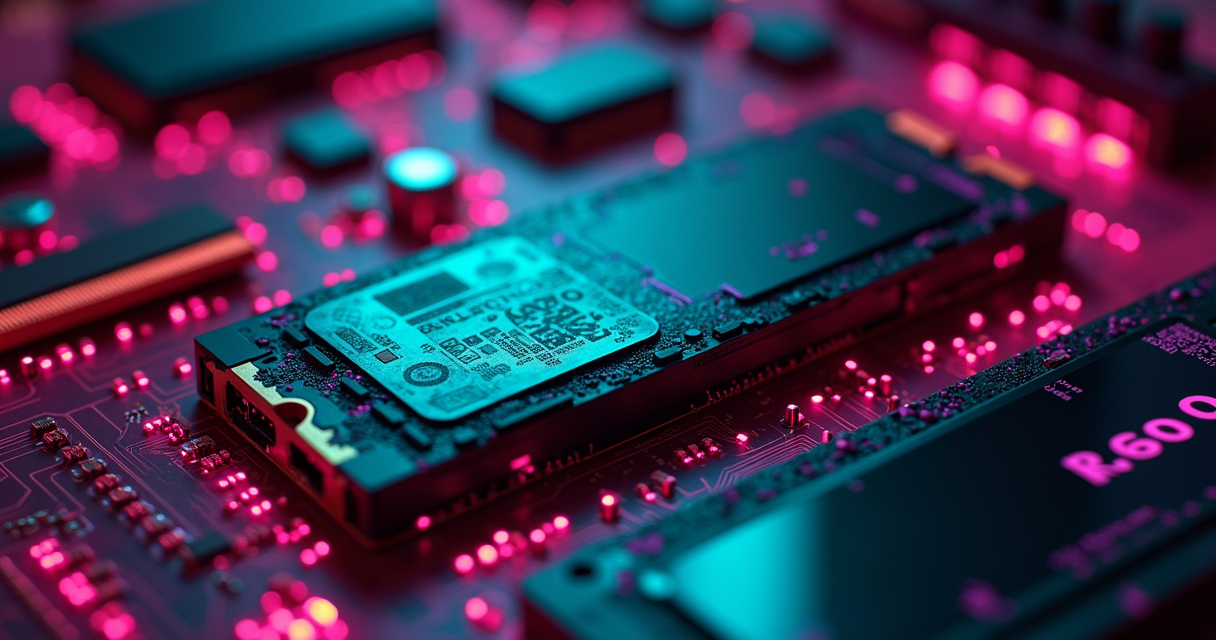
Here is the part the press releases buried under the word up to: the first PCIe 6.0 SSD to reach finished-product status in 2025 is not for you. It is not for your Steam library, your shader cache, your 180 GB shooter that recompiles its entire pipeline every time the publisher remembers it exists. It is for a rack in a building you will never enter, feeding a GPU cluster that is busy hallucinating images of cats wearing crowns. The headline number â 28 GB/s sequential read â is real, and it is also irrelevant to the machine under your desk, and the gap between those two facts is the whole story.
So let us tell it properly, because the trade coverage has a habit of printing the throughput figure in bold and then forgetting to mention that the drive ships in an E3.S sled and costs more than your car. The PCIe 6.0 SSD era began in 2025. It began in the data center. And on present evidence, it will stay there until the back half of this decade.
What Actually Shipped
The marker event is Micron's 9650, presented in 2025 and described as the first PCIe 6.0 SSD to reach finished-product status rather than tradeshow-demo status. That distinction matters. The industry has been waving PCIe 6.0 controller silicon and reference boards at conferences for a couple of years; a shipping enterprise drive with a spec sheet and a form factor and a roadmap is a different animal. PCMag's coverage of the launch put the 9650 family squarely where Micron put it: servers and data centers, explicitly tied to AI infrastructure, explicitly not aimed at consumer PCs.
Related: Best Gaming Mouse 2026
Right behind it is Samsung's PM1763, shown at the GMIF Innovation Summit 2025 and targeting a 2026 launch â also a server and datacentre part, also pitched at AI-scale throughput. Club386's preview pegged it at roughly 30 GB/s on a PCIe 6.0 x4 link using a 16-channel controller. Two vendors, two enterprise drives, zero gaming products. That is the entire PCIe 6.0 SSD market as of this writing, and it is worth sitting with that before anyone gets excited about loading screens.
The deadpan summary: the fastest storage interface humanity has productized arrived in 2025, and the consumer was not invited. He gets a postcard in roughly 2030.
The Numbers, Unsentimental
Let us deal in figures, because this is the part the spec-sheet poets actually got right. PCIe 6.0's underlying standard delivers 64 GT/s per lane â gigatransfers per second, the raw signalling rate â which is a clean doubling of PCIe 5.0's 32 GT/s. A full x16 implementation is cited at 256 GB/s bidirectional bandwidth, the kind of number that belongs to GPUs and accelerators, not drives. An SSD does not get x16. An SSD gets an x4 link, and on PCIe 6.0 that x4 link is the relevant interface for everything we are discussing here.
What does an x4 6.0 link buy in practice? Micron's 9650 answers that with up to 28 GB/s sequential read and up to 14 GB/s sequential write, plus up to 5.5 million IOPS for random operations. Hold those against the PCIe 5.0 enterprise drives they are meant to replace and Micron's framing is up to 100% faster sustained reads and writes up to 40% faster. Double the read throughput is not a rounding error. It is the entire point of skipping a generation of patience.
The signalling change underneath is the genuinely interesting engineering. PCIe 6.0 abandons the simple NRZ encoding of every prior generation for PAM4 â four-level pulse-amplitude modulation, two bits per symbol â and layers FLIT (flow control unit) framing with forward error correction on top to keep PAM4's noisier signalling honest. That is why the per-lane rate doubled without the clock doubling, and it is also why the controllers are expensive and hot. You do not get PAM4 and FEC for free. You pay for them in silicon area, in power, and ultimately in the price of admission. The PCI Express standard has the full encoding story for anyone who wants the gory layer-diagram version.
Related: PCIe 6.0 SSDs 2026
Micron's 9650 and the 28 GB/s Headline
The 9650 is the drive that opened the era, so it deserves the close read. Beyond the 28/14 GB/s and 5.5M IOPS, the part of the announcement that should make storage architects sit up is the capacity roadmap. Micron's first PCIe 6.0 variants are expected in 2025 at up to 122 TB, in E3.S and U.2 form factors â the two sleds that own modern server storage bays â followed by 245 TB versions in the first half of 2026.
Read those capacities again. A single drive holding a quarter of a petabyte is not a gaming peripheral; it is a strategic decision about how an AI training pipeline keeps its GPUs fed without starving on I/O. The positioning is explicit and unembarrassed: AI data centers and high-throughput infrastructure workloads. Micron is not pretending this is a halo product that will trickle down to enthusiasts next Christmas. It is a forklift-upgrade enterprise component, and the company's own language draws the line in permanent marker.
This is the inversion worth noting for a gaming audience. For most of consumer computing history, the bleeding edge debuted in the prosumer or enthusiast tier and migrated to the server. PCIe 6.0 storage is doing the opposite â born enterprise, and likely to die enterprise for years before any consumer controller exists to exploit it. Ars Technica-style enterprise coverage and Germany's heise online both filed the 9650 under datacenter hardware, not under anything a system builder would spec.
Samsung's PM1763 and the Capacity Play
Samsung's entry rhymes with Micron's but plays a slightly different chord. The PM1763 targets a 2026 launch at roughly 30 GB/s on PCIe 6.0 x4 via a 16-channel controller â nominally a touch faster than the 9650's headline, though comparing vendor up to figures is a mug's game until independent benchmarks exist. The number that actually distinguishes Samsung's pitch is power: about 25 W, which the company frames as roughly 60% more efficient than previous solutions.
Efficiency is the quiet war in enterprise storage. At hyperscale, watts are the budget. A drive that delivers 30 GB/s while sipping 25 W changes the math on how many you can cram into a rack before the cooling gives up, and that is a more consequential lever than a two-gigabyte-per-second throughput bragging-rights gap. Samsung clearly knows it, because the efficiency claim got equal billing with the speed.
Related: Best Gaming Keyboard 2026
Then there is the longer roadmap, which tells you what PCIe 6.0 is really for. Samsung points to 256 TB PCIe 5.0 SSDs and, later, 512 TB PCIe 6.0 SSDs. Half a petabyte on a single drive. Notice the framing: the 6.0 generation is being used to scale capacity as aggressively as speed. The new interface is not just a faster pipe; it is the bandwidth budget that makes monstrous single-drive capacities usable without the controller becoming the bottleneck. For AI workloads that need to keep enormous datasets close to the accelerators, that capacity-times-bandwidth product is the actual product.
How We Got Here: 2022 to Silicon
The standard is not new. PCI-SIG officially released PCIe 6.0 in January 2022. That is more than three years before a shippable SSD existed â a gap that surprises nobody who has watched a PCIe generation crawl from specification to silicon to product. The pattern is metronomic: PCI-SIG ratifies a spec, controller vendors spend a year or two taping out parts, drive makers spend another stretch turning controllers into qualified products, and the enterprise gets it first because the enterprise will pay.
That cadence â a bandwidth doubling roughly every three years â is the org's stated mission, and PCI-SIG leadership including chairman Al Yanes has consistently framed each generation as exactly that: double the per-lane rate, hold the lane count, let the ecosystem catch up. PCIe 6.0 honored the contract. 64 GT/s is precisely double 5.0's 32. The standard did its job in 2022. The 2025â2026 story is purely about the long, expensive descent from ratified spec to a drive you can bolt into a chassis.
The historical irony is that this is the fast version of the story for the data center and the slow version for everyone else. PCIe 4.0 SSDs reached consumers within a couple of years of the spec. PCIe 5.0 consumer drives followed reasonably promptly, if hot and power-hungry. PCIe 6.0 is breaking the pattern â the consumer trickle-down is not late, it is being actively deferred, because the people who set the timelines have looked at the cost of PAM4 controllers in a $150 retail SSD and quietly walked away. Which brings us to the part of the article where the gaming editorial earns its keep.
The Spec Sheet
Two tables. The first situates PCIe 6.0 in the lineage; the second puts the two real 2025â2026 products side by side. All figures trace to PCI-SIG specification rates and the vendor disclosures cited throughout.
Related: RTX 5080 vs 4080
| Generation | PCI-SIG Year | Per-Lane Rate | Approx. x4 Throughput | Encoding |
|---|---|---|---|---|
| PCIe 3.0 | 2010 | 8 GT/s | ~3.9 GB/s | NRZ / 128b-130b |
| PCIe 4.0 | 2017 | 16 GT/s | ~7.9 GB/s | NRZ / 128b-130b |
| PCIe 5.0 | 2019 | 32 GT/s | ~15.8 GB/s | NRZ / 128b-130b |
| PCIe 6.0 | 2022 | 64 GT/s | ~32 GB/s (x16 = 256 GB/s bidir.) | PAM4 + FLIT + FEC |
The per-lane bandwidth math
A note on reading that table: the x4 figure is theoretical link ceiling, not measured drive output. Micron's 28 GB/s real-world read sits comfortably under the ~32 GB/s x4 ceiling, which is exactly what you expect once protocol overhead and NAND realities take their cut. The headline is honest, in other words, but it is a ceiling, not a promise of free lunch.
| Spec | Micron 9650 | Samsung PM1763 |
|---|---|---|
| Interface | PCIe 6.0 x4 | PCIe 6.0 x4 (16-channel) |
| Sequential read | Up to 28 GB/s | ~30 GB/s |
| Sequential write | Up to 14 GB/s | Not specified |
| Random IOPS | Up to 5.5 million | Not specified |
| Power | Not specified | ~25 W (~60% more efficient) |
| Capacity | Up to 122 TB (245 TB H1 2026) | Roadmap to 512 TB (6.0) |
| Form factor | E3.S, U.2 | Enterprise (server) |
| Target market | AI data centers | Servers / datacentre |
| Availability | 2025 | 2026 (target) |
Confirming link state on Linux
If you want to feel the x4-versus-x16 distinction in your hands rather than your head, the back-of-envelope is trivial. A 6.0 lane is 64 GT/s; PAM4 carries 2 bits per symbol, and after the protocol's effective overhead you land near 8 GB/s of usable throughput per lane:
PCIe 6.0 per-lane: 64 GT/s (PAM4, 2 bits/symbol)
  usable/lane     ~ 8 GB/s   (after FLIT/FEC overhead)

  x4  SSD link    ~ 32 GB/s  ceiling  -> Micron 9650 hits 28 GB/s real read
  x16 GPU link    ~ 256 GB/s bidirectional  (not for storage)
You can confirm a host's link state the boring way, on any Linux box with the drive installed, by reading the negotiated speed and width straight off the bus:
$ lspci -vv -s 01:00.0 | grep -E 'LnkCap|LnkSta'
  LnkCap: Speed 64GT/s, Width x4
  LnkSta: Speed 64GT/s (ok), Width x4 (ok)
# 64GT/s + x4 == PCIe 6.0 storage link negotiated correctly
Why None of This Touches Your Rig
Now the thesis. There is no PCIe 6.0 gaming SSD, there will not be one soon, and even when one eventually exists it will not do what the marketing implies. Three reasons, in descending order of how much they will annoy you.
When even Gen6 controllers say 2030
One: the timeline is brutal. 2025 industry coverage puts consumer PCIe 6.0 SSDs at roughly 2030. That is not a typo and it is not pessimism â it is the on-record read from someone whose job is selling the controllers. Silicon Motion CEO Wallace Kou said it without hedging: "You will not see any PCIe Gen6 [solutions] until 2030." When the man whose company would profit from consumer Gen6 controllers tells you they are five years out, believe him over the tradeshow render.
Related: 144Hz vs 240Hz 2026
Two: the platform isn't there. AMD is reported to support PCIe 6.0 starting in 2026, but the same reporting is blunt that consumer adoption remains delayed â the technology is judged too expensive and too complex for home PCs. PAM4 signalling, FEC, the controller power and thermals â these are surmountable in a $40,000 server and absurd in a gaming desktop where the SSD is already the third-hottest thing in the case. The host platforms will get 6.0 lanes for GPUs and accelerators long before anyone wires them to a consumer M.2 slot.
PCIe 5.0's nonexistent gaming payoff
Three â and this is the one nobody wants to hear â even PCIe 5.0 barely matters to games. This was true at 4.0 and it is more true now. Game load times are dominated by decompression, asset streaming logic, shader compilation, and CPU-side work â not by raw sequential throughput. The Verge and the broader enthusiast press documented this with PCIe 5.0 consumer drives: the benchmarks scream and the loading screens shrug. DirectStorage on Windows and the PS5's I/O complex were supposed to change the equation, and they helped at the margins, but the wall is no longer the interface. Doubling 5.0 to 6.0 for a workload that wasn't interface-bound at 4.0 is solving a problem your games do not have. You would be paying a PAM4 premium to shave milliseconds off a process gated by something else entirely.
The honest gaming takeaway, then: the first real PCIe 6.0 SSDs are enterprise products of 2025â2026, full stop. They are not gaming upgrades, they are not coming to your rig this console generation, and when a consumer version finally lands near 2030 it will improve a metric you cannot feel. That is not cynicism. That is the spec sheet read out loud.
The Competitive Picture
Within the enterprise lane where this race is actually being run, it is a two-and-a-half-horse contest. Micron has the first-mover trophy â the 9650 is the drive that crossed the finished-product line in 2025, and being first to a qualified PCIe 6.0 SSD in AI-server bays is worth design wins that compound. Samsung counters with the efficiency story and a capacity roadmap that runs to 512 TB, betting that hyperscalers care more about watts-per-terabyte and density than about who hit 30 GB/s first.
The half-horse is everyone else â SK Hynix, Kioxia, Western Digital â all of whom have PCIe 6.0 enterprise silicon in flight and none of whom had crossed the same finished-product threshold as Micron at the time of writing. The controller suppliers, Silicon Motion and Marvell among them, are the kingmakers here, and Kou's 2030 consumer comment tells you where Silicon Motion is putting its 6.0 effort: enterprise now, consumer later, no apologies.
The competitive subtext is that PCIe 6.0 leadership is, for once, almost entirely decoupled from the consumer brand war. Nobody is going to win a gaming SSD shootout with a 6.0 part in 2026 because there is no gaming 6.0 part to enter. The fight is over data-center sockets â over which drive sits next to the GPUs in the next training cluster â and the gaming press is, for the moment, a spectator at someone else's tournament. Engadget-tier consumer coverage will get interesting around the platform launches; the storage itself stays enterprise for years.
Predictions for 2026 and 2027
Predictions are where editorials go to embarrass themselves later, so let us be specific enough to be wrong on the record.
- Micron ships 245 TB PCIe 6.0 drives in the first half of 2026, on schedule. The capacity roadmap is already public and the 122 TB parts establish the platform; the 245 TB jump is an evolution, not a moonshot. Expect it roughly on time, in E3.S first.
- Samsung's PM1763 launches in 2026 but slips toward the back half. A 2026 target for a brand-new PAM4 enterprise controller almost always means H2 once qualification reality arrives. The ~25 W efficiency figure will headline the launch even more than the ~30 GB/s.
- No consumer PCIe 6.0 SSD is announced in the next 12 months â and probably not the 12 after that. Kou's 2030 marker holds. The most you'll see is platform-side 6.0 lane support arriving with AMD in 2026, wired to GPUs and accelerators, not to M.2 storage slots.
- The AI-datacenter framing intensifies. Every PCIe 6.0 SSD announcement through 2027 will lead with training-pipeline and inference-throughput language, because that is who buys them. Capacity-times-bandwidth will be the pitch, not gaming, not creator workstations.
- The first PCIe 5.0 consumer drives get cheaper as enterprise moves to 6.0. The genuine consumer benefit of this whole cycle is indirect: as the data center's attention shifts to 6.0, 5.0 NAND and controllers mature and slide down the price curve. The gamer's 2026â2027 win is a more affordable PCIe 5.0 drive, not a 6.0 one.
The Verdict
PCIe 6.0 SSDs are here, they are extraordinary, and they have nothing to do with you. That is the deadpan truth under the 28-GB/s confetti. Micron's 9650 made 2025 the year the interface went from spec to silicon to shippable product, Samsung's PM1763 will press the point in 2026 with a half-petabyte roadmap and a power figure that matters more than its speed, and the entire generation will live in AI server racks for the foreseeable future.
If you build gaming PCs, file this under interesting, not actionable. Buy a good PCIe 4.0 drive, or a PCIe 5.0 one if the price has come down and you like the bragging rights, and understand that neither will load your games meaningfully faster than the other because the interface stopped being the bottleneck a generation ago. The PCIe 6.0 SSD you eventually buy, somewhere around 2030, will be a marvel of PAM4 engineering that improves a number you cannot perceive. Until then, the only honest thing to do with a 28-GB/s enterprise drive is admire it through the glass â and remember that the fastest storage ever productized was built for a machine dreaming of cats in crowns, not for your save files.
Questions the search bar asks me
- Is there a PCIe 6.0 SSD I can put in my gaming PC in 2026?
- No. The only PCIe 6.0 SSDs that exist — Micron's 9650 (2025) and Samsung's PM1763 (2026 target) — are enterprise drives in E3.S and U.2 form factors for AI data centers. Industry coverage and Silicon Motion CEO Wallace Kou put consumer PCIe 6.0 SSDs at roughly 2030.
- How fast is the Micron 9650, exactly?
- Up to 28 GB/s sequential read, up to 14 GB/s sequential write, and up to 5.5 million IOPS for random operations. Micron frames it as up to 100% faster sustained reads and up to 40% faster writes than PCIe 5.0 competitors. The drive scales to 122 TB in 2025 and 245 TB in the first half of 2026.
- When was PCIe 6.0 actually released, and why did SSDs take so long?
- PCI-SIG officially released the PCIe 6.0 standard in January 2022, but the first finished-product SSD didn't arrive until 2025 — over three years later. The delay is the normal spec-to-silicon-to-qualified-product lag, made worse by 6.0's expensive PAM4 signalling and forward error correction, which is why it debuted in enterprise hardware first.
- Will PCIe 6.0 make my games load faster than PCIe 5.0?
- Almost certainly not in any way you'd feel. Game load times are dominated by decompression, asset streaming, shader compilation, and CPU work — not raw sequential throughput. PCIe 5.0 already showed negligible real-world loading gains over 4.0, so doubling the interface again to 6.0 solves a problem games don't have.
- What's the difference between the x4 and x16 PCIe 6.0 numbers?
- PCIe 6.0 runs 64 GT/s per lane. A full x16 implementation reaches about 256 GB/s bidirectional — that's for GPUs and accelerators, not drives. SSDs use an x4 link, which tops out near 32 GB/s, and that's the ceiling Micron's real-world 28 GB/s read sits under.

Marcus covers the gaming PC, GPU, and peripheral side of staresback. Every post under this byline is reviewed pre-publish by Sam P., Editor & Operator — corrections to info@instalinkoteam.com. Published 2026-08-29 · Last updated 2026-08-29. Full bios on the author page.