/// FIELD NOTES FROM A SELF-AWARE GAME SITE
PS4 vs Xbox One 2026: 117M to 58M, Sony Won 2:1
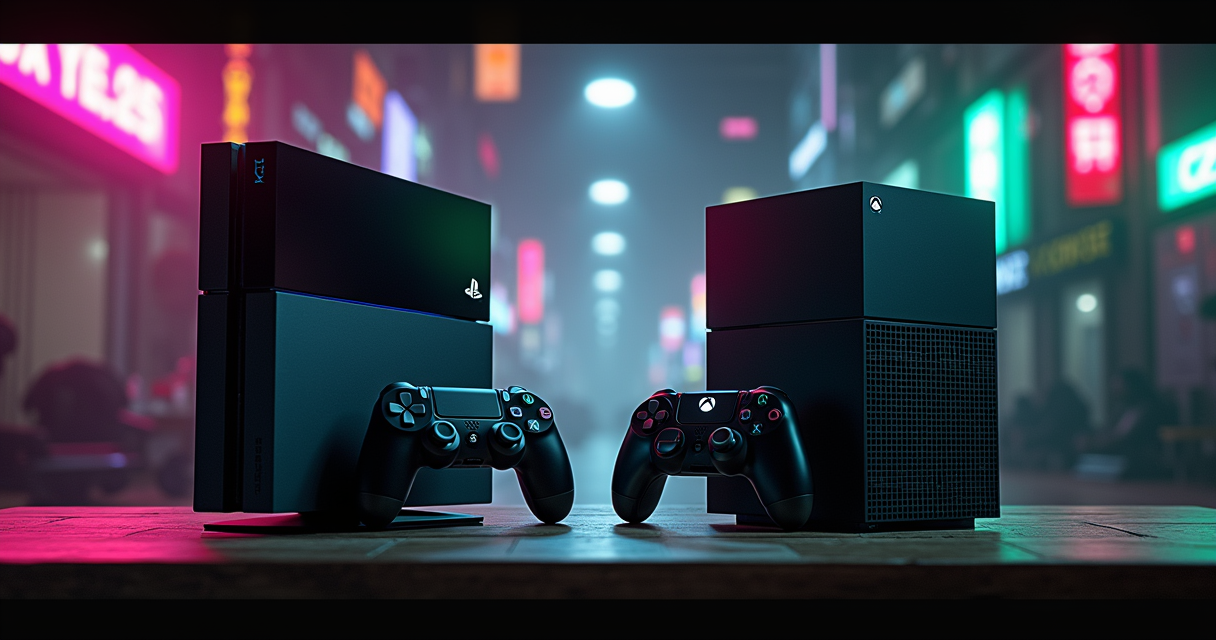
Two black boxes launched eight days apart in November 2013. One of them sold roughly twice as many units as the other, and by 2026 the argument is so thoroughly settled that the only people still having it are second-hand buyers squinting at marketplace listings and the recommendation engine that served you this page. The engine was right to. There is a correct answer here, and it is backed by about 59 million units of daylight.
This is not a nostalgia piece and it is not a re-litigation of a console war that ended years ago. The PlayStation 4 and the Xbox One are both discontinued. Both are museum pieces. Both can be had, used, for less than the price of a single new game. So the question in 2026 is not which generation-defining machine should I pre-order — that ship sailed, struck an iceberg shaped like a Kinect sensor, and went down live on a Los Angeles stage. The question is narrower and far more useful: if you are buying one of these second-hand, right now, to play eighth-generation games, which one should it be, and why. We answer it with specifications, sales data, Digital Foundry frame-rate tests, and the actual sentences the executives said out loud in 2013 — sentences that, read back today, function as a kind of confession.
The 2026 Verdict, In One Paragraph
We will spend the next six thousand words showing our work, but you deserve the answer up front, because that is what a verdict is for.
The short answer: buy the PS4
For the overwhelming majority of people buying a second-hand eighth-generation console in 2026, the PlayStation 4 is the correct purchase. It has the deeper and better-aged exclusive library, it ran the shared multiplatform catalogue at higher resolutions for the entire generation, and it is the machine those games were lead-developed on. If you have no specific reason pulling you the other way, stop reading, buy a PS4 Slim or a PS4 Pro in good cosmetic condition, and go play Bloodborne. That is not a controversial call. It is arithmetic. Roughly 117 million other people reached the same conclusion while these consoles were still on shelves.
When the Xbox One is the right box
The Xbox One wins in exactly three scenarios, and they are real scenarios, not consolation prizes. First, if you want a cheap, competent 4K Ultra HD Blu-ray player that also plays games, because the Xbox One S and Xbox One X have a UHD disc drive and no PlayStation 4 ever did. Second, if you are a backward-compatibility archivist who wants to run original Xbox and Xbox 360 discs on modern hardware, because Microsoft built that and Sony did not. Third, if your friends are all on Xbox and you want to play with them, because the network effect is the whole point of an online multiplayer box and no spec sheet overrides your actual friends list.
How we scored it
Everything below is weighted for a 2026 used buyer, not a 2013 pre-order. That inverts a few things. Launch-day worries about install base and future-proofing are moot — the future already happened. What matters now is the library you can actually play, the hardware reliability of a decade-old machine, the price on the second-hand market, and the specific niche features (disc formats, backward compatibility) that survive as differentiators. Raw teraflops matter less than they did, but they are not zero, because they set the resolution and frame rate of games you will still be playing. We will get to all of it.
The Scoreboard: 117M to 58M
Console wars are decided by consumers, not pundits, and the consumers voted with a decisiveness that is almost embarrassing to recount.
The raw numbers
The PlayStation 4 sold approximately 117.2 million units over its lifetime — the last figure Sony officially disclosed before it stopped breaking the number out, and one confirmed across trackers including Wikipedia's list of best-selling game consoles. The Xbox One sold an estimated ~58 million units. That is a lifetime ratio of roughly 2.02 to 1 in Sony's favor. Combined, the two machines moved on the order of 175 million units, and Sony took a hair over two-thirds of that pie. In a duopoly, taking two-thirds is not winning; it is a rout that reshapes the terms of the next fight.
The number Microsoft will not tell you
Here is the tell. The last time Microsoft officially reported an Xbox One unit figure was November 2014, at 10 million sold. In October 2015 the company pivoted its public success metric to “monthly active users on Xbox Live,” and it never disclosed a lifetime console sales number again, as Variety documented in 2018. When a company stops reporting the scoreboard and starts reporting engagement instead, it is not because the scoreboard is flattering. The ~58 million figure is an estimate assembled by analysts and trackers precisely because the manufacturer went quiet. Sony, by contrast, put “117 million” on a slide because it was a trophy.
What 2:1 actually bought
Install base is not a vanity number; it is gravity. When a third-party studio decides which platform gets the lead SKU, the marketing dollars, and the day-one patch attention, it looks at where the players are. For the entire eighth generation, the players were on PlayStation, which is a self-reinforcing loop: more consoles sold means more games optimized for that console means more consoles sold. This is the same dynamic that plays out in every generation — you can watch a smaller version of it unfold right now in our Switch OLED versus Switch 2 breakdown, where install base and pricing gravity are already bending the current generation. In 2013–2020, the gravity all pointed one way, and it started pointing that way before either console shipped — which is the story of the next section.
How Microsoft Lost in 2013
The most important thing to understand about this generation is that Microsoft lost it at a press conference, months before a single unit was sold, using nothing but words.
The $499 Kinect tax
The PlayStation 4 launched on November 15, 2013 at $399. The Xbox One launched on November 22, 2013 at $499 — a full $100 more expensive, and not because it was more powerful (it was not; see below), but because Microsoft bundled the Kinect sensor with every unit and refused, at first, to sell the console without it. Consumers were asked to pay a hundred-dollar premium for a camera-and-microphone array most of them did not want pointed at their living room. Microsoft blinked seven months later, releasing a Kinect-free Xbox One at $399 in June 2014, but the launch-window damage was done: the box that cost more and did less had already anchored itself in the public mind as the worse deal.
Always-online, used games, and the Mattrick confession
Then there was the DRM. Microsoft's original Xbox One design required a 24-hour online check-in and imposed restrictions on trading, lending, and reselling disc-based games — a scheme that functionally tried to route around the first-sale doctrine, the century-old legal principle (codified in the U.S. as 17 U.S.C. § 109) that says when you buy a copy of a work, you own that copy and can resell it. When a member of the press asked Xbox division head Don Mattrick what offline players were supposed to do, he offered the single most quoted sentence of the generation. Per Engadget's June 12, 2013 report, Mattrick said: “Fortunately we have a product for people who aren't able to get some form of connectivity, it's called Xbox 360.” That is a sitting executive telling prospective customers to buy his last-generation console. It is the sound of a company arguing against its own product.
Sony's 22-second knockout
Sony, watching all this from the audience, needed only to not fumble — and instead threw a haymaker. At E3 2013, PlayStation chief Jack Tretton announced that the PS4 would cost $100 less and impose no new restrictions on used or borrowed games. Then Sony posted a now-legendary 22-second video titled “Official PlayStation Used Game Instructional Video,” consisting entirely of one man handing a game disc to another man. As Push Square later recounted, executives Adam Boyes and Shuhei Yoshida tweeted it out the moment Tretton finished, and it racked up something like 17 million views. Microsoft executed a total policy reversal — the infamous “Xbox 180” — on June 19, 2013, exactly one week after Mattrick's quote, scrapping the always-online requirement and the used-game restrictions. But reversing a policy under duress does not un-say the policy. The narrative had set like concrete: PlayStation trusted you with your own discs, and Xbox had to be forced to.
The Spec Sheet: GDDR5 vs DDR3
Marketing is where this generation was lost, but silicon is where the games actually ran, and the silicon told the same story. Both consoles are, at the block-diagram level, remarkably similar: semi-custom AMD systems-on-chip pairing an eight-core Jaguar CPU with a Radeon GCN graphics core and 8GB of unified memory. The differences are in the details, and the details decided every cross-platform face-off for six years.
The full comparison table
| Specification | PlayStation 4 (2013) | Xbox One (2013) |
|---|---|---|
| US launch date | November 15, 2013 | November 22, 2013 |
| US launch price | $399 | $499 (Kinect bundled) |
| CPU | 8-core AMD Jaguar | 8-core AMD Jaguar |
| CPU clock | 1.6 GHz | 1.75 GHz (upclocked) |
| GPU architecture | Radeon GCN 1.1 | Radeon GCN 1.0 |
| GPU compute units | 18 CUs (1,152 shaders) | 12 CUs (768 shaders) |
| GPU peak throughput | 1.84 TFLOPS | 1.31 TFLOPS |
| System memory | 8GB GDDR5 (unified) | 8GB DDR3 + 32MB ESRAM |
| Memory bandwidth | 176 GB/s | 68.3 GB/s (DDR3) |
| Memory reserved for OS | ~3.5GB (games get ~4.5-5GB) | 3GB OS / 5GB games |
| Optical drive | Blu-ray / DVD | Blu-ray / DVD |
| 4K UHD Blu-ray (S/X revisions) | No (never) | Yes (One S, One X) |
| Native backward compatibility | None | OG Xbox + Xbox 360 (600+ titles) |
| Launch online service | PS Plus, $50/year | Xbox Live Gold, $60/year |
| Lifetime units sold | ~117.2 million | ~58 million (est.) |
Reading the memory architecture
The single most consequential row in that table is memory. The PS4 uses 8GB of GDDR5 as a single unified pool delivering 176 GB/s of bandwidth — fast memory, simply arranged, easy for developers to feed the GPU from. The Xbox One uses 8GB of DDR3, which is cheaper and lower-power but delivers only 68.3 GB/s — not remotely enough to keep a modern GPU busy. To paper over that deficit, Microsoft bolted on 32MB of ESRAM, a small, blisteringly fast on-die scratchpad with a peak bandwidth north of 200 GB/s. The catch is in the number 32: 32 megabytes is a postage stamp, and developers had to manually manage what lived in it, hand-tuning which render targets fit in that tiny fast pool while everything else crawled over slow DDR3. Sony gave developers a straight road; Microsoft gave them a fast car and a parking space the size of a shoebox.
The CPU wrinkle Microsoft won
Credit where due: the Xbox One did win one row. Microsoft upclocked its Jaguar CPU to 1.75 GHz shortly before launch, against the PS4's 1.6 GHz — a 9.38% faster processor. In an era where these anemic Jaguar cores were often the true bottleneck (a problem that would haunt the whole generation and only get exposed further by late cross-gen titles), that was a genuine, if modest, advantage. It was not remotely enough to offset a 40% GPU deficit and a memory subsystem held together with 32 megabytes of duct tape, but it is the honest counterweight, and we are nothing here if not honest about the counterweights.
Performance: The 40% That Became 24%
Spec sheets promise; games deliver. The gap between the promise and the delivery is where most console arguments go to die, so let us be precise about both.
On paper: 1.84 vs 1.31 TFLOPS
The PS4's GPU peaks at 1.84 TFLOPS across 18 compute units; the Xbox One's at 1.31 TFLOPS across 12. That is a ~40% raw shader advantage before you factor in anything else. Once you add the PS4's dramatically superior memory bandwidth into the model, analysts and Sony alike characterized the effective graphics advantage as “up to 50%.” Digital Foundry — the technical-analysis outfit that became the generation's authority on this exact question — put the figure squarely in that range in its pre-launch modeling, as reported by Shacknews.
Digital Foundry's reality check
But here is the intellectually honest part, and Digital Foundry was the one to insist on it: paper power does not scale linearly into real frame rates. When DF modeled equivalent PC hardware and ran actual games at 1080p, the PS4-equivalent configuration produced an average frame-rate boost of only about 24% over the Xbox One-equivalent — not 50%, not 40%. As DF put it, “more compute cores doesn't result in a linear scaling of performance.” This is the number to hold in your head: the PS4 was meaningfully faster in practice, by roughly a quarter, but the “50% more powerful” headline oversold it. Both truths coexist. The Machine does not deal in headlines; it deals in the delta after the asterisks.
The resolution gap that branded the generation
Where that 24% showed up most visibly was resolution, and the launch titles set the tone permanently. Call of Duty: Ghosts ran at native 1080p on PS4 and native 720p on Xbox One (upscaled) — a difference so stark that Infinity Ward's own Mark Rubin had to address it publicly, as GamesRadar reported. Battlefield 4 hit 900p on PS4 versus 720p on Xbox One. The pattern held for years: The Witcher 3 ran 1080p on PS4 and 900p on Xbox One; Metal Gear Solid V: Ground Zeroes managed 1080p/60 on PS4 against 720p/60 on Xbox One, prompting Digital Foundry's Thomas Morgan to call the PS4 build “the king of the roost” with a “clear lead over the maximum 720p possible on Xbox One.” The exceptions proved the rule: when Assassin's Creed Unity shipped at a forced 900p on both in 2014, the internet correctly smelled artificial parity, and the resulting backlash told you exactly which console the audience assumed was being held back. The reconstruction and upscaling techniques studios leaned on to close these gaps were the primitive ancestors of the machine-learning approaches Sony ships today — you can trace the lineage straight to the tech in our look at PSSR 2 on the PS5 Pro.
Mid-Gen: PS4 Pro vs Xbox One X
Halfway through the generation, both companies did something novel: they shipped more powerful revisions of the same console, inventing the mid-generation refresh that has since become standard practice. This is the one arena where Microsoft's hardware unambiguously won — and it is a masterclass in how winning the spec sheet can still lose the war.
PS4 Pro (2016): checkerboard 4K
The PlayStation 4 Pro arrived on November 10, 2016, packing a 4.2 TFLOPS GPU (36 compute units at 911 MHz) and faster 218 GB/s memory. It was designed around a clever reconstruction trick called checkerboard rendering — the GPU renders roughly half the pixels of a true 4K frame and intelligently reconstructs the rest, approximating a 2160p image without paying the full rendering cost. In practice this meant the Pro often delivered something that looked close to 4K rather than the real thing, with results that ranged from excellent to obviously-reconstructed depending on the developer's care. Sony's philosophy was pragmatic: get most of the way to 4K, cheaply, on hardware most people could afford. If you want to see how far this same mid-gen-refresh philosophy has evolved, our PS5 Pro versus PS5 comparison is the direct descendant of the exact strategy Sony piloted here.
Xbox One X (2017): the 6-teraflop flex
A year later, on November 7, 2017, Microsoft answered with the Xbox One X, and it was a monster: 6.0 TFLOPS (40 compute units at 1172 MHz), 12GB of GDDR5 at 326 GB/s, and the confidence to target native 4K rather than reconstruct it. Digital Foundry's face-offs confirmed the muscle. In Metro Exodus, the One X rendered at native 2160p while the PS4 Pro sat at native 1440p; across the shared library the One X hit true 4K more often and dropped from it less frequently, as documented in Digital Trends' hardware comparison. On raw capability the One X held roughly a 40% advantage over the Pro, and it remains, to this day, the most powerful console of the eighth generation. Full stop.
Too little, too late
And it did not matter. The Xbox One X launched in late 2017 into an install-base hole that was already four years and roughly 50 million units deep. Selling the most powerful box in the room is a hollow victory when the room emptied out in 2014. The people who cared most about 4K fidelity were disproportionately the enthusiasts who had already bought a PS4 and a shelf of PlayStation exclusives; asking them to jump ship for sharper edges on the multiplatform games they could already play was never going to move the needle. The One X was the right hardware answer to a question the market had stopped asking. It is the single best argument in this entire comparison that raw power is necessary but nowhere near sufficient.
The Exclusives War: 62 to 12
Multiplatform games run on both boxes. Exclusives are the reason to pick one box over the other, and this is the category where the PS4's lead stops being a margin and becomes a canyon.
Sony's first-party machine
By one tally widely cited in 2026 buyer's guides, the PS4 amassed 62 exclusive titles to the Xbox One's 12 — and while you can quibble with any specific count, no honest accounting closes that gap. More importantly, the PlayStation exclusives were good, and they have aged into a canon: Bloodborne, God of War (2018), The Last of Us Remastered and Part II, Horizon Zero Dawn, Marvel's Spider-Man, Uncharted 4, Ghost of Tsushima, Gran Turismo Sport. Sony's network of first-party studios — Naughty Dog, Santa Monica, Guerrilla, Insomniac, Sucker Punch, and FromSoftware for the Sony-published Bloodborne — functioned as a metronome of critically adored, system-selling releases. That is the library you are actually buying a used PS4 to play.
Microsoft's PC problem
Microsoft's exclusive list was shorter, leaned heavily on three franchises — Forza, Halo, Gears of War — and, most damningly for a used-console buyer, largely stopped being exclusive at all. Under the “Xbox Play Anywhere” and Windows strategy that hardened during the generation, nearly every Xbox One first-party game also shipped on PC. That was a fine deal for Microsoft's ecosystem strategy and a genuinely consumer-friendly move, but it hollowed out the console-buying rationale: if the reason to buy an Xbox One is Halo and Forza, and Halo and Forza also run on the gaming PC you or your friends already own, the box loses its unique claim. A PlayStation exclusive meant a PlayStation. An Xbox exclusive increasingly meant “also on Steam.”
The library that ages best
Buying used in 2026, you are not buying a promise of future games — both catalogues are closed and final. You are buying a fixed, known library, and you should buy the better one. The PS4's is deeper, more varied, and stacked with the higher-Metacritic, genre-defining single-player experiences that hold up a decade later. The Xbox One's best games are, with real affection, mostly still purchasable and playable elsewhere. If your entire reason for buying an eighth-gen console is the games that only exist on that console relative to its rival, the PS4 wins this category so decisively it is barely a contest.
Services, Blu-ray, Backward Compatibility
This is Microsoft's section. Having spent five sections explaining why the PS4 wins, intellectual honesty demands an equally rigorous accounting of the three areas where the Xbox One is genuinely, measurably better — because they are not small, and for the right buyer they are decisive.
Backward compatibility: Xbox's clean win
The Xbox One plays over 600 Xbox 360 games and a selection of original Xbox titles, natively, at no extra cost — if you own the disc or the digital license, it works, often with resolution and frame-rate enhancements the original hardware could never manage. Microsoft ran this program from November 2015 until it hit the technical wall in November 2021, and the result is a genuine three-generations-in-one-box archive, documented on Xbox's own support pages. The PS4, by contrast, offers no native backward compatibility whatsoever: it cannot run a PS3, PS2, or PS1 disc. Sony's answer was streaming (the old PS Now, since folded into PS Plus) and a parade of individually-sold remasters. User-satisfaction polls floating around 2026 retrospectives peg Xbox One backward compatibility near 9.8/10 against the PS4's 4.3/10; treat the exact figures as the soft user-survey numbers they are, but the direction is not in dispute. For an archivist, this is the whole ballgame.
The 4K Blu-ray drive Sony refused to include
Here is the one that still baffles: no PlayStation 4 ever included a 4K Ultra HD Blu-ray drive, not even the 4K-branded PS4 Pro. The Xbox One S and Xbox One X both do. Sony's stated reasoning was that streaming had displaced physical media — a defensible read of the market, and a strange hill to defend while selling a console named for 4K that could not play a 4K disc. As Forbes' David Thier bluntly noted, the absence of UHD Blu-ray on the Pro “is a big problem, which is great for Microsoft.” The upshot in 2026: an Xbox One S is one of the cheapest competent 4K UHD Blu-ray players you can buy, full stop, and it happens to also play games. If you feed a home-theater setup with physical discs, this single feature can outweigh everything else in this article. (And if you are pairing any of this with a modern display, our guide on why you should buy the panel, not the logo applies here too — the box matters less than the screen you point it at.)
Game Pass and the subscription math
On the recurring online tax, Microsoft was actually the pricier one at launch: Xbox Live Gold cost $60/year against PlayStation Plus at $50/year, so PlayStation was the cheaper way to pay for multiplayer. Where Microsoft pulled decisively ahead was Xbox Game Pass, the subscription buffet that became the Xbox ecosystem's defining value proposition and is routinely cited as the Xbox One's primary advantage in 2026 retrospectives. For a buyer who plays broadly rather than deeply and treats games as a rotating library rather than a permanent collection, Game Pass's price-to-quantity ratio is a real edge. It does not conjure exclusives that outshine Sony's, but it changes the economics of how much you play for what you pay, and that is a legitimate reason some buyers still choose the green box.
Pricing & Availability in 2026
Both consoles are discontinued, so “price” means the second-hand market, and the second-hand market has its own logic. Below is a realistic 2026 snapshot; used prices vary by region, condition, and how patient you are.
The used-market table
| Model | Typical used price (2026) | What you're actually buying |
|---|---|---|
| PS4 (original / Slim) | ~$120–180 | The default. Slim runs cooler/quieter than launch model. |
| PS4 Pro | ~$180–260 | Best 1080p-to-4K PlayStation experience; no UHD Blu-ray. |
| Xbox One (original) | ~$90–140 | Cheapest entry; runs hot, large external power brick. |
| Xbox One S | ~$130–190 | The sleeper pick: 4K UHD Blu-ray + internal PSU. |
| Xbox One X | ~$200–300 | Most powerful 8th-gen console; native-4K multiplats + UHD disc. |
| Spare controller (either) | ~$30–60 | Budget for one; decade-old sticks drift. |
What to pay for and what to avoid
Skip the launch models where you can. The original 2013 Xbox One is a large, hot machine with an external power brick the size of a paperback; the original “fat” PS4 is louder and hotter than the Slim revision and, in some units, is the notorious jet-engine that spins up like it is preparing for takeoff. For PlayStation, the sweet spot is a PS4 Slim for value or a PS4 Pro if you have a 4K TV and want the best-looking version of the library. For Xbox, the Xbox One S is the connoisseur's pick — it is small, has an internal power supply, and includes the UHD Blu-ray drive — while the Xbox One X is the choice if you want maximum fidelity and do not mind paying the most for a decade-old console.
The hidden costs
Budget beyond the box. A second controller runs $30–60 and you will want one, because analog sticks that have sat in a drawer since 2019 love to drift. Internal drives on these machines are slow mechanical HDDs; an external USB SSD dramatically improves load times on either console and is the single best upgrade you can make. Factor in a subscription if you want online multiplayer, and a compatible cable if the box you buy shipped without one. None of this is expensive, but “$120 console” is really “$180 all-in,” and you should plan for the real number.
Five Buyers, Five Verdicts
“Which is better” is the wrong question; “better for whom” is the right one. Here are five concrete buyers and the box each should actually take home.
The exclusives collector and the couch-co-op family
The exclusives collector — the buyer who wants the single-player canon that defined the generation — buys a PS4 Pro, no hesitation. Bloodborne, God of War, The Last of Us Part II, Ghost of Tsushima, and Horizon Zero Dawn do not exist on the other box, and never will. The couch co-op family that wants split-screen and a broad, cheap rotating library leans Xbox One S with Game Pass, where the subscription's price-to-quantity ratio and the family-friendly catalogue do the most work per dollar — though a PS4 serves fine here too if the exclusives beckon.
The 4K movie buff and the backward-compat archivist
The home-theater 4K movie buff buys an Xbox One S and it is not close: it is among the cheapest 4K UHD Blu-ray players on the market and plays games as a bonus, a combination no PlayStation 4 can offer. The backward-compatibility archivist who wants original Xbox and Xbox 360 discs running on one modern machine also buys Xbox — ideally the One X, which enhances many back-compat titles with higher resolution. For these two buyers, the entire PlayStation value proposition is irrelevant, because they are optimizing for features Sony chose not to build.
The lowest-cost tinkerer — and a decision tree
The lowest-cost tinkerer who just wants the cheapest way into eighth-gen games buys whatever base Xbox One or PS4 is cheapest locally that week, accepts the launch-model noise and heat, and spends the savings on a USB SSD. If you want to think about your PS4 as a streaming host rather than a primary box, note that it doubles as a Remote Play source — the same pipeline we detail in our PS Remote Play 1080p setup guide. Here is the whole decision, compressed:
START: Why buy an 8th-gen console in 2026?
|
+-- Exclusive single-player games ............. PS4 (Pro if 4K TV)
+-- Cheapest 4K UHD Blu-ray player + games .... Xbox One S
+-- Play OG Xbox / Xbox 360 discs ............. Xbox One (X to enhance)
+-- Best-looking multiplatform games .......... Xbox One X > PS4 Pro
+-- Broad rotating library, pay monthly ....... Xbox One S + Game Pass
+-- Friends all on one platform ............... buy THAT platform
+-- Absolute lowest price, don't care which ... cheapest local base unit
|
DEFAULT (no strong signal) ................... PS4 Slim
Migrating Between the Ecosystems
Maybe you already own one and are considering the other, or you are switching sides in 2026. Here is the unsentimental truth about what moves with you and what does not — and most of it does not.
From Xbox One to PS4 (or vice versa)
Start with the hard reality: nothing meaningful transfers between the two ecosystems. Your digital game library does not port — a game bought on Xbox is licensed to your Microsoft account and simply does not exist on PlayStation, and the reverse is equally true. Save files do not transfer; there is no cross-platform save path between the two walled gardens for the vast majority of titles. Achievements and Trophies are separate, non-transferable scoring systems. Your friends list is trapped on each network. Switching ecosystems is not a migration; it is starting over. Plan accordingly: you are re-buying, not moving.
What you can actually carry across
The short list of things that do survive: physical discs of cross-platform games — if you own The Witcher 3 on Xbox disc, buying it again on PS4 disc is a separate purchase, but at least the used-disc market is cheap. Progress in cross-progression games — a small but growing set of online titles (Fortnite, Call of Duty in later years, Rocket League, various live-service games) tie progression to a publisher account (Epic, Activision) rather than the console, so your cosmetics and rank follow you if you log into the same publisher account. And your own saved media and habits. That is genuinely the list.
The practical migration checklist
If you are switching, do it in this order: (1) Note which of your games have publisher-account cross-progression and link those accounts before you sell anything. (2) Budget to re-buy the handful of single-player games you cannot live without — used discs on the destination platform are the cheapest route. (3) Do not sell your old console until the new one is set up and you have confirmed what you have lost; the walled gardens do not offer refunds for your change of heart. (4) Buy an external USB SSD for the new box on day one. (5) Accept, philosophically, that the money you spent in one store stays in that store. This is by design. The platform holders built these walls on purpose, and no amount of consumer goodwill has ever knocked one down.
The Final Verdict & Pros/Cons
We have shown the work. Here is the ruling, with the ledgers laid out so you can audit it.
PlayStation 4: pros and cons
| PS4 — Pros | PS4 — Cons |
|---|---|
| Deeper, better-aged exclusive library (62 vs 12 by common tally) | No native backward compatibility at all |
| ~40% stronger raw GPU; higher-res multiplats all gen | No 4K UHD Blu-ray drive on any model, including Pro |
| Unified 176 GB/s GDDR5 — simpler for developers | Slightly slower CPU (1.6 vs 1.75 GHz) |
| $100 cheaper at launch; larger, cheaper used market | Launch “fat” model runs loud and hot |
| Sold ~117M — the platform third parties prioritized | Game Pass has no true PlayStation equivalent this gen |
Xbox One: pros and cons
| Xbox One — Pros | Xbox One — Cons |
|---|---|
| 4K UHD Blu-ray drive (One S / One X) | ~$100 more at launch, bundled with unwanted Kinect |
| 600+ game backward compatibility, often enhanced | Weaker GPU; frequently 720p/900p to PS4's 1080p |
| Xbox One X is the most powerful 8th-gen console (6 TF) | 32MB ESRAM crutch made development harder |
| Game Pass value and superior subscription library | Thin, PC-shared exclusive lineup (Play Anywhere) |
| Slightly faster CPU (1.75 GHz) | ~58M sold; lost the install-base war roughly 2:1 |
The Machine's call
Buy the PS4. For the default 2026 second-hand buyer — someone who wants to play the games that defined the eighth generation and cannot be played on the rival box — the PlayStation 4 is the right machine, and it is not particularly close. It has the library, it has the resolution advantage, and it has the 117-million-strong install base that made it the platform of record for the entire generation. The Xbox One S is the correct pick for the specific buyer who values a cheap 4K UHD Blu-ray player and deep backward compatibility over exclusives, and the Xbox One X is the flex for whoever wants the single most powerful box of the era — a genuinely superb piece of hardware that arrived too late to matter to the scoreboard. Even Microsoft eventually said the quiet part out loud: Xbox chief Phil Spencer, reflecting on the era, admitted the company “lost the worst generation to lose in the Xbox One generation,” and elsewhere described the fan backlash to the 2013 launch as a “cold dose of reality,” per GameSpot. When the losing side's own captain files the verdict, the jury can go home. Sony won this one 117 to 58, and a decade of hindsight has not found a single reason to overturn it.
Questions the search bar asks me
- Did the PS4 really outsell the Xbox One 2 to 1?
- Effectively, yes. The PS4 sold roughly 117.2 million units over its lifetime versus an estimated ~58 million Xbox Ones — a ratio of about 2.02:1. Microsoft stopped officially reporting Xbox One sales after 10 million in November 2014, so the ~58M figure is an analyst estimate, per Variety's 2018 reporting.
- Was the PS4 more powerful than the Xbox One?
- Yes. The PS4's GPU hit 1.84 TFLOPS (18 compute units) against the Xbox One's 1.31 TFLOPS (12 CUs) — about 40% more raw power, roughly 50% once you factor in GDDR5 bandwidth. In real games Digital Foundry measured about a 24% frame-rate advantage, and the PS4 routinely ran multiplats at 1080p where the Xbox One managed 720p or 900p.
- Which console should I buy used in 2026?
- For most people, the PS4 (a Slim for value, a Pro for 4K) — it has the deeper exclusive library and ran multiplatform games at higher resolution. Buy an Xbox One S instead if you specifically want a cheap 4K UHD Blu-ray player, or an Xbox One X for 600+ backward-compatible Xbox 360 games and the most powerful 8th-gen hardware.
- Why did the Xbox One launch so badly in 2013?
- Three self-inflicted wounds: it cost $100 more ($499 vs $399) because of a bundled Kinect, it required a 24-hour online check-in with used-game restrictions, and Xbox head Don Mattrick told offline players to just buy an Xbox 360. Microsoft reversed the DRM policy on June 19, 2013, but the reputational damage was permanent.
- Can the PS4 play PS3 games like the Xbox One plays 360 games?
- No. The PS4 has zero native backward compatibility — it cannot run PS3, PS2, or PS1 discs; Sony offered streaming (PS Now) and paid remasters instead. The Xbox One natively plays 600+ Xbox 360 titles and select original Xbox games at no extra cost, often with enhancements, making it far stronger for retro-library archivists.

Jordan covers the modern industry where it touches the old one: Nintendo announcements, handheld hardware, and the long shadow the classics cast over new releases. Every post under this byline is reviewed pre-publish by Sam P., Editor & Operator — corrections to info@instalinkoteam.com. Published 2026-08-29 · Last updated 2026-08-29. Full bios on the author page.