/// FIELD NOTES FROM A SELF-AWARE GAME SITE
PS4 vs Xbox One 2026: 1.84 vs 1.31 TFLOPS, Sony Won
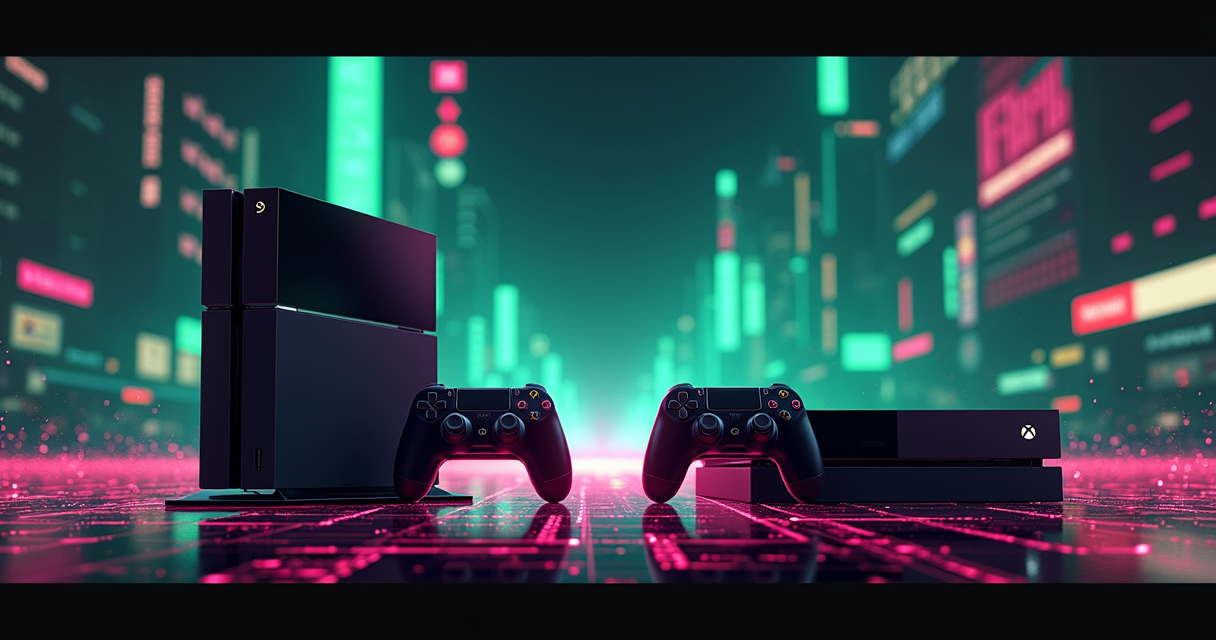
Here is a question that should not survive contact with a calendar: in 2026, with both machines discontinued, their storefronts skeletal, and their successors three years into a victory lap, should you buy a PlayStation 4 or an Xbox One? The honest answer is that nobody at Sony or Microsoft wants you to ask it. Both companies would much prefer you spend $500 on current hardware. And yet the question refuses to die, because a used PS4 remains one of the cheapest doors into a library of generation-defining games, and a used Xbox One is one of the cheapest 4K Blu-ray players on earth that also happens to run roughly six hundred older titles.
So we will treat this the way it deserves: not as a launch-window shootout replayed for nostalgia, but as an autopsy with purchasing advice attached. Two consoles that shipped within a week of each other in November 2013, fought for seven years, and left behind a combined install base larger than most countries. We will tell you which one had the better silicon (it is not close), which one aged into the better deal (closer than the silicon suggests), and which one belongs under your television in 2026. Every number below traces to a real, named source. Where the internet has invented facts about these consoles — and it has, energetically — we will say so out loud.
Why Compare Two Corpses in 2026?
Legacy hardware, not news
Let us establish the basic forensics before anyone gets sentimental. The PlayStation 4 launched on November 15, 2013 at $399.99. The Xbox One launched a week later, on November 22, 2013, at $499 with a mandatory Kinect sensor bolted to the box. Both are now legacy hardware in the truest sense: no new flagship revision since 2017, no current marketing budget, and a software pipeline that has slowed to roster updates for annual sports titles and the occasional cross-gen straggler. There is no 2026 news for these platforms. There are no new exclusives, no firmware that changes the calculus, no surprise price cut from a manufacturer that stopped caring years ago.
This matters because the web is full of "2026" content for these consoles that is simply wrong. If you have seen a freshly-dated list claiming Cuphead or Gears of War 4 as new platform exclusives, close the tab. Cuphead shipped in 2017 from Studio MDHR; Gears of War 4 shipped in 2016 from The Coalition. Those are transcript errors and aggregator hallucinations dressed up with a current year. Nothing new ships for the PS4 or Xbox One. Treat any source that says otherwise as evidence the author never touched the hardware.
What changed since 2016: effectively nothing
The last genuine events in either lineage were the mid-generation refreshes. Sony shipped the PS4 Slim and then the PS4 Pro in 2016. Microsoft shipped the Xbox One S in 2016 and the Xbox One X in 2017. After that, the spec sheets froze in amber: 8GB of unified RAM, mechanical drives ranging from 500GB to 2TB, the same controllers, the same dashboards getting progressively heavier. If you read a breathless 2026 "spec reveal" for these boxes, it is recycling numbers that have not moved since the Obama-to-Trump transition. Precision here is a feature, not pedantry — the entire value of this comparison rests on knowing which frozen numbers actually differ.
Who this is actually for
This article is for the used-market buyer weighing two cheap boxes in a marketplace listing. It is for the parent assembling a starter console that will not require a second mortgage. It is for the retro-curious who wants a physical disc library and does not care that the silicon is a decade old. And it is for the cord-cutter who has quietly realized that an Xbox One S is a competent 4K disc spinner that also plays games. If you instead want to know where these platforms are heading next, that is a different autopsy — the rumored PlayStation 6 timeline and its $599 question is its own separate threat model, and it does not change a single thing about whether you should buy a $130 PS4 this weekend.
The Silicon: 1.84 vs 1.31 TFLOPS
GPU: an 18-versus-12 compute-unit gap
Strip away seven years of marketing and the fundamental story is settled in the GPU. Both consoles used a semi-custom AMD APU built on the same Jaguar CPU and Graphics Core Next GPU architecture, which makes the comparison unusually clean: same family, same era, same fabrication node. The difference is how many graphics resources each company paid for. The PS4 shipped with 18 active compute units producing roughly 1.84 TFLOPS of single-precision throughput. The Xbox One shipped with 12 compute units producing roughly 1.31 TFLOPS. That is a 40% raw graphics advantage for Sony, baked into the hardware on day one, impossible to patch away.
Microsoft tried to compensate with a marginally higher GPU clock (853 MHz against the PS4's 800 MHz), but you cannot clock your way out of a six-compute-unit deficit. The lore here is instructive: the Xbox One's design budget was partly consumed by Kinect and a media-box ambition that Sony never indulged. Sony built a games machine first. Microsoft built a living-room hub that also played games, and the GPU paid the bill.
Memory: GDDR5 unified versus DDR3 plus an ESRAM bandage
The memory architecture is where the gap turns from a lead into a structural advantage. The PS4 used 8GB of unified GDDR5 running at about 176 GB/s — a single fast pool that both CPU and GPU could hammer without ceremony. The Xbox One used 8GB of cheaper DDR3 running at roughly 68 GB/s, then tried to rescue its bandwidth-starved GPU with 32MB of fast on-die ESRAM. ESRAM was clever silicon, but 32MB is a cramped scratchpad, and developers spent the early years fighting it rather than using it. The practical result, as one secondhand-market buying analysis bluntly put it, is that "the Xbox One's DDR3 memory often resulted in lower frame rates or resolution dips" while the PS4's unified GDDR5 simply did not have that problem.
This is the single most important line in the entire comparison. Compute units win benchmarks; memory bandwidth wins shipped games. The PS4 had more of both, and the gap showed up in nearly every cross-platform title for the first two years of the generation.
CPU parity and the full spec table
Credit where it is due: the Xbox One's CPU was actually clocked slightly higher. Both used an 8-core AMD Jaguar, but Microsoft shipped at 1.75 GHz against Sony's 1.6 GHz. In CPU-bound situations that occasionally mattered, which is why the gap narrowed in later, more CPU-heavy games. But a 9% CPU clock edge does not offset a 40% GPU deficit and a 2.5x memory-bandwidth deficit. The table below lays out the whole skeleton.
| Spec | PlayStation 4 | Xbox One | Edge |
|---|---|---|---|
| Launch date & price | Nov 15, 2013 / $399.99 | Nov 22, 2013 / $499 (w/ Kinect) | PS4 |
| CPU | 8-core AMD Jaguar @ 1.6 GHz | 8-core AMD Jaguar @ 1.75 GHz | Xbox One (slight) |
| GPU compute units | 18 CUs (GCN) | 12 CUs (GCN) | PS4 |
| GPU throughput | ~1.84 TFLOPS | ~1.31 TFLOPS | PS4 (~40%) |
| Memory | 8GB unified GDDR5 | 8GB DDR3 + 32MB ESRAM | PS4 |
| Memory bandwidth | ~176 GB/s | ~68 GB/s (DDR3 main pool) | PS4 |
| Storage (launch) | 500GB HDD | 500GB HDD | Tie |
| Typical multiplat res (2013-14) | 1080p / 900p | 900p / 720p | PS4 |
| Disc-based backward compat | None (some digital PS2 classics) | 600+ Xbox 360 / OG Xbox titles | Xbox One |
| VR support | PlayStation VR (2016) | None | PS4 |
| Mid-gen flagship | PS4 Pro: 4.2 TFLOPS, checkerboard 4K | Xbox One X: 6.0 TFLOPS, native 4K | Xbox One X |
| 4K UHD Blu-ray drive | No (not even on Pro) | Yes (One S and One X) | Xbox One |
| Controller power | Built-in rechargeable battery | AA batteries (default) | PS4 |
| Online multiplayer paywall | PlayStation Plus | Xbox Live Gold / Game Pass | Xbox (value) |
| Lifetime sales pace (53 mo.) | 77.49M units | 40.13M units | PS4 |
Performance Reality: 720p vs 900p
Battlefield 4: a 50% pixel gap on day one
Spec sheets are theory. Digital Foundry, the long-running technical-analysis outfit at Eurogamer, turned that theory into frame-counted reality, and their early face-offs are the most-cited evidence of the gap. Take Battlefield 4, a launch-window flagship. The Xbox One version rendered at 1280x720. The PS4 version rendered at 1600x900 — a roughly 50% lead in output pixels. That is not a rounding error. That is the difference between a soft, upscaled image and a noticeably crisper one on the same television.
Resolution was only half of it. In matching sequences, the PS4 also held a frame-rate edge: Digital Foundry measured a constant 2-4fps lead in a directly comparable cut-scene, and the gap widened during heavy effects work like a canister explosion, where the PS4 recovered to 60fps far faster than the fluctuating Xbox One code. Same engine, same developer, same budget — different silicon, measurably different result.
Saints Row, parity, and the slow Xbox climb
The pattern repeated across the early catalog. In Saints Row IV: Re-Elected, Digital Foundry clocked the PS4 at an average of 43.2fps (dipping to a low of 27) against the Xbox One's 38.7fps average (low of 23). Across Call of Duty, Assassin's Creed, and a long tail of third-party releases, the PS4 routinely shipped at higher native resolution while holding equal or better frame rates. The numbers were so lopsided that "parity" became a loaded word: when Assassin's Creed Unity in 2014 launched locked to 900p on both consoles, the gaming press treated it as a scandal and openly speculated that the cap existed to spare Microsoft an embarrassing comparison.
To its credit, Microsoft clawed back ground. As the Xbox One development tools matured and DirectX 12-era techniques arrived, the resolution gap in later cross-platform games narrowed, and by the back half of the generation many titles reached genuine parity. But "caught up by 2018" is a damning sentence when the competitor was ahead from the first disc inserted in 2013.
The mid-gen rematch: PS4 Pro vs Xbox One X
The refresh consoles inverted exactly one part of the story. The PS4 Pro (2016) pushed roughly 4.2 TFLOPS and leaned on checkerboard rendering to approximate 4K. The Xbox One X (2017) pushed a genuine 6.0 TFLOPS with 12GB of GDDR5 and frequently hit native 4K where the Pro reconstructed it. For the only time in the generation, Microsoft owned the performance crown, and it knew it. Xbox chief Phil Spencer declared the One X "the most powerful console ever made," with the tagline "there is no power greater than X."
The lore-aware caveat is that even Spencer hedged the teraflops fixation, noting it is "not just the number of teraflops that makes it powerful" — a reasonable point about memory, bandwidth, and software, and also a convenient one to make after years of losing the teraflops argument with the base hardware. Microsoft's own framing of the One X's specs and ambitions is preserved in Time's launch-day breakdown. The One X was a magnificent machine that arrived a year late, cost $499, and sold a fraction of the units. It won the benchmark and lost the generation.
Libraries: Exclusives vs Backward Compatibility
Sony's first-party stranglehold
If hardware were the whole story, the PS4 would win on a walkover. But consoles are delivery mechanisms for software, and here the two companies chose opposite strategies. Sony bet on first-party exclusives, and that bet defined the generation. The PS4 library accumulated a deep bench of critically dominant, platform-locked titles from Sony's owned studios — the kind of games that sold the hardware on their own and never appeared on a competitor's box. Across the generation, the secondhand-market consensus is blunt: "Sony has historically invested heavily in first-party studios, resulting in a deep catalog of critically acclaimed exclusives unavailable on Xbox."
That catalog is the single strongest argument for buying a PS4 in 2026. It is a fixed, finished, fully-patched library available for pennies on the used disc market, and most of it is forward-compatible with the PS5 if you ever upgrade. You are not buying a dying platform so much as buying permanent access to a closed, complete collection.
Microsoft's 600-game time machine
Microsoft, having lost the exclusives war, leaned into a genuinely excellent compensating feature: backward compatibility. The Xbox One plays a large, curated slice of the Xbox 360 and original Xbox catalogs — Microsoft has enabled over 600 titles from previous generations to run on Xbox One and Series consoles, including 466 of the 989 original Xbox games. The program is free, it works with discs and digital purchases you already own, and many older titles received resolution and performance enhancements on the newer hardware. The full backward-compatible list is exhaustively documented, and the project was formally closed with a final batch of 69 titles on November 15, 2021, timed to the original Xbox's 20th anniversary.
This is the inverse of Sony's strategy and, for a certain buyer, the more compelling one. An Xbox One is not just an eighth-generation console; it is a three-generation Xbox museum in a single box. If your nostalgia points at Halo, Gears, and the 360 era generally, the Xbox One is the cheapest legitimate way to play those discs on a modern television.
The 2026 misinformation tax
A warning, because this comparison is uniquely polluted by bad data. Because both consoles are old and out of the news cycle, the "current" information about them online is disproportionately wrong — auto-generated lists, mistranscribed videos, and aggregators that confidently date 2016-2017 games to 2026. We already buried the Cuphead-and-Gears nonsense above. The same rot infects voice-feature claims (Kinect voice control and Cortana were quietly deprecated years ago, not living 2026 features) and "new" spec reveals that are just 2016 numbers with a fresh timestamp. The practical defense: trust dated primary sources — Digital Foundry frame counts, manufacturer spec pages, VGChartz tallies — and distrust anything that presents a decade-old console as a source of breaking news.
Online, Media, and the 4K Blu-ray Trap
Paywalls: PS Plus, Live Gold, and the Game Pass shadow
Both platforms gate online multiplayer behind a paid subscription — PlayStation Plus on the Sony side, the old Xbox Live Gold (now folded into Game Pass Core) on the Microsoft side. On price and structure they are near-twins, and both bundle a rotating set of "free" monthly titles. The asymmetry is Game Pass: Microsoft's subscription library was the standout value proposition of the late generation, and although its best tiers are built around current hardware, an Xbox One can still tap a meaningful slice of it. For a buyer who wants breadth over ownership, that tilts the subscription math toward Microsoft.
One caveat that has aged into relevance: digital storefronts for both consoles are in slow wind-down. Servers for some older online titles have been retired, and the convenience of buying everything digitally is fading. In 2026, the physical disc is once again the safer bet on both platforms — which, conveniently, is also where the used-market savings live.
The 4K Blu-ray inversion
Here is the most counterintuitive fact in the entire comparison, and it permanently dented Sony's premium pitch. The PS4 Pro — Sony's $399 enthusiast machine — cannot play 4K UHD Blu-ray discs. Its optical drive reads DVDs and standard Blu-rays only; the sole route to 4K video on a Pro is streaming. The cheaper Xbox One S and the Xbox One X both ship with full 4K UHD Blu-ray drives. As GamesBeat put it at the time, the Xbox One S does what the PlayStation 4 Pro will not: play UHD 4K Blu-ray discs.
For a home-theater buyer this is decisive. The Xbox One S, at a $299 launch price, was one of the cheapest 4K UHD Blu-ray players on the market — a function it still performs admirably in 2026, long after its gaming relevance faded. Sony shipping a more expensive "premium" console that downgrades your disc library was, and remains, an own goal.
Controllers, VR, and the peripherals nobody mentions
Two more differentiators that the spec wars tend to bury. First, VR: the PS4 supports PlayStation VR (2016), giving it an entire category of experiences the Xbox One simply never offered. Microsoft flirted with VR and abandoned it; the Xbox One has no headset, full stop. If VR-on-a-budget is even slightly on your radar, this is a PS4-only conversation.
Second, controllers. The DualShock 4 ships with a built-in rechargeable battery, a touchpad, a share button, and a light bar. The standard Xbox One controller, by contrast, defaults to disposable AA batteries — you buy a Play and Charge kit separately or feed it Duracells forever. The Xbox pad is widely praised for ergonomics and trigger feel, so this is a genuine trade rather than a clean win, but "my controller charges off the console" is a quality-of-life advantage that compounds over a decade of ownership. The whole Kinect saga, meanwhile, ended in the landfill: Microsoft stopped manufacturing the sensor in 2017, and the voice-command future it promised never materialized.
The Sales Verdict: 117.63M and a 2:1 Rout
The generational pace, by the numbers
Sales are not a measure of quality, but they are a measure of which bet the market rewarded, and the market was not subtle. The cleanest dataset comes from VGChartz, which tracks each generation against the same point in its lifecycle. As of the March 2025 sales comparison, the PS4 and Xbox One had together sold a combined 117.63 million units at the 53-month mark of their generation — a figure large enough that the current PS5-and-Xbox-Series pairing, at 108.06 million over the same window, still trailed the older duo by 9.57 million units. The eighth generation outpaced the ninth at the equivalent point in time. The dead consoles are, in a strict sense, still winning a race the living ones are running.
PS4 77M versus Xbox One 40M
Within that combined number, the head-to-head is a rout. At the 53-month mark VGChartz logged the PS4 at 77.49 million units against the Xbox One's 40.13 million — a gap of roughly two to one. Lifetime estimates, gathered before both manufacturers stopped reporting precise figures, hold that same ratio: the PS4 finished its run with an install base nearly double its rival's. We have walked through the same brutal arithmetic before in our breakdown of the PS4's $100-cheaper, two-to-one rout, and nothing in the years since has softened it.
Why did Sony win so decisively? Three reasons, all visible above: the PS4 was $100 cheaper at launch, measurably more powerful in every shipped game, and unburdened by the Kinect-and-DRM public-relations catastrophe that opened the generation. Microsoft spent its first year apologizing and reversing policies; Sony spent it shipping discs.
What the install base means for a 2026 buyer
An enormous install base is not an abstraction when you are shopping used. It means the PS4 has more secondhand units in circulation, more cheap used discs, more accessories, and a longer tail of community support and repair parts. The Xbox One's smaller base makes some of its hardware marginally scarcer on the used market, though its backward-compatibility appeal keeps demand specific rather than broad. Practically: the PS4 is the safer liquidity bet if you ever want to resell, and the cheaper-per-game bet if you are building a physical library. The market voted nearly two to one, and the used market still reflects that vote.
Pricing and Availability in 2026
What they cost when they were alive
Pricing is where the generation's defining blunder is most legible. The PS4 launched at $399.99. The Xbox One launched at $499 — a full $100 more — because Microsoft bundled a mandatory Kinect that most buyers did not want. The correction came fast: in 2014 Microsoft released a Kinect-free Xbox One at $399 to match Sony, a reversal documented in CNN's coverage of the price cut. By the time the Slim and S models arrived in 2016, both base consoles had settled around $299, and the enthusiast tiers landed at $399 (PS4 Pro) and $499 (Xbox One X).
The used market, with caveats
Now the part everyone actually wants, with the disclaimer the topic demands: the figures below for 2026 are estimated secondhand street prices, not manufacturer pricing. Nobody sells these new at MSRP anymore; the used market is variable, regional, and condition-dependent. Treat the ranges as a sanity check against a listing, not as gospel. As a rule, a clean PS4 Slim or Pro commands a small premium over the equivalent Xbox One precisely because of that two-to-one demand advantage and the exclusive library behind it. If you are cross-shopping current hardware instead, the same value logic plays out one generation up in our look at the Series X versus Series S $200 gap.
| Model | Launch date | Launch MSRP | Notes |
|---|---|---|---|
| PlayStation 4 (original) | Nov 15, 2013 | $399.99 | 500GB; undercut Xbox by $100 |
| Xbox One (w/ Kinect) | Nov 22, 2013 | $499 | Mandatory Kinect bundle |
| Xbox One (Kinect-free) | Jun 9, 2014 | $399 | Price-matched the PS4 |
| PS4 Slim | Sep 2016 | $299 | Smaller, no other gains |
| Xbox One S | Aug 2, 2016 | $299 | 4K UHD Blu-ray + HDR |
| PS4 Pro | Nov 10, 2016 | $399 | Checkerboard 4K; no UHD disc |
| Xbox One X | Nov 7, 2017 | $499 | Native 4K; 6.0 TFLOPS |
| Used in 2026 (est. street) | — | ~$120-200 PS4 / ~$100-180 Xbox One | Secondhand estimate, NOT MSRP |
Where to actually buy
Skip the impulse marketplace listing with one blurry photo. The healthiest used inventory comes from refurbishers who test and warranty their units, from established trade-in retailers, and from local sellers who will let you power the box on before money changes hands. The lore of used-console buying is unglamorous but real: a $130 console that bricks in a month is more expensive than a $180 console that works for five years. The inspection checklist in the migration section below applies whether you are buying a PS4 or an Xbox One.
Five Real-World Use Cases
Cases 1 and 2: the exclusives machine and the backward-compat shrine
The first and most common case is the exclusives buyer. You want the PS4's deep first-party library at clearance prices, you intend to play physical discs, and you do not care that the hardware is a decade old. Buy a PS4 Slim for the cheapest entry or a PS4 Pro if you have a 4K television and want checkerboard-reconstructed sharpness. This is the single best-supported reason to choose Sony, and it is unanswerable on the Xbox side.
The second case is the mirror image: the backward-compatibility collector. You care about the Xbox 360 and original Xbox catalogs, you own a stack of old discs, and you want one box that plays three generations. The Xbox One — ideally an One S or One X for the resolution enhancements — is the only console here that does this. Six hundred-plus titles, free, on discs you already own. For this buyer, the PS4's lack of disc-based backward compatibility is a dealbreaker, and the comparison ends immediately.
Cases 3 and 4: the kid's console and the media box
The third case is the secondary or child's console. You want a cheap, durable box for a kid's room or a guest setup where a $500 current-gen machine would be reckless. Either console works, but the PS4's larger used base means cheaper games and easier replacement, and the DualShock 4's built-in battery means no endless AA resupply. Lean PS4 unless your household already lives in the Xbox ecosystem.
The fourth case is the cord-cutter's media box. You want a cheap, capable 4K UHD Blu-ray player that also plays games as a bonus. This is an Xbox One S or One X, full stop — the PS4 Pro's missing UHD drive disqualifies Sony entirely. If your PS4 is instead going to serve as a streaming-to-another-room source, that is a different feature set, and our walkthrough of getting PS Remote Play to clean 1080p covers exactly how to push a PS4 signal to a phone, tablet, or PC.
Case 5: the capture and streaming rig
The fifth case is the retro streamer or archivist. You want to capture footage from a legacy library — old multiplayer sessions, exclusive playthroughs, a backward-compatible 360 game that never got a remaster. Both consoles output clean HDMI that a capture device can ingest, and the workflow is identical to the modern one; our capture-card guide for 1080p60 applies almost verbatim to a PS4 or Xbox One source, minus the HDCP headaches on certain protected apps. For an archivist, the Xbox One's backward-compatible catalog is the more interesting capture target; for a highlight-reel streamer, the PS4's exclusive library is the bigger draw. Either way, the decade-old hardware is perfectly adequate as a video source.
Pros and Cons, Tabulated
PlayStation 4: where it wins and bleeds
The PS4 is the stronger console on raw merit and the safer buy for most people. Its weaknesses are real but narrow: no disc-based backward compatibility, no 4K UHD Blu-ray even on the premium Pro, and aging mechanical storage that benefits enormously from an SSD swap. The strengths are the things that actually defined the generation.
| PS4 Pros | PS4 Cons |
|---|---|
| ~40% stronger GPU (1.84 vs 1.31 TFLOPS) | No disc-based backward compatibility |
| Unified GDDR5 = higher res, steadier frames | PS4 Pro cannot play 4K UHD Blu-ray discs |
| Deep, exclusive first-party library | Slower stock HDD (SSD upgrade advised) |
| PlayStation VR support | Smaller bundled subscription value than Game Pass |
| Controller charges off the console | Forward-compat with PS5, but you may just upgrade |
| Larger used base = cheaper games & resale | Digital storefront winding down |
Xbox One: where it wins and bleeds
The Xbox One lost the generation on the numbers, but it aged into a specialist's machine with two genuinely best-in-class features: backward compatibility and 4K disc playback. If your use case lands in its lane, it is the correct choice despite the weaker silicon.
| Xbox One Pros | Xbox One Cons |
|---|---|
| 600+ backward-compatible 360 / OG Xbox games | ~40% weaker GPU than the PS4 |
| 4K UHD Blu-ray on One S and One X | DDR3 + ESRAM caused early res/frame dips |
| Xbox One X: native 4K, 6.0 TFLOPS | Thin first-party exclusive library |
| Game Pass access for breadth | Controller uses disposable AA batteries by default |
| Slightly higher CPU clock (1.75 GHz) | No VR support, ever |
| Excellent controller ergonomics | Sold ~half the PS4's units; smaller community |
Migration Guide: Switching Camps
What does and does not transfer
Suppose you are jumping ship — selling an Xbox One to buy a PS4, or vice versa. Set expectations first, because the cross-platform reality is harsh: almost nothing transfers between these two walled gardens. Your game licenses do not move. Your save files do not move. Your friends list does not move. Your subscription does not move. The platforms were designed to be incompatible, and a decade later that has not changed. What you are really doing is starting fresh on the new platform and salvaging what little is portable.
What does survive is narrow. Cross-platform accounts for individual games — anything tied to a publisher login like an EA, Ubisoft, or Epic account — will carry your progress in those specific titles across the divide. Cross-progression is a per-game feature, not a platform one, so check each title individually. Physical discs are platform-locked and worthless on the other console, so factor their resale into your switching math.
The step-by-step
The actual switch is less a technical procedure than a disciplined handoff. Do it in order:
- On the outgoing console, link any publisher accounts (EA, Ubisoft, Epic, etc.) and confirm cross-save is enabled for every game that supports it.
- Back up your saves to cloud storage or a USB drive while you still can — even though they will not load on the new platform, you may return to the old one.
- Note your digital library. You are abandoning it; price the loss honestly before you sell.
- Fully sign out and deactivate the console as your primary device, then perform a factory reset (this protects the buyer and your account).
- Sell the old hardware and discs to fund the new platform. The two-to-one demand gap means a PS4 generally liquidates faster than an Xbox One.
- On the new console, create or sign into your account, re-link the same publisher accounts, and recover the per-game progress that survived.
- Rebuild your subscription and re-download or re-buy the games you cannot live without.
Inspect-before-you-buy checklist
Whether you are switching or buying your first legacy box, never hand over money for a used console you have not tested. Run this checklist on the unit before you commit:
USED CONSOLE PRE-PURCHASE CHECKLIST
-----------------------------------
[ ] Power on cold  -> reaches dashboard in < 60s
[ ] Disc drive     -> insert + eject a game disc twice
[ ] Fan noise      -> steady hum, NOT grinding/rattling
[ ] HDMI out       -> clean 1080p/4K signal, no flicker
[ ] Controller     -> both sticks center, zero drift
[ ] Storage        -> Settings: confirm advertised size + free space
[ ] Account        -> seller fully signed out + factory reset done
[ ] Console ID      -> not flagged on a stolen/banned list
[ ] Heat test      -> run a game 20 min, no thermal shutdown
[ ] Ports          -> USB + power jack snug, no wobble
The law-and-lore footnote: a factory-reset, deactivated console is non-negotiable. If a seller cannot or will not deactivate their account and wipe the device, walk away — you are either buying a brick locked to someone else's login or, worse, stolen hardware that may be banned from online services entirely.
The Verdict: Who Actually Won
On raw merit: PS4, decisively
Let us not pretend the data is ambiguous. On hardware, the PS4 won every meaningful round of the base-console fight: a ~40% stronger GPU, more than double the usable memory bandwidth, higher native resolutions in nearly every cross-platform game for the first two years, and Digital Foundry frame counts to prove it. On software, Sony's exclusive library is the deepest argument any console made all generation. On sales, the market ratified all of it with a roughly two-to-one rout — 77.49 million PS4 units to 40.13 million for the Xbox One at the 53-month mark. If someone hands you both consoles and asks which is better, the answer is the PS4, and it is not particularly close.
On value and longevity: closer than the silicon
But "better console" and "better buy for you" are different verdicts, and this is where the Xbox One earns its keep. The Xbox One is the only machine here that plays 600-plus backward-compatible discs and the only one that doubles as a cheap 4K UHD Blu-ray player. For a retro collector or a home-theater buyer, those two features outweigh every teraflop Sony banked. The Xbox One X, specifically, remains a legitimately powerful native-4K box that you can now buy for a fraction of its $499 launch price. Microsoft lost the war and built a better museum, and museums age well. The same divide-by-use-case logic governs the current generation too, which is why the modern Xbox tier war rhymes so neatly with this one.
The one-line recommendation
Here is the decision tree, compressed:
WHICH 2013 CONSOLE? (2026 EDITION)
   |
   +- Strongest first-party library? ---------> PS4 (Slim/Pro)
   |
   +- Play Xbox 360 / OG Xbox discs? ---------> Xbox One (S/X)
   |
   +- Cheap 4K UHD Blu-ray player? -----------> Xbox One S/X
   |
   +- VR on a budget? ------------------------> PS4 + PSVR
   |
   +- Max native-4K fidelity for the gen? ----> Xbox One X
   |
   +- Cheapest path to great games? ----------> PS4 Slim
For the broadest possible buyer — someone who wants the best games at the lowest price with the safest resale — buy a used PS4 Slim or Pro. It won the generation on merit and on math, and the used market still reflects that. Choose the Xbox One S or X only when your specific need is backward compatibility or 4K disc playback, in which case it is not a consolation prize but the correct tool. And if neither of those use cases fits, the honest verdict is the one Sony and Microsoft would both endorse for once: skip the autopsy, save your money, and put it toward current hardware. These two consoles fought a real war in 2013. In 2026 they are bargains, not battlegrounds — buy accordingly.
Questions the search bar asks me
- Is the PS4 or Xbox One more powerful?
- The PS4, clearly. Its GPU pushes ~1.84 TFLOPS across 18 compute units versus the Xbox One's ~1.31 TFLOPS across 12 — about 40% more graphics throughput — plus 176 GB/s of unified GDDR5 against the Xbox One's 68 GB/s DDR3. Digital Foundry measured the real-world result: Battlefield 4 ran at 900p on PS4 versus 720p on Xbox One, a ~50% pixel advantage.
- Which sold more, the PS4 or the Xbox One?
- The PS4, by roughly two to one. VGChartz logged the PS4 at 77.49 million units against the Xbox One's 40.13 million at the 53-month mark of the generation (March 2025 data). Combined, the PS4 and Xbox One reached 117.63 million units — still ahead of the PS5/Xbox Series pace of 108.06 million at the same point.
- Can the Xbox One play Xbox 360 games?
- Yes. Microsoft enabled over 600 backward-compatible Xbox 360 and original Xbox titles on Xbox One, including 466 of 989 original Xbox games. It is free and works with discs or digital copies you already own. The program closed with a final batch of 69 titles on November 15, 2021. The PS4 has no disc-based backward compatibility.
- Does the PS4 Pro play 4K Blu-rays?
- No. The PS4 Pro's optical drive reads only DVDs and standard Blu-rays; 4K video on the Pro is streaming-only. The Xbox One S and Xbox One X both include full 4K UHD Blu-ray drives, which is why the $299 Xbox One S doubled as one of the cheapest UHD disc players on the market while Sony's $399 Pro could not play a single 4K disc.
- Is it worth buying a PS4 or Xbox One in 2026?
- As a cheap secondary, retro, or media box, yes; as a primary console, no. Both are frozen at 2017-era specs, run modern ports at 900p-1080p with frame dips, and many new games skip them entirely. Buy used at roughly $100-200 (estimated street price, not MSRP) for the library or backward compatibility, not for current-gen gaming.

Ben covers the hardware end of retro gaming: FPGA cores, real-cartridge dumping, capture setups, CRT vs scaler workflows, and the legal and physical preservation infrastructure that keeps old games playable. Every post under this byline is reviewed pre-publish by Sam P., Editor & Operator — corrections to info@instalinkoteam.com. Published 2026-08-29 · Last updated 2026-08-29. Full bios on the author page.