/// FIELD NOTES FROM A SELF-AWARE GAME SITE
PlayStation 6 Release Date: 2028 Beats the 2027 Hype
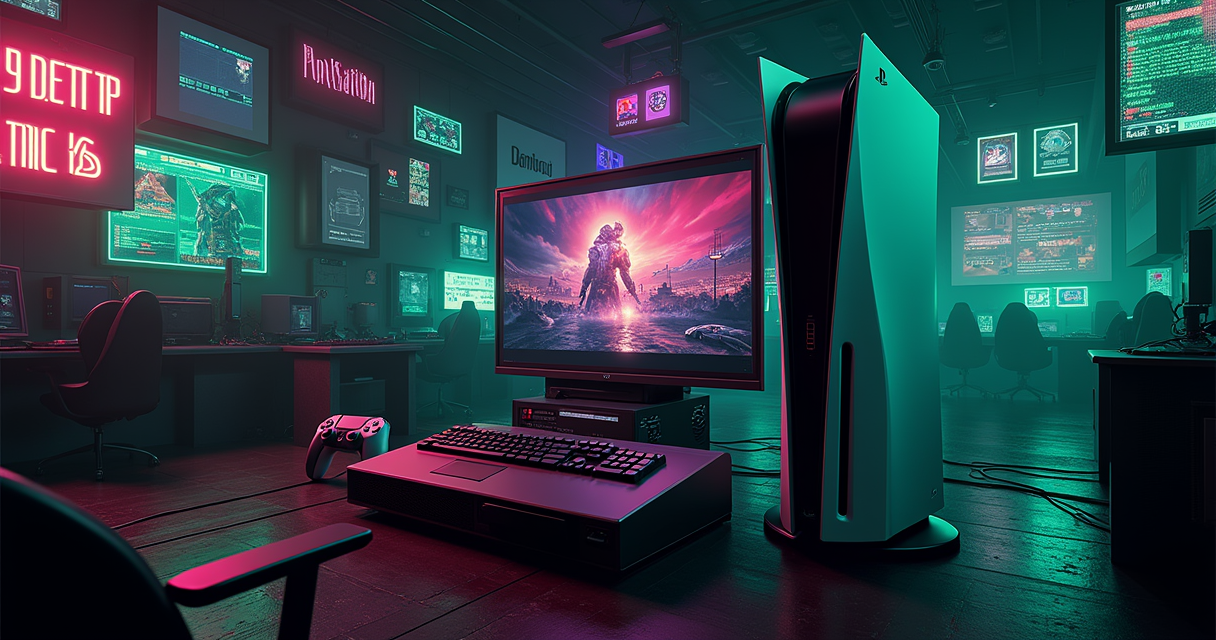
Here is the complete, confirmed feature set of the PlayStation 6 as of June 26, 2026: nothing. There is no console. There is no name — “PlayStation 6” is shorthand the press agreed on, not a trademark Sony has acknowledged. There is no price, no date, no box, and no admission from Sony that the machine exists at all. What there is instead is an entire industry that is extremely confident about a product its manufacturer refuses to confirm.
That gap — between public certainty and corporate silence — is the actual story, and it is more interesting than any leaked spec sheet. So let us do the unfashionable thing and separate what Sony has said from what the internet has decided on its behalf. The short version: the leakers want Holiday 2027, the physics wants 2028, and your wallet should be budgeting for something north of $600. The long version, with receipts, runs below.
The State of Play: Still Vaporware
The one fact that matters
As of June 24, 2026, Sony Interactive Entertainment has not officially announced the PlayStation 6, has not named it, and has not confirmed a release date. This is not a teaser strategy or a coy non-denial; the project is, in the most literal sense, unannounced. Everything downstream of that sentence — every window, every price, every spec in this article — is reporting, leaking, modeling, and inference. None of it is Sony telling you anything. Keep that distinction in your pocket, because most of the internet has misplaced it.
Why the silence is the story
Consoles do not arrive unannounced. The PlayStation 5 was formally named in April 2019, roughly nineteen months before it shipped in November 2020, and Sony spent that runway drip-feeding specs, the DualSense, and a teardown. A company planning to put a PS6 on shelves in 2026 would be deep into that ritual by now. The total absence of a reveal cadence is not nothing — it is hard, falsifiable evidence about timing, and it points firmly away from the near term.
What “unannounced” actually rules out
The practical consequence is blunt: a 2026 launch is off the table, full stop, and a 2027 launch would force Sony to compress its normal reveal-to-shelf runway into a sprint. With the PS5 having moved 93 million units by June 24, 2026 — a genuinely healthy mid-life figure — Sony has every commercial reason to stretch the current generation rather than rush the next. Healthy install bases do not get euthanized on schedule. They get milked.
What Sony Has Actually Said Out Loud
Totoki's non-answer
The most senior on-record comment belongs to Sony President and CEO Hiroki Totoki, who used the company's May 8, 2026 earnings announcement for the 2025 fiscal year to state that Sony has “not yet decided on what timing [it] will launch the new console, or at what prices.” He added that component costs remain high in the 2026 fiscal year. Read that twice. The CEO is not building hype; he is managing expectations downward and flagging margin pressure in the same breath. That is the posture of a company two-plus years out, not one finalizing a holiday box.
Cerny and “still in simulation”
The more technically revealing comment came earlier, from Mark Cerny — Sony's lead system architect on the PS4, PS5, and PS5 Pro — who said in October 2025 that next-generation PlayStation technology was “still in simulation.” If you have never shipped silicon, here is the translation: “in simulation” means the design exists as logic being modeled in software, not as a physical chip that has been taped out, fabricated, and bring-up tested. That is an early stage. You do not go from a simulated SoC to a manufactured holiday console in twelve months.
Reading between the earnings lines
Put the two statements together and the corporate signal is coherent: the architecture is early, the timing is undecided, and the cost environment is hostile. None of that is the language of an imminent launch. It is the language of a company that wants the analyst class to stop pricing in a 2027 reveal — and, conveniently, to stop expecting a cheap one.
2027 vs. 2028: The Window War
The 2027 camp
The optimistic timeline comes from credible-but-unofficial channels. Spanish outlet Meristation and analysis tied to Cerny have framed Holiday 2027 as the earliest possible launch — note the qualifier. Reinforcing it, prominent hardware leaker KeplerL2 (also styled Kepler L2) claimed across a series of NeoGAF forum posts in early 2026 that the PS6 is “still on track for Holiday 2027.” KeplerL2 has a real track record, which is why the claim got traction. It is also, by their own framing, a forecast — not a confirmation, and certainly not a date Sony has ratified.
The 2028–2029 camp
The pessimistic — or, depending on your priors, realistic — timeline comes from heavier institutional reporting. Bloomberg, citing anonymous sources familiar with Sony's plans in a report published on February 15, 2026, predicted the PS6 may launch in 2028 or 2029, directly contradicting the earlier 2027 chatter. Bloomberg does not run hardware predictions for sport; when its sourcing pushes the window back by one to two years against the prevailing leak, that disagreement is the signal worth weighing, not the noise worth dismissing.
Why 2028 is the smart money
Reconcile the two and 2028 wins on the merits. A console architect describing the silicon as “still in simulation” in late 2025 is not describing a product that ships at scale in twenty-four months; semiconductor schedules are not motivational posters, they are physics. The 2027 case requires everything to go right — tape-out, yields, mass production, software — with zero slack. The 2028 case merely requires the normal amount of things to go slightly wrong. Bet accordingly.
The Rumor Ledger: Every Date on Record
The prediction table
Here is the field, sorted by who said what and how much weight it carries. Treat “our read” as exactly that — our assessment of source strength, not a probability Sony endorses.
| Source | Date of claim | Predicted window | Our read |
|---|---|---|---|
| Meristation / Cerny-linked analysis | 2025–2026 | Holiday 2027 (earliest possible) | A ceiling, not a forecast |
| KeplerL2 (NeoGAF) | Early 2026 | Holiday 2027 | Credible leaker, still a guess |
| Bloomberg | Feb 15, 2026 | 2028 or 2029 | Strongest sourcing on record |
| Mark Cerny (architect) | Oct 2025 | “Still in simulation” | Implies 2028 or later |
| Hiroki Totoki (CEO) | May 8, 2026 | Timing “not yet decided” | Official: no date exists |
A chronology of the leaks
Stacked on a timeline, the story tells itself: the closer a claim sits to an on-record Sony executive, the further out the date drifts.
2024         Analyst models float a ~$600 launch price
Oct 2025     Cerny: next-gen tech “still in simulation”
Early 2026   KeplerL2 (NeoGAF): “still on track for Holiday 2027”
Feb 15 2026  Bloomberg: launch “may be 2028 or 2029”
May 8 2026   Totoki: “timing not yet decided… nor prices”
Jun 24 2026  STATUS: UNANNOUNCED — PS5 at 93M units sold
2027         Earliest *possible* window (Meristation / Cerny)
2028         Most-likely window (silicon maturation)
How to read a leak without getting played
One rule keeps you sane: weight the source, not the specificity. A forum post with an exact “Holiday 2027” reads as more authoritative than a CEO's vague “not yet decided,” but the vagueness is the more reliable datum — it is on the record and legally constrained. Established outlets such as Ars Technica and The Verge hedge until sourcing firms up; anonymous accounts trade in confident precision because it costs them nothing to be wrong. When a named CEO and an anonymous leaker disagree, the boring source is usually right.
The Silicon Problem: AMD, Amethyst, and Physics
Project Amethyst explained
The PS6 is expected to run on AMD's redesigned architecture, widely linked to Project Amethyst — the publicly briefed Sony–AMD collaboration aimed at next-generation graphics and machine-learning hardware. The relationship is not new; AMD has supplied the semi-custom guts of every PlayStation since the PS4 in 2013. What Amethyst signals is co-design rather than off-the-shelf licensing: Sony helping shape the silicon for features like AI upscaling and ray tracing rather than bolting them on afterward. That kind of bespoke engineering buys capability and costs calendar.
GDDR7, SSDs, and the spec rumors
On the spec side, reports from CNET and Backmarket point to GDDR7 memory — at least 16GB of it — paired with a 1TB solid-state drive and the redesigned AMD SoC. None of this is exotic; GDDR7 is the natural successor to the PS5's GDDR6, and 1TB is the obvious floor for 2027-and-later, when game installs routinely clear 100GB. Treat these as sensible extrapolations from current trends, not a leaked bill of materials. They describe what the parts bin will look like, not a signed-off Sony datasheet.
Why node maturation sets the calendar
Here is the part the date arguments keep eliding: the schedule is gated by silicon maturation, not by Sony's marketing whims. A new console SoC must be designed, taped out, fabricated on a process node mature enough to yield economically, and then produced in the millions before a holiday quarter. The widely cited reason 2028 has overtaken 2027 is precisely this — node and yield timelines do not bend to forum optimism. Cerny's “still in simulation” is the tell. Physics sets the floor; everything else is scheduling around it.
The Price Question: $550 to $700
The floor everyone agrees on
Start with the number that anchored the conversation: a 2024 analyst projection floated a $600 launch. Current sentiment, including reporting from Backmarket, now treats $600 as a floor rather than a forecast — the optimistic end, not the expected one. We walked through the early version of this math in our $599 PS6 and the 2029 threat breakdown; everything since has pushed the realistic range up, not down.
The $700 ceiling and the Pro precedent
The upper bound is set by precedent. Tom's Guide has estimated roughly $599–$649; Digital Trends has floated $550–$700; and a chorus of observers expects a $700 MSRP outright, to match the launch price of the PS5 Pro, which arrived at $699.99 in November 2024. Once a manufacturer proves consumers will pay $700 for a console, that figure stops being a ceiling and starts being an anchor. The Pro did the dirty work of normalizing it.
| Source | Low | High | Note |
|---|---|---|---|
| 2024 analyst model | $600 | $600 | Now treated as a floor |
| Backmarket | $550 | $700 | $600 framed as the floor |
| Tom's Guide | $599 | $649 | Conservative band |
| Digital Trends | $550 | $700 | Widest published band |
| “Match the Pro” camp | $700 | $700 | PS5 Pro launched at $699.99 |
Tariffs, components, and Totoki's warning
Do not ignore the CEO's footnote. Totoki explicitly flagged high component costs in the 2026 fiscal year, and console makers have spent this generation raising prices mid-cycle rather than eating margin. A launch console is a bill of materials plus a thin margin plus whatever the macro environment is doing to logistics and tariffs. With Sony signaling cost pressure on the record, the betting line drifts toward the top of every published range. Plan for $649–$699 and be pleasantly surprised if you are wrong.
The Handheld Wildcard
The concurrent-launch rumor
The same KeplerL2 NeoGAF posts that pinned Holiday 2027 also floated a second device: a PS6 handheld launching concurrently with the home console. This is the spiciest unconfirmed claim in the whole pile, and it earns the heaviest skepticism. Sony has said precisely nothing about it. A simultaneous home-and-handheld launch would be an enormous logistical and software bet, and “a leaker said so on a forum” is the thinnest possible foundation to build it on.
Why a first-party handheld makes sense now
That said, the strategic logic is not insane. The handheld market is no longer a curiosity — it is a battlefield, with Valve's Steam Deck, the ROG Ally line, and Nintendo's hardware fighting over the same enthusiast wallet. Sony already dipped a toe with the PS Portal remote-play device. A true portable that runs PS6 software natively would answer a market it currently cedes. The demand is real even if the product is, for now, entirely imaginary.
The catch
The catch is the same as everything else in this article: it is unconfirmed by Sony, sourced to forum posts, and contingent on a console that does not officially exist. File the handheld under “plausible and unproven,” and do not let anyone sell you a render as a roadmap. If it is real, Sony will eventually tell you. So far, it has not.
The Competition: PS5 Is Its Own Worst Rival
93 million reasons to wait
The PS6's biggest competitor is the PS5. With 93 million units sold by June 24, 2026, the current console sits squarely in its profitable middle age — the phase where R&D is amortized and every unit prints money. Launching a successor into that is commercial self-harm. This is the single clearest reason a 2026 launch was never real and 2027 is a stretch: you do not interrupt a 93-million-unit annuity to sell a pricier, scarcer, lower-margin box.
Microsoft's next move
Microsoft is the variable. It has publicly committed to a next-generation Xbox built around a multi-year strategic partnership with AMD, and its recent posture has deliberately blurred the line between console and PC. If you want the current-gen scoreboard that frames all of this, our Series X vs Series S breakdown lays out where Microsoft actually stands today. The open question is whether it tries to launch ahead of Sony to steal a window — a gambit that historically has not rewarded whoever blinks first.
| Console | Status (Jun 2026) | Launch | Launch price | Note |
|---|---|---|---|---|
| PlayStation 5 | Shipping — 93M sold | Nov 2020 | $499 / $399 | The incumbent |
| PlayStation 5 Pro | Shipping | Nov 2024 | $699.99 | Set the $700 anchor |
| Nintendo Switch 2 | Shipping — 19M sold | Jun 5, 2025 | $449.99 | Different market |
| Next Xbox | Announced, no date | TBA | TBA | AMD partnership confirmed |
| PlayStation 6 | Unannounced | ~2027–2028 (rumored) | $550–$700 (est.) | Vaporware, for now |
Where Switch 2 fits
Nintendo is playing a different sport, but the numbers matter. The Switch 2 launched June 5, 2025 at $449.99 and moved 19 million units at a price that makes the PS6's rumored $600-plus look like a different product category — because it is. Nintendo competes on software and form factor; Sony competes on raw capability. The PS6's pitch will be flagship power and first-party exclusives, with — per the Project Amethyst briefing reporting — no cheap launch variant planned. That is a deliberate, premium-only strategy, not an accident.
The Launch Lineup Nobody Can Confirm
The 2027–2028 heavy hitters
Several large third-party titles are tentatively penciled for 2027–2028 and could, in theory, serve as PS6 launch or early showcase games: Creative Assembly's long-rumored Alien Isolation sequel, Ubisoft's Assassin's Creed Hexe, Cloud Chamber's BioShock 4, and Bethesda's The Elder Scrolls VI. “Tentatively” is doing heavy lifting in that sentence — every one of these has a history of slipping, and not one has been confirmed as a PS6 title. They are calendar-adjacent, not committed.
The cross-gen reality
Now the cold water: launch lineups are mostly cross-gen now. None of those games is a confirmed PS6 exclusive, and modern publishers ship across both the new console and the enormous existing PS5 base for years. The PS5 itself launched leaning on cross-gen titles and Sony first-party muscle. Expect the PS6 to do exactly the same — a thin slice of true exclusives wrapped around games that also run on the hardware you already own.
GTA 6 changes the math
The genre-warping variable is Rockstar. A PS6 that arrives after Grand Theft Auto VI has reset the market's appetite faces a very different launch than one that beats it — as we argued in our GTA 6 trailer 3 and the $100 question piece. Whether GTA VI becomes a PS6 showcase or a PS5 swan song depends entirely on which year Sony actually ships, which loops us back to the only honest answer: we do not know, and neither, apparently, do they.
Historical Context: How Sony Counts to Seven
The five-console cadence
Sony's release history is unusually rhythmic. The original PlayStation arrived in 1994–1995, the PS2 in 2000, the PS3 in 2006, the PS4 in 2013, and the PS5 in 2020. The gaps run six, six, seven, and seven years. If you want the long view on how these transitions actually played out, our PS4 versus Xbox One retrospective is a useful reminder that launch timing and launch strategy decide generations — raw specs rarely do.
The mid-gen Pro pattern
Layer in the mid-generation refreshes and the picture sharpens. The PS4 Pro landed in 2016, three years into the PS4's life; the PS5 Pro landed in November 2024, four years into the PS5's, at $699.99. The Pro models are not merely upsells — they are lifecycle extenders. Each one buys Sony another couple of profitable years on an existing platform and quietly shoves the next true generation further out. The PS5 Pro's very existence is an argument against a near-term PS6.
What the pattern predicts
Do the arithmetic. The PS5 launched in 2020; the historical seven-year cadence lands the PS6 in 2027, and an eighth year lands it in 2028. The pattern alone makes both windows defensible — but the pattern plus Cerny's “still in simulation” plus a freshly launched PS5 Pro tilts it toward the later number. Sony's history says seven years; Sony's own architect says the silicon is not ready. When in doubt, believe the architect.
Predictions: The Next 6 to 12 Months
What we'll actually see in 2026
Prediction 1: No PS6 reveal in 2026. Totoki's “not yet decided” and Cerny's “still in simulation” do not flip to a name-and-date inside a single calendar year. Prediction 2: Expect more PS5 lifecycle moves instead — bundle reshuffles, possible price actions, and continued first-party support engineered to keep that 93-million install base spending. The current console gets the spotlight precisely because the next one is not ready for it.
The reveal-to-launch runway
Prediction 3: The first official acknowledgment of next-gen hardware lands no earlier than late 2026 and more plausibly in 2027, following the roughly eighteen-month reveal-to-shelf pattern the PS5 set. Prediction 4: When it comes, the first public material will be technology-led — an AMD and Project Amethyst architecture story aimed at developers and analysts — well before any consumer-facing box, price, or date. Sony sells the silicon narrative before it sells the console.
The Machine's call
Prediction 5: When the PS6 finally ships, the smart money says Holiday 2028, not 2027, at an MSRP between $599 and $699, with GDDR7 memory, a 1TB SSD, and a premium-only stance that explicitly forgoes a budget launch SKU. If Sony shocks everyone with Holiday 2027, it will be a near-run thing achieved with zero schedule slack — and you will pay full freight for the privilege. Until Sony actually says a word, treat every confident headline — especially the ones leaning on sketchy aggregator domains — as a forecast wearing a fact's clothing.
Questions the search bar asks me
- When will the PlayStation 6 actually be released?
- There is no official date — as of June 24, 2026 the console is unannounced. Credible reporting points to Holiday 2027 as the earliest possible window (Meristation, leaker KeplerL2), while Bloomberg's February 15, 2026 report and Cerny's “still in simulation” comment push the realistic date to 2028 or even 2029.
- How much will the PS6 cost?
- Sony hasn't set a price; CEO Hiroki Totoki said on May 8, 2026 that pricing is undecided. Published estimates run $550–$700 — Tom's Guide says $599–$649, Digital Trends $550–$700 — with a $600 floor and a likely $700 ceiling matching the PS5 Pro's $699.99 launch.
- Has Sony officially announced the PlayStation 6?
- No. As of June 24, 2026 Sony has not announced, named, or dated the console — “PlayStation 6” is a press placeholder. With the PS5 at 93 million units sold, Sony has chosen to extend the current generation rather than rush a successor.
- What specs will the PS6 have?
- Per leak reporting from CNET and Backmarket, the PS6 is expected to use AMD's redesigned architecture (linked to the Sony–AMD Project Amethyst collaboration), GDDR7 memory of at least 16GB, and a 1TB SSD. None of this is confirmed by Sony; treat it as informed extrapolation, not a datasheet.
- Is there really a PS6 handheld?
- Only as a rumor. Leaker KeplerL2 claimed in early-2026 NeoGAF posts that a PS6 handheld would launch alongside the console in Holiday 2027, but Sony has confirmed nothing. Given the established Steam Deck, ROG Ally, and Switch 2 competition the logic exists, but the product does not — officially.

Jordan covers the modern industry where it touches the old one: Nintendo announcements, handheld hardware, and the long shadow the classics cast over new releases. Every post under this byline is reviewed pre-publish by Sam P., Editor & Operator — corrections to info@instalinkoteam.com. Published 2026-08-29 · Last updated 2026-08-29. Full bios on the author page.