/// FIELD NOTES FROM A SELF-AWARE GAME SITE
PS5 vs Xbox Series X 2026: $100 Cheaper, Sony Wins
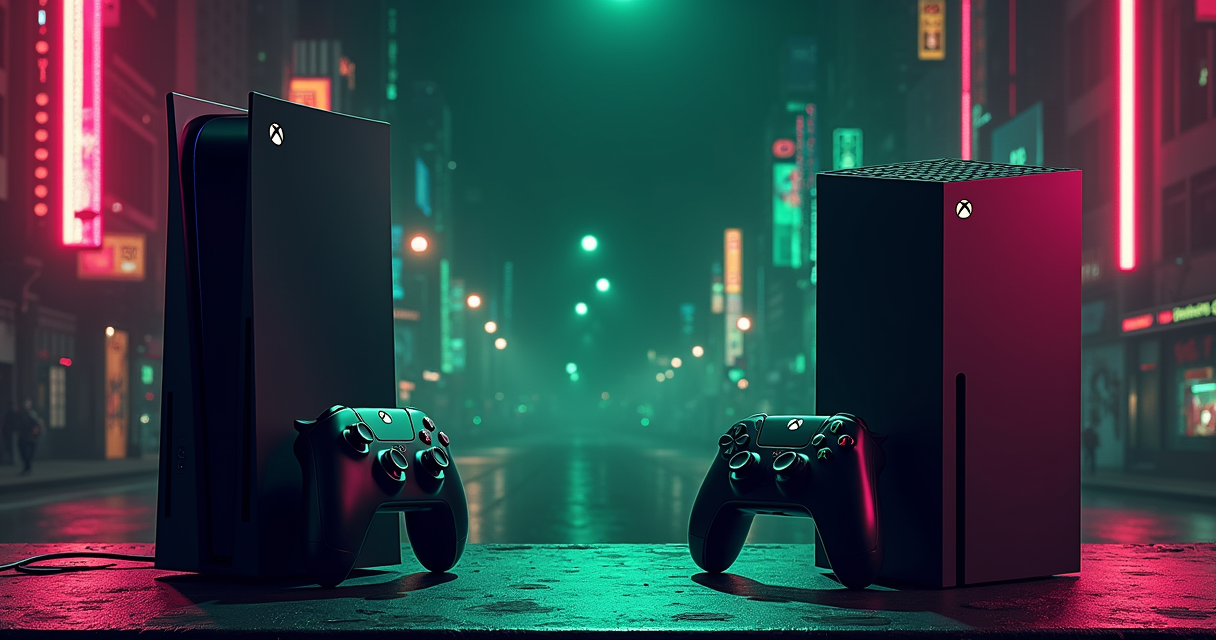
There is a version of this comparison that fits in one sentence: the Xbox Series X has more teraflops, the PlayStation 5 is a hundred dollars cheaper, buy the cheaper one. That version is not wrong. It is just useless, because it explains nothing about why the more powerful box spent five years losing its own benchmark face-offs, why Microsoft quietly shipped the best preservation machine of the generation and then barely mentioned it, or why the single most important number on either spec sheet is the one neither company prints on the carton.
So here is the longer version. We are going to put both consoles on the table, take the screws out, and read every number that matters in 2026 — the $100 gap at the flagship tier, the 1.9-teraflop lead that mostly evaporates on contact with real software, the SSD throughput difference that is the only genuinely lopsided spec in the whole fight, and the backward-compatibility chasm that runs in the exact opposite direction to everything else. Then we will tell you which one to buy, and — more usefully — the three specific cases where that answer flips.
A note on sourcing before we start, because this genre is swamped with invented benchmarks. Every hardware figure below traces to a published spec sheet or a named outlet. The performance claims come from Digital Foundry's multiplatform testing; the price and storage numbers from retail listings; the architecture quotes from the people who actually designed the silicon. Where we do not have a number, we say so instead of inventing one. That last rule eliminates roughly ninety percent of the console-comparison internet.
The Headline Numbers
Three numbers decide this comparison, and two of them are misunderstood almost universally. Get these straight and the rest of the article is commentary.
The $100 that is actually real
At the flagship tier in 2026, the standard PlayStation 5 with a disc drive sells for $549.99 in the United States. The Xbox Series X with a disc drive sells for $649.99. That is a flat $100 difference, and unlike most spec-sheet gaps, this one does not shrink when you look closer — a dollar is a dollar at the register. Sony is the cheaper flagship, full stop.
This is the cleanest, least disputable fact in the entire comparison, which is precisely why it gets buried under teraflop arguments. People who have already spent the money would rather debate compute units than admit the deciding factor was the price tag. But for the overwhelming majority of buyers walking into a store with one console-shaped hole in the budget, $100 is not a rounding error. It is a year of online service, or two new releases, or the difference between buying now and waiting.
It also reverses the launch-day picture. Both consoles arrived in November 2020 at an identical $499, Sony Interactive Entertainment and Microsoft Gaming locked at the same number. Five years of inflation, revisions, and pricing strategy later, Sony is $100 under and Microsoft is $150 over that original line. If you tracked the same dynamic last generation — we did, in our PS4-versus-Xbox-One retrospective — you will recognize the pattern. Sony keeps winning the price column, and the price column keeps mattering more than the forums admit.
The 1.9 teraflops that mostly is not
The Xbox Series X delivers 12.155 TFLOPs of GPU compute from a custom AMD RDNA 2 design with 52 compute units running at a fixed 1.825 GHz. The PlayStation 5 delivers 10.28 TFLOPs from the same RDNA 2 family using 36 compute units at a variable clock that boosts up to 2.23 GHz. On paper, that is a roughly 18 percent compute advantage for Microsoft, and Microsoft was entirely correct to call the Series X the more powerful box. It is.
The problem is the word “powerful” doing work nobody checks. A teraflop is a theoretical peak — floating-point operations per second under ideal, fully-occupied conditions that real game engines almost never sustain. Two GPUs with identical teraflop counts can perform very differently depending on clock speed, cache behaviour, memory contention, and how the work is scheduled. The PS5 trades compute units for frequency: fewer cores, spinning faster. Higher clocks accelerate the parts of rendering that do not parallelize cleanly — rasterization, geometry, the front end of the pipeline — which is exactly where raw teraflop counts stop predicting outcomes.
The result is a gap that exists in the spec sheet and largely dissolves in the games, a point we return to with data below. Hold onto the 1.9-teraflop number, but hold it loosely. It is the most quoted statistic in this fight and the least decisive.
The number nobody prints on the box
Here is the figure that actually separates these machines, and you will not find it on either retail listing: SSD throughput. The PS5 moves data off its internal drive at 5.5 GB/s raw and roughly 8–9 GB/s compressed. The Series X manages 2.4 GB/s raw and 4.8 GB/s compressed. That is not an 18 percent edge. That is the PS5 reading from storage more than twice as fast, and it is the single most lopsided spec in the entire comparison.
Storage speed is invisible in a screenshot and decisive in an experience — load times, asset streaming, the elimination of the elevator-ride disguises developers used to hide disk latency. It is the one number where the cheaper console also wins the hardware argument outright, which is an inversion you do not see often. We give it a full section shortly, because it deserves one.
Specs Head to Head
Below is the complete teardown, every spec that matters lined up side by side. Read it once, then we will pull apart the three rows that decide anything.
| Specification | PlayStation 5 | Xbox Series X |
|---|---|---|
| Maker | Sony Interactive Entertainment | Microsoft Gaming |
| Launch | Nov 2020 — $499 | Nov 2020 — $499 |
| 2026 flagship price (disc) | $549.99 | $649.99 |
| Cheapest 2026 SKU | PS5 Slim — $499 | Series S — $399 |
| GPU architecture | Custom AMD RDNA 2 | Custom AMD RDNA 2 |
| Compute units | 36 | 52 |
| GPU clock | Variable, up to 2.23 GHz | Fixed 1.825 GHz |
| GPU compute | 10.28 TFLOPs | 12.155 TFLOPs |
| System memory | 16 GB GDDR6 | 16 GB GDDR6 |
| Memory bandwidth | 448 GB/s unified | 560 GB/s (10 GB) / 336 GB/s (6 GB) |
| SSD raw throughput | 5.5 GB/s | 2.4 GB/s |
| SSD compressed | ~8–9 GB/s | 4.8 GB/s |
| Internal storage | 825 GB (~700 GB usable) | 1 TB (~800 GB usable) |
| Backward compatibility | PS4 | OG Xbox, 360, Xbox One, Series |
| Signature feature | DualSense (adaptive triggers, haptics) | Quick Resume |
| Max output | 4K up to 120 fps | 4K up to 120 fps |
| Active power draw (measured) | — (not in cited dataset) | 153W active / 13W sleep |
| Mid-gen variant | PS5 Pro (late 2024): +67% CUs, +28% memory, +45% rendering | None in this dataset |
One honesty note on that table: the only officially cited active-power figure we have is Microsoft's, which is why the PS5 cell is a dash rather than a guess. Microsoft published the Series X drawing 153W in active gameplay and 13W in sleep at launch, and those numbers remain valid in 2026. We are not going to invent a matching PS5 wattage to make the row look tidy.
GPU, CPU, and the teraflop theatre
Both consoles run the same RDNA 2 graphics architecture and a closely matched eight-core Zen 2 CPU, which is the structural reason multiplatform games behave so similarly on them. This is not two different philosophies of computing; it is two configurations of nearly the same AMD parts. Microsoft optioned more graphics cores at a lower, fixed clock. Sony optioned fewer cores at a higher, variable clock. Same shop, different order.
The fixed-versus-variable distinction matters more than the core count. The Series X clock never moves, which makes performance perfectly predictable for developers — you always have exactly 12.155 teraflops to budget against. The PS5 clock floats, dropping slightly under the heaviest loads to stay inside a power envelope. That sounds like a disadvantage until you hear how Sony's architect framed it, which we will, in the SSD section. The short version: the downclocks are small, the peak frequency is high, and the net effect is a GPU that punches above its teraflop weight on the work that does not scale with core count.
Memory: unified versus split-pool
Both boxes carry 16 GB of GDDR6, and this is where Microsoft's design gets genuinely awkward. The PS5 presents a single unified pool at 448 GB/s — one number, every byte the same speed, simple to program against. The Series X splits its memory into two tiers: 10 GB at a fast 560 GB/s and 6 GB at a slower 336 GB/s. The fast tier beats the PS5 handily; the slow tier sits well below it.
In practice, developers route graphics work to the fast 10 GB and park the operating system and lower-priority data in the slow 6 GB. When it works, the Series X enjoys higher peak bandwidth than the PS5. When a workload spills the fast pool or the split fights the access pattern, the Series X can end up bandwidth-starved in ways the PS5's flat pool never is. It is more peak headroom in exchange for more ways to trip. The unified design is less spectacular and harder to mishandle, and “harder to mishandle” describes a surprising amount of why the PS5 wins face-offs.
The SSD gap nobody markets correctly
We have flagged it twice and we will say it plainly here so the table does not bury it: the PS5's storage subsystem is more than twice as fast as the Series X's at the raw level — 5.5 GB/s against 2.4 GB/s — and the gap holds up compressed, at roughly 8–9 GB/s versus 4.8 GB/s. This is the one row in the entire teardown where the lead is not marginal, not theoretical, and not reversed by real-world conditions. It earns its own section, and it gets one next.
The SSD Story
If you only internalize one technical fact from this comparison, make it this one. The teraflop gap favours Xbox and barely shows up. The SSD gap favours PlayStation and changes how the machine feels to use.
Mark Cerny's “different paradigm”
Sony's lead system architect, Mark Cerny, spent the PS5 reveal explaining a design choice the marketing never quite landed. On the variable clock that so many treat as a weakness, he was blunt about the inversion at the heart of it. “It's a completely different paradigm,” Cerny said in the hardware deep-dive reported by Video Games Chronicle. “Rather than running at constant frequency and letting the power vary based on the workload, we run at essentially constant power and let the frequency vary based on the workload.”
That is the philosophy under the whole machine: fix the power, float the clock, and engineer the I/O so aggressively that storage stops being the bottleneck it has been since the dawn of the optical disc. Cerny's ambition for the SSD was not faster loading screens — it was their abolition. “As game creators, we go from trying to distract the player from how long fast travel is taking — like those Spider-Man subway rides — to being so blindingly fast that we might even have to slow that transition down,” he said in the same reveal. When the lead architect's stated problem is that the drive is too fast for the player to register the transition, the spec is not marketing. It is a design target met.
5.5 GB/s versus 2.4 GB/s in practice
Numbers on a slide are abstract; here is what 5.5 versus 2.4 GB/s does. It collapses fast-travel loads from the ten-to-thirty-second waits of the prior generation to a second or two. It lets engines stream assets in tightly enough that environments can change faster than a player can turn, which is the actual mechanism behind several PS5 showcase titles, not raw GPU muscle. And it sets a streaming floor — the slowest the world can be fed to the GPU — that sits more than twice as high on Sony's hardware.
The Series X is not slow in any absolute sense; 2.4 GB/s raw obliterates the mechanical drives of the Xbox One era. But it is meaningfully behind, and Microsoft knew it, which is why the company leaned on software — the Velocity Architecture and Quick Resume — to do with cleverness what Sony did with brute throughput. That is a legitimate strategy and we credit it below. It is also a tacit admission of which drive is faster.
Why it rarely shows up on screen
Here is the honest caveat that keeps this from being Sony propaganda. The SSD advantage is real and it is mostly invisible in cross-platform games, because multiplatform titles are built to run on the slower drive too. A studio shipping on both consoles — which is nearly all of them — cannot design streaming around 5.5 GB/s when half the audience is on 2.4. So the gap is throttled to the lowest common denominator, and the PS5's storage lead becomes a faster-loading version of a game built for the Xbox's budget.
Where it surfaces is the first-party exclusive, the title engineered for one drive and no other. That is where Cerny's “blindingly fast” stops being a quote and becomes a thing you feel. So weight the SSD by how you intend to use the machine: if your library is cross-platform, it is a nice-to-have that trims loading screens; if you are buying for Sony's exclusives, it is structural. Either way, it is the only spec where the cheaper console is also the faster one, and that is worth saying twice.
Real-World Performance
Spec sheets predict; benchmarks decide. The interesting thing about this generation is how rarely the box with more teraflops wins the test, and how thoroughly that has been documented by the people who measure for a living.
Digital Foundry's 5–10 percent reality
The authority on this question is Digital Foundry, the outlet that captures frame-by-frame video and counts pixels for a living. Across years of multiplatform face-offs, their finding is consistent and unglamorous: the real-world gap between PS5 and Series X in cross-platform games lands in the 5–10 percent range, and it does not reliably favour the more powerful console. In a number of titles the PS5 holds more consistent frame pacing and occasionally outright wins, a pattern Digital Foundry examined directly in its analysis of why some games run better on PS5 than Xbox Series X. An 18 percent paper advantage producing a 5–10 percent real-world spread that sometimes points the wrong way is the whole story of the teraflop gap in one sentence.
This was visible from launch. Digital Foundry's first next-gen face-off, on Devil May Cry 5 Special Edition in 2020, found the PS5 significantly faster and more consistent than the Series X across many of the scenes tested — the more powerful console losing its own debut benchmark. The pattern that opened the generation never really closed.
Resolution versus frame pacing
Where the Series X advantage does show up, it shows up quietly. As the spec dynamics predict and the research bears out, the difference in real-world gameplay is modest, “often resulting in slightly higher resolution on Xbox rather than visibly superior visuals.” The Series X will sometimes render at a somewhat higher internal resolution — a dynamic 4K that holds its top value a little more often, a handful of extra pixels you would need a zoom tool and a still frame to confirm.
That is a real win and a nearly imperceptible one. Sitting on a couch at normal viewing distance, almost nobody distinguishes a game running at a slightly higher dynamic resolution from the same game a notch lower. What people do notice is frame pacing — the evenness of frame delivery — and there the PS5 frequently matches or edges ahead. Higher resolution you have to measure; stutter you feel. Sony tends to win the one you feel.
The 120 fps asterisk, and three independent reads
Both consoles support 4K at up to 120 fps, and both deserve the asterisk: 120 fps is a ceiling a minority of games hit, usually by dropping resolution or detail, and it requires an HDMI 2.1 display most living rooms still do not own. Treat it as a capability, not an everyday mode. To keep this section honest, here is the performance picture from three independent vantage points rather than one.
| Source | What they measured | Finding |
|---|---|---|
| Digital Foundry (multiplatform) | Frame-rate and pixel-count face-offs | Real-world gap ~5–10%; PS5 often matches or edges ahead on frame pacing |
| Digital Foundry (DMC5 SE, 2020) | First next-gen launch face-off | PS5 significantly faster and more consistent across many scenes |
| Spec analysis (research / ) | Resolution under load | Series X sometimes renders slightly higher resolution, not visibly superior visuals |
| Microsoft official spec (research ) | Power draw | Series X 153W active / 13W sleep |
| Tech Insider (research ) | Overall buyer verdict | PS5 the “better default purchase” for most gamers |
Three independent reads, one conclusion: the performance difference is real, small, and not consistently in the direction the teraflop count predicts. Tech Insider's 2026 comparison lands on the PS5 as the “better default purchase” for most gamers on exactly this basis — price, SSD speed, and library — while granting the Series X the raw-GPU and Game Pass columns. We will arrive at the same place, with the exceptions spelled out.
Backward Compatibility
Everything above tilts toward Sony. This section does not. Backward compatibility is the one major axis where Microsoft is not slightly ahead but in a different league, and for a certain kind of buyer it outweighs the entire rest of the comparison. The Machine knows its lore, and the lore here is lopsided.
Microsoft's four-generation library
The Xbox Series X plays games from four console generations: the original Xbox, the Xbox 360, the Xbox One, and the current Series. That is roughly two decades of software running on one machine, much of it auto-enhanced — higher resolutions, steadier frame rates, faster loading — with no patch and no extra purchase, off your original discs and licenses where they apply. There is nothing comparable anywhere else in console gaming.
Microsoft's backward-compatibility effort was, by any preservation standard, a quiet act of public service: a funded program to keep older games not merely playable but improved on current hardware. It is the most under-marketed feature of the generation, mentioned in passing on a spec sheet that should have led with it. If you own a deep Xbox or 360 library, the Series X is not a competing option to the PS5. It is a different category of device — the one that respects the money you already spent.
Sony's PS4-only wall
The PS5, by contrast, plays PS4 titles and stops there. No PS3, no PS2, no original PlayStation through native backward compatibility. Sony's catalogue heritage — three generations of some of the most important games ever shipped — is reachable on a PS5 mainly through streaming and curated re-releases on its subscription tiers, which is to say behind a recurring fee and an internet connection, not by dropping in a disc you already own.
This is a genuine, structural mark against the PS5, and we are not going to soften it. If your idea of a console includes your back catalogue — the PS2 library, the PS3 oddities that never got remastered — the PS5 will disappoint you and the Series X will not. The cheaper, faster console is also the one that forgot where it came from. It is the same generational forgetting Sony has practiced before, and it remains the most defensible reason to buy Xbox in 2026.
Spencer on preservation, and the law
Microsoft's posture here is not an accident of engineering; it is stated policy from the top, and it is where the law and the lore meet. Xbox chief Phil Spencer has repeatedly framed backward compatibility as cultural preservation rather than a feature checkbox. “I think it's important that art media lives with us, and we learn from it, and I think games are the same,” Spencer told Windows Central — the rare console executive talking about games the way a film archivist talks about nitrate prints.
The wall they keep running into is legal, not technical. When Microsoft eventually paused additions to its back-compat catalogue, the company was explicit that it had “reached the limit of our ability to bring new games to the catalog from the past due to licensing, legal and technical constraints” — the licensing and legal listed first, because that is the real ceiling. Music rights expire, studios fold, contracts lapse, and the right to re-publish a thirty-year-old game often cannot be reassembled at any price. That is the same legal thicket that makes preservation hard everywhere, and the reason a four-generation library on a current console is closer to a minor miracle than a marketing bullet. Sony has simply chosen to spend less effort fighting through it.
Quick Resume vs DualSense
Strip away the spec sheets and each console has one signature trick it bet its identity on. Microsoft's is software. Sony's is hardware you hold. Neither company built the other's, and the choice between them is partly a choice between two ideas of what a console is for.
Quick Resume and the Velocity Architecture
The Series X's headline feature is Quick Resume, which lets you suspend several games at once and jump back into any of them in seconds, exactly where you left off — mid-level, mid-cutscene, past the unskippable logos. It is the closest a console has come to treating games like browser tabs, and when it works it quietly reorganizes how you play, because the cost of switching titles drops to nearly zero.
The mechanism is the Velocity Architecture, and Xbox's Jason Ronald described it precisely. “Through the unique design of our operating system and the Xbox Velocity architecture, we can quickly persist the full state of your game when you switch to a different title, even through a console reboot and a system update,” Ronald explained in the breakdown reported by GameSpot. State survives a reboot. That is software earning its keep — and, not coincidentally, the cleverness Microsoft used to route around the slower drive. The Series X cannot read assets as fast as the PS5, so it learned to avoid reading them again at all.
DualSense: the controller as a feature
Sony made the opposite bet. The PS5's signature innovation is not in the box; it is in your hands. The DualSense controller pairs adaptive triggers — able to stiffen, resist, and snap in software, so a bowstring fights back and a clogged trigger jams — with high-fidelity haptics that render texture and impact far past the old rumble motor. In a well-built game it is the most convincing case in years that controller feedback is a feature and not a gimmick.
The split is philosophical. Quick Resume optimizes the space around the game — getting you in and out faster. DualSense optimizes the moment inside it — making the play feel more physical. One is convenience infrastructure; the other is sensory immersion. Which matters more is genuinely a matter of temperament, and it is the rare comparison point where neither answer is wrong. It is also worth noting that DualSense is the harder feature to copy: a competitor can write a state-persistence system, but the trigger motors are bespoke hardware in tens of millions of pads already shipped.
Game Pass versus the exclusives
The feature war extends to what you actually play. Microsoft's real weapon is Game Pass, a subscription that drops a large rotating library — including first-party titles on release day — onto the console for a monthly fee, and it is, in pure dollars-to-content terms, the best value in console gaming. If your model of fun is variety and you would rather sample twenty games than own three, Game Pass on the Series X is close to unbeatable.
Sony answers with exclusives and the controller that serves them. As Polygon's editorial coverage has long held, the DualSense and a single-player catalogue anchored by the likes of God of War Ragnarök and The Last of Us Part II Remastered make the PS5 the more immersive machine for narrative-driven players — the kind of tentpole productions that justify a console on their own. Both consoles also stream to your other screens: Remote Play turns a PS5 into a host you can reach from a phone or PC, and if you want that pipeline tuned, our Remote Play setup walkthrough gets it to clean 1080p. The pattern is consistent. Microsoft sells you breadth. Sony sells you depth. Pick the axis you actually live on.
Pricing & Availability
Price is where this comparison started and where most purchases end. Here is the full 2026 ladder, both ecosystems, so you can see exactly what each tier of money buys.
The full price ladder
| Model | Tier | 2026 US price | Notes |
|---|---|---|---|
| PlayStation 5 (disc) | Flagship | $549.99 | Standard current model |
| PlayStation 5 Slim | Revision | $499 | Released late 2023 |
| PlayStation 5 Pro | Premium | Premium (MSRP not in cited data) | Late 2024; most powerful current-gen console |
| Xbox Series X (disc) | Flagship | $649.99 | $100 over the PS5 |
| Xbox Series S | Budget | $399 | Disc-free, lower-tier |
You will notice one cell where a competitor would have printed a number and we printed a refusal. The cited dataset does not include a PS5 Pro MSRP, so we do not state one — inventing a price to complete a table is exactly the kind of fabrication that makes the rest of a comparison untrustworthy. What we can say is documented: the Pro exists, it launched in late 2024, and it sells at a premium above the standard PS5.
The Pro question
The PS5 Pro is the spec-sheet wild card. Against the base PS5 it brings 67 percent more compute units, 28 percent faster memory, and roughly 45 percent faster gameplay rendering, which makes it the most powerful console in the current generation — and, notably, repositions the raw-power crown the Series X held at launch onto a PlayStation. Microsoft fielded no mid-generation Series X Pro in this dataset, so at the top of the performance ladder there is, in 2026, no Xbox answer.
That reframes the teraflop argument entirely. The Series X out-computes the base PS5, true. But if raw power is genuinely your deciding factor, the honest top-end recommendation is not the Series X at all — it is the PS5 Pro, the most powerful box on the shelf. The buyer who wants maximum performance and the buyer who wants four-generation backward compatibility are different people who should buy different machines, and neither is buying the base Series X for the reason they think they are.
Storage, power, and the long-term cost
Two ownership costs round out the math. On storage, the Series X ships 1 TB (about 800 GB usable) against the PS5's 825 GB (about 700 GB usable), per Best Buy's teardown — roughly 100 GB more breathing room on Xbox, which in an era of 100 GB installs is one or two extra games before you start deleting. A modest, real point for Microsoft.
On power, the cited figure is Microsoft's: 153W active, 13W sleep. Over years of ownership that translates to a few dollars a month in electricity and an argument for disabling the higher-draw standby mode. Both machines also benefit from basic housekeeping — if a PS5 starts choking on downloads, a Safe Mode cache clear usually fixes it, which we document step by step in our PS5 cache-clear guide. None of this overturns the $100 headline, but it nudges the long-run total a little closer than the sticker suggests, and it is the kind of detail the spec-sheet skirmishes skip.
Which One Fits You
General verdicts are useless because nobody is a general buyer. Below are five concrete profiles — find the one that sounds like you, because the right console depends entirely on which of these you are, and most people are exactly one of them.
The single-player narrative player and the value maximizer
1. The single-player, story-first player. You want a handful of remarkable games, a controller that makes them feel like more than pixels, and the fastest possible path from couch to immersion. Buy the PS5. The DualSense, the exclusive catalogue, and the SSD that erases loading screens are all aimed precisely at you, and you are the buyer the machine was designed around.
2. The value maximizer. You want the most game for the least money and you would rather rent breadth than own depth. Buy the Xbox Series X and a Game Pass subscription — or, if the budget is genuinely tight, the Series S at $399. The dollars-to-content ratio is the best in console gaming, and you will play more distinct games per year this way than any disc-buyer will. Just know you are renting the library, not building one.
The retro collector and the multiplayer household
3. The back-catalogue collector. You own Xbox and 360 discs, you care about game preservation, and the idea of your library evaporating each generation offends you. Buy the Series X, and it is not close. Four generations of auto-enhanced backward compatibility is a feature the PS5 structurally cannot match, and for you it outweighs every spec the PS5 wins.
4. The multiplayer household. Your purchase is dictated by where your friends already are, because cross-vendor play is still patchy and party chat is not. Buy whatever console your group is on — this is the one profile where the hardware comparison is genuinely irrelevant. A faster SSD is cold comfort if nobody you know is online to play with. Follow the friends list, not the spec sheet.
The 4K purist and the streamer
5. The 4K purist or the streamer. If you want the maximum-fidelity console, the answer is the PS5 Pro — the most powerful box on the market in 2026, not the Series X. If you are buying to broadcast, both consoles work, but the limiting factor is your capture chain, not the hardware; our PS5 capture-card walkthrough covers a clean 4K60 path into OBS. The console you stream from matters far less than the encoder in front of it. Below, the decision compressed into something you can read at a glance:
function pickConsole(you) {
  if (you.budget === 'tight')              return 'Series S ($399) or PS5 Slim ($499)';
  if (you.library === 'OG-Xbox..One')      return 'Xbox Series X';   // 4 generations
  if (you.wants === 'GamePass-value')      return 'Xbox Series X';
  if (you.wants === '4K-max')              return 'PS5 Pro';         // not the Series X
  if (you.plays === 'single-player')       return 'PS5';             // DualSense + exclusives
  if (you.friends_on === 'Xbox')           return 'Xbox Series X';   // follow the party
  return 'PS5';                                                      // $549.99 default
}
Migration Guide
Switching ecosystems is more expensive than the hardware, and almost nobody budgets for it. Console platforms are walled gardens by design, and the walls do not have doors between them. Here is what actually happens when you cross over, in both directions, with no comforting fictions.
Xbox to PS5: what transfers, what does not
Short version: almost nothing transfers. Your purchased games do not move — licenses are tied to the platform, so a library bought on Xbox must be re-bought or re-downloaded on PlayStation where the title exists at all. Your saves do not move, because there is no cross-vendor cloud. Game Pass ends; PlayStation's tiers are a separate subscription with a different catalogue. Achievements do not convert to Trophies — you start a new completion record from zero. Your friends list, your digital wallet, your reformatted external drives: all of it is rebuilt on the other side. Here is the pre-flight, the checklist to read before you commit money:
XBOX SERIES X  →  PLAYSTATION 5   :  PRE-FLIGHT
[ ] Game library       DOES NOT TRANSFER  (re-buy / re-download on PSN)
[ ] Save files         DOES NOT TRANSFER  (no cross-vendor cloud)
[ ] Game Pass          ENDS              (PS Plus is a separate sub)
[ ] Achievements       DOES NOT TRANSFER  (Trophies start at 0)
[ ] Friends list       REBUILD on PSN
[ ] Digital wallet     DOES NOT TRANSFER
[ ] Controllers        DualSense required (Xbox pads will not pair)
[ ] External USB drive REFORMAT           (file systems differ)
[ ] Cross-progression  ONLY where the publisher supports it  (*)
The one asterisk worth its own line: cross-progression. A growing number of live-service and multiplayer games — the big ones you have sunk hundreds of hours into — tie your progress to a publisher account rather than a console account. Link that account before you switch and your characters, unlocks, and ranks follow you across the wall, because they were never really stored on the Xbox to begin with. It is the only meaningful exception to “nothing transfers,” and it can rescue the part of your library you actually care about.
PS5 to Xbox: the reverse
Going the other way is symmetric and just as unforgiving. PlayStation purchases do not move to Xbox; Trophies do not become Achievements; PS Plus cloud saves do not sync to a Microsoft account. The DualSense will not pair with a Series X for games, so you are buying Xbox controllers too. The single advantage of this direction is at the destination, not in the move: once you arrive, the Series X's four-generation backward compatibility means an old Xbox or 360 library you still own becomes playable again — a homecoming the PS5 cannot offer in reverse.
The stuff you lose either way
Whichever way you cross, three things evaporate and no checklist saves them. Time-in-ecosystem: years of curated friends, tuned settings, and muscle memory, gone on day one. Sunk digital spend: every download-only purchase that has no disc to fall back on is stranded on the platform you left. Completion history: your Achievement or Trophy record, the visible artifact of everything you have played, resets to zero. None of this is a reason never to switch — it is a reason to switch deliberately, with the real cost counted, rather than discovering it the week after you have sold the old console. The hardware is the cheap part of changing sides.
Pros & Cons
Everything above, compressed into two ledgers. If you scrolled straight here, the verdict section that follows tells you what to do with them.
The PlayStation 5 ledger
| PlayStation 5 — Pros | PlayStation 5 — Cons |
|---|---|
| $100 cheaper at the flagship tier ($549.99) | Backward compatibility limited to PS4 |
| SSD more than 2x faster (5.5 vs 2.4 GB/s raw) | ~100 GB less usable storage (700 vs 800 GB) |
| DualSense adaptive triggers and haptics | 1.9 fewer teraflops on paper (10.28 vs 12.155) |
| Stronger single-player exclusive catalogue | Variable GPU clock dips under peak load |
| Often matches or beats Series X in DF face-offs | No Game Pass-equivalent value subscription |
| PS5 Pro offers the most powerful console option | Pre-PS4 catalogue locked behind streaming/re-buys |
The Xbox Series X ledger
| Xbox Series X — Pros | Xbox Series X — Cons |
|---|---|
| More raw GPU compute (12.155 TFLOPs) | $100 more expensive flagship ($649.99) |
| Four generations of backward compatibility | SSD less than half the PS5's raw speed |
| Quick Resume instant game-switching | No DualSense-class controller feedback |
| ~100 GB more usable storage (800 GB) | Weaker first-party exclusive lineup |
| Game Pass — best value in console gaming | Raw power rarely visible in real games |
| Higher resolution in some multiplatform titles | No mid-gen Pro to answer the PS5 Pro |
The tiebreakers
Read the ledgers side by side and a structure appears. The PS5's advantages — price, SSD, controller, exclusives — are the ones you encounter daily, on every session, regardless of what you are playing. The Series X's advantages — raw teraflops, backward compatibility, Quick Resume, Game Pass — are situational, decisive for specific buyers and close to invisible for everyone else. That asymmetry is the whole comparison: the PS5 wins the average day, the Series X wins specific lives. The tiebreaker is just honesty about which life is yours.
The Verdict
We promised a data-backed recommendation and three exceptions. Here they are, with the reasoning attached, so you can disagree with the logic rather than the conclusion.
The data-backed default
For most people, buy the PlayStation 5. It is $100 cheaper at the flagship tier, its SSD is more than twice as fast, its real-world performance matches or beats the Series X in Digital Foundry's testing despite the lower teraflop count, and its exclusive catalogue and DualSense controller deliver the experiences you cannot get anywhere else. This is not a fanboy conclusion; it is the same one Tech Insider reaches in calling the PS5 the “better default purchase,” and it is what the numbers support. The more powerful console on paper is the less compelling buy in practice, and it has been since launch. When the cheaper machine is also the faster-loading one and the one with the better games, the default is not a hard call.
When to buy the Series X anyway
Three clean exceptions, and outside them the PS5 wins. One: you own a meaningful Xbox or Xbox 360 library, in which case four-generation backward compatibility — the thing Phil Spencer frames as preservation and we frame as respecting your wallet — is worth more than every spec the PS5 wins, and it is not close. Two: you value breadth over depth and want Game Pass, the best dollars-to-content deal in the medium; the Series X (or the $399 Series S) is built for you. Three: your friends are on Xbox, because a multiplayer console is only as good as the people already on it, and no SSD outruns an empty party. If none of those three describe you, the $100 you would spend going Xbox is better left in your pocket or in your game budget.
The longer view
One last calibration, because consoles are a multi-year commitment. The raw-power crown has already moved: the PS5 Pro, not the Series X, is the most powerful console of 2026, which means even the spec-chaser's case for Xbox has quietly weakened. And the generation is aging — with a PlayStation 6 already casting a shadow over the back half of the decade, a console bought today has a finite runway, so weight your decision toward the games you will actually play in the next two or three years over specs that will be midrange by the time the successor lands. The lore rhymes, too: Sony won the price-and-performance argument last generation, as we documented in the PS4-versus-Xbox-One verdict, and it has won the same argument again, on nearly the same terms, for nearly the same reasons. Buy the PS5 unless you are one of the three exceptions. The data has been pointing at that answer since November 2020, and in 2026 it points harder.
Questions the search bar asks me
- Is the PS5 or Xbox Series X cheaper in 2026?
- The PS5 is $100 cheaper at the flagship tier — $549.99 with a disc drive versus $649.99 for the Xbox Series X. Below that, the PS5 Slim sits at $499 and the disc-free Xbox Series S at $399. Both consoles launched at an identical $499 in November 2020, so the $100 gap opened up over the generation.
- Which console is more powerful, PS5 or Xbox Series X?
- On paper the Series X, with 12.155 TFLOPs from 52 RDNA 2 compute units at a fixed 1.825 GHz versus the PS5's 10.28 TFLOPs from 36 CUs boosting to 2.23 GHz. But the PS5's SSD is more than twice as fast (5.5 vs 2.4 GB/s raw), and Digital Foundry's testing finds the real-world gap is only about 5–10% and often favours the PS5. The PS5 Pro, released late 2024, is actually the most powerful current-gen console.
- Does the Xbox Series X have better backward compatibility?
- Yes, decisively. The Series X plays games from four generations — original Xbox, Xbox 360, Xbox One, and Series — many auto-enhanced at no extra cost. The PS5 supports only PS4 titles natively, with older PlayStation libraries reachable mainly through streaming and paid re-releases. For collectors with deep Xbox catalogues, this is the strongest single reason to choose Xbox.
- Is the PS5 Pro worth it over the base PS5?
- It depends on whether you chase maximum fidelity. The PS5 Pro, released in late 2024, brings roughly 67% more compute units, 28% faster memory, and 45% faster gameplay rendering than the base PS5, making it the most powerful console of the generation. For 4K purists it is the top recommendation; for everyone else the $549.99 base PS5 already matches or beats the Series X in real games.
- What is the difference between Quick Resume and DualSense?
- Quick Resume is the Xbox Series X feature that suspends several games at once and resumes any of them in seconds — Xbox's Jason Ronald says the Velocity Architecture persists full game state even through a reboot. DualSense is the PS5's controller, with adaptive triggers and haptic feedback that make gameplay feel physical. One optimises convenience around the game; the other optimises immersion inside it.

Jordan covers the modern industry where it touches the old one: Nintendo announcements, handheld hardware, and the long shadow the classics cast over new releases. Every post under this byline is reviewed pre-publish by Sam P., Editor & Operator — corrections to info@instalinkoteam.com. Published 2026-08-29 · Last updated 2026-08-29. Full bios on the author page.