/// FIELD NOTES FROM A SELF-AWARE GAME SITE
PS4 vs Xbox One 2026: 175M Sold, Sony Won It 2:1
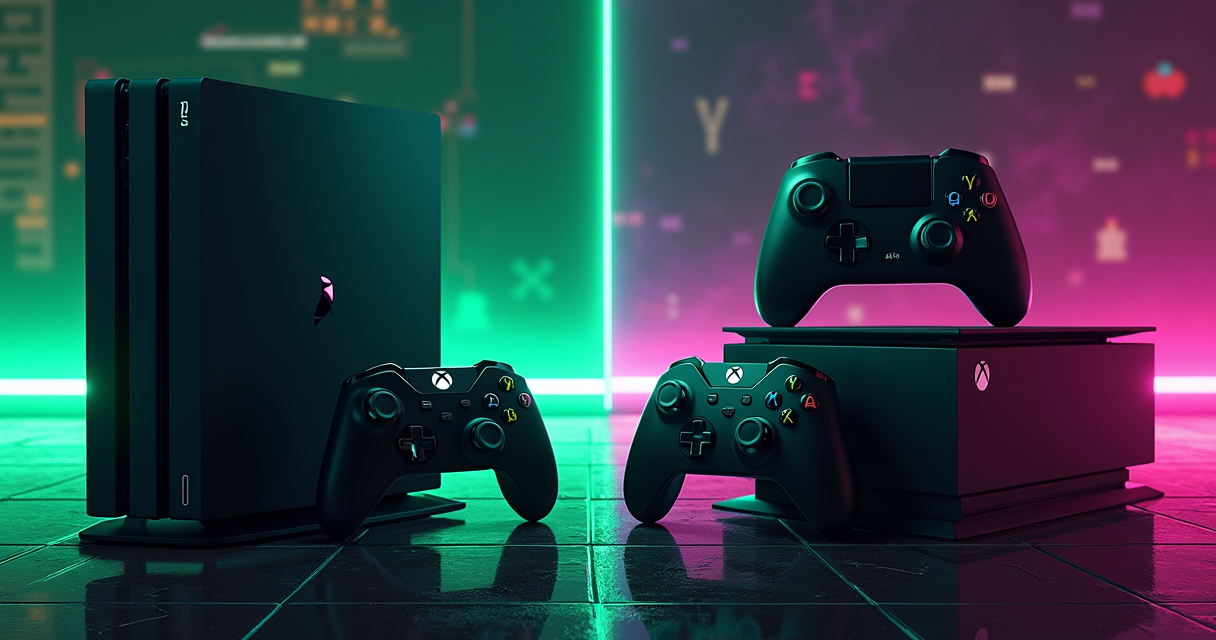
Here is a comparison of two consoles that no longer exist in any commercial sense: discontinued, unmanufactured, unpatched, and unloved by their own makers. The PlayStation 4 and the Xbox One are not products anymore. They are a settled historical record — and unusually for the console wars, the record is not close. What follows is not a hype preview. It is a coroner's report on the eighth generation, written now that all the evidence is in.
The Verdict in One Line
The short answer, for people with lives
The PlayStation 4 won this generation so decisively that Microsoft's own head of Xbox eventually stood up in public and called it "the worst generation to lose." That is not editorializing on our part. That is the losing general filing the after-action report. Sony moved roughly 117 million PS4s against Microsoft's roughly 58 million Xbox Ones — a shade over two-to-one — while charging a hundred dollars less at launch, rendering the same third-party games at higher resolutions, and pointedly declining to treat its own paying customers as suspects in a piracy investigation. Revisiting the two boxes in 2026 does not soften any of that.
So the recommendation is blunt. If you are buying exactly one of these consoles on the secondhand market today, buy a PlayStation 4 — a PS4 Pro if your budget stretches — and reach for an Xbox One only if you have a specific, defensible reason: its 4K UHD Blu-ray drive, or its genuinely best-in-class backward compatibility. Everything below is the six thousand words of evidence behind that sentence, because a verdict without receipts is just an opinion, and this site does not traffic in those.
Who still has a reason to care in 2026
Both machines left production years ago. Neither receives new first-party games. So why would anyone read a face-off between two dead consoles? Because the eighth generation left behind one of the deepest software libraries in the medium's history, and the hardware that plays it natively is now cheaper than a decent controller cost at launch. A used PS4 or Xbox One is, in 2026, a legitimate way to buy into a thousand-game back catalogue for the price of a single new release. Kids get a first console. Collectors chase the powerful revisions. Households want a cheap disc spinner that also plays 4K movies. All of those are real 2026 buyers, and all of them deserve to know which box actually holds up.
There is also the small matter of legacy. As of January 2026, the combined PS4 and Xbox One install base was still, by one measure, outselling the current generation at the equivalent point in its life — a fact we will unpack in the sales section, because it is stranger and more interesting than it sounds.
How we are grading this
We are not grading the 2013 marketing. We are grading the eight-year record on four axes: the silicon (what the hardware could actually do), the software (what you could actually play), the sales (what the market actually decided), and the 2026 reality (what you can actually buy, and for how much). Where a claim has a number, that number is traceable to a named source — Digital Foundry for performance, VGChartz for sales, the manufacturers and CNET for specs, and contemporaneous reporting for the quotes. Nothing here is invented. In a genre drowning in fabricated benchmarks, that is the whole value proposition.
The Spec Sheet, Fully Loaded
The full comparison table
Start with the numbers, because the numbers set up everything that follows. The table below covers both the launch machines (2013) and the mid-generation refreshes (2016-2017) side by side. Read it as four consoles, not two, because the PS4 Pro and Xbox One X changed the calculus considerably.
| Category | PlayStation 4 family | Xbox One family | Edge |
|---|---|---|---|
| Launch model, date & price | PS4, Nov 15 2013, $399 | Xbox One, Nov 22 2013, $499 (Kinect bundled) | PS4 |
| Mid-gen model, date & price | PS4 Pro, Nov 10 2016, $399 | Xbox One X, Nov 7 2017, $499 | Draw |
| Base CPU | 8-core AMD Jaguar @ 1.6 GHz | 8-core AMD Jaguar @ 1.75 GHz | Xbox One |
| Base GPU (teraflops) | 1.84 TF, 18 compute units | 1.31 TF, 12 compute units | PS4 |
| Mid-gen GPU (teraflops) | 4.2 TF, 36 CU @ 911 MHz | 6.0 TF, 40 CU @ 1172 MHz | Xbox One X |
| Base memory | 8 GB GDDR5, 176 GB/s unified | 8 GB DDR3 @ 68.3 GB/s + 32 MB ESRAM | PS4 |
| Mid-gen memory | 8 GB GDDR5 @ 218 GB/s | 12 GB GDDR5 @ 326 GB/s | Xbox One X |
| Typical launch resolution (multiplat) | 1080p common | 720p-900p common | PS4 |
| Optical drive | Blu-ray/DVD (1080p) — Pro has no UHD drive | 4K UHD Blu-ray on One S / One X | Xbox One |
| Backward compatibility | None native; PS Now streaming only | 600+ Xbox 360 & original Xbox titles | Xbox One |
| Controller | DualShock 4: touchpad, built-in battery, Share | Xbox One pad: AA batteries, Impulse Triggers | Preference |
| Virtual reality | PlayStation VR supported | None | PS4 |
| Online service (multiplayer) | PS Plus, ~$60/yr | Xbox Live Gold, ~$60/yr | Draw |
| Free-games program | PS Plus monthly titles | Games with Gold | Draw |
| Cloud saves | PS Plus online storage | Xbox network cloud sync (default on) | Xbox One |
| Motion/camera | PS Camera optional | Kinect bundled at launch, dropped mid-2014 | PS4 |
| Flagship exclusives | God of War, Bloodborne, Spider-Man, TLOU2 | Forza, Halo 5, Gears 4/5, Sunset Overdrive | PS4 |
| Lifetime units sold | ~117 million | ~57.9 million (est.; never officially confirmed) | PS4 |
That is a lot of PS4-favoring rows, and it is not cherry-picked. The Xbox One wins on CPU clock, on backward compatibility, on 4K disc playback, and on cloud-save defaults. The PS4 wins on almost everything that moved units.
Reading the silicon: GDDR5 vs DDR3 + ESRAM
The single most consequential engineering decision of the generation was memory. Sony built the PS4 around 8 GB of unified GDDR5 — fast graphics memory, 176 GB/s of bandwidth, one pool that both the CPU and GPU could hammer without ceremony. Microsoft, worried in 2012 that 8 GB of GDDR5 might not be procurable at volume, hedged. It paired 8 GB of cheaper, slower DDR3 (68.3 GB/s) with 32 MB of on-die ESRAM as a high-bandwidth scratchpad. On paper the ESRAM's peak throughput was competitive; in practice, 32 MB is a cramped window, and developers had to hand-tune what lived inside it. Sony handed studios a wide, flat, fast highway. Microsoft handed them a service road with a carpool lane you had to manually merge into.
The result was that cross-platform games were simply easier to make run well on PS4, and they usually did. This is not folklore. It is the mechanical explanation for the resolution gap documented later in this article. When a developer under deadline can hit 1080p on one box without fighting the memory subsystem, and has to claw for 900p on the other, the 1080p box wins the screenshots — and screenshots sell consoles.
The CPU wash and the GPU chasm
People forget that the Xbox One had the faster CPU. Both consoles used the same 8-core AMD Jaguar architecture — a low-power laptop-class part, frankly underpowered for both machines — but Microsoft clocked it at 1.75 GHz to Sony's 1.6 GHz. In the real world this bought almost nothing, because eighth-gen games were overwhelmingly GPU-bound, and the GPU is where the chasm opened. The PS4's graphics core carried 18 compute units to the Xbox One's 12, translating to 1.84 teraflops against 1.31 — roughly a 40 percent raw advantage. Forty percent is not a rounding error. It is the difference between native 1080p and upscaled 720p, over and over, for the first three years of the generation. Microsoft spent those three years explaining that teraflops were not everything. Sony spent them shipping games that looked better on identical televisions.
The 2013 Reveal: Microsoft Lost at the Podium
The always-online own goal
The generation's outcome was arguably decided in the summer of 2013, before a single unit shipped. Microsoft revealed the Xbox One in May 2013 with a strategy built around digital rights management: the console would need to phone home at least once every 24 hours to remain functional, and used-game resale would be gated behind publisher-controlled licensing checks. In a world of always-on broadband this might have been survivable. In the actual world — of data caps, apartment Wi-Fi, military deployments, and rural dead zones — it read as a machine that could brick your library if your internet hiccuped. Microsoft was, in effect, trying to convert disc ownership into revocable licensing by fiat, and it did so without first winning the argument that anyone wanted that.
The knock-on message was worse than the policy. A console you cannot pass down, cannot lend, cannot resell, and cannot use during an outage is a console you rent. Buyers understood this immediately, even when the executives explaining it did not.
Mattrick's Xbox 360 line
Then came the quote that has followed the Xbox One like a bad smell for over a decade. Asked at E3 2013 what offline players — people with no reliable connection — were supposed to do, Xbox chief Don Mattrick said, on the record, "Fortunately we have a product for people who aren't able to get some form of connectivity, it's called Xbox 360." You can still read the contemporaneous write-up at Engadget's coverage from June 12, 2013. Telling your prospective customers to go buy your last-generation console instead is not a gaffe you recover from in a news cycle. It defined the launch. Mattrick left Microsoft weeks later, in July 2013, but the sentence stayed.
The deeper problem was that the line was honest. It accurately described a company that had designed a console for a connectivity utopia and could not articulate a fallback for reality. Under sustained backlash, Microsoft reversed the DRM policies later that June — no 24-hour check-in, no used-game restrictions — but reversing a policy does not reverse an impression. The pre-orders had already tilted.
Sony's 21-second knife
Sony, meanwhile, ran the cleanest counter-punch in console history. On stage at E3 2013, Jack Tretton confirmed the PS4 would cost $399 — a full hundred dollars under the Xbox One — with no always-online requirement, no bundled camera watching the room, and no change whatsoever to how used games worked. Then Sony released a now-legendary 21-second video demonstrating its revolutionary game-sharing technology: one PlayStation employee handing a physical disc to another. That was the whole gag. As Push Square later documented, the clip — the improvised idea of executives Adam Boyes and Shuhei Yoshida — went on to rack up some 17 million views and became the emotional shorthand for the entire generation's opening move.
It was devastating precisely because it was so cheap. Sony spent nothing, promised nothing new, and won the crowd by simply not taking anything away. When your competitor's marquee innovation is "you can still lend your friend a disc," you have already lost the framing war. If you want the modern sequel to this rivalry, we broke down how the PS5 versus Xbox Series X fight is playing out in 2026 — and you will notice the price-and-messaging pattern rhymes.
The Resolution Gap: 1080p vs 720p
Digital Foundry's launch face-offs
Marketing is one thing; measured pixels are another. Digital Foundry, the technical-analysis outfit at Eurogamer that turned frame-counting into a discipline, spent the launch window putting identical games on both boxes and reporting the raw numbers. The results were brutal and consistent. Call of Duty: Ghosts, a launch tentpole, ran at native 1080p on PS4 and 720p (upscaled) on Xbox One. Battlefield 4 hit 900p on PS4 against 720p on Xbox One. These were not obscure titles being quietly benchmarked — they were the biggest shooters of the holiday, the exact games buyers were comparing in stores, and they looked visibly sharper on the cheaper console.
The pattern held as the generation matured. The Witcher 3 ran 1080p on PS4 and 900p on Xbox One. Where Microsoft did achieve parity, it often came at a cost elsewhere: Tomb Raider: Definitive Edition reached 1080p on both, but ran at 60 frames per second on PS4 versus 30 on Xbox One. Same resolution, half the frame rate. The consumer takeaway required no technical literacy at all — the PlayStation version was the one to buy, almost by default.
The benchmark table
Here is the launch-era resolution scoreboard, drawn from Digital Foundry's face-off series and corroborated across the community face-off archives that aggregated them (the long-running NeoGAF and Reddit console-tech threads that catalogued every comparison). Three independent bodies of evidence, one consistent story.
| Game (year) | PS4 | Xbox One | Advantage | Primary source |
|---|---|---|---|---|
| Call of Duty: Ghosts (2013) | 1080p | 720p (upscaled) | PS4 | Digital Foundry |
| Battlefield 4 (2013) | 900p | 720p | PS4 | Digital Foundry |
| Watch Dogs (2014) | 900p | 792p | PS4 | Digital Foundry |
| Tomb Raider: Definitive (2014) | 1080p / 60 fps | 1080p / 30 fps | PS4 (frame rate) | Digital Foundry |
| Assassin's Creed Unity (2014) | 900p | 900p | Draw (forced parity) | Digital Foundry |
| The Witcher 3 (2015) | 1080p | 900p | PS4 | Digital Foundry |
Five wins, one deliberate draw, zero losses across the sample. And that draw is its own scandal, which brings us to the next point.
Why parity became a dirty word
Assassin's Creed Unity shipped at 900p and 30 frames per second on both consoles — and Ubisoft, under pointed questioning, indicated the parity was intentional, to avoid "debates." The gaming public did not read this as diplomacy. It read it as the more powerful hardware being held back to spare the weaker one embarrassment, and the backlash was fierce enough that "parity" became a slur for the rest of the generation. It was an implicit admission of the very gap Microsoft kept insisting did not matter: nobody deliberately caps the PS4 to match the Xbox One unless the PS4 was going to win. When the discourse around your console centers on whether rivals are throttling competitors to protect your dignity, the technical argument is already over.
Mid-Gen: PS4 Pro vs Xbox One X
4.2 vs 6 teraflops
Halfway through the generation, both companies blinked and shipped upgraded hardware — the first true mid-generation refreshes at scale, and the template that the PS5 Pro would later inherit. Sony went first with the PS4 Pro in November 2016 at $399: 4.2 teraflops, 36 compute units at 911 MHz, memory bandwidth up to 218 GB/s. A year later Microsoft answered with the Xbox One X in November 2017 at $499 — and this time, it swung a hammer. The One X packed 6.0 teraflops across 40 compute units at 1172 MHz, backed by a full 12 GB of GDDR5 at 326 GB/s. That is roughly 1.4 times the PS4 Pro's graphics throughput, and Microsoft was not shy about branding it "the world's most powerful console." For once, the marketing matched the multimeter. Both the spec-by-spec breakdown at CNET and the hands-on comparison at Digital Trends land on the same conclusion: the One X was the stronger box.
There is a bitter irony here for Microsoft. Having lost the generation by being underpowered and overpriced in 2013, it won the hardware rematch in 2017 by being overpowered and — relative to the value it delivered — arguably underpriced. But by 2017 the install bases were already set in concrete. Winning the spec sheet two years late is like showing up to the duel after the other man has already opened his shop across the street with your former customers.
Native 4K vs checkerboard
The extra silicon showed on screen. In Digital Foundry's mid-gen face-offs, the Xbox One X frequently rendered native 3840x2160 where the PS4 Pro reached for checkerboard reconstruction — a clever technique that rebuilds a 4K-ish image from roughly half the pixels, very good but not truly native. In Diablo III, for instance, the One X held near-perfect 4K throughout while the Pro achieved full native resolution mainly in interior areas. On a large, genuine 4K display sitting close, the difference in texture clarity was visible to a careful eye. The One X could also host higher-resolution PC-grade texture packs that the Pro's tighter memory budget simply could not stream smoothly.
The honest caveat: on most living-room televisions at normal viewing distance, checkerboard 4K and native 4K are difficult to tell apart in motion. The One X's advantage was real and measurable, but it lived in the top ten percent of image quality that only enthusiasts with the right panel actually perceived. Which is a recurring theme with the Xbox One family — technically superior in ways that rarely translated into a reason the mass market switched.
The UHD Blu-ray asterisk
Here is the detail that quietly won Microsoft the home-theater crowd, and it is one Sony fans still find hard to defend. Every Xbox One from the One S onward — including the flagship One X — includes a 4K UHD Blu-ray drive. The PS4 Pro, Sony's premium $399 machine, does not. It cannot play a 4K disc. Sony bet the future was streaming and omitted the drive; Microsoft included one and, for a stretch, the Xbox One S was among the cheapest standalone 4K Blu-ray players you could buy. If your use case involves physical 4K film — and for collectors and cinephiles it absolutely does — the Xbox One is the only correct answer in this comparison, full stop. A more powerful console that cannot play the disc in your hand is, for that task, the wrong tool.
The Exclusives War
Sony's first-party juggernaut
Hardware sells the first year; software sells the other seven. And this is where the generation stopped being competitive and became a rout. Sony's first-party studios delivered a murderer's row of critically adored, system-selling exclusives: Bloodborne, Uncharted 4, Horizon Zero Dawn, God of War (2018), Marvel's Spider-Man, The Last of Us Part II, and Ghost of Tsushima. These were not niche prestige pieces. They were mass-market blockbusters that also swept awards, the rare combination of commercial and critical dominance. Each one was a reason to own a PS4 that you could not satisfy any other way, and Sony released them at a metronomic cadence for years.
The strategic effect compounds. Every exclusive that lands is both a sale and an anchor — it deepens the library that keeps you from ever switching. By 2020, a lapsed player returning to consoles faced a PS4 catalogue of must-plays and an Xbox One catalogue that leaned heavily on iteration. The choice made itself.
Microsoft's services pivot
Microsoft's first-party output, by contrast, thinned as the generation wore on. Halo 5 was competent but divisive; Gears of War 4 and 5 were solid; Forza Motorsport and Forza Horizon were genuinely excellent and remain the Xbox One's strongest single argument; Sunset Overdrive and Ori and the Blind Forest earned cult affection. But the sheer volume and cultural weight of Sony's slate was not there, and Microsoft knew it. So it changed the board. Rather than out-gun Sony game for game, Microsoft pivoted to services — Xbox Game Pass, a Netflix-style subscription that made the library itself the product, plus aggressive cross-play, cross-buy, and eventually play-anywhere PC integration. It was a smart, defensible retreat from a fight it was losing. It was also, by definition, an admission that it could not win on exclusives.
The Metacritic reality
Aggregate critical reception tells the same story the sales charts do. Sony's marquee exclusives clustered in the high 80s and 90s on Metacritic and collected Game of the Year hardware with regularity; the PS4 simply had more of the generation's defining games, and more of its best-reviewed ones. Even sympathetic coverage of the Xbox lineup tended to frame it as "underrated and better than its reputation" rather than "superior" — a defensive posture, not a winning one. The consensus that hardened over eight years, and that no one seriously disputes now, is that the Xbox One had a handful of great franchises and Game Pass, while the PS4 had the generation's library. When the argument for your platform is the price of the buffet rather than the quality of the dishes, you are playing a different, humbler game than your rival.
Backward Compatibility and the Living Room
Xbox's 600-game head start
Credit where it is genuinely due: the Xbox One's backward compatibility was the best thing Microsoft did all generation, and it is not close. Starting in 2015, Microsoft built a compatibility program that eventually brought more than 600 Xbox 360 and original Xbox titles to the Xbox One — playable from disc or digital purchase, often with resolution and frame-rate enhancements layered on for free. Your old library did not die; it followed you forward and, in many cases, ran better than it ever had. For anyone with a shelf of 360 discs, this was a real, tangible reason to buy an Xbox One, and it remains a reason to keep one around in 2026.
This was Microsoft playing to a genuine strength — a preservationist ethic that Sony, for all its first-party brilliance, simply did not match. If you care about the eighth generation as a retro platform, as a way to keep two prior Xbox generations alive on modern hardware, the Xbox One is the superior museum piece.
Sony's streaming-only answer
Sony's answer to backward compatibility was, bluntly, to not have one. The PS4 could not play PS3, PS2, or PS1 discs — a limitation rooted partly in the PS3's famously baroque Cell architecture, which is brutally hard to emulate. Sony's substitute was PlayStation Now, a streaming service that piped older titles from its servers over broadband. It technically expanded the catalogue, but streaming is not ownership and not local play; it depended on your connection, added latency, and rented you access rather than restoring your shelf. For local, offline, own-it-forever back catalogue, the Xbox One won this category outright. If your interest in old games runs deeper than either console reaches, that is what a PC and a clean RetroArch install are for — but as living-room boxes, the Xbox held the compatibility crown.
Controllers, VR, and the extras
The peripheral war split. Sony's DualShock 4 introduced a clickable touchpad, a built-in rechargeable battery, a light bar, and the Share button that made the console the default home of the streaming-and-clips era. Microsoft's Xbox One controller — widely, correctly praised as the more ergonomic pad — refined its already-excellent bumpers and triggers and added Impulse Triggers with localized rumble, but still shipped with disposable AA batteries in the box, a baffling choice that outlasted the entire generation. Sony took the innovation; Microsoft took the ergonomics.
Sony also owned virtual reality outright: PlayStation VR gave the PS4 an entire category the Xbox One never contested. And Microsoft's launch-window insistence on bundling Kinect — the motion camera that inflated the $499 price and unnerved privacy-minded buyers — was so poorly received that Microsoft unbundled it in mid-2014 to hit $399, tacitly conceding it had shipped a $100 accessory nobody had asked for. If you want to take either library off the box entirely, note that Sony's ecosystem also matured into strong Remote Play streaming, letting you push PS4 games to a phone or PC — another small edge in the everyday-convenience column.
The Sales Scoreboard: 175 Million Units
175 million and a 2:1 beating
Now the ledger. By the accounting at VGChartz, the PS4 sold roughly 117 million lifetime units and the Xbox One roughly 57.9 million, for a combined install base around 175.16 million. Do the division: 117 divided by 58 is 2.02. Sony did not merely win the generation — it won it two-to-one. And note the asterisk on Microsoft's figure: the company never officially disclosed a final Xbox One sales total. When a corporation stops reporting a number, the number is not good, and the silence is itself a data point. We assembled the full unit-by-unit accounting in our breakdown of the 175-million-unit scoreboard, but the headline is that simple: a hundred-dollar price gap, a resolution gap, and a public-relations gap compounded into a two-to-one blowout.
Phil Spencer, who took over Xbox in 2014 and spent the rest of the generation cleaning up, put it most plainly himself. In 2023 he conceded to GamesRadar and others that Microsoft "lost the worst generation to lose in the Xbox One generation" — worst, he explained, because it was the generation in which everyone built their permanent digital library. Lose a player during the eighth generation and you likely lose them for the ninth too, because their games, their saves, and their friends all live on the platform they picked. The DRM fiasco did not just cost Microsoft a console cycle. It cost it the lock-in that carries forward.
The legacy gap in 2026
Here is the genuinely surprising 2026 wrinkle. According to VGChartz's January 2026 aligned-launch comparison, if you line the two console generations up by months-since-launch, the combined PS4-and-Xbox-One had sold 140.54 million units at their equivalent point, versus 124.49 million for the combined PS5-and-Xbox-Series at month 63 (January 2026). The older generation is ahead by 16.05 million units at the aligned mark — and in that month the legacy generation actually extended its lead by another 0.59 million. In other words, the eighth-gen pairing sold faster, at the same stage of life, than the ninth-gen pairing is selling now.
Read that carefully, because it is easy to misread. This is a timing-aligned comparison, not a claim that anyone is still buying millions of PS4s. It reflects the reality that the current generation launched into a pandemic-scarred supply crunch and a market where mid-generation upgrades and steep hardware prices slowed adoption. But the takeaway stands: the PS4-and-Xbox-One cycle was, by this measure, a more commercially explosive console generation than its successor — a legacy that keeps casting a long shadow.
What the numbers actually mean
Do not let the aligned-sales curiosity blur the core fact. Lifetime, at their equivalent point, and by essentially every cut of the data, the PlayStation 4 dominated the Xbox One. The combined 175-million figure is a monument to how large the generation was; the 2:1 split is a monument to who won it. If a friend tells you the Xbox One "wasn't that far behind," they are misremembering. It was, by unit sales, roughly half the console the PS4 was — a gap so wide that Microsoft restructured its entire strategy around never fighting on those terms again.
Which One Fits You in 2026
If you play multiplatform games and exclusives
Two of the most common buyers, one clear answer each. Use case 1 — "I want the best-looking versions of the 2013-2020 multiplatform catalogue." For base consoles, buy a PS4; the resolution and frame-rate edge documented above means the PlayStation cut of nearly every cross-platform game is the better one. The single exception is native-4K mid-gen rendering, where the Xbox One X pulls ahead — so if 4K is the priority and budget allows, that specific box wins this narrow slice. Use case 2 — "I want the generation's best single-player, story-driven games." Buy a PS4, without hesitation. God of War, The Last of Us Part II, Bloodborne, Spider-Man, and Ghost of Tsushima are PlayStation-only and represent the cinematic peak of the era. There is no Xbox-side equivalent to this depth of exclusive drama.
If you want a media box or a retro Xbox
Use case 3 — "I want a cheap 4K UHD Blu-ray player that also plays games." Buy an Xbox One S or One X. They contain the UHD drive the PS4 Pro omits, and a used One S remains one of the more sensible budget 4K disc players in existence. Use case 4 — "I want to replay my Xbox 360 and original Xbox library on modern hardware." Buy an Xbox One. The 600-plus backward-compatible titles, often enhanced, make it the definitive way to keep two prior Xbox generations alive under one HDMI cable. Use case 5 — "I want a first console for a kid, cheap, with a bottomless library." Either works, but a used PS4 Slim edges it on sheer breadth of affordable games and the larger, safer online population.
If you want VR, raw power, or a crowd
Use case 6 — "I want console VR on a budget." Buy a PS4 and a PlayStation VR headset; the Xbox One never offered VR at all, so this is a category of one. Use case 7 — "I want the single most powerful eighth-gen box for a collection." Buy the Xbox One X — 6 teraflops, the generation's technical high-water mark, and increasingly a collector's piece as stock dries up. Use case 8 — "My friends still play on one of these and I want the biggest active community." Buy a PS4; the roughly 2:1 install-base advantage means more players, more populated servers, and longer online life for multiplayer titles. Eight scenarios, and the PS4 is the correct answer in five of them — which is, more or less, the whole article in miniature.
Pricing and Availability in 2026
Original MSRP, for the record
Both consoles are discontinued, so there is no current retail price to quote — only the official launch MSRPs (which are the only prices we will state as fact) and the reality of the secondhand market. The table below is anchored on manufacturer pricing; treat the 2026 column as market observation, not an official figure, because used prices float with condition, region, and seller.
| Model | Launch MSRP | Launched | 2026 status |
|---|---|---|---|
| PlayStation 4 (500 GB) | $399 | Nov 2013 | Discontinued; secondhand only |
| Xbox One (Kinect bundle) | $499 | Nov 2013 | Discontinued; secondhand only |
| Xbox One (Kinect-less) | $399 | Jun 2014 | Discontinued; secondhand only |
| PS4 Slim | $299 | Sep 2016 | Discontinued; common used |
| PS4 Pro | $399 | Nov 2016 | Discontinued; sought used |
| Xbox One S | $299 | Aug 2016 | Discontinued; common used |
| Xbox One X | $499 | Nov 2017 | Discontinued; collectible used |
The 2026 secondhand market
In broad strokes — and this is observation, not MSRP — the base machines and the slim revisions are the cheap end of the market, the disc-drive-and-a-library tier. The premium revisions command more: the PS4 Pro holds value on the strength of the library it plays best, and the Xbox One X, being both the most powerful box and increasingly the scarcest, has drifted toward collector pricing. Condition is everything at this age. These are used consoles with used thermal paste, aging optical drives, and hard disks that have been spinning for the better part of a decade. Budget for a possible SSD swap (both families accept user storage upgrades, which is the single best thing you can do for load times) and inspect the disc drive before you pay.
What to actually pay for
Do not overpay for the wrong revision. If you want the library and the exclusives, the cheapest healthy PS4 or PS4 Slim does the job — the Pro is a nice-to-have, not a requirement, unless you own a 4K set and care about the sharper multiplat renders. If you want the media-and-retro use case, the Xbox One S is the value pick and the One X is the enthusiast pick. Paying One-X money for a base Xbox One, or Pro money for a launch PS4, is how people lose the secondhand game. Match the revision to the use case from the section above and you will not overspend.
Switching Ecosystems: A Migration Guide
The bad news: libraries do not move
If you are switching from one of these consoles to the other — or consolidating — set expectations first, because the news is mostly bad. Digital purchases are tied to a platform account and do not transfer between ecosystems. A game bought on PlayStation Network does not follow you to Xbox, and vice versa. There is no cross-buy across the aisle, no license portability, no exceptions. Cross-buy exists only within a family (a PS4 game you can also grab on PS5, say). Save data likewise does not cross the divide — a PS4 save cannot be imported to an Xbox One. Physical discs are also platform-locked. Practically, "migrating" from PS4 to Xbox One means rebuilding your library from scratch on the new platform. Know that going in.
Moving saves within an ecosystem
Where migration does work cleanly is within a family — PS4 to PS4 Pro, or Xbox One to Xbox One X. Both platforms make this painless, though by different defaults. On PlayStation, saves move via PS Plus cloud storage or a plain USB stick. On Xbox, cloud sync is on by default, so a save often just appears on the new console after sign-in; a direct console-to-console network transfer is also available on a shared LAN. The commands, roughly:
# Within the PlayStation family (PS4 -> PS4 / PS4 Pro)
Settings > Application Saved Data Management > Upload to Online Storage   # requires PS Plus
# or, no subscription needed:
Settings > Application Saved Data Management > Copy to USB Storage Device

# Within the Xbox family (Xbox One -> Xbox One X)
Cloud sync is enabled by default on the Xbox network — sign in and wait.
# or, both consoles on the same LAN:
Settings > System > Backup & transfer > Network transfer
Cross-progression escape hatches
The one genuine bridge across ecosystems is publisher-level cross-progression. A handful of live-service and multiplayer titles store your progress against a publisher account rather than a platform account, so linking that account on both machines carries your unlocks over. The usual suspects: Fortnite (Epic account), Rocket League (Epic), Minecraft (Microsoft account), Destiny 2 (Bungie account), and Call of Duty (Activision account). The step-by-step for switching:
- Inventory your digital library and accept that platform-locked purchases will not move — only cross-progression titles carry over.
- For each game, check whether it supports a publisher-account link (Epic, Bungie, Activision, Microsoft) for cross-progression.
- Link that publisher account on the old console before you sell it, then sign into the same account on the new one.
- Back up within-ecosystem saves to cloud or USB while you still have the old hardware powered on.
- Re-download or re-buy the games that do not support cross-play; there is no shortcut here.
- Remember that controllers and accessories do not cross over — a DualShock 4 will not pair with an Xbox One, and vice versa.
Note the asymmetry of what you lose in each direction. Moving from Xbox One to PS4, you forfeit the 600-game backward-compatible library. Moving from PS4 to Xbox One, you forfeit PlayStation VR and the entire Sony first-party catalogue. Neither switch is free, which is precisely why the eighth generation's lock-in was so durable — and why Spencer called losing it the worst outcome of all.
The Machine's Final Verdict
The data-backed pick
Assemble the evidence and the verdict writes itself. The PlayStation 4 was cheaper at launch ($399 vs $499), more powerful at launch (1.84 vs 1.31 teraflops), rendered the same games at higher resolution (1080p vs 720p in the marquee shooters, per Digital Foundry), carried the generation's defining exclusives, added VR as a bonus category, and outsold its rival roughly two-to-one to a ~117-million-unit lifetime total. Microsoft's own Xbox chief called it the worst generation to lose. When the winning and losing parties agree on the outcome, the debate is closed. For a single all-purpose eighth-gen console in 2026, buy a PlayStation 4 — the Pro if you own a 4K display and want the sharpest multiplat renders, the Slim if you just want the library at the lowest price.
The contrarian case for Xbox
Being right does not mean being absolute. The Xbox One earns a genuine recommendation in specific hands, and it would be dishonest to pretend otherwise. It is the better retro-Xbox machine, full stop, thanks to 600-plus backward-compatible titles that often run enhanced. It is the better media box, because the One S and One X include the 4K UHD Blu-ray drive that the PS4 Pro inexplicably lacks. And the Xbox One X remains the most powerful console of the generation — 6 teraflops, native 4K where the Pro reconstructs, and an increasingly collectible piece of hardware. If your use case is old Xbox games, physical 4K film, or raw mid-gen power for a collection, the Xbox is not the consolation prize. It is the correct choice. The ledger below sums it up.
| PlayStation 4 family | |
|---|---|
| Pros | $100 cheaper at launch; 1.84 TF GPU; higher multiplat resolutions; generation's best exclusives; PSVR; ~117M sold; huge active community |
| Cons | No native backward compatibility; PS4 Pro has no 4K UHD Blu-ray drive; weaker mid-gen box than One X; streaming-only legacy catalogue |
| Xbox One family | |
|---|---|
| Pros | 600+ backward-compatible games; 4K UHD Blu-ray on One S/X; Xbox One X is the most powerful eighth-gen box (6 TF); ergonomic controller; Game Pass legacy |
| Cons | $100 pricier at launch with Kinect; weaker launch GPU; lower launch resolutions; botched DRM reveal; thin exclusive slate; ~2:1 sales defeat |
Final word
Use the decision tree if you skipped everything above. It is the whole 6,000 words compressed into a flowchart.
START
 |- Best exclusives / cinematic single-player? -----> PS4 (Pro)
 |- Replay Xbox 360 / original Xbox library? -------> Xbox One (S/X)
 |- Need a 4K UHD Blu-ray player too? --------------> Xbox One S / One X
 |- Native-4K multiplats, maximum raw power? -------> Xbox One X
 |- Console VR on a budget? ------------------------> PS4 + PlayStation VR
 |- Biggest active online player base? -------------> PS4
 `- Just want the library at the lowest price? -----> PS4 Slim
The eighth generation is over, the votes are counted, and the result is not in dispute: Sony won, two-to-one, on price and pixels and games and public relations, and Microsoft spent the following decade rebuilding around the lessons of that defeat. Buy the PS4 for the games and the crowd; buy the Xbox One for the movies, the mid-gen muscle, and the old-Xbox museum. Buy neither expecting a new patch — those days ended years ago. What remains is a settled piece of history and a very cheap way to own it. Choose the box that fits the shelf you actually want to fill.
Questions the search bar asks me
- Did the PS4 really outsell the Xbox One two to one?
- Roughly, yes. VGChartz tracks the PS4 at about 117 million lifetime units against the Xbox One's ~57.9 million — a 2.02:1 ratio — for a combined ~175 million. Microsoft never officially confirmed a final Xbox One figure, which itself tells you how the generation went.
- Which console runs multiplatform games better?
- At launch, the PS4, clearly. Digital Foundry measured Call of Duty: Ghosts at native 1080p on PS4 versus 720p on Xbox One, and Battlefield 4 at 900p versus 720p. The mid-gen partly flips for raw 4K: the 6-teraflop Xbox One X often hit native 4K where the 4.2-teraflop PS4 Pro leaned on checkerboard reconstruction.
- Is the Xbox One X still worth buying in 2026?
- For two niches. It is the most powerful eighth-gen console at 6 teraflops, and it ships with a 4K UHD Blu-ray drive that even the PS4 Pro lacks. As a general games machine, though, the larger PS4 library and the roughly 2:1 online population make the PlayStation the safer secondhand pick.
- Can I transfer my games or saves between PS4 and Xbox One?
- No. Purchases are tied to a platform account and do not move between ecosystems. Saves migrate only within a family — PS4 to PS4 Pro via PS Plus cloud or USB, Xbox One to One X via Xbox cloud sync. A handful of cross-progression titles (Fortnite, Rocket League, Minecraft) carry progress through a linked publisher account.
- Why did the Xbox One lose so badly?
- A $499 launch price with Kinect bundled against Sony's $399, a botched always-online DRM reveal that Don Mattrick defended by telling offline buyers to 'stick with Xbox 360,' and a weaker GPU (1.31 vs 1.84 teraflops). Sony undercut on price, out-specced the hardware, and won E3 2013 with a 21-second video about lending a friend a disc.

Ben covers the hardware end of retro gaming: FPGA cores, real-cartridge dumping, capture setups, CRT vs scaler workflows, and the legal and physical preservation infrastructure that keeps old games playable. Every post under this byline is reviewed pre-publish by Sam P., Editor & Operator — corrections to info@instalinkoteam.com. Published 2026-08-29 · Last updated 2026-08-29. Full bios on the author page.