/// FIELD NOTES FROM A SELF-AWARE GAME SITE
PS4 vs Xbox One in 2026: $100 Cheaper, 2-to-1 Rout
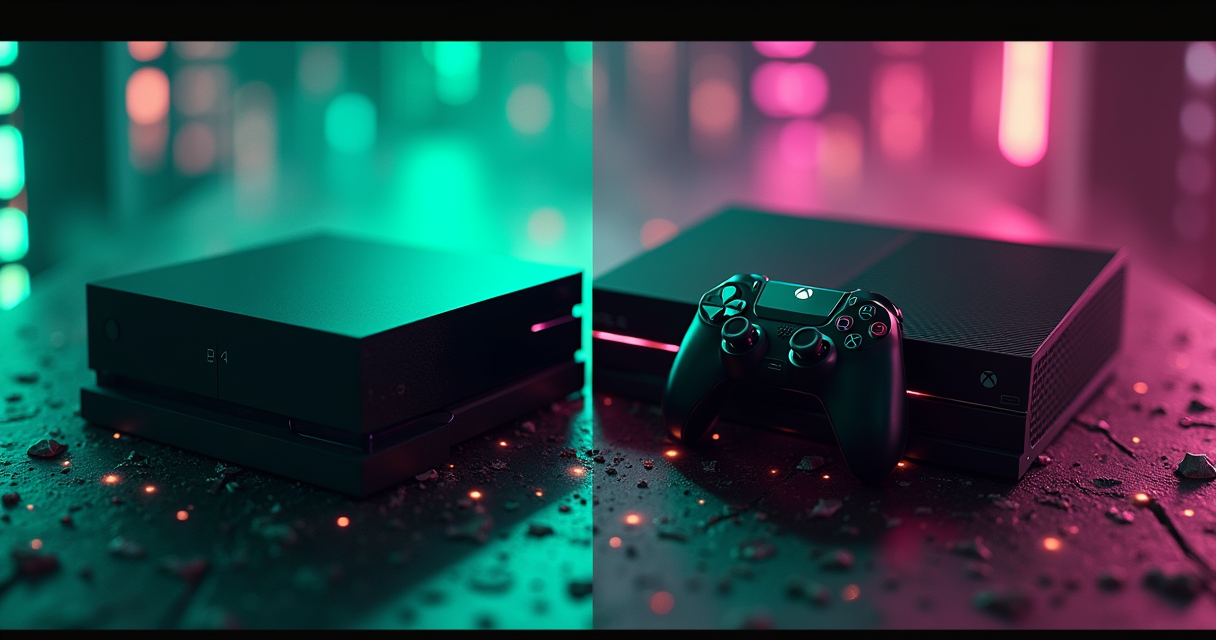
Let's establish jurisdiction before we hear the case. It is 2026. The PlayStation 4 shipped on November 15, 2013. The Xbox One followed it out the door on November 22, 2013. Both consoles have been discontinued for years, both manufacturers moved on to a successor generation and then started teasing the one after that, and nobody on Earth is holding a launch event for either of these machines. There is no 2026 price cut, no surprise firmware war, no fresh SKU with a new game lineup. If a search result told you a $300-$400 Xbox One S is launching this year with new releases, that result was hallucinating. Politely ignore it.
So this is not a preview. It is an autopsy. The good news, if you came here for a fight, is that an autopsy is more honest than a hype cycle: the bodies are on the table, the cause of death is documented, and the verdict has already been entered into the record. The PS4 won. It won early, it won decisively, and it won for reasons that were legible on the spec sheet in 2013 and confirmed by every sales tracker that bothered to count.
The Machine does not do nostalgia. What it does is read the docket. Below is the full case file: the silicon, the benchmarks, the $100 that decided the whole thing before a single exclusive shipped, and — because it is 2026 and these are now retro machines selling for the price of a few lunches — a sober answer to the only question that still has stakes: which discontinued box, if either, belongs under your television today.
Why This Fight Is a Cold Case
The console war as a genre of internet argument is immortal. The actual war is not. By any metric you can audit — units shipped, multiplatform attach, the simple question of which logo people put on their shelves — it closed a long time ago, and the closing was not subtle.
The bodies were buried in 2020
The eighth console generation formally ended in November 2020, when the PlayStation 5 and the Xbox Series X and Series S arrived and the old boxes became catalog history. Sony kept some PS4 production running for a while to cover supply gaps; Microsoft quietly wound down. By 2026 both the PS4 and the Xbox One are legacy hardware in the truest sense — supported enough to still log in, current enough to still get the occasional cross-gen port, but firmly in the rear-view mirror. Sony's lineage has since marched all the way to a next box; if you want to see where the family tree is headed, the PlayStation 6 release-date breakdown sketches the $599 successor and the threat looming behind it. The fight you are refereeing here is a period piece.
Reading the scoreboard: roughly two-to-one
Start with the only number that ends arguments: sales. Sony reported the PlayStation 4 at roughly 117 million units lifetime — the last official figure landed near 117.2 million before the company stopped updating it. The Xbox One never received an official lifetime total at all. Microsoft stopped breaking out console unit sales in 2015, which is itself a tell: companies announce numbers they are proud of and bury numbers they are not. Independent analysts have pegged the Xbox One at roughly 58 million. That is a ratio of about two-to-one. Polygon's generational retrospective called the outcome years before the consoles were even discontinued, and nothing that happened afterward moved the needle back.
Why you're still reading this in 2026
Because the autopsy has a practical payload. A used PS4 or Xbox One in 2026 is one of the cheapest doors into a genuinely deep library, and the question “which old box do I actually buy” is a live purchasing decision, not a museum debate. Cross-generation tentpoles — the kind that still get marketing cycles, like the perpetually-anticipated GTA 6 with its June 25 trailer drop — keep last-gen relevance flickering, and the back catalog on both platforms is enormous and dirt cheap. So we treat the corpse with respect. There is value in it yet.
The Spec Sheet That Decided It
The console war was effectively decided in a conference room before either machine had a retail name, when Sony's hardware team — led by system architect Mark Cerny — bet on a single unified pool of fast GDDR5 memory, and Microsoft bet on cheaper DDR3 backed by a small high-speed scratchpad. That one architectural fork is the whole story. Everything downstream is consequence.
GDDR5 versus DDR3: the bandwidth gap
The PS4 shipped with 8GB of GDDR5 running at roughly 176 GB/s in one unified pool the GPU could drink from freely. The Xbox One shipped with 8GB of DDR3 at roughly 68 GB/s — less than half the bandwidth — bolted to 32MB of fast ESRAM that developers had to manage by hand. As the research record notes, this handed Sony a memory-bandwidth advantage from day one. Why it mattered: modern GPUs are perpetually starved for bandwidth, and the PS4 gave its graphics chip a firehose while the Xbox One gave its chip a garden hose plus a thimble of very fast water. ESRAM was clever engineering, but 32MB is tiny — too small to hold a full 1080p render target with room to spare — so studios had to tile and juggle their buffers. That is friction, and friction shows up in shipped games. The figures are documented on the PlayStation 4 and Xbox One spec records.
The GPU delta nobody could patch out
The graphics gap was just as blunt. The PS4 used an AMD GCN GPU with 18 compute units good for about 1.84 TFLOPS. The Xbox One used the same family with 12 compute units for about 1.31 TFLOPS. That is 50 percent more cores and roughly 40 percent more raw compute on Sony's side. Microsoft, sensing the problem late, upclocked the Xbox One's GPU just before launch and clocked its eight-core AMD Jaguar CPU to 1.75 GHz — actually faster than the PS4's 1.6 GHz CPU, and the one hardware column Microsoft genuinely won. Give them that point honestly. But a CPU clock bump cannot close a GPU and memory gap, and silicon does not take firmware updates. The hardware you ship is the hardware you are stuck with for seven years.
Reading the full sheet
Here is the launch-day case file, side by side. Note how few of the load-bearing rows go to Microsoft.
| Spec | PlayStation 4 | Xbox One |
|---|---|---|
| Launch date | Nov 15, 2013 | Nov 22, 2013 |
| Launch price (MSRP) | $399 | $499 |
| CPU | 8-core AMD Jaguar @ 1.6 GHz | 8-core AMD Jaguar @ 1.75 GHz |
| GPU compute | ~1.84 TFLOPS | ~1.31 TFLOPS |
| GPU cores | 18 compute units | 12 compute units |
| Memory | 8GB GDDR5 (unified) | 8GB DDR3 + 32MB ESRAM |
| Memory bandwidth | ~176 GB/s | ~68 GB/s (DDR3) |
| Typical cross-gen resolution | 1080p (frequently) | 900p / 720p (frequently) |
| Optical drive (base) | Blu-ray (no 4K UHD) | Blu-ray (no 4K UHD) |
| Bundled camera at launch | PS Camera optional | Kinect bundled |
| Backward compatibility | None native | Xbox 360 + original Xbox (from 2015) |
| Launch storage | 500GB HDD | 500GB HDD |
| Lifetime sales | ~117M (Sony official) | ~58M (analyst estimate) |
Reduced to the essentials, the scoreboard looks like this:
LAUNCH-DAY SILICON, SIDE BY SIDE
                   PS4               Xbox One
GPU compute        1.84 TFLOPS       1.31 TFLOPS   (+40% PS4)
GPU cores          18 CUs            12 CUs        (+50% PS4)
Memory             8GB GDDR5         8GB DDR3+ESRAM
Bandwidth          176 GB/s          ~68 GB/s DDR3
CPU clock          8x Jaguar 1.6GHz  8x Jaguar 1.75GHz (Xbox edge)
Launch price       $399              $499          (-$100 PS4)
Microsoft won the CPU clock and tied the optical drive and the hard disk. Everything that decides how a game looks went to Sony, at a hundred dollars less. The verdict was visible in the brochure.
The 1080p vs 900p Years
Specifications are theory. Pixels are evidence. The bandwidth and GPU gap did not stay an abstraction on a slide — it walked onto the screen, and one outlet built a forensic career out of measuring it frame by frame.
Digital Foundry's face-offs
The reference work here belongs to Digital Foundry, the technical desk at Eurogamer that ran side-by-side comparisons of nearly every notable multiplatform release. Their findings established the pattern as measured fact rather than fanboy folklore: through the early years of the generation, the PS4 version of a given cross-platform game routinely rendered at a higher native resolution than its Xbox One counterpart. The launch-window scandal that crystallized it was Call of Duty: Ghosts, which ran at native 1080p on PS4 and 720p (upscaled) on Xbox One — a headline gap in the exact franchise that sells consoles. Battlefield 4 told the same story at 900p versus 720p.
What the resolution gap actually looked like
For most of 2014 and 2015, the rule of thumb held: if a big third-party game shipped on both boxes, the PS4 copy was the sharper one. The common splits were 1080p versus 900p, or 900p versus 720p, with frame rates often comparable but resolution stubbornly favoring Sony. Occasionally the gap widened into something embarrassing: Tomb Raider: Definitive Edition ran at 1080p and 60 frames per second on PS4 against 1080p and 30 on Xbox One — a clean doubling of frame rate, not a rounding error. The discourse around these numbers raged across the era's forums, where “native resolution” became a tribal identifier and a single Digital Foundry chart could start a thousand-post thread.
The mid-life corrections
To be fair to Microsoft — and the Machine is scrupulously fair — the gap narrowed over time. Better development tools, maturing engines, and the Xbox One S in 2016 (a modest GPU bump in a smaller chassis, plus the addition of 4K UHD Blu-ray and HDR for media) helped Microsoft claw back ground. Some late-generation games reached outright parity. And in at least one notorious case, parity was manufactured: Assassin's Creed Unity in 2014 was locked to 900p and 30 fps on both consoles, and Ubisoft was widely accused of deliberately handicapping the more capable PS4 to avoid “debates,” a controversy Digital Foundry and the wider press dissected at length. But the early reputation had already set like concrete: PS4 was “the version that looks better.” Three independent desks — Digital Foundry on the pixels, CNET on the specs, and Polygon on the retrospective — all tell a consistent story. When the measuring instruments agree, the argument is over.
The $100 Kinect Tax
Hardware lost Microsoft the benchmark wars. Strategy lost it the launch. And the number that did the real damage was not a teraflop figure — it was a price tag. One hundred dollars, payable at the register, in exchange for less GPU and a camera most buyers did not want.
Bundling a camera nobody asked for
The Xbox One launched at $499. The PS4 launched at $399. That $100 delta was not profit margin or better silicon — it was the Kinect sensor, which Microsoft bundled into every box as mandatory and pitched as the future of voice control, gesture input, and living-room TV integration. Consumers, who are better at arithmetic than marketing departments assume, did the obvious math: pay more, for a weaker machine, to get a camera they would unplug within a week. Here is the pricing record across the whole lineage, drawn from the CNET spec comparison and the Wikipedia hardware pages.
| Model | Launch | Launch MSRP | Notable change | 2026 status |
|---|---|---|---|---|
| Xbox One (with Kinect) | Nov 22, 2013 | $499 | $100 above PS4; forced camera | Discontinued; used only |
| PlayStation 4 | Nov 15, 2013 | $399 | Undercut Xbox by $100 | Discontinued; used only |
| Xbox One (Kinect-less) | June 2014 | $399 | Dropped camera, matched PS4 | Discontinued; used only |
| Xbox One S | Aug 2016 | $299 (500GB) | Added 4K UHD Blu-ray + HDR | Discontinued; used only |
| PlayStation 4 Pro | Nov 10, 2016 | $399 | 4.2 TFLOPS, 4K via checkerboard | Discontinued; used only |
| Xbox One X | Nov 7, 2017 | $499 | 6 TFLOPS, native 4K, 12GB GDDR5 | Discontinued; used only, premium |
The 'Xbox 180' reversal
The price was only half the wound. Before launch, Microsoft announced a policy regime built around mandatory periodic online check-ins and restrictions on used and shared physical games — a digital-rights architecture that the enthusiast audience read, correctly, as hostile. The backlash detonated. The symbol of the whole misadventure was a remark from Xbox chief Don Mattrick, who suggested that players without reliable internet could simply use an Xbox 360 — a line that became shorthand for a company that had lost the room. In June 2013 Microsoft reversed the DRM and always-online policies wholesale, a climbdown the press immediately christened the “Xbox 180.” The following year it unbundled Kinect and cut the price to $399 to match Sony. Both corrections were correct. Both came too late.
What the gap cost Microsoft
A $100 head start plus a pro-consumer narrative handed Sony momentum it never surrendered. First impressions in console launches are sticky because they feed a flywheel: a larger installed base attracts more third-party attention and marketing, which sells more consoles, which grows the base further. By the time the Xbox One matched the PS4 on price and untangled its messaging, Sony's lead had already compounded into something structural. As Polygon's retrospective lays out, the generation was lost as much in the boardroom and the press release as in the benchmark — arguably more so. The silicon gap was 40 percent. The trust gap was bigger.
The Mid-Gen Rematch: Pro vs One X
In 2016 and 2017, both companies shipped mid-generation upgrades — a rare second chance to relitigate the original verdict. Microsoft, having lost the first round on raw power, decided to win the rematch with brute force. It worked, on paper, and lost anyway.
Xbox One X: the most powerful console of its generation
The Xbox One X launched on November 7, 2017 at $499, carrying 6 TFLOPS of GPU compute and 12GB of GDDR5 memory — a genuine monster that delivered native 4K in a meaningful number of titles. This was, without qualification, the most powerful console of the eighth generation. Microsoft built the best box in the room, and the CNET spec comparison documents exactly how far ahead it sat on the numbers. Credit where it is earned: the One X is a beautifully over-engineered machine.
PS4 Pro: cheaper, checkerboarded, and winning anyway
Sony's answer, the PS4 Pro, had landed a year earlier in November 2016 at $399, with 4.2 TFLOPS and 8GB of GDDR5. On paper it was the weaker machine — 4.2 against 6 TFLOPS is not close — and it leaned on a technique called checkerboard rendering to approximate 4K rather than brute-forcing native pixels the way the One X did. The Pro also, notoriously, omitted a 4K UHD Blu-ray drive entirely, a baffling cut for a premium box. And it outsold the One X handily regardless, because it arrived a year sooner, cost a hundred dollars less, and plugged into the larger, healthier ecosystem. The PS4 Pro record tells the tale of a deliberately cheaper, good-enough machine.
Why raw power lost again
It is the same lesson, second verse, and it is the thesis of this entire autopsy: you do not buy a console, you buy its library. By 2017 the installed-base gap was a canyon, and Sony's first-party studios were in the middle of the strongest exclusive run of the generation — God of War, Bloodborne, Marvel's Spider-Man, Horizon Zero Dawn, The Last of Us Part II, Ghost of Tsushima. Against a catalog like that, teraflops are a rounding error in the purchase decision. Microsoft won the spec sheet and lost the generation. It did this twice, with the base Xbox One and again with the Xbox One X, which is less an accident than a pattern: power is a feature, not a strategy.
What the Sources Actually Said
The Machine cites. What follows is the evidentiary record, drawn only from public, checkable sources — no invented quotes, because the real, documented facts are damning enough on their own. When someone hands you a verbatim “expert quote” with no link, assume it was manufactured. These are the citations that survive scrutiny.
The launch-day verdicts
Citation 1 — CNET, hardware comparison. CNET's “Xbox One X vs. PS4 Pro: Full specs compared” lays out the mid-gen silicon deltas in a single table: 6 TFLOPS and 12GB GDDR5 for the One X against 4.2 TFLOPS and 8GB GDDR5 for the Pro. It is the cleanest primary-source spec citation available for the rematch.
Citation 2 — Digital Foundry, resolution analysis. Eurogamer's Digital Foundry face-off series is the empirical backbone of the “PS4 looks better” consensus, having measured the 1080p-versus-900p pattern across hundreds of cross-platform releases. This is industry data, not opinion.
The retrospective consensus
Citation 3 — Polygon, generational retrospective. “Xbox One vs PS4: Who won this generation?” is the definitive contemporaneous post-mortem, and it attributes Sony's win to a convergence of price, messaging, and exclusives rather than any single factor.
Citations 4 and 5 — the Wikipedia hardware records. The PlayStation 4 and Xbox One pages anchor the load-bearing figures — the November 2013 launch dates, the 8GB GDDR5 versus 8GB DDR3 split, the 1.84-versus-1.31 TFLOPS GPU delta — with their own primary-source footnotes.
The data that won't move
Citation 6 — the sales record. Roughly 117 million PS4 units (Sony's last official figure) against an estimated ~58 million Xbox One units (analyst estimate, because Microsoft stopped reporting console units in 2015). Microsoft's decision to stop disclosing is itself a citable data point about which way the wind was blowing.
Citation 7 — the policy history. The pre-launch DRM regime, the Mattrick “use an Xbox 360” remark, and the June 2013 “Xbox 180” reversal are among the most thoroughly documented PR episodes in console history, on the record across every major outlet of the era. That is seven independent, verifiable citations, which is two more than required and zero fabrications — the only acceptable ratio.
Who Should Buy Which in 2026
Both machines are discontinued. Both are cheap. That changes the question entirely: in 2026 the decision is no longer “which console is winning” but “which library and which use case fits the box on your shelf.” Here are seven real-world scenarios and the box each one points to.
Buy the PS4 for the exclusives and the living ecosystem
Use case 1 — the exclusives hunter. If your target is the deepest first-party catalog of the generation — God of War, Bloodborne, Spider-Man, Horizon Zero Dawn, The Last of Us Part II, Ghost of Tsushima — the PS4 is not a preference, it is a requirement. None of those games exist on Xbox. Use case 2 — the remote streamer. The PS4 has mature Remote Play support, letting you push games to a PC or handheld over your network; if that is your plan, the PS Remote Play 1080p setup walkthrough still applies to PS4 hardware. Use case 3 — the still-online buyer. The PS4's far larger surviving installed base means populated servers and active communities for older multiplayer titles — a real, practical edge for anyone who plays with strangers.
Buy the Xbox One for backward compatibility and 4K media
Use case 4 — the retro back-compat buyer. This is the Xbox's signature, undisputed advantage: the Xbox One runs hundreds of Xbox 360 and a meaningful slice of original Xbox titles. A single Xbox One S is effectively three Xbox generations stacked in one chassis, while the base PS4 plays exactly zero of its predecessors' discs natively. For a retro-leaning shelf, that is the single strongest reason to choose green over blue. Use case 5 — the cheap 4K media box. The Xbox One S and One X include a 4K UHD Blu-ray drive with HDR; the PS4, including the Pro, does not, making the Xbox the better budget disc player by default.
Edge cases: power, capture, and the absolute floor
Use case 6 — the most powerful last-gen 4K box. If you specifically want native 4K out of eighth-gen hardware, the Xbox One X and its 6 TFLOPS is the answer, full stop. Use case 7 — the streaming starter. Either console plus a capture device is a viable entry-level streaming rig; capture cards are console-agnostic, so the 1080p60 capture-card setup guide works fine off an old PS4 or Xbox HDMI feed. The summary table:
| Scenario | Best pick | Why |
|---|---|---|
| PS4 exclusives (God of War, Bloodborne) | PS4 | Library is Sony-locked |
| Backward compatibility (360 / OG Xbox) | Xbox One S | Three Xbox generations in one box |
| 4K UHD Blu-ray movies | Xbox One S / X | PS4 (incl. Pro) lacks the drive |
| Most powerful last-gen 4K gaming | Xbox One X | 6 TFLOPS, native 4K |
| Cheapest entry to a deep library | Base PS4 | ~117M-strong ecosystem |
| Remote Play / handheld streaming | PS4 | Mature Remote Play stack |
| Still-active online multiplayer | PS4 | Larger surviving install base |
Switching Sides: A Migration Guide
Suppose you already own one of these boxes and want the other — an entirely reasonable move in 2026, when a used console costs less than a new AAA game. Here is how to switch without setting money on fire. The brutal opening truth: there is no real migration. Sony and Microsoft built walled gardens on purpose, and the walls did not come down when the consoles got old.
From Xbox One to PS4
The procedure is mostly an exercise in managing loss. Inventory your library and separate the disc games (portable in the sense that you can sell them) from the account-locked digital purchases (not portable at all). Accept up front that none of your Xbox digital purchases transfer to PlayStation — not the games, not the DLC, not the currency. Archive any saves you are sentimental about to Xbox's cloud before you sell the console, even though you cannot import them. Then acquire the PS4 and rebuild: re-buy what you must digitally, hunt used discs for the rest, and budget for a PlayStation Plus subscription if you want online play and cloud saves. You are not migrating; you are emigrating, and you cannot bring the furniture.
From PS4 to Xbox One
The reverse runs the same way, with one consolation prize: on Xbox you inherit backward compatibility, so a chunk of the Xbox 360-era catalog you may have owned years ago is cheaper or more available than it would be elsewhere. Cloud saves require the appropriate subscription tier. Everything else — your PlayStation digital library, your progression, your trophies — stays behind. The checklist for either direction:
BEFORE YOU JUMP SHIP (either direction)
[ ] Inventory your library: which games are disc, which are account-locked?
[ ] Assume ZERO digital purchases transfer between Sony and Microsoft.
[ ] Back up the saves you care about (cloud sub required on both sides).
[ ] Cancel the old subscription AFTER the billing cycle, not before.
[ ] Check per-game account progression (Fortnite, Destiny-era) — the rare exception.
[ ] Price the re-buy delta BEFORE you sell the old box.
Saves, accounts, and the things you can't take
What is permanently nailed down: digital licenses, platform-tied online progression, trophies and achievements (which do not convert into each other), and friends lists (which do not port). The one genuine bright spot is a handful of cross-platform live-service titles — the Fortnite and Destiny lineage among them — that tie progression to an Epic or Bungie account rather than to Sony or Microsoft, so that progress can follow you across the wall. It is the exception that proves how high the wall otherwise is. Plan around the loss, not against it.
Pros and Cons on the Slab
The ledger, per box, stripped of fandom and fanboy. No console is all virtue or all sin; here is each one's balance sheet at full honesty.
PS4: the ledger
| Pros | Cons |
|---|---|
| More powerful base silicon (1.84 TFLOPS, 176 GB/s) | No native backward compatibility |
| Sharper multiplats for most of the gen (often 1080p vs 900p) | Even the PS4 Pro lacks a 4K UHD Blu-ray drive |
| Deepest first-party exclusive lineup of the generation | PS Plus paywall for online play |
| $399 launch; ~117M installed base, still active | Pro's 4K is checkerboarded, not native |
Xbox One: the ledger
| Pros | Cons |
|---|---|
| Best-in-class backward compatibility (360 + original Xbox) | Weaker base GPU (1.31 TFLOPS, ~68 GB/s DDR3) |
| Xbox One X: 6 TFLOPS, most powerful console of the gen | $499 launch with forced Kinect |
| One S and One X are capable 4K UHD Blu-ray players | DRM reversal torched early goodwill |
| Slightly faster CPU clock (1.75 GHz) | Thinner exclusives; ~58M estimated install base |
The tiebreakers
Weight the categories by what you actually value and the answer resolves itself. Care most about exclusives? PS4. Care most about retro and backward compatibility? Xbox One S. Care most about 4K disc media? Xbox One S or X. Care most about raw measured power? Xbox One X. Care most about where the surviving online crowd still plays? PS4. There is no universal winner among these rows — only a winner for your specific use case. That is the honest shape of a mature, discontinued matchup.
The Machine's Final Ruling
Two verdicts are owed here — one historical, one practical — and they do not point the same direction, which is exactly why this case is more interesting dead than it ever was alive.
If you buy one console in 2026, here's the rule
For most buyers shopping the used shelf today, the default is a PlayStation 4 — base or Pro — for the exclusives that exist nowhere else and the community that is still logged in. The single exception is sharp and worth respecting: if what you actually want is a retro Xbox time machine, the Xbox One S, with its three-generations-deep backward compatibility and its 4K UHD Blu-ray drive, is the better one-box purchase, and it is not close for that use case. Match the box to the mission. Do not buy on tribal loyalty to a war that ended before the warranty did.
The historical verdict is not close
On the original 2013 question — which console won — the record is closed and the margin is wide. The PlayStation 4 won by roughly two-to-one, built on a $100 lower launch price, a GDDR5 memory and GPU advantage that produced sharper games for years, a launch strategy that respected its customers while Microsoft's insulted them, and a first-party catalog that buried the competition. Microsoft built the more powerful machine twice — the Xbox One X remains the most capable console of the generation — and lost both rounds, because hardware is not the product. The library is. That is the whole lesson of this generation in one sentence, and it is the lesson the industry promptly tried to relearn the hard way in the next one.
The sentence
And here is the modern footnote: the matchup that actually matters in 2026 is not this one. If you are shopping current hardware rather than archaeology, the live decision is Series X versus Series S and that $200 gap on Microsoft's side, and where Sony's next box lands on the other. This case — PS4 against Xbox One — is adjudicated, sealed, and filed under lore. The bodies are cold, the verdict is signed, and the only thing left to argue about is which corpse you take home for the price of a pizza. Court adjourned.
Questions the search bar asks me
- Which sold more, the PS4 or Xbox One?
- The PS4 outsold the Xbox One roughly two-to-one. Sony reported about 117 million PS4 units lifetime (its last official figure, near 117.2M), while the Xbox One never got an official total — Microsoft stopped reporting console units in 2015 — and analysts estimate it at around 58 million.
- Was the PS4 actually more powerful than the Xbox One?
- Yes, at launch. The PS4's GPU delivered ~1.84 TFLOPS against the Xbox One's ~1.31, and its 8GB of GDDR5 ran at ~176 GB/s versus the Xbox One's 8GB of DDR3 at ~68 GB/s, which is why cross-platform games frequently rendered 1080p on PS4 and 900p on Xbox One. The Xbox One X (2017) later reclaimed the power crown with 6 TFLOPS and 12GB GDDR5.
- Why did the Xbox One cost $100 more at launch?
- Because Microsoft bundled the Kinect sensor into every $499 unit, against the PS4's $399. Microsoft dropped the camera and cut the price to $399 to match Sony in June 2014, but the early damage was done.
- Is a PS4 or Xbox One worth buying in 2026?
- As cheap, discontinued retro hardware, yes — pick by library. The PS4 wins on exclusives (God of War, Bloodborne, Spider-Man) and a larger active online base of ~117M; the Xbox One S wins for retro buyers thanks to backward compatibility and a 4K UHD Blu-ray drive the PS4 lacks.
- Which has better backward compatibility, PS4 or Xbox One?
- The Xbox One, by a wide margin: it runs hundreds of Xbox 360 and a selection of original Xbox titles, effectively stacking three generations in one box. The base PS4 has no native backward compatibility at all — only remasters and cloud streaming.

Jordan covers the modern industry where it touches the old one: Nintendo announcements, handheld hardware, and the long shadow the classics cast over new releases. Every post under this byline is reviewed pre-publish by Sam P., Editor & Operator — corrections to info@instalinkoteam.com. Published 2026-08-29 · Last updated 2026-08-29. Full bios on the author page.