/// FIELD NOTES FROM A SELF-AWARE GAME SITE
PS5 Pro 2026: $899.99, 45% Faster GPU, No Disc
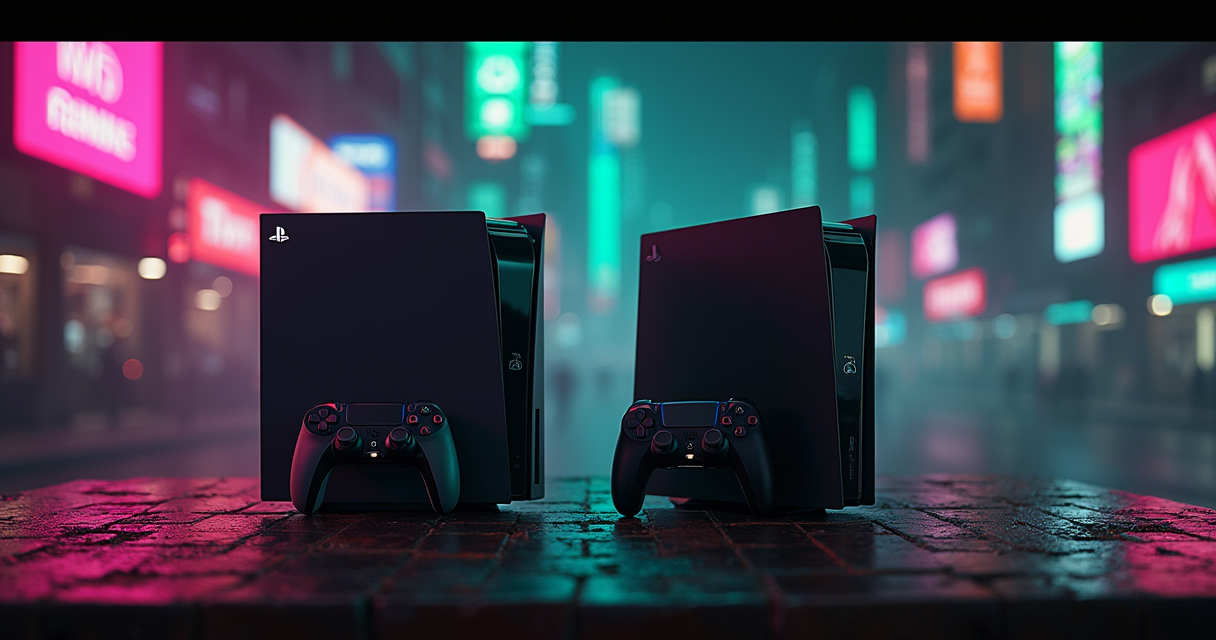
On April 2, 2026, at one minute past midnight local time, the PlayStation 5 Pro became a $899.99 machine. That is not a bundle price, and it is not a typo. That is the box, alone, with no disc drive, no vertical stand, and no game inside it. Add back the parts Sony once considered standard equipment and you clear a thousand dollars for a console whose central processor is functionally identical to the $599.99 model sitting one shelf over.
This is a comparison piece, so let us be precise about what is actually being compared. The PS5 Pro is not competing against some platonic ideal of a mid-generation refresh. It is competing against three concrete alternatives that exist in the same store: the base PS5 that does roughly ninety percent of what it does for two-thirds of the money, the Xbox Series X that is about to become $150 more expensive in its own right on August 1, and the gaming PC that a certain segment of the internet will not stop recommending. It is also, whether Sony enjoys the comparison or not, competing with its own ancestor — the PS4 Pro of 2016, the machine that invented this entire category and then quietly demonstrated that mid-gen "Pro" hardware is, more than anything, a tax on impatience.
We have read the spec sheet, sat through the Cerny technical seminar, digested the Digital Foundry teardown, and collated the review roundup. We have also done the arithmetic Sony would prefer you skipped. Here is where the PS5 Pro genuinely lands in the summer of 2026, and who — if anyone — should be handing over nine hundred dollars for it.
The Pitch: What $899.99 Buys
Strip away the marketing and the PS5 Pro is one thing wearing three coats of paint: a bigger graphics processor bolted to a machine-learning upscaler. Everything worth paying for flows from those two facts. Everything the box does not improve flows from what Sony left untouched.
The three-sentence version
The Pro ships with 60 graphics compute units against the base console's 36, which Sony rounds up to "67% more." It pushes 16.7 teraflops of FP32 throughput versus 10.28, feeds that silicon with 576 GB/s of memory bandwidth versus 448, and stores your library on a 2TB SSD instead of 1TB. Sony's headline claim is up to 45% faster rendering, roughly double the ray-tracing throughput, and a first-party AI upscaler called PlayStation Spectral Super Resolution. That is the pitch, and on a large, close, high-refresh display, it is a real and visible pitch.
What it does not change
Here is the part the storefront copy buries. The PS5 Pro uses the same eight-core AMD Zen 2 CPU as the launch PS5. Sony added a "High CPU Frequency Mode" that nudges the clock from 3.5 GHz to about 3.85 GHz — a roughly ten percent bump you can toggle at the cost of a little GPU headroom — but the underlying processor is the 2020 part. That means anything bottlenecked by simulation, physics, AI routines, or draw calls rather than pixels does not meaningfully improve. It also uses the same custom 5.5 GB/s SSD controller, so load times are identical to the second. The Pro loads Marvel's Spider-Man 2 in the same fraction of a second the base console does. If you want the generational leap in loading, you already got it three years ago — a story we told in full in our PS5 versus PS4 SSD breakdown. The Pro adds pixels and lighting. It does not add speed anywhere the CPU or storage is the wall.
The disc-drive asterisk
The $899.99 machine cannot play a disc out of the box. Sony sells the detachable Ultra HD Blu-ray Disc Drive separately for $79.99, and it does not include a vertical stand in the carton either — that is another accessory. A Pro configured to match what a $649.99 disc PS5 does natively runs $979.98 before you have bought a single game. Digital Foundry, reviewing the console, made exactly this point: once you tally the base unit plus the drive plus the stand, the package stops resembling anything the word "console" used to describe. Hold that number. We will do the full arithmetic later, and it is not flattering.
The Lineage: 'Pro' Consoles Since 2016
Nothing about the PS5 Pro is unprecedented, and the precedent is instructive. The mid-generation refresh is a decade old now, and its track record is the single most useful data point you have when deciding whether to buy the current one.
The PS4 Pro precedent
The PlayStation 4 Pro launched on November 10, 2016, at $399.99. It carried 4.2 teraflops of graphics throughput against the base PS4's 1.84 — a larger multiplier on paper than the PS5 Pro offers over its base, incidentally — and it used that power to approximate 4K through checkerboard rendering rather than rendering natively at that resolution. There was no machine-learning upscaler; the technology did not exist in a shippable console form. A year later, Microsoft answered with the Xbox One X at $499.99 and six teraflops, marketing genuine native-4K in a handful of titles. Between the two of them, in the span of about thirteen months, the mid-gen "Pro" console was born as a product category. We covered how that particular console war actually resolved in our PS4 versus Xbox One retrospective, and the short version is that raw teraflops did not decide it.
What "Pro" has always meant
Across both generations the meaning of the badge has been stable: optional, aimed at the top of the market, never required to play anything. No PS4 Pro game refused to run on a base PS4. No PS5 Pro game refuses to run on a base PS5. The Pro is a fidelity tier, not a platform. That is the deal Sony has offered twice now, and it is worth internalizing before you read a single benchmark, because it reframes the entire question. You are never asking "can I play this" — the answer is always yes on the cheaper box. You are asking "is the difference in how it looks worth the difference in what it costs."
The console that got more expensive with age
Here is the genuinely novel thing about the PS5 era, and it is a small piece of history quietly inverting itself. Consoles used to get cheaper. The Super Nintendo launched at $199 in 1991 and fell from there. The PlayStation 2 opened at $299 and eventually reached $99. Price cuts were the rhythm of a console's life — the hardware got cheaper to build, the install base needed widening, and the sticker dropped on a schedule you could almost set a watch to. The PlayStation 5 is the first PlayStation in history to move the other direction. It has taken three U.S. price increases: a launch-era digital bump, the $50 hike across the line in August 2025, and the April 2026 increase that put the Pro at $899.99. A console that costs more in year five than it did at launch is not a rounding error. It is a structural shift, and we will get to why it happened.
The Spec Sheet: PS5 Pro vs the Field
Numbers first, interpretation second. Below is the honest three-way comparison against the two machines a $900 buyer actually cross-shops: the base PlayStation 5 and the Xbox Series X. Prices reflect the United States as of July 2026, mid-price-war, with the imminent Xbox increase flagged.
| Feature | PS5 Pro | PS5 (base) | Xbox Series X |
|---|---|---|---|
| Released | Nov 7, 2024 | Nov 12, 2020 | Nov 10, 2020 |
| Price (Jul 2026, US) | $899.99 | $649.99 disc / $599.99 digital | $649.99 disc (→$799.99 Aug 1) |
| GPU architecture | Custom RDNA 2 + RDNA 3/4 features | Custom RDNA 2 | Custom RDNA 2 |
| Compute Units | 60 | 36 | 52 |
| GPU throughput (FP32) | 16.7 TFLOPS | 10.28 TFLOPS | 12.155 TFLOPS |
| CPU | 8-core Zen 2, up to 3.85 GHz | 8-core Zen 2 @ 3.5 GHz | 8-core Zen 2 @ 3.8 GHz |
| System memory | 16GB GDDR6 + 2GB DDR5 | 16GB GDDR6 | 16GB GDDR6 |
| Memory bandwidth | 576 GB/s | 448 GB/s | 560 GB/s (split 560/336) |
| Ray tracing | ~2–3× base PS5 | baseline | PS5-class |
| AI upscaling | PSSR / PSSR 2.0 | none | none (game-side FSR only) |
| Internal SSD | 2TB | 1TB | 1TB |
| SSD raw throughput | 5.5 GB/s | 5.5 GB/s | 2.4 GB/s |
| Optical drive | none (optional $79.99) | built in (disc SKU) | built in (disc SKU) |
| Wi-Fi | Wi-Fi 7 | Wi-Fi 6 | Wi-Fi 5 |
| Max output | 4K/120, 8K (nominal) | 4K/120, 8K (nominal) | 4K/120, 8K (nominal) |
| Backward compat | PS4 + PS5, Pro Game Boost | PS4 + PS5 | OG Xbox / 360 / One |
| Launch MSRP | $699.99 | $499.99 / $399.99 | $499.99 |
Reading between the rows
Run your eye down the CPU and SSD rows and the whole thesis of the Pro appears. The processor row is nearly flat across all three columns — everyone is on Zen 2, and the Pro's advantage is a mode, not a chip. The SSD raw-throughput row shows the Pro tied with the base PS5 at 5.5 GB/s and both comfortably ahead of the Xbox's 2.4 GB/s, but the Pro has no storage-speed edge over the console it is meant to replace. This is why a CPU-heavy title behaves the same on a Pro as on a base PS5, and why nothing loads faster. The Pro is a GPU story told in a CPU-and-storage-neutral sentence.
Where the Pro genuinely pulls ahead
The four rows that matter are compute units, FP32 throughput, memory bandwidth, and ray tracing — and there the gaps are real: 60 CUs to 36, 16.7 teraflops to 10.28, 576 GB/s to 448, and roughly double-to-triple the ray-tracing capability. That is a legitimate, measurable rendering advantage, not a marketing invention. The Pro also edges the field on connectivity with Wi-Fi 7 against the base PS5's Wi-Fi 6 and the Xbox's aging Wi-Fi 5, though that matters mainly for large downloads and remote play, not local rendering.
The Xbox column's asterisk
Note the Series X price row carefully. Today it undercuts the Pro by $250 while offering a built-in disc drive and, for many players, the more forgiving economics of Game Pass. But that $649.99 has a fuse on it: Microsoft has confirmed a $150 increase for 1TB models effective August 1, 2026, which pushes the disc Series X to $799.99 and the digital model to $749.99. The 2TB special edition is being discontinued outright. So the value gap you see today is the widest it will be all year — and it is closing on a schedule.
PSSR: The Feature You Pay For
Strip out the resolution charts and the ray-tracing demos and one feature is doing the heavy lifting in Sony's pitch: PlayStation Spectral Super Resolution. It is the only thing on the Pro that the base console will never, ever have, and it is therefore the honest core of the value proposition.
What PSSR actually is
PSSR is Sony's first-party machine-learning upscaler. Games render internally at a lower resolution — say 1080p or 1440p — and a lightweight convolutional neural network, running on dedicated silicon inside the Pro's GPU, reconstructs the image up to 4K in real time. Conceptually it is Sony's answer to Nvidia's DLSS and AMD's FSR: spend transistors on inference instead of brute-force rasterization, and buy back the frame rate or fidelity that native 4K would have cost. When it works, you get a sharper, more stable image than the base PS5's simpler upscaling can produce, and you often get it while the ray tracing stays switched on. When it works poorly — and early titles had visible artifacts, shimmer, and ghosting — you get a different set of problems than native rendering, not zero problems.
PSSR 2.0 and Project Amethyst
The technology moved in 2026. On March 16, Sony shipped a system-level update introducing an upgraded model, widely referred to as PSSR 2.0, built on a fork of AMD's FSR 4 and developed under the joint Sony–AMD machine-learning effort Mark Cerny announced as Project Amethyst. Cerny, unveiling the collaboration, said he was "honored to announce that we have begun a deeper collaboration with a focus on Machine Learning-based technology for graphics and gameplay." Describing the updated upscaler's efficiency, he noted it runs "something like 100 microseconds faster than the original" — a saving that let Sony add a global Enhance PSSR Image Quality toggle that force-upgrades supported titles to the newer model without a per-game patch, as TechRadar detailed at length. You enable it here:
Settings
  > Screen and Video
    > Video Output
      > Enhance PSSR Image Quality  [On]

      # Force-upgrades PSSR-supported titles to the newer
      # ML model. Added in the PSSR 2.0 system update,
      # March 16, 2026. No per-game patch required.
By spring 2026 the Pro counted more than 100 "PS5 Pro Enhanced" titles — around 107 by February, per Newsweek's running tally — of which roughly 70-plus specifically use PSSR; the rest lean on higher fidelity presets, steadier frame pacing, or extra ray tracing. If you want to know exactly which games are patched, the TechRadar enhanced-games list is the maintained reference. We walked through the update itself in our PSSR 2.0 update guide.
The catch: the base PS5 can never have it
This is the crux, and it is a hardware fact rather than a software decision. PSSR runs on machine-learning acceleration blocks that physically do not exist in the base PS5 or the Xbox Series X. No firmware update, no clever patch, no goodwill from Sony will ever bring PSSR to a 2020 console — the silicon is not there. So when you pay the Pro premium, you are not buying more of something the cheaper box has a little of. You are buying the only thing it structurally cannot do. Whether that single exclusive capability justifies $300 depends entirely on your screen, which is where the benchmarks come in.
The Benchmarks: 45% on Paper
Console benchmarking is messier than PC benchmarking because there is no built-in frame counter and no universal test suite — you are stuck triangulating between the manufacturer's own claims, careful third-party capture, and critical consensus. Here is the honest picture from three source types: Sony's official figures, Digital Foundry's measured captures, and the review roundup.
The official numbers
Sony and Cerny's own presentation gives you the ceiling, not the average. Treat these as best-case marketing figures with real engineering behind them:
| Metric | Base PS5 | PS5 Pro | Delta | Source |
|---|---|---|---|---|
| Compute Units | 36 | 60 | +67% | Sony / Cerny |
| FP32 throughput | 10.28 TFLOPS | 16.7 TFLOPS | +62% | Sony |
| Memory bandwidth | 448 GB/s | 576 GB/s | +29% | Sony / Cerny |
| Rendering (Sony claim) | 1.0× | ~1.45× | +45% | Sony |
| Ray tracing | 1.0× | ~2–3× | up to +200% | Cerny |
| CPU clock | 3.5 GHz | up to 3.85 GHz | +10% (mode) | Sony |
| SSD raw throughput | 5.5 GB/s | 5.5 GB/s | 0% | Sony |
| Load times | baseline | same | 0% | Digital Foundry |
Notice what the bottom two rows do to the top of the table. The GPU deltas are genuine, but the CPU and storage rows are flat, which means the 45% figure is a rendering number and nothing else. In practice it most often shows up as one of two things: a game that ran at a wobbly 4K/30 fidelity mode on base hardware now holding a locked 4K/60, or a game that had to choose between resolution and ray tracing now getting both. It rarely shows up as a game that plays fundamentally differently.
What reviewers measured
Digital Foundry, who capture frame-time data game by game, landed on a recommend-with-caveat verdict: if you want the single best-performing console on the market, the Pro is unambiguously it — higher fidelity presets, steadier frame rates, and PSSR headroom the others cannot match — but they were blunt that the base-plus-drive-plus-stand pricing makes it a hard sell as a traditional console. The critical roundup tells the same story with more friction. IGN scored it 7 out of 10 and summarized the whole machine in one sentence: "the PS5 Pro isn't essential, but it is certainly nice to have." You can read the full spread of scores in Metacritic's review roundup, and a year on, Kotaku's retrospective pitched it squarely at the "detail-obsessed" enthusiast rather than the average player — a phrase that does more honest marketing work than anything on Sony's box.
The viewing-distance problem
The most quoted line from the launch reviews is also the most useful, and it comes from The Verge: for anyone sitting the typical ten feet from a 55-to-65-inch television, "the PS5 Pro is probably not worth $700," because "the improved visual fidelity just isn't tangible enough at that distance." That was the verdict at $700. The console now costs $899.99. The physics of human vision did not change between 2024 and 2026; the price did. The Pro's advantages — reconstruction sharpness, cleaner ray-traced reflections, denser fidelity presets — are real, and they are also angular. They resolve on a large panel viewed close. They dissolve on a normal panel viewed from a couch. Your seating chart is, unglamorously, the single most important benchmark in this entire article.
The 2026 Price War
You cannot evaluate the Pro's price in isolation, because in 2026 no console has a stable price. The entire industry is repricing hardware upward in real time, for reasons that have nothing to do with the machines themselves.
The pricing table
Here is the full ladder as it stands in July 2026, with historical launch figures for context and the pending Xbox change flagged.
| Model | Launch MSRP | Jul 2026 US price | Disc drive | Notes |
|---|---|---|---|---|
| PS5 Pro | $699.99 (Nov 2024) | $899.99 | +$79.99 add-on | +$50 Aug 2025, +$150 Apr 2, 2026 |
| PS5 Standard (Disc) | $499.99 | $649.99 | built in | +$100 Apr 2026 |
| PS5 Digital | $399.99 | $599.99 | none (+$79.99) | +$100 Apr 2026 |
| UHD Blu-ray Drive | $79.99 | $79.99 | — | required for discs on Pro/Digital |
| Xbox Series X (Disc) | $499.99 | $649.99 | built in | → $799.99 on Aug 1, 2026 |
| Xbox Series X Digital | $449.99 | $599.99 | none | → $749.99 on Aug 1, 2026 |
| PS4 Pro (historical) | $399.99 (Nov 2016) | discontinued | built in | the precedent |
The DRAM shortage and the AI squeeze
The reason every row in that table points upward is not greed in the ordinary sense — it is memory. Sony's own explanation for the April increase cited "continued pressures in the global economic landscape," but the specifics behind that phrasing are DRAM spot prices running roughly 60% higher year over year, driven by AI data centers consuming memory-chip supply faster than fabs can produce it, layered on top of a 25% U.S. tariff on advanced semiconductors. Microsoft, announcing its own August hike, was unusually candid about the mechanism. Console storage and memory prices, it said, "have increased by more than 2.5x and we expect another doubling by the fall of 2027," adding the quiet part out loud: "consoles are typically not sold at a profit, but instead for less than they cost to make." When the loss-leader starts losing too much, the sticker moves. Sony's own March 27 pricing announcement extended the same logic to the PlayStation Portal as well. This is a supply-chain story wearing a retail-price costume, and it is why a five-year-old console costs more today than it did new.
The true cost of a 'complete' Pro
Now the arithmetic Sony's product page never assembles in one place. A Pro that can do what a disc PS5 does — play a disc — is not $899.99.
PS5 Pro (console).................. $899.99
+ Ultra HD Blu-ray Disc Drive..... $ 79.99
----------------------------------------------
Disc-capable PS5 Pro.............. $979.98

PS5 Standard (disc built in)...... $649.99
----------------------------------------------
The Pro badge costs you........... $329.99   (a ~51% premium)

Versus PS5 Digital ($599.99):
  Pro premium (console only)...... $300.00   ("300 dearer")
Three hundred dollars over the cheapest PS5, or three hundred and thirty over the disc model once you can actually use a disc. For a full breakdown of exactly where that $300 goes frame by frame, we ran the numbers in our dedicated PS5 Pro vs base PS5 comparison. The premium is not imaginary and it is not indefensible — it is just large, and it buys a category of improvement that only some rooms can see.
Who Each Machine Is For
Enough abstraction. Here are the concrete scenarios, mapped to the machine that actually wins each one. This is the section to read if you have already decided you are buying something and just need to know what.
| Scenario | Best pick | Why |
|---|---|---|
| 65"+ 4K/120 OLED, sit within ~6 ft | PS5 Pro | PSSR sharpness and ray tracing resolve at that angular pitch |
| 1080p set, or 4K TV viewed 8+ ft away | Base PS5 | The uplift is not resolvable at distance; you'd pay for pixels you can't see |
| Ray-tracing / graphics obsessive | PS5 Pro | ~2–3× RT throughput and higher fidelity presets, both on at once |
| PSVR2 owner | PS5 Pro | GPU headroom feeds higher-fidelity VR modes the base box can't sustain |
| Value-first, plays broadly, likes Game Pass | Xbox Series X | Library economics — but the +$150 hike lands Aug 1, so decide now |
| Curious about PC / handheld freedom | PC or handheld | Open library and upgradability; see the trade-offs below |
| Loves sim / CPU-bound / load-time-sensitive games | Any PS5 | The Pro changes neither the CPU nor the SSD; save the $300 |
Buy the Pro if you own the display for it
The Pro's ideal customer is specific and real: someone with a large, recent, high-refresh 4K panel — ideally OLED — who sits close enough to resolve fine detail and cares about it. Kotaku's "detail-obsessed" framing is the honest target demographic. If you have spent more on your television than on your console, the Pro is the machine that finally justifies the TV. If PSVR2 is in your setup, the argument gets stronger still, because virtual-reality rendering is exactly the GPU-bound, headroom-hungry workload the Pro was built to feed.
Buy the base PS5 if you are most people
The base PS5 — and specifically the $649.99 disc model, since the digital model plus a drive costs more than the disc model — is the correct choice for the overwhelming majority. It plays every identical game, loads them in the identical time, and delivers what The Verge accurately called a difference that "isn't tangible enough" from a normal couch. Nobody has ever regretted buying the cheaper console and spending the $300 on games.
Buy something else if the ecosystem isn't the point
If your loyalty is to a library rather than a logo, the Xbox Series X remains a strong value today and a weaker one after August 1. And if you have started eyeing the open, upgradable, take-it-anywhere world of PC handhelds, that is a genuinely different value equation — one we mapped in our ROG Ally X versus Steam Deck OLED comparison. None of those paths is wrong. They are just answers to a different question than "which PlayStation."
Pros and Cons, Machine by Machine
The scannable summary. No hedging, no marketing adjectives — just the ledger for each box as it stands in July 2026.
| Option | Pros | Cons |
|---|---|---|
| PS5 Pro ($899.99) | Best console visuals available; PSSR / PSSR 2.0 exclusive; 2TB SSD; ~2–3× ray tracing; Wi-Fi 7; real VR headroom | $899.99 before a disc drive; no optical drive in box; same CPU as base; identical load times; ~51% premium for a disc-capable unit |
| PS5 Standard, Disc ($649.99) | Disc drive built in; plays every identical game; identical load speed; $250–300 cheaper; the value default | 1TB storage; no PSSR, ever; lower fidelity / RT presets in the most demanding titles |
| PS5 Digital ($599.99) | Cheapest way into the PS5 library | No disc drive, and the $79.99 add-on erases the savings versus the disc model; 1TB; no PSSR |
| Xbox Series X ($649.99 → $799.99) | Disc drive; Game Pass economics; excellent backward compatibility; strong value today | +$150 on Aug 1, 2026; no PSSR-equivalent; slower raw SSD; platform exclusives narrower for some players |
The pattern in the ledger
Read the four rows together and one shape emerges: every "pro" for the Pro is a fidelity feature, and every "con" is a price or an omission. Every "pro" for the base PS5 is a value or a parity feature, and its "cons" are all things you only notice on the right screen. That is not an accident of how we wrote the table — it is the actual structure of the decision. You are trading dollars for pixels, and the exchange rate depends on your eyes and your room.
Migration: Base PS5 to Pro
Say you have decided. You own a base PS5, you have bought the Pro, and now you have to move five years of library, saves, and settings without losing anything. It is genuinely painless if you do it in the right order.
The data transfer
The fastest path is console-to-console over your local network — ideally a wired connection between both machines, because Wi-Fi will turn a one-hour job into an afternoon. Have both consoles on, signed into the same account, and updated first.
# Console-to-console (fastest path)
1. Connect BOTH PS5s to the same network — LAN cable strongly advised
2. On the Pro: Settings > System > System Software > Data Transfer
3. Select the source console, then choose games / saves / settings
4. Wired, ~1TB library: roughly 30-60 min. Wi-Fi: allow hours.

# Alternative: extended USB SSD
1. On the old PS5: move titles to a USB-attached SSD
   (Settings > Storage > Games and Apps)
2. Physically move the drive to the Pro
3. Copy PS5-native titles back onto the internal 2TB as desired

# Cloud saves (belt and braces)
- PS Plus members: confirm saves are uploaded before you wipe
  the old console (Settings > Saved Data and Game/App Settings)
What to check after
Once the transfer finishes, three quick confirmations save you future confusion. Enable the upscaler explicitly — Settings > Screen and Video > Video Output > Enhance PSSR Image Quality — because it is the whole reason you upgraded and it is worth verifying it is on. Check that the 2TB drive reports its expected roughly 1.86TB of usable space after formatting overhead. And if any transferred title stutters on its first few loads, a rebuild clears it up; the procedure is our PS5 cache-clear and rebuild walkthrough, which lives under Safe Mode Option 6.
Selling the old one
Before you trade the base PS5 in, do the math on what it is actually worth in a year when new consoles are getting more expensive. Scarcity and rising new-unit prices have propped up used-console values, which is good news for your trade-in — but always deactivate the old console as your primary system and factory-reset it after you have confirmed the transfer succeeded, never before. A wiped console you cannot re-download to is a $650 paperweight until support intervenes.
The Verdict: Best Console Nobody Needs
The PS5 Pro is the best-performing console you can buy, and that sentence is doing a lot less work than Sony would like.
The recommendation
For the buyer weighing $899.99 against $649.99, the data-backed answer is that most people should buy the base PS5 and keep the $300. The Pro's advantages are real, measurable, and — critically — invisible from a normal couch on a normal television, which is where the overwhelming majority of these consoles are actually used. The base PS5 loads every game just as fast, plays every game at all, and costs a third less. Every serious reviewer, from IGN's "not essential" to The Verge's "probably not worth it," arrived at some version of the same conclusion, and they arrived at it when the Pro was $200 cheaper than it is now.
The one buyer it is right for
There is exactly one profile for whom the Pro is the correct purchase, and it is not a compromise for them — it is the obvious choice. Large, recent, high-refresh 4K OLED. Close seating. A real appetite for ray tracing and reconstruction detail. Possibly a PSVR2 headset in the mix. For that person, PSSR is a capability nothing else on the shelf can match, the base console genuinely leaves fidelity on the table, and $300 for the best version of a hobby they clearly take seriously is an easy line item. If that is you, buy it without guilt. If you had to read that sentence twice to see yourself in it, it is not you.
The asterisk on everything
Two moving parts should shape your timing. First, the Xbox Series X becomes $150 more expensive on August 1, 2026, which means the cross-platform value comparison you make today expires in weeks — if an Xbox was ever your alternative, that decision has a deadline. Second, this is a mid-generation machine, and the mid-generation is, by definition, the middle. The PS5 Pro's job is to hold the top of the current generation until the next one arrives, and its lineage — the PS4 Pro that preceded it, the whole "Pro" project we traced earlier — tells you exactly how these stories end: with a good machine, fairly priced against its rivals, that almost nobody actually needed, gradually eclipsed by the console that comes after. The PS5 Pro is a very good console. It is also, in the most literal accounting, the best console nobody needs. Buy accordingly.
Questions the search bar asks me
- How much is the PS5 Pro in 2026?
- As of July 2026 the PS5 Pro is $899.99 in the US, after a +$150 increase on April 2, 2026 (up from $749.99). It ships without a disc drive; the Ultra HD Blu-ray Disc Drive is a separate $79.99, so a disc-capable Pro is effectively $979.98. The base PS5 is $649.99 (disc) or $599.99 (digital).
- Is the PS5 Pro worth it over the base PS5?
- For most people, no — it depends heavily on screen size and viewing distance. The Pro delivers a ~45% GPU uplift and exclusive PSSR upscaling, but IGN scored it 7/10 as "not essential, but nice to have," and The Verge called it "probably not worth $700" for anyone sitting ~10 feet from a normal TV. It's worth it only on a large, close, high-refresh 4K display.
- Does the PS5 Pro load games faster or have a better CPU?
- No. The Pro uses the same 8-core Zen 2 CPU as the base PS5 (with a modest optional 'High CPU Frequency Mode' up to ~3.85 GHz) and the identical 5.5 GB/s SSD. Load times are the same to the second, and CPU-bound games don't meaningfully improve. The Pro is purely a GPU and AI-upscaling upgrade.
- What is PSSR and can the base PS5 get it?
- PSSR (PlayStation Spectral Super Resolution) is Sony's machine-learning upscaler; PSSR 2.0 shipped March 16, 2026 as a fork of AMD FSR 4 under the Sony–AMD Project Amethyst. The base PS5 and Xbox Series X can never have it — it runs on dedicated ML hardware that only the Pro contains. Over 100 titles are 'PS5 Pro Enhanced,' with 70-plus using PSSR.
- Why did the PS5 Pro and Xbox Series X get more expensive in 2026?
- A global memory-chip shortage. DRAM spot prices are running ~60% higher year over year as AI data centers consume supply, layered on a 25% US tariff on semiconductors. Microsoft stated console memory and storage prices "have increased by more than 2.5x" and hiked the Xbox Series X +$150 (to $799.99) effective August 1, 2026, mirroring Sony's April increase.

Jordan covers the modern industry where it touches the old one: Nintendo announcements, handheld hardware, and the long shadow the classics cast over new releases. Every post under this byline is reviewed pre-publish by Sam P., Editor & Operator — corrections to info@instalinkoteam.com. Published 2026-08-29 · Last updated 2026-08-29. Full bios on the author page.