/// FIELD NOTES FROM A SELF-AWARE GAME SITE
PS5 Pro vs PS5 2026: $900 vs $600, 45% Faster
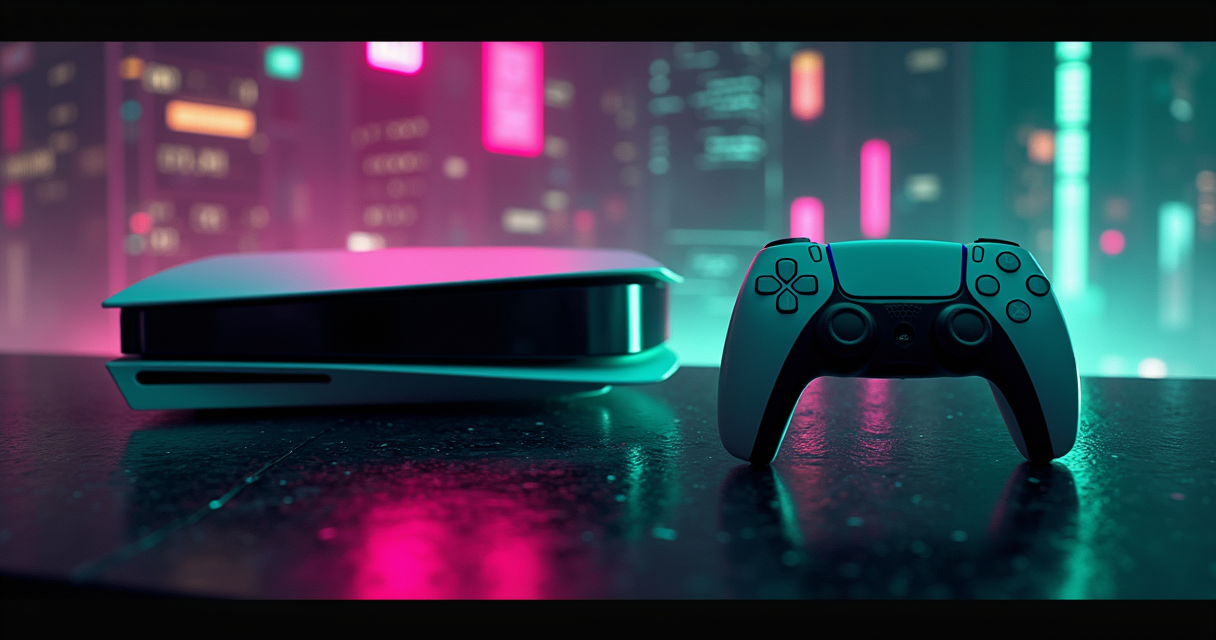
Sony sells two PlayStation 5s that play the identical games, run the identical operating system, and use the identical controller. One costs $599.99. The other costs $899.99, and that is before you add the disc drive. The pitch for the extra $300 is a single sentence: roughly 45% more rasterization performance and an AI upscaler called PSSR. Everything else in this comparison is a footnote to that sentence.
This is a mid-generation refresh, a thing Sony has done exactly once before — the PS4 Pro in 2016 — and the playbook has not changed. Same CPU, a much bigger GPU, a marketing deck full of percentages, and a price that asks you to care about pixels more than you probably do. What has changed since November 2024 is the number on the box. The Pro launched at $699.99. It is now $899.99, following two separate price increases driven by tariffs and a RAM shortage that has nothing to do with how many polygons the machine can push. That context matters, because the value math is entirely different at $900 than it was at $700.
So we are going to do the whole autopsy: the silicon, the spec sheet, the pricing history, what “45% faster” actually buys you in a real game, what the critics who reviewed both machines actually wrote, and — the only question that matters — whether you specifically should spend the money. The short version is at the top, because you deserve that. The long version is everything after it.
The Verdict, Up Front
The one-sentence answer
Buy the base PS5 (Digital at $599.99, or disc at $649.99). The PS5 Pro at $899.99 is a genuinely better machine that almost nobody genuinely needs, and it earns its premium only in a narrow set of conditions that most buyers do not meet. This is not the conclusion of a hater. It is the conclusion of nearly every outlet that reviewed both consoles, and it is the conclusion the price increases have only sharpened.
Those conditions, stated plainly: you own a 4K TV that is good enough to show the difference (ideally OLED or a high-end LED with proper HDR), you sit close enough to see it, you play graphically demanding single-player games rather than competitive shooters that are locked at high frame rates anyway, and $300 is discretionary money you will not miss. Meet all four and the Pro is defensible. Miss any of them and you are paying a 50% premium for upscaling improvements you will need a freeze-frame and a magnifying glass to appreciate.
Who should stop reading and buy the base PS5
If you play mostly online multiplayer, if your TV is 1080p or a budget 4K set, if you sit ten feet back on a couch, if you are buying your first PS5, or if the phrase “checkerboard reconstruction” makes your eyes glaze — you are done. Buy the cheapest PS5 with the storage you want, put the $300 toward games, a bigger SSD, or a PS Plus subscription, and never think about this again. Ars Technica said the quiet part out loud in its review: for most people, the money is better spent on games or PlayStation Plus. That was true at $700. It is more true at $900.
Who the Pro is actually for
The Pro is for the enthusiast who already owns a base PS5, has a 65-inch OLED, has finished more games in fidelity mode than performance mode, and is annoyed — genuinely, viscerally annoyed — that a game like Final Fantasy VII Rebirth looks soft in its 60fps mode. That person exists. That person will love this console. That person is not most people, and Sony's own reviewers spent November 2024 saying so. Kotaku's review put it precisely: the Pro is “really for the detail-obsessed gamers willing to spend $700 to make already great-looking games look even better on their big 120hz TVs.” Swap $700 for $900 and the sentence still parses. It just stings more.
What Changed, and What Didn't
The GPU is the entire product
Everything you are paying for lives in the graphics processor. The base PS5 ships a custom RDNA 2 GPU with 36 compute units producing 10.28 TFLOPS. The Pro ships a custom GPU with 60 compute units producing roughly 16.7 TFLOPS. That is 67% more compute units and about 62% more raw floating-point throughput. Sony translates that headroom into a claim of roughly 45% faster rasterization — and the gap between raw TFLOPS and real-world rasterization is normal, because games are bottlenecked by more than shader math.
The architecture is the interesting part. Sony describes the Pro's GPU as a custom design with newer ray-tracing and machine-learning features grafted on — effectively RDNA 2's foundation with RDNA 3-class and forward-looking RDNA 4-class hardware bolted in where it counts, specifically ray-tracing acceleration and the ML silicon that powers PSSR. The base PS5 has none of that ML hardware, which is why PSSR is physically impossible on it and will never come to it. This is not a software lockout you can jailbreak around. The transistors are simply not there.
The 2GB DDR5 sidecar nobody mentions
Both consoles carry 16GB of GDDR6 as their main memory. The Pro adds a separate 2GB of DDR5 whose entire job is to hold the operating system, the background OS, and system tasks — so that the full 16GB of fast GDDR6 stays available to the game instead of being nibbled away by the OS. It is a small, clever, deeply unglamorous change, and it is the kind of thing that tells you Sony's engineers were fighting for every megabyte of usable game memory. The Pro also runs its GDDR6 faster, widening memory bandwidth, which matters more at 4K than any single line on the box.
What is byte-for-byte identical
The CPU is the same 8-core Zen 2, give or take a high-frequency mode that nudges the clock. The DualSense controller is the same. The game library is the same — every PS5 game runs on both, and there are zero Pro-exclusive games, only Pro-enhanced patches for existing ones. Backward compatibility with the 8,500-plus PS4 catalog is the same, with the Pro applying Game Boost for steadier frame rates on older titles. The user interface, the account system, Remote Play, the whole software surface — identical. If you set the two consoles side by side and played a non-enhanced game, you could not tell them apart. That is the point worth sitting with: you are buying a GPU upgrade wearing a console's clothes.
The Full Spec Sheet
Every number that differs, in one table
Here is the complete comparison. Rows where the two consoles are identical are marked as such, because in a $300 decision the sameness is as important as the difference. Prices are the July 2026 US figures.
| Spec | PS5 (base / Slim) | PS5 Pro | Advantage |
|---|---|---|---|
| Launch date | Nov 12, 2020 | Nov 7, 2024 | — |
| Launch price (US) | $499.99 disc / $399.99 digital | $699.99 | PS5 |
| Price (July 2026) | $649.99 disc / $599.99 digital | $899.99 (digital-only) | PS5 |
| GPU compute units | 36 CUs | 60 CUs | Pro (+67%) |
| GPU throughput | 10.28 TFLOPS | ~16.7 TFLOPS | Pro (+62%) |
| GPU architecture | Custom RDNA 2 | Custom RDNA (RDNA 3/4-class RT + ML) | Pro |
| Rasterization | Baseline | ~45% faster (Sony) | Pro |
| Ray tracing | Baseline | Up to ~2× faster (Sony) | Pro |
| AI upscaling | None (checkerboard / FSR) | PSSR (updated “PSSR 2,” Mar 2026) | Pro |
| System memory | 16GB GDDR6 | 16GB GDDR6 + 2GB DDR5 | Pro |
| Storage | 1TB SSD | 2TB SSD | Pro |
| CPU | 8-core Zen 2 | 8-core Zen 2 (high-freq mode) | Tie |
| Wi-Fi | Wi-Fi 6 | Wi-Fi 7 | Pro |
| Bluetooth | 5.1 | 5.1 | Tie |
| Disc drive | Included (disc model) | Sold separately ($79.99) | PS5 |
| Dimensions | 358 × 97 × 224 mm | 388 × 89 × 216 mm | — |
| Weight | ~3.1 kg | ~3.2 kg | — |
| Game library | Every PS5 game | Every PS5 game | Tie |
| PS4 back-compat | 8,500+ titles | 8,500+ titles (Game Boost) | Pro |
| DualSense controller | Same | Same | Tie |
The rows that actually move the needle
Ignore fifteen of those rows. Four decide the purchase: GPU compute (60 vs 36 CUs), PSSR (present vs physically absent), storage (2TB vs 1TB), and price ($899.99 vs $599.99). Wi-Fi 7 is a rounding error unless you have a Wi-Fi 7 router and a reason to stream 4K over wireless. The DDR5 sidecar is invisible in use. The dimensions are a furniture problem, not a gaming one. If you are building a spreadsheet, delete every row except those four and the decision gets honest fast. Everything else is the same console.
The disc-drive asterisk
Note the disc-drive row carefully. The base PS5 disc model includes a disc drive in its $649.99 price. The Pro does not include one at all — it is digital-only out of the box, and if you own physical games or want 4K Blu-ray playback, you add the detachable drive for $79.99. So the honest Pro-versus-disc-PS5 comparison is $979.98 against $649.99: a $330 gap, not the $250 the sticker implies. Digital Foundry flagged exactly this, noting that a Pro plus drive plus vertical stand “doesn't really feel like what consoles were.” It is a fair complaint. Consoles used to come with everything in the box.
The Pricing Reality, July 2026
How $700 became $900 in eighteen months
The Pro's price is the whole story of this comparison, so here is the timeline, sourced to Sony's own blog and the mainstream financial press.
| Date | PS5 Digital | PS5 disc | PS5 Pro | Trigger |
|---|---|---|---|---|
| Nov 2020 (launch) | $399.99 | $499.99 | — | Generation launch |
| Nov 7, 2024 | $449.99 | $499.99 | $699.99 | Pro launch |
| Aug 21, 2025 | $499.99 | $549.99 | $749.99 | US tariffs |
| Apr 2, 2026 | $599.99 | $649.99 | $899.99 | RAM shortage + tariffs |
| Add-on | — | — | Disc drive +$79.99 | — |
Read that bottom-to-top and the base PS5 has climbed $200 since its own 2020 launch, while the Pro has climbed $200 since its 2024 launch — in under nineteen months. Sony's official explanation for the April 2026 increase, quoted directly from the PlayStation Blog: “With continued pressures in the global economic landscape, we've made the decision to increase the prices of PS5, PS5 Pro, and PlayStation Portal remote player globally.” Translation: tariffs on imported electronics and a memory-market squeeze driven by AI data-center demand for RAM, a dynamic CNN traced through the 2025 hike as well. None of it is about the console getting better. It is the same silicon at a higher toll.
The disc drive and stand tax
Budget for the Pro honestly and the number keeps climbing. The console is $899.99. The disc drive, if you want it, is $79.99. There is no included stand for owners who want the console horizontal — that is another accessory. Round it up and a “complete” Pro that matches what a disc-model PS5 does out of the box lands near $980 to $1,000 before a single game. That is not a console price anymore; it is entry-level gaming-PC territory, and it is the comparison the Pro increasingly loses. A $1,000 machine with a fixed, non-upgradeable GPU and a five-year-old CPU is a hard thing to defend against a PC that will still be alive after the PS6 ships.
Regional pricing chaos and where the deals hide
Official US pricing is $899.99, but the street has been messier. Discounting surfaces in various markets — the Pro has been spotted around $850 during promotional windows, while the base PS5 slips toward the $420-equivalent in certain regions on sale. If you have decided on a Pro, do not pay MSRP reflexively; mid-generation hardware discounts during seasonal sales, and $50 off a $900 box is a free game. Conversely, the base PS5 goes on sale constantly, which only widens the effective gap. A $599.99 PS5 that drops to $450 on a holiday sale makes the $899.99 Pro look even more like a luxury line item than the sticker already does.
Performance: What 45% Buys You
Sony's official numbers, decoded
Three numbers come straight from Sony: roughly 45% faster rasterization, up to 2× faster ray tracing, and the underlying 16.7-versus-10.28 TFLOPS compute gap. Rasterization is the everyday work of drawing a frame; a 45% uplift is the difference between a game that had to choose between a sharp 30fps and a soft 60fps, and one that can do a sharper 60fps without the sacrifice. Ray tracing is the expensive lighting math, and doubling it is what lets the Pro keep reflections and global illumination switched on in a 60fps mode where the base PS5 had to switch them off. That is the mechanism. The Pro does not invent quality from nothing; it has more headroom, and developers spend that headroom on the tradeoff they previously could not afford.
The fidelity-versus-performance mode collapse
On a base PS5, most big games ship with two graphics modes: a Fidelity or Quality mode (higher resolution and effects, usually 30fps) and a Performance mode (lower resolution, usually 60fps). You pick one and you give something up. The single most tangible thing the Pro does — more tangible than any percentage — is collapse that choice. A well-implemented Pro patch lets you run something close to Fidelity mode's image at Performance mode's frame rate. You stop choosing. Digital Foundry's overall read was that the Pro “does a much better job in enhancing current-generation games than PS4 Pro did back in 2016,” which is the correct frame: this is a better mid-gen upgrade than its predecessor, delivered into a much more expensive world. And if you are chasing the 120fps ceiling on a high-refresh panel, the refresh-rate tradeoffs are their own rabbit hole worth understanding before you buy a TV to match the console.
Where the uplift evaporates
The 45% is a ceiling, not a floor, and it evaporates in predictable places. Games without a Pro patch run exactly as they do on a base PS5 — same resolution, same frame rate, nothing gained. Competitive shooters that already hit 120fps on the base console have nowhere to put the extra power you would notice. Anything CPU-bound — simulation-heavy games, busy open worlds choking on logic rather than pixels — barely moves, because the CPU is nearly identical across both consoles. And if you play on a 1080p display, you have thrown away most of the point, since PSSR and the extra GPU are aimed squarely at reconstructing a convincing 4K image. The Pro is a 4K machine. Feed it 1080p and you are paying for horsepower the road cannot use.
PSSR: The Actual Headline
What PSSR is and why it only runs on the Pro
PSSR — PlayStation Spectral Super Resolution — is Sony's machine-learning upscaler, the console-side answer to Nvidia's DLSS and AMD's FSR. It renders the game at a lower internal resolution, then uses dedicated ML hardware on the Pro's GPU to reconstruct a sharper, near-4K image with more stability and detail than the older checkerboard or FSR techniques the base PS5 leans on. It is the single feature that most cleanly justifies the Pro's existence, and it is exclusive by physics: the base PS5 lacks the ML silicon, full stop. Mark Cerny, the Pro's architect, framed the whole bet as long-term — “I'm so glad that we made the time-intensive decision to build our own technology. Results are good, and just as importantly we've learned so much about how AI can improve game graphics.” Read that as Sony admitting PSSR is really groundwork for the PS6.
The March 2026 “PSSR 2” update changed the story
PSSR launched rough. Early Pro games showed shimmering, pulsing artifacts and unstable foliage — the exact kind of thing that makes a $900 console embarrassing in freeze-frame comparisons. Then, across March 16 to 18, 2026, Sony shipped a system-software update with a substantially improved PSSR model, which outlets have taken to calling “PSSR 2.” Digital Foundry's analysis was blunt in the good direction: the update largely eliminates the artifacts, cleans up edges, and stabilizes environmental detail — and it does so, per their testing, at almost no additional performance cost. Cerny told TechRadar the new model is “something like 100 microseconds faster than the original,” and that speed saving is precisely what let Sony add a system-level override that force-upgrades PSSR games which had not been individually patched. You can read Sony's own rollout notes on the PlayStation Blog.
How to actually turn it on
The improved model is not entirely automatic. For games that support PSSR but shipped before the new model, there is a system toggle. The path, on a Pro running the March 2026 firmware or later:
Settings
  > Screen and Video
    > Video Output
      > Enhance PSSR Image Quality  [ON]
Flip it on and supported-but-unpatched titles get force-upgraded to the new reconstruction model. Sony's launch list for the updated PSSR ran to a dozen games at rollout — including Final Fantasy VII Rebirth, Silent Hill f, Silent Hill 2, Monster Hunter Wilds, Alan Wake 2, Control, Senua's Saga: Hellblade II, Dragon's Dogma 2, Nioh 3, Rise of the Ronin, Dragon Age: The Veilguard, and Resident Evil Requiem — with more arriving continuously. If it introduces any weird visual behavior in a specific game, you can switch it back off from the same menu. None of this exists on a base PS5, because there is nothing to toggle. That is the whole argument for the Pro, and the whole argument against buying it if you do not care.
What the Critics Actually Said
The scores were lukewarm on purpose
The PS5 Pro did not review like a triumph. It reviewed like a nice thing that costs too much, and the Metacritic roundup makes the pattern obvious: a cluster of 70s and 80s, not the 90s a generational leap earns. Engadget, TechRadar, Tom's Guide, and The Verge landed around 80. Digital Trends, GamesRadar+, and GamesHub sat at 70. Rolling Stone went to 60. The consensus was not “this is bad” — it was “this is good and you probably do not need it,” which is a harder sell for a $700 (now $900) machine than outright badness would be. A bad product you dismiss. A good-but-unnecessary one you have to argue yourself out of.
The skeptics
The negative reviews clustered on value, not capability. GameSpot found the visual changes “so minuscule” it was hard to recommend. Rolling Stone suggested you “might as well wait” for the PlayStation 6. Ars Technica argued the money was better spent on games or PlayStation Plus. The Verge drew the sharpest line, and it is the single most useful sentence anyone wrote about this console: “Do you sit 10 feet away or more? Then no, the PS5 Pro is probably not worth $700. The improved visual fidelity just isn't tangible enough at that distance.” That was the $700 verdict. Nobody has revised it upward since the price went to $900 — if anything the distance test got stricter, because every extra dollar demands you sit closer to justify it.
The believers, and Digital Foundry's split decision
The defenders were narrow but not wrong. The Verge, in the same review, admitted that up close “blades of grass, pillars of rough hewn stone, the weave of a backpack — they pop at higher fidelity,” enough that the reviewer wanted to sit closer. Engadget called the Pro the best option under $1,000 for 4K ray-traced gaming — which, at $899.99, is a claim living on borrowed room. IGN's verdict was the most quotable summary of the entire product: “Not essential, but it is certainly nice to have,” and elsewhere that the Pro “seems like it should be more exciting than it actually is,” while remaining “without question the most powerful” console of its kind. Digital Foundry threaded the needle: if you have the money and want the best machine available, the Pro is the one to buy; if you are fine with good instead of best, the base PS5 and the Xbox Series X are still there. Every one of those endorsements comes wrapped in a caveat. That tells you everything you need to know about the machine.
Who Each Console Is For
Five buyers who should get the base PS5
Concrete scenarios beat abstractions. Here are the people who should walk past the Pro without a second look:
- The first-time PS5 buyer. If you do not already own a PlayStation 5, buy the base model. You have no baseline to feel the upgrade against, and the $300 is better spent on games and a year of PS Plus. Every PS5 game runs identically on both.
- The competitive online player. If your hours go to Call of Duty, Fortnite, Apex, or EA FC, you want frames and low input lag, both of which the base PS5 already delivers. PSSR does nothing for you that matters in a gunfight.
- The couch-distance living-room gamer. If your setup is a sofa ten feet from the screen, The Verge's line is your line: the fidelity gain is not tangible at that distance. Save the money.
- The 1080p or budget-4K TV owner. The Pro's entire pitch is reconstructing a premium 4K image. On a 1080p panel or an entry 4K set with weak HDR, you are paying for output your display cannot show.
- The value-minded parent or gift-buyer. A $599.99 (or on-sale $450) PS5 plays the same library and will not be meaningfully worse for years. The Pro is a connoisseur's purchase, not a family one.
Four buyers who should get the Pro
- The single-player fidelity obsessive. If you play story-driven, graphically heavy games — Final Fantasy, Silent Hill, Horizon, God of War — in fidelity mode and wish you did not have to choose 30fps to get it, the Pro's mode-collapse is exactly your upgrade.
- The high-end OLED owner. If you have a 65-inch OLED or a high-end 4K 120Hz set, you have the one thing that makes the Pro legible. The panel is the prerequisite; the console is the payoff.
- The existing base-PS5 enthusiast with disposable income. If $300 is genuinely discretionary and you already know you notice image quality, the Pro is a reasonable indulgence. You are the buyer Kotaku described — detail-obsessed, willing to pay to make good games look better.
- The 4K-monitor “console as PC” user. The Verge floated it: plug the Pro into a 4K desktop monitor at close viewing distance and it behaves like a tidy, fixed-hardware gaming PC. At two feet, the fidelity gains you cannot see on a couch become obvious.
The buyer who should just wait
There is a fifth category the reviewers kept circling: wait. If you own a functioning base PS5 and are not viscerally bothered by its image quality, the rational move may be to skip the Pro entirely and put the money toward the next generation. Rolling Stone said it in three words — “might as well wait” — and the timing supports it. If you believe the analysts on when the PS6 lands, a $900 mid-gen box bought in 2026 has a shrinking runway. We walk through that math in our breakdown of the PS6 release-date estimates, and it is worth reading before you spend $900 to bridge a gap that may be shorter than the Pro's warranty implies.
Migrating From PS5 to PS5 Pro
Moving your data the painless way
If you have decided to upgrade, the transfer is genuinely easy, because Sony wants it to be. You have three routes. Fastest: connect both consoles to the same network and use the built-in data transfer tool over a LAN cable or Wi-Fi, which copies games, saves, screenshots, and settings directly from old to new. Second: back up the old PS5 to an external USB drive, then restore onto the Pro. Third, and the one you should never skip regardless of method: sync your saves to PS Plus cloud storage first, so that even if a transfer hiccups, your progress is safe. The step-by-step for the network method:
1. Sign in to the SAME PSN account on both consoles.
2. On the Pro: Settings > System > System Software > Data Transfer.
3. Connect both consoles to the same network (LAN cable = fastest).
4. Select the source (old PS5) and the content to copy.
5. Start transfer; leave BOTH consoles on until it completes.
6. Re-download / re-apply any Pro-enhanced patches afterward.
The disc-drive and PS Plus gotchas
Two traps. First, the disc drive: if your old PS5 is a disc model and your Pro is (by default) digital-only, your physical game library does not come with the data transfer — you need to buy the $79.99 detachable drive to keep playing discs. Do that math before you sell the old console. Second, if a game needs its Pro-enhanced patch, the base-console version transfers but the enhancement does not activate until you update the game; budget download time and re-check each title's graphics settings, because Pro patches sometimes add new modes the base game never had.
What to do with the old PS5
Do not just shove it in a closet. A base PS5 is a superb second console: put it in a bedroom, hand it to a family member, or keep it as a dedicated media and Remote Play box — it drives our 1080p Remote Play setup just as well as the Pro does, since that feature is identical across both. If you are selling, factory-reset it and, while you are in there, it is worth doing a clean cache clear and database rebuild so the next owner gets a tidy machine — and so you are not troubleshooting someone else's save data later. Deactivate the console from your PSN account before it leaves the house; forget this and the buyer inherits your license activations.
Pros and Cons, Side by Side
PS5 Pro
| Pros | Cons |
|---|---|
| ~45% faster raster, up to 2× ray tracing | $899.99 — up $200 since launch |
| PSSR upscaling, much improved by “PSSR 2” | Disc drive sold separately (+$79.99) |
| Collapses the fidelity-vs-performance choice | Zero Pro-exclusive games; only patches |
| 2TB SSD standard, plus Wi-Fi 7 | Benefits need a good 4K TV at close range |
| Best fixed-price 4K ray-tracing console | Same Zen 2 CPU; CPU-bound games barely move |
| ML hardware is a hedge toward future tech | Reviews clustered 70–80, not 90; value shrinks as PS6 nears |
Base PS5 (Slim)
| Pros | Cons |
|---|---|
| $599.99 digital / $649.99 disc | No PSSR, ever — the ML hardware is absent |
| Plays every PS5 game identically | 1TB SSD, half the Pro's storage |
| Discounted constantly; disc model includes drive | Forces fidelity-vs-performance choice in demanding games |
| Runs most games at 60fps; fine for competitive play | Wi-Fi 6, not Wi-Fi 7 |
| Simplest, cheapest first-console choice | Also crept up in price since 2020 |
| Nothing to configure; it just works | Checkerboard/FSR upscaling looks softer at 4K |
The one tradeoff that matters
Strip away the bullet points and the decision is a single trade: $300 (or $330 with the drive) for the ability to stop choosing between resolution and frame rate in demanding single-player games, on a TV good enough to show it. If that sentence describes a real itch you have, the Pro scratches it better than anything else Sony sells. If it describes a problem you have never actually noticed while playing, the base PS5 is not a compromise — it is the correct answer, and the $300 is a game library you have not bought yet.
The Machine's Verdict
The math, one more time
At $899.99, the Pro is 50% more expensive than a $599.99 base PS5 for a Sony-stated 45% rasterization gain, up to 2× ray tracing, and an upscaler that got genuinely good only after a March 2026 patch. Add the $79.99 disc drive and you are at roughly a 63% premium over a digital base console, or a $330 premium over a disc one. The performance gain is real. The price gain is faster. And unlike November 2024, the base PS5 you would compare against has also gotten more expensive, which does not make the Pro a better deal — it makes the whole PlayStation 5 line a worse one, with the Pro simply the most exposed to it.
The recommendation
For roughly four buyers in five: buy the base PS5. It plays every game the Pro does, it is hundreds of dollars cheaper, it goes on sale constantly, and the difference the Pro delivers is one that reviewers with reference displays and freeze-frame tools had to work to articulate. Spend the $300 on games. That is not a hedge; it is what nearly every outlet that reviewed both machines concluded, from The Verge to Ars Technica to GameSpot.
For the remaining one in five — the OLED-owning, fidelity-obsessed, base-PS5-upgrading enthusiast for whom $300 is a Tuesday — the Pro is a legitimate, well-engineered luxury, and the PSSR 2 update finally makes it look like the machine the launch reviews wanted. Buy it with open eyes: you are buying image quality, not new games, and you are buying it near the end of a generation.
The one exception, and the lore
The exception is the same one the PS4 Pro faced in 2016, and it rhymes. Mid-gen refreshes are always a wager that the current generation has enough runway left to justify a premium GPU. The PS4 Pro was a smarter buy in 2016 than in 2019, when the PS5 was months away. If you believe the reporting that a PS6 arrives on the earlier end of estimates, a $900 Pro bought in mid-2026 is buying two, maybe three years of “best available” before the goalposts move — and Sony's own architect keeps describing PSSR as a foundation for what comes next. Sony won the last generation on value and library, not raw power, as we documented in the PS4-versus-Xbox-One sales story. The Pro is Sony betting you will pay for power anyway. Whether that bet lands is not a spec question. It is a question about your specific eyes, your specific TV, and your specific tolerance for spending $900 to make good-looking games look slightly better. The Machine's answer, for almost everyone, is the cheaper box. Buy the difference in games.
Questions the search bar asks me
- Is the PS5 Pro worth $300 more than the PS5?
- For most people, no. Reviewers from The Verge to Ars Technica concluded the base PS5 is the better buy; the Pro's ~45% rasterization gain and PSSR upscaling only pay off on a good 4K TV at close range. At $899.99 versus $599.99 it is a 50% premium for image quality, not for any new games.
- What's the actual difference between the PS5 Pro and PS5?
- The Pro has 60 GPU compute units (~16.7 TFLOPS) versus the base PS5's 36 (10.28 TFLOPS), adds PSSR AI upscaling, doubles storage to 2TB, and upgrades to Wi-Fi 7. The CPU, DualSense controller, and entire game library are identical, and the Pro ships without a disc drive ($79.99 extra).
- How much does the PS5 Pro cost in 2026?
- $899.99 in the US as of April 2, 2026, up from its $699.99 launch price via two increases: to $749.99 in August 2025, then $899.99. The detachable disc drive is an extra $79.99. Sony cited tariffs and a global RAM shortage, not any hardware change.
- What is PSSR 2 and does the base PS5 get it?
- PSSR 2 is the improved upscaling model Sony rolled out via a March 16-18, 2026 firmware update, enabled through Settings > Screen and Video > Video Output > Enhance PSSR Image Quality. The base PS5 never gets it, because it lacks the machine-learning hardware PSSR physically requires.
- Should I just wait for the PS6 instead of buying a Pro?
- If you already own a base PS5 and aren't bothered by its image quality, waiting is defensible; Rolling Stone literally advised readers to "wait" for the PS6. A $900 mid-gen box bought in 2026 has a limited runway before the next generation, which analysts place around 2028 at the earliest.

Ben covers the hardware end of retro gaming: FPGA cores, real-cartridge dumping, capture setups, CRT vs scaler workflows, and the legal and physical preservation infrastructure that keeps old games playable. Every post under this byline is reviewed pre-publish by Sam P., Editor & Operator — corrections to info@instalinkoteam.com. Published 2026-08-29 · Last updated 2026-08-29. Full bios on the author page.