/// FIELD NOTES FROM A SELF-AWARE GAME SITE
Retroid Pocket 6 vs G2 2026: $25 More, 120Hz vs 60Hz
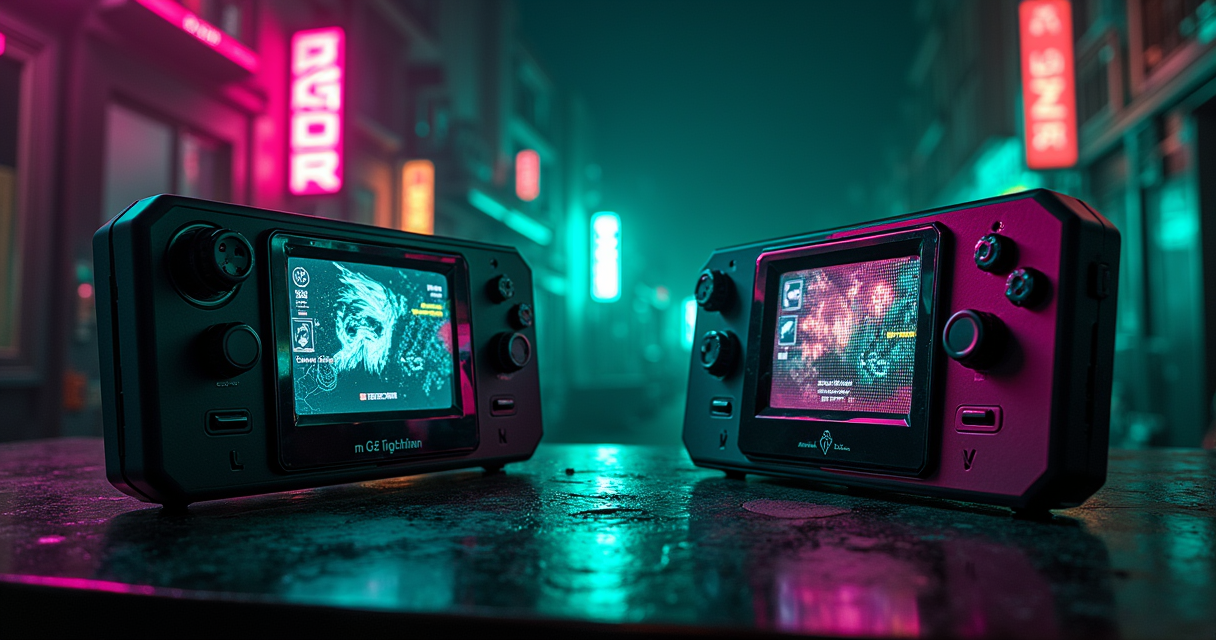
Retroid spent the back half of 2025 doing something faintly perverse: it announced two handhelds that cost almost the same money, positioned one as the flagship and one as the budget option, and then spent six months making it genuinely difficult to say which one you should buy. The Retroid Pocket 6 is the premium model. The Retroid Pocket G2 is the value model. As of the current 2026 pricing, the gap between them is $25. That is the whole ballgame.
Twenty-five dollars is not a rounding error and it is not a chasm. It is exactly the kind of number that turns a spec comparison into an argument. The Pocket 6 buys you a 120Hz AMOLED panel, Wi-Fi 7, a bigger battery, and a Qualcomm chip with years of mature GPU drivers behind it. The G2 undercuts it with a brand-new gaming chip that, in the benchmarks that exist, lands within about ten percent of the flagship's processor. One of these devices is clearly better. The other is arguably smarter. This piece is about telling those two things apart.
We pulled the numbers from the outlets that actually tested these things — Notebookcheck, Retro Handhelds, DROIX, Pocket Retro Gaming, Steam Deck HQ — and cross-checked the pricing history against Retroid's own store listings. No fabricated frame counts, no invented SKUs. Just the two devices, the $25 between them, and the question of who should hand it over.
The 30-Second Verdict
If you want the short version
Buy the Pocket G2 if your ceiling is the sixth console generation — PlayStation 2, GameCube, Wii, Dreamcast, and everything older — and you want the most emulation-per-dollar in a 5.5-inch Retroid. Buy the Pocket 6 if you want the 120Hz screen, the bigger battery, Wi-Fi 7, and — the part nobody prints on the box — a GPU whose Linux drivers have been baking for years. The G2 is the value play. The Pocket 6 is the no-asterisks play. Both are correct answers to different questions.
The one number that matters
Retroid marketed the Pocket 6 as roughly twice as fast as the G2. Steam Deck HQ, relaying Retroid's own pre-launch positioning, wrote that the Pocket 6 “should be around twice as performant as the G2.” Then the reviews landed, and that framing quietly fell apart. The G2's Snapdragon G2 Gen 2 turned out to sit only about ten percent behind the Pocket 6's Snapdragon 8 Gen 2 in single-core CPU throughput, per Notebookcheck's roundup of early testing. Ban at Retro Handhelds put it more bluntly: the G2 “is a major improvement, but still falls just behind an 8 Gen 2 despite being too close for comfort pricing.” Too close for comfort is the entire story.
The asterisk
Close in raw silicon is not the same as close in experience. The Pocket 6's Adreno 740 is a known quantity with mature Mesa Turnip drivers; the G2's newer Adreno is still being tuned, and it “exhibits graphical issues in some Switch games using its stock GPU drivers,” per Notebookcheck. If you live at the bleeding edge — Switch, Wii U, the stuff that makes a handheld sweat — that driver gap is worth more than $25. If you don't, it's worth nothing. Hold that thought; we'll spend a whole section on it.
Two Devices, One $25 Gap
The flagship that got cold feet
The Pocket 6 had a rough gestation. Retroid unveiled it in late 2025, took pre-orders, and then pulled those pre-orders after the community objected to the front design and ergonomics of the first revision. The device came back with two body styles and five colorways, including the black-and-orange finish that French IGN photographed on December 29, 2025 and that lent The Memory Core its excellent headline: “Pocket 6 gets spooked off the shelves, but the Pocket G2 lurks in the shadows.” Notebookcheck reported in October 2025 that pre-orders wouldn't dispatch until January 2026 at the earliest, and that timeline held — first shipments were confirmed for January.
What returned was unambiguously the nicer object: a Snapdragon 8 Gen 2, an Adreno 740, 8GB of LPDDR5x, 128GB of UFS 3.1 storage, a 5.5-inch 1080p AMOLED running at 120Hz with roughly 550 nits of peak brightness, a 6,000mAh battery, active cooling, 3D Hall-effect sticks, Wi-Fi 7, Bluetooth 5.3, and Android 13. It is, on paper, one of the best small Android emulation handhelds Retroid has ever shipped, which is roughly what DROIX concluded when it called the Pocket 6 “highly recommended if you want a high-performance mid-range option among Android gaming handhelds.”
The value model that shipped first
The G2, meanwhile, just showed up and started selling. NerdsHeaven reported that the G2's shipping rollout began on October 29, 2025, with additional colorways on November 5 — a full two months of real-world market presence before the Pocket 6 reached a single doorstep. Retroid built the G2 as a revised Pocket 5: it reuses that model's 5.5-inch 1080p AMOLED (at 60Hz), pairs it with 8GB of LPDDR5x and 128GB of UFS 3.1, a 5,000mAh battery, active cooling, Wi-Fi 6, and Hall sticks — and drops in Qualcomm's new gaming-focused Snapdragon G2 Gen 2 where the Pocket 5 had an older chip.
That last swap is the whole reason the G2 exists. It is a Pocket 5 chassis with a materially faster brain, sold cheap. If you've read our ranking of Retroid's 2026 lineup, you already know the company's strategy is to blanket every $150-to-$300 price band with a slightly different permutation of the same parts. The G2 and the Pocket 6 are the two permutations that happen to overlap.
Why they cost almost the same
At launch the split was clean: the Pocket 6 8GB/128GB opened at $229 (with a $209 pre-order discount), a 12GB/256GB variant sat at $279, and the G2 came in at $219 with a $20 early-buyer discount that dropped it to $199 for the first two weeks. ComputerBase reported on November 4, 2025 that Retroid had locked in those prices before it had even committed to a firm release date — the numbers came first, the calendar second. Then component prices went haywire, and the tidy $10 gap became a messier $25 one. More on that in the pricing section, because it is the single biggest thing that changed between announcement and today.
The Spec Sheet, Line by Line
The full sheet
Here is every spec that matters, side by side. Where a number comes from third-party testing rather than Retroid's own listing, we've kept it conservative.
| Spec | Retroid Pocket 6 | Retroid Pocket G2 |
|---|---|---|
| SoC | Snapdragon 8 Gen 2 (1×3.2 + 4×2.8 + 3×2.0 GHz) | Snapdragon G2 Gen 2 (Qualcomm G-series, GDC 2025) |
| GPU | Adreno 740 (~680 MHz) | Newer Adreno, A7xx family |
| RAM | 8GB LPDDR5x (12GB discontinued Mar 2026) | 8GB LPDDR5x |
| Storage | 128GB UFS 3.1 + microSD | 128GB UFS 3.1 + microSD |
| Display | 5.5-inch AMOLED, 1920×1080 | 5.5-inch AMOLED, 1920×1080 (Pocket 5 panel) |
| Refresh rate | 120Hz | 60Hz |
| Brightness / BFI | ~550 nits, Black Frame Insertion | Standard AMOLED |
| Battery | 6,000mAh | 5,000mAh |
| Charging | 27W wired | 27W wired |
| Wi-Fi | Wi-Fi 7 | Wi-Fi 6 |
| Bluetooth | 5.3 | 5.x |
| OS | Android 13 | Android 13 (Pocket 5 base) |
| Sticks | 3D Hall-effect | Hall-effect |
| Cooling | Active | Active |
| Video out | Up to 4K (external) | External display out |
| CPU (relative) | ~10% ahead of G2 (baseline flagship) | ~10% behind Pocket 6; ~+50% vs Snapdragon 865 |
| Launch price (base) | $229 ($209 pre-order) | $219 ($199 first 2 weeks) |
| 2026 price (base) | $244 (Retrododo: $249) | ~$219 |
| First shipments | January 2026 | October 29, 2025 |
Reading between the rows
Three rows do the heavy lifting: the SoC, the refresh rate, and the price. Everything else is either identical (both are 5.5-inch, 1080p, 8GB/128GB, UFS 3.1, 27W, active-cooled) or a second-order difference (Wi-Fi 7 vs 6, 6,000 vs 5,000mAh). If you cover the SoC, refresh-rate, and price rows with your thumb, these are the same handheld. Uncover them and they're a genuine decision.
Note what is not on this sheet: cycle accuracy. Neither of these devices is a MiSTer-style FPGA recreating original hardware gate-for-gate. They are fast ARM SoCs running software emulators, which means “runs great” is a spectrum, not a checkbox, and it moves every time someone updates a driver or an emulator core.
The three real differences
Distilled: the Pocket 6 gives you a 120Hz panel instead of 60Hz, Wi-Fi 7 instead of Wi-Fi 6, and a 6,000mAh battery instead of 5,000mAh — plus a chip with a small measured lead and much better driver support. The G2 gives you a chip that's within roughly ten percent of the flagship's, in a proven chassis, for $25 less. That's the trade. The rest of this article is just pressure-testing whether that $25 is well spent.
The Silicon: 8 Gen 2 vs G2 Gen 2
Snapdragon 8 Gen 2: the known quantity
The Pocket 6 runs the Qualcomm Snapdragon 8 Gen 2 — a 2022-vintage flagship phone chip with a 1+4+3 CPU layout (one prime core at 3.2GHz, four performance cores at 2.8GHz, three efficiency cores at 2.0GHz) and an Adreno 740 GPU clocked around 680MHz. It has been the default “best value flagship” silicon in the Android handheld scene for years, and for good reason: it is fast, it is efficient enough to sit behind a 6,000mAh battery, and — critically — its GPU has been supported by the open-source Mesa Turnip project for a long time. When DROIX says you can “run just about everything up to the PlayStation 2 era without performance issues” and push rendering resolution “to 1080p and, in some cases, 4K when outputting to a TV,” that is the 8 Gen 2 talking.
Snapdragon G2 Gen 2: the wildcard
The G2 runs the Snapdragon G2 Gen 2, a chip from Qualcomm's gaming-specific G-series that was shown at GDC 2025 and purpose-built for handhelds rather than phones. Its GPU belongs to the same Adreno A7xx family as the 8 Gen 2's, but it is a newer part, and “newer” is a double-edged sword here. Newer means it can, in theory, exceed the 8 Gen 2 in some GPU workloads. Newer also means the drivers that make emulators sing haven't caught up — a problem we'll dissect shortly. Pocket Retro Gaming, which reviewed the G2 under the apt title “Weird Snapdragon, Great Results,” measured “up to 2.3× GPU gains and 55% CPU improvements” relative to the Snapdragon 865 that anchored earlier Retroids. That is a big generational jump for a value device.
How close is “close”?
Here is the collision. Retroid's pre-launch line was that the Pocket 6 would be about twice the G2's performance. The measured reality, per Notebookcheck's synthesis of early reviews, is that the G2 Gen 2 sits roughly 50% ahead of the old 865 in single-core and only about 10% behind the 8 Gen 2 — while its GPU lands close to twice the 865's. In other words, the “2x” gap Retroid implied is really a ~10% CPU gap and a variable GPU gap. Ban at Retro Handhelds, who actually held both, confirmed it from the other direction: the G2 “still falls just behind an 8 Gen 2 despite being too close for comfort pricing.” When the value model is within ten percent of the flagship and $25 cheaper, the flagship has to justify itself on everything except raw CPU. It mostly can — but it has to.
Benchmarks: What Actually Runs
The CPU numbers
Emulation is famously CPU-bound — the demanding part of recreating a PlayStation 2 or a Switch is the interpreter and JIT work, not the pixel fill. So the CPU delta is the number that predicts real compatibility, and it's small. Consolidating the public figures:
- Notebookcheck (Oct 2025 roundup): the Snapdragon G2 Gen 2 is ~50% faster than the Snapdragon 865 in single-core and ~10% slower than the Snapdragon 8 Gen 2.
- Pocket Retro Gaming: ~55% CPU improvement and up to 2.3× GPU over the 865.
- Steam Deck HQ (launch): relayed Retroid's own estimate that the Pocket 6 would be “around twice as performant as the G2” — an estimate the review data did not bear out.
Three sources, one conclusion: on the CPU that determines whether a game boots and holds framerate, the two devices are neighbors, not strangers.
The GPU numbers
The GPU story is messier, and it cuts toward the G2 on paper and away from it in practice. On raw throughput, the G2 Gen 2's newer Adreno can match or exceed the Adreno 740 in some tests — it is, after all, a later part. But GPU throughput only helps if the driver can express it, and here the 8 Gen 2's mature Turnip support means the Pocket 6 more reliably converts its silicon into frames. Notebookcheck's blunt caveat — the G2 Gen 2 “exhibits graphical issues in some Switch games using its stock GPU drivers” — is a GPU-driver problem, not a GPU-horsepower problem. The horsepower is there. The plumbing isn't finished.
What that means per console
Translated into the systems people actually care about:
- Up to PS1, plus most 2D and 16-bit: Flawless on both. This is not a contest; a $90 Miyoo Mini Plus hits the PS1 ceiling for a third of the money.
- PS2 / GameCube / Wii / Dreamcast: Strong on both. The G2 emulates “PlayStation 2 games at a 2.5x scale or a 3x scale for GameCube titles,” per Notebookcheck — and the Pocket 6 does the same with a little more headroom and a faster screen.
- 3DS: Comfortable on both at 2x–3x internal resolution.
- Switch / Wii U: This is where they separate. The G2 can run The Legend of Zelda: The Wind Waker HD at 1080p/30 and Super Mario Odyssey at 1080p/60 with High Performance mode, per Notebookcheck — genuinely impressive for the price. But this is exactly the tier where the G2's stock-driver glitches show up, and where the Pocket 6's mature drivers earn their $25.
The Display: 120Hz vs 60Hz
120Hz vs 60Hz on a 5.5-inch panel
Both handhelds use a 5.5-inch, 1920×1080 AMOLED. The Pocket 6's runs at 120Hz; the G2's, carried over from the Pocket 5, runs at 60Hz. For emulation specifically, this matters less than the spec sheet implies — the overwhelming majority of retro content is locked to 60fps or below, and a PS2 game targeting 30fps looks identical on a 60Hz and a 120Hz panel. Where 120Hz earns its keep is everywhere outside the emulator: Android's UI, scrolling through a 4,000-ROM library, browsing menus, and the handful of native Android games and high-refresh cores that can actually push past 60fps. DROIX flagged the “5.5-inch 120Hz AMOLED screen” as one of the Pocket 6's “standout features” for a reason — it makes the whole device feel quicker even when nothing on screen is running faster.
Brightness, BFI, and the AMOLED tax
The Pocket 6's panel peaks around 550 nits and supports Black Frame Insertion, a strobing technique that trades brightness for dramatically reduced motion blur — useful precisely because sample-and-hold OLEDs smear moving images in a way old CRTs never did. The G2's 60Hz panel is the same size and resolution but is the older, simpler part. Neither is a bad screen; both are sharp, contrasty AMOLEDs that embarrass the LCDs on cheaper handhelds. The Pocket 6 just has the newer, faster, brighter, blur-fighting version.
Does the refresh rate matter for emulation?
Honest answer: rarely, and never in the way marketing wants you to think. 1080p on a 5.5-inch screen is already past the point of visible pixels at normal viewing distance — the same diminishing-returns curve we mapped in our 1440p-vs-4K breakdown, just shrunk to handheld scale. And 120Hz does nothing for a 60fps SNES game. If you buy the Pocket 6 for its screen, buy it for the UI smoothness, the BFI, and the 550 nits — not for a refresh number most of your library will never touch. If those three things don't move you, the G2's 60Hz panel is not a compromise you'll notice mid-game.
The Driver Tax
What Turnip is and why you care
Every Qualcomm-based Android handheld runs its GPU through a driver, and the stock Qualcomm driver is frequently not the one you want for emulation. The community solution is Turnip, the open-source Vulkan driver for Adreno GPUs developed under the Mesa project's Freedreno umbrella. Installing a current Turnip build into an emulator like a Switch core routinely fixes crashes, graphical corruption, and missing effects that the stock driver chokes on. It is not an exotic tweak; it is standard practice, and the maturity of Turnip support for a given GPU is one of the most important — and least advertised — factors in how well a handheld actually emulates. You can read the driver's own Mesa documentation if you want to see how the sausage is made.
The Adreno 740 advantage
The Pocket 6's Adreno 740 has been a Turnip target for years. That means when a new emulator update lands, or a new game needs a driver workaround, the Pocket 6 is almost always covered by an existing, well-tested build. This is the quiet reason the 8 Gen 2 remains the darling of the Android emulation scene long after phones moved on: not because it's the fastest chip you can buy, but because it's the fastest chip with finished software underneath it. The silicon and the drivers grew up together.
The G2's driver debt
The G2 Gen 2's GPU, though part of the same A7xx family, is a newer part that the Turnip team is still refining. Notebookcheck's early-review roundup is explicit that the chip “exhibits graphical issues in some Switch games using its stock GPU drivers.” That is the driver debt made visible. It will improve — the A7xx lineage means the groundwork exists, and Mesa's Freedreno developers are actively working it — but “it will improve” is a promise, not a purchase. If you buy the G2 today for cutting-edge Switch and Wii U emulation, you are betting on a driver roadmap. If you buy the Pocket 6, you are buying the finished road. This is the single most important thing the $25 gap actually pays for, and it is nowhere on either spec sheet. It's also why Ban at Retro Handhelds, despite the G2's value, leaned toward the flagship: “For not much more money, you get a newer styled handheld with more performance and support.”
Pricing, RAM Panic, Availability
The launch prices
At announcement, the lineup was straightforward. The Pocket 6 came in two configurations, both on UFS 3.1 storage and LPDDR5x RAM; the G2 came in one. Steam Deck HQ documented the launch pricing precisely: the Pocket 6 8GB/128GB “will retail for $229” with a pre-order price of $209, while the G2 “will retail for $219, but for the first two weeks, it will be available for $199.” A clean $10 separation between the value and flagship base models — the kind of gap that makes the decision easy.
The March 2026 RAM panic
Then the memory market caught fire. In early March 2026, Retroid raised the Pocket 6's 8GB base price by $15 and discontinued the 12GB/256GB model outright. Retrododo reported the increase on March 1, 2026 (clocking the new price at $249), and Time Extension reported on March 2 that Retroid explicitly blamed “ongoing shortages and sharply rising costs for both RAM and storage.” This is not a Retroid-specific story — RAM and NAND pricing spiked industry-wide — but Retroid is a small operator with thin margins, and it passed the cost straight through. The 12GB Pocket 6, the one enthusiasts actually wanted, simply vanished from the store. If you want the fuller arc of how the Pocket 6's price and positioning shifted versus its own predecessor, we traced it in our Pocket 6-vs-Pocket 5 breakdown.
What you actually pay now
As of mid-2026, The Gadgeteer confirmed on June 12 that the Pocket 6 8GB/128GB was holding at $244 on Retroid's store — the higher post-hike price, still active months later. The G2, meanwhile, stayed near its $219 launch figure. That's the $25 gap this whole article keeps circling. Here's the pricing and availability picture in one place:
| Model / config | Launch price | Launch promo | 2026 price | Availability / status |
|---|---|---|---|---|
| Pocket 6 — 8GB/128GB | $229 | $209 pre-order | $244 | Shipping since Jan 2026 |
| Pocket 6 — 12GB/256GB | $279 | — | Discontinued | Pulled Mar 2026 (RAM/NAND costs) |
| Pocket G2 — 8GB/128GB | $219 | $199 (first 2 weeks) | ~$219 | Shipping since Oct 29, 2025 |
The takeaway: the 12GB Pocket 6 is gone, the 8GB Pocket 6 costs more than it did at launch, and the G2 quietly became an even better relative value simply by not moving.
Five People, Two Handhelds
Buy the Pocket 6 if...
1. You're a Switch/Wii U-first emulation enthusiast. You want the mature Turnip drivers, the extra GPU headroom, and the fewest asterisks on the hardest systems. The G2 can technically run these titles, but you don't want to be debugging stock-driver glitches on a Tuesday night. The $25 is trivial against the hours you'd otherwise spend troubleshooting.
2. You care about the device as an object. The 120Hz panel, the ~550-nit brightness, BFI, Wi-Fi 7, and the bigger 6,000mAh battery add up to a nicer thing to hold and look at, independent of any single game. If a handheld is something you'll use daily for years, the premium feel compounds.
Buy the Pocket G2 if...
3. Your realistic ceiling is PS2/GameCube/Wii and below. This is most people. If you're honest that you'll spend 90% of your time in PS1, SNES, Genesis, GBA, PSP, Dreamcast, and the occasional GameCube session, the G2 does all of it beautifully for $25 less, and the driver immaturity never touches you — those systems are long since solved.
4. You want the best emulation-per-dollar in a 5.5-inch Retroid. A chip within ~10% of the flagship, in a proven Pocket 5 chassis, at the lowest price in the pairing. If you optimize for value rather than ceiling, the math points at the G2 and doesn't waver.
5. You want it now and hate waiting. The G2 has been shipping since late October 2025; the Pocket 6 spent months in pre-order limbo. Availability is a feature, and for two months it was the only feature that mattered.
Buy neither if...
If your library genuinely tops out at the PlayStation 1 and you mostly play 8- and 16-bit games, both of these are overkill and you should look one tier down — a Miyoo, an Anbernic, or a similar sub-$100 device will hit that ceiling without the Android overhead. And if you want accuracy rather than raw speed — original-hardware timing, cycle-exact behavior — no ARM emulator handheld will satisfy you the way an FPGA solution does. Know which problem you're solving before you spend the money.
Migration Guide
Moving your SD card
Because both devices are Android handhelds with microSD expansion, moving between them — or up from a Pocket 5 — is mostly a matter of relocating a folder structure, not reinstalling a life. If you're coming from a Pocket 5 to a G2, in many cases the same microSD card slots in and works, since the G2 is a Pocket 5 revision. Between the G2 and the Pocket 6, the safe path is to copy your library and per-emulator data across and let each device manage its own drivers. Here's the structure you're actually moving:
/microSD
  /Roms
    /PS2   /GC   /PSP   /Switch   /Dreamcast ...
  /Bios          # console BIOS / firmware files
  /Saves         # in-game SRAM / memory-card saves
  /States        # emulator save states (device-specific!)
  /RetroArch
    /config      # per-core .cfg + retroarch.cfg
    /system      # RetroArch BIOS
    /saves
    /states

# Safe migration order:
1. Power off, pull the microSD, image it to your PC as a backup.
2. Copy /Roms, /Bios, /Saves, /RetroArch/saves to the new device.
3. Re-scan libraries in each frontend (do NOT trust old absolute paths).
4. Reinstall GPU drivers (Turnip) PER DEVICE - never copy them across.
5. Test save states LAST; they are the least portable thing you own.
Porting saves, states, and BIOS
In-game saves (SRAM and virtual memory-card files) are portable and safe — copy them freely. BIOS files are portable too, assuming you're using the same emulator. Save states are the exception. A save state is a snapshot of emulator memory, and it is tightly coupled to the exact emulator version, core, and sometimes the GPU driver that produced it. Move states across devices at your own risk, and never delete the originating device's copy until you've confirmed they load. Treat in-game saves as your source of truth and states as a convenience.
Reinstalling drivers and emulators
This is the step people skip and regret. Do not copy GPU drivers between the G2 and the Pocket 6. They run different GPUs — a newer A7xx part in the G2, the Adreno 740 in the Pocket 6 — and each needs its own Turnip build. Reinstall your emulators fresh on the new device, pull the appropriate current driver for that GPU, and reconfigure. On the G2 in particular, if a Switch title shows graphical corruption on the stock driver, a current Turnip build is the first thing to try — it's the documented fix for exactly the class of glitch Notebookcheck flagged.
Pros and Cons
Retroid Pocket 6
| Pocket 6 — Pros | Pocket 6 — Cons |
|---|---|
| 120Hz, ~550-nit AMOLED with BFI | $25 dearer; base rose to $244 |
| Adreno 740 with mature Turnip drivers | 12GB model discontinued — 8GB only |
| 6,000mAh battery, Wi-Fi 7, up to 4K out | Late to ship (Jan 2026) after pre-order chaos |
| Small CPU lead + best Switch/Wii U reliability | Premium you may never cash in below PS2 |
Retroid Pocket G2
| Pocket G2 — Pros | Pocket G2 — Cons |
|---|---|
| $25 cheaper; best emulation-per-dollar | Newer GPU, immature stock drivers (Switch glitches) |
| CPU within ~10% of the 8 Gen 2 | 60Hz panel vs 120Hz |
| Proven Pocket 5 chassis; shipping since Oct 2025 | 5,000mAh and Wi-Fi 6 (vs 6,000mAh / Wi-Fi 7) |
| PS2 at 2.5x, GameCube at 3x with ease | Bleeding-edge systems mean betting on a driver roadmap |
The tiebreakers
When the spec columns are this close, the decision usually comes down to two questions no table captures. First: what is the hardest system you'll genuinely run weekly? If the honest answer is Switch or Wii U, the Pocket 6's drivers break the tie. If it's PS2 and below, the G2 does. Second: do you value the object or the outcome? The Pocket 6 is the nicer thing to own; the G2 is the smarter thing to buy. Neither answer is wrong, which is exactly why Retroid can sell both.
The Verdict
The data-backed pick
On the numbers alone, the Pocket G2 is the value winner, and it isn't especially close. A chip within ~10% of the flagship's CPU (Notebookcheck), up to 2.3× the GPU of the old 865 (Pocket Retro Gaming), PS2 at 2.5x and GameCube at 3x scale, and Switch titles like Wind Waker HD at 1080p/30 — all for $25 less than the Pocket 6 and available since October 2025. For the buyer whose ceiling is the sixth generation, which is most buyers, the G2 extracts more emulation per dollar than anything else in Retroid's 5.5-inch class.
The contrarian pick
And yet the reviewer who held both — Ban at Retro Handhelds — leaned the other way, and the reasoning is sound: “For not much more money, you get a newer styled handheld with more performance and support.” Support is the operative word. The Pocket 6's Adreno 740 has finished drivers; the G2's newer GPU does not, and “exhibits graphical issues in some Switch games using its stock GPU drivers” (Notebookcheck). If your emulation ambitions run to the bleeding edge, the Pocket 6's $25 premium buys you out of a driver-troubleshooting hobby you didn't ask for — plus a 120Hz screen, Wi-Fi 7, and a bigger battery you'll enjoy regardless.
What we'd actually buy
Split the room. If you're buying for someone who wants a great retro handheld and will mostly play PS2-and-below — a gift, a first serious device, a value-maximizer — buy the G2 and pocket the $25. If you're the person reading a 6,000-word comparison of two handhelds that cost within a rounding error of each other, you already know you want the Pocket 6: you'll use the 120Hz, you'll chase Switch and Wii U, and you'll care that the drivers just work. The $25 isn't buying you speed — the silicon proved that's nearly a wash. It's buying you the finished version of the software stack, the faster screen, and the peace of mind. For that particular reader, it's $25 well spent. For nearly everyone else, the G2 is the answer, and it's not embarrassing to save the money.
Questions the search bar asks me
- Is the Retroid Pocket 6 worth $25 more than the Pocket G2?
- It depends on your ceiling. The $244 Pocket 6 buys a 120Hz AMOLED (vs 60Hz), Wi-Fi 7, a 6,000mAh battery, and mature Adreno 740 Turnip drivers — worth it if you chase Switch/Wii U. But the $219 G2's CPU lands within ~10% of it (Notebookcheck), so for PS2-and-below the gap is hard to justify.
- What processor is in the Retroid Pocket G2?
- The Snapdragon G2 Gen 2, a Qualcomm gaming-focused chip shown at GDC 2025. Pocket Retro Gaming measured up to 2.3× the GPU and ~55% more CPU than the old Snapdragon 865; Notebookcheck puts it ~10% behind the Pocket 6's Snapdragon 8 Gen 2 in single-core.
- Why did the Retroid Pocket 6 go up to $244?
- In early March 2026 Retroid raised the 8GB base by $15 and discontinued the 12GB model, citing (via Time Extension) 'ongoing shortages and sharply rising costs for both RAM and storage.' Retrododo reported the new price as $249 on March 1; The Gadgeteer confirmed $244 on June 12, 2026.
- Can the Pocket 6 or G2 emulate Nintendo Switch?
- Both can, within limits. The G2 runs The Legend of Zelda: The Wind Waker HD at 1080p/30 and Super Mario Odyssey at 1080p/60 in High Performance mode (Notebookcheck) — but its stock GPU drivers glitch in some Switch titles. The Pocket 6's mature Turnip drivers make it the more reliable Switch/Wii U device.
- Which is better for GameCube and PS2?
- Both handle GameCube at ~3x and PS2 at ~2.5x internal resolution (Notebookcheck). The Pocket 6 has slightly more headroom and a faster screen; the G2 does it for $25 less with drivers that are already mature at that tier. For sixth-gen and below, the G2 is the value pick.

Casey writes about speedrunning, tool-assisted runs, and the strange engineering of going fast in old games. Every post under this byline is reviewed pre-publish by Sam P., Editor & Operator — corrections to info@instalinkoteam.com. Published 2026-08-29 · Last updated 2026-08-29. Full bios on the author page.