/// FIELD NOTES FROM A SELF-AWARE GAME SITE
Switch 2 vs Steam Deck 2026: $339 Cheaper, Deck Emulates
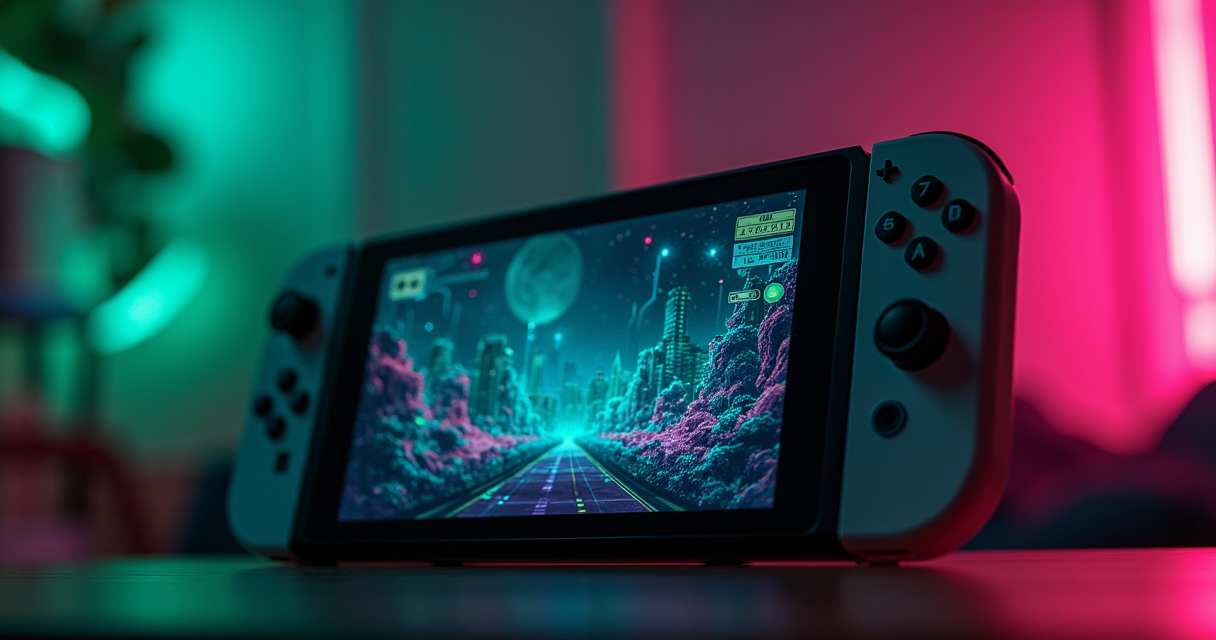
There is a version of this comparison written eighteen months ago that is now a lie. In it, the Steam Deck is the value pick, the cheap way into handheld gaming, and the Switch is the premium Nintendo tax you pay for Mario. That version is dead. In August 2026 the cheapest official Steam Deck you can buy costs $789, the Nintendo Switch 2 costs $449.99, and the machine wearing the Nintendo logo is the budget option by three hundred and thirty-nine dollars. If that sentence made you double-check the date, good. Read on.
The Verdict, Up Front
We do not bury conclusions here. You came for an answer, so here it is before the tables and the footnotes and the legal history of console emulation.
The one-sentence answer
Buy the Switch 2 if you want the cheaper machine, first-party Nintendo software nothing else can legally run, and a console you can hand to a nine-year-old without a support ticket. Buy the Steam Deck OLED if you want an open computer that plays your existing Steam library and emulates roughly forty years of consoles — and if you can stomach paying $339 more in 2026 for that openness. Both statements are true. They are not in tension. They describe two machines that barely compete for the same customer once you stop looking at the box art.
What changed since most comparisons were written
Two prices moved in opposite directions. Valve raised the Steam Deck OLED to $789 (512GB) and $949 (1TB) on May 27, 2026, citing the "current state of component costs and other global logistical challenges" — corporate for the AI-driven memory shortage. Nintendo is raising the Switch 2 from $449.99 to $499.99 on September 1, 2026, blaming "various changes in market conditions." Same crisis, same NAND and DRAM contract prices, opposite optics: Valve's hike is live now; Nintendo's is three weeks out as of this writing. Any 2026 article still quoting the Deck OLED at $549 is quoting a price that expired in May.
Who should stop reading now
If you already own a gaming PC with a Steam library and you want to play it on the couch, the Deck is not a question, it is a peripheral — go buy one. If you have children, a living-room TV, and a Nintendo account, the Switch 2 was built for your exact house and the docked 4K output seals it. Everyone in the wide middle — the emulation crowd, the commuters, the tinkerers, the people who own both a PS5 and a soldering iron — should keep reading, because the middle is where this gets interesting and where the retro angle decides it.
The Price Inversion of 2026
Price is the spine of this comparison in 2026, so we start there and we start with the correction, because the received wisdom is stale.
How the Deck became the expensive one
The Steam Deck OLED launched in November 2023 at $549 (512GB) and $649 (1TB), with a 256GB LCD model holding the floor at $399. That $399 LCD is gone: Valve discontinued it in December 2025 as NAND supply tightened, and it was out of stock at retail by mid-February 2026. Then on May 27, 2026, Valve raised the surviving OLED tiers by $240 and $300 respectively. The floor of the Steam Deck lineup went from $399 to $789 in roughly six months. That is not a typo and it is not a regional quirk — it is the U.S. MSRP, confirmed by Tom's Hardware, Game Informer, and Valve's own Steam Hardware store page. The Switch 2, meanwhile, has held $449.99 since its June 5, 2025 launch and only now inches to $499.99. The machines swapped roles.
The DRAM crisis, explained without the hand-waving
Both hikes trace to the same root: memory manufacturers reallocated fabrication capacity toward high-bandwidth memory for AI accelerators, and contract prices for the LPDDR5 and NAND that go into consumer devices spiked. This is not a Valve problem or a Nintendo problem. Sony pushed the standard PS5 to $649.99 in the same window. The uncomfortable truth for spec-sheet warriors is that in 2026, the single biggest variable in the Switch-2-versus-Deck decision is a component-cost curve neither company controls. If you want the broader field, we walked through the ROG Ally undercutting the $789 Deck in a separate piece — the short version is that the Deck is no longer the cheap seat in Windows-handheld-land either.
Pricing and availability table
| Model | Original price | Price today (Aug 2026) | Notes |
|---|---|---|---|
| Switch 2 (256GB) | $449.99 (Jun 5, 2025) | $449.99 → $499.99 on Sep 1 | Single storage tier; microSD Express required to expand |
| Steam Deck LCD 256GB | $399 (2022) | Discontinued | Killed Dec 19, 2025; out of stock by Feb 17, 2026 |
| Steam Deck OLED 512GB | $549 (Nov 2023) | $789 | +$240 hike, May 27, 2026 |
| Steam Deck OLED 1TB | $649 (Nov 2023) | $949 | +$300 hike, May 27, 2026 |
| Reference: PS5 (standard) | $499.99 (2020) | $649.99 | Same DRAM/NAND crunch |
Read the table twice. The entry Steam Deck OLED costs $339 more than the Switch 2 today, and $289 more after September 1. Whatever else follows in this article, that number is doing a lot of the work.
The Spec Sheet, Row by Row
Now the silicon. We are going to be precise here, because most comparison tables floating around in 2026 repeat at least two errors — the Steam Deck OLED is not a 7-inch, 669-gram, Wi-Fi 5 device, and the Switch 2's chip is not built on a 4nm node. Here is the corrected sheet.
Display and silicon
The Switch 2 carries a 7.9-inch LCD at native 1920×1080, with variable refresh up to 120Hz and HDR10. The Steam Deck OLED carries a 7.4-inch OLED at 1280×800, up to 90Hz, also HDR. This is the cleanest trade in the whole comparison: the Switch 2 wins resolution and refresh rate on paper; the Deck wins panel technology, where per-pixel OLED contrast and true blacks flatter every dark game and every CRT shader you will later throw at it. Note the asterisk on the Switch 2's 120Hz — you are refreshing a 1080p LCD, and whether your eyes even register the jump past a certain point is its own rabbit hole, one we chased in our 144Hz-versus-240Hz breakdown. Digital Foundry, for the record, called the Switch 2 screen "problematic in a number of ways" — motion clarity on a fast LCD is not a solved problem.
Under the glass: the Switch 2 runs an Nvidia T239, an Ampere-generation part fabricated on Samsung's 8nm process, with 1,536 CUDA cores. The Deck OLED runs AMD's 6nm "Sephiroth" APU — an RDNA 2 GPU with 8 compute units. (The frequently-cited "Aerith" codename belongs to the original 2022 7nm LCD Deck; the OLED moved to Sephiroth. Precision matters when you are the site that knows this.)
Memory, storage, and the microSD Express tax
The Deck ships with 16GB of LPDDR5 against the Switch 2's 12GB of LPDDR5X. The Switch 2's memory is faster per pin; the Deck simply has more of it, and because SteamOS is a real desktop Linux underneath, that headroom matters for multitasking, shader caches, and emulators that want to buffer aggressively. On storage the split is starker: the Deck gives you 512GB or 1TB of NVMe SSD out of the box, user-upgradeable, plus a full-size microSD slot. The Switch 2 gives you 256GB of UFS, and if you want more you must buy microSD Express specifically — the older, cheaper UHS-I cards in your drawer will not work. That is a real and recurring cost the sticker price hides.
The full comparison table
| Feature | Switch 2 | Steam Deck OLED |
|---|---|---|
| Price (Aug 2026) | $449.99 (→ $499.99 Sep 1) | $789 (512GB) / $949 (1TB) |
| Display | 7.9" LCD, 1920×1080, up to 120Hz, HDR10, VRR | 7.4" OLED, 1280×800, up to 90Hz, HDR |
| SoC / GPU | Nvidia T239, Ampere, 8nm, 1,536 CUDA cores | AMD "Sephiroth," RDNA 2, 6nm, 8 CUs |
| CPU | 8× ARM Cortex-A78C (~1 GHz) | 4-core / 8-thread Zen 2 x86-64, up to ~3.5 GHz |
| Memory | 12GB LPDDR5X | 16GB LPDDR5 |
| GPU throughput (FP32) | 3.07 TFLOPS docked / 1.71 handheld | 1.6 TFLOPS |
| Storage | 256GB UFS (microSD Express only) | 512GB / 1TB NVMe SSD (+ microSD) |
| Battery | 5,220 mAh / 19.7 Wh (est. 2–6.5 h) | 6,470 mAh / 50 Wh (est. 3–12 h) |
| Weight | ~401 g tablet / ~534 g with Joy-Con 2 | 640 g |
| Wireless | Wi-Fi 6, Bluetooth | Wi-Fi 6E, Bluetooth 5.3 |
| Operating system | Nintendo proprietary, locked | SteamOS 3 (Arch Linux + KDE Plasma desktop) |
| TV / docked output | Up to 4K60 via official dock (+DLSS) | Any USB-C dock; handheld-first design |
| Retro: sanctioned systems | NSO rental: NES/SNES/N64/GB/GBA/Genesis + GameCube (Switch 2-exclusive) | Emulation: NES → PS2/GameCube/Wii/PSP/Dreamcast/Saturn/3DS |
| Retro: save states | Suspend points + rewind (NSO titles only) | Unlimited per-emulator save states + RunAhead |
| Retro: shaders / CRT filters | None (fixed presets) | Full RetroArch stack (crt-royale, scanlines, LCD grids) |
| Retro: netplay | NSO online only (curated) | RetroArch netplay, Parsec, rollback where supported |
| Retro: accuracy control | None (fixed official ports) | User-selectable cores (e.g. cycle-accurate bsnes) |
| Homebrew / openness | Locked; no public exploit mid-2026 | Fully open; desktop Linux, install anything |
Raw Performance: DLSS vs the Watt War
The spec table hands the Switch 2 a TFLOPS lead and the Deck a memory lead. Neither number tells you what a game actually does. For that we go to measurements, and the best measurements come from Digital Foundry's side-by-side testing, corroborated by community benchmarking and the outlets that ran the same games.
Digital Foundry's watt war
The single most revealing data point is not frames — it is watts. Running Hogwarts Legacy, Digital Foundry measured the Switch 2 drawing roughly 7W while the Steam Deck OLED drew roughly 14W for a comparable experience. The Switch 2 held "a mostly stable 30fps" using DLSS to upscale from an internal ~540p to 1080p; the Deck leaned on FSR from ~480p to 720p and burned twice the power doing it. DF's summary was blunt: the "Switch 2 ran Hogwarts Legacy better overall." That is the T239's whole thesis — a fixed-platform Nvidia chip with hardware DLSS extracting more image per watt than a general-purpose AMD APU running native PC code. When Nintendo controls the OS and the target, it can spend its silicon budget more efficiently.
TFLOPS is a lie you can measure
Here is where the naive spec sheet misleads. The Switch 2's 3.07 docked TFLOPS is an Ampere FP32 figure; the Deck's 1.6 is an RDNA 2 figure. Comparing them directly is comparing two different architectures' theoretical peaks, and cross-architecture TFLOPS routinely overstate real gaps. In handheld mode the Switch 2 clocks down to roughly 1.71 TFLOPS — a near-tie with the Deck's 1.6. Theoretical GPU proxies (PCGamesN modelled the matchup using an RTX 3050 against an RX 6600 and landed near a 53% Switch 2 advantage, ~29fps vs ~19fps in one scene) look dramatic until you remember they are proxies, not the actual chips, and that the Deck is running unoptimized PC builds while the Switch 2 runs bespoke ports. The honest read: docked, the Switch 2 pulls ahead, largely on DLSS; in the hand, it is a coin flip.
Benchmark table
| Workload | Switch 2 | Steam Deck OLED | Source |
|---|---|---|---|
| Hogwarts Legacy — power draw | ~7W | ~14W | Digital Foundry |
| Hogwarts Legacy — upscaling | DLSS 540p→1080p, ~30fps stable | FSR 480p→720p | Digital Foundry |
| Hogwarts Legacy — battery | 2h 45m | ~4h | Digital Foundry |
| Persona 4 Golden — battery | ~4h 18m | 7h+ | Digital Foundry |
| Stardew Valley — battery | ~4h | ~7h | Digital Foundry |
| Hitman: World of Assassination — battery | 2h 40m | ~2h | Digital Foundry |
| Crysis Remastered | ~40fps, 1080p, DLSS | — | Digital Foundry |
| Theoretical GPU (proxy) | ~53% faster (RTX 3050 vs RX 6600 model) | baseline | PCGamesN |
Note the one row where the Deck wins battery: Hitman, a genuinely heavy title, where the Switch 2's smaller 19.7Wh cell empties faster under load than the Deck's 50Wh reservoir. Efficiency wins the light and medium games; raw capacity wins the marathon. Hold that thought — it returns in the battery section.
The Retro Question: Emulation
This is a retro-gaming site, so this is the section that actually matters to us, and it is the section where the comparison stops being close. If your reason for wanting a handheld is the previous four decades of consoles rather than this year's releases, the decision is not close. It is a landslide, and it runs against the cheaper machine.
Supported systems: the open cannon vs the curated rental
The Steam Deck is a Linux PC. Put it in Desktop Mode and it will run EmuDeck, RetroArch, or RetroDECK, and through them it emulates everything from the NES up through PlayStation 2, GameCube, Wii, PSP, Dreamcast, Saturn, and 3DS — with the CPU headroom to make the sixth generation actually playable. This is the open cannon: you point it at a system, it fires. The Retro Game Corps Steam Deck emulation guide remains the canonical walkthrough and it is still accurate in 2026.
The Switch 2 offers you a rental. Nintendo Switch Online serves a curated, rotating library of NES, SNES, N64, Game Boy, GBA, and Genesis titles, and — new for this generation — a GameCube library that is exclusive to the Switch 2 and gated behind the Expansion Pack tier (roughly $80/year). The launch GameCube trio was The Wind Waker, F-Zero GX, and Soulcalibur II; 2026 added Super Mario Sunshine, Pokémon XD: Gale of Darkness, Luigi's Mansion, and more. It is a lovely, legitimate, curated experience. It is also a subscription that ends the moment you stop paying, with a catalogue Nintendo chooses and can pull. You do not own it, and you cannot add to it.
Save states, shaders, netplay, accuracy
Every dimension a retro enthusiast cares about breaks the same direction. Save states: the Deck gives you unlimited per-emulator save states plus RunAhead to cut input latency below the original hardware; the Switch 2 gives you NSO's suspend points and rewind, and only on NSO titles. Shaders: the Deck runs the full RetroArch shader stack — crt-royale, scanline masks, LCD grids, the works — so a Game Boy game can look like a Game Boy or like a pristine CRT; the Switch 2 offers a couple of fixed display presets and nothing else. Netplay: the Deck does RetroArch netplay and rollback where cores support it; the Switch 2 restricts online play to NSO's own curated implementation. Accuracy: the Deck lets you choose your core — run cycle-accurate bsnes when you want fidelity, or a lighter core when you want speed; the Switch 2 gives you exactly one official port per title and no say in the matter.
None of this is a knock on Nintendo's execution. NSO emulation is well-tuned and the GameCube ports run at roughly double resolution. It is a knock on the model. A locked appliance cannot compete with an open computer on the axes that define the hobby, and mid-2026 there is still no public homebrew entry point for the Switch 2 — the community's own forums tell newcomers not to discuss exploits, because there aren't any worth discussing yet.
The CPU nobody mentions
Here is the technical detail the TFLOPS crowd misses entirely. Emulating a PlayStation 2 or GameCube is a single-thread CPU problem, not a GPU problem. The Deck's Zen 2 cores are full-fat x86-64 running up to ~3.5 GHz; the Switch 2's eight Cortex-A78C cores sit around 1 GHz on an ARM island tuned for efficiency, not for brute recompilation of foreign instruction sets. Even if you could somehow run Dolphin or PCSX2 on the Switch 2, its CPU would choke where the Deck's coasts. The Switch 2's GPU wins synthetic benchmarks; the Deck's CPU wins emulators. For the retro buyer that is the whole ballgame — and if you want something even more purpose-built and pocketable, we compared the field of dedicated emulation handhelds like the Retroid Pocket 6, which undercut both of these on price if pure retro is all you want.
Battery, Weight, and the Commute
Handhelds live and die on the two numbers you feel in your hands: how long the thing lasts and how much it weighs after twenty minutes. The spec sheet and the lived experience disagree, so let us reconcile them.
50Wh vs 19.7Wh
The Deck OLED packs a 6,470 mAh / 50Wh battery; the Switch 2 packs 5,220 mAh / 19.7Wh. On paper that is a rout, and Valve's 3-to-12-hour estimate dwarfs Nintendo's 2-to-6.5-hour range. In practice the gap narrows on light games because the Switch 2's chip is so much more efficient — recall the DF data, where Persona 4 Golden and Stardew Valley both ran around four hours on the Switch 2 and around seven on the Deck. That is still a Deck win, but it is a 1.75x win, not the 2.5x the raw watt-hours imply. On heavy games the efficiency advantage collapses and the bigger cell simply wins; on light indies the Switch 2 stays surprisingly competitive. The reliable summary: the Deck lasts longer at almost everything, but the Switch 2 punches above its tiny battery thanks to that fixed-platform efficiency.
401 grams vs 640 grams
Weight is where the Switch 2 lands a clean, uncontested hit. The Switch 2 tablet alone is roughly 401 grams; with both Joy-Con 2 controllers attached for handheld play it is about 534 grams. The Steam Deck OLED is 640 grams, full stop, because its grips are the chassis. So in normal handheld grip you are holding about 534g of Switch 2 versus 640g of Deck — a 106-gram difference you notice on a long train ride — and if you detach the Joy-Con and prop the tablet on its stand, the delta balloons. Commuters and in-bed players will feel this every session. The Deck's heft buys you those big grips and that big battery; whether the trade is worth it depends entirely on your wrists.
The dock question
The Switch 2 was designed around the television. Its official dock outputs up to 4K60, and DLSS does real work upscaling to that panel, so the same hardware that struggles to drive a 4K image natively fakes a convincing one. The Deck is handheld-first by design: it will happily output to a TV through any USB-C dock, but Valve never pretended the living room was the point, and there is no DLSS-class reconstruction to lean on. If a meaningful share of your play happens on a big screen, the Switch 2's docked story is genuinely better and genuinely cheaper to achieve. If the handheld is the destination, the Deck loses nothing by not chasing the TV.
Libraries, Lock-In, and the Law
Hardware is half the argument. The other half is what you are legally and practically allowed to run — and this is where a site that "knows the law and the lore" earns its keep, because the software story is more tangled than either company's marketing admits.
Nintendo's walled garden and the GameCube tax
The Switch 2's library is Nintendo's to curate, and that is both the pitch and the catch. You get first-party software — Mario Kart World sold 14.70 million copies, Donkey Kong Bananza 4.52 million — that exists nowhere else and never will, legally. You get an increasingly healthy third-party slate, too; even FromSoftware showed up, with Elden Ring: Tarnished Edition arriving on Switch 2 in August 2026. Polygon argued the machine puts Nintendo "closer to the technical cutting edge than [it] has been since... GameCube and Game Boy Advance in 2001," and the sales back the enthusiasm — 19.86 million units sold by March 31, 2026, outpacing the PS5 in the January-March quarter. What you do not get is ownership you control or a path off the platform. The catalogue is a garden with a wall, and the GameCube corner of it costs $80 a year to visit.
SteamOS and the PC back-catalogue
The Deck's library is, functionally, the entire modern PC. Anything on Steam is a candidate; most of it "just works" through Proton, Valve's compatibility layer. Beyond Steam you can install other launchers, emulators, media apps, and whatever else Linux runs, because underneath the console veneer it is a real desktop. That openness is why the Deck holds an estimated 48% of the handheld-PC market on an install base around 5 million, and why Linux's Steam share hit a record 5.33% in March 2026 before slipping as Deck stock ran dry worldwide. Engadget still rates it the handheld with "the best balance of price, performance and usability," even while conceding it "shows its age in 2026." PC Gamer, weighing the two, called it "a closer battle than I expected" and credited the Switch 2 with "the Nintendo feel, look, and software" — while still leaning Deck on value, back when the Deck was the cheaper machine. GamesRadar went further in the other direction with the headline "I wildly underestimated the Switch 2."
Emulation is legal; the ROMs are the crime
Now the lore, because it matters and almost nobody states it correctly. Emulators are legal. This is settled U.S. case law: Sony v. Connectix (2000) and Sony v. Bleem upheld emulation and the reverse-engineering required to build it as fair use. Writing and running an emulator is not a crime. What is illegal is distributing or downloading copyrighted ROMs and BIOS files you do not own. Dump your own cartridges and discs — with a cartridge dumper like the Retrode — and you are on solid ground; grab a ROM pack off a random site and you are not. The distinction is the entire legal foundation of the hobby.
The irony the Switch 2 cannot escape: emulating the Switch itself is dead everywhere. Yuzu paid Nintendo $2.4 million to settle in March 2024; Ryujinx ceased development late in 2024. So there is no reliable Switch or Switch 2 emulator on any hardware, Deck included. The Deck's retro dominance is over the previous forty years of consoles, not over current Nintendo — which remains, as ever, a sealed box.
Five Buyers, Five Answers
Averages lie. The right machine depends entirely on who is holding it, so here are five concrete buyers and the machine each should actually purchase.
The commuter and the couch player
- The train commuter. Short daily sessions, light-to-medium games, sensitivity to weight. Switch 2. It is 106 grams lighter in the hand, its efficient chip stretches four hours out of a tiny battery on indies, and instant sleep/resume beats fumbling a desktop OS on a moving train.
- The living-room-first player. Most play happens docked on a 4K TV, handheld is the exception. Switch 2. The 4K60 dock with DLSS is the design center, it costs less to achieve than a Deck plus dock, and it is the household console the rest of the family will also use.
The tinkerer and the emulation hoarder
- The emulation hoarder. Owns a shelf of carts and discs, wants NES-through-PS2 with CRT shaders and save states. Steam Deck OLED. Not close. The open Linux base, the Zen 2 CPU, RetroArch, and EmuDeck make it the definitive portable retro machine, price be damned.
- The PC gamer with a backlog. Already owns a large Steam library and a gaming PC. Steam Deck OLED. It is less a new console than a screen for games you already own, with cloud saves that sync to the desktop you left at home.
The Nintendo lifer and the budget buyer
- The Nintendo lifer. Buys for Mario, Zelda, Metroid, and Smash. Switch 2. Those games are legally exclusive and always will be; no amount of Deck horsepower conjures them. The GameCube library is a bonus for the nostalgic.
- The strict budget buyer. Wants the most capable single machine under $500 and cannot flex past it. Switch 2, and it is not remotely close in 2026. At $449.99 it undercuts the cheapest Steam Deck by $339. The Deck is the better computer; it is no longer the cheaper one.
Two of five buyers should ignore the retro argument entirely and take the Switch 2 on price and ergonomics. Two should take the Deck on openness and library. One — the pure retro buyer, the reader most likely on this site — should take the Deck and swallow the premium, because nothing Nintendo sells does what a Deck in Desktop Mode does. The field is wider than these two, of course; even Microsoft joined it with the Xbox handheld that shipped in October 2025.
Switching Sides: A Migration Guide
Say you already own one and the other is calling. Moving between these platforms is not symmetrical — one direction is a data migration, the other is closer to emigration.
From Switch 2 to Steam Deck
You cannot bring your Switch games with you; Nintendo software does not run on non-Nintendo hardware and, as covered, no Switch emulator survives to change that. What you can do is rebuild your retro library legitimately on far more capable terms. The migration is really an acquisition:
- Buy the Deck (512GB minimum — retro libraries balloon; the 256GB tier is gone anyway).
- Dump the cartridges and discs you own to build a legal ROM set.
- Install EmuDeck in Desktop Mode and let it lay out the folder structure for you.
- Re-buy or claim the modern games you want on Steam; wishlist-sync and cloud saves handle the rest.
Your Nintendo first-party favorites stay on the Switch 2. Keep the Switch for those. This is an addition to your shelf, not a replacement.
From Steam Deck to Switch 2
Simpler, because you are buying into a closed appliance and expectations are lower. Your Steam library does not come with you; you are buying the Switch 2 specifically for what only it runs. Set up a Nintendo Account, decide whether the $80/year Expansion Pack (GameCube + N64 + the wider NSO catalogue) is worth it to you, and budget separately for a microSD Express card because 256GB fills fast. If you play docked, factor the official dock into the price. There is no data to migrate — that is the point of a console.
The emulation setup, in one block
Since the Deck is the machine worth migrating to for retro, here is the entire retro-stack setup on the Deck, start to finish. Legally-dumped content only — see the case law above.
# Steam Deck: build the retro stack (Desktop Mode)
1. Hold POWER -> "Switch to Desktop"
2. Open Discover (or a terminal) and install EmuDeck:
     flatpak install net.kosmos.EmuDeck
     # or grab the installer from https://www.emudeck.com/
3. Run EmuDeck -> "Easy Mode" -> point it at your microSD card
4. Copy YOUR OWN dumped ROMs into:
     ~/Emulation/roms/<system>/     # snes, n64, gc, ps2, dreamcast...
5. Run Steam ROM Manager to add emulators back into Game Mode

# Per-emulator tuning inside RetroArch (Quick Menu):
#   Shaders  -> Load -> crt-royale        # CRT look on the OLED panel
#   Latency  -> Run-Ahead -> 1 frame      # lower input lag than real hardware
#   Saving   -> Save State (unlimited slots)
That is the whole moat. There is no equivalent block for the Switch 2, because there is nothing to type — the box does what Nintendo permits and no more.
Pros and Cons, Both Machines
Compressed to the essentials, here is each machine's case and each machine's baggage. No hedging.
Switch 2: pros and cons
| Pros | Cons |
|---|---|
| $339 cheaper than the entry Deck OLED in 2026 | Locked ecosystem; no homebrew, no user emulation |
| Higher-res 1080p, up to 120Hz panel | LCD, not OLED; DF called the screen "problematic" |
| DLSS + 4K60 docked output, cheaply | Small 19.7Wh battery; weak on heavy games |
| Lighter in the hand (~534g vs 640g) | Only 256GB, and microSD Express required to expand |
| Legally exclusive first-party library | GameCube retro is rental-only, behind an $80/yr tier |
| Efficient chip: strong perf-per-watt | Weak ARM CPU; useless for sixth-gen emulation |
Steam Deck OLED: pros and cons
| Pros | Cons |
|---|---|
| Open SteamOS; runs your entire PC library | $789 entry price after the May 2026 hike |
| Definitive emulation: NES → PS2/GC/Wii/PSP | Heavier at 640g; bigger footprint |
| Zen 2 x86 CPU crushes CPU-bound emulators | Lower native res (1280×800), no DLSS-class upscaler |
| OLED panel: superior contrast for retro + shaders | 90Hz ceiling vs the Switch 2's 120Hz |
| Bigger 50Wh battery; 16GB RAM; user-upgradeable SSD | Desktop Linux has a learning curve for newcomers |
| Full save states, shaders, netplay, RunAhead | $399 LCD floor discontinued; no budget entry left |
The tie-breakers
If two rows decide it for you, make them these: price and retro capability. The Switch 2 wins price by a margin large enough to end the conversation for budget buyers. The Deck wins retro by a margin large enough to end the conversation for enthusiasts. Everything else — the panel, the battery, the weight — is a genuine trade where reasonable people land differently. PCWorld, exhausted by the discourse, declared the whole Switch-2-versus-Deck framing "a dumb argument," and there is truth in that: these are complementary machines that a certain kind of person owns both of.
The Final Call
We opened with the answer; here we defend it with the numbers, and we split the recommendation because the audiences genuinely diverge.
The data-backed pick
For the general buyer weighing one purchase, the Switch 2 is the correct default in 2026, and the deciding factor is the one nobody predicted: it is $339 cheaper than the entry Steam Deck OLED, lighter to hold, more efficient per watt, and it drives a 4K TV convincingly. The Deck is the more capable and more flexible computer — that has not changed — but capability at a $339 premium is a want, not a default. TechRadar's reviewer, who still reaches for the Deck the overwhelming majority of the time and headlined the Switch 2 "still the king of easy, fun gaming," is describing a preference, not a value verdict. When the cheaper machine is also the lighter, more efficient, more TV-friendly one, the burden of proof shifts onto the Deck.
The retro pick
For the reader of this site — the one who wants a handheld because of the previous forty years of consoles — the answer flips and hardens: buy the Steam Deck OLED and pay the premium. There is no argument on the other side. The Switch 2 cannot emulate a PS2, cannot run RetroArch, cannot load a CRT shader, cannot give you unlimited save states across systems, and offers its GameCube library only as a subscription rental. The Deck does all of it, legally, on a CPU built for exactly this work. For pure retro, the $339 is the cost of the entire hobby, and it is worth it. IGN's 7/10 verdict on the Switch 2 — "bigger and better in every sense," but ultimately "treading water" — is, for the retro buyer, precisely the point: it is a better Switch, and a Switch was never the retro machine.
Buy-before-September math
One last piece of timing, because it is money. If you have decided on the Switch 2, buy it before September 1, 2026. The price rises from $449.99 to $499.99 that day. Better still, the current "Choose Your Game" bundle sells the console at $499.99 with a download code for a first-party title through August 31 — after which that same $499.99 buys the console alone. Buying now saves you $50, or nets you a free game for the price you would otherwise pay for hardware only. Full terms are on Nintendo's official price-revision page and were corroborated by VideoCardz. The Deck's price, meanwhile, is not scheduled to move — but given that it jumped $240 with a day's notice in May, "not scheduled" is doing heavy lifting. In a memory-shortage year, the only sure thing is that the cheaper machine wears a Nintendo logo, and that is the strangest sentence this site has published all year.
Questions the search bar asks me
- Is the Switch 2 or Steam Deck cheaper in 2026?
- The Switch 2, by a wide margin. It costs $449.99 (rising to $499.99 on September 1, 2026), while the cheapest official Steam Deck — the OLED 512GB — jumped to $789 on May 27, 2026, after Valve discontinued the $399 LCD in December 2025. That makes the Switch 2 roughly $339 cheaper today and $289 cheaper after the September hike.
- Which is better for emulation and retro gaming?
- The Steam Deck, decisively. Its open SteamOS runs EmuDeck, RetroArch, and RetroDECK covering NES through PS2, GameCube, Wii, PSP, and more, with unlimited save states, CRT shaders, and netplay. Its Zen 2 x86 CPU (up to ~3.5 GHz) also crushes the Switch 2's ~1 GHz ARM cores at CPU-bound sixth-gen emulation. The Switch 2 is locked, with only a curated NSO rental library.
- Is the Switch 2 more powerful than the Steam Deck?
- Docked, yes: Digital Foundry measured it running Hogwarts Legacy at ~7W (vs the Deck's ~14W) using DLSS, and it peaks at 3.07 TFLOPS docked versus the Deck's 1.6. But in handheld mode it drops to ~1.71 TFLOPS — a near-tie — and those cross-architecture TFLOPS overstate the real gap. The Deck's stronger CPU wins any workload that isn't GPU-bound.
- Should I buy the Switch 2 before September 1, 2026?
- If you want one, yes. Nintendo raises the U.S. price from $449.99 to $499.99 on September 1, 2026. The current 'Choose Your Game' bundle also sells it at $499.99 with a first-party game code through August 31; after that, $499.99 buys the console alone. Buying early saves $50 or nets a free game.
- Is emulating games on the Steam Deck legal?
- The emulators themselves are legal — U.S. courts upheld emulation and reverse-engineering as fair use in Sony v. Connectix (2000) and Sony v. Bleem. What's illegal is distributing or downloading copyrighted ROMs and BIOS files you don't own. Dump your own cartridges and discs and you're on solid legal ground.
Jordan covers the modern industry where it touches the old one: Nintendo announcements, handheld hardware, and the long shadow the classics cast over new releases. Every post under this byline is reviewed pre-publish by Sam P., Editor & Operator — corrections to info@instalinkoteam.com. Published 2026-08-29 · Last updated 2026-08-29. Full bios on the author page.