/// FIELD NOTES FROM A SELF-AWARE GAME SITE
Switch 2 vs Steam Deck 2026: $339 Cheaper, DLSS Edge
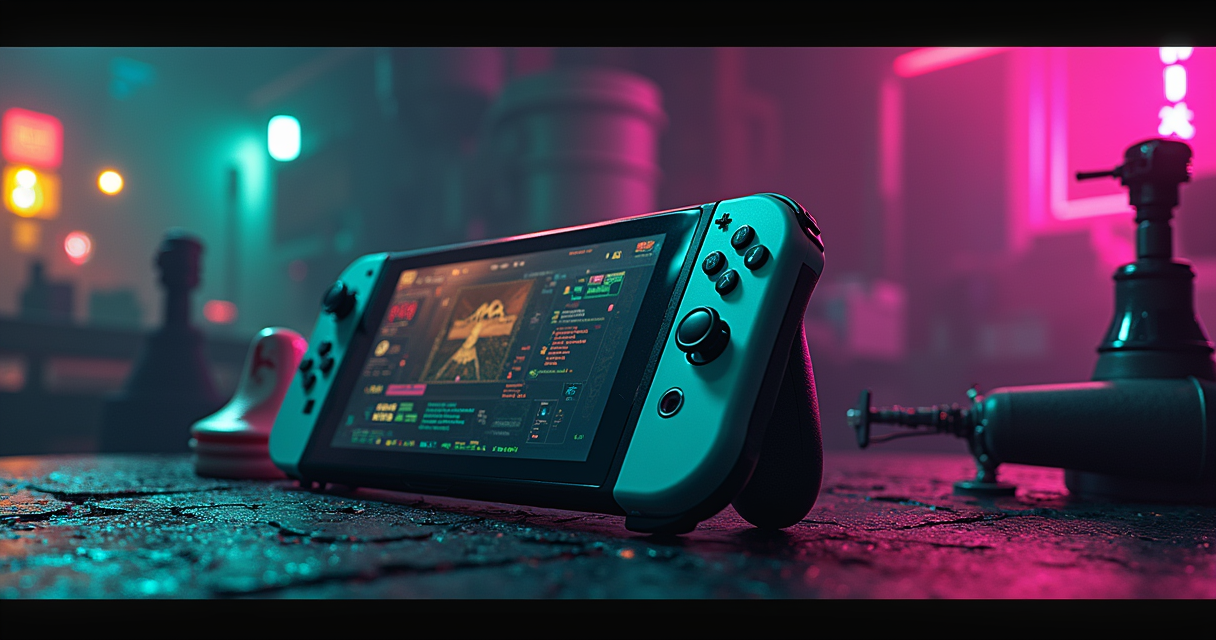
For most of a decade the joke wrote itself. The Steam Deck was the enthusiast's toy — open, hackable, a Linux computer that happened to fold into a messenger bag — and the Nintendo machine was the locked appliance you bought your nephew: cheap plastic, expensive cartridges, absolutely no ROMs allowed. One was for people who read GitHub issues for fun. The other was for people who wanted to press a button and see a plumber.
Then May 27, 2026 arrived, Valve quietly rewrote its own price sheet, and the joke stopped being funny. As of this writing the cheapest new Steam Deck OLED costs $789. The Nintendo Switch 2 costs $449.99. The open PC handheld is now the premium product by $339, and the walled-garden appliance is the budget pick. If you built your identity around “Deck cheap, Nintendo greedy,” the market just repossessed it.
That inversion is the headline, but it is not the whole story — and on a site that cares about save states and CRT shaders more than about first-party platformers, it is arguably not even the interesting part. Because underneath the price war sits a much older question that the retro crowd has been asking since 2022: which of these boxes is the better emulation machine? One of them will run your entire life's library of cartridge dumps with a shader stack and rewind. The other one will sell you Super Mario Sunshine again, at 2x resolution, for eighty dollars a year, and pretend that's the same thing. This is the comparison, done properly.
The 2026 Price Inversion
Start with money, because in 2026 money is where the entire narrative flipped. For two and a half years the Steam Deck's pitch was “a real gaming PC for the price of a console.” That pitch is dead. What killed it was not incompetence — it was silicon economics, and the same shortage is squeezing every device in this category.
What the Steam Deck OLED costs now
On May 27, 2026, Valve restocked the Steam Deck after months of shortages and simultaneously raised the price by up to $300 in a single announcement. The 512GB OLED went from $549 to $789. The 1TB OLED went from $649 to $949. The reason Valve gave was corporate-bland and completely honest: the new prices “reflect the current state of component costs and other global logistical challenges,” per the company's official Steam Hardware announcement. Translation: the RAM and NAND that go into a Deck now cost multiples of what they did in 2023, because every gigabyte of DRAM on Earth is being fought over by AI datacenters.
This wasn't a U.S. quirk, either — Valve raised the Deck across every region at once: roughly €779/€919 in the EU, £649/£849 in the UK, CA$1,129/CA$1,349 in Canada, and AU$1,199/AU$1,499 in Australia. A globally synchronized increase is the signature of a supply-cost shock, not a market experiment. Nobody runs a pricing test in five currencies on the same Tuesday.
The other half of that story is the corpse in the corner. The entry-level Steam Deck LCD 256GB — the $399 model that anchored every “it's cheaper than a Switch” argument — was discontinued on December 19, 2025 and had sold out of retail channels by February 2026. So the “$399 Deck” you may still see quoted in older comparisons no longer exists as a new product. The floor is $789. If you want a cheap Deck, you are shopping the used market, and used is where Valve's value proposition now lives entirely.
The Switch 2 and the September 1 cliff
The Switch 2 launched on June 5, 2025 at $449.99, and Nintendo has held that line longer than anyone expected. But not forever: per Nintendo's official price-revision notice, on September 1, 2026 the U.S. MSRP rises to $499.99 — a $50 bump driven by the same DRAM crunch hammering Valve. That is the deadline that matters. Buy before September and you pay $449.99; buy after and you pay fifty dollars more. Either number is still hundreds below the Deck. We walk through the countdown and the regional figures in our breakdown of the Switch 2's June 2025 launch and September price hike, and if you're weighing the older hardware instead, the Switch OLED vs Switch 2 matchup covers where the previous generation lands now.
Why both went up: the AI memory crunch
Here is the part the fanboy discourse misses: both companies raised prices, in the same window, for the same reason. This is not Valve being greedy or Nintendo being greedy. It is a global memory shortage — the one the trade press started calling “RAMageddon” — in which AI accelerator demand has bid up DRAM and NAND to the point that consumer hardware margins evaporate. The PS5 Pro got hit. Retro handhelds got hit. The Deck and the Switch 2 got hit. The difference is the magnitude: Nintendo passed along $50, Valve passed along up to $300. When your competitor absorbs a shock six times better than you do, the price gap is not a rounding error — it's a strategy.
| Model / Tier | Price (mid-2026) | Storage | Status |
|---|---|---|---|
| Nintendo Switch 2 | $449.99 (→ $499.99 on Sep 1, 2026) | 256GB UFS 3.1 | In production, widely available |
| Steam Deck OLED 512GB | $789 | 512GB NVMe | Restocked May 2026, cheapest new Deck |
| Steam Deck OLED 1TB | $949 | 1TB NVMe | Top model |
| Steam Deck LCD 256GB | — (was $399) | 256GB eMMC | Discontinued Dec 19, 2025 |
| Switch 2 “Choose Your Game” bundle | $499.99 (ends Aug 31, 2026) | 256GB | Console + one digital title |
| Used Steam Deck LCD (typical) | ~$300–$350 | varies | Where the Deck stays “cheap” |
The single most important sentence in this article: as a new purchase, the Switch 2 is the cheaper handheld by $339, and it will still be cheaper by $290 after September 1. Every performance argument that follows has to be read against that fact.
Full Specs, Side by Side
Now the tale of the tape. These two devices are built on opposite philosophies — a purpose-tuned Nvidia SoC with hardware machine-learning upscaling versus a general-purpose AMD PC APU — so raw numbers only tell part of the story. Read the table, then read the three subsections that explain where the numbers lie to you.
| Specification | Nintendo Switch 2 | Steam Deck OLED |
|---|---|---|
| Launch / status | June 5, 2025 | Nov 2023 (OLED); restocked May 2026 |
| Price (new) | $449.99 (→ $499.99 Sep 1) | $789 (512GB) / $949 (1TB) |
| Display | 7.9″ LCD, 1080p, 120Hz VRR, HDR | 7.4″ OLED, 1280×800, 90Hz, HDR |
| SoC | Nvidia T239 (Ampere, Samsung 8nm) | AMD “Sephiroth” APU (Zen 2 + RDNA 2, 6nm) |
| GPU compute (FP32) | 1.71 TFLOPS handheld / 3.07 TFLOPS docked | ~1.6 TFLOPS |
| Shader config | 1,536 CUDA cores (561/1007 MHz) | 8 RDNA 2 CUs (512 shaders, up to 1.6 GHz) |
| Upscaling | Nvidia DLSS (hardware ML) | AMD FSR (software, no ML units) |
| RAM | 12GB LPDDR5X | 16GB LPDDR5 |
| Storage | 256GB UFS 3.1 (microSD Express) | 512GB / 1TB NVMe PCIe Gen 3 (microSD) |
| Battery | 5,220 mAh (19.7 Wh), ~2–6.5 hrs | 50 Wh, ~3–12 hrs |
| Weight | ~401g tablet / 534g with Joy-Con 2 | 640g |
| OS | Nintendo OS (closed) | SteamOS 3.x (Arch Linux) + optional Windows 11 |
| Wireless | Wi-Fi 6, Bluetooth 5.3 | Wi-Fi 6E, Bluetooth 5.3 |
| USB | USB-C 3.2 Gen 2 (×2) | USB-C 3.2 Gen 2 |
| Video out (docked) | 4K@60 / 1080p@120 | “8K” spec; ~4K@60 practical |
| Software catalogue | eShop + NSO retro (incl. Switch 2-exclusive GameCube) | ~100,000 Steam titles; 21,694 “Deck Verified” |
| Emulation / homebrew | Locked; no public homebrew (mid-2026) | Open — EmuDeck, RetroArch, RetroDECK |
| Save states (retro) | NSO suspend points / rewind only | Full per-core save states + shaders + netplay |
The display split: 120Hz LCD vs 90Hz OLED
Nintendo went big and fast; Valve went deep and rich. The Switch 2's 7.9″ LCD is larger, sharper (native 1080p), and runs at up to 120Hz with VRR — genuinely useful for the handful of high-frame-rate titles that target it. But it is an LCD, and Digital Foundry flagged its pixel-response and motion characteristics as “problematic in a number of ways.” The Deck OLED's 7.4″ panel is smaller and only 1280×800 at 90Hz, but it is an OLED: per-pixel black, HDR that actually means something, and the kind of contrast that makes a 90s JRPG's night scenes look like the developers intended. For retro content specifically — where CRT phosphor shaders live or die on black level — the OLED is the better canvas, full stop. For raw modern-game motion clarity and resolution, the Switch 2's bigger 120Hz screen takes it.
Silicon: Ampere and DLSS vs RDNA 2 brute force
The Switch 2 runs Nvidia's T239, a custom Ampere part on Samsung's 8nm process with 1,536 CUDA cores and, crucially, hardware tensor cores that power DLSS. Undocked it clocks the GPU at 561 MHz for 1.71 TFLOPS; docked it jumps to 1007 MHz and 3.07 TFLOPS. The Deck OLED runs AMD's “Sephiroth” APU — a Zen 2 CPU paired with an 8-CU RDNA 2 GPU on a 6nm process — peaking around 1.6 TFLOPS with no dedicated ML upscaling hardware. On paper the docked Switch 2 nearly doubles the Deck. In practice, as the next section explains, that comparison is a trap. If you want the RDNA-versus-x86 argument taken to its logical extreme, our ROG Ally X vs Steam Deck OLED comparison pits two AMD handhelds against each other where the DLSS wildcard doesn't apply.
Battery, weight, and the wireless footnote
The Deck OLED carries a 50Wh battery; the Switch 2 carries 19.7Wh (5,220 mAh) — less than half. That gap is real and it shows up in runtime tests. The Switch 2 counters with weight: about 401g as a bare tablet and 534g with the Joy-Con 2 attached, versus the Deck's 640g brick. Hold both for a two-hour flight and your wrists will notice. One correction to the spec sheets that keep circulating: the Deck OLED weighs 640g, not the 669g often quoted — 669g was the original LCD model. And on wireless, the common claim that the Switch 2 has “better connectivity” is backwards: the Deck has Wi-Fi 6E, the Switch 2 only Wi-Fi 6. Both run Bluetooth 5.3 and USB-C 3.2 Gen 2.
One more asterisk, on storage expansion, because it's a hidden tax: the Switch 2 requires the newer, pricier microSD Express format — ordinary microSD cards won't run games — while the Deck accepts any standard microSD and, for the truly committed, lets you crack the shell and swap the NVMe SSD outright. Expandability is both cheaper and more flexible on the Deck, which matters a great deal once a ROM library starts measuring itself in hundreds of gigabytes.
Raw Performance & the DLSS Question
Here is where the discourse goes feral, because both camps can cite a true number that flatters their box. The Deck partisans point at native PC horsepower; the Switch 2 partisans point at DLSS. They are both right, and they are talking past each other. Let us use measurements instead of vibes.
What Digital Foundry actually measured
The most-cited head-to-head numbers come from Digital Foundry, whose cross-platform testing has become the reference. Running Hogwarts Legacy, DF found the Switch 2 drew about 7W while the Steam Deck OLED drew roughly 14W for a comparable result — and that the Switch 2 “ran Hogwarts Legacy better overall, keeping it locked to a mostly stable 30fps.” On image reconstruction, DF put the Switch 2's DLSS pass from 540p to 1080p ahead of the Deck's FSR pass from 480p to 720p — cleaner, more temporally stable, at half the wattage. Those two facts — better output, lower power — are the entire case for the Switch 2 as a piece of hardware.
But watch the battery, because the 50Wh cell fights back. In DF's runtime testing the ranking depends on the game:
| Game (Digital Foundry) | Switch 2 runtime | Steam Deck OLED runtime |
|---|---|---|
| Hogwarts Legacy | ~2h 45m | ~4h |
| Stardew Valley | ~4h | ~7h |
| Persona 4 Golden | ~4h | 7h+ |
| Hitman World of Assassination | ~2h 40m | ~2h |
So the Switch 2 is more efficient per watt, but the Deck's far larger battery usually delivers more wall-clock hours on lighter titles — while heavy games flip it back toward the Switch 2. Anyone selling you a one-line battery verdict is selling you something.
The TFLOPS trap
“3.07 vs 1.6” looks like a knockout. It isn't, for three reasons. First, TFLOPS do not translate across architectures: an Ampere FLOP and an RDNA 2 FLOP are not the same unit of work, and comparing them directly is like comparing horsepower to torque. Second, the 3.07 figure is docked only — plugged into the TV, actively cooled, off battery. In handheld mode, where you actually hold the thing, the Switch 2 sits at 1.71 TFLOPS against the Deck's 1.6, which is a near-tie. PCGamesN's proxy testing (using desktop GPUs of similar class as stand-ins) pegged the Switch 2's GPU as maybe ~53% faster in theory — roughly 29fps vs 19fps in one scene — but flagged it hard as a theoretical ceiling, not a promise.
Third, and most overlooked: there's a whole CPU the FLOPS number ignores. The Switch 2 runs eight ARM Cortex-A78C cores at roughly 1 GHz; the Deck runs a four-core, eight-thread Zen 2 at up to about 3.5 GHz. For modern console ports that gap barely registers, but for emulation it is decisive — PS2 and GameCube emulation are heavily CPU-bound, and a high-clocked x86 core does work an ARM core at 1 GHz simply cannot. It's the reason the Deck can brute-force Dolphin and PCSX2 while the Switch 2, even if it were open, would choke on the same jobs. GPU FLOPS win benchmarks; CPU single-thread wins emulators. And the Deck's other trump card is that it runs native, unmodified PC code — it doesn't need a developer to ship a hand-tuned port, because it simply runs the game you already own.
Docked: where the gap becomes a canyon
The one place the Switch 2 wins cleanly is on the television. Docked, it pushes its clocks up, engages DLSS more aggressively, and outputs a clean 4K@60 (or 1080p@120) that the Deck cannot match — the Deck's dock advertises “8K,” but in real games it lands around 4K@60 and often lower once you're driving a demanding title. This is why PC Gamer concluded that while the Deck leads on raw horsepower thanks to its AMD APU and higher power draw, the Switch 2's DLSS tricks give it “a slight real-world edge” in the games engineered for it — and titled the whole piece “a closer battle than I expected.” The operative words are in supported games. Which brings us to the part of this comparison that a retro site actually cares about.
Retro Gaming: The Real Battleground
Everything above is a modern-games argument, and if that's all you want, the two boxes trade blows with the Switch 2 ahead on price. But this is STARESBACK, and the question we care about is older and blunter: which one is the better retro machine? Here the “closer battle” framing collapses. It is not close. It is a slaughter, and the appliance loses.
The Steam Deck is an emulation cannon
The Steam Deck is, out of the box, the best mass-market emulation handheld ever built, because it is a full x86 PC that boots into desktop Linux with two thumbsticks bolted on. Drop into Desktop Mode, install EmuDeck or RetroDECK, and in twenty minutes you have a configured stack that spans the NES through the PlayStation 2. The community's consensus starter set is unglamorous and devastatingly effective: RetroArch for everything up to the 16-bit era, plus Dolphin, DuckStation, PCSX2, and PPSSPP — five emulators that, as one widely-shared guide put it, “cover an enormous share of gaming history without needing a high-wattage handheld.” Dolphin renders GameCube and Wii games at multiples of native resolution. PCSX2 runs the bulk of the PS2 library. It is, functionally, a museum you own the keys to. For the front-end and core setup itself, our walkthrough on installing 200+ RetroArch cores is written with exactly this hardware in mind, and Retro Game Corps' Steam Deck emulation guide remains the definitive first read.
The Switch 2 is a museum with a velvet rope
The Switch 2 emulates too — it just doesn't let you decide what. Nintendo curates. Through Switch Online + Expansion Pack ($80/year) you get NES, SNES, Game Boy, GBA, N64, and Genesis libraries, plus a genuinely notable addition: a Switch 2-exclusive GameCube catalogue, documented on Nintendo's official Nintendo Classics page. It launched alongside the console in 2025 with The Legend of Zelda: The Wind Waker, F-Zero GX, and Soulcalibur II, and through 2026 Nintendo has been dripping in more — Super Mario Sunshine, Pokémon XD: Gale of Darkness, Luigi's Mansion, Wario World, Mario Strikers, Chibi-Robo, and Fire Emblem: Path of Radiance, per GameSpot's running list. It's a nice library. It is also a rental, curated by the rights-holder, running at roughly 2x resolution with input lag that Digital Foundry described as the emulation's biggest weakness — multiple frames of latency. You cannot add a ROM. You cannot pick your core. When Nintendo pulls a title or ends the service, your access ends with it.
Save states, shaders, netplay: the feature gap
This is the part that separates a real emulator from a licensed nostalgia dispenser. On the Deck, RetroArch gives you arbitrary save states (as many slots as you want, at any moment), full shader pipelines — CRT-Royale, scanlines, NTSC composite masks, the entire aesthetic-restoration toolbox — netplay for rollback-style online co-op on cores that support it, and RunAhead to claw back the input latency that plagues emulated games. On the Switch 2, you get Nintendo's version of these: “suspend points” (a single-slot save state by another name) and rewind on some titles. No custom shaders. No user netplay outside Nintendo's own online implementation for supported classics. No latency-reduction tooling — in fact the GameCube emulation adds latency. If your definition of retro gaming includes how the game is presented and preserved, this is not a comparison. It is a category difference.
Emulation Accuracy & System Support
Let's make the feature gap concrete with a system-by-system table, then talk about the two things the table can't show: accuracy, and the legal weather.
What each device can actually run
| System | Steam Deck OLED | Switch 2 |
|---|---|---|
| NES / SNES / GB / GBA | Flawless (RetroArch: Mesen, Snes9x, mGBA) | Curated subset via NSO app |
| Genesis / Mega Drive | Flawless (Genesis Plus GX) | Curated subset via NSO Expansion Pack |
| Nintendo 64 | Very good (Mupen64Plus-Next / ParaLLEl) | Curated subset via NSO Expansion Pack |
| GameCube / Wii | Excellent, upscaled (Dolphin) | Switch 2-exclusive NSO list (~2x res, input lag) |
| PlayStation 1 | Flawless (DuckStation / Beetle PSX) | None |
| PlayStation 2 | Good–very good (PCSX2) | None |
| PSP | Excellent (PPSSPP, upscaled) | None |
| Dreamcast | Very good (Flycast) | None |
| Saturn / Wii U / 3DS | Playable (Beetle Saturn / Cemu / Azahar) | None |
| Arbitrary ROMs | Yes — any file you own | No |
| Save states | Yes, unlimited slots, all cores | Single “suspend point” + rewind |
| Custom CRT / scanline shaders | Yes (RetroArch, ReShade) | No |
| User netplay | Yes (RetroArch rollback netplay) | NSO online for supported classics only |
Accuracy: cores you can inspect vs a black box
Emulation accuracy is not a marketing number; it's a spectrum, and openness is what lets you climb it. On the Deck, if a game runs wrong you can switch cores — from a fast core to a cycle-accurate one like Mesen or bsnes — tweak overclock/underclock, adjust timing, and read the documentation. A tricky SNES title that leans on the SA-1 coprocessor, or an N64 game with fussy microcode, has a known fix because the community can see under the hood. Nintendo's NSO emulator is a black box: you get whatever accuracy Nintendo shipped, frozen, with no cores to swap and no settings to fix the input lag DF flagged on the GameCube titles. When Nintendo's emulator gets something wrong — and historically its NSO releases have shipped with audio and timing bugs — you wait for a patch that may never come. Accuracy you can't influence isn't a feature; it's a promise.
The legal shadow over Switch emulation
One honest caveat, because The Machine does not do fan-service: Switch and Switch 2 games themselves are the one thing the Deck can't reliably emulate in 2026. Yuzu shut down in March 2024 after a $2.4 million settlement with Nintendo, and Ryujinx ceased development later that year. Switch emulation is now legally radioactive and not a dependable install target on any hardware — and the homebrew scene is deliberately steering clear of the Switch 2, with community spaces posting explicit “do not discuss Switch 2 exploits” notices.
Worth stating plainly, because the law here is settled and widely misunderstood: emulators themselves are legal. U.S. courts established that two decades ago — Sony v. Connectix (2000) and Sony's failed campaign against Bleem both upheld console emulation, reverse-engineering and all, as fair use. What's illegal is distributing copyrighted ROMs and BIOS files. So the Deck's emulation stack is entirely above-board; the only legal question is ever where your game files came from, and the honest answer for a retro hobbyist is “from cartridges and discs I own and dumped myself.” Yuzu didn't die because emulation is illegal — it died over piracy-adjacent conduct and a seven-figure settlement. The distinction matters, and Nintendo would very much prefer you blur it.
Five Real-World Use Cases
Abstract spec-sheet warfare is useless at the register. Here are the buyers, and the box each one should actually carry to checkout.
If you want to press power and play
The commuter, the parent, the person who plays 40 minutes before bed and does not want a hobby-within-a-hobby: Switch 2. It boots instantly, the first-party library is the best in the business, docking to the TV is one motion, and it costs $339 less. This is the buyer TechRadar had in mind when it called the Nintendo machine “still the king of easy, fun gaming.” Nothing about the Deck's openness helps this person; it only adds friction they will never pay off.
If your library is 4,000 ROMs deep
The retro archivist with a NAS full of legally-dumped cartridges and discs: Steam Deck OLED, and it isn't a discussion. EmuDeck, per-core save states, CRT shaders on an OLED panel, and the horsepower to upscale Dolphin and PCSX2. The Switch 2 offers this person a rental catalogue and a velvet rope. If your budget is tighter than $789, note that a dedicated device like a Retroid Pocket covers the 8-bit-through-Dreamcast range for a fraction of the money — the Deck earns its premium only once you need PS2/GameCube-class muscle.
If you already own 1,200 Steam games
The PC gamer with a decade-deep Steam backlog: Steam Deck OLED. Those games are already bought; the Deck just plays them portably, no re-purchase, with more than 21,600 titles carrying a “Deck Verified” badge and tens of thousands more merely unrated rather than broken. The same openness lets it double as a remote-play client — you can stream a PS5 or Xbox to it, as outlets like Polygon have noted, at the cost of more setup than a Nintendo device ever asks. If that's your plan, our PS Remote Play 1080p guide gets the streaming path dialed in.
Rounding out the five, quickly:
- The living-room / docked player → Switch 2. Clean 4K@60 output and DLSS on the TV; the Deck's dock is fussier and tops out lower in real games.
- The tinkerer / modder → Steam Deck OLED. Desktop Linux, dual-boot Windows 11, mod loaders, config files, an SSH server if you want one. The Switch 2 offers none of this by design.
Migrating Between Them
Say you already own one and the price inversion (or the emulation gap) has you eyeing the other. Here's how the move actually goes — including the one direction that is effectively a one-way door.
Switch 2 → Steam Deck: going open
This is the migration people make when they realize they want their own retro library, not Nintendo's rental. There is no save transfer — the platforms share nothing — so this is a fresh start, not a port. Buy the Deck, boot into Desktop Mode, install EmuDeck, and rebuild your retro collection from your own dumps. EmuDeck lays down a predictable folder tree; drop your files in and run Steam ROM Manager to fold them into the SteamOS library with box art:
# Steam Deck, Desktop Mode, after installing EmuDeck.
# EmuDeck creates this structure on your microSD or SSD:

/run/media/deck/SDCARD/Emulation/
  |-- roms/
  |     |-- snes/
  |     |-- genesis/
  |     |-- n64/
  |     |-- gamecube/
  |     |-- ps2/
  |     +-- psp/
  |-- bios/
  +-- saves/

# Copy your legally-owned dumps over the LAN from a PC:
rsync -av --progress ~/RetroLibrary/ \
  deck@steamdeck.local:/run/media/deck/SDCARD/Emulation/roms/

# Then launch Steam ROM Manager to generate Steam entries + art:
#   EmuDeck > Tools > Steam ROM Manager > Preview > Save to Steam
From there RetroArch handles save states, shaders, and netplay per core. Fifteen minutes of setup buys you a library Nintendo will never sell you.
Steam Deck → Switch 2: going simple
The reverse move is for the person exhausted by tinkering who just wants first-party games and a device their household understands. It's trivial: buy the Switch 2, sign into a Nintendo Account, and you're playing. If you want the retro catalogue, subscribe to Switch Online + Expansion Pack ($80/year) for the NSO libraries and the Switch 2-exclusive GameCube list. The only thing to internalize is that you are trading a platform where you decide for one where Nintendo decides — and paying less for the privilege.
The one thing you can't migrate: your saves
Be clear-eyed about the asymmetry. Leaving the Deck, everything you own is portable in principle — ROMs, PC saves, emulator states all live in files you control. Leaving the Switch 2, you take nothing: eShop purchases are locked to the platform, NSO progress lives in Nintendo's cloud, and there is no supported export. The open box lets you walk out with your library. The closed box lets you walk out with your controller. Factor that into a $339 decision you may reverse later.
Pros & Cons, Per Device
The ledger, stripped of tribalism. Read both columns; the “right” answer is entirely a function of which cons you can live with.
Steam Deck OLED: the ledger
| Pros | Cons |
|---|---|
| Best-in-class emulation: EmuDeck, RetroArch, RetroDECK, save states, shaders, netplay | $789 — now $339 more than the Switch 2 |
| OLED panel: true blacks, HDR, ideal for CRT shaders | 640g; heaviest of the pair |
| ~100,000 Steam titles + non-Steam launchers + remote play | Lower peak resolution (1280×800, 90Hz) |
| Full PC freedom: Linux, dual-boot Windows, mods, desktop apps | Steeper learning curve; more setup and maintenance |
| 16GB RAM, 512GB/1TB NVMe, Wi-Fi 6E, huge 50Wh battery | Docked output trails the Switch 2 in real games |
Switch 2: the ledger
| Pros | Cons |
|---|---|
| $449.99 — the cheaper new device by $339 (until Sep 1) | Locked platform: no homebrew, no arbitrary ROMs |
| Best first-party library; DLSS edge in supported games at ~half the power | Retro gaming is rental-only via NSO ($80/yr), curated by Nintendo |
| Bigger, sharper 7.9″ 1080p 120Hz screen; clean docked 4K@60 | LCD, not OLED; DF called the panel “problematic in a number of ways” |
| Lightest (401g tablet), instant-on, effortless TV docking | 19.7Wh battery — runs shorter on light games than the Deck |
| microSD Express slot (fast) | No save export; nothing migrates off the platform |
What the tables don't capture
Two intangibles decide most real purchases. The first is time: the Deck rewards the hours you pour into configuration with a library nothing else can match, and punishes the person who won't. The second is philosophy: one of these devices treats your game library as files you own, and the other treats it as access you rent. Reasonable people land on opposite sides of that — which is why GamesRadar, after using both, published the headline “I wildly underestimated the Switch 2,” while TechRadar admitted it still reaches for the Deck by reflex. Both are true. They're just true for different people.
The Verdict
A comparison that ends in “it depends” is a cop-out. So here is the ruling, in three parts, with the data attached.
For retro gaming, the Deck wins on merit
If the thing you value is what this site is named for — emulation, preservation, save states, shaders, owning your library — the Steam Deck OLED wins decisively, price hike and all. It runs forty years of console history from your own files, with every knob exposed and every enhancement available, on an OLED screen built for the job. The Switch 2's retro offering is a curated $80/year rental with input lag and a velvet rope. $789 is a lot. It is still the correct spend for the archivist, because the alternative doesn't do the job at any price. Engadget summarized the Deck's standing as the “best balance of price, performance and usability” even as it “shows its age in 2026” — and for retro specifically, age is a feature.
For everyone else, the Switch 2 wins on math
For the buyer who wants great games with minimal friction, the Switch 2 is the better product and the better deal in 2026, and it isn't especially close. It's $339 cheaper, lighter, sharper-screened, better on the TV, and armed with a first-party catalogue plus a DLSS edge that Digital Foundry and PC Gamer both measured as real. IGN's 7.0 review called it “bigger and better in every sense” — a modest score for a machine that, at this price gap, is the default recommendation for normal humans. The scale numbers back the sentiment: Nintendo's platform has moved 1.416 billion units of software at a 9.2-game attach rate, and the combined Switch install base hit 172.96 million by March 2026 against the Deck's estimated ~5.6 million — a roughly 31-to-1 gap. One of these is a mass-market phenomenon; the other is a beloved niche.
The uncomfortable truth: buy both
The honest end state, for anyone who takes this hobby seriously, is that these boxes don't actually compete — they cover different ground. The Switch 2 is the best console; the Deck OLED is the best portable PC and the best emulation machine. TheGamer's headline said the quiet part out loud — when everyone compares them, “the answer isn't obvious” — and the reason it isn't obvious is that the correct answer for a committed player is frequently “one of each.” If you can only buy one, use the filter that actually predicts your happiness: if you want to play games, buy the Switch 2; if you want to own them, buy the Steam Deck. The price inversion changed which box is cheaper. It did not change which box is yours.
Questions the search bar asks me
- Is the Steam Deck really more expensive than the Switch 2 now?
- Yes, and it isn't close. Since Valve's May 27, 2026 revision, the cheapest new Steam Deck OLED (512GB) costs $789 and the 1TB is $949. The Switch 2 is $449.99 until September 1, 2026, then $499.99 — so the Nintendo machine is $339 cheaper today and $290 cheaper this fall.
- Which is better for emulation and retro games?
- The Steam Deck, decisively. It runs EmuDeck, RetroArch, and RetroDECK out of the box, covering everything from the NES up through PS2, GameCube, Wii, Dreamcast, and PSP — with save states, CRT shaders, netplay, and RunAhead. The Switch 2 is locked: as of mid-2026 there is no public homebrew, and your only retro library is whatever Nintendo curates through Switch Online.
- Can you emulate GameCube on the Switch 2?
- Only through the Nintendo Switch Online + Expansion Pack tier ($80/year), which offers a Switch 2-exclusive GameCube catalogue — Wind Waker, F-Zero GX, Soulcalibur II at launch, with Super Mario Sunshine, Pokémon XD, Luigi's Mansion and Fire Emblem: Path of Radiance added through 2026. Titles run at roughly 2x resolution but with noticeable input lag, and you cannot load arbitrary ROMs.
- Does the Switch 2's DLSS actually beat the Steam Deck?
- In games that support it, yes. Digital Foundry measured the Switch 2 reconstructing Cyberpunk 2077 from 540p to 1080p with DLSS — visibly cleaner than the Deck's FSR pass from 480p to 720p — while drawing about half the power (7W vs 14W in Hogwarts Legacy). The catch: only a fraction of the Deck's ~100,000-title catalogue is DLSS-enabled, because most of it isn't Nvidia-tuned console code.
- Should I buy a Steam Deck or a Switch 2 in 2026?
- Buy the Switch 2 for value, first-party exclusives, and press-power-and-play simplicity — it's $339 cheaper and lighter. Buy the Steam Deck OLED if you want the OLED screen, the ~100,000-game Steam catalogue (21,694 of them 'Deck Verified'), open emulation, and full PC modding. Committed players frequently end up owning both, because they solve different problems.

The Machine is STARESBACK.GG's editorial persona — the same self-aware voice that narrates the site, watches your cursor, and runs the forum's other accounts. Every post under this byline is reviewed pre-publish by Sam P., Editor & Operator — corrections to info@instalinkoteam.com. Published 2026-08-29 · Last updated 2026-08-29. Full bios on the author page.