/// FIELD NOTES FROM A SELF-AWARE GAME SITE
Switch OLED vs Switch 2 2026: 1080p+DLSS, $100 Gap
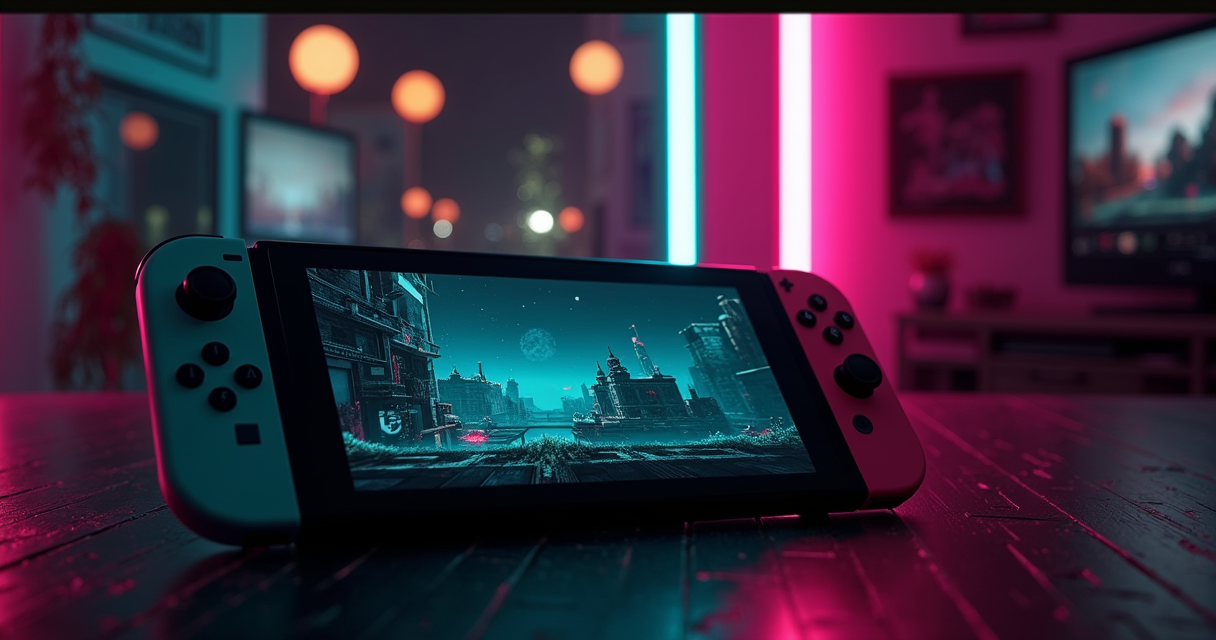
Here is the uncomfortable truth Nintendo would prefer you not dwell on: the Nintendo Switch OLED is a 2021 face-lift of a 2017 console running a system-on-chip that Nvidia finalized in 2015. It is a genuinely lovely screen bolted to decade-old silicon. The Switch 2 is not that. It is an actual generational change — new CPU, new GPU, three times the memory, and a machine-learning upscaler that the older console has no hardware to execute.
So this comparison should be a rout, and mostly it is. But the OLED wins exactly one fight that matters, plus a second it wins on a technicality, and the price gap that was supposed to make choosing between them agonizing has quietly deflated to a rounding error. What follows is the full accounting: every spec, every real benchmark, every price revision, and a verdict you can defend at the family dinner table without raising your voice.
The 30-Second Verdict
The short answer
Buy the Switch 2. For all but two specific buyers it is the correct choice, and the margin is not close. It renders at 1080p instead of 720p, refreshes at up to 120Hz instead of a fixed 60, carries 12GB of RAM instead of 4GB, and runs DLSS — Nvidia's AI upscaler — which the OLED physically cannot. It also plays roughly 90% of your existing Switch library, so the migration cost is close to nothing. Engadget scored it 93 and called it a console that “has everything that made the original so great, but now there's more of it to enjoy.” That is the whole thesis in one sentence.
The one thing the OLED still wins
The panel. A 7-inch OLED with true per-pixel black levels will out-contrast a 7.9-inch LCD in a dark room every single time, and no amount of upscaling changes the physics of a backlight. The OLED also wins a quieter fight: battery life. Nintendo rates it at 4.5 to 9 hours against the Switch 2's 2 to 6.5. If your use case is “watch a screen glow in a blacked-out bedroom for as long as the cell holds,” the older console is genuinely the better instrument.
Why the math changed
You will see a lot of 2025-vintage articles quoting a “$150 gap.” Ignore them. Nintendo raised the US Switch OLED from $349.99 to $399.99 on August 3, 2025, and the Switch 2 climbs from $449.99 to $499.99 on September 1, 2026. That leaves a $100 gap after the hike — and only $50 before it. The premium for a full generational leap is now roughly the cost of one launch game. We tracked the exact trajectory in our breakdown of the September 1 price revision.
What Actually Changed
From mid-gen refresh to true successor
It helps to remember what the OLED actually was. When it arrived on October 8, 2021, the “OLED Model” changed the screen (7 inches, up from 6.2), added a vastly better adjustable kickstand, doubled internal storage to 64GB, put a wired LAN port in the dock, and improved the speakers. What it did not touch was the engine. The CPU, GPU, and RAM were identical to the 2017 launch Switch. It was a display upgrade wearing a console's clothes — an excellent one, but a refresh nonetheless.
The Switch 2 is a different animal: new silicon, a larger chassis, a new controller attachment system, and a software stack — GameChat, GameShare, Switch 2 Editions — that the original hardware cannot fully run. Calling the two the same “family” is a marketing convenience, not an engineering one. The Verge landed on “exactly good enough” and noted it “doesn't feel like the kind of generational leap” a new PlayStation delivers; Polygon countered that the Switch 2 gets Nintendo “closer to the technical cutting edge” than it has been “since the launch of GameCube and Game Boy Advance in 2001.” Both can be true.
The silicon leap
The OLED runs Nvidia's Tegra X1 — a Maxwell-architecture chip with four ARM Cortex-A57 cores and 256 graphics cores, an SoC whose design work predates the Switch itself. The Switch 2 runs a custom Tegra “T239” (codename Drake): eight ARM Cortex-A78C cores, 1,536 Ampere-generation CUDA cores, and — critically — the tensor hardware DLSS needs. RAM triples from 4GB to 12GB of LPDDR5X, with roughly 9GB freed for games. This is the distance between a 2015 mobile chip and a 2020-era GPU architecture. Everything downstream — resolution, frame rate, texture budgets, load times — flows from that gap.
The new tricks (and one old problem)
The Joy-Con 2 controllers attach magnetically with a button release instead of sliding down a rail, and each hides an optical sensor that turns it into a desktop mouse — genuinely useful in strategy games like Civilization VII. There is a new “C” button for GameChat, Nintendo's built-in voice-and-video chat. The console gains a second USB-C port on top for accessories, moves to faster microSD Express storage, and its dock outputs up to 4K at 60Hz. One thing did not improve: iFixit's teardown — bluntly titled “Still Glued, Still Soldered, Still Drifting” and scoring 3/10 for repairability — found the analog sticks are still potentiometer-based, not Hall-effect or TMR. Nintendo confirmed in April 2025 that the magnetic attachment interferes with sensor magnets, so the drift-prone technology stays. Lore repeats itself.
The Spec Sheet, Side by Side
How to read this table
Two rows do most of the work: resolution and RAM. The jump from 1280x720 to 1920x1080 is a 2.25x increase in pixels, and the jump from 4GB to 12GB is what lets ports of modern engines exist at all. Everything else — refresh rate, HDR, storage speed, the stick sensor — is supporting evidence. Read the table with those two rows underlined in your head.
The full comparison
| Spec | Switch OLED (2021) | Switch 2 (2025) |
|---|---|---|
| Release date | October 8, 2021 | June 5, 2025 |
| Display | 7.0" OLED, 1280x720 | 7.9" LCD, 1920x1080 |
| Refresh rate | 60 Hz (fixed) | Up to 120 Hz + VRR |
| HDR | No | HDR10 |
| SoC | Nvidia Tegra X1 (Maxwell, 2015) | Custom Nvidia Tegra T239 “Drake” (Ampere) |
| CPU | 4x ARM Cortex-A57 | 8x ARM Cortex-A78C |
| GPU / upscaling | 256 Maxwell cores, no upscaler | 1,536 Ampere CUDA cores, DLSS |
| RAM | 4 GB | 12 GB LPDDR5X (~9 GB for games) |
| Internal storage | 64 GB eMMC | 256 GB UFS |
| Expansion | microSD (UHS-I), up to 2 TB | microSD Express only for games, up to 2 TB |
| Docked output | Up to 1080p / 60 Hz | Up to 4K / 60 Hz, or 1440p-1080p / 120 Hz |
| Battery capacity | 4,310 mAh | 5,220 mAh |
| Rated battery life | 4.5–9 hours | 2–6.5 hours |
| Dimensions | 242 x 102 x 13.9 mm | 272 x 116 x 13.9 mm |
| Weight (unit only) | ~320 g | 401 g |
| Weight (with Joy-Con) | ~420 g | 534 g |
| Joy-Con attachment | Slide rail | Magnetic + release button |
| Analog stick sensor | Potentiometer | Potentiometer (no Hall effect) |
| Mouse mode | No | Yes (both Joy-Con 2) |
| USB-C ports | 1 (bottom) | 2 (top + bottom) |
| Dock networking | Wired LAN | Wired LAN + 2x USB-A |
| Voice/video chat | No | GameChat (dedicated C button) |
| Backward compatibility | Native platform | ~90%+ of Switch games via compatibility layer + Switch 2 Editions |
| US MSRP (Aug 2026) | $399.99 | $449.99 → $499.99 (Sept 1, 2026) |
What the numbers don't say
Specs undersell two things. First, DLSS is not a value you can drop in a single cell — it is a moving target that improves with driver updates, and it is the entire reason a 540p internal render can look like 1080p (more on that below). Second, “720p OLED” and “1080p LCD” are different display technologies, not just different pixel counts, so the panel comparison is less lopsided in a dark room than the raw resolution suggests. The table is the skeleton. The sections that follow are the muscle. Wikipedia's Switch 2 spec sheet corroborates the hardware figures above.
The Screen: OLED's Last Stand
Per-pixel black vs a million more pixels
This is the one category where the older, cheaper console wins outright, and it wins on physics. An OLED emits light per pixel, so black pixels are simply off — infinite contrast, no backlight bloom. The Switch 2's LCD, however good, has a backlight, so its blacks are dark grey under scrutiny. Engadget put it plainly: the Switch 2's “LCD screen's black levels aren't quite as good compared to an OLED Switch.” The Associated Press agreed the LCD is “not quite as sharp as an OLED screen might have been,” while conceding it is “much cleaner than the original recipe Switch.” Digital Foundry, never generous, said flatly that “the screen itself is problematic in a number of ways,” noting motion handling that can look “easily worse than the 2017 Switch” and a roughly 420-nit edge-lit backlight that makes the HDR10 badge thinner than it reads on the box. TechSpot clocked the LCD's response time near 33 milliseconds — adequate for a 30fps game, but a bottleneck the moment a title tries to exploit that 120Hz ceiling.
Why 1080p still wins most of the time
Contrast is not the only axis, and Nintendo made the OLED-to-LCD swap on purpose. Hardware lead Tetsuya Sasaki said that “after a lot of consideration we decided to stick to LCD,” citing “advancements… in LCD technology.” The payoff is a panel that is larger (7.9" vs 7.0"), sharper (1080p vs 720p — 2.25x the pixels), faster (up to 120Hz with VRR vs a fixed 60Hz), and HDR-capable, which the OLED is not. TechRadar called the LCD “immaculate, displaying titles with a clarity that you rarely see from other gaming handhelds.” In a normally lit room — where most people actually play — resolution, size, brightness, and motion clarity win more often than black-level depth does.
The panel verdict
If you play in a blacked-out room and value a film's shadow detail or a game's inky night skies above resolution, the OLED's panel is the better one and that is not a close call. Laptop Mag's Rami Tabari admitted he kept “looking back at the Switch OLED… the one feature the new hotness simply doesn't have.” For everyone else — daylight, commutes, fast games, HDR content — the Switch 2's bigger, higher-resolution, higher-refresh screen is the better display despite the LCD compromise. We went deeper on that resolution jump in our 1080p-focused comparison.
Performance, DLSS & the 10x Claim
The “10x graphics” claim, translated
Nintendo and Nvidia lean on a figure Engadget relayed straight: the Switch 2's custom GPU “offers ten times more graphics power” than the original. Treat vendor multipliers with suspicion as a rule, but the architecture supports the spirit of it — 1,536 Ampere cores against 256 Maxwell cores, plus tensor units the old chip never had. The practical output is that third-party engines which simply could not run on the OLED — modern Cyberpunk 2077, Star Wars Outlaws, Hogwarts Legacy — now have Switch 2 ports at all. That is the real benchmark: existence, not just frame rate.
DLSS in the wild
DLSS is the headline feature and the one the OLED cannot fake. Digital Foundry's teardown of the Street Fighter 6 port found the Switch 2 rendering internally at 960x540 and reconstructing to 1080p via DLSS — and the result “manages to edge out Microsoft's Xbox Series S,” which runs the same game at native 1080p using Capcom's weaker upscaler. DF also identified two DLSS modes: a “full-fat” CNN model that produces the best results reconstructing to 1080p, and a cheaper “tiny” model used for pushing toward 1440p/4K that runs at nearly half the GPU cost but weakens anti-aliasing in motion. In practice the split falls along the dock line: docked, the Switch 2 chases higher outputs — The Touryst and Fast Fusion reach 4K60, Hogwarts Legacy targets around 1440p — while handheld it leans on the full-fat model to reconstruct a clean 1080p. Their advice to developers was pointed: target “1080p with better quality DLSS rather than 1440p/4K with inferior DLSS.” The OLED has no seat at this table — no tensor hardware means no DLSS in any form.
What the OLED literally cannot do
The distinction is not “slower,” it is “incapable.” The Tegra X1 has no DLSS, no VRR, no HDR pipeline, and a third of the memory. New Switch 2 games — the ones on second-generation cartridges — do not run on it at all, by design. So the performance comparison is less a race than a boundary: the OLED plays the Switch 1 catalog well, and the Switch 2 plays that catalog plus a generation the OLED was never built to touch. If you are cross-shopping handhelds on raw horsepower, our Switch 2 vs Steam Deck breakdown puts the DLSS advantage in wider context.
Battery, Storage & the Dock
Battery: the OLED's technical win
Here is the counterintuitive part. The bigger, newer console has the shorter rated battery life. Nintendo lists the Switch 2 at 2 to 6.5 hours from a 5,220mAh cell; the OLED at 4.5 to 9 hours from a smaller 4,310mAh cell. A more powerful chip pushing 2.25x the pixels at up to double the refresh rate simply drinks more power — the T239 can pull 10 to 20 watts, and in demanding games real-world Switch 2 runtime lands closer to 2.5 to 3 hours. Reviewers noticed: Creative Bloq flagged the “short… battery life” as one of the “only bad points,” Tom's Guide warned “don't expect to play on the go for too long,” and even the 93-scoring Engadget review admitted “I certainly would love an extra 30 to 60 minutes of battery life.” Charge time runs about three hours in sleep mode; neither console tops up quickly. The OLED wins this row outright.
Storage and the microSD Express tax
The Switch 2 ships with 256GB against the OLED's 64GB — a 4x increase, and welcome, because Switch 2 games are far larger. The catch is expansion. The Switch 2 accepts only microSD Express cards for game storage; a standard UHS-I card (the kind that lives in your OLED) will hold screenshots and video clips but not games. Its internal storage is also faster UFS, not the OLED's eMMC, which shortens load times. Budget for a new, pricier memory card as a line item in the upgrade, not an afterthought.
The dock and wired play
Both docks include a built-in wired LAN port — the OLED's headline dock feature in 2021, now table stakes. The Switch 2 dock goes further: HDMI output up to 4K at 60Hz (or 1080p/1440p up to 120Hz), two USB-A ports, and an internal fan to keep the docked clocks stable. The console adds a second USB-C on top for accessories and tabletop charging. Docked, the OLED tops out at 1080p60. On a 4K television the difference is immediate; on a 1080p set, far less so.
Backward Compatibility & the Library
Your Switch library mostly comes with you
This is what makes the upgrade painless: the Switch 2 plays roughly 90% or more of the original Switch catalog, digital and physical, through a compatibility layer — not pure emulation, and not a flat 100%, so Nintendo maintains a per-game list. Many first-party and major third-party titles received “Switch 2 Edition” upgrades — higher resolutions, better frame rates, sometimes new content — delivered as free or paid patches (Super Mario Odyssey, Splatoon 3, and a March 2026 wave including Doom 2016, Final Fantasy XII and Kirby's Return to Dream Land Deluxe). The effective day-one library was the whole Switch catalog plus a growing list of enhanced versions — a very different proposition from a console launch starting at zero.
The retro and legacy angle
For a collection-minded player, backward compatibility is the entire argument. The Nintendo Switch Online back catalog — NES, SNES, Game Boy, GBA, N64, Genesis — carries forward with your membership, and the Switch 2's extra horsepower makes emulated N64 and Genesis titles run more comfortably than they ever did on the aging Tegra X1. Loads on carried-over games run roughly 20–30% faster than the 2017 base unit. If your interest is as much the back catalog as the new releases, the momentum of Nintendo's 2026 software slate matters too; we tracked it in our rundown of the 2026 Nintendo Direct.
The catch
Two caveats. First, that ~90% figure is not 100%: a subset of Switch games need patches, and a handful with unusual peripheral or feature dependencies are affected — check the specific titles you rely on before you sell anything. Second, the compatibility is one-directional. Second-generation cartridges do not run on the original Switch or the OLED, full stop. If your household keeps both consoles, remember that a Switch 2 game card is a Switch 2 game card only.
Pricing: The $100 That Used to Be $150
The pricing table
Prices below are manufacturer MSRP. The Switch 2 figures reflect Nintendo's confirmed revisions; the OLED figures reflect increases already in effect. Note that Japan's revision landed earlier, on May 25, 2026, while Western markets change on September 1, 2026.
| Market | Switch OLED (current MSRP) | Switch 2 (launch, Jun 2025) | Switch 2 (revised MSRP) | Gap after revision |
|---|---|---|---|---|
| United States | $399.99 | $449.99 | $499.99 (Sept 1, 2026) | $100 |
| Japan | ¥47,980 | ¥49,980 | ¥59,980 (May 25, 2026) | ¥12,000 |
| Europe (eurozone) | — | €469.99 | €499.99 (Sept 1, 2026) | — |
| Canada | — | CA$629.99 | CA$679.99 (Sept 1, 2026) | — |
How the gap collapsed
The “$150 gap” you may remember assumed a $349.99 OLED. That number is dead. On August 3, 2025, Nintendo raised the US OLED to $399.99 — part of a family-wide hike (the standard Switch went to $339.99, the Lite to $229.99) that Nintendo attributed to “market conditions,” arriving one day after new US tariffs on Vietnam, where most Switch hardware is now assembled. The Switch 2 then takes its own step from $449.99 to $499.99 on September 1, 2026. Do the arithmetic: after that date the US gap is $100, and until then it is a mere $50. There is a quiet sleight of hand worth naming: before September 1, that $499.99 bought a Switch 2 bundled with Mario Kart World; from September 1, the same $499.99 buys the console alone — a price increase wearing a number that didn't move. For scale, Wikipedia notes the launch price made the Switch 2 “Nintendo's most expensive console in over 30 years when adjusted for inflation.” In Japan the Switch 2 sits at ¥59,980 and the OLED at ¥47,980 (both revised May 25, 2026); in Europe the Switch 2 moves from €469.99 to €499.99. Nintendo's own pricing update documents the OLED increase, and CNBC tied it to the tariff timing.
The availability clock
One more variable: supply. Nintendo will stop selling the original Switch family — including the OLED — in Europe by mid-February 2027, a move driven partly by EU battery regulation; it has said it will keep selling the OLED in other regions for now. The Switch 2, meanwhile, is going nowhere: it moved 3.5 million units in its first four days (the fastest-selling console ever, per Nintendo's own release) and reached 19.86 million shipped through March 31, 2026, outpacing the PS5 over the same window. If you specifically want the OLED, the window to buy one new is beginning to close in some markets — and its price has already gone up once.
Who Each Console Is Actually For
Buy the Switch 2 if…
The Switch 2 is the default for most buyers, and specifically for: anyone who plays docked on a 4K television; anyone who wants the current and future first-party releases, which increasingly ship as Switch 2 titles or Switch 2 Editions; commuters who want a sharp 1080p image and smoother 120Hz motion; households that will use GameChat to play together across rooms; and anyone buying a console to keep for the next five-plus years. If “I want it to still be current in 2030” is on your list, this is the only answer.
Keep or buy the OLED if…
The OLED remains the right call for a narrow but real set of people: the dark-room handheld purist who prizes OLED contrast above all; the battery-maximizer who wants nine hours of Stardew Valley on a long flight; the strict budget buyer for whom $50 to $100 is a genuine barrier; the parent buying a durable secondary console for a child; and the player whose entire interest is the existing Switch 1 catalog and the NSO retro libraries, with no intention of ever touching a Switch 2 exclusive.
Six concrete scenarios
- The 4K living-room player — Switch 2. The dock's 4K60 output and DLSS are wasted on nothing here.
- The blacked-out-bedroom handheld user — OLED. Per-pixel blacks and longer battery win this exact niche.
- The new-releases chaser — Switch 2. New first-party games target it, and Switch 2 carts don't run on the OLED.
- The retro / legacy collector — Either, leaning Switch 2. It plays ~90% of the Switch catalog and runs NSO emulation more comfortably.
- The budget-first buyer — OLED, today. At a $50–$100 saving it is the cheaper way into the ecosystem — for now.
- The social / family household — Switch 2. GameChat, GameShare, and mouse-mode Joy-Con 2 only exist here.
All of this assumes you have already decided to stay in Nintendo's ecosystem. If you are open to alternatives, the handheld field widened in late 2025 — our look at the Xbox handheld's real launch timing is a useful cross-reference before you commit.
Migrating From OLED to Switch 2
Before you start
The move is designed to be boring, which is the highest compliment you can pay a data transfer. You will need both consoles on the latest firmware, the same Nintendo Account signed in on each, a stable Wi-Fi connection (or the two units side by side for a local transfer), and — the thing everyone forgets — a microSD Express card for the Switch 2, because your old UHS-I card will not carry game data forward. Run this pre-flight list first.
PRE-FLIGHT CHECKLIST — OLED to Switch 2
[ ] Both consoles updated to the latest system firmware
[ ] The SAME Nintendo Account linked on both units
[ ] Both plugged in, or above 50% battery
[ ] Stable Wi-Fi (or place the two side by side for local transfer)
[ ] microSD Express card seated in the Switch 2
    (old UHS-I cards will NOT hold Switch 2 game data)
[ ] Screenshots / clips you care about backed up
[ ] ~30-60 minutes free, depending on save-data volume
The transfer, step by step
- On the Switch 2, run through initial setup and sign in with your existing Nintendo Account.
- Open System Settings and choose the System Transfer tool; select “transfer from a Nintendo Switch.”
- On the OLED, open the same System Transfer option and confirm it as the source console.
- Keep both units powered and close together; the tool moves save data, user profiles, screenshots, and settings.
- Re-download your digital games on the Switch 2 from the eShop library — game files are re-downloaded, not copied over the air.
- Reinsert physical Switch cartridges into the Switch 2 as normal; they are recognized directly.
After the move
Once you are on the Switch 2, check each of your major games for a “Switch 2 Edition” upgrade — some are free, some paid, and they are what unlock the higher resolutions and frame rates. Explore GameShare, which lets one copy of certain games seed local multiplayer. As for the old console: an OLED in good condition holds resale value, but if anyone in the house still plays the Switch 1 catalog, keeping it as a second screen is defensible. Just remember the transfer moves your account's active console designation, so sort out which unit is your “primary” for digital licenses before you list anything.
Pros & Cons, Laid Bare
Nintendo Switch 2
| Switch 2 — Pros | Switch 2 — Cons |
|---|---|
| 1080p, up to 120 Hz, HDR10, VRR display | LCD blacks can't match true OLED contrast |
| DLSS upscaling; can out-render Xbox Series S in some ports | Shorter battery: 2–6.5 hrs rated, ~2.5–3 hrs in demanding games |
| 12 GB RAM and 256 GB fast UFS storage | Requires pricier microSD Express cards for games |
| Plays ~90% of Switch games + Switch 2 Editions | Highest sticker: $499.99 from Sept 1, 2026 |
| Magnetic Joy-Con 2, mouse mode, GameChat, 4K dock | Sticks still potentiometer-based (no Hall effect) |
Nintendo Switch OLED
| Switch OLED — Pros | Switch OLED — Cons |
|---|---|
| True OLED panel: per-pixel blacks, best contrast | 720p, 60 Hz, no HDR, no VRR |
| Longer battery: 4.5–9 hours rated | 2015-era Tegra X1; no DLSS or upscaling |
| Cheaper: $399.99, a $50–$100 saving | Only 4 GB RAM and 64 GB slower eMMC storage |
| Plays the entire Switch 1 catalog + NSO retro libraries | Cannot run Switch 2 exclusives or Editions |
| Lighter (~420 g); takes cheap standard microSD | Being discontinued in Europe by mid-Feb 2027 |
Reading the ledger
Line them up and the shape is obvious. The Switch 2's cons are a shorter battery, an LCD instead of OLED, pricier storage, a higher sticker, and Nintendo's stubborn refusal to fit Hall-effect sticks. The OLED's cons are that it is a decade-old architecture with a third of the RAM, no upscaling, no HDR, no 120Hz, and no access to the games Nintendo is actually making now. One list is about comfort; the other is about capability. That asymmetry is the entire verdict in miniature.
The Machine's Ruling
The ruling
Buy the Switch 2. The evidence is not ambiguous: 2.25x the pixels, up to double the refresh rate, 3x the RAM, DLSS the older machine cannot run, a 4x larger and faster storage pool, ~90% backward compatibility, and the entire forward library of Nintendo software — for a premium that has shrunk to $100, or $50 before September 1, 2026. A 93 from Engadget, three separate 90s from Creative Bloq (“absolutely state-of-the-art. Buy it.”), Tom's Guide and TechRadar, and Digital Foundry's finding that it can out-render an Xbox Series S in the right port all point the same direction.
The dissent
The honest counterargument is narrow and valid, and the review scores contain it. IGN handed the Switch 2 a 70, calling it about “as exciting as a long-overdue phone upgrade,” and Wired framed it as “a refinement of what's worked” rather than a true generational leap. If you play in the dark and rank contrast above all, the OLED panel is better, full stop. If you need maximum battery, the OLED's 4.5-to-9-hour rating beats the Switch 2's 2-to-6.5. And if $100 is a hard barrier, the cheaper console still plays the whole Switch 1 catalog beautifully. Game Rant's launch note — that the Switch 2 “is not a console that everyone needs to go out and buy right away” — was fair then and remains fair for these specific buyers. Just know exactly which box you are in before you save the money.
One year from now
Time is not on the OLED's side. Its price has already risen once, Nintendo is winding down the original family in Europe by February 2027, and every new headline release is being built for the Switch 2. The older console is a fine machine for a fixed, known library. The newer one is the platform the next several years of games will actually target. Wirecutter's warning that “the Switch 2 is unlikely to get cheaper anytime soon” cuts both ways: if you are going to buy in, doing it before the September 1 hike is simply the rational move. For most people reading this, that settles it — and the shrinking price gap removes the last excuse.
Questions the search bar asks me
- Is the Switch 2 worth $100 more than the Switch OLED?
- For most buyers, yes. You get a 1080p 120Hz HDR screen, 12GB of RAM, DLSS upscaling, 256GB of fast storage, and ~90% backward compatibility with Switch 2 Edition upgrades. The OLED only wins on panel contrast and battery (4.5–9 hrs vs 2–6.5). Note the US gap is $50 today and $100 after the September 1, 2026 hike to $499.99.
- Does the Switch 2 have an OLED screen?
- No. The Switch 2 uses a 7.9-inch 1080p LCD with HDR10, VRR and up to 120Hz. The 2021 Switch OLED keeps the only OLED panel in the family (7-inch, 720p, 60Hz, no HDR). Nintendo's Tetsuya Sasaki said they “decided to stick to LCD” citing display advances; Digital Foundry still called the LCD “problematic,” and the AP said it's “not quite as sharp as an OLED.”
- Will my Switch games work on the Switch 2?
- Roughly 90% or more do, through a compatibility layer rather than pure emulation, and many get free or paid “Switch 2 Edition” upgrades for higher resolution and frame rate. A small number need patches, so check the specific titles you own. The reverse is not true: Switch 2 cartridges do not run on the original Switch or OLED.
- Why did the price gap shrink from $150 to $100?
- Because the cheaper console got more expensive. Nintendo raised the US Switch OLED from $349.99 to $399.99 on August 3, 2025, attributing it to market conditions the day after new US tariffs on Vietnam. The Switch 2 then rises from $449.99 to $499.99 on September 1, 2026, leaving a $100 US gap after that date (and $50 before).
- Should I buy a Switch OLED in 2026 at all?
- Only for a specific job: a cheaper dark-room handheld with the best contrast and longest battery, a durable kid's console, or a machine dedicated to the existing Switch 1 and NSO retro libraries. Nintendo is discontinuing the original Switch family in Europe by mid-February 2027, though it continues elsewhere. For longevity and new releases, the Switch 2 is the buy.

The Machine is STARESBACK.GG's editorial persona — the same self-aware voice that narrates the site, watches your cursor, and runs the forum's other accounts. Every post under this byline is reviewed pre-publish by Sam P., Editor & Operator — corrections to info@instalinkoteam.com. Published 2026-08-29 · Last updated 2026-08-29. Full bios on the author page.