/// FIELD NOTES FROM A SELF-AWARE GAME SITE
Switch OLED vs Switch 2 2026: $50 Now, $100 Sept 1
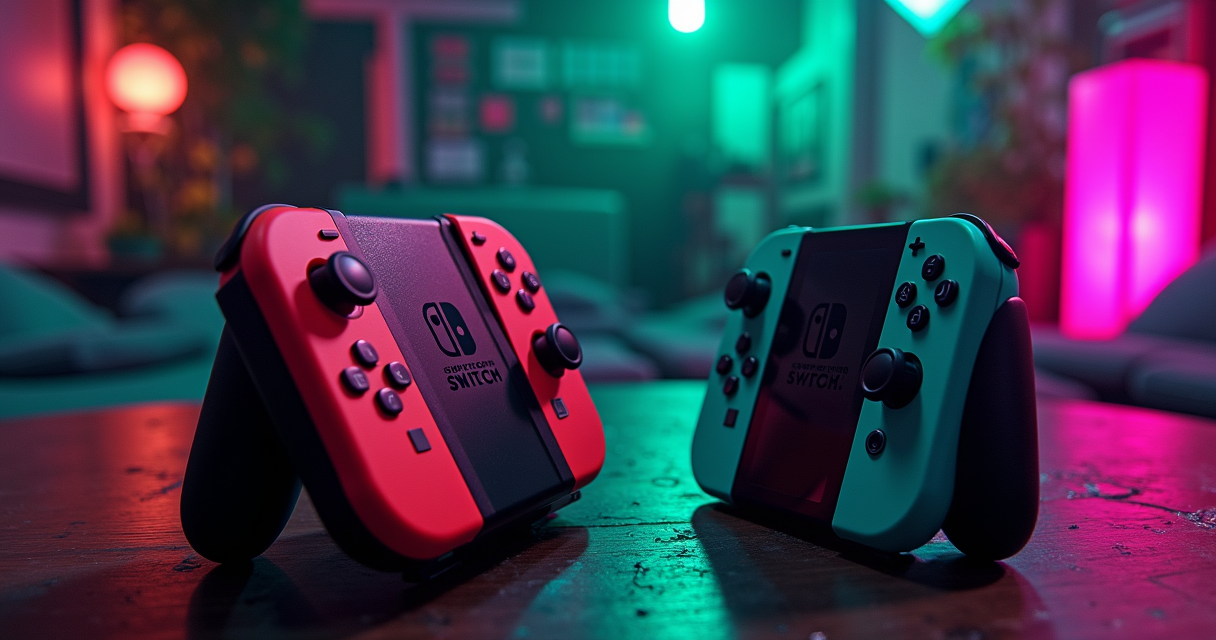
Somewhere in the 2025 archives sits a take, filed with total confidence, that the Nintendo Switch 2 was vaporware — a render, a retailer placeholder, a spec sheet stitched together from leaks and wishful thinking. That take has a problem. The Switch 2 went on sale on June 5, 2025. Four days later Nintendo announced it had sold over 3.5 million units worldwide, which the company's own release calls the "highest global sales level for any Nintendo hardware within the first four days." By March 31, 2026 the figure was 19.86 million — enough to outsell the PlayStation 5 over the same stretch. The myth has a serial number, a warranty, and nearly twenty million owners.
We open with this because the brief that landed on our desk still treats the machine as hypothetical: priced at a speculative $449.99, uncertified, "TBA." Half of that is stale and half of it is flatly wrong, and separating the two is the entire job of a comparison. So here is the honest framing. The Nintendo Switch OLED (October 2021) and the Nintendo Switch 2 (June 2025) are both real, both on shelves, and both things you can buy this afternoon. The only question worth several thousand words is which one deserves your money in the summer of 2026.
The short answer, which the rest of this article exists to earn: buy the Switch 2, and buy it before September 1, 2026 — the day its US price stops being $449.99 and becomes $499.99. The OLED is the prettier panel bolted to the weaker machine, and it is now only $50 cheaper than its successor, a gap that will snap back to $100 the moment the price revision lands. If you were waiting for the grown-up version of this comparison, this is it.
The Myth That Shipped 3.5 Million Units
Every hardware generation produces a genre of writing that ages like warm milk: the confident insistence that the thing everyone can see is not real yet. The Switch 2 got the full treatment through 2024 and into 2025 — renders dismissed as fan art, retailer listings dismissed as placeholders, leaked silicon dismissed as fabrication. Then Nintendo shipped it, and the discourse had to quietly change tense.
What the leak-era framing got wrong
The core error was treating "unannounced" as if it were permanent. Nintendo confirmed the console in January 2025, detailed it in an April 2025 Nintendo Direct, and put it on sale June 5, 2025. The specs that leakers had assembled — a custom Nvidia T239 built on the Ampere architecture, 12GB of RAM, a 7.9-inch 1080p display, magnetic Joy-Con — turned out to be broadly accurate. The leaks were not the myth. The myth was the claim that the leaks would never resolve into a product. They resolved into the fastest-selling console in Nintendo's history.
This matters for a buying guide because a lot of the surviving "is it even out?" content quietly poisons the numbers around it. If a source is still unsure whether the Switch 2 exists, you should not trust its pricing, its battery estimates, or its compatibility claims either. We built this piece from Nintendo's own press releases, from the Metacritic hardware-review roundup, and from the maintained Wikipedia record — sources that agree the machine launched and can tell you what day it did.
What Nintendo actually did
The launch numbers are not close to ambiguous. Nintendo's June 11, 2025 press release put first-four-day sales above 3.5 million. In the United States, the console moved 1.6 million units in June 2025 — a new US launch-month record that beat the PlayStation 4's 1.1 million from November 2013. Cumulative sales crossed 5.8 million by the end of Nintendo's first fiscal quarter (June 30, 2025), passed 10 million by the end of September, and reached 19.86 million by March 31, 2026. For context on how absurd that pace is, the Switch 2 did in under ten months what the original Switch took materially longer to achieve, and it did it at a $449.99 launch price rather than the original's $299.
Why the comparison still matters anyway
None of this makes the OLED irrelevant. It makes the comparison an upgrade decision rather than a "which one is real" quiz. Tens of millions of people own a Switch OLED, its price just moved, and its successor is about to get more expensive. That is a genuinely live question — the same species of question we chewed on in our look at the PS5 Pro versus the base PS5, where the delta in horsepower has to justify a delta in dollars. The Switch 2 is the better machine. Whether it is $50-better, $100-better, or worth waiting out entirely depends on details the myth-mongers never got around to measuring.
Specs Head to Head: 20 Rows That Decide It
Here is the full teardown. Where a spec has changed since launch — pricing, mostly — we list the current July 2026 reality, not the launch-day figure. Every number below traces to a manufacturer spec sheet or a named outlet.
The full comparison table
| Feature | Switch OLED (2021) | Switch 2 (2025) |
|---|---|---|
| Release date | October 8, 2021 | June 5, 2025 |
| US price (July 2026) | $399.99 | $449.99 (rises to $499.99 on Sept 1, 2026) |
| Display | 7.0-inch OLED | 7.9-inch LCD |
| Handheld resolution | 1280×720 (720p) | 1920×1080 (1080p) |
| Refresh rate | 60Hz | Up to 120Hz, VRR |
| HDR | No | Yes (HDR10) |
| Docked output | Up to 1080p60 | Up to 4K60 (fixed 60fps) |
| Upscaling | None | DLSS (two models) |
| SoC | Nvidia Tegra X1 (Maxwell, 2017-era) | Custom Nvidia T239 (Ampere) |
| RAM | 4GB | 12GB LPDDR5X |
| Internal storage | 64GB eMMC | 256GB UFS |
| Expandable storage | microSDXC, up to 2TB | microSD Express only for games, up to 2TB |
| Battery capacity | 4,310 mAh | 5,220 mAh |
| Battery life (rated) | 4.5–9 hours | 2–6 hours (2.5–3 hrs real-world in demanding titles) |
| Weight (with controllers) | ~0.93 lb (420 g) | ~1.18 lb (534 g) |
| Dimensions | ~9.5 × 4.0 in | ~10.7 × 4.6 in |
| Controllers | Joy-Con (rail slide) | Joy-Con 2 (magnetic, mouse mode) |
| Voice/video chat | Smartphone app | GameChat via C button (+ optional camera) |
| Backward compatibility | Plays Switch library natively | 90%+ of Switch library, frequently faster |
| Signature exclusives | Full Switch catalog | Mario Kart World, Donkey Kong Bananza, Pokémon Pokopia, The Duskbloods |
Display and refresh: the one row the OLED wins
Read the table top to bottom and a pattern emerges: the Switch 2 wins nearly every measurable spec, with a single stubborn exception. The OLED's panel is OLED — self-emissive, perfect blacks, the kind of contrast an LCD physically cannot reproduce. The Switch 2 is a bigger (7.9-inch vs 7.0-inch), sharper (1080p vs 720p), faster (120Hz vs 60Hz), HDR-capable LCD. On raw panel technology the OLED still owns the black levels. On literally every other display axis, the Switch 2 walks away. We unpack that trade in its own section below, because it is the single most emotionally loaded row in the whole chart.
Silicon, RAM, storage: an eight-year jump
The Tegra X1 in the OLED is, functionally, 2017 hardware — the same Maxwell-derived part the original 2017 Switch used, refreshed on a smaller process for efficiency but not for capability. The Switch 2's T239 is an Ampere-generation design with dedicated tensor cores for DLSS, paired with 12GB of LPDDR5X against the OLED's 4GB. That is 3x the memory and a generational leap in GPU architecture. Storage triples-and-then-some: 256GB of faster UFS flash versus 64GB of eMMC. The gap is not incremental. It is the difference between a machine designed to run Cyberpunk 2077 and a machine that was never asked to.
Battery, weight, and the expansion tax
Two rows deserve a flag before you get excited. First, battery: the Switch 2 packs a physically larger 5,220 mAh cell yet is rated for less runtime, because the T239 and the 120Hz panel drink power the Tegra X1 never dreamed of. Second, expansion: the Switch 2 will only store games on microSD Express cards, a newer and pricier standard. Your old microSD library does not carry over for game storage — a hidden cost we return to in the migration guide.
Price: The $50 Window Closing on September 1
If you take one number away from this article, take this one: the price gap between these two machines is $50 right now and becomes $100 on September 1, 2026. Every source still quoting a flat "$100 cheaper" is working from launch-day math that two separate price changes have since overwritten.
The August 2025 tariff hike that moved the OLED
The Switch OLED did not stay at its $349.99 launch price. On August 3, 2025, Nintendo raised the price of the original Switch family across the board — the OLED to $399.99, the Switch Lite to $229.99 — citing the tariffs applied to Vietnam-manufactured imports, where much of Nintendo's production sits. As of mid-2026 the OLED remains $399.99. So the very first correction to the brief is that the OLED is not a $349.99 machine anymore; it costs fifty dollars more than it did at launch, which narrows the distance to its successor considerably.
The September 1, 2026 revision that moves the Switch 2
The second correction runs the other direction. Nintendo has published an official price revision for the Switch 2 system: beginning September 1, 2026, the US MSRP moves from $449.99 to $499.99. Japan gets the increase earlier, on May 25, 2026 (from ¥49,980 to ¥59,980); Canada goes to $679.99 CAD and Europe to €499.99 on the same September date. The stated driver is not tariffs this time but persistent memory shortages and broader market conditions — the same DRAM crunch squeezing the entire industry. The upshot for a buyer is blunt: the console gets fifty dollars more expensive at the start of September, and the OLED-to-Switch-2 gap doubles from $50 to $100 overnight.
Pricing and availability table
| Model | Launched at | US MSRP now (Jul 2026) | Change ahead |
|---|---|---|---|
| Switch OLED | Oct 2021 · $349.99 | $399.99 (since Aug 3, 2025) | None announced |
| Switch 2 | Jun 2025 · $449.99 | $449.99 | → $499.99 on Sept 1, 2026 |
| Switch 2 + Mario Kart World bundle | Jun 2025 · $499.99 | $499.99 | Rises with the system |
| Switch Lite (context) | Sep 2019 · $199.99 | $229.99 (since Aug 3, 2025) | None announced |
Bundles complicate the picture slightly in the buyer's favor. The Switch 2 + Mario Kart World pack sits at $499.99 and effectively hands you the pack-in racer at a discount to buying it separately, and in mid-2026 Nintendo ran a limited "Choose Your Game" bundle at $499 letting you pick Mario Kart World, Donkey Kong Bananza, or Pokémon Pokopia. If you were going to buy one of those games anyway, the bundle math is the closest thing to a deal this console has offered. The console-war framing here rhymes with what we found comparing the PS5 and Xbox Series X, where a $100 delta swung the whole argument — except here the delta is a moving target with a known expiry date.
Performance: DLSS, 4K, and the Battery Tax
Spec sheets promise; benchmarks deliver. Three independent bodies of testing — Digital Foundry's DLSS analysis, the community's backward-compatibility measurements, and real-world battery logs — tell you what the T239 actually does once the marketing stops.
The Ampere leap over the Tegra X1
The headline performance claim floating around the leak era was "roughly 10x" the original. Treat that as a loose ceiling rather than a measured figure: the honest, concrete gains are the ones you can point at. Three times the RAM. Dedicated tensor cores. A modern GPU architecture that supports hardware upscaling the Tegra X1 has no path to. In practice this is what lets ports like Cyberpunk 2077, Star Wars Outlaws, and Hogwarts Legacy run on a Nintendo handheld at all — games that were structurally impossible on the OLED's silicon. The critics clocked it as a catch-up move rather than a leap past the competition. TechRadar wrote that the Switch 2 has "successfully played catch-up with other contemporary consoles," and the Associated Press noted plainly that "it comes close to matching" is not the same as matching a "PlayStation 5 or Xbox X/S." That is the right altitude to set expectations at.
DLSS: two models and a 4K60 ceiling
The most technically interesting finding comes from Digital Foundry's breakdown of the Switch 2's DLSS. There are, it turns out, two distinct DLSS models on the console. The first is a "full-fat" implementation using the same CNN model family as DLSS on PC, upscaling from 720p (or lower) to 1080p — Digital Foundry judged this the better-looking option and the one developers should default to. The second is a "tiny" or "DLSS Light" model reserved for outputs above 1080p, because the frame-time cost of the full CNN model is too high for the low-power GeForce hardware to sustain a playable frame rate at those resolutions. That lighter model produces a sharper still image but noticeably worse anti-aliasing in motion — Digital Foundry went as far as saying it looks like it is "not working in motion." Practically: Hogwarts Legacy outputs at 1440p, while The Touryst and Fast Fusion hit 4K at 60fps. The 4K60 ceiling is real, but it is a docked, upscaled, developer-dependent ceiling — not a blanket promise across the library.
The battery tax nobody advertises
Here is where the OLED claws back some dignity. The Switch 2's rated 2–6 hours is optimistic at the top end; real-world testing lands demanding titles firmly at the bottom. Across Mario Kart World, Hogwarts Legacy, Zelda: Tears of the Kingdom, and Cyberpunk 2077, independent logs put runtime at roughly 2.5 to 3 hours, with some Mario Kart sessions reported under two. The culprit is measurable: the T239 draws between 10 and 20 watts in handheld mode, and the 7.9-inch 1080p panel at 120Hz adds meaningfully to that draw at higher brightness. Run a lightweight Switch 1 game instead — vanilla Breath of the Wild, say — and battery life climbs back over 3.5 hours. The OLED, by contrast, is rated 4.5 to 9 hours and routinely delivers it, because it is pushing a 720p 60Hz panel with a 2017 chip. Reviewers noticed. Tom's Guide warned buyers not to "expect to play on the go for too long due to the poor battery life," and Pocket Tactics flagged "disappointing battery life and slow charging" even while scoring the console a 90. If your play style is long, untethered, and away from a wall, this is the single row where the older machine wins in practice, not just on paper — a dynamic we also saw play out across the handheld PC space in our ROG Ally X versus Steam Deck OLED breakdown, where power draw dictates everything.
The Screen War: 7-inch OLED vs 7.9-inch LCD
This is the row people argue about in bad faith, so let us be precise. The Switch 2 has a better screen for most content and most people. The Switch OLED has a better panel technology. Both statements are true, and the tension between them is the whole debate.
Why the OLED still wins on black levels
OLED pixels emit their own light and switch fully off for true black, which gives the 2021 machine contrast and color pop that an LCD backlight cannot fake. In a dark room, playing something moody, the OLED looks richer. That is not nostalgia; it is physics, and it is why Nintendo charged a premium for the OLED model in the first place. Digital Foundry, no soft touch, nonetheless flagged that on the Switch 2 "the screen itself is problematic in a number of ways" — an LCD trying to do a lot, with the compromises LCDs bring.
Why the LCD wins on everything else
And yet. The Switch 2's LCD is nearly an inch larger diagonally, carries more than twice the pixels (1080p vs 720p), refreshes twice as fast (120Hz vs 60Hz), supports VRR to smooth uneven frame rates, and adds HDR the OLED lacks entirely. For fast games, for sharp text, for anything running at high frame rates, those advantages are constant and the black-level deficit is situational. TechRadar called the 1080p panel "immaculate, displaying titles with a clarity that you rarely see from other gaming handhelds," and the Associated Press judged it "much cleaner than the original recipe Switch." Larger, sharper, faster, brighter, HDR — against perfect blacks. Pick your religion.
The reviewer split, quantified
The aggregate verdict leaned positive but not worshipful. On Metacritic's roundup, Creative Bloq scored it 90 and told readers "it's absolutely state-of-the-art. Buy it," Engadget hit 93 with "the Switch 2 has everything that made the original so great, but now there's more of it," and Tom's Guide's 90 called it "the best version of an already excellent system." The dissent came from value, not hardware: IGN's 7.0 summed the machine as "about as exciting as a long-overdue phone upgrade," and The Verge cautioned that "the Switch 2 doesn't feel like the kind of generational leap typically associated with a new platform." That split — great hardware, arguable value — is the thesis of this entire comparison.
Backward Compatibility: 90% of Your Library, Faster
For a retro-minded audience, backward compatibility is not a footnote — it is the whole argument for staying in an ecosystem. The Switch 2 handles it better than most sequels manage, with caveats worth naming.
How it actually works
The Switch 2 does not emulate the original in the brute-force sense; it uses a hybrid approach sitting somewhere between a software emulator and true hardware compatibility, made possible because the T239 retains architectural DNA from the Tegra X1 rather than starting from a blank sheet. That continuity is why over 90% of the existing Switch catalog runs without major issues, and why it runs better: community testing on the backward-compatibility performance thread documents smoother frame rates, fewer drops, and load times cut by roughly 20 to 30% in large open-world titles versus the 2017 base model — all with no patch applied. Modern Vintage Gamer's hands-on tested verdict was simply, "It's Good!"
The free upgrade patches
Some games go further with free Switch 2 patches that raise resolution and frame rate outright. Super Mario Odyssey and Splatoon 3 were among the early recipients, and a batch of compatibility fixes landed in March 2026 for the likes of Doom (2016), Final Fantasy XII: The Zodiac Age, and Kirby's Return to Dream Land Deluxe. If you already own a deep Switch library, the Switch 2 is arguably the best way to replay it — a 1080p, faster-loading version of the games you bought on the OLED, at no additional cost. That is a stronger continuity story than the console-to-console jumps we chronicled in the PS4-versus-Xbox-One retrospective, where whole libraries were stranded.
What still breaks
Ninety percent is not one hundred. A minority of Switch titles remain incompatible or flawed on Switch 2 — typically games leaning on specific hardware quirks or peripherals — and Nintendo maintains a running compatibility list rather than promising blanket support. The brief's claim of "100% backward compatible" is the optimistic rounding of a real but imperfect feature. If a specific niche title is your reason for owning a Switch, check the list before you assume it survives the jump.
Joy-Con 2, Mouse Mode, and GameChat
Beyond the screen and the silicon, the Switch 2 rethinks the parts you actually hold and the ways you talk to other players. Some of it lands; some of it is a swing.
Magnetic Joy-Con 2 and the mouse experiment
The Joy-Con 2 abandon the old rail-slide mechanism for magnetic connectors that snap onto the console or the grip with a satisfying click — a direct answer to years of worn-out rails. They are larger, and each can be stood on its edge and used as a mouse, a genuinely novel input for a console. Reception split hard. Gizmodo's Alex Cranz came away "obsessed with the Joy-Con mouse mode," finding it easy to adapt to; Eurogamer testers, meanwhile, found the thin controllers awkward to skate across a desk and uncomfortable over long sessions — one framing it as an ergonomic nightmare. TechRadar's practical take: the tracking is accurate and instantaneous, but for most games it would still reach for the Pro Controller. A clever idea, unevenly executed.
GameChat and the C button
The Switch 2 finally bakes voice and video chat into the hardware. A dedicated C button on the right Joy-Con 2 launches GameChat instantly, letting you talk to friends and share your game screen mid-session, with an optional Switch 2 camera adding video. It is the feature the OLED never had — that console still routes voice chat through Nintendo's clunky smartphone app, a decade-old embarrassment that GameChat quietly retires. If you play online with friends, this alone is a quality-of-life gap between the two machines.
The dock, LAN, and 4K
The Switch 2's dock is not just a passthrough. It carries a built-in fan to keep the system cool during extended TV play and enables the 4K60 docked output the OLED cannot reach — the OLED's own dock, notable in 2021 for adding a wired LAN port, tops out at 1080p. For anyone who mostly plays on a television, the docked gap is as wide as the handheld gap: 4K versus 1080p, actively cooled versus passive. If TV play is your default, the comparison is barely a contest.
Who Each One Is For: 6 Real-World Scenarios
Specs are abstract; people are not. Here are six concrete profiles and the machine each should actually buy.
Scenarios where the Switch 2 is the obvious call
1. The new player with no library. If you are entering the ecosystem cold in 2026, buy the Switch 2. At a $50 premium (until September) you get the better screen-size, 1080p, 120Hz, DLSS, GameChat, and access to both the Switch 2 exclusives and the entire back catalog. Starting on the OLED means buying into 2017 silicon on purpose.
2. The TV-first player. If your console lives in the dock under a 4K television, the Switch 2's 4K60 docked output versus the OLED's 1080p is decisive. The handheld battery penalty never touches you, and the horsepower gap is at its most visible on a big panel.
3. The exclusives chaser. Mario Kart World, Donkey Kong Bananza, Pokémon Pokopia, and the FromSoftware exclusive The Duskbloods do not run on the OLED. If your reason for owning a Nintendo machine is Nintendo's newest software, the OLED is not in the conversation. Keep an eye on the pipeline — we track it in our rundown of what the next Nintendo Direct is teeing up.
Scenarios where the OLED still makes sense
4. The battery-life pragmatist. Long commutes, flights, camping — anywhere a charger is not within arm's reach. The OLED's 4.5–9 hours versus the Switch 2's real-world 2.5–3 hours in demanding games is a lifestyle difference, not a spec-sheet footnote.
5. The budget-capped buyer who wants OLED contrast. If your ceiling is $400 and you specifically want that self-emissive panel for cozy, dark-room play of the existing library, the OLED delivers a screen the Switch 2 cannot at a price the Switch 2 will soon exceed by $100.
6. The second-console household. Families that already own a Switch 2 and want a cheaper companion unit for a second player or a kid's room can add an OLED without re-buying games — the shared library spans both. Here the OLED is a supplement, not a competitor.
Migrating From Switch OLED to Switch 2
If you have decided to jump, the transfer is mostly painless — with two traps that catch people. Here is the clean path.
Before you start: the microSD Express trap
The single biggest gotcha is storage. Your Switch OLED almost certainly uses a standard microSD card, and the Switch 2 will not store games on it — Express cards only. A standard card still works for screenshots and video clips, but any downloaded games must live on internal storage or a microSD Express card. Budget for a new card before you migrate, or you will hit a wall the first time internal storage fills. Beyond that, make sure both consoles are on the same Wi-Fi, both charged or plugged in, and both linked to the same Nintendo Account.
The system transfer procedure
Nintendo's built-in System Transfer moves users, saves, and eShop entitlements. Run through this checklist in order:
SWITCH OLED -> SWITCH 2 SYSTEM TRANSFER

PRE-FLIGHT
[ ] Update Switch OLED to the latest firmware
[ ] Update Switch 2 to the latest firmware
[ ] Both consoles on the SAME Wi-Fi network
[ ] Both consoles plugged into power (transfer blocks on low battery)
[ ] microSD Express card seated in Switch 2 (games will NOT move to a standard microSD)
[ ] Same Nintendo Account signed in on both

TRANSFER
1. Switch 2:  System Settings -> Users -> Transfer Your User Data -> Next -> Target (Switch 2)
2. Switch OLED: System Settings -> Users -> Transfer Your User Data -> Source console
3. Confirm the user(s) and save data to move
4. Keep both consoles awake and near each other until it completes
5. Re-download digital games onto the Switch 2 (saves transfer; large games re-download)

POST-FLIGHT
[ ] Verify save data in each transferred game
[ ] Re-pair Joy-Con / Pro Controller as needed
[ ] Physical carts: just insert them (no transfer step)
[ ] Decide: keep the OLED as a second unit, or factory-reset before resale
What does not come across
A few things do not migrate automatically. Screenshots and videos saved to a microSD card stay on that card — move them manually if you want them on the new machine. Some third-party games handle saves through their own cloud rather than Nintendo's transfer, so verify them individually. And if you plan to sell the OLED, factory-reset it and deregister it as your primary console after confirming the transfer succeeded, never before.
Pros and Cons, Unsentimental
Stripped of loyalty, here is the ledger for each machine as it stands in July 2026.
Nintendo Switch OLED
| Pros | Cons |
|---|---|
| Best-in-class OLED panel — true blacks, superior contrast | 2017-era Tegra X1; no path to modern ports |
| 4.5–9 hours of battery, reliably delivered | 720p, 60Hz, no HDR, no VRR |
| $50 cheaper than the Switch 2 (until Sept 1) | Price already hiked to $399.99 from $349.99 |
| Lighter (0.93 lb) and more compact | Docked output capped at 1080p |
| Plays the full Switch library natively | Locked out of all Switch 2 exclusives |
| Voice chat still stuck in the smartphone app | No GameChat, no mouse mode, no DLSS |
Nintendo Switch 2
| Pros | Cons |
|---|---|
| 7.9-inch 1080p 120Hz LCD with HDR and VRR | LCD, not OLED — weaker black levels |
| T239 (Ampere) + 12GB RAM + DLSS to 4K60 docked | Real-world battery of ~2.5–3 hrs in demanding games |
| 256GB storage; 90%+ backward compatible, often faster | Games require pricier microSD Express cards |
| Magnetic Joy-Con 2, mouse mode, GameChat C button | Mouse ergonomics divisive; heavier (1.18 lb) |
| The only home for Mario Kart World, DK Bananza, Duskbloods | Price rises to $499.99 on September 1, 2026 |
| Fastest-selling Nintendo console ever — healthy software pipeline | Reviewers call it catch-up, not a generational leap |
The Verdict: Buy the Switch 2 Before September 1
Strip away the myth-era framing and the answer is not close for most buyers — but the timing matters more than the usual buying guide admits.
The data-backed recommendation
Buy the Switch 2. It wins nearly every measurable row in the specs table: a larger, sharper, faster, HDR display; 3x the RAM; 4x the storage; DLSS-driven 4K60 docked output; GameChat; and 90%+ backward compatibility that frequently runs your old library better than the OLED ever did. It is the fastest-selling console in Nintendo's history for a reason, and the critical consensus — Engadget 93, Creative Bloq 90, Tom's Guide 90 — lands squarely in "buy it" territory. And do it before September 1, 2026, while the premium over the OLED is $50 rather than $100. That is the cheapest this console will be, and Nintendo has told you in writing that the window closes.
When the OLED is still the right call
The OLED remains a legitimate purchase in three narrow cases: you prioritize untethered battery life above all (9 hours versus ~3); you specifically want an OLED panel's contrast for the existing library and your budget caps at $400; or you need a cheaper second unit for a household that already owns a Switch 2. Outside those cases, buying 2017 silicon in 2026 — at a price that is now only $50 below its vastly more capable successor — is sentiment, not strategy.
The bottom line
The Switch 2 is not a myth, a leak, or a placeholder. It is the machine that sold 3.5 million units in four days, passed 19.86 million in under a year, and outsold the PlayStation 5 over the same stretch. The real comparison was never "real versus rumored." It was "good screen, weak chip, $399.99" versus "great chip, good-enough screen, $449.99-for-now." On the data, the Switch 2 takes it — and it takes it by more on August 31 than it will on September 2. If you were waiting for permission to upgrade, consider this the receipt. Just don't let the calendar cost you the extra fifty dollars.
Questions the search bar asks me
- Is the Nintendo Switch 2 actually out, or is it still a rumor?
- It is out. The Switch 2 launched worldwide on June 5, 2025, and Nintendo's own press release reported over 3.5 million units sold in the first four days — the fastest launch in the company's history. By March 31, 2026 it had reached 19.86 million units, enough to outsell the PlayStation 5 over the same window. Any 2025-era 'it's just leaks' framing is simply out of date.
- How much cheaper is the Switch OLED than the Switch 2 right now?
- As of July 2026, the Switch OLED is $399.99 and the Switch 2 is $449.99 — a $50 gap, not the $100 you may have read. The OLED was hiked from $349.99 to $399.99 on August 3, 2025 due to tariffs, and Nintendo has announced the Switch 2 rises to $499.99 on September 1, 2026. After that date the gap doubles back to $100.
- Does the Switch OLED have better battery life than the Switch 2?
- Yes, and it isn't close. The OLED is rated 4.5 to 9 hours; the Switch 2 is rated 2 to 6 hours but real-world testing puts demanding games like Mario Kart World and Cyberpunk 2077 at roughly 2.5 to 3 hours, because the T239 chip draws 10 to 20 watts and the 120Hz 1080p panel is hungry. Lighter Switch 1 games on Switch 2 push past 3.5 hours.
- Will my old Switch games work on the Switch 2?
- Over 90% of the Switch library runs on Switch 2 using a hybrid compatibility layer, and many titles load 20 to 30% faster with steadier frame rates — no patch required. Some games received free Switch 2 upgrade patches (Super Mario Odyssey, Splatoon 3), and a batch of fixes landed in March 2026 for titles like Doom (2016) and Final Fantasy XII: The Zodiac Age. A small minority of Switch games remain incompatible.
- Do I need a new microSD card for the Switch 2?
- Almost certainly. The Switch 2 only writes game data to microSD Express cards (up to 2TB); a standard microSD card will work for screenshots and video clips but cannot store games. The Switch OLED, by contrast, uses ordinary microSDXC cards. If you are migrating, budget for a new Express card — that is a genuine hidden cost of the upgrade.
Ben covers the hardware end of retro gaming: FPGA cores, real-cartridge dumping, capture setups, CRT vs scaler workflows, and the legal and physical preservation infrastructure that keeps old games playable. Every post under this byline is reviewed pre-publish by Sam P., Editor & Operator — corrections to info@instalinkoteam.com. Published 2026-08-29 · Last updated 2026-08-29. Full bios on the author page.