/// FIELD NOTES FROM A SELF-AWARE GAME SITE
Analogue 3D Firmware 1.5.0: A 2x N64 Upscaler in 2026
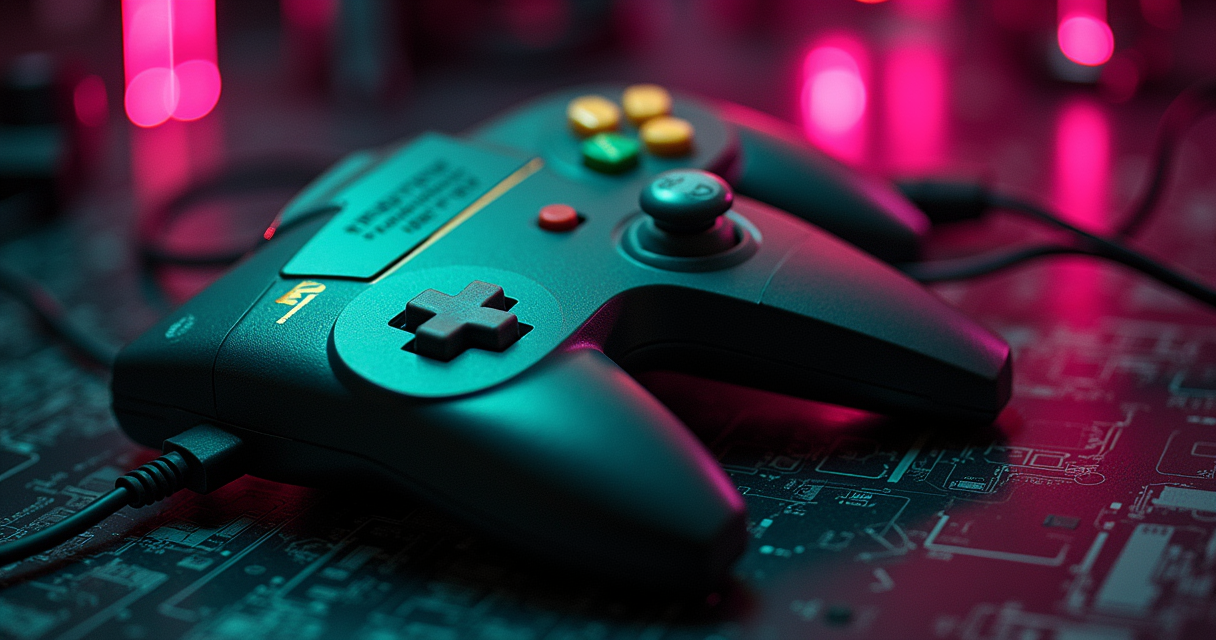
On July 21, 2026, Analogue pushed 3D OS 1.5.0 to its FPGA-based Nintendo 64 recreation and buried the lede inside its own changelog. The headline feature is an internal graphical upscaler that doubles the console's horizontal resolution — with no host GPU, no machine-learning guesswork, and, per Analogue, no hit to timing or performance. It is the most consequential thing the hardware has done since launch, and it arrived as a free download with the MD5 hash a00db9c90a2d8f09f25ec7f2d47c1802.
The less flattering reading is that 1.5.0 is roughly the twelfth documented firmware build in eight months, and that several of those builds quietly rewrote the low-level emulation behavior an independent developer publicly accused Analogue of getting wrong. Both things are true. This is the story of a console that has been patched harder and faster than any FPGA console before it, and of what that pace reveals about the distance between "100% compatible" marketing copy and cycle-accurate reality. If you only read one changelog this year, read this console's.
The Update in One Sentence
The internal upscaler, explained
Analogue describes the marquee feature as internal graphical upscaling that "enhances detail and clarity while remaining faithful to the original hardware rendering process." In its own words, "resolution is doubled horizontally for twice as many pixels onscreen without affecting 2D graphics," with "no impact to timing authenticity or performance." Translated out of press-release English: the FPGA reconstructs the N64's output at the Reality Display Processor (RDP) and Video Interface (VI) stages, before the frame is ever handed to your television, then resamples that denser image for a 4K panel. The console is not sharpening a finished picture. It is drawing a better one.
What "horizontal doubling" actually buys you
The N64 was famous for a soft, low-resolution image — most games render at a modest internal resolution and lean on the console's own blur to hide the seams. Doubling the horizontal sample count is not a full 2x2 supersample, but it targets exactly the axis where N64 aliasing is most visible: the jagged, shimmering edges of polygons in motion. Generation Amiga, which walked through the feature the day after release, noted that "polygon edges should look cleaner, distant objects should appear more defined, and the overall image should feel less soft." The crucial caveat is in Analogue's own wording — 2D graphics are untouched, so sprites, HUD elements and pre-rendered backgrounds are not distorted by the extra samples.
The quiet quality-of-life pile
The upscaler grabbed the headlines, but 1.5.0 shipped a stack of smaller fixes that matter more day to day. Instant Quick Loading makes the console's save-state system ("Memories," introduced back in 1.3.0) feel immediate. A new "Recent Memory" startup action can boot you straight into your last save. There are progressive-video jitter reductions, a Quick Load hotkey with an enable/disable toggle, dynamic in-game menu opacity, improved scaling defaults tuned across the library, and a fix for simultaneous C-button presses and USB rumble on the 8BitDo N64 Modkit. And, tellingly, "full RSP scalar/vector interlock and branch behavior" — a phrase we will come back to.
The Machine Underneath
Cyclone 10 GX and what an FPGA buys you
The Analogue 3D is built around an Intel Cyclone 10 GX FPGA with roughly 220,000 logic elements. Unlike a software emulator running on a general-purpose CPU, an FPGA is reconfigured to behave like the original chips at the gate level, which is why FPGA consoles advertise low input latency and cartridge-slot authenticity. The 3D reads real N64 cartridges through four original controller ports and a genuine cart slot, outputs over HDMI 2.1 at up to 4K with HDR and VRR, and pushes 48kHz/16-bit PCM audio. It weighs 837g, measures 180 x 230 x 49mm, and draws 30W over USB-C PD 3.0. A 16GB microSD card ships in the box. For the wider FPGA context, the Wikipedia entry on the Analogue 3D is a serviceable primer.
Ports, output, and the $269.99 question
Analogue announced the 3D on October 16, 2023 and, after a long wait, shipped it on November 18, 2025 at $249.99. Within about a week the price rose to $269.99, which the company attributed to tariffs. No controller is included — the 8BitDo wireless N64 pad is a separate purchase, a decision that still rankles buyers who expected a $270 console to come with something to hold. Engadget covered the ship date after years of slippage.
3D OS, five display modes, and the house style
The firmware is branded 3D OS (Analogue's "Analogue OS" rendered in 4K), and its signature feature set is the five Original Display Modes: BVM, PVM, CRT, Scanlines and Clean. These are the CRT-emulation profiles that make the picture look like the monitors N64 games were mastered on, and — as we will see — they are the reason the new upscaler is more than a gimmick. Analogue, led by CEO Christopher Taber, has done this before: the Super Nt (2017), Mega Sg (2019) and Pocket (2021) all followed the same playbook of premium FPGA hardware plus a slow drip of firmware features.
Eight Months, a Dozen Builds
Launch to New Year: 1.1.0 to 1.2.0
The 3D shipped on day one with build 1.1.0. Ten days later, 1.1.9 (November 28, 2025) improved SD connect-mode device support and substantially upgraded the "Unleashed" overclock for CPU-bound games such as Perfect Dark and GoldenEye 007 — a notable early signal that Analogue intended to push past the original hardware's limits, not just match them. After the holidays, 1.2.0 (January 30, 2026) fixed compatibility with certain 4K displays and switches and squashed a corrupted-OS-graphics bug.
The spring tuning sprint: 1.2.1 to 1.2.6
Spring 2026 was relentless. Builds landed roughly every two weeks: 1.2.1 (Feb 13) improved idle behavior when powered off and auto-selected a virtual Controller Pak or Rumble Pak per game; 1.2.2 (Feb 27) fixed incorrect ODM selection for unknown cartridges; 1.2.3 (Mar 13) fixed cartridge detection, GameShark compatibility, HDR brightness and a stuck controller LED; 1.2.4 (Mar 28) began treating each ROM on a flash cart as a separate library entry; a 1.2.5 update was discussed in community coverage in early April; and 1.2.6 (Apr 24) clarified Advanced HDR, improved SD stability and Progressive Output (beta), and fixed screen flicker in games like Resident Evil 2.
Memories and the upscaler: 1.3.0 to 1.5.0
The back half of the timeline shifted from bug-fixing to feature work. 1.3.0 (May 15) introduced "Memories" save states. 1.4.0 (June 23) was an interim build with no detailed public changelog, carrying the MD5 b7cfc37a0b1d4c92698cd57990868f90. Then 1.5.0 (July 21) delivered the upscaler. Analogue's support page for the console was last refreshed on August 20, 2026. The table below collapses the sprint into one view.
| Version | Release date | Headline change |
|---|---|---|
| 1.1.0 | Nov 18, 2025 | Launch build |
| 1.1.9 | Nov 28, 2025 | Unleashed overclock (Perfect Dark, GoldenEye) |
| 1.2.0 | Jan 30, 2026 | 4K display/switch fixes; corrupted-OS-graphics fix |
| 1.2.1 | Feb 13, 2026 | Idle behavior; auto Controller/Rumble Pak |
| 1.2.2 | Feb 27, 2026 | ODM selection fix for unknown carts |
| 1.2.3 | Mar 13, 2026 | Cart detection, GameShark, RSP/CPU/VI timing |
| 1.2.4 | Mar 28, 2026 | Per-ROM library entries for flash carts |
| 1.2.5 | Apr 2026 | Community-reported interim update |
| 1.2.6 | Apr 24, 2026 | Advanced HDR, SD stability, RE2 flicker fix |
| 1.3.0 | May 15, 2026 | "Memories" save states |
| 1.4.0 | Jun 23, 2026 | Interim build (MD5 b7cfc37...) |
| 1.5.0 | Jul 21, 2026 | Internal 2x horizontal upscaler (MD5 a00db9c...) |
Twelve documented builds — and the unlisted 1.1.x releases between 1.1.0 and 1.1.9 push the real count higher. That cadence is extraordinary for a device you plug into a cartridge slot, and it is not an accident.
The Accusation That Shaped the Roadmap
Kaze Emanuar and "Analogue Lied"
On December 14, 2025 — less than a month after launch — veteran N64 developer Kaze Emanuar published a video titled "Analogue Lied," arguing that the 3D is "nowhere near cycle accurate," despite marketing that claimed "100% compatibility with all officially released N64 games." Compatibility and cycle accuracy are not the same thing, and Kaze's point was that Analogue had blurred the line. Notebookcheck's write-up and Time Extension's coverage carried the story well beyond the emulation community.
The numbers: 6% CPU, 30% RSP
Kaze's side-by-side tests against real hardware put the 3D's CPU roughly 6% slower and its RSP — the N64's geometry co-processor — a striking 30% slower. Diddy Kong Racing ran frames about 4% slow, the console failed several system tests, and it lacked quirks that homebrew relies on, including the N64's secret ninth megabyte of RAM. This is the kind of gap that a casual player will never notice and a developer will always measure. Notably, even after all that, Kaze rated the 3D the second-best way to play N64 games without major headaches — behind only a modded original N64 with HDMI output.
Reading the changelogs as a rebuttal
Analogue stayed conspicuously tight-lipped. But the firmware did the talking. Build 1.2.3 listed "RSP dual instruction interlocks," "CPU CP0 behavior" and "VI Core register timing adaptation." Build 1.5.0 added "full RSP scalar/vector interlock and branch behavior." These are not features a normal user requests; they are the exact subsystems Kaze flagged. Whether they closed the gap is unknown — Analogue has published no before/after timing benchmarks — but the roadmap reads like a point-by-point response to a critique the company never formally acknowledged. If you want to understand why FPGA timing matters, the debate mirrors the one that plays out constantly in software land, where choosing between RetroArch's N64 cores is largely an argument about accuracy versus speed.
How the Upscaler Avoids Being DLSS
RDP and VI, not a host GPU
The reason the 1.5.0 upscaler is interesting is what it is not. Modern upscaling — DLSS on an RTX-class GPU, or the scaler baked into your TV — takes a finished, low-resolution frame and infers the missing pixels after the fact. Analogue's approach works earlier in the pipeline. As Generation Amiga put it, "it doesn't simply stretch the final HDMI image or add a generic sharpness filter"; instead "the system increases the amount of visual information before the picture reaches your television." The reconstruction happens at the RDP and VI stages, inside the FPGA, using the game's actual rendering output rather than a downstream guess.
Why 2D stays untouched
The single smartest constraint here is that the doubling only applies to the 3D pipeline. 2D graphics — text, HUDs, sprite-based menus, pre-rendered art — are explicitly left alone. This avoids the classic upscaler failure mode where a sharpening pass turns crisp 2D UI into a haloed mess. It also explains the "twice as many pixels onscreen without affecting 2D graphics" phrasing: Analogue is drawing more polygon detail while refusing to touch the layers that were already pixel-perfect. It is a targeted intervention, not a blanket filter.
The ODM synergy
Because the extra detail is generated before the Original Display Modes are applied, the upscaler and the CRT profiles compound rather than fight. Feed a denser image into a BVM or PVM emulation and the scanline structure has more to work with; the shadow-mask and aperture-grille effects resolve finer geometry. This is the part reviewers find genuinely novel — a scaler that makes a fake CRT look more like a good real one, rather than smearing it. Analogue's framing that the result "remains faithful to the original hardware rendering process" is doing a lot of work, but it is not marketing nonsense: the pixels are real console output, just more of them.
What Changed for Flash Carts and HDR
The 1.2.4 library fix
Flash carts and multicarts were an early pain point. Because the 3D builds a library from what it reads in the slot, a single flash cartridge loaded with dozens of ROMs originally confused the system. Build 1.2.4 (March 28, 2026) fixed this by treating each ROM loaded from the same cartridge as a separate library entry — a mundane-sounding change that transformed the experience for anyone using an EverDrive-class device. Notebookcheck flagged it in early April as the practical quality-of-life win of the spring. If you are dumping your own cartridges to build that library legitimately, our guide to dumping carts with a Retrode covers the workflow.
HDR, from clarification to Max Luminance
HDR on the 3D matured across several builds. 1.2.3 fixed OS brightness with HDR enabled; 1.2.6 clarified "Advanced HDR" behavior and added a Max Luminance control and color tags. The net effect is that the console's HDR is now something you configure deliberately rather than something that surprises you. Given that the 3D outputs HDR over HDMI 2.1 to 4K panels, getting the tone-mapping right is the difference between the ODMs looking like a calibrated studio monitor and looking washed out.
Progressive Output and the RE2 flicker
The "Progressive Output (beta)" path — which drives progressive-scan displays cleanly — got repeated attention. 1.2.6 improved it and specifically fixed blinking and flickering in some games, with Resident Evil 2 called out by name, and 1.5.0 reduced progressive-video jitter further. This is the unglamorous grind of FPGA video: dozens of games, dozens of edge cases, each needing its own timing accommodation. It is also why the build list is so long.
Installing 1.5.0 Without Bricking Anything
The manual SD-card workflow
There is no store or auto-updater doing the heavy lifting here; the 3D updates from the SD card. The process, documented in community walkthroughs, is deliberately dull: download the update from analogue.co/support/3d, copy it to the root of your SD card, insert it, power the console on, and wait. The whole flash takes roughly 3-6 minutes. The cardinal rule, as with any firmware flash, is do not cut power partway through.
Verifying the build with MD5
Analogue publishes an MD5 hash for each release, which is exactly what you want for confirming you have the untampered, correct build before you flash it. Verify the download first:
# 3D OS 1.5.0 - verify before you flash
# macOS:
md5 <downloaded-update-file>
# Linux:
md5sum <downloaded-update-file>

# Expected hash (3D OS 1.5.0):
#   a00db9c90a2d8f09f25ec7f2d47c1802
# For reference, 1.4.0 was:
#   b7cfc37a0b1d4c92698cd57990868f90

# Then: copy the file to the SD card root (FAT32/exFAT),
# insert, power on, wait ~3-6 min. Do NOT cut power.
What can go wrong
The common failure points are not the flash itself but the card: a wrongly formatted SD card, the update file placed in a subfolder instead of the root, or a flaky card that early builds struggled with (which is why 1.2.6 and others repeatedly listed "SD stability" fixes). Use a known-good card, confirm the hash, and put the file at the top level. If the console does not see the update, the file location is the first thing to check.
Analogue 3D vs. Every Other Way to Play N64
Versus a real N64 with an HDMI mod
The purist's benchmark remains an original N64 with an HDMI mod (UltraHDMI or similar). It is, by definition, cycle accurate — it is the hardware — and it is what Kaze ranks first. The trade-offs are cost, installation, availability of aging consoles, and the absence of Analogue's modern conveniences: no save states, no built-in ODMs, no overclock, no library. The 3D loses on raw accuracy and wins on everything around it.
Versus software emulation
Software emulation is free and, on a strong PC, extremely capable — the ParaLLEl and mupen64plus-next cores can produce excellent results. The costs are latency, setup complexity and the accuracy asterisks that follow any N64 emulator. If you would rather run cores than cartridges, a purpose-built emulation OS like Batocera gets you there in an afternoon, and modern handhelds now handle a chunk of the N64 library too. What they cannot give you is a real cartridge slot and FPGA-class latency.
Versus Nintendo Switch Online
Nintendo's own N64 emulation via Switch Online + Expansion Pack is the mainstream option, and with the Switch 2 now on the market it reaches more households than any FPGA box ever will. But it is a curated subscription catalog, not your cartridges, and it has its own emulation-accuracy complaints. The table below lays out the trade-offs.
| Method | Accuracy | Max output | Cost | The catch |
|---|---|---|---|---|
| Analogue 3D (1.5.0) | High (FPGA), debated | 4K/HDR/VRR + 2x upscale | $269.99 | No controller in box |
| Original N64 + HDMI mod | Highest (real HW) | 1080p (mod-dependent) | Console + mod | No modern features |
| Software emulation | Good, asterisks | Up to your GPU | Free | Latency + setup |
| Switch Online + Exp. Pak | Emulated, curated | 1080p (docked) | Subscription | Catalog, not your carts |
What the Reviewers Actually Said
The overall verdict
Reception was strong before 1.5.0 and got stronger after. Gizmodo's Kyle Barr scored the console 4.5/5 and did not hedge: "I've had more fun with this console than I have on most novel, high-end hardware that costs two to four times as much," adding that "Analogue's FPGA console actually makes games more playable, not less." That last clause is the whole pitch in nine words.
The upscaler's reception
The 1.5.0 upscaler was received as a genuine step-change rather than a patch note. Time Extension called it "A Game Changer." Generation Amiga's technical framing — that the system "increases the amount of visual information before the picture reaches your television" — is the clearest short explanation of why this is not just another sharpening filter, and why it earned that reaction.
The accuracy skeptics
Not everyone is sold, and the dissent is worth taking seriously. Engadget's review carried the pointed headline that "modern processing can't fix vintage flaws," and Kaze Emanuar's cycle-accuracy findings still stand unrebutted in public data. The honest summary is that the 3D is a superb player's machine whose engineer's credentials remain contested — and that Analogue would rather ship an upscaler than a benchmark.
What Happens in the Next 6-12 Months
Cadence and the next builds
Expect the frantic every-two-weeks pace to slow now that the two big features — Memories and the upscaler — have landed. My bet: a 1.6.x build by Q4 2026 focused on refining upscaler scaling defaults and per-game video timing rather than a new headline feature. The bug-fix long tail (Progressive Output, SD stability, controller edge cases) never fully ends on a device that reads thousands of different cartridges.
The accuracy question won't close quietly
Two more predictions here. First, Analogue will continue to ship RSP/CPU/VI timing tweaks without ever publishing before/after benchmarks — the company's default posture is silence, and 1.5.0's "full RSP scalar/vector interlock" line suggests the work is ongoing. Second, the most likely catalyst for the debate reigniting is an independent re-test — a Kaze follow-up measuring the post-1.5.0 firmware against his original December 2025 figures. If that gap has narrowed, it will be the biggest FPGA story of 2027.
The features Analogue hasn't shipped yet
Finally, two bets on scope. A higher upscaling mode (vertical as well as horizontal, or beyond 2x) is the obvious next ask, but it is bandwidth- and timing-constrained on the Cyclone 10 GX; if it ships, expect it gated behind a warning about the "faithful rendering" promise. And netplay or online features are unlikely within 12 months — Analogue's Pocket and Super Nt history is resolutely local-first. On price, do not expect relief: the tariff move from $249.99 to $269.99 points up, not down. The 3D will get better for free; it just won't get cheaper.
Questions the search bar asks me
- Is the 1.5.0 upscaler the same as DLSS or my TV's upscaler?
- No. It runs entirely inside the FPGA at the Reality Display Processor and Video Interface stages, doubling horizontal resolution before the frame leaves the console. There is no host GPU and no machine-learning guesswork, 2D graphics are left untouched, and Analogue says there is no impact to timing authenticity or performance.
- Does 1.5.0 finally fix the cycle-accuracy problems Kaze Emanuar found?
- Unclear, and Analogue won't say. In December 2025 Kaze measured a roughly 6% slower CPU and 30% slower RSP versus a real N64. Builds 1.2.3 and 1.5.0 added RSP interlock and branch-behavior work plus CPU and VI timing changes, but Analogue has published no before/after benchmarks and no independent re-test has confirmed parity.
- How do I install the update and how long does it take?
- Download the file from analogue.co/support/3d, copy it to the root of your SD card, insert it, and power the console on. The flash takes roughly 3-6 minutes; do not cut power. You can verify the download against Analogue's published MD5 of a00db9c90a2d8f09f25ec7f2d47c1802 before flashing.
- How much does the Analogue 3D cost now?
- It launched at $249.99 on November 18, 2025, then rose to $269.99 within about a week, which Analogue attributed to tariffs. Firmware updates including 1.5.0 are free, but no controller is bundled — the 8BitDo wireless N64 pad is a separate purchase.
- Is it worth it over software emulation or a real N64?
- It depends on what you value. Gizmodo scored it 4.5/5 and praised the low-latency, real-cartridge experience, and 1.5.0 now sharpens the picture for free. But Kaze Emanuar rates a modded N64 with HDMI as more accurate, and software emulators like ParaLLEl are free if you can tolerate higher latency and setup.
Ben covers the hardware end of retro gaming: FPGA cores, real-cartridge dumping, capture setups, CRT vs scaler workflows, and the legal and physical preservation infrastructure that keeps old games playable. Every post under this byline is reviewed pre-publish by Sam P., Editor & Operator — corrections to info@instalinkoteam.com. Published 2026-08-29 · Last updated 2026-08-29. Full bios on the author page.