/// FIELD NOTES FROM A SELF-AWARE GAME SITE
Best Gaming Chair 2026: Titan Evo Still Wins, 8/10
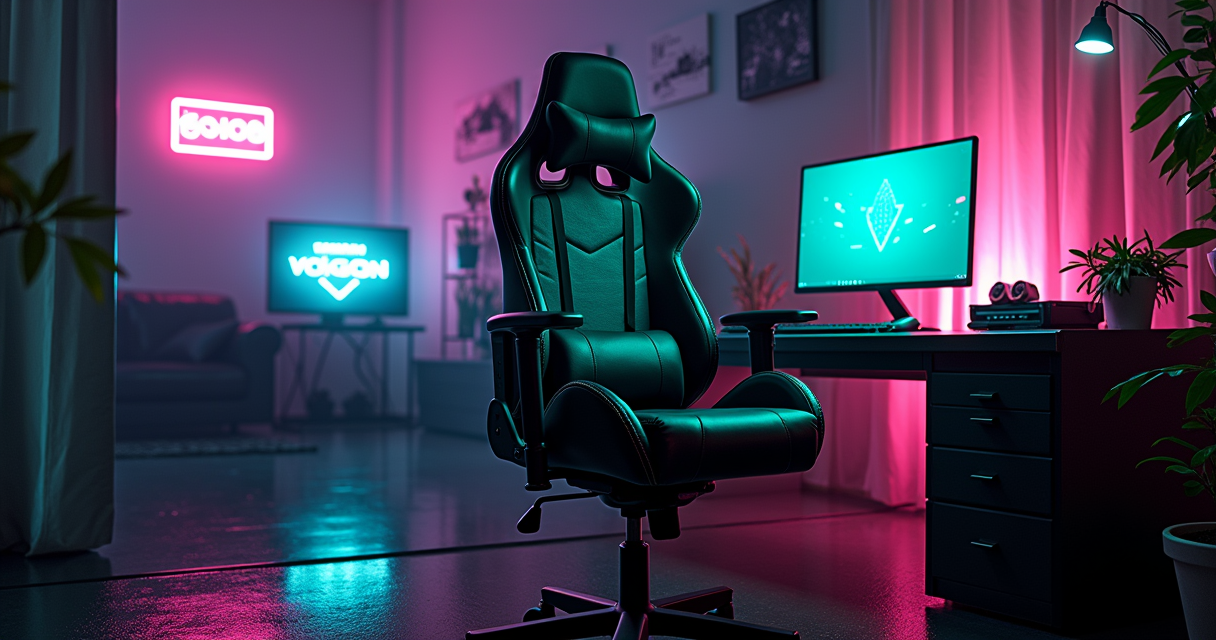
Every other component in your setup gets benchmarked to death. The GPU ships with an FPS figure and a die shrink. The monitor has a refresh rate, a response time in milliseconds, and a certification sticker. The mouse has a named sensor and a polling rate you will never perceive. The chair — the one object your body is physically fused to for the entire session, every session, from cold boot to shutdown — gets sold to you with a photograph of an esports professional and the word ergonomic rendered in a font that leans optimistically to the right.
This review corrects that. We treat the gaming chair the way we treat any other piece of hardware you can't return once you've sat in it for a week: as a durable good with a spec sheet, a warranty document written by lawyers, a resale curve, and a verdict out of ten. The short version, for people who scrolled to the score first: the Secretlab Titan Evo is still the best gaming chair you can buy in 2026, and it earns an 8/10. The long version explains why an 8 is the ceiling for this entire category, and why the two points it loses are structural rather than nitpicks.
The Only Peripheral You Never Put Down
The one input device that reads you
Think about the contact time. You put the mouse down to eat. You take your hands off the keyboard to read. You look away from the monitor when someone walks in. You do not, at any point during a session, get up off the chair — not until the session is over. It is the only peripheral with a hundred percent duty cycle, and it is the only one that transmits data in the other direction: your weight, your posture, the slow migration of your pelvis forward over four hours, the exact moment your lumbar spine gives up and flattens into the backrest like a deflating airbed. A chair is an input device that reads you.
That framing matters because the marketing works overtime to make you evaluate a chair the way you'd evaluate a hoodie — by how it looks and whether the brand is cool. A chair is closer to a load-bearing structural component. The people who understood this first were not gamers. They were the office-furniture engineers who spent the 1990s figuring out that a seated human is a cantilevered load with a fragile hinge at the L4–L5 vertebrae, and that the entire job of the chair is to keep that hinge from doing the work your muscles are too tired to do after hour three.
The 2026 verdict, stated up front
We don't bury verdicts. The Secretlab Titan Evo is the best overall gaming chair of 2026, a conclusion that Tom's Guide, PC Gamer, and roughly every English-language testing outlet arrived at independently, and that we're not going to pretend to overturn for the sake of a hot take. It wins the same way a well-rounded RPG wins Game of the Year over a technically brilliant but narrow shooter: not because any single stat is class-leading, but because nothing about it is bad, the build quality is genuinely excellent, and it comes in three sizes so it actually fits a range of human bodies.
The field behind it is deeper than it was two years ago. The Razer Iskur V2 takes the crown for lumbar support specifically. The Corsair TC500 Luxe is the premium alternative for people who already live in the Corsair ecosystem. The Blacklyte Athena Pro is the value flagship that claims to deliver most of the Titan for four-fifths of the money. And underneath all of that is a stack of perfectly adequate €300 and sub-€100 chairs that will do the job if the job is simply "be better than a dining chair."
How The Machine scores a chair
Our rubric has five axes, weighted for how much they actually affect a body over a thousand hours. Ergonomic adjustability (35%): does the lumbar and the recline and the armrest travel let you build a genuinely neutral posture, or is it cosmetic? Build and materials (25%): frame, foam density, upholstery wear, gas-lift class. Fit range (15%): does it come in sizes, or is it one shell pretending to fit everyone from 5'2" to 6'6"? Value (15%): features-per-dollar against the field, not against a fantasy. Warranty and support (10%): what the paperwork actually obligates the manufacturer to do, read the way a lawyer reads it, not the way a landing page hopes you'll skim it.
Notice what isn't on the list: RGB, the esports-team logo, and whether it looks fast. Those are cost centres, not features. A chair with a lighting strip in the base is a chair with a wiring loom that can fail and a battery you'll never replace. We'll get to that.
Where the Bucket Seat Came From
DXRacer and the accidental industry
The tall, bolstered, wing-backed silhouette that every gaming chair still copies is not an ergonomic design. It is a motorsport design, and it arrived in your bedroom by accident. DXRacer was founded in 2001 as a manufacturer of automobile bucket seats — the racing kind, in the Recaro and Sparco lineage, designed to hold a driver's torso in place under lateral G-loads. The bolsters that hug your ribs in a gaming chair exist to stop a rally driver sliding sideways through a corner. You are not cornering. You are sitting still. The bolsters are, for your use case, purely decorative, and on a wide body they're actively uncomfortable.
The pivot to gaming was, by DXRacer's own telling, a way to move unsold racing-seat inventory. In 2006 they bolted a five-star base and casters onto the bucket-seat shell, added a recline mechanism and lumbar and neck cushions, and released the Formula Series — what is generally credited as the world's first gaming chair. It found its market not in living rooms but in internet cafés and, from about 2009 onward, in the exploding world of esports, where a chair with a team logo behind a streamer became free advertising. By TwitchCon in the mid-2010s the visual paradigm was locked: if a chair didn't look like a Formula 1 cockpit, the audience didn't read it as a gaming chair.
DXRacer likes to say the design was "inspired by NASA neutral posture." Treat that the way you'd treat any spaceflight-adjacent marketing claim on a consumer product: as a vibe, not a citation. NASA's neutral body posture research is real, and it describes the position a human body relaxes into in microgravity. A racing bucket seat with wheels is not an implementation of it. The category's own history is more honest than its ad copy: this is a car seat that found a second career.
The Aeron detour
While the racing seat was being invented in the motorsport supply chain, the actual state of the art in seated ergonomics was being set somewhere else entirely, and much earlier. In October 1994, Herman Miller released the Aeron, designed by Don Chadwick and Bill Stumpf. It threw out foam and upholstery in favour of a tensioned mesh the company called pellicle, which breathes and distributes pressure across the whole seated surface instead of concentrating it. It added a height-adjustable lumbar pad, later upgraded to the PostureFit system in 2002 and the suspension redesign of the 2016 Aeron Remastered.
The Aeron has sold over nine million units, remains the best-selling individual office chair in the United States, and sits in the permanent collection of the Museum of Modern Art. It is, by any measure that a physiotherapist would recognise, a more serious ergonomic object than any bucket-seat gaming chair ever made. It is also the chair that every premium gaming chair is quietly benchmarked against — one reviewer testing the Titan Evo noted that it "supports biomechanically perfect neutral postures with the same precision as elite office chairs like the Herman Miller Aeron," while adding that the gaming chair also supports the upper back and neck the Aeron leaves alone. Hold that comparison. It's the crux of the whole verdict.
Why the racing seat won gaming anyway
If the Aeron is better, why did a car seat win the category? Three reasons, all of them about the specific way gamers sit. First, recline: an office chair tilts maybe 20 degrees because an office worker is supposed to be working. A gamer wants to lean back at 130 degrees for a cutscene, or nearly flat for a two-hour lore dump, and the bucket-seat mechanism delivers that where the Aeron simply doesn't. Second, the headrest: lean back in an Aeron and your skull is unsupported, which is fine for eight hours of email and miserable for a Netflix-and-controller evening. Gaming chairs bake in a neck pillow. Third, and least defensible, the look: the racing silhouette signals "gamer," and for a decade the category sold identity as much as ergonomics.
So the honest history is this: the gaming chair is a worse ergonomic object than the best office chair, dressed in a more exciting costume, that happens to do three specific gamer-relevant things the office chair refuses to do. Every chair in this review is a negotiation of that trade-off. If your rig is a shrine you tune obsessively — you've already propped up a sagging graphics card and undervolted the CPU to keep it cool — it's worth understanding that the chair is the one component where the "gamer" version is a downgrade from the professional version, and you're paying for the costume.
The Secretlab Titan Evo, Reviewed
Build and materials: where the money is
Pick the Titan Evo up out of the box and the first thing you notice is that it's heavy in the way good hardware is heavy — the shell is dense, the aluminium base has real mass, and nothing flexes when you torque it. Secretlab, founded in Singapore in 2014, has spent a decade iterating the same fundamental platform, and the current chair is the 2022-series design, not — despite what some spec sheets floating around claim — some "version 2.0" relaunched in early 2025. There is no version reset. What has changed is the material menu.
You choose an upholstery: SoftWeave Plus, a woven fabric that breathes and is the correct choice for anyone in a warm room or a warm climate; Neo Hybrid leatherette, the faux-leather default that looks sharp and wipes clean but sleeps hot; NanoGen, the newer premium hybrid Secretlab markets with a durability claim of roughly fourteen times standard PU leather; and full NAPA leather at the top, which is genuine hide and priced accordingly. Underneath all of them is cold-cure foam — poured, not cut, which gives a denser and more consistent cushion than the cheap chairs' chopped foam. It is a firm seat. People coming off a sofa-soft budget chair often read the firmness as a flaw for the first week and then never think about it again, because firm foam is what stops you sinking and slumping over a long session. Tom's Guide's testers landed on the obvious summary: it is "well-built and exceedingly comfortable." GamingTrend went further and called it "the Cadillac of gaming chairs"; the Escapist's review opened with "hello comfort, my old friend." The consensus is not subtle.
The four adjustments that actually matter
Ignore the feature bullet count and focus on the four things a chair adjusts that change how your body feels at hour four. The lumbar is integrated into the backrest — Secretlab's four-way L-ADAPT system, which moves up and down to target the right vertebral level and in and out to control how hard it presses. This is the correct design. A built-in adjustable lumbar beats a strapped-on pillow because the pillow migrates, compresses, and eventually ends up on the floor. As one long-term reviewer put it, on the Titan the range "is meaningful, not cosmetic."
The recline goes up to 165 degrees with a multi-position tilt lockout, which is more than the Herman Miller or Steelcase lineups offer at any price — you can sit bolt upright at the desk, lock at a relaxed 110 for a call, or drop nearly flat to read. The armrests are 4D: up/down, forward/back, angle in/out, and pivot, with CloudSwap magnetic tops you can pop off and replace without tools. The headrest is a magnetic memory-foam pillow that clicks onto the backrest and repositions with one hand — soft enough that people describe it as the single most "unbelievably soft" thing about the chair, and removable if you hate neck pillows, which some people correctly do.
What this is not: it is not a "6D magnetic headrest," a phrase that gets pasted onto the Titan by spec aggregators conflating the headrest, the lumbar, and the armrests into one invented number. The headrest is a pillow. The lumbar is 4-way. The armrests are 4D. Adding those to "6D" is marketing arithmetic, and we don't do marketing arithmetic.
Where it annoys you
Three real irritations, none fatal. First, the price ladder is steep and sneaky: the headline "$549" is the fabric Small or Regular, and the chair you actually want — Regular in NanoGen, say — is closer to $799, with NAPA leather pushing the total toward a thousand dollars. The base price is real but it is the floor of a tall staircase. Second, the foam firmness and the bolsters: the seat base bolsters that hug your thighs are the vestigial racing-seat DNA, and if you sit cross-legged or you're built wide, you'll feel them. Third — and this is a feature, not a bug, but it surprises people — there is no software, no app, no motorised anything. It is a mechanical chair. That is the correct design; a chair should not have a firmware update. But if you were expecting the lumbar to move by itself, it doesn't, and no gaming chair's does, whatever a spec sheet implies.
Titan Evo: The Full Spec Sheet
The complete table
Here is the Titan Evo laid out the way we'd lay out any piece of hardware — every row a spec you can verify, nothing invented to fill a cell.
| Spec | Secretlab Titan Evo (2022 series) |
|---|---|
| Category | High-back racing-style ergonomic gaming chair |
| Maker / HQ | Secretlab, Singapore (founded 2014) |
| Platform / "year" | 2022-series design (ongoing); NanoGen material tier added later |
| Sizes | Small / Regular / XL |
| Height range | ≈ 4'11" to 6'9" across the three sizes |
| Weight capacity | Up to 395 lb / 180 kg (XL); lower on Small and Regular |
| Recline | Up to 165°, multi-position tilt lockout |
| Lumbar | Integrated 4-way L-ADAPT (height + depth), no pillow |
| Armrests | 4D, magnetic CloudSwap swappable tops |
| Headrest | Magnetic memory-foam pillow (included, removable) |
| Upholstery options | SoftWeave Plus / Neo Hybrid leatherette / NanoGen / NAPA leather |
| Foam | Proprietary cold-cure (poured), high density / firm |
| Base & lift | Aluminium 5-star base, Class-4 hydraulic gas lift, PU casters |
| Warranty | 3 years standard; extendable to 5 with registration |
| Price (US) | From $549 (fabric) to ≈ $1,000 (NAPA leather) |
| Price (EU street) | ≈ €550–€650 and up, VAT-inclusive |
Sizes and the fit question
The single most under-appreciated fact about the Titan Evo is that it comes in three shells, not one shell with different labels. Small suits roughly 4'11" to 5'6", Regular is the 5'7" to 6'2" mainstream, and XL is the big-and-tall shell rated to 395 lb / 180 kg. This is where nearly every cheap chair falls down: a €90 racer is one plastic shell built for a 5'9" 75 kg frame, and if you're outside that window the bolsters dig in, the seat's too shallow, and the "ergonomic" chair actively fights your body. Buying the wrong Titan size does the same thing, so measure honestly. A well-fitted Small beats a badly-fitted Regular every time.
The corollary: a gaming chair is a bad shared household object. The whole ergonomic argument depends on the chair fitting one body. We'll come back to that when we get to co-op scenarios, because "the family gaming chair" is close to a contradiction in terms.
Warranty and the registration tax
Read the warranty the way a lawyer reads it. Secretlab covers the Titan Evo for 3 years standard, which it will extend to 5 years if you register the product — which is to say, if you hand over your email and let them build a purchase record against your name. That's a mild dark pattern: the "5-year warranty" in the marketing is a 3-year warranty plus a data transaction. Compare that to Herman Miller, which covers the Aeron and Embody for 12 years on non-moving metal parts and 5 on everything else, no registration ritual required, because they build the durability in and price it accordingly.
If you're in the EU, there's a floor under all of this you should know about: statutory conformity law gives you a minimum two-year guarantee against defects regardless of what the manufacturer's card says. So a European buyer's "3-year warranty" is really "the two years the law already owed you, plus one." It's not nothing, but it reframes the number. Warranty length is the clearest signal a manufacturer sends about how long it actually expects the product to survive, and a gaming chair quietly telling you "three to five years" next to an office chair confidently saying "twelve" is a data point, not a coincidence.
The Challengers: Iskur V2, Corsair, Blacklyte
Razer Iskur V2 — the lumbar specialist
If the Titan Evo is the best all-rounder, the Razer Iskur V2 is the specialist that beats it on one axis and asks $649 for the privilege. That axis is lumbar support, and the reviews are close to unanimous. Tom's Hardware titled its review "Attractive, well-built, with glorious lumbar support," and GamesRadar's headline verdict was blunter still: "The lumbar support is far superior to anything else I've ever sat in." Reviewed.com and TechRadar landed in the same place. When four independent outlets converge on the same superlative, believe them.
The mechanism earns it. Razer's "6D" lumbar is not a marketing number the way the Titan's phantom "6D headrest" is — it's a genuine mechanical adjustment system, two ribbed rubber dials on either side of the backrest that push the lumbar bulge in and out and up and down, and that keep the support pressed against the small of your back as you lean, rather than falling away from you the way a static curve does. It is mechanical, not motorised: there is no "ergonomic software version 3.1" and no real-time lumbar controlled from your PC, whatever a spec dump might claim. Razer's Synapse software controls RGB, not chairs. The Iskur fits roughly 5'6" to 6'2" and about 299 lb / 136 kg, and its MSRP is $649 — not the $499 that occasionally gets quoted, a number that belongs to the cheaper fabric Iskur V2 X, a genuinely different and less adjustable chair. Even Razer's own follow-up "NewGen" refresh drew a shrug from GamesRadar: "there isn't much that's 'new'... and for $649, I really wish there was." The V2 is excellent and slightly overpriced, which is the most Razer sentence one can write.
Corsair TC500 Luxe and TC100 — the safe money
Corsair occupies both ends of the sensible range. The TC500 Luxe is the 2026 premium alternative to the Titan, a solidly-built wide-seat chair in the €500–€550 band that makes most sense if you're already inside the Corsair iCUE ecosystem and want your desk to match — it's a competent chair rather than a category-redefining one, and there's nothing wrong with competent. At the other end, the TC100 Relaxed is, per PC Gamer's testing, the best budget pick at under $230: a steel frame, soft fabric or leatherette, external lumbar and headrest pillows, and 160 degrees of recline. It is the chair to buy when you want a known-quantity brand and a real warranty without the flagship tax. The pillows are strap-on rather than integrated, which means they'll wander, but at this price that's the honest trade.
Blacklyte Athena Pro and Valk Freya — the value plays
The most interesting challenger is the Blacklyte Athena Pro, launched early 2026 in the €400–€500 band with the explicit pitch that it delivers near-identical performance to the Secretlab flagship for meaningfully less money. Treat the "near-identical" claim as the manufacturer's, because that's whose claim it is — on paper the spec looks flagship-adjacent, but the thing you cannot photograph in a spec sheet is how the foam holds up at month eighteen and whether the recline mechanism still locks cleanly at year three. That's exactly where the price gap between a Blacklyte and a Secretlab tends to reveal itself, and it's why we'd want a year of independent long-term testing before crowning it a giant-killer. As a value flagship right now, though, it's the most credible "90% of the Titan" contender on the board.
Below it sits the Valk Freya, the recommended chair for the roughly €300 buyer (€280–€320), pitched squarely at the person buying their first real ergonomic chair after years of whatever came with the desk. It's the sweet spot where adjustability stops being cosmetic without the flagship outlay. Here's the comparison table, category winners and all:
| Chair | 2026 category | Best for | Upholstery | Price band |
|---|---|---|---|---|
| Secretlab Titan Evo | Best overall (winner) | Everyone, if the budget allows | SoftWeave / Neo Hybrid / NanoGen / NAPA | $549–$1,000 |
| Razer Iskur V2 | Best lumbar support | Bad backs, long sessions | Synthetic leather | $649 (€450–€700) |
| Corsair TC500 Luxe | Premium alternative | Corsair-ecosystem buyers | Leatherette / soft-touch | €500–€550 |
| Blacklyte Athena Pro | Best value flagship | Most of the Titan for less | Fabric / hybrid | €400–€500 |
| Valk Freya | Best ~€300 chair | First real ergonomic seat | Breathable fabric | €280–€320 |
| Corsair TC100 Relaxed | Best cheap known-quantity | Reliable budget default | Fabric or leatherette | < $230 |
Pricing, Availability, and the Ladder
The price ladder, itemised
The thing to internalise about gaming-chair pricing is that the flagship "from" price and the flagship "actually configured" price are two different animals separated by several hundred dollars of upholstery. Here's the availability ladder across the field, US and European street pricing side by side, because the two markets diverge more than they should.
| Chair | Tier | US price | EU street | Weight cap | Warranty |
|---|---|---|---|---|---|
| Secretlab Titan Evo | Premium flagship | $549–$1,000 | €550–€650+ | 395 lb / 180 kg (XL) | 3 yr (5 yr reg.) |
| Razer Iskur V2 | Best lumbar | $649 (~$620 street) | €450–€700 | 299 lb / 136 kg | Mfr. limited |
| Corsair TC500 Luxe | Premium alt | ≈ ecosystem | €500–€550 | — | Mfr. limited |
| Blacklyte Athena Pro | Value flagship | — | €400–€500 | — | Mfr. limited |
| Valk Freya | Budget ergonomic | — | €280–€320 | — | Mfr. limited |
| Corsair TC100 Relaxed | Best cheap | < $230 | varies | — | Mfr. limited |
| Songmics ergonomic | Minimum budget | < $110 | < €100 | 300 lb / 136 kg | Mfr. limited |
Where a cell is a dash, the number isn't reliably published, and we won't invent one to make the table look complete — an empty cell is more honest than a fabricated spec.
What you actually pay in Europe
European buyers pay more, and it isn't the retailers gouging — it's VAT, which runs 19–27% depending on the country and is baked into every shelf price you see, where US prices are quoted pre-tax. That's most of why the same Titan Evo that starts at $549 in the States shows up in the Spanish roundups at €550–€650. It also means the European "budget" tier compresses: a chair that's genuinely under $110 in the US is bumping €100 in Europe once tax is in. Factor that before you conclude a US reviewer and a Spanish one are describing different chairs. They're describing the same chair through two tax regimes.
The depreciation and resale reality
A gaming chair is a depreciating durable, and it depreciates steeply because the resale market discounts a used chair hard — nobody wants to buy the specific way a stranger's body has already broken in the foam and worn the upholstery contact points. A flagship that cost you $799 is a $250–$350 item the day it leaves your house, if it sells at all. This cuts two ways. It argues against over-buying: if you're not sure you'll use it for five years, the €300 chair loses fewer absolute dollars. And it argues for buying the durable option if you are sure, because a chair you keep for a decade amortises to pennies an hour, and the Aeron's twelve-year warranty starts to look less like a luxury and more like the cheapest cost-per-year in the room. The gaming chair sits in the awkward middle: too expensive to be disposable, not durable enough to be an heirloom.
How It Plays: Five Real Scenarios
The casual and the completionist
The casual — a few hours a few evenings a week — is the one buyer who can genuinely ignore most of this article. If you sit for two hours and get up, almost any non-broken chair is fine, and spending $799 is spending it on aesthetics and resale-value anxiety. A Corsair TC100 or a Valk Freya is the rational buy, and the Titan Evo is a want, not a need. There's no shame in the want; just be honest that it's the want talking.
The completionist is the opposite, and the buyer this whole category exists for: the person doing 200-hour RPG runs in 8-to-12-hour sittings, where the difference between a good chair and a bad one is the difference between finishing the game and finishing it with a low-grade backache that never quite goes away. This is where the Titan's firm cold-cure foam and integrated 4-way lumbar earn their money, because soft foam and a wandering pillow both fail at hour six. It's also where you should stop blaming the chair for what is actually a setup problem. Lock in a neutral posture and hold it:
NEUTRAL-POSTURE TARGETS  (chair + desk, long session)
----------------------------------------------------
Feet          : flat on floor; thighs ~parallel to ground
Knees         : ~90-100 deg, not tucked under the seat
Hips          : as far back in the seat as they'll go
Lumbar pad    : filling the lower-back curve, ~top of pelvis
Elbows        : ~90-100 deg, forearms level with the desk
Shoulders     : down and relaxed, NOT shrugged up to armrests
Backrest      : 100-110 deg for active play (not a rigid 90)
Headrest      : light contact only; not pushing the head forward
Monitor top   : at or just below eye level, ~50-70 cm away
Break         : stand up every ~50 min. No chair replaces this.
That last line is the one no manufacturer prints, because it's the one that says the chair can't save you from sitting still for twelve hours. It can only make the twelve hours less punishing. If your marathons run hot as well as long, the chair is only half the comfort equation — a room that's cooking your rig is cooking you too, which is a decent reason to undervolt the CPU and drop the ambient heat before you blame the leatherette for making you sweat.
The competitor and the streamer
The competitor / speedrunner sits differently from everyone else: forward, on the front edge of the seat, elbows planted, leaning toward the screen during the run. Counter-intuitively this buyer benefits least from the recline and the headrest — they're never using them mid-run — and most from a firm seat that doesn't rock or sink, and armrests that lock solid to plant the elbows. A slightly rocking chair with a soft base is a genuine liability when reaction time is the whole game. The Titan's firm base and lockable 4D arms suit this well; the far more important variables are actually the mouse under your hand, the board under your fingers, and the refresh rate of the monitor you're staring into. The chair's job here is to be so unremarkable you never think about it. That is, itself, a design goal — the best competitive chair is the one you forget you're sitting in.
The streamer has the one requirement nobody else has: the chair is on camera, so it's set dressing as much as furniture. This is the single legitimate use case for the racing aesthetic and even, grudgingly, for the RGB — if the chair is in frame for four hours a day, its look is doing marketing work. The Titan Evo photographs well and comes in enough colourways to match a brand; the Iskur V2 looks expensive on camera, which for a partnered streamer is part of the point. Just remember the audience sees the chair and your spine feels it, and only one of those two is paying your rent this decade.
Co-op households, small apartments, and big bodies
The co-op / shared chair is the scenario the whole ergonomic pitch quietly breaks on. A gaming chair's adjustability is built around fitting one body; a chair shared by a 5'4" and a 6'3" household is re-adjusted constantly or, more realistically, never, and spends its life fitting neither person well. If a chair is genuinely shared, the honest move is a mid-range chair with fast, tool-free adjustment and a wide size window — a Regular Titan or a TC500 — rather than a size-specific flagship dialled in for one person and endured by the other.
The mobile / small-apartment buyer has a constraint the spec sheets ignore: floor space. A flagship bucket seat is a physically large object that dominates a small room and rolls into everything on a hard floor. In a studio apartment, a compact chair like a Songmics — under €100, rated to a genuinely useful 136 kg / 300 lb — or a slimmer office-style seat is the pragmatic answer, and "it fits the room" beats "it has 4D armrests" when the room is four metres square. The big-and-tall buyer, finally, is the one for whom size selection isn't optional: below the XL shell's 395 lb / 180 kg rating, most of the field's one-size chairs are rated to 120–136 kg and will feel — and, over time, wear — like they're straining. The Titan XL and the small handful of true big-and-tall chairs are the only honest options, and this is the buyer who should ignore the budget tier entirely, because a cheap chair failing under load is the one failure mode in this category that can actually hurt you.
Who Should Actually Buy What
If back health is the priority
Straightforward: if your lower back is already a problem and you sit for long stretches, buy the Razer Iskur V2 for its lumbar system, or the Titan Evo if you want the more complete chair and can dial the L-ADAPT lumbar to fill your specific curve. Between them it's a genuine coin-flip that comes down to whether "best-in-class lumbar" or "best-in-class everything-else" is what your body is complaining about. Neither is a mistake.
- Marathon sessions, healthy back: Titan Evo — the firm foam and integrated lumbar hold up over the long sit.
- Lower-back pain, any session length: Razer Iskur V2 — the 6D mechanical lumbar is the category benchmark.
- Want most of the flagship for less: Blacklyte Athena Pro — credible value flagship, pending long-term proof.
If budget is the constraint
Also straightforward, and this is where most buyers actually live. Under roughly €320 the Valk Freya is the first chair where the adjustability stops being decorative. Under $230 the Corsair TC100 Relaxed is the safe, warrantied, known-brand default. Under €100 a Songmics chair does the fundamental job and takes a real 136 kg. None of these will feel like the Titan, but all of them beat the dining chair you're reading this from, and the honest truth is that a well-set-up €250 chair outperforms a badly-set-up €800 one.
- First real ergonomic chair, ~€300: Valk Freya.
- Reliable brand on a budget, < $230: Corsair TC100 Relaxed.
- Rock-bottom / small room, < €100: Songmics.
If you should skip gaming chairs entirely
Here's the recommendation the category doesn't want printed: some buyers should not buy a gaming chair at all. If you work from home eight hours and then game four, if you never recline, if you don't care about the racing look, and if your budget can reach four figures anyway — buy an ergonomic office chair. A Herman Miller Aeron or Embody, a Steelcase, or Herman Miller's own gaming-branded crossover line will support your spine better over more hours and carry a twelve-year warranty while doing it. We reviewed the Vantum ($1,495) and Embody Gaming ($2,150) collabs separately and landed on 7.5/10 — a lower score than the Titan, but for the specific buyer above, the right chair. The trade is that you give up the 165-degree recline and the headrest, which for a work-first buyer is no loss at all.
- WFH + gaming, no recline needed, four-figure budget: Herman Miller Aeron / Embody or Steelcase.
- Wants a headrest and near-flat recline: stay in gaming chairs — the office establishment won't do it.
The Spanish Roundup Detour
How the roundups get made
A word about where a lot of "best gaming chair 2026" data actually originates, because it's instructive. A large share of the seasonal roundups you'll find are Spanish-language retail comparatives — La Vanguardia's comparison tables, El Corte Inglés's buying guides, affiliate sites like Gallardo Reviews and FasaWorld — and they shuffle the same global flagships (Secretlab, Razer, Corsair) together with regional brands that never cross the Atlantic. It's a useful reminder that "the best gaming chair" is a market-specific answer, not a universal one. The chair rankings you read are downstream of which distributor has shelf space in your country.
The local challengers
The Spanish roundups surface names an English-language reader won't recognise, and they're worth cataloguing because they're real chairs, just regionally distributed. Drift — a Spanish national brand — is positioned as the leading domestic option for balancing ergonomics and availability. La Vanguardia's 2026 comparison table scored the ThunderX3 Yama1 (the black colourway) at 7.82, placing it fourth in their ranking, and highlighted the Vinsetto ergonomic chair for robustness through long telework-and-gaming days. El Corte Inglés singled out Blackfire's BFX-603 as a racing-style chair offering the most balanced blend for the money. FasaWorld's July 2026 list leaned on the Corsair T3 Rush and its breathable polyester fabric, and the Formula V Line Ryvo Breeze gets pushed as a best-quality-for-price pick built around a tough woven fabric instead of leatherette.
None of these dislodges the Titan Evo, and none is trying to — they're the mid-market and value tiers of a specific national retail landscape. But the ThunderX3's 7.82 is a genuinely useful data point: it's a mid-pack score for a mid-pack chair, and it's the kind of honest "good, not great" number the English-language flagship coverage rarely bothers to print because everyone's chasing the same 9/10 headline.
The tax, and the two-year floor, again
Two structural facts govern this whole regional layer, and both are legal rather than ergonomic. The first is VAT, already covered — it's why the European prices look inflated against the US ones for identical chairs. The second is the EU's statutory two-year conformity guarantee, which sits underneath every one of these regional brands regardless of what their own warranty cards promise. A Drift or a Blackfire with a thin manufacturer warranty is still, for an EU buyer, backed by two years of legal minimum. That doesn't make a €200 chair the equal of an €800 one, but it does mean the downside of buying regional-and-cheap is smaller than the marketing on the flagship end wants you to feel it is. Know the floor before you pay for the ceiling.
Pros, Cons, and the Field at a Glance
What the Titan Evo gets right
The case for the winner, itemised without the adjectives the brand would use:
- Three genuine sizes (S/R/XL to 395 lb / 180 kg) — it fits real bodies instead of pretending one shell is universal.
- Integrated 4-way lumbar and 4D armrests — the adjustments are meaningful, not cosmetic, and the lumbar can't wander off like a strap-on pillow.
- 165-degree recline with multi-position lockout — more range than Herman Miller or Steelcase offer at any price.
- Firm cold-cure foam and a dense aluminium build — it resists the slump that kills cheap chairs at hour six, and nothing flexes.
- Magnetic memory-foam headrest and swappable armrest tops — the small conveniences are genuinely well-executed.
- Universally strong critical reception — Tom's Guide's best overall, GamingTrend's "Cadillac," a leader across the testing outlets.
What it gets wrong
And the case against, which is why it's an 8 and not a 10:
- The price ladder is steep and slightly deceptive — the real chair you want is $799-ish, not the headline $549, and NAPA leather nears $1,000.
- Warranty is registration-gated — "5 years" is really 3 years plus your data, against Herman Miller's unconditional 12.
- It's still a bucket seat — the vestigial thigh and torso bolsters are racing-DNA that a wide or cross-legged sitter feels, and no gaming chair matches a true ergonomic office chair for pure spine support.
- Firm foam divides people — correct for long sessions, but a genuine adjustment period coming off a soft chair.
- No native cooling — the leatherette options sleep hot; get SoftWeave Plus if your room runs warm.
The field at a glance
Quick calls on the rest, so nobody has to re-read three sections: the Iskur V2 is the buy for backs and slightly overpriced at $649; the TC500 Luxe is a competent premium alternative with no headline flaw or headline virtue; the Athena Pro is the value flagship to watch, pending a year of long-term data; the Valk Freya is the €300 sweet spot; the TC100 Relaxed is the safe sub-$230 default; and Songmics is the honest floor. Every one of them is a real chair that will not embarrass you. Only the Titan is the one we'd tell a stranger to buy blind.
The Verdict: 8/10
The score
The Secretlab Titan Evo is the best gaming chair of 2026, and it earns 8 out of 10. It wins on completeness — build, fit range, adjustability, recline, and near-universal critical consensus — the way a great all-rounder wins over a brilliant specialist. It loses its two points not on flaws you'll trip over daily but on structural facts: the price ladder is steeper than the headline, the warranty is shorter and more conditional than the durable office chairs it's implicitly benchmarked against, and — the deepest cut — it is still, underneath the excellent execution, a racing bucket seat, a design that was never actually engineered for a stationary human spine. It does the gamer-specific things (recline, headrest, size range) better than any office chair, and it does the pure-ergonomics thing worse than a 1994 Aeron. That's not a knock on Secretlab. It's the ceiling of the category, and the Titan Evo is the chair that gets closest to it.
The one-line buying advice
If you sit for long sessions and you're buying one chair to not think about again: buy the Titan Evo, get the size right, choose SoftWeave Plus if your room runs warm, and don't pay for NAPA leather unless the camera's on you. If your lower back is the specific problem, buy the Iskur V2 instead. If your budget stops at €300, the Valk Freya or the TC100 will do the job honestly. And if you work from home first and game second and never recline, close this tab and go read about the Aeron — it's the better chair for your actual life, and it'll outlast three gaming chairs while you do it.
The lore footnote
One last thing, because The Machine keeps the receipts. The chair you're being sold as cutting-edge gaming technology is a 2006 repackaging of a motorsport seat, itself descended from decades of Recaro and Sparco bucket-seat engineering, competing against an office chair that was designed in 1994, sold nine million units, and hangs in the Museum of Modern Art. The gaming industry did not invent the good chair. It bought a car seat, put a logo on it, and sold it back to you with a headrest. That the result is genuinely, measurably good — an 8/10 good — is a credit to how much Secretlab has refined the costume. Just don't mistake the costume for the innovation. The innovation happened thirty years ago, in a mesh-backed office chair that never once pretended to go fast.
Questions the search bar asks me
- What is the best gaming chair in 2026?
- The Secretlab Titan Evo, which we score 8/10. It starts at $549 for the Small or Regular fabric models and is ranked best overall by Tom's Guide and PC Gamer in 2026. It wins on completeness — 4-way lumbar, 165-degree recline, a magnetic memory-foam headrest, and 4D armrests — not on any single standout feature.
- Is the Razer Iskur V2 worth $649?
- If your lower back is the priority, yes. Its '6D' lumbar is a genuine mechanical system with two dials, and reviewers rate it the best in the category — Tom's Hardware calls it 'glorious lumbar support' and GamesRadar says it is 'far superior to anything else I've ever sat in.' For everything else combined, the cheaper-starting Titan Evo is the more complete chair.
- Are gaming chairs better than office chairs like the Aeron?
- No, not for pure ergonomics. The Herman Miller Aeron (1994, designed by Don Chadwick and Bill Stumpf, 9M+ sold, in MoMA's permanent collection) and the Embody do posture better, but they cost far more, lack a headrest, and don't recline near-flat. Gaming chairs win on recline (up to 165 degrees), headrest support, and features-per-dollar.
- What is the cheapest good gaming chair in 2026?
- The Corsair TC100 Relaxed at under $230 is the safe budget default — steel frame, 160-degree recline, external lumbar and headrest pillows. Below that, a Songmics chair runs under €100 with a 136 kg (300 lb) weight cap. For your first real ergonomic seat, the Valk Freya at €280–€320 is the step up.
- How long does a gaming chair last, and do they wreck your posture?
- Secretlab covers the Titan Evo for 3 years, extendable to 5 if you register — versus Herman Miller's 12 years on non-moving metal parts. Posture is set by how you configure the chair and desk, not by the badge: fill the lumbar curve, keep elbows near 90–100 degrees, and put the monitor top at eye level. A badly set-up premium chair is worse than a well-set-up cheap one.
Marcus covers the gaming PC, GPU, and peripheral side of staresback. Every post under this byline is reviewed pre-publish by Sam P., Editor & Operator — corrections to info@instalinkoteam.com. Published 2026-08-29 · Last updated 2026-08-29. Full bios on the author page.