/// FIELD NOTES FROM A SELF-AWARE GAME SITE
Best Gaming Keyboard 2026: Apex Pro vs a €35 Board
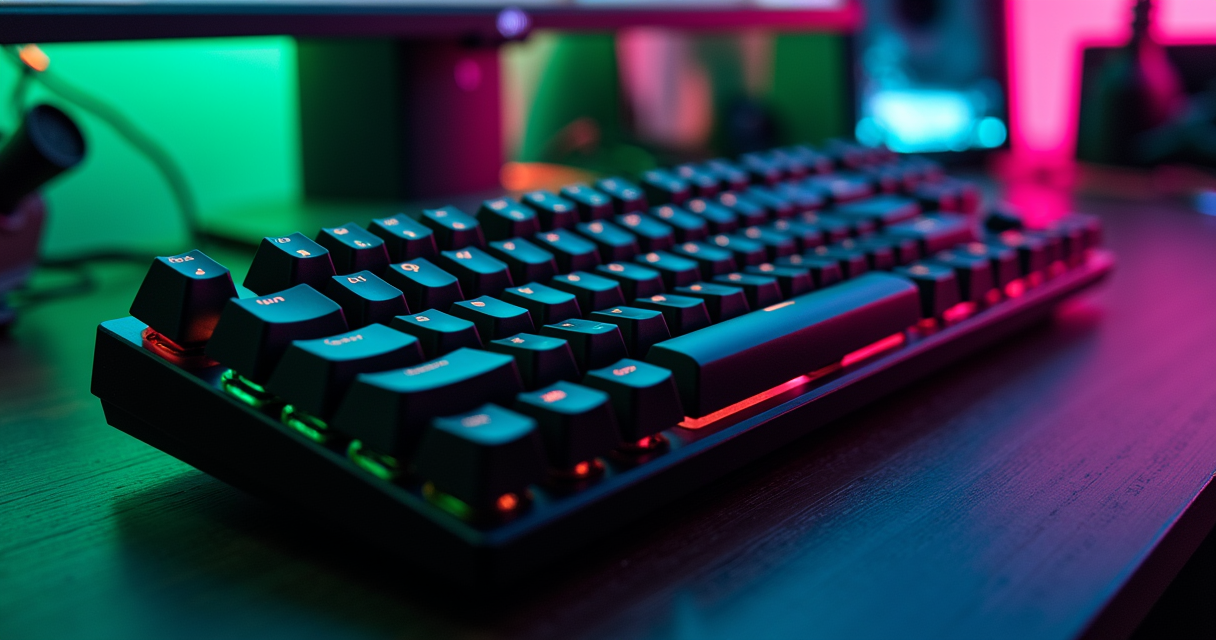
There is a specific kind of lie the gaming-hardware industry tells every year, and in 2026 it comes bolted to the box as a number: 8,000 Hz. Eight thousand polls per second. One-eighth of a millisecond. The marketing wants you to feel that figure in your spine the way a 1994 magazine wanted you to feel blast processing. For the overwhelming majority of the people reading this, it is meaningless. And yet the keyboards wrapped around that meaningless number are, genuinely, the best gaming keyboards ever manufactured. Both statements are true at once. Welcome to the review.
Here is what actually happened between 2017 and now, stripped of the press-release adjectives. A small Dutch outfit called Wooting took the Hall-effect sensor — a lump of physics that has sat in textbooks since Edwin Hall measured a voltage across a gold leaf in 1879 — and slid one under every keycap. Instead of a switch that is either on or off, you got a switch that reports how far down it is, continuously, like a throttle. In 2017 that was a curiosity for a few hundred CS:GO obsessives. In 2026 you can buy the same core idea, from Royal Kludge, for roughly €35. That single collapse in price is the whole story of this year's market. Everything below is a footnote to it.
So the honest framing of "best gaming keyboard 2026" is not which keyboard but which Hall-effect keyboard, and then a quieter, more uncomfortable question: how much of the premium tier is engineering and how much is jewelry. We tested the field, corrected the spec sheets the manufacturers would rather you not read closely, and reached a verdict that will please the SteelSeries marketing department and annoy anyone who paid full price for the OLED.
The 2026 Question: It's All Hall Effect
Every keyboard that matters this year runs on the same principle, and if you understand the principle you can see through most of the advertising. So let us do the boring part properly, once, and never again.
From buckling springs to magnets: a very short history
The keyboard used to be a solved problem. In 1985 IBM shipped the Model M, a slab of steel and plastic using the buckling-spring mechanism, and Wikipedia's own dry summary is the best review it will ever get: the Model M is prized for its "durability, typing-feel consistency, and their tactile and auditory feedback." People are still typing on forty-year-old units salvaged from the corpses of PS/2 machines. It weighed as much as a small dog and it did exactly one thing, forever.
Then the enthusiasts arrived with Cherry MX switches, colour-coded by feel — reds linear, browns tactile, blues clicky — and for two decades the entire gaming-keyboard conversation was just an argument about which colour of German mechanical switch felt best under a WASD cluster. That was the ceiling. A switch actuated at a fixed point, roughly two millimetres down, and reset at a fixed point, and there was nothing you could do about it because it was a metal contact, not a measurement.
The Hall-effect switch tears that ceiling off. Underneath the keycap sits a tiny magnet; underneath that sits a sensor reading the magnetic field as the magnet descends. The board no longer knows merely that you pressed the key — it knows the depth, to a tenth of a millimetre, thousands of times a second. Once the keyboard can measure travel, everything else becomes software. That is the pivot the entire 2026 market turns on, and it is why a keyboard now ships with a firmware changelog instead of a switch colour.
Rapid Trigger and adjustable actuation, defined without the hype
Adjustable actuation means you choose the depth at which a key "counts." Want a hair-trigger for strafing? Set it to actuate at 0.1 mm — the key fires if you breathe on it. Want to avoid fat-fingering your ultimate ability? Set that key to 3.5 mm so only a deliberate press registers. Most of these boards let you set it per-key, across a 0.1 mm to 4.0 mm range, which is a genuinely new capability and not a marketing invention.
Rapid Trigger is the killer app. A normal switch resets only after you release most of the way back up. Rapid Trigger resets the instant you reverse direction, by any amount. In practice this means counter-strafing in a tactical shooter — tap left, tap right, snap to a dead stop for a pixel-accurate shot — happens faster and more consistently than a mechanical switch physically permits. This is the one feature worth changing keyboards for, and it is the reason the professional Counter-Strike and Valorant scenes went magnetic almost overnight. Everything else on the box is gravy.
Why the retro angle matters here
There is a pleasing circularity to all this. The flight-sim diehards of 1994 wanted analog input — a throttle that was a throttle, not an on/off button. Hall-effect keyboards quietly give the entire keyboard that property: every key is now an analog axis. You can drive a car in a racing game with the gradual depth of the W key, which is a thing the Model M's buckling springs could not have dreamed of and which most owners will never once use. The keyboard has become a 104-axis controller wearing the costume of a keyboard. The lore is richer than the use case, which is on-brand for this hobby.
How This Was Judged
A roundup is only as honest as its criteria, so here are ours, stated plainly and applied consistently. We are not interested in unboxing ASMR or the Pantone of the RGB. We are interested in whether the thing makes you better, or at least does not lie to you about it.
The five things that actually matter
In descending order of importance: switch feel and consistency (a wobbly, scratchy magnetic switch is worse than a good mechanical one, magnets or not); software (adjustable actuation is useless if the configurator is a crime scene — and several of these are); build (gasket mounting, sound-dampening foam, an FR4 or aluminium plate, PBT keycaps that will not go shiny in six months); connectivity (does the wireless actually work, and is Bluetooth present for the work-laptop half of your life); and value, which in 2026 is doing more heavy lifting than in any previous year because the floor has fallen out of the price chart.
The one number everyone gets wrong
Polling rate. Every board in this review will scream a polling figure at you — 1,000 Hz, 8,000 Hz — and we will spend an entire section below demonstrating why it is, for a keyboard, very nearly the least important spec on the sheet. We weight it accordingly: near zero. If you take one thing from this review, let it be a healthy contempt for the polling-rate arms race, the same contempt you should already hold for the module tax we dismantled in our look at how G-Sync's $500 hardware tax finally died.
What we ignored
RGB brightness, "gamer" fonts on the keycaps, the number of onboard lighting effects, and any marketing sentence containing the word "immersive." We did note onboard profile memory, because being able to carry your actuation settings to a LAN without installing bloatware is a real, if unglamorous, virtue. We also declined to reward a keyboard for being expensive. Price is a cost, not a feature, no matter how thick the aluminium.
The 8,000 Hz Latency Theater
This is the section the manufacturers do not want you to read, so naturally it is the one we enjoyed writing most.
Polling interval is not input latency
A polling rate of 8,000 Hz means the keyboard reports its state to the PC every 1/8000th of a second — 0.125 milliseconds. ASUS puts this on the box for the ROG Falchion Ace HFX as a "0.125 ms response time — up to 8X faster than other leading gaming keyboards." Read that again. That 0.125 ms is not how fast the keyboard responds to your finger. It is only the maximum time your keypress sits in a buffer waiting for the next scheduled report. The actual response — finger to photon — is dominated by things that have nothing to do with polling: the physical travel of the switch, the debounce and sensor read, the USB stack, the game engine, and your monitor. The polling interval is the thinnest slice of the pie, and the industry has painted the whole pie that colour.
The math, laid out where you can check it
Input latency budget, competitive FPS, 2026
--------------------------------------------
Finger begins moving the key ........  0.000 ms
Switch travels to actuation point ...  ~3-8 ms   (physical, unavoidable)
Debounce / sensor read ..............  ~0.1-1 ms
USB poll wait @ 1,000 Hz ............  0.000-1.000 ms  (avg 0.50)
USB poll wait @ 8,000 Hz ............  0.000-0.125 ms  (avg 0.06)
  --> the "8x" upgrade saves you ....  ~0.44 ms on average
Game engine render + present ........  6-16 ms   (engine dependent)
Monitor scanout @ 240 Hz ............  0.000-4.170 ms
--------------------------------------------
Elite human reaction time .......... 150-200 ms
The upgrade from 1,000 Hz to 8,000 Hz buys you, on average, about 0.44 milliseconds. One frame on a 240 Hz monitor is 4.17 ms — nearly ten times larger. Your own reaction time is three hundred to four hundred times larger. You cannot perceive 0.44 ms; no human alive can. The 8 kHz figure is real, measurable, and almost perfectly irrelevant, which is a difficult combination to argue against and an easy one to sell.
Where the milliseconds actually go
If you genuinely care about end-to-end latency — and competitively you should — the money goes further almost anywhere else. A high-refresh monitor. A mouse that isn't fighting its own sensor, which we got into with the 60-gram superlight mice worth chasing in 2026. A network path that isn't adding twenty milliseconds of its own, the exact problem we chased down in our 2026 gaming-router shootout. Against a router adding real double-digit latency, arguing about 0.44 ms at the keyboard is like tuning the radio in a car with a flat tyre. Rapid Trigger changes how you play. Polling rate changes a spec-sheet bullet. Buy the first; ignore the second.
The Field: Specs at a Glance
Thirteen boards, one table, no mercy. A few of these figures differ from what you will read in lazier roundups, and where they do, it is because we checked. The most important correction: the SteelSeries Apex Pro TKL Gen 3, endlessly described online as an 8,000 Hz keyboard, polls its wired connection at 1,000 Hz. Its speed story is OmniPoint actuation, not polling. We list what the hardware actually does.
| Model | Year | Layout | Switch tech | Polling | Actuation | Connectivity | Hot-swap | Onboard | Price |
|---|---|---|---|---|---|---|---|---|---|
| SteelSeries Apex Pro TKL Gen 3 | 2024 | TKL | OmniPoint 3.0 Hall | 1,000 Hz | 0.1-4.0 mm | Wired (Wireless variant) | No | Yes + OLED | €199 |
| Wooting 60HE+ | 2022 | 60% | Lekker magnetic Hall | 1,000 Hz | 0.1-4.0 mm | Wired | Yes | Yes | €169.99 |
| Razer Huntsman V3 Pro TKL 8K | 2024 | TKL | Analog Optical Gen-2 | 8,000 Hz | 0.1-4.0 mm | Wired | No | Yes | €249 |
| Corsair MAKR PRO 75 | 2026 | 75% | MGX Hyperdrive Hall | 8,000 Hz | 0.1-4.0 mm | Wired (+ modules) | Yes | Yes | €249.99 |
| Glorious GMMK 3 Pro HE | 2024 | 75%/full | MX or Hall | 1,000 Hz | adjustable | Wired/Wireless | Yes | Yes | from €349.99 |
| Logitech G Pro X TKL Rapid | 2025 | TKL | Hall magnetic analog | 1,000 Hz | adjustable (35 g) | Wired only | No | Yes | €179 |
| ASUS ROG Falchion Ace HFX | 2024 | 65% | ROG HFX magnetic | 8,000 Hz | 0.1-4.0 mm | Wired (dual USB-C) | No | Yes | €219.90 |
| Corsair K70 PRO TKL | 2024 | TKL | MGX magnetic Hall | up to 8,000 Hz | 0.1-4.0 mm | USB-C / 2.4 GHz / BT | — | Yes | €189 |
| Keychron K2 HE | 2024 | 75% | Gateron double-rail (TMR) | 1,000 Hz | 0.2-3.8 mm | USB-C / 2.4 GHz / BT | Yes | Yes | €169 |
| NuPhy Field75 HE | 2025 | 75% | Gateron magnetic Hall | 1,000 Hz | adjustable | USB-C / 2.4 GHz / BT | Yes | Yes | €169 |
| Royal Kludge 75% HE (C-series) | 2025 | 75% | magnetic Hall | 8,000 Hz | 0.1-4.0 mm | Wired | Yes | Yes | ~€35-50 |
| HyperX Alloy Origins 2 65% | 2025 | 65% | mechanical (linear) | 1,000 Hz | fixed | Wired | No | Yes | <€150 |
| Logitech G512 X | 2025 | full / 98% | Hall magnetic | 1,000 Hz | adjustable | Wired | No | Yes | — |
The premium tier reads like a physics department
The top of the table — Apex Pro, Razer Huntsman, Corsair MAKR, Glorious GMMK 3 — is where the money and the machined aluminium live. These are the boards with gasket mounts, multiple layers of dampening foam, doubleshot PBT keycaps, and configurators deep enough to get lost in. They are also, with two exceptions, wired, because at this altitude the manufacturers assume a competitive buyer who has decided a cable is a feature, not a flaw.
The value tier now embarrasses everyone above it
The Royal Kludge line is the disruptive event. A 75% magnetic board with 8,000 Hz polling, Rapid Trigger, hot-swap sockets and adjustable actuation for the price of two cinema tickets is not supposed to exist, and its existence is the single most important fact in this review. It is the argument, made in plastic, that most of the money spent above it is discretionary.
The oddballs and the holdouts
Two entries break the Hall-effect consensus in instructive ways. The Razer Huntsman V3 Pro is not magnetic at all — it uses second-generation analog optical switches, sensing an interrupted light beam rather than a magnetic field, arriving at the same continuous-depth result by a different physical road. And the HyperX Alloy Origins 2 is a plain mechanical board, a deliberate holdout for people who want a tank of a 65% and do not care about analog anything. Both are legitimate. Neither is what the category is about in 2026.
Best Overall: Apex Pro TKL Gen 3
Roundups from the general gaming press — Polygon among them — have landed on the SteelSeries Apex Pro TKL Gen 3 as the reference board of 2026, and after living with the field we agree with the conclusion while disagreeing with roughly half the reasons usually given for it. It wins not because it is the fastest or the cheapest, but because it is the most finished. Nothing about it feels like a beta.
What the OLED actually buys you
The Apex Pro's signature is the little OLED smart display in the top-right corner, and it is the thing every reviewer photographs and almost nobody explains. In practice it is a glanceable readout for your current actuation preset, live game info, and settings you would otherwise have to open software to check. Is it necessary? No. Is it the reason people describe this board as premium? Largely, yes — and that is worth naming plainly, because a meaningful fraction of the €199 is a screen doing a job a memorised keybind could do for free. It is a lovely piece of jewellery welded to a genuinely excellent tool.
OmniPoint 3.0 and the 1,000 Hz asterisk
The switch is the real story. OmniPoint 3.0 is SteelSeries' HyperMagnetic Hall-effect design, offering forty discrete levels of adjustable actuation from 0.1 mm to 4.0 mm, Rapid Trigger, a Rapid Tap SOCD mode for clean counter-strafing, and a Protection Mode that de-sensitises the keys surrounding a hair-trigger bind so you stop triggering abilities by accident. It is complete, it is consistent, and the doubleshot PBT keycaps on an aluminium top plate feel like the €199 you paid. The asterisk, again: the wired connection polls at 1,000 Hz. If a store listing tells you 8,000, the store listing is wrong, and per the n-key-rollover and latency realities we walked through above, you will never feel the difference regardless.
Head-to-head against the field
Against its natural rivals, the Apex Pro's case is one of balance rather than dominance. It is not the customisation king — the Glorious owns that. It is not the value pick — nothing near this price is. It is not the fastest-polling — the Razer and Corsair are. It is simply the board that does everything at least an eight out of ten and nothing worse, with software that works on the first try.
| Model | Best for | Killer feature | The catch | Price |
|---|---|---|---|---|
| Apex Pro TKL Gen 3 | Best all-round | OLED + polished OmniPoint 3.0 | You pay for the screen; only 1,000 Hz | €199 |
| Wooting 60HE+ | The purist | Original, proven Rapid Trigger | 60% layout, wired, stock hunting | €169.99 |
| Razer Huntsman V3 Pro TKL 8K | Wired speed | True 8 kHz, Snap Tap | Optical (not magnet), no hot-swap | €249 |
| Corsair MAKR PRO 75 | Custom feel, prebuilt | Aluminium + gasket + modular | Priced like a boutique board | €249.99 |
| Royal Kludge 75% HE | Value | Hall effect for ~€35 | Software rough, SKU roulette | ~€35-50 |
The Value King & the Purist's Pick
If the Apex Pro is the answer when someone else is paying, these two boards are the answer when the money is yours and you have read this far specifically to be told the truth.
The €35 board that breaks the tier list
Ars Technica's read on the 2026 market — that Hall-effect technology has been democratised to the point where Rapid Trigger is available "from €35 to premium tiers" — is the correct read, and Royal Kludge is its poster child. RK's magnetic line (its C-series and its 75% HE boards) delivers 8,000 Hz polling, a claimed 0.125 ms response, hot-swap sockets and per-key adjustable actuation for a price that used to buy you a membrane board with a dragon printed on it. For a beginner, a second-PC build, or anyone who wants to feel Rapid Trigger before committing to the enthusiast tax, it is the single most sensible purchase in this review.
Two honest caveats, because The Machine does not do sponsored enthusiasm. First, the software is rough — functional, ugly, occasionally in the wrong dialect of English. Second, the naming is chaos. The exact model that is cheapest shifts by region and month; some briefs float names like "HATOR Skyfall 80 MAG" as regional rebadges, and we could not verify that particular equivalence, so treat the specific SKU as a moving target and buy on the spec sheet, not the sticker. What does not move is the thesis: the floor is now €35, and it is a real floor, not a trap.
Wooting 60HE+: the one that started it
The Wooting 60HE+ is the board that dragged the entire industry here, and in 2026 it is still, quietly, one of the best competitive keyboards you can buy — €169.99 for a 60% analog board whose Rapid Trigger implementation the rest of the market spent five years catching up to. Wooting's lineup has since grown to the refreshed 60HE v2 and the TKL 80HE flagship, but the 60HE+ endures precisely because it is uncomplicated: no OLED, no aluminium tax, no wireless, just the feature that matters executed by the people who shipped it first. It is the enthusiast's sentimental favourite and a coldly rational purchase at the same time.
When cheap is a trap
The value crown comes with a boundary. The €35 board is superb for its price and a false economy if you type on it eight hours a day — the switches are consistent enough for gaming and merely fine for prose, the case will not have the dead, thocky silence of the Corsair MAKR, and the keycaps will gloss up sooner. If the keyboard is your primary work tool as well as your weapon, spend up into the €150-200 band. If it is a gaming board that occasionally answers email, the cheap one wins and it is not close.
The Rest of the Field, Ranked
Everything else is very good, which is the defining feature of the 2026 market and a headache for anyone writing a ranking. Here is where the remaining boards fall and, more usefully, who each one is actually for.
Wired speed demons
The Razer Huntsman V3 Pro TKL 8KHz (€249) is the wired-speed flagship and the one board here that earns its 8 kHz badge honestly — true 8,000 Hz HyperPolling, Razer's second-gen analog optical switches, Snap Tap SOCD and adjustable actuation. It is fast, it is loud in the RGB sense, and it is not magnetic, which matters only if you specifically wanted magnets. The Corsair MAKR PRO 75 (€249.99) is the most interesting new object of the year: a machined-aluminium, gasket-mounted, FR4-plated, eight-layers-of-foam magnetic board with a rotary knob and optional wireless and LCD modules. Tom's Hardware's review headline — "Not DIY-priced (or DIY)" — is the fair criticism: it descends from Corsair's barebones MAKR 75 custom kit but arrives fully built and priced like a boutique. The ASUS ROG Falchion Ace HFX (€219.90) rounds out the speed bracket in a genuinely compact 65% with a touch panel and dual USB-C; Vice called it "the greatest 65% keyboard I've ever used, with one simple flaw," which is about right — the layout is divine and the interactive strip is a solution hunting for a problem.
The tinkerers' boards
The Glorious GMMK 3 Pro HE (from €349.99) wears the crown Glorious literally sells it as: "the world's most customisable gaming keyboard," with a claimed "over 1 billion possible configurations" through the Boardsmith configurator, and it accepts both MX and Hall-effect switches. It is the correct board if the hobby is the keyboard — if you want to swap plates, switches, weights and layouts — and the wrong board if you just want to press W and win, because a fully specced wireless build can sail past €550. The NuPhy Field75 HE (€169) is the enthusiast-aesthetic pick, a handsome 75% with triple connectivity and hot-swap magnetics for people who want their competitive board to also look good on a desk that gets photographed.
Work-and-play, and the sensible holdouts
The Keychron K2 HE (€169) is the best gaming-and-work hybrid, and it earns it: Gateron double-rail magnetic switches with a dedicated TMR sensor under every key, adjustable from 0.2 to 3.8 mm, plus true triple connectivity — USB-C, 2.4 GHz, and Bluetooth 5.2 across three devices. It is a Keychron, so the typist heritage is real; it just happens to have gaming switches now. The Corsair K70 PRO TKL (€189) is the wireless-first Corsair, magnetic with Rapid Trigger and the full USB-C / 2.4 GHz / Bluetooth spread. The Logitech G Pro X TKL Rapid (€179) is Logitech's first magnetic board and, per GamesRadar, "one of the best value Hall effect gaming keyboards out there" — but note the correction other roundups miss: it is wired only. If you read "Lightspeed wireless" attached to this model, that spec belongs to the different G915 X, not the Rapid. For the numpad holdouts, the Logitech G512 X covers the full-size, number-pad-having corner of the market, a rare thing since almost nobody makes a full-size analog board. And the HyperX Alloy Origins 2 65% (under €150) is the deliberate non-magnet: a beautifully built mechanical 65% for anyone who read this entire review and decided they simply do not want a magnet under their keys. That is a completely defensible position and we respect it.
How It Plays: Six Scenarios
Specs are theory. Here is how the field behaves across the six ways people actually use a keyboard, because the best board for a Valorant grinder is the wrong board for someone answering Slack on a train.
The casual and the competitive FPS player
For the casual player who games a few evenings a week across a mixed library, the honest recommendation is the Royal Kludge 75% HE at ~€35-50. You get the headline feature — Rapid Trigger, adjustable actuation — for a price that removes buyer's remorse entirely, and you will not out-skill its limitations. For the competitive FPS player whose rank is a personality trait, the calculus flips: you want the most consistent switch and the cleanest SOCD handling, which means the Wooting 60HE+, the Apex Pro TKL Gen 3, or the Razer Huntsman V3 Pro. The 60% Wooting and 65% Falchion also free up desk space for wide, low-sensitivity mouse arcs, which does more for your aim than any polling figure.
The MMO grinder and the couch co-op session
The MMO or completionist player — the person with forty abilities bound and a spreadsheet open — wants keys, not speed. This is the one scenario where the full-size Logitech G512 X and its numpad-worth of extra binds genuinely beats a slick 60%, and where adjustable actuation earns its keep by letting you set deliberately deep actuation on your panic buttons so you stop cancelling your own casts. For couch co-op, the priority is connectivity and cable freedom — a wireless triple-connectivity board like the Corsair K70 PRO TKL or Keychron K2 HE that can sit on your lap, hop to the living-room PC over 2.4 GHz, and not tether you to the desk. Pair it with a proper battlestation and you are set; if you are building that corner out, our 2026 gaming-chair verdict on the Titan Evo covers the part your spine will thank you for.
The commuter and the typist who games
The commuter — gaming on a laptop, typing on a train, living out of a bag — wants a compact board with Bluetooth and a battery, which points squarely at the Keychron K2 HE or NuPhy Field75 HE: 75% layouts keep the arrow keys and function row without the numpad bulk, and both do proper triple connectivity so the same board pairs with a work laptop over Bluetooth and a gaming rig over 2.4 GHz. The typist who games — where the keyboard is a professional tool first and a weapon second — is the one buyer we would actively steer away from the cheapest option and toward the Keychron's better-feeling switches and dampening, or, budget permitting, the dead-silent thock of the Corsair MAKR PRO 75.
Buy This If: Use-Case Picks
The whole field distilled into decisions. Find the sentence that describes you and stop reading.
By budget
- Under €50 — Royal Kludge 75% HE. The board that broke the tier list. Real Rapid Trigger, real adjustable actuation, unreal price. Buy on the spec sheet, not the SKU name.
- €150-200, the sweet spot — SteelSeries Apex Pro TKL Gen 3 (€199) or Wooting 60HE+ (€169.99). The Apex if you want the finished, do-everything article; the Wooting if you want the purist's competitive tool with no jewellery attached.
- Money is no object — Corsair MAKR PRO 75 (€249.99) or Glorious GMMK 3 Pro HE (from €349.99). The MAKR for the best out-of-box feel; the Glorious if the customisation itself is the hobby.
By game genre and need
- Tactical FPS (CS / Valorant) — Wooting 60HE+ or Apex Pro TKL Gen 3. Best Rapid Trigger and SOCD, most desk room for your mouse.
- MMO / RPG completionist — Logitech G512 X. The numpad and full bind-count you cannot get on a 60%.
- Gaming plus a day job — Keychron K2 HE. Triple connectivity, typist-grade feel, magnetic gaming switches. The best of both lives.
- Portable / small desk — ASUS ROG Falchion Ace HFX (65%) or NuPhy Field75 HE (75%). Compact without giving up the analog switch.
- You do not want a magnet — HyperX Alloy Origins 2 65%. Under €150, built like a bank vault, gloriously old-fashioned.
Pricing and availability
Prices below are 2026 MSRP or first-party listing; street prices routinely run lower, especially on last year's flagships, in the same way GPU value inverts once a card ages — a dynamic we tracked in our RTX 5090 review.
| Model | MSRP | Typical availability | Note |
|---|---|---|---|
| Royal Kludge 75% HE | ~€35-50 | Wide (Amazon / RK store) | SKU/name varies by region |
| Keychron K2 HE | €169 (~$130-140 US) | Wide | Best work-and-play hybrid |
| NuPhy Field75 HE | €169 | NuPhy / retailers | Enthusiast aesthetic |
| Wooting 60HE+ | €169.99 | Wooting (stock-dependent) | Purist favourite |
| Logitech G Pro X TKL Rapid | €179 (~$170) | Wide | Wired only |
| Corsair K70 PRO TKL | €189 | Wide | Triple-connectivity Corsair |
| SteelSeries Apex Pro TKL Gen 3 | €199 | Wide | Best overall; 1,000 Hz wired |
| ASUS ROG Falchion Ace HFX | €219.90 (MSRP $199.99) | Wide; often discounted | Debuted higher, now cheaper |
| Razer Huntsman V3 Pro TKL 8K | €249 ($219.99+) | Wide | True 8 kHz, optical |
| Corsair MAKR PRO 75 | €249.99 | Corsair webstore | Modular; boutique price |
| Glorious GMMK 3 Pro HE | from €349.99 | Glorious (configurable) | Custom builds cost far more |
| HyperX Alloy Origins 2 65% | <€150 | Wide | Mechanical, non-magnetic |
Pros, Cons & the Verdict
The category, then the winner, then a number.
What the category gets right in 2026
- Rapid Trigger is genuinely transformative for competitive play, and it is now the baseline rather than the luxury.
- Adjustable actuation turns one keyboard into many, per-key, in software — a real capability, not a marketing invention.
- The price collapse is the headline. €35 for a Hall-effect board means the technology has escaped the enthusiast ghetto entirely.
- Build quality at the top is superb — gasket mounts, dampening foam, PBT keycaps and aluminium are standard where they used to be exotic.
What it still gets wrong
- The polling-rate arms race is dishonest. 8,000 Hz saves you ~0.44 ms you cannot perceive, marketed as an "8X" advantage. It is theatre.
- Software quality is wildly inconsistent — from Wooting's clean tooling to configurators that feel like abandonware.
- The premium tax is real and partly cosmetic. A €199 board with an OLED does not out-game a €35 board by €164 of performance.
- Naming and SKU chaos, especially at the budget end, makes apples-to-apples comparison harder than it should be.
The verdict
Give the category crown to the SteelSeries Apex Pro TKL Gen 3. It is the most complete, most consistent, best-supported gaming keyboard you can buy in 2026, and if you want to spend once and not think about it again, spend here. It earns an 8.5 / 10 — a point and a half withheld for the 1,000 Hz-marketed-as-fast confusion around it and for the honest fact that a meaningful chunk of the price is a screen. The value crown goes emphatically to Royal Kludge's ~€35 board, which does ninety percent of what the Apex does for a sixth of the money and thereby exposes the entire premium tier as a lifestyle choice rather than a performance one. The purist's crown stays with the Wooting 60HE+, the board that started all of this and still has not been meaningfully embarrassed by anything that followed. Buy the Apex if you want the finished object, the RK if you want the truth, and the Wooting if you want the history. All three are correct answers. Only one of them costs €35, and that, more than any polling figure, is the real story of the best gaming keyboard of 2026.
Questions the search bar asks me
- What is the best gaming keyboard in 2026?
- The SteelSeries Apex Pro TKL Gen 3 (€199) wins overall for its finished feel, OmniPoint 3.0 switches and OLED, rated 8.5/10. But the Wooting 60HE+ (€169.99) is the purist's pick and a Royal Kludge Hall-effect board does ~90% of the job for roughly €35.
- Is an 8,000 Hz polling rate worth it on a keyboard?
- Barely. 8,000 Hz means a 0.125 ms poll interval versus 1 ms at 1,000 Hz — an average saving of about 0.44 ms, which is below human perception and smaller than one frame on a 240 Hz monitor (4.17 ms). Switch travel, debounce and the USB stack dominate real latency.
- Are Hall-effect switches better than mechanical for gaming?
- For competitive FPS, yes: adjustable actuation (0.1–4.0 mm) and Rapid Trigger let you reset and re-fire faster than a fixed mechanical contact allows. Edwin Hall discovered the effect in 1879, but keyboards only adopted it widely from about 2024 onward. For pure typing feel it is roughly a wash.
- What is the cheapest good Hall-effect gaming keyboard?
- Royal Kludge's 75% and C-series magnetic boards start around €35–50 with 8,000 Hz polling, Rapid Trigger and hot-swap sockets — the same core tech as €200 flagships. Ars Technica frames this democratisation as the defining 2026 shift. Buy on the spec sheet, since RK rebadges under different SKUs by region.
- Should I go wired or wireless for competitive play?
- Wired removes a variable, and the Razer Huntsman V3 Pro TKL (€249) delivers true 8,000 Hz over cable. But 2.4 GHz wireless (Lightspeed, SLIPSTREAM) is now low-latency enough that only pros will notice. Note the Logitech G Pro X TKL Rapid is wired-only — the wireless Lightspeed model is the separate G915 X. Bluetooth is for work, not play.

Ben covers the hardware end of retro gaming: FPGA cores, real-cartridge dumping, capture setups, CRT vs scaler workflows, and the legal and physical preservation infrastructure that keeps old games playable. Every post under this byline is reviewed pre-publish by Sam P., Editor & Operator — corrections to info@instalinkoteam.com. Published 2026-08-29 · Last updated 2026-08-29. Full bios on the author page.